Tuesday, October 13, 2026
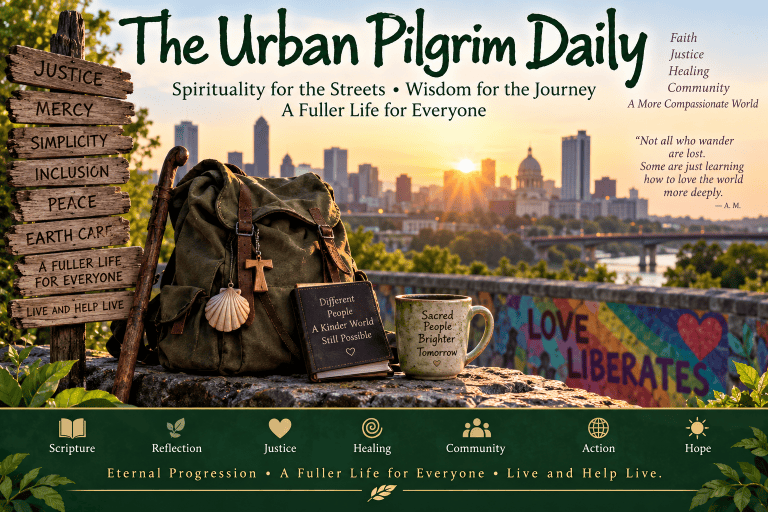
Spirituality for the Streets • Wisdom for the Journey • A Fuller Life for Everyone
Eternal Progression • A Fuller Life for Everyone • Live and Help Live
📖 SCRIPTURE FOR THE DAY
“Except these abide in the ship, ye cannot be saved.”
— Acts 27:31, KJV
There is a remarkable story in the Book of Acts.
A ship encounters a violent storm.
The passengers are terrified.
The crew struggles to maintain control.
Supplies are lost.
The vessel begins falling apart.
And in the middle of the chaos, the Apostle Paul reminds everyone that their survival is connected.
Today is the International Day for Disaster Risk Reduction.
The 2026 theme is:
“Resilience Starts at Home.”
But perhaps resilience begins with an even deeper realization.
We are responsible for one another.
✍️ FROM THE PILGRIM’S DESK
Prepared, Not Paranoid
I have been thinking about preparedness.
Not the Hollywood version.
Not underground bunkers stocked with enough supplies to outlast three generations of zombies.
Not elaborate fantasies about becoming the last person standing after civilization collapses.
I mean ordinary preparedness.
A flashlight that works.
A little extra food.
A safe place to sleep.
Knowing where important documents are located.
Understanding how to respond to an emergency.
And knowing which neighbors might need help.
As an Urban Pilgrim, I believe preparedness belongs naturally within Franciscan spirituality.
Francis taught simplicity.
Clare taught community.
Neither requires us to become helpless.
In fact, simplicity can make us more resourceful.
When we learn to repair, reuse, organize and share, we become less dependent upon endless consumption.
And when neighbors cooperate, they can accomplish things that isolated individuals cannot.
Today, I want to challenge a common assumption.
Preparedness is not primarily about what you own. It is about what you know, what you practice and whom you can count on.
A thousand-dollar survival kit cannot replace good judgment.
A perfectly packed backpack cannot replace a trustworthy community.
And possessing emergency supplies means little if we have forgotten the people living next door.
The Urban Pilgrim approach is simple:
Prepare your household. Learn practical skills. Care for your neighbors. Protect creation.
No apocalypse required.
🎙️ TODAY’S SERMON
EVERYBODY ON THE BOAT
Acts 27:13–44
The Gospel of Shared Survival
There is something extraordinary about the twenty-seventh chapter of Acts.
It is one of the most detailed travel narratives in the New Testament.
And it is not particularly glamorous.
There are no magnificent temples.
No triumphant religious ceremonies.
No crowds celebrating a miraculous healing.
Instead, we encounter a ship in serious trouble.
Paul is being transported as a prisoner toward Rome.
He is traveling under Roman custody.
The voyage takes place during a dangerous season for Mediterranean navigation.
And the ship encounters severe weather.
The author describes a powerful wind.
The crew struggles to control the vessel.
Cargo is thrown overboard.
Eventually, the passengers lose sight of the sun and stars.
That last detail matters.
Ancient sailors depended upon celestial observations and accumulated navigational knowledge.
When storm conditions obscured the sky, navigation became more difficult.
The narrative tells us that hope of survival began disappearing.
Now consider the situation.
There are sailors aboard.
Soldiers.
Prisoners.
A Roman centurion.
People occupying very different positions within the imperial hierarchy.
Some possess authority.
Others possess specialized knowledge.
Some possess almost no freedom.
But the storm does not respect their social arrangements.
The sea does not care who is wealthy.
The wind does not recognize military rank.
And the waves are not impressed by imperial citizenship.
Everybody is in danger.
This is where the story becomes particularly interesting.
Earlier in the voyage, Paul had warned that continuing would be dangerous.
But the centurion placed greater confidence in the ship’s pilot and owner.
That decision is understandable within the narrative.
The pilot possessed maritime expertise.
Paul was a prisoner.
Why should a Roman officer listen to him?
Yet the story uses this disagreement to explore the limits of authority and the importance of recognizing danger.
Eventually, the situation becomes desperate.
Paul encourages the passengers.
He urges them to eat.
He assures them that their lives will be preserved, even though the ship will be lost.
Then something remarkable happens.
Some sailors attempt to escape using the ship’s boat.
Paul warns the centurion that the others cannot survive if the sailors abandon them.
The soldiers cut the boat loose.
The sailors remain.
And the narrative continues toward a difficult landing.
The ship ultimately breaks apart.
But Acts reports that all 276 people aboard reach land alive.
Now, historical-critical scholarship requires us to approach this account carefully.
Acts is an ancient theological narrative, not a modern maritime accident report.
Its author uses the voyage to portray Paul as a trustworthy witness whose mission continues despite danger.
The account contains detailed nautical language, but scholars debate the relationship between those details, possible travel traditions and the author’s literary shaping.
We should not assume that every speech is a verbatim transcript.
Nor should we treat the story as an emergency manual.
For example, Paul’s instruction to remain aboard is specific to this narrative. In a real emergency, people should follow appropriate safety procedures and official evacuation instructions.
But the theological and ethical questions remain powerful.
What does it mean to survive together?
Who gets heard when danger approaches?
What happens when authority refuses to recognize useful knowledge?
And how do people cooperate when their lives depend upon one another?
The first lesson is that danger does not eliminate our responsibility to think.
Faith is not an excuse for ignoring evidence.
Paul does not simply tell everyone to pray harder while refusing to acknowledge the storm.
The narrative includes practical decisions.
Sailors adjust the ship.
Equipment is used.
Cargo is discarded.
Food is distributed.
People make choices.
There is no suggestion that spiritual confidence makes practical action unnecessary.
That is important.
Too often, religious people have treated preparation as evidence of insufficient faith.
Why prepare for emergencies if God will protect us?
Why develop community plans if divine providence controls everything?
Why learn practical skills if prayer is enough?
But such reasoning misunderstands the relationship between spirituality and responsibility.
A person can pray for safety while installing a smoke alarm.
A community can seek divine guidance while organizing emergency shelter.
A family can trust in love while storing clean drinking water.
These are not contradictions.
They are different dimensions of human life.
The second lesson concerns power.
The ship contains a miniature version of Roman society.
Military authority.
Economic interests.
Specialized labor.
Prisoners.
People with unequal freedom.
But their survival requires cooperation across those differences.
The centurion cannot navigate the ship simply because he possesses authority.
The sailors cannot guarantee their own survival by abandoning everyone else.
And Paul cannot accomplish everything through religious speech.
Different forms of knowledge and responsibility must work together.
This raises an important liberation-theological question.
Whose knowledge do we recognize before disaster strikes?
Do we listen to people living in flood-prone neighborhoods?
Do we consult disabled residents when designing evacuation procedures?
Do we involve people experiencing homelessness in emergency planning?
Do we recognize the practical expertise of workers who maintain buildings, roads, water systems and communication networks?
Or do we wait until disaster exposes what we should have understood beforehand?
Liberation theology reminds us that vulnerability is not distributed equally.
A storm may strike an entire city.
But its consequences depend partly upon housing conditions, income, disability access, infrastructure and available support.
Someone living in a well-maintained building with savings and transportation may have options unavailable to someone living in unstable housing.
That difference matters.
We should not romanticize people who endure hardship.
Nor should we blame those who lack resources for failing to prepare adequately.
Preparedness requires material opportunities.
From my anarcho-communist perspective, mutual aid and voluntary cooperation offer important ways to strengthen communities.
But mutual aid should not become an excuse for institutions to abandon their responsibilities.
Safe buildings, reliable warnings, accessible transportation and functioning emergency services require coordinated effort.
The point is not to replace every institution with a neighborhood group.
It is to resist unnecessary domination while expanding meaningful participation and shared responsibility.
The third lesson concerns the meaning of home.
The passengers in Acts 27 are far from home.
They are aboard a damaged ship in unfamiliar waters.
Their immediate community is not something they selected.
It consists of whoever happens to be traveling with them.
And yet their survival becomes a shared concern.
That sounds remarkably Franciscan.
Francis did not understand community merely as a gathering of people who shared identical backgrounds.
His spirituality challenged social distinctions and emphasized kinship.
Clare built a community sustained through shared commitments and practical care.
The Franciscan Clarean tradition invites us to recognize that belonging creates responsibilities.
Not unlimited responsibilities.
Not the demand that one person rescue everyone.
But the recognition that our lives are connected.
Queer theology deepens this understanding.
Many LGBTQIA people know that biological family and legal structures do not always provide reliable support.
Chosen families can become essential networks of care.
Friends help friends recover from illness.
Neighbors share transportation.
Communities organize food and shelter.
People create belonging where conventional institutions have failed them.
These relationships deserve recognition in emergency planning.
A preparedness system that recognizes only conventional households may overlook the people someone actually depends upon.
Feminist theology also reminds us that much of the labor sustaining households remains undervalued.
Who remembers the medications?
Who checks on children?
Who knows where the supplies are?
Who notices that an older neighbor has not been seen?
Who keeps everyone connected?
Often, this labor is performed quietly.
Yet it can become essential during an emergency.
Ecological theology offers another insight.
Disasters do not happen in isolation from the environment.
Flood risk can be affected by land use.
Heat risk can be intensified by urban design.
Deforestation and ecosystem damage can increase certain vulnerabilities.
Climate change is altering the risks associated with some extreme weather events.
Responsible preparedness therefore includes environmental stewardship.
We cannot separate the safety of human communities from the ecological systems supporting them.
And where is God in all this?
I do not imagine God as a supernatural ruler deciding which houses a storm will destroy and which families deserve protection.
That image raises profound moral difficulties.
Following John D. Caputo, I understand God as the insistence of love and responsibility.
God does not arrive as an irresistible force controlling the weather.
God insists when someone shares a warning.
God insists when a neighbor checks on another neighbor.
God insists when communities demand safer housing.
God insists when a person refuses to abandon someone who needs assistance.
God insists when practical compassion becomes possible.
The divine event is not necessarily the suspension of nature.
It is the interruption of indifference.
And perhaps that is the most important lesson from Acts 27.
The ship is lost.
The journey does not proceed as planned.
The passengers endure danger.
But the story refuses to treat human survival as an individual achievement.
They reach land together.
Not because everyone possessed identical abilities.
Not because everyone occupied the same social position.
But because the narrative brings their different actions into a shared struggle for survival.
Today, on the International Day for Disaster Risk Reduction, I want to offer a simple challenge.
Prepare your home.
Learn your neighborhood.
Understand the risks where you live.
Practice the skills you might need.
But do not stop there.
Consider the people around you.
The neighbor without transportation.
The family with small children.
The person who needs accessible information.
The person whose income makes purchasing emergency supplies difficult.
The person living alone.
The household caring for animals.
Ask what practical cooperation might look like.
Because the question is not merely:
Can I survive the storm?
The deeper question is:
How can we reduce the danger before the storm arrives, and help one another through it?
That is not paranoia.
That is compassion with a plan.
And perhaps, in a world that often celebrates individual survival, it is a small but meaningful revolution.
Amen.
🌍 THE WORLD OUTSIDE OUR DOOR
International Day for Disaster Risk Reduction 2026
Reported facts — October 13, 2026
Today, the United Nations is marking the International Day for Disaster Risk Reduction.
The official 2026 theme is “Resilience Starts at Home.”
The campaign emphasizes that disaster safety depends upon household preparation as well as decisions about housing, infrastructure, urban planning, accessible warnings and community support.
The United Nations is also organizing events from October 13–15 in Geneva, including a youth festival focused on practical preparedness and a discussion about communication during emergencies.
A particularly important element of the campaign is its recognition that households cannot reduce disaster risks through individual action alone. Governments, businesses, civil society organizations and communities all have responsibilities.
Urban Pilgrim Commentary
The theme is valuable because home is where ordinary life happens.
But we should not confuse household responsibility with household blame.
A person cannot personally repair an unsafe apartment building.
A low-income family cannot simply purchase its way out of every disaster risk.
A disabled resident cannot create accessible evacuation infrastructure alone.
From my Franciscan and anarcho-communist perspective, resilience requires cooperation, shared resources and resistance to arrangements that leave vulnerable people without meaningful protection.
The goal should not be a society where wealthy households survive comfortably while everyone else struggles.
It should be communities where safety is increasingly accessible to everyone.
Preparedness is most meaningful when it becomes an expression of solidarity.
📚 SCHOLAR’S CORNER
Was Acts 27 Written by an Eyewitness?
Acts contains several passages narrated using the first-person plural, including portions of Paul’s sea voyage.
These are commonly called the we-passages.
Some scholars interpret them as evidence of eyewitness travel traditions.
Others understand them as literary devices or material incorporated from earlier sources.
There is no universal scholarly agreement.
The sea voyage also resembles other ancient Mediterranean narratives in which storms, shipwrecks and divine guidance play important literary roles.
The important historical-critical lesson is that Acts should be read as ancient narrative theology.
It tells us how an early Christian author understood Paul’s mission, danger, providence and communal survival.
A biblical story can offer ethical insight without becoming a modern technical report.
❓ QUESTION EVERYTHING
Is Preparedness a Privilege?
We frequently tell people to prepare for emergencies.
But preparation requires resources.
Storage space.
Transportation.
Money.
Time.
Accessible information.
Sometimes physical assistance.
What happens when people lack those things?
Should they be blamed for being unprepared?
Or should communities examine the conditions that make preparation difficult?
Perhaps the most important preparedness question is not:
“Why didn’t they prepare?”
But:
“What would make preparation possible for everyone?”
🌿 CREATION IS OUR MONASTERY
Trees Are Part of Our Infrastructure
Urban trees provide more than beauty.
They offer shade.
Help reduce local heat exposure.
Provide habitat.
Intercept rainfall.
And contribute to healthier urban environments.
But trees also require responsible management.
Poorly maintained trees can present hazards during storms.
The goal is not simply to plant more trees without planning.
It is to create healthy urban ecosystems that support people and other living beings.
Today, notice the trees around your home.
Consider how they affect shade, temperature, drainage and wildlife.
Ecological stewardship is one form of community preparedness.
🏳️🌈 QUEER WISDOM
Chosen Family Is Real Family
Emergency plans frequently assume that everyone belongs to a conventional household.
But human relationships are more diverse.
Some people live with friends.
Some depend upon chosen family.
Some share homes with unrelated adults.
Some receive support from partners who lack formal legal recognition.
Some live alone but belong to strong community networks.
Queer wisdom reminds us that care cannot be reduced to one family structure.
A good emergency plan identifies the people who actually provide support.
Family is not merely a category on a form. It is also a relationship of responsibility and love.
💡 ONE BIG IDEA
Social Vulnerability
Disaster researchers distinguish between hazards and vulnerability.
A hazard might be a hurricane, flood, earthquake or extreme heat event.
Vulnerability concerns the circumstances that affect people’s ability to anticipate, withstand and recover from those hazards.
Housing quality matters.
Income matters.
Health and disability access matter.
Transportation matters.
Social support matters.
The same storm can produce very different outcomes across different neighborhoods.
This does not mean people are powerless.
It means disaster preparedness must address both immediate hazards and the conditions that make people vulnerable.
Resilience is not simply personal toughness. It is also the strength of our relationships and institutions.
✊ SAINT, HERETIC & TROUBLEMAKER OF THE DAY
Rebecca Solnit
Writer Rebecca Solnit has explored the ways communities respond to disasters.
Her book A Paradise Built in Hell examines examples of cooperation, improvisation and solidarity during major catastrophes.
Solnit challenges the assumption that disaster automatically transforms ordinary people into selfish, violent competitors.
Her work highlights instances in which people organize spontaneous mutual aid.
Of course, disasters can also produce exploitation, conflict and serious institutional failures.
But cooperation is a real and important part of the human response.
The Urban Pilgrim lesson:
When ordinary systems break down, ordinary people sometimes discover extraordinary capacities for cooperation.
🕊️ WORDS FOR THE ROAD
A prepared home protects a household. A prepared community protects the possibility of a fuller life for everyone.
📓 PILGRIM JOURNAL PROMPT
My Circle of Care
Think about the people who form your everyday support network.
Who would you contact during an emergency?
Who might contact you?
Does anyone nearby need assistance receiving warnings or obtaining supplies?
What practical skills could you share?
What help might you need?
Write down one small action that could strengthen your circle of care.
😇 HOLY FOOLERY
The Franciscan Prepper
Friend:
“How much survival gear do you own?”
Franciscan:
“Enough.”
Friend:
“How much is enough?”
Franciscan:
“Enough to meet reasonable needs.”
Friend:
“But what about the apocalypse?”
Franciscan:
“I have a flashlight.”
Friend:
“And zombies?”
Franciscan:
“I’ll offer them hospitality.”
Friend:
“You can’t offer hospitality to zombies!”
Franciscan:
“Then I’ll begin with the living.”
Sometimes the most radical survival strategy is remembering that other people are human.
🙏 PRAYER FOR PEACE ACROSS ALL FAITHS
A Prayer for Safe Homes
Sacred Mystery beyond every name,
bless those whose homes are threatened.
Those facing floods.
Those enduring storms.
Those living through earthquakes.
Those experiencing extreme heat.
Those displaced by war.
Those without permanent shelter.
Bless emergency workers.
Community volunteers.
Caregivers.
Neighbors.
Scientists.
And everyone working to reduce suffering before disaster strikes.
May Christians, Jews, Muslims, Hindus, Buddhists, Sikhs, Pagans, Indigenous peoples, humanists, atheists and people of every tradition cooperate in protecting life.
May warnings reach those who need them.
May shelter become more accessible.
May resources be shared wisely.
May fear give way to practical knowledge.
May isolation give way to solidarity.
And may every household discover that it belongs to a larger human community.
Amen.
🕯️ FRANCISCAN CLAREAN REFLECTION
Simplicity Makes Room for Readiness
Franciscan simplicity is sometimes misunderstood.
People imagine it means having nothing.
But voluntary simplicity is not the same as neglecting practical needs.
A simple household can be well organized.
A person with limited possessions can develop valuable skills.
A community can share tools rather than requiring everyone to purchase identical equipment.
Clarean spirituality reminds us that resources are best understood in relation to community.
What we possess can become an opportunity for service.
The question is not how much equipment we can accumulate.
It is how wisely we use what is available.
Preparedness without compassion becomes self-protection alone. Preparedness joined with compassion becomes service.
🌱 THE HERBAL MINUTE
Bay Leaf — A Small Treasure in the Pantry
Bay leaves commonly used in cooking come from Laurus nobilis.
They are often added to soups, stews and beans to provide aroma and flavor.
Dried bay leaves store conveniently in a sealed container away from moisture and excessive heat.
They are a useful example of how simple pantry ingredients can make shelf-stable meals more enjoyable.
Although bay laurel has a history of traditional medicinal use, evidence does not support treating it as a cure for serious medical conditions.
Safety note: Whole bay leaves remain tough after cooking and should generally be removed before serving because they can pose a choking or injury hazard. Do not confuse culinary bay laurel with other plants called “laurel,” some of which are poisonous.
Today’s herbal wisdom:
A practical pantry should nourish both the body and the enjoyment of ordinary life.
🎒 URBAN PREPAREDNESS
The Five-Minute Pet Readiness Drill
Today, consider the animals who share your household.
A small dog and a cat have different emergency needs.
A dog may need a secure harness and leash.
A cat may need an accessible carrier.
Both need appropriate food, drinking water, identification and a plan for any essential medications.
Practice locating the necessary supplies.
Check that the carrier is usable.
Make sure everyone in the household knows who will help each animal if evacuation becomes necessary.
Keep the exercise calm.
A frightened animal may hide or resist handling, so gentle familiarity is more useful than a stressful surprise drill.
Remember that evacuation should follow actual conditions and official instructions.
And if you have a neighbor with pets, consider whether sharing information about pet-friendly temporary shelter might be helpful.
Preparedness includes the creatures who depend upon us.
🥾 OUTDOOR PILGRIM SKILL
Recognizing Flood-Prone Ground
One useful outdoor skill is learning to recognize terrain where water may accumulate.
Look for low-lying areas.
Drainage channels.
Creek beds.
Depressions.
Underpasses.
And places where runoff collects after heavy rainfall.
Even a normally dry area may become dangerous during intense storms.
When planning a walk or outdoor activity, consider both the weather forecast and the terrain.
Never attempt to cross moving floodwater.
Do not assume shallow-looking water is safe.
Floodwater can conceal damaged surfaces, debris and strong currents.
The National Weather Service emphasizes a simple principle:
Turn Around, Don’t Drown.
The responsible pilgrim understands that knowing when to turn around is a survival skill.
And sometimes the wisest outdoor adventure is choosing a safe route home.
🚶 PILGRIM PRACTICE FOR TODAY
One Neighbor, One Conversation
Today, take one small step toward community resilience.
If appropriate and safe, speak with a neighbor or housemate about emergency preparedness.
Ask whether they know how to receive local emergency warnings.
Share a useful resource.
Discuss a practical household concern.
Or simply establish a friendly connection.
Do not pressure anyone to disclose private information.
Do not turn the conversation into a lecture about catastrophe.
The goal is ordinary human connection.
Preparedness becomes more effective when neighbors know they can communicate with one another.
✨ CLOSING BLESSING
May our homes become places of safety.
May our neighborhoods become places of cooperation.
May our preparedness grow from wisdom rather than fear.
May Francis teach us the freedom of simplicity.
May Clare teach us the strength of shared life.
May the wisdom of Scripture challenge our assumptions about power and responsibility.
May liberation theology remind us that vulnerability is shaped by social conditions.
May feminist and queer wisdom help us recognize overlooked forms of care.
May ecological spirituality deepen our responsibility toward the living Earth.
May our practical skills become opportunities for service.
May our supplies be sufficient without becoming objects of obsession.
May our planning include children, elders, disabled people, chosen families, neighbors and the animals who depend upon us.
And may the God who does not control the weather through supernatural coercion,
but insists whenever love becomes practical,
continue calling us toward a more compassionate world.
Prepare.
Learn.
Listen.
Share.
Practice.
Cooperate.
Protect.
And remember the ship in Acts 27.
Its passengers occupied different positions.
They possessed different abilities.
They faced uncertainty.
And their journey did not unfold as expected.
Yet the narrative brings them safely to land.
May we build communities in which fewer people are left without help when danger approaches.
May our homes become places where compassion takes material form.
May our neighborhoods become networks of mutual care.
And may we never mistake isolation for independence.
For we are not merely individuals attempting to survive.
We are companions upon a shared Earth.
Pilgrims learning to live wisely.
Neighbors learning to care boldly.
And communities discovering that the most meaningful preparation is not for the end of the world.
It is for the continuation of life together.
Eternal Progression • A Fuller Life for Everyone • Live and Help Live.
Leave a Reply