Author: Sister Abigail Hester, CSF-OFC

  • 🌎 THE URBAN PILGRIM DAILY

    🌎 THE URBAN PILGRIM DAILY

    Friday, October 16, 2026

    Spirituality for the Streets • Wisdom for the Journey • A Fuller Life for Everyone

    Eternal Progression • A Fuller Life for Everyone • Live and Help Live


    📖 SCRIPTURE FOR THE DAY

    “Go thy way, eat thy bread with joy, and drink thy wine with a merry heart.”

    — Ecclesiastes 9:7, KJV

    Today is World Food Day.

    The 2026 theme is:

    “Innovate today. Nourish tomorrow.”

    It is a day to consider agriculture, nutrition, food security, ecological responsibility, and the millions of people who struggle to obtain adequate nourishment.

    But today I want to explore another dimension of food.

    Joy.

    Because food is not merely fuel.

    It is culture.

    Memory.

    Hospitality.

    Celebration.

    Community.

    And sometimes, an expression of love.

    A fuller life requires more than surviving another day. It requires opportunities to enjoy being alive.


    ✍️ FROM THE PILGRIM’S DESK

    A Little More Than Bread

    I have been thinking about the difference between having enough food to survive and having enough food to enjoy life.

    There is a difference.

    Someone may have sufficient calories but little dietary variety.

    A household may have canned goods but no reliable way to prepare a nutritious meal.

    A person may have access to food but no opportunity to share a meal with someone they love.

    And someone struggling financially may feel guilty about purchasing anything that brings a little pleasure.

    I know that Franciscan simplicity is sometimes misunderstood.

    People imagine that simplicity means rejecting comfort, enjoyment, and beautiful things.

    But voluntary simplicity is not a competition to see who can endure the most deprivation.

    It is an invitation to discover what genuinely matters.

    A simple meal can be wonderful.

    A bowl of soup.

    A piece of bread.

    A cup of tea.

    A little seasoning.

    A conversation.

    Perhaps a dog waiting patiently beneath the table, convinced that gravity will eventually provide dinner.

    The point is not luxury.

    It is appreciation.

    And on World Food Day, I want to ask a question that reaches beyond nutrition.

    What would our communities look like if everyone had a meaningful opportunity not only to eat, but to enjoy eating?


    🎙️ TODAY’S SERMON

    YOU ARE ALLOWED TO ENJOY YOUR BREAD

    Ecclesiastes 9:7–10

    The Radical Theology of Ordinary Joy

    There is a strange little book in the Hebrew Bible.

    It is called Ecclesiastes.

    And it is not particularly interested in making religious people comfortable.

    Its central speaker, traditionally called Qohelet, examines the ordinary assumptions through which people attempt to make sense of existence.

    Work hard, and you will prosper.

    Be wise, and everything will turn out well.

    Live virtuously, and life will reward you.

    Acquire wealth, and you will become secure.

    Build something magnificent, and your achievements will endure.

    Qohelet looks at these promises and asks an uncomfortable question.

    Are you sure?

    Because the world does not always operate according to our expectations.

    Good people suffer.

    Foolish people prosper.

    Hard work does not guarantee financial security.

    Wisdom does not eliminate uncertainty.

    And eventually, everyone dies.

    This is not the kind of message that usually appears on an inspirational coffee mug.

    Imagine walking into a Christian bookstore and finding a mug that says:

    “Everything is temporary, your plans may fail, and death is coming. Have a nice day!”

    Perhaps Ecclesiastes would not be the most commercially successful devotional brand.

    But beneath its unsettling observations, the book contains a remarkable invitation.

    In chapter nine, the speaker tells us to eat our bread with joy.

    Enjoy our drink.

    Wear pleasant clothing.

    Appreciate loving relationships.

    And engage meaningfully with the work available to us.

    What a fascinating response to uncertainty.

    Qohelet does not say that life becomes meaningful only when we solve every philosophical problem.

    He does not promise that the righteous will always receive material rewards.

    He does not claim that suffering can be eliminated through positive thinking.

    Instead, he invites us to appreciate the ordinary experiences available within our finite lives.

    Bread.

    Companionship.

    Work.

    Pleasure.

    Love.

    The present moment.

    Historical-critical scholarship helps us appreciate the significance of this message.

    Ecclesiastes belongs to the wisdom literature of ancient Israel.

    Its precise composition date remains debated, although many scholars place its final form in the Persian or Hellenistic periods.

    The Hebrew title Qohelet is associated with gathering or addressing an assembly.

    The book is traditionally linked with Solomon, but most modern scholars do not consider Solomon its historical author.

    One of its most important Hebrew words is hevel.

    English translations frequently render this word as vanity, meaninglessness, or futility.

    But its concrete meaning is something like vapor or breath.

    Something fleeting.

    Something difficult to grasp.

    Something that cannot be permanently possessed.

    That image changes how we read the book.

    Qohelet is not necessarily declaring that nothing matters.

    He is questioning our attempts to make temporary things permanent.

    We want guarantees.

    We want certainty.

    We want control.

    But life repeatedly escapes our grasp.

    And precisely because life is temporary, ordinary joys become precious.

    Now, what does this have to do with World Food Day?

    Quite a lot.

    Because hunger is not merely the absence of food.

    It is also the loss of possibilities.

    A person struggling to obtain adequate nutrition may have less energy for work, education, relationships, and recreation.

    A child experiencing food insecurity may face challenges that extend far beyond an empty stomach.

    A family constantly worrying about groceries may find little opportunity for relaxed meals or celebrations.

    And someone who must depend upon emergency food assistance may experience shame that should never accompany the act of receiving nourishment.

    Qohelet’s invitation to eat bread with joy becomes ethically challenging when we recognize that not everyone possesses bread.

    What does it mean to tell someone to enjoy a meal when they cannot afford one?

    What does it mean to celebrate abundance while others experience deprivation?

    And what does it mean to preach gratitude without addressing the circumstances that prevent people from meeting their needs?

    Liberation theology insists that we cannot separate spiritual reflection from material conditions.

    Food security is not simply a matter of individual discipline.

    It involves agriculture.

    Wages.

    Housing costs.

    Transportation.

    Land.

    Water.

    Markets.

    Conflict.

    Climate.

    Public policy.

    And relationships of power.

    The question is not whether individuals should make responsible choices.

    Of course we should.

    The question is whether everyone possesses meaningful opportunities to make those choices.

    From my anarcho-communist perspective, food offers a particularly important example of the tension between human need and economic organization.

    People require nourishment regardless of their purchasing power.

    Farmers and agricultural workers deserve dignity.

    Communities benefit when people can participate in decisions affecting their food systems.

    Mutual aid, cooperatives, community gardens, and shared resources can strengthen local resilience.

    But we should not romanticize poverty or assume that volunteer efforts alone can address global hunger.

    Large-scale food systems require infrastructure, expertise, transportation, environmental management, and accountability.

    The ethical challenge is to organize those systems around human flourishing rather than unnecessary domination and exploitation.

    Franciscan spirituality enters this conversation with a different kind of question.

    What is enough?

    Francis embraced voluntary simplicity.

    Clare developed a communal life shaped by shared commitment.

    But neither person’s historical experience should be used to suggest that involuntary deprivation is spiritually desirable.

    There is a profound difference between choosing to live simply and being unable to obtain adequate food.

    One can express freedom.

    The other can express injustice.

    And that distinction matters.

    Now consider the word joy.

    We sometimes imagine joy as a luxury.

    Something we will experience after all our responsibilities are complete.

    After the bills are paid.

    After the house is organized.

    After the political situation improves.

    After we become healthier.

    After we become more productive.

    After we finally deserve it.

    But Qohelet interrupts that logic.

    Eat your bread with joy.

    Not because every problem has disappeared.

    Not because life is perfectly fair.

    Not because you have achieved complete certainty.

    But because life is happening now.

    And ordinary enjoyment matters.

    Feminist theology reminds us that the preparation of meals has often depended upon labor that remains invisible.

    Who grows the food?

    Who purchases it?

    Who plans meals?

    Who prepares ingredients?

    Who washes the dishes?

    Who makes sure everyone else has eaten?

    If one person enjoys the table while another is permanently exhausted by the work required to maintain it, something is wrong.

    Joy should not depend upon someone else’s exploitation.

    A genuinely shared table requires shared responsibility.

    Queer theology adds another dimension.

    For many LGBTQIA people, meals have become important expressions of chosen family.

    A holiday dinner with friends.

    A potluck.

    A birthday celebration.

    A shared meal after a difficult week.

    These gatherings can create belonging where conventional family structures have failed.

    Food becomes more than nutrition.

    It becomes a way of saying:

    You are welcome here.

    You do not need to disguise yourself.

    You do not need to earn your place.

    There is room for you.

    And disability theology reminds us that an inclusive table must recognize different needs.

    Some people require modified food textures.

    Some have allergies.

    Some need assistance eating.

    Some require accessible seating or utensils.

    Some experience sensory difficulties.

    Others may have medical dietary restrictions.

    Hospitality does not mean assuming that everyone needs the same thing.

    It means taking differences seriously.

    Ecological theology also belongs at the table.

    Food comes from the living Earth.

    Soil.

    Water.

    Sunlight.

    Plants.

    Animals.

    Microorganisms.

    Human labor.

    Agricultural knowledge.

    Every meal connects us with a vast network of relationships.

    But these relationships can be damaged.

    Unsustainable farming practices can degrade soil.

    Pollution can threaten water supplies.

    Climate disruption can undermine agricultural production.

    Food waste can squander resources.

    Responsible enjoyment therefore includes stewardship.

    We should not feel guilty for eating.

    We should become more attentive to how food reaches us and what happens when it is wasted.

    And where is God in all of this?

    I do not imagine God as a supernatural accountant calculating whether we have suffered enough to deserve a pleasant meal.

    Following the radical theological insights of John D. Caputo, I understand God as the insistence of love, justice, hospitality, and possibility.

    God does not force joy upon us.

    God does not guarantee prosperity.

    God does not eliminate the uncertainty described by Qohelet.

    But the divine call insists that life matters.

    That bodies matter.

    That nourishment matters.

    That companionship matters.

    That pleasure need not be shameful.

    And that human beings deserve opportunities for fuller lives.

    God insists when a hungry person receives a meal without humiliation.

    God insists when agricultural workers are treated with dignity.

    God insists when communities protect their water and soil.

    God insists when people share food across social boundaries.

    God insists when someone who has been excluded finally finds a welcoming table.

    And God insists when we discover that joy is not something we must postpone until the world becomes perfect.

    That is the radical wisdom of Ecclesiastes.

    Life is temporary.

    Certainty is limited.

    Human achievement cannot guarantee permanence.

    And yet—

    Eat your bread with joy.

    Notice the flavor.

    Appreciate the companionship.

    Recognize the labor.

    Remember the Earth.

    Make room for someone else.

    And do not confuse suffering with holiness.

    On this World Food Day, I want to offer a simple invitation.

    If you have food today, receive it with gratitude.

    If you have enough to share, consider sharing.

    If you need assistance, remember that receiving help does not diminish your dignity.

    If you prepare meals for others, recognize the value of your labor.

    And if you have been taught that pleasure is spiritually suspicious, perhaps it is time to reconsider.

    A fuller life is not merely a life in which we survive.

    It is a life in which we have meaningful opportunities to experience connection, creativity, nourishment, and joy.

    Perhaps the most radical thing Qohelet says is also the simplest.

    You are allowed to enjoy your bread.

    And perhaps the ethical responsibility that follows is equally simple.

    We should care whether our neighbors have bread to enjoy.

    Amen.


    🌍 THE WORLD OUTSIDE OUR DOOR

    World Food Day 2026: Innovation, Hunger, and the Future of Nourishment

    Reported Facts — October 16, 2026

    Today, the Food and Agriculture Organization of the United Nations marks World Food Day under the theme “Innovate today. Nourish tomorrow.”

    The campaign emphasizes combining scientific advances, traditional knowledge, and inclusive approaches to make nutritious food more accessible while protecting the environment.

    The 2026 World Food Forum in Rome includes youth participation, scientific discussions, and investment initiatives addressing the future of agriculture and food systems.

    There is encouraging news alongside continuing hardship.

    According to the 2026 State of Food Security and Nutrition in the World report, an estimated 645 million people experienced hunger in 2025, representing 7.8% of the global population.

    That was a decline from approximately 8.1% in 2024.

    However, about 2.1 billion people experienced moderate or severe food insecurity in 2025.

    Progress has been uneven, and hunger remains a major challenge.

    Urban Pilgrim Commentary

    Innovation can be valuable.

    Better agricultural techniques, improved infrastructure, accessible technology, and scientific research can help communities.

    But technology alone cannot answer every ethical question.

    Who controls new agricultural tools?

    Who benefits financially?

    Whose traditional knowledge is recognized?

    Are small farmers and agricultural workers included in decisions?

    Can low-income households actually afford nutritious food?

    From my Franciscan perspective, food systems should support life rather than excessive accumulation.

    From my anarcho-communist perspective, shared stewardship, meaningful participation, and cooperation deserve serious consideration alongside technological innovation.

    The goal is not merely to produce more food. It is to create conditions in which more people can live well.


    📚 SCHOLAR’S CORNER

    What Does “Vanity” Mean in Ecclesiastes?

    The Hebrew word hevel appears repeatedly throughout Ecclesiastes.

    It is traditionally translated as “vanity.”

    But the word also refers to breath or vapor.

    Something temporary.

    Something difficult to hold.

    Something that disappears.

    This imagery helps explain the book’s concern with uncertainty, mortality, and the limits of human control.

    Ecclesiastes does not present a simple theology of guaranteed rewards.

    It questions the assumption that wisdom, wealth, or hard work can make life entirely predictable.

    Against that uncertainty, the speaker repeatedly recommends enjoying ordinary gifts.

    The fleeting nature of life does not necessarily make joy meaningless. It can make joy more precious.


    ❓ QUESTION EVERYTHING

    Is Having Enough Calories the Same as Being Well Fed?

    A person may consume enough calories while lacking dietary variety or essential nutrients.

    A household may have food but struggle to afford fresh produce.

    A community may have grocery stores while residents face transportation barriers.

    And someone may have access to nutritious ingredients but lack the equipment, time, or assistance needed to prepare them.

    Food security is more complicated than counting meals.

    What would change if we evaluated food systems by nourishment, accessibility, dignity, and enjoyment?

    Shouldn’t the goal be more than preventing starvation?


    🌿 CREATION IS OUR MONASTERY

    The Life Beneath the Garden

    Healthy soil is not simply dirt.

    It is a living environment containing microorganisms, fungi, invertebrates, organic matter, minerals, air, and water.

    These relationships support plant growth and nutrient cycling.

    Agricultural practices can either protect or damage soil health.

    Today, consider the ground beneath your feet.

    Even in a city, soil helps support trees, gardens, insects, and other living beings.

    If you have access to a garden, observe the soil without unnecessarily disturbing it.

    If you do not, notice a tree growing along the sidewalk.

    The food on our tables begins within ecological relationships much larger than ourselves.


    🏳️‍🌈 QUEER WISDOM

    The Chosen-Family Potluck

    There is something beautiful about a potluck.

    Everyone brings what they can.

    Some people prepare elaborate dishes.

    Others bring something simple.

    Some contribute drinks, utensils, or help with cleanup.

    And someone inevitably brings a dessert that disappears before the main course.

    For many queer communities, shared meals have helped create spaces of belonging.

    But genuine hospitality must also consider affordability, allergies, accessibility, and different dietary needs.

    Nobody should be embarrassed because they cannot contribute financially.

    The best table is not the one with the most expensive food. It is the one where people are genuinely welcome.


    💡 ONE BIG IDEA

    Food Sovereignty

    Food sovereignty emphasizes the ability of communities and food producers to participate meaningfully in decisions about how food is grown, distributed, and consumed.

    The concept became prominent through the international peasant movement La Via Campesina in the 1990s.

    It raises questions about land access, agricultural policy, ecological stewardship, labor, and local knowledge.

    Food sovereignty is related to food security, but the concepts are not identical.

    Food security concerns reliable access to adequate food.

    Food sovereignty also asks who has power within the food system.

    The Urban Pilgrim question:

    Can communities have a meaningful voice in the systems that nourish them?


    ✊ SAINT, HERETIC & TROUBLEMAKER OF THE DAY

    Fannie Lou Hamer

    Fannie Lou Hamer was an American civil rights activist whose work extended beyond voting rights.

    In 1969, she helped establish the Freedom Farm Cooperative in Mississippi.

    The project sought to address poverty and economic insecurity through agricultural cooperation and access to land and food.

    Hamer recognized that political rights and economic circumstances were deeply connected.

    A person who lacks food, housing, or economic security may face substantial obstacles to exercising meaningful freedom.

    Her work was shaped by the particular history of racism and economic exploitation in the American South.

    The Urban Pilgrim lesson:

    Freedom becomes more meaningful when people have the resources necessary to live.


    🕊️ WORDS FOR THE ROAD

    A full stomach sustains life. A welcoming table reminds us why life is worth sustaining.


    📓 PILGRIM JOURNAL PROMPT

    The Meal I Remember

    Think about a meal that remains meaningful to you.

    Perhaps it was something a grandparent prepared.

    A meal shared with friends.

    A simple dinner during a difficult period.

    Or food enjoyed outdoors after a long walk.

    What made it memorable?

    Was it the flavor?

    The people?

    The location?

    The sense of safety?

    Write about what that meal taught you.

    Then consider how you might create a small moment of nourishment or hospitality for yourself or someone else.


    😇 HOLY FOOLERY

    Qohelet Visits the Supermarket

    Cashier:

    “Did you find everything you were looking for?”

    Qohelet:

    “No.”

    Cashier:

    “What couldn’t you find?”

    Qohelet:

    “Permanent happiness, certainty, and the ultimate meaning of existence.”

    Cashier:

    “Sir, this is a grocery store.”

    Qohelet:

    “Indeed. Everything is vapor.”

    Cashier:

    “Would you like your receipt?”

    Qohelet:

    “No. I shall enjoy my bread while I can.”

    Cashier:

    “That’s $4.29.”

    Qohelet:

    “Even bread is expensive.”


    🙏 PRAYER FOR PEACE ACROSS ALL FAITHS

    A Prayer for the World’s Tables

    Sacred Mystery beyond every name,

    bless those who are hungry.

    Those who grow food.

    Those who harvest crops.

    Those who transport groceries.

    Those who prepare meals.

    Those who distribute emergency supplies.

    Those who work to protect soil and water.

    And those whose labor is too often overlooked.

    May Christians, Jews, Muslims, Hindus, Buddhists, Sikhs, Pagans, Indigenous peoples, humanists, atheists, and people of every tradition cooperate in reducing hunger.

    May children receive adequate nourishment.

    May elders experience dignity.

    May families find stability.

    May farmers and workers be treated fairly.

    May food be shared without humiliation.

    May ecological wisdom guide agricultural decisions.

    And may every community discover new opportunities for nourishment, belonging, and joy.

    Amen.


    🕯️ FRANCISCAN CLAREAN REFLECTION

    The Table of Enough

    Franciscan simplicity does not mean that food must be unpleasant.

    A modest meal can be nourishing, flavorful, and beautiful.

    Clarean community reminds us that shared resources can strengthen relationships.

    But simplicity should never become a demand that people accept inadequate nutrition.

    The person who voluntarily chooses a modest meal occupies a different position from someone who has no other choice.

    A Franciscan Clarean approach to food begins with gratitude and continues toward responsibility.

    Appreciate what is available.

    Avoid unnecessary waste.

    Respect the people who produce food.

    Share when possible.

    And never make someone feel ashamed for needing assistance.

    The spirituality of enough should make room for the dignity of everyone at the table.


    🌱 THE HERBAL MINUTE

    Dill — A Little Flavor Goes a Long Way

    Dill, Anethum graveolens, is a familiar culinary herb.

    Its feathery leaves add flavor to potatoes, vegetables, soups, beans, and other dishes.

    Dill seed is also used as a spice.

    Fresh dill can be chopped into food near the end of cooking to preserve more of its distinctive flavor.

    Dried dill is convenient for a shelf-stable pantry, although its flavor gradually fades during storage.

    This herb illustrates an important principle of simple cooking.

    Inexpensive ingredients can become more enjoyable through thoughtful seasoning.

    Safety note: Culinary amounts of dill are generally well tolerated, but allergic reactions are possible. Concentrated essential oils and medicinal-dose preparations should not be treated as equivalent to ordinary food use, particularly during pregnancy or when taking medications.

    Today’s herbal wisdom:

    Good nourishment should include opportunities for pleasure, not merely the absence of hunger.


    🎒 URBAN PREPAREDNESS

    The No-Cook Pantry Meal

    Today, consider whether your household could prepare a simple meal without electricity.

    This is not an invitation to purchase expensive emergency food.

    Begin with what you already have.

    Perhaps canned beans.

    Shelf-stable crackers.

    Nut butter.

    Canned vegetables.

    Ready-to-eat fruit.

    Or another familiar food that does not require refrigeration before opening.

    Choose items that suit your household’s dietary needs and can be eaten safely without cooking.

    Check expiration or best-by dates, packaging integrity, and whether a manual can opener is necessary.

    Remember that shelf-stable food still requires safe storage and handling.

    Once opened, many canned foods must be refrigerated or consumed promptly.

    For a household of three, consider whether everyone could eat a reasonable meal from the available supplies.

    And remember the animals.

    A resident dog and cat need their own appropriate food and drinking water.

    Do not assume that human emergency foods are suitable for pets.

    The goal is not to build an enormous stockpile.

    It is to discover whether a temporary power outage would leave your household without a practical meal.

    Preparedness begins with knowing what you already have and how to use it.


    🥾 OUTDOOR PILGRIM SKILL

    Packing Food for a Day Outdoors

    Food safety matters during urban walks, hikes, and other outdoor activities.

    A simple daypack meal can be inexpensive and practical.

    Whole fruit.

    Crackers.

    Nuts, if appropriate for your dietary needs.

    Shelf-stable snacks.

    And sufficient drinking water.

    If you carry perishable foods such as meat sandwiches, cooked leftovers, or dairy products, use an insulated container with adequate cold packs.

    Keep cold perishable foods at 40°F or below.

    Perishable food should generally not remain at unsafe temperatures for more than two hours, or one hour when the surrounding temperature exceeds 90°F.

    Do not rely upon smell or appearance alone to determine whether improperly stored food is safe.

    Pack out your wrappers and other waste.

    Avoid leaving food scraps where wildlife may encounter them.

    And plan meals around your actual needs rather than purchasing specialized outdoor products unnecessarily.

    Good fieldcraft means eating safely, carrying responsibly, and leaving the landscape in good condition.


    🚶 PILGRIM PRACTICE FOR TODAY

    One Meal, Three Acts of Awareness

    Today, choose one meal.

    Before eating, consider three things.

    First: Gratitude.

    Recognize the people and ecological systems that helped make the meal possible.

    Second: Enjoyment.

    If circumstances permit, slow down long enough to notice the flavor, texture, and experience of eating.

    Third: Solidarity.

    Consider one practical way to support food security.

    Perhaps share a shelf-stable item with a community pantry.

    Offer assistance to someone who has requested it.

    Learn about a local food cooperative.

    Or reduce unnecessary food waste in your household.

    Do not turn the practice into a guilt exercise.

    The purpose is to connect appreciation with responsibility.

    Enjoy your bread. And remember your neighbor.


    ✨ CLOSING BLESSING

    May our tables become places of nourishment.

    May our homes become places of hospitality.

    May our communities become places where people can ask for help without shame.

    May Francis teach us the freedom of simplicity.

    May Clare teach us the strength of shared life.

    May Qohelet remind us that uncertainty need not destroy our capacity for joy.

    May liberation theology challenge the arrangements that produce unnecessary hunger.

    May feminist wisdom help us recognize the labor behind every meal.

    May queer wisdom teach us to create tables where belonging does not depend upon conformity.

    May ecological spirituality deepen our gratitude for soil, water, sunlight, and the living Earth.

    May our preparedness help us meet ordinary difficulties with practical wisdom.

    May our outdoor skills teach us to travel responsibly.

    May our resources become opportunities for generosity.

    And may the God who does not rule through supernatural coercion,

    but insists whenever love, justice, and hospitality become possible,

    continue calling us toward a fuller life.

    Eat.

    Share.

    Appreciate.

    Learn.

    Grow.

    Protect.

    Welcome.

    And remember the strange wisdom of Ecclesiastes.

    Life is uncertain.

    Human achievement is temporary.

    We cannot possess tomorrow.

    But today we may discover something meaningful in ordinary bread.

    A simple meal.

    A shared conversation.

    A familiar flavor.

    A moment of rest.

    A small experience of joy.

    May we never romanticize hunger.

    May we never confuse poverty with holiness.

    May we never treat the need for assistance as a moral failure.

    And may we never become so preoccupied with the future that we forget the possibilities of the present.

    For we are pilgrims.

    Travelers upon a shared Earth.

    People whose lives depend upon relationships we cannot fully comprehend.

    Neighbors who need one another.

    And communities learning that a fuller life requires both material nourishment and meaningful belonging.

    On this World Food Day, may we remember that feeding people is essential.

    But so is creating a world where people have opportunities to flourish.

    A world where meals can become celebrations.

    Where nourishment is accessible.

    Where agricultural workers are respected.

    Where the Earth is protected.

    And where joy is not reserved for the fortunate.

    You are allowed to enjoy your bread.

    And everyone deserves the opportunity to do the same.

    Eternal Progression • A Fuller Life for Everyone • Live and Help Live.

  • THE URBAN PILGRIM DAILY

    THE URBAN PILGRIM DAILY

    Thursday, October 15, 2026

    Spirituality for the Streets • Wisdom for the Journey • A Fuller Life for Everyone

    Eternal Progression • A Fuller Life for Everyone • Live and Help Live


    📖 SCRIPTURE FOR THE DAY

    “If I then, your Lord and Master, have washed your feet; ye also ought to wash one another’s feet.”

    — John 13:14, KJV

    Today is Global Handwashing Day.

    The international campaign carries a simple message: Be a Handwashing Hero.

    At first glance, handwashing hardly seems like a revolutionary subject.

    We wash our hands before preparing food, after using the bathroom, and when caring for someone who is ill.

    Ordinary things.

    Small things.

    Things we barely notice.

    But what if the ordinary act of washing our hands could teach us something about justice, human dignity, public health, and the sacred responsibility of caring for one another?

    What if one of the most radical spiritual practices begins at the sink?


    ✍️ FROM THE PILGRIM’S DESK

    The Holiness of Ordinary Care

    I have been thinking about how much of human life depends upon things we rarely celebrate.

    Clean drinking water.

    Working plumbing.

    Soap.

    Public restrooms.

    Sanitation workers.

    Nurses.

    Caregivers.

    People who clean hospitals, schools, shelters, and public buildings.

    These are not particularly glamorous subjects.

    Nobody builds a magnificent cathedral to honor a functioning sewer system.

    And yet, without these ordinary services, human suffering increases.

    As an Urban Pilgrim, I believe spirituality must concern itself with the material conditions of everyday life.

    We cannot meaningfully speak about loving our neighbors while ignoring whether they have access to safe water.

    We cannot celebrate human dignity while treating sanitation workers as invisible.

    And we cannot preach compassion while overlooking people whose disabilities, poverty, or housing circumstances make basic hygiene difficult.

    Franciscan spirituality calls us toward simplicity.

    But simplicity should never mean accepting preventable suffering.

    Clarean spirituality calls us toward community.

    But community must involve more than beautiful language.

    It must become practical care.

    Today, I want to explore a simple conviction:

    Holiness is not always found in extraordinary experiences. Sometimes it is found in the ordinary work of keeping one another well.


    🎙️ TODAY’S SERMON

    THE GOD WHO PICKS UP A TOWEL

    John 13:1–17

    When Service Becomes Sacred

    There is a remarkable scene in the thirteenth chapter of the Gospel of John.

    Jesus is sharing a meal with his disciples.

    The atmosphere is tense.

    The narrative places the meal near the end of Jesus’ life.

    Betrayal is approaching.

    The shadow of Roman execution hangs over the story.

    And in the middle of this gathering, Jesus does something unexpected.

    He rises from the table.

    Removes his outer garment.

    Takes a towel.

    Pours water into a basin.

    And begins washing his disciples’ feet.

    Now, for modern readers, this scene can seem strange.

    Why would washing someone’s feet be such a significant act?

    To understand the story, we must enter the social world of the ancient Mediterranean.

    People commonly traveled along dusty roads wearing sandals.

    Footwashing could be associated with hospitality and the practical needs of travelers.

    In some households, this work was performed by servants or others occupying lower social positions.

    It was not necessarily considered prestigious labor.

    And that is precisely why the story matters.

    The Gospel presents Jesus, the teacher and leader, performing an action associated with service.

    He reverses expectations.

    He challenges conventional arrangements of status.

    He takes the position of someone expected to serve.

    And Peter objects.

    Peter does not initially understand what Jesus is doing.

    The narrative presents him as uncomfortable with the reversal.

    His teacher should not be washing his feet.

    His teacher should be receiving honor.

    His teacher should occupy the position of authority.

    But Jesus refuses to accept that arrangement.

    Instead, he uses the action to redefine what authority means.

    He tells the disciples that they should follow his example.

    Now, historical-critical scholarship requires some care here.

    The Gospel of John is generally understood as a late-first-century theological narrative, although its precise dating and composition remain debated.

    It presents Jesus through a distinctive literary and theological perspective.

    Unlike the Synoptic Gospels, John places this footwashing scene at the center of its final-meal narrative.

    The author uses symbolic actions, extended dialogue, and theological interpretation to communicate the meaning of Jesus.

    We should not assume that every conversation has been preserved as a word-for-word transcript.

    Nor should we treat the footwashing as a modern lesson in germ theory.

    The biblical scene concerns hospitality, relationship, status, participation, and service.

    Modern handwashing concerns public health and infection prevention.

    These are different subjects.

    But they can illuminate one another ethically.

    Because both invite us to consider the importance of ordinary bodily care.

    And both raise questions about whose needs matter.

    Consider the central image.

    Jesus has a towel.

    Not a throne.

    Not a sword.

    Not an imperial crown.

    A towel.

    In a world shaped by hierarchy, this is a striking literary and theological image.

    The teacher serves.

    The honored person performs ordinary labor.

    The one whom the narrative portrays as possessing authority refuses to express that authority through domination.

    Now, this does not mean that every form of service is automatically liberating.

    Throughout history, people have been forced into unpaid or degrading labor.

    Women have often been expected to provide endless care without recognition.

    Enslaved people were compelled to serve those who claimed authority over them.

    Poor workers have been told that their suffering is spiritually noble.

    We must never use Jesus’ example to justify exploitation.

    The point is not that vulnerable people should accept mistreatment.

    The point is that power should not excuse anyone from responsibility toward others.

    And that brings us to liberation theology.

    Liberation theology asks us to examine the material conditions that shape human life.

    Who has access to clean water?

    Who has a functioning bathroom?

    Who can afford soap?

    Who lives in housing where plumbing regularly fails?

    Who must depend upon public facilities that may be inaccessible or poorly maintained?

    And who is expected to solve these problems without adequate resources?

    These questions matter.

    Because cleanliness is often treated as a matter of individual morality.

    People who appear unwashed may be judged as irresponsible.

    But what if someone has no reliable access to a shower?

    What if a person is living outdoors?

    What if an apartment building has a prolonged water interruption?

    What if someone needs physical assistance with personal care?

    What if public restrooms are unavailable?

    Suddenly, the issue becomes more complicated.

    A person’s appearance tells us very little about the circumstances shaping their life.

    And compassion requires that we recognize those circumstances.

    On Global Handwashing Day, we rightly encourage people to wash their hands with soap.

    This is sound public-health advice.

    But advice alone cannot produce water.

    A poster cannot repair broken plumbing.

    A public-awareness campaign cannot automatically make sanitation facilities accessible.

    And telling people to practice good hygiene does not eliminate the economic and social barriers they may face.

    This is where personal responsibility and collective responsibility meet.

    We should practice good hygiene when we can.

    And we should support the conditions that make good hygiene possible for everyone.

    From my anarcho-communist perspective, access to essential resources should not depend entirely upon someone’s ability to purchase them.

    Water, sanitation, and basic health protections are matters of shared human concern.

    Mutual aid can help.

    Neighbors can share supplies.

    Community organizations can provide hygiene kits.

    Volunteers can help maintain accessible facilities.

    But voluntary cooperation does not eliminate the need for reliable public infrastructure.

    Clean water systems require technical knowledge, investment, maintenance, and accountability.

    The deeper question is how communities can organize these responsibilities without unnecessary domination, exclusion, or exploitation.

    Franciscan spirituality offers another perspective.

    Francis embraced a life that challenged conventional assumptions about wealth and social status.

    He sought relationships across social boundaries.

    Clare organized a community whose shared life depended upon practical cooperation.

    Their historical circumstances differed enormously from ours.

    We should not pretend that they possessed modern public-health knowledge.

    But their spirituality can inspire a contemporary commitment to care.

    And feminist theology deepens this commitment.

    Who washes the dishes?

    Who cleans the bathrooms?

    Who helps children bathe?

    Who changes bedding?

    Who cares for someone who cannot independently perform every daily task?

    Who sanitizes the surfaces in a hospital?

    Who performs the work that allows other people to live comfortably?

    Much of this labor remains undervalued.

    Sometimes it is unpaid.

    Sometimes it is poorly compensated.

    Sometimes it is treated as naturally belonging to women.

    But care is not women’s work.

    It is human work.

    And the people who perform it deserve dignity, support, and meaningful choices.

    Queer theology asks us to examine another dimension.

    For many transgender and gender-nonconforming people, access to public restrooms can become a source of anxiety or exclusion.

    A basic bodily need becomes entangled with arguments about identity, belonging, and social control.

    But sanitation should not become a privilege granted only to people who conform to someone else’s expectations.

    Human beings need safe, accessible facilities.

    That is not a complicated theological mystery.

    It is a matter of dignity.

    Disability theology raises similar questions.

    Can a person using a wheelchair reach the sink?

    Can someone with limited vision identify the soap dispenser?

    Can a person with limited hand mobility operate the faucet?

    Can someone who needs assistance receive that assistance respectfully?

    Accessibility is not an optional luxury.

    It is part of making care available.

    And ecological theology reminds us that water is not an unlimited resource.

    Clean water depends upon functioning ecosystems and responsible management.

    Pollution affects both human communities and other living beings.

    Water conservation matters.

    But conservation should not become an excuse for denying essential hygiene.

    Responsible stewardship means protecting water resources while ensuring that people can meet basic needs.

    Now, let us return to Jesus.

    He takes a towel.

    He washes feet.

    And he challenges the disciples to understand leadership differently.

    Where is God in this story?

    I do not imagine God as a supernatural monarch who occasionally intervenes to reward the obedient.

    Following John D. Caputo, I understand God as the insistence of love, justice, and hospitality.

    God does not compel us to care.

    God calls.

    God insists.

    God unsettles our comfortable arrangements.

    God interrupts the assumption that some people exist merely to serve others.

    God insists when a caregiver receives proper support.

    God insists when a community installs an accessible sink.

    God insists when someone provides soap to a person who needs it.

    God insists when workers demand safe conditions.

    God insists when we recognize the dignity of people whose bodies and circumstances differ from our own.

    The divine event is not necessarily a spectacular miracle.

    It may be the moment when ordinary care becomes an expression of extraordinary compassion.

    And perhaps that is the challenge of John 13.

    We often want religion to make us feel important.

    We want impressive ceremonies.

    Magnificent buildings.

    Powerful experiences.

    Grand theological declarations.

    But the Johannine Jesus picks up a towel.

    He redirects attention from status toward service.

    From prestige toward relationship.

    From authority toward responsibility.

    And perhaps he asks us to do the same.

    Not by abandoning our boundaries.

    Not by allowing ourselves to be exploited.

    Not by accepting every demand placed upon us.

    But by recognizing that care is not beneath our dignity.

    It is one of the ways dignity becomes visible.

    Today, wash your hands.

    Do it properly.

    Do it because protecting health matters.

    But while you do, consider the people who make that ordinary action possible.

    The workers who maintain the water system.

    The people who clean the building.

    The caregivers who teach children.

    The communities working to expand sanitation access.

    And the people who still lack these necessities.

    Then ask yourself:

    What would our world look like if we treated ordinary care as seriously as we treat extraordinary power?

    Perhaps the answer begins with a towel.

    A basin.

    A little water.

    And the recognition that no human being is beneath our concern.

    Amen.


    🌍 THE WORLD OUTSIDE OUR DOOR

    Global Handwashing Day 2026: Clean Hands, Unequal Access

    Reported Facts — October 15, 2026

    Today is Global Handwashing Day, an international observance established in 2008.

    The continuing campaign theme is “Be a Handwashing Hero.”

    Recent public-health reporting highlights the importance of handwashing for children’s health.

    Proper handwashing can reduce the spread of infectious diseases, but many children lack reliable access to safe water, soap, and functioning hygiene facilities.

    Approximately one in four schools worldwide still lacks basic handwashing facilities with soap and water.

    Public-health organizations continue supporting hygiene initiatives, including handwashing facilities and infection-prevention education in communities experiencing infectious-disease outbreaks.

    These efforts are parts of broader public-health responses, not substitutes for medical care, surveillance, vaccination where appropriate, or other disease-control measures.

    Urban Pilgrim Commentary

    Handwashing is an individual practice.

    But access to handwashing is a social question.

    A child cannot wash their hands at a school that has no functioning sink.

    A family cannot maintain ordinary hygiene when clean water is unavailable.

    A disabled person cannot independently use a facility that was designed without accessibility in mind.

    From my Franciscan perspective, providing basic necessities is an expression of compassion.

    From my anarcho-communist perspective, essential resources should be organized around human need rather than unnecessary exclusion.

    The lesson is not that individuals have no responsibilities.

    It is that personal responsibility becomes meaningful when people have the resources necessary to act.

    Clean hands matter. So does a world in which everyone has a fair opportunity to keep them clean.


    📚 SCHOLAR’S CORNER

    Why Does John Include the Footwashing?

    The Gospel of John differs significantly from Matthew, Mark, and Luke.

    In John 13, the footwashing becomes a central action during Jesus’ final meal with his disciples.

    The narrative connects the action with participation in Jesus’ life and with a model of mutual service.

    Scholars interpret the scene in several ways.

    Some emphasize its relationship to hospitality and social status.

    Others explore its symbolic connections with purification, discipleship, and Jesus’ approaching death.

    The story also participates in John’s broader literary pattern of presenting Jesus through symbolic actions followed by theological explanation.

    Importantly, ancient footwashing should not be confused with modern infection-prevention handwashing.

    The historical setting differs, but the narrative’s challenge to status and domination remains ethically provocative.


    ❓ QUESTION EVERYTHING

    Is Cleanliness Always a Moral Virtue?

    We often associate cleanliness with responsibility.

    But what happens when that association becomes a judgment against people?

    Someone experiencing homelessness may lack access to bathing facilities.

    A person with a disability may need assistance with hygiene.

    Someone living through a disaster may temporarily lose running water.

    A person facing poverty may struggle to obtain basic supplies.

    None of these circumstances determines their moral worth.

    Perhaps we should distinguish between encouraging healthy practices and using cleanliness as a measure of human value.

    Can we promote hygiene without humiliating people who face barriers to practicing it?


    🌿 CREATION IS OUR MONASTERY

    Water Is a Shared Responsibility

    Turn on a faucet.

    Watch the water flow.

    Consider the remarkable systems that make this ordinary experience possible.

    Rivers.

    Reservoirs.

    Groundwater.

    Treatment facilities.

    Pipes.

    Pumps.

    Skilled workers.

    Public investment.

    And functioning ecosystems.

    Water connects human life with the larger Earth.

    Today, practice gratitude without romanticizing scarcity.

    Use the water you need for health and hygiene.

    Avoid unnecessary waste.

    And remember that protecting watersheds is part of protecting communities.

    Creation care is not simply admiring a beautiful river. It is also protecting the conditions that allow people and ecosystems to thrive.


    🏳️‍🌈 QUEER WISDOM

    Everybody Needs a Safe Bathroom

    Public restrooms are ordinary places.

    Yet for some transgender and gender-nonconforming people, using them can involve fear, exclusion, or confrontation.

    Queer theology asks us to examine how ordinary spaces become instruments of social control.

    Who is considered welcome?

    Whose body is treated as suspicious?

    Whose comfort determines the rules?

    And whose basic needs are overlooked?

    The goal should be safe, accessible sanitation facilities that respect everyone’s dignity and privacy.

    Human beings should not have to prove that they belong before meeting basic bodily needs.


    💡 ONE BIG IDEA

    The Ethics of Care

    Political philosopher Joan Tronto has helped develop the ethics of care as a framework for understanding responsibility, dependency, and social life.

    Care is not merely a private feeling.

    It involves noticing needs, accepting appropriate responsibility, providing competent assistance, and listening to the people receiving care.

    This perspective challenges the assumption that human beings are completely independent individuals.

    We all depend upon networks of care.

    Children depend upon caregivers.

    Patients depend upon healthcare workers.

    Communities depend upon sanitation systems.

    And everyone depends upon the living Earth.

    The Urban Pilgrim lesson:

    A society reveals its values partly through the care it makes possible.


    ✊ SAINT, HERETIC & TROUBLEMAKER OF THE DAY

    Lillian Wald

    Lillian Wald was a pioneering American nurse and social reformer.

    In the late nineteenth century, she helped establish the Henry Street Settlement in New York City.

    Her work connected nursing with the social conditions affecting health.

    She recognized that illness could not be understood apart from poverty, housing, sanitation, and access to care.

    Wald helped develop the field of public-health nursing and advocated for services reaching people beyond traditional medical institutions.

    Her legacy reminds us that healthcare involves more than treating disease after it appears.

    It also requires attention to the conditions in which people live.

    Compassion becomes more effective when it understands the world surrounding the person who needs care.


    🕊️ WORDS FOR THE ROAD

    The sacred is not always found in extraordinary miracles. Sometimes it appears when ordinary care becomes available to everyone.


    📓 PILGRIM JOURNAL PROMPT

    The Invisible Helpers

    Think about the ordinary services that support your daily life.

    Who provides your drinking water?

    Who maintains your building?

    Who cleans the places you visit?

    Who helps keep your community healthy?

    Which of these workers have you rarely considered?

    Write about one form of everyday labor you would like to appreciate more consciously.

    Then ask:

    How might gratitude become practical respect?


    😇 HOLY FOOLERY

    Saint Francis Discovers Modern Plumbing

    Francis:

    “Brother, what is this remarkable device?”

    Plumber:

    “A sink.”

    Francis:

    “And water comes out whenever you need it?”

    Plumber:

    “Usually.”

    Francis:

    “Astonishing!”

    Plumber:

    “Wait until you see the toilet.”

    Francis:

    “Surely this is a miracle!”

    Plumber:

    “No, it’s infrastructure.”

    Francis:

    “Then blessed are those who maintain the infrastructure.”

    Plumber:

    “Finally, somebody understands.”


    🙏 PRAYER FOR PEACE ACROSS ALL FAITHS

    A Prayer for Clean Water and Human Dignity

    Sacred Mystery beyond every name,

    bless those who lack clean water.

    Those living without adequate sanitation.

    Those displaced by war.

    Those recovering from disasters.

    Those caring for children.

    Those tending the sick.

    Those working in hospitals.

    Those maintaining water systems.

    And those whose labor is too often overlooked.

    May Christians, Jews, Muslims, Hindus, Buddhists, Sikhs, Pagans, Indigenous peoples, humanists, atheists, and people of every tradition cooperate in protecting health and dignity.

    May communities receive the resources they need.

    May caregivers receive support.

    May sanitation workers receive respect.

    May public spaces become more accessible.

    May water be protected as a shared necessity.

    And may our concern for one another become practical compassion.

    Amen.


    🕯️ FRANCISCAN CLAREAN REFLECTION

    The Humility of the Towel

    Franciscan simplicity is not about making life unnecessarily difficult.

    It is about freeing ourselves from the assumption that status determines human worth.

    The Gospel of John presents Jesus performing an ordinary act of service.

    This challenges our understanding of greatness.

    Perhaps greatness is not always found in commanding others.

    Perhaps it is sometimes found in recognizing a need and responding appropriately.

    Clarean community reminds us that care should be shared.

    No single person should be expected to carry every burden.

    Healthy communities distribute responsibilities and respect individual abilities and boundaries.

    A towel can become a symbol of service. But genuine service must always preserve the dignity of both the giver and the receiver.


    🌱 THE HERBAL MINUTE

    Calendula — Caring for Hardworking Hands

    Calendula, Calendula officinalis, is a flowering plant commonly known as pot marigold.

    Its flowers have a long history of traditional use in skin-care preparations.

    Calendula is sometimes included in creams, salves, and lotions intended to moisturize or soothe dry skin.

    Frequent handwashing can contribute to dryness or irritation, particularly when people use harsh soaps or wash repeatedly throughout the day.

    A plain, fragrance-free moisturizer is often a sensible first choice for dry hands.

    Calendula-containing products may appeal to people who prefer botanical skin-care preparations, but evidence for specific medicinal benefits remains limited.

    Safety note: Calendula can cause allergic reactions, especially in people sensitive to plants in the daisy family. Patch-test new products and avoid applying herbal preparations to infected or seriously damaged skin without appropriate medical guidance. Calendula products are not substitutes for soap, effective hand sanitizer, or medical treatment.

    Today’s herbal wisdom:

    Caring for the skin does not require turning every plant into a miracle medicine.


    🎒 URBAN PREPAREDNESS

    The Simple Hygiene Backup Kit

    One of the most practical household preparedness projects is creating a small hygiene kit for temporary disruptions.

    You do not need an expensive commercial survival kit.

    Begin with supplies you already own.

    A small bar of soap or travel-sized liquid soap.

    A clean hand towel.

    A sealed bottle of water.

    A few tissues.

    A small amount of toilet paper.

    And, if available, alcohol-based hand sanitizer containing at least 60% alcohol.

    Keep the supplies together in a clean, clearly labeled container.

    During a temporary water interruption, this kit can help maintain basic hygiene.

    Public-health guidance recommends scrubbing hands with soap and clean water for at least 20 seconds.

    When soap and water are unavailable, sanitizer containing at least 60% alcohol can be useful, although it is less effective when hands are visibly dirty or greasy and does not remove every type of contaminant.

    Follow local public-health instructions during water contamination emergencies.

    And remember that household preparedness should include everyone who lives there, including people who need assistance and animals who depend upon human care.

    Preparedness is not about imagining the worst. It is about reducing ordinary difficulties before they become serious problems.


    🥾 OUTDOOR PILGRIM SKILL

    Washing Your Hands Without Polluting a Stream

    Good outdoor hygiene protects both people and ecosystems.

    When hiking or camping, use established restroom and handwashing facilities whenever available.

    If you must wash outdoors, do not introduce soap directly into a creek, river, or lake.

    Even biodegradable soap can affect water quality.

    Leave No Trace guidance recommends carrying water at least 200 feet away from natural water sources before washing yourself or dishes.

    Use only a small amount of soap and dispose of wastewater according to local rules.

    Where appropriate, alcohol-based hand sanitizer can reduce the need for rinse water, though it does not replace washing in every situation.

    Remember that outdoor hygiene is not simply about personal comfort.

    It helps protect the next person using the area.

    It helps protect wildlife.

    And it helps preserve water quality.

    The responsible pilgrim leaves the stream as clean as possible for everyone who comes afterward.


    🚶 PILGRIM PRACTICE FOR TODAY

    Make One Ordinary Act of Care More Accessible

    Today, choose one small action.

    Check whether your household has soap and clean hand-drying supplies.

    Make sure the sink is easy to use.

    Move supplies within comfortable reach of everyone who needs them.

    Replace an empty soap dispenser.

    Offer a hygiene item to someone who has requested help.

    Or thank a person whose work keeps your community clean and safe.

    Do not turn the activity into a shopping expedition.

    Use what you have.

    And remember that accessibility is often improved through small, thoughtful changes.

    One practical act of care is enough to begin.


    ✨ CLOSING BLESSING

    May our hands become instruments of compassion.

    May our homes become places of dignity.

    May our communities recognize the sacred importance of ordinary care.

    May Francis teach us humility without humiliation.

    May Clare teach us community without coercion.

    May liberation theology remind us that health is shaped by material conditions.

    May feminist wisdom help us recognize the labor that sustains everyday life.

    May queer wisdom challenge the boundaries that deny people dignity and belonging.

    May ecological spirituality deepen our responsibility toward water, land, and living creatures.

    May our preparedness remain practical rather than fearful.

    May our outdoor skills help us protect the places through which we travel.

    May our knowledge become useful.

    May our resources become shareable.

    May our concern become action.

    And may the God who does not compel the world through supernatural domination,

    but insists whenever love becomes practical,

    continue calling us toward a fuller life.

    Wash.

    Care.

    Listen.

    Share.

    Protect.

    Respect.

    And remember the image from John’s Gospel.

    A teacher rises from the table.

    He takes a towel.

    He kneels.

    And the ordinary act of washing becomes a challenge to the arrangements of power.

    May we likewise learn that dignity does not depend upon status.

    May we remember that caring for others is not beneath us.

    May we recognize that receiving care is not shameful.

    May we protect the dignity of those who provide essential services.

    May we work toward communities where clean water, safe sanitation, and accessible facilities are not privileges reserved for the fortunate.

    May our faith never become so preoccupied with heaven that it forgets the needs of people on Earth.

    May our spirituality never become so abstract that it overlooks a broken faucet, an inaccessible bathroom, or a child without soap.

    For we are pilgrims.

    Travelers upon a shared Earth.

    Neighbors whose lives are connected.

    People who depend upon one another in ways we do not always recognize.

    And perhaps one of the most radical lessons of the Gospel is also one of the simplest.

    Love does not always arrive carrying a magnificent revelation.

    Sometimes love arrives carrying a towel.

    Eternal Progression • A Fuller Life for Everyone • Live and Help Live.

  • THE URBAN PILGRIM DAILY

    THE URBAN PILGRIM DAILY

    Wednesday, October 14, 2026

    Spirituality for the Streets • Wisdom for the Journey • A Fuller Life for Everyone

    Eternal Progression • A Fuller Life for Everyone • Live and Help Live


    📖 SCRIPTURE FOR THE DAY

    “Alas, master! for it was borrowed.”

    — 2 Kings 6:5, KJV

    A borrowed axe falls into a river.

    A worker panics.

    A prophet stops to help.

    And one of the strangest little miracles in the Hebrew Bible reminds us that even ordinary possessions can carry extraordinary significance.

    Today is International E-Waste Day, and the 2026 theme is:

    “Fast Tech: Don’t Bin It, Bring It!”

    Our question today is simple:

    What happens when we live in a society that finds it easier to replace things than to care for them?


    ✍️ FROM THE PILGRIM’S DESK

    The Spirituality of Making Things Last

    I have been thinking about how quickly we throw things away.

    A charging cable stops working.

    A backpack develops a tear.

    A small appliance breaks.

    A perfectly useful device becomes unfashionable.

    And almost immediately, somebody suggests purchasing a replacement.

    Sometimes replacement is necessary. Not everything can be repaired safely or economically.

    But I wonder whether we have forgotten something important.

    There is a quiet dignity in caring for what we already possess.

    A repaired backpack can continue serving its owner.

    A carefully maintained flashlight may remain useful for years.

    A donated computer can become somebody else’s opportunity to learn.

    And a working device that is shared rather than discarded can make a meaningful difference.

    Franciscan simplicity is not merely about owning fewer things.

    It is about developing a different relationship with possessions.

    Instead of asking, “What else can I acquire?” we might ask, “How can I make better use of what I already have?”

    Instead of treating every inconvenience as a shopping opportunity, we might learn a practical skill.

    Instead of confusing abundance with accumulation, we might rediscover sufficiency.

    There is something profoundly liberating about knowing how to mend a torn garment, maintain a tool, organize a pantry or repair a simple household item.

    Of course, not everyone has the physical ability, time, money or technical knowledge to perform repairs.

    And nobody should be shamed for needing affordable products.

    The problem is larger than individual consumption.

    It concerns how products are designed, manufactured, marketed and discarded.

    Today, the Urban Pilgrim considers the relationship between simplicity, technology, ecological responsibility and the ancient biblical story of a borrowed axe.

    Because sometimes the most radical question is:

    Do we really need another one?


    🎙️ TODAY’S SERMON

    THE GOD OF THE BORROWED AXE

    2 Kings 6:1–7

    When Ordinary Things Become Matters of Justice

    There is a delightful little story in the Second Book of Kings.

    It is only seven verses long.

    And if you are accustomed to spectacular biblical miracles, you might overlook it.

    There are no armies defeated.

    No cities destroyed.

    No dramatic confrontation between rival religions.

    Instead, a group of prophetic disciples needs a larger place to live.

    Their existing accommodations have become too small.

    So they approach the prophet Elisha and propose building a new dwelling near the Jordan River.

    Elisha agrees.

    The group begins cutting timber.

    Then something goes wrong.

    One of the workers is using an axe when its iron head slips off and falls into the water.

    The worker cries out in distress.

    Why?

    Because the axe was borrowed.

    Now, to modern readers, this may seem like a minor inconvenience.

    A tool has been lost.

    Surely the worker can simply purchase another one.

    But that assumption reveals how easily we read our own economic circumstances into ancient texts.

    Iron tools were valuable.

    Metalworking required specialized knowledge and labor.

    And borrowing an axe created an obligation to return it.

    The worker’s distress is understandable.

    He has lost something that belongs to another person.

    He may not possess the resources to replace it.

    And he has been placed in a difficult situation through an ordinary accident.

    The biblical narrative then tells us that Elisha cuts a stick, throws it into the water, and the iron axe head rises to the surface.

    The worker retrieves it.

    And the story ends.

    That’s it.

    A lost tool.

    A worried worker.

    A prophet who helps.

    And a recovered axe head.

    Historical-critical scholarship invites us to approach this account as part of the Elisha miracle cycle.

    Second Kings preserves traditions portraying Elisha as a prophet whose activity extends into the practical needs of ordinary communities.

    These narratives include stories about food, water, illness, debt, conflict and daily survival.

    The floating axe head belongs to this collection of wonder stories.

    We do not need to pretend that the narrative provides scientific evidence that iron can ordinarily float.

    Nor must we force ourselves into a literalist reading to discover its theological significance.

    The story’s literary purpose includes portraying prophetic power as attentive to an ordinary person’s material difficulty.

    That is what interests me.

    The prophet notices the worker’s problem.

    And the problem matters.

    Not because the worker is wealthy.

    Not because the axe is sacred.

    Not because the incident will change the course of an empire.

    But because an ordinary person’s ordinary difficulty deserves attention.

    Think about how frequently religion overlooks ordinary material needs.

    We speak about eternity while people struggle to pay rent.

    We debate heavenly rewards while workers cannot afford groceries.

    We construct elaborate theological systems while someone desperately needs transportation to a medical appointment.

    We preach about spiritual abundance while people lack the resources necessary for everyday life.

    But this ancient story refuses to separate spirituality from material reality.

    A borrowed axe matters.

    A worker’s anxiety matters.

    A practical problem matters.

    And that leads us toward liberation theology.

    Liberation theology insists that faith cannot be separated from the economic and social conditions shaping human life.

    Poverty is not merely an unfortunate background detail.

    Economic vulnerability can determine whether a small accident becomes a manageable inconvenience or a serious crisis.

    A wealthy person might replace a lost tool without difficulty.

    Someone living with very limited resources may experience the same loss as a major setback.

    The difference is not moral character.

    It is access to resources.

    The story of the borrowed axe reminds us that economic circumstances shape the meaning of ordinary events.

    And now consider our contemporary world.

    Today is International E-Waste Day.

    We live surrounded by electronic devices.

    Phones.

    Computers.

    Chargers.

    Headphones.

    Power banks.

    Flashlights.

    Kitchen appliances.

    Communication equipment.

    These devices can improve our lives enormously.

    Technology helps people communicate across distances.

    It makes information accessible.

    It supports healthcare.

    It provides opportunities for education.

    And for many disabled people, technology is an essential means of independence and participation.

    But our relationship with technology also contains serious contradictions.

    We celebrate innovation while discarding enormous quantities of equipment.

    We purchase inexpensive gadgets that may be difficult to repair.

    We replace devices because software support ends.

    We accumulate cables, adapters and accessories that no longer serve a purpose.

    And we often fail to consider what happens after these products leave our homes.

    Electronic waste does not disappear when we throw it away.

    It becomes somebody else’s responsibility.

    Workers must collect it.

    Facilities must process it.

    Materials must be recovered or disposed of.

    And when waste is handled improperly, communities and ecosystems can suffer.

    This is where ecological theology becomes important.

    Creation is not merely the beautiful landscape we encounter during a walk.

    It includes the materials beneath our feet.

    The minerals extracted from the Earth.

    The water used in manufacturing.

    The energy required to produce goods.

    The ecosystems affected by mining and disposal.

    And the people whose labor connects these processes.

    Every electronic device has a material history.

    The small object in our hands is connected to a much larger world.

    Franciscan spirituality invites us to recognize those relationships.

    Francis spoke of kinship with creation.

    His spirituality challenged the assumption that the world exists solely for human possession.

    Clare’s commitment to communal simplicity reminds us that possessions should serve life rather than dominate it.

    Neither Francis nor Clare lived in a world of smartphones and rechargeable batteries.

    But their spiritual commitments raise questions that remain relevant.

    What is enough?

    What should we share?

    What can we repair?

    What responsibilities accompany ownership?

    And how can we avoid making consumption the measure of a meaningful life?

    My anarcho-communist perspective adds another question.

    Who controls the conditions under which things are produced, repaired and discarded?

    If a device is deliberately difficult to repair, consumers may have little meaningful choice.

    If replacement parts are unavailable, an otherwise useful product may become waste.

    If workers face unsafe conditions during manufacturing or recycling, the apparent convenience of cheap technology conceals human costs.

    And if poor communities lack access to reliable technology, the benefits of innovation remain unequally distributed.

    From my perspective, mutual aid, shared resources, repair cooperatives and community stewardship offer ways to challenge unnecessary dependence upon constant purchasing.

    But we should avoid turning simplicity into another form of moral superiority.

    A person who purchases an inexpensive phone because it is all they can afford is not the enemy.

    A disabled person who needs specialized equipment should not be told to sacrifice accessibility for somebody else’s ideal of minimalism.

    And a household struggling financially should not be expected to solve global environmental problems through perfect consumer choices.

    Justice requires attention to systems as well as individuals.

    Feminist theology also asks us to notice the labor involved in maintaining everyday life.

    Who repairs clothing?

    Who cleans equipment?

    Who keeps household supplies organized?

    Who remembers when something needs replacing?

    Who maintains the tools that allow a family or community to function?

    Much of this work has historically been overlooked or undervalued.

    Yet maintenance is essential.

    Without maintenance, even impressive systems eventually fail.

    Queer theology offers another insight.

    Our society frequently treats whatever does not fit established expectations as defective.

    Bodies.

    Identities.

    Relationships.

    Families.

    People are sometimes pressured to conform to an imagined standard of normality.

    But human beings are not appliances.

    We are not objects to be repaired because somebody else considers us inconvenient.

    The language of repair must never become an excuse for coercive attempts to change someone’s identity.

    There is a profound difference between maintaining a tool and respecting a person.

    Objects serve human needs.

    Human beings possess dignity that does not depend upon usefulness, conformity or productivity.

    That distinction matters.

    And where is God in the story of the borrowed axe?

    I do not need to imagine a supernatural ruler temporarily suspending the laws of physics to prove divine authority.

    Following John D. Caputo, I understand God as the insistence of compassion, justice and responsibility.

    God insists when an ordinary person’s problem is taken seriously.

    God insists when someone lends a needed tool.

    God insists when a community repairs something rather than discarding it unnecessarily.

    God insists when workers demand safer conditions.

    God insists when people share resources without demanding payment from those who cannot afford it.

    God insists when care interrupts indifference.

    The divine event is not necessarily the floating iron.

    It is the call to recognize that another person’s material difficulty matters.

    And that brings us back to Elisha.

    A worker loses a borrowed axe.

    He is distressed.

    The prophet responds.

    The story does not tell us that the worker becomes wealthy.

    It does not promise that every lost possession will be miraculously returned.

    It does not establish a universal guarantee against accidents.

    But it preserves an image of attention to ordinary need.

    Perhaps that is enough for today’s reflection.

    Because the world does not need more religious communities promising magical solutions to every material problem.

    It needs communities willing to practice compassion.

    Communities that teach useful skills.

    Communities that share resources.

    Communities that protect workers.

    Communities that reduce unnecessary waste.

    Communities that recognize the dignity of people who cannot afford to replace everything that breaks.

    And communities that understand that caring for creation includes caring for the things we make from it.

    Today, examine your relationship with possessions.

    Not with guilt.

    Not with fear.

    Not with the fantasy that you must become perfectly self-sufficient.

    But with curiosity.

    What can you maintain?

    What can you repair?

    What can you share?

    What can you responsibly recycle?

    And what might you discover if you stopped treating every broken thing as an invitation to purchase something new?

    The borrowed axe reminds us that ordinary things matter.

    And perhaps a fuller life begins when we learn to care for what has already been entrusted to us.

    Amen.


    🌍 THE WORLD OUTSIDE OUR DOOR

    International E-Waste Day 2026: The Hidden Cost of Fast Tech

    Reported Facts — October 14, 2026

    Today is International E-Waste Day, focusing attention on discarded electrical and electronic equipment.

    The 2026 campaign highlights inexpensive electronic products sometimes described as Fast Tech—items such as charging cables, adapters, miniature fans, electronic toys and other small gadgets.

    Recent research commissioned for the campaign found widespread ownership and rapid replacement of these products among surveyed European consumers.

    The broader environmental problem is substantial.

    The Global E-Waste Monitor has estimated that the world generated approximately 62 million metric tonnes of electronic waste in 2022, while only about 22.3% was documented as formally collected and recycled.

    Urban Pilgrim Commentary

    These figures reveal more than a problem of individual disposal habits.

    They raise questions about product design, corporate responsibility, consumer expectations and the unequal distribution of environmental costs.

    From my Franciscan perspective, simplicity encourages us to make thoughtful use of resources.

    From my anarcho-communist perspective, the ability to repair, share and reuse essential goods should not be unnecessarily restricted by concentrated economic power.

    But responsible environmental practice must remain accessible to people with limited incomes.

    We should not demand that poor households purchase expensive products merely to demonstrate ecological virtue.

    The larger goal is a society where durable, repairable and responsibly recycled technology becomes increasingly available to everyone.

    A device may be inexpensive at the checkout counter while carrying costs that someone else eventually pays.


    📚 SCHOLAR’S CORNER

    Why Did a Lost Axe Matter?

    Second Kings 6:1–7 belongs to a collection of stories about the prophet Elisha.

    The passage describes members of a prophetic community building a larger dwelling near the Jordan River.

    The expression traditionally translated “sons of the prophets” refers to members of prophetic groups or communities, not necessarily biological sons.

    The worker’s distress centers on the fact that the lost axe was borrowed.

    This detail suggests concern about responsibility and the economic consequences of losing another person’s property.

    The floating iron belongs to the narrative’s miraculous presentation of Elisha.

    Historical-critical interpretation distinguishes the story’s literary and theological functions from claims that its events can be scientifically verified.

    The text portrays prophetic concern extending into the practical difficulties of communal life.


    ❓ QUESTION EVERYTHING

    When Did Replacement Become Easier Than Repair?

    Why are some products so difficult to open?

    Why are replacement parts sometimes unavailable?

    Why can repairing an item cost nearly as much as purchasing another?

    And why do we often assume that newer automatically means better?

    There are legitimate reasons to replace unsafe or obsolete equipment.

    But convenience should not prevent us from questioning the economic arrangements that make unnecessary waste seem normal.

    What would change if durability mattered as much as sales?


    🌳 CREATION IS OUR MONASTERY

    The Minerals Inside Our Pockets

    A smartphone contains materials extracted from the Earth.

    Copper.

    Gold.

    Lithium.

    Cobalt.

    Rare-earth elements and other substances, depending upon the device.

    These materials connect everyday technology with geology, ecosystems, mining communities and global supply chains.

    Today, hold an electronic device and consider its material history.

    Where did its components originate?

    Who helped manufacture it?

    How long might it remain useful?

    And what will happen when it reaches the end of its life?

    Franciscan ecological awareness begins by recognizing relationships we ordinarily overlook.

    The Earth does not stop being present when its minerals become technology.


    🏳️‍🌈 QUEER WISDOM

    People Are Not Broken Products

    A culture obsessed with fixing things can sometimes extend that obsession toward human beings.

    People whose bodies, identities or relationships differ from social expectations may be treated as problems requiring correction.

    But human diversity is not a manufacturing defect.

    Transgender people do not need to be repaired.

    Disabled people deserve accessibility and autonomy, not the assumption that their lives lack value.

    Queer people do not owe society conformity.

    The language of maintenance belongs appropriately to equipment.

    The language of dignity belongs to people.

    We repair objects because they serve life. We respect people because their lives already matter.


    💡 ONE BIG IDEA

    The Circular Economy

    A circular economy seeks to reduce waste by keeping materials and products useful for longer.

    Instead of the familiar pattern—

    Extract.

    Manufacture.

    Purchase.

    Discard.

    —a circular approach emphasizes thoughtful design, maintenance, reuse, repair, refurbishment and responsible recycling.

    But recycling alone is not enough.

    Preventing unnecessary waste is often preferable to managing waste after it has already been created.

    The Urban Pilgrim translation:

    The most useful item may be the one you already own.


    ✊ SAINT, HERETIC & TROUBLEMAKER OF THE DAY

    William Morris

    William Morris was a nineteenth-century British artist, writer, designer and socialist.

    He became associated with the Arts and Crafts movement, which emphasized craftsmanship, meaningful work and the relationship between beauty and everyday life.

    Morris criticized aspects of industrial production that separated workers from creative control and produced goods without adequate regard for quality.

    His political and artistic commitments were not identical to contemporary environmental movements.

    Nevertheless, his work invites us to question the relationship between production, labor and human flourishing.

    He reminds us that the things we make can express care rather than merely generate profit.

    A useful object can also be an expression of human dignity.


    🕊️ WORDS FOR THE ROAD

    Simplicity is not the absence of useful things. It is the freedom to stop needing unnecessary things.


    📓 PILGRIM JOURNAL PROMPT

    What Am I Keeping?

    Look around your home.

    Identify one possession you have maintained, repaired or used for many years.

    What makes it valuable?

    Is it useful?

    Does it carry a memory?

    Did someone give it to you?

    Could its continued use teach you something about gratitude?

    Then consider one item you no longer need.

    Could it be shared, donated or responsibly recycled?


    😇 HOLY FOOLERY

    Saint Francis Visits an Electronics Store

    Salesperson:

    “Welcome! Would you like our newest smartphone?”

    Francis:

    “What happened to the old one?”

    Salesperson:

    “It became outdated.”

    Francis:

    “Does it still work?”

    Salesperson:

    “Yes.”

    Francis:

    “Can it still make calls?”

    Salesperson:

    “Yes.”

    Francis:

    “Can it still help people?”

    Salesperson:

    “Yes.”

    Francis:

    “Then why must I replace it?”

    Salesperson:

    “Because the camera has seventeen additional features.”

    Francis:

    “I have been observing birds with my eyes.”

    Salesperson:

    “But this phone has artificial intelligence!”

    Francis:

    “Wonderful. Perhaps it can explain why I need another phone.”


    🙏 PRAYER FOR PEACE ACROSS ALL FAITHS

    A Prayer for the Earth and Its Workers

    Sacred Mystery beyond every name,

    bless the people whose labor sustains our daily lives.

    Those who mine materials.

    Those who manufacture equipment.

    Those who transport goods.

    Those who repair devices.

    Those who collect waste.

    Those who recover useful materials.

    And those who live near polluted environments.

    May Christians, Jews, Muslims, Hindus, Buddhists, Sikhs, Pagans, Indigenous peoples, humanists, atheists and people of every tradition recognize our shared responsibility toward the Earth.

    May workers experience dignity and safety.

    May communities receive protection from pollution.

    May useful resources be conserved.

    May unnecessary waste be reduced.

    May generosity replace excessive accumulation.

    And may our technologies increasingly serve life rather than domination.

    Amen.


    🕯️ FRANCISCAN CLAREAN REFLECTION

    The Freedom of Enough

    Franciscan simplicity does not require rejecting modern technology.

    A flashlight can protect someone walking after dark.

    A radio can provide emergency information.

    A phone can connect someone with help.

    A computer can make education accessible.

    The question is not whether possessions are inherently good or evil.

    The question is how we relate to them.

    Do they serve life?

    Do they support community?

    Do they help us practice compassion?

    Or have they become substitutes for meaning?

    Clarean spirituality invites us to share resources and recognize the value of communal life.

    Sometimes the most Franciscan thing we can do is not purchase another item.

    It is maintain the one we already have.

    Enough is not necessarily a quantity. Sometimes it is a relationship of contentment and responsibility.


    🌱 THE HERBAL MINUTE

    Parsley — Don’t Throw Away the Stems

    Parsley, Petroselinum crispum, is a familiar culinary herb.

    Its leaves are commonly used in salads, soups, sauces and other dishes.

    But the stems also contain flavor.

    Instead of automatically discarding them, clean parsley stems can be finely chopped for cooking or added to a vegetable stock.

    This is a simple example of reducing kitchen waste while making better use of food.

    Parsley is also a reminder that ordinary culinary herbs can be valuable without being treated as miracle medicines.

    Safety note: Normal culinary amounts are generally appropriate for most people, but concentrated parsley essential oil and medicinal-dose preparations can present significant risks, particularly during pregnancy. People taking warfarin should maintain consistent vitamin K intake and discuss substantial dietary changes with their clinician. Never consume wild plants resembling parsley without reliable identification; some poisonous species look similar.

    Today’s herbal wisdom:

    Before discarding part of a useful plant, learn whether it has another safe purpose.


    🎒 URBAN PREPAREDNESS

    Give Your Electronics a Five-Minute Checkup

    Today, examine the small electronic devices you rely upon during ordinary life and emergencies.

    Begin with your flashlight, headlamp, phone charger or power bank.

    Check whether each device works.

    Inspect charging cables for damaged insulation.

    Make sure connectors fit properly.

    Confirm that rechargeable equipment can hold a charge.

    Clean accessible external surfaces according to manufacturer instructions.

    Organize the cables you actually use.

    If you discover equipment with a swollen battery, unusual heat, leaking material or obvious damage, stop using it and seek appropriate professional handling or disposal advice.

    Do not attempt to open or repair damaged lithium-ion battery cells.

    Lithium-ion batteries should not be placed in household trash or ordinary curbside recycling bins because they can create fire hazards.

    Use designated battery or electronics collection services instead.

    You do not need to purchase another gadget today.

    The goal is to ensure that the equipment you already own remains safe and useful.

    And if you discover a working item you no longer need, consider whether it could help someone else.

    Preparedness is partly the art of maintaining useful things before they fail.


    🥾 OUTDOOR PILGRIM SKILL

    Inspect Your Footwear Before the Journey

    One of the simplest outdoor skills is checking your shoes before leaving home.

    Look at the soles.

    Are they excessively worn?

    Check the laces.

    Are they frayed?

    Examine the seams.

    Are they separating?

    Notice whether the footwear is dry, comfortable and appropriate for the conditions.

    A loose lace can create a tripping hazard.

    Poorly fitting shoes can cause blisters.

    Wet footwear can increase discomfort and contribute to skin problems.

    If a lace is damaged, replace it with a suitable spare when possible.

    If the shoe is unsafe, choose another pair rather than attempting a risky temporary repair.

    You do not need expensive hiking boots for every urban adventure.

    You need footwear appropriate to the terrain and your abilities.

    Franciscan fieldcraft begins with practical attention.

    A well-maintained pair of ordinary shoes can be more useful than expensive equipment that does not fit.


    🚶 PILGRIM PRACTICE FOR TODAY

    Repair, Reuse or Recycle One Thing

    Today, choose one small item in your home.

    Ask three questions.

    Can I repair it safely?

    If so, consider a simple repair using tools and skills you already possess.

    Can someone else use it?

    If the item still works, consider donating or sharing it.

    Does it require special recycling?

    If it is electronic equipment, investigate an appropriate collection option rather than placing it automatically in household trash.

    Do not create unnecessary work or expense.

    One small action is enough.

    And if you know someone who enjoys repairing things, consider learning a basic skill from them.

    Skills grow when communities share knowledge.

    The goal is not perfection. It is responsible care.


    ✨ CLOSING BLESSING

    May we learn to recognize the value of ordinary things.

    May we care for what has been entrusted to us.

    May our homes become places of simplicity rather than endless accumulation.

    May our technology serve connection rather than isolation.

    May our possessions become instruments of compassion rather than measures of status.

    May Francis teach us the freedom of enough.

    May Clare teach us the joy of sharing.

    May liberation theology remind us that material conditions shape human possibilities.

    May feminist wisdom help us recognize the often-invisible labor of maintenance and care.

    May queer wisdom remind us that people are never defective products.

    May ecological spirituality teach us to recognize the Earth within everything we use.

    May our preparedness become an expression of responsibility rather than fear.

    May our outdoor skills help us travel wisely and gently.

    May our communities rediscover the value of repair, cooperation and shared knowledge.

    And may the God who does not compel the world through supernatural domination,

    but insists whenever love becomes practical,

    continue calling us toward a fuller life.

    Notice.

    Maintain.

    Repair.

    Share.

    Reuse.

    Recycle responsibly.

    Protect.

    And remember the worker beside the Jordan River.

    His borrowed axe fell into the water.

    He was distressed.

    And the ancient story refused to dismiss his problem as insignificant.

    May we likewise learn to notice ordinary needs.

    May we remember that a small loss can become a serious burden for someone with limited resources.

    May we develop the wisdom to distinguish what must be replaced from what can be restored.

    May we recognize that the Earth is not an unlimited warehouse.

    And may we never confuse the accumulation of possessions with the abundance of life.

    For we are pilgrims.

    Not permanent owners of the world.

    We are caretakers of the things entrusted to us.

    Companions in a shared community.

    Participants in the living Earth.

    And neighbors called to make life more sustainable, accessible and compassionate.

    May we learn to make things last.

    May we learn to make kindness last even longer.

    Eternal Progression • A Fuller Life for Everyone • Live and Help Live.

  • THE URBAN PILGRIM DAILY

    THE URBAN PILGRIM DAILY

    Tuesday, October 13, 2026

    Spirituality for the Streets • Wisdom for the Journey • A Fuller Life for Everyone

    Eternal Progression • A Fuller Life for Everyone • Live and Help Live


    📖 SCRIPTURE FOR THE DAY

    “Except these abide in the ship, ye cannot be saved.”

    — Acts 27:31, KJV

    There is a remarkable story in the Book of Acts.

    A ship encounters a violent storm.

    The passengers are terrified.

    The crew struggles to maintain control.

    Supplies are lost.

    The vessel begins falling apart.

    And in the middle of the chaos, the Apostle Paul reminds everyone that their survival is connected.

    Today is the International Day for Disaster Risk Reduction.

    The 2026 theme is:

    “Resilience Starts at Home.”

    But perhaps resilience begins with an even deeper realization.

    We are responsible for one another.


    ✍️ FROM THE PILGRIM’S DESK

    Prepared, Not Paranoid

    I have been thinking about preparedness.

    Not the Hollywood version.

    Not underground bunkers stocked with enough supplies to outlast three generations of zombies.

    Not elaborate fantasies about becoming the last person standing after civilization collapses.

    I mean ordinary preparedness.

    A flashlight that works.

    A little extra food.

    A safe place to sleep.

    Knowing where important documents are located.

    Understanding how to respond to an emergency.

    And knowing which neighbors might need help.

    As an Urban Pilgrim, I believe preparedness belongs naturally within Franciscan spirituality.

    Francis taught simplicity.

    Clare taught community.

    Neither requires us to become helpless.

    In fact, simplicity can make us more resourceful.

    When we learn to repair, reuse, organize and share, we become less dependent upon endless consumption.

    And when neighbors cooperate, they can accomplish things that isolated individuals cannot.

    Today, I want to challenge a common assumption.

    Preparedness is not primarily about what you own. It is about what you know, what you practice and whom you can count on.

    A thousand-dollar survival kit cannot replace good judgment.

    A perfectly packed backpack cannot replace a trustworthy community.

    And possessing emergency supplies means little if we have forgotten the people living next door.

    The Urban Pilgrim approach is simple:

    Prepare your household. Learn practical skills. Care for your neighbors. Protect creation.

    No apocalypse required.


    🎙️ TODAY’S SERMON

    EVERYBODY ON THE BOAT

    Acts 27:13–44

    The Gospel of Shared Survival

    There is something extraordinary about the twenty-seventh chapter of Acts.

    It is one of the most detailed travel narratives in the New Testament.

    And it is not particularly glamorous.

    There are no magnificent temples.

    No triumphant religious ceremonies.

    No crowds celebrating a miraculous healing.

    Instead, we encounter a ship in serious trouble.

    Paul is being transported as a prisoner toward Rome.

    He is traveling under Roman custody.

    The voyage takes place during a dangerous season for Mediterranean navigation.

    And the ship encounters severe weather.

    The author describes a powerful wind.

    The crew struggles to control the vessel.

    Cargo is thrown overboard.

    Eventually, the passengers lose sight of the sun and stars.

    That last detail matters.

    Ancient sailors depended upon celestial observations and accumulated navigational knowledge.

    When storm conditions obscured the sky, navigation became more difficult.

    The narrative tells us that hope of survival began disappearing.

    Now consider the situation.

    There are sailors aboard.

    Soldiers.

    Prisoners.

    A Roman centurion.

    People occupying very different positions within the imperial hierarchy.

    Some possess authority.

    Others possess specialized knowledge.

    Some possess almost no freedom.

    But the storm does not respect their social arrangements.

    The sea does not care who is wealthy.

    The wind does not recognize military rank.

    And the waves are not impressed by imperial citizenship.

    Everybody is in danger.

    This is where the story becomes particularly interesting.

    Earlier in the voyage, Paul had warned that continuing would be dangerous.

    But the centurion placed greater confidence in the ship’s pilot and owner.

    That decision is understandable within the narrative.

    The pilot possessed maritime expertise.

    Paul was a prisoner.

    Why should a Roman officer listen to him?

    Yet the story uses this disagreement to explore the limits of authority and the importance of recognizing danger.

    Eventually, the situation becomes desperate.

    Paul encourages the passengers.

    He urges them to eat.

    He assures them that their lives will be preserved, even though the ship will be lost.

    Then something remarkable happens.

    Some sailors attempt to escape using the ship’s boat.

    Paul warns the centurion that the others cannot survive if the sailors abandon them.

    The soldiers cut the boat loose.

    The sailors remain.

    And the narrative continues toward a difficult landing.

    The ship ultimately breaks apart.

    But Acts reports that all 276 people aboard reach land alive.

    Now, historical-critical scholarship requires us to approach this account carefully.

    Acts is an ancient theological narrative, not a modern maritime accident report.

    Its author uses the voyage to portray Paul as a trustworthy witness whose mission continues despite danger.

    The account contains detailed nautical language, but scholars debate the relationship between those details, possible travel traditions and the author’s literary shaping.

    We should not assume that every speech is a verbatim transcript.

    Nor should we treat the story as an emergency manual.

    For example, Paul’s instruction to remain aboard is specific to this narrative. In a real emergency, people should follow appropriate safety procedures and official evacuation instructions.

    But the theological and ethical questions remain powerful.

    What does it mean to survive together?

    Who gets heard when danger approaches?

    What happens when authority refuses to recognize useful knowledge?

    And how do people cooperate when their lives depend upon one another?

    The first lesson is that danger does not eliminate our responsibility to think.

    Faith is not an excuse for ignoring evidence.

    Paul does not simply tell everyone to pray harder while refusing to acknowledge the storm.

    The narrative includes practical decisions.

    Sailors adjust the ship.

    Equipment is used.

    Cargo is discarded.

    Food is distributed.

    People make choices.

    There is no suggestion that spiritual confidence makes practical action unnecessary.

    That is important.

    Too often, religious people have treated preparation as evidence of insufficient faith.

    Why prepare for emergencies if God will protect us?

    Why develop community plans if divine providence controls everything?

    Why learn practical skills if prayer is enough?

    But such reasoning misunderstands the relationship between spirituality and responsibility.

    A person can pray for safety while installing a smoke alarm.

    A community can seek divine guidance while organizing emergency shelter.

    A family can trust in love while storing clean drinking water.

    These are not contradictions.

    They are different dimensions of human life.

    The second lesson concerns power.

    The ship contains a miniature version of Roman society.

    Military authority.

    Economic interests.

    Specialized labor.

    Prisoners.

    People with unequal freedom.

    But their survival requires cooperation across those differences.

    The centurion cannot navigate the ship simply because he possesses authority.

    The sailors cannot guarantee their own survival by abandoning everyone else.

    And Paul cannot accomplish everything through religious speech.

    Different forms of knowledge and responsibility must work together.

    This raises an important liberation-theological question.

    Whose knowledge do we recognize before disaster strikes?

    Do we listen to people living in flood-prone neighborhoods?

    Do we consult disabled residents when designing evacuation procedures?

    Do we involve people experiencing homelessness in emergency planning?

    Do we recognize the practical expertise of workers who maintain buildings, roads, water systems and communication networks?

    Or do we wait until disaster exposes what we should have understood beforehand?

    Liberation theology reminds us that vulnerability is not distributed equally.

    A storm may strike an entire city.

    But its consequences depend partly upon housing conditions, income, disability access, infrastructure and available support.

    Someone living in a well-maintained building with savings and transportation may have options unavailable to someone living in unstable housing.

    That difference matters.

    We should not romanticize people who endure hardship.

    Nor should we blame those who lack resources for failing to prepare adequately.

    Preparedness requires material opportunities.

    From my anarcho-communist perspective, mutual aid and voluntary cooperation offer important ways to strengthen communities.

    But mutual aid should not become an excuse for institutions to abandon their responsibilities.

    Safe buildings, reliable warnings, accessible transportation and functioning emergency services require coordinated effort.

    The point is not to replace every institution with a neighborhood group.

    It is to resist unnecessary domination while expanding meaningful participation and shared responsibility.

    The third lesson concerns the meaning of home.

    The passengers in Acts 27 are far from home.

    They are aboard a damaged ship in unfamiliar waters.

    Their immediate community is not something they selected.

    It consists of whoever happens to be traveling with them.

    And yet their survival becomes a shared concern.

    That sounds remarkably Franciscan.

    Francis did not understand community merely as a gathering of people who shared identical backgrounds.

    His spirituality challenged social distinctions and emphasized kinship.

    Clare built a community sustained through shared commitments and practical care.

    The Franciscan Clarean tradition invites us to recognize that belonging creates responsibilities.

    Not unlimited responsibilities.

    Not the demand that one person rescue everyone.

    But the recognition that our lives are connected.

    Queer theology deepens this understanding.

    Many LGBTQIA people know that biological family and legal structures do not always provide reliable support.

    Chosen families can become essential networks of care.

    Friends help friends recover from illness.

    Neighbors share transportation.

    Communities organize food and shelter.

    People create belonging where conventional institutions have failed them.

    These relationships deserve recognition in emergency planning.

    A preparedness system that recognizes only conventional households may overlook the people someone actually depends upon.

    Feminist theology also reminds us that much of the labor sustaining households remains undervalued.

    Who remembers the medications?

    Who checks on children?

    Who knows where the supplies are?

    Who notices that an older neighbor has not been seen?

    Who keeps everyone connected?

    Often, this labor is performed quietly.

    Yet it can become essential during an emergency.

    Ecological theology offers another insight.

    Disasters do not happen in isolation from the environment.

    Flood risk can be affected by land use.

    Heat risk can be intensified by urban design.

    Deforestation and ecosystem damage can increase certain vulnerabilities.

    Climate change is altering the risks associated with some extreme weather events.

    Responsible preparedness therefore includes environmental stewardship.

    We cannot separate the safety of human communities from the ecological systems supporting them.

    And where is God in all this?

    I do not imagine God as a supernatural ruler deciding which houses a storm will destroy and which families deserve protection.

    That image raises profound moral difficulties.

    Following John D. Caputo, I understand God as the insistence of love and responsibility.

    God does not arrive as an irresistible force controlling the weather.

    God insists when someone shares a warning.

    God insists when a neighbor checks on another neighbor.

    God insists when communities demand safer housing.

    God insists when a person refuses to abandon someone who needs assistance.

    God insists when practical compassion becomes possible.

    The divine event is not necessarily the suspension of nature.

    It is the interruption of indifference.

    And perhaps that is the most important lesson from Acts 27.

    The ship is lost.

    The journey does not proceed as planned.

    The passengers endure danger.

    But the story refuses to treat human survival as an individual achievement.

    They reach land together.

    Not because everyone possessed identical abilities.

    Not because everyone occupied the same social position.

    But because the narrative brings their different actions into a shared struggle for survival.

    Today, on the International Day for Disaster Risk Reduction, I want to offer a simple challenge.

    Prepare your home.

    Learn your neighborhood.

    Understand the risks where you live.

    Practice the skills you might need.

    But do not stop there.

    Consider the people around you.

    The neighbor without transportation.

    The family with small children.

    The person who needs accessible information.

    The person whose income makes purchasing emergency supplies difficult.

    The person living alone.

    The household caring for animals.

    Ask what practical cooperation might look like.

    Because the question is not merely:

    Can I survive the storm?

    The deeper question is:

    How can we reduce the danger before the storm arrives, and help one another through it?

    That is not paranoia.

    That is compassion with a plan.

    And perhaps, in a world that often celebrates individual survival, it is a small but meaningful revolution.

    Amen.


    🌍 THE WORLD OUTSIDE OUR DOOR

    International Day for Disaster Risk Reduction 2026

    Reported facts — October 13, 2026

    Today, the United Nations is marking the International Day for Disaster Risk Reduction.

    The official 2026 theme is “Resilience Starts at Home.”

    The campaign emphasizes that disaster safety depends upon household preparation as well as decisions about housing, infrastructure, urban planning, accessible warnings and community support.

    The United Nations is also organizing events from October 13–15 in Geneva, including a youth festival focused on practical preparedness and a discussion about communication during emergencies.

    A particularly important element of the campaign is its recognition that households cannot reduce disaster risks through individual action alone. Governments, businesses, civil society organizations and communities all have responsibilities.

    Urban Pilgrim Commentary

    The theme is valuable because home is where ordinary life happens.

    But we should not confuse household responsibility with household blame.

    A person cannot personally repair an unsafe apartment building.

    A low-income family cannot simply purchase its way out of every disaster risk.

    A disabled resident cannot create accessible evacuation infrastructure alone.

    From my Franciscan and anarcho-communist perspective, resilience requires cooperation, shared resources and resistance to arrangements that leave vulnerable people without meaningful protection.

    The goal should not be a society where wealthy households survive comfortably while everyone else struggles.

    It should be communities where safety is increasingly accessible to everyone.

    Preparedness is most meaningful when it becomes an expression of solidarity.


    📚 SCHOLAR’S CORNER

    Was Acts 27 Written by an Eyewitness?

    Acts contains several passages narrated using the first-person plural, including portions of Paul’s sea voyage.

    These are commonly called the we-passages.

    Some scholars interpret them as evidence of eyewitness travel traditions.

    Others understand them as literary devices or material incorporated from earlier sources.

    There is no universal scholarly agreement.

    The sea voyage also resembles other ancient Mediterranean narratives in which storms, shipwrecks and divine guidance play important literary roles.

    The important historical-critical lesson is that Acts should be read as ancient narrative theology.

    It tells us how an early Christian author understood Paul’s mission, danger, providence and communal survival.

    A biblical story can offer ethical insight without becoming a modern technical report.


    ❓ QUESTION EVERYTHING

    Is Preparedness a Privilege?

    We frequently tell people to prepare for emergencies.

    But preparation requires resources.

    Storage space.

    Transportation.

    Money.

    Time.

    Accessible information.

    Sometimes physical assistance.

    What happens when people lack those things?

    Should they be blamed for being unprepared?

    Or should communities examine the conditions that make preparation difficult?

    Perhaps the most important preparedness question is not:

    “Why didn’t they prepare?”

    But:

    “What would make preparation possible for everyone?”


    🌿 CREATION IS OUR MONASTERY

    Trees Are Part of Our Infrastructure

    Urban trees provide more than beauty.

    They offer shade.

    Help reduce local heat exposure.

    Provide habitat.

    Intercept rainfall.

    And contribute to healthier urban environments.

    But trees also require responsible management.

    Poorly maintained trees can present hazards during storms.

    The goal is not simply to plant more trees without planning.

    It is to create healthy urban ecosystems that support people and other living beings.

    Today, notice the trees around your home.

    Consider how they affect shade, temperature, drainage and wildlife.

    Ecological stewardship is one form of community preparedness.


    🏳️‍🌈 QUEER WISDOM

    Chosen Family Is Real Family

    Emergency plans frequently assume that everyone belongs to a conventional household.

    But human relationships are more diverse.

    Some people live with friends.

    Some depend upon chosen family.

    Some share homes with unrelated adults.

    Some receive support from partners who lack formal legal recognition.

    Some live alone but belong to strong community networks.

    Queer wisdom reminds us that care cannot be reduced to one family structure.

    A good emergency plan identifies the people who actually provide support.

    Family is not merely a category on a form. It is also a relationship of responsibility and love.


    💡 ONE BIG IDEA

    Social Vulnerability

    Disaster researchers distinguish between hazards and vulnerability.

    A hazard might be a hurricane, flood, earthquake or extreme heat event.

    Vulnerability concerns the circumstances that affect people’s ability to anticipate, withstand and recover from those hazards.

    Housing quality matters.

    Income matters.

    Health and disability access matter.

    Transportation matters.

    Social support matters.

    The same storm can produce very different outcomes across different neighborhoods.

    This does not mean people are powerless.

    It means disaster preparedness must address both immediate hazards and the conditions that make people vulnerable.

    Resilience is not simply personal toughness. It is also the strength of our relationships and institutions.


    ✊ SAINT, HERETIC & TROUBLEMAKER OF THE DAY

    Rebecca Solnit

    Writer Rebecca Solnit has explored the ways communities respond to disasters.

    Her book A Paradise Built in Hell examines examples of cooperation, improvisation and solidarity during major catastrophes.

    Solnit challenges the assumption that disaster automatically transforms ordinary people into selfish, violent competitors.

    Her work highlights instances in which people organize spontaneous mutual aid.

    Of course, disasters can also produce exploitation, conflict and serious institutional failures.

    But cooperation is a real and important part of the human response.

    The Urban Pilgrim lesson:

    When ordinary systems break down, ordinary people sometimes discover extraordinary capacities for cooperation.


    🕊️ WORDS FOR THE ROAD

    A prepared home protects a household. A prepared community protects the possibility of a fuller life for everyone.


    📓 PILGRIM JOURNAL PROMPT

    My Circle of Care

    Think about the people who form your everyday support network.

    Who would you contact during an emergency?

    Who might contact you?

    Does anyone nearby need assistance receiving warnings or obtaining supplies?

    What practical skills could you share?

    What help might you need?

    Write down one small action that could strengthen your circle of care.


    😇 HOLY FOOLERY

    The Franciscan Prepper

    Friend:

    “How much survival gear do you own?”

    Franciscan:

    “Enough.”

    Friend:

    “How much is enough?”

    Franciscan:

    “Enough to meet reasonable needs.”

    Friend:

    “But what about the apocalypse?”

    Franciscan:

    “I have a flashlight.”

    Friend:

    “And zombies?”

    Franciscan:

    “I’ll offer them hospitality.”

    Friend:

    “You can’t offer hospitality to zombies!”

    Franciscan:

    “Then I’ll begin with the living.”

    Sometimes the most radical survival strategy is remembering that other people are human.


    🙏 PRAYER FOR PEACE ACROSS ALL FAITHS

    A Prayer for Safe Homes

    Sacred Mystery beyond every name,

    bless those whose homes are threatened.

    Those facing floods.

    Those enduring storms.

    Those living through earthquakes.

    Those experiencing extreme heat.

    Those displaced by war.

    Those without permanent shelter.

    Bless emergency workers.

    Community volunteers.

    Caregivers.

    Neighbors.

    Scientists.

    And everyone working to reduce suffering before disaster strikes.

    May Christians, Jews, Muslims, Hindus, Buddhists, Sikhs, Pagans, Indigenous peoples, humanists, atheists and people of every tradition cooperate in protecting life.

    May warnings reach those who need them.

    May shelter become more accessible.

    May resources be shared wisely.

    May fear give way to practical knowledge.

    May isolation give way to solidarity.

    And may every household discover that it belongs to a larger human community.

    Amen.


    🕯️ FRANCISCAN CLAREAN REFLECTION

    Simplicity Makes Room for Readiness

    Franciscan simplicity is sometimes misunderstood.

    People imagine it means having nothing.

    But voluntary simplicity is not the same as neglecting practical needs.

    A simple household can be well organized.

    A person with limited possessions can develop valuable skills.

    A community can share tools rather than requiring everyone to purchase identical equipment.

    Clarean spirituality reminds us that resources are best understood in relation to community.

    What we possess can become an opportunity for service.

    The question is not how much equipment we can accumulate.

    It is how wisely we use what is available.

    Preparedness without compassion becomes self-protection alone. Preparedness joined with compassion becomes service.


    🌱 THE HERBAL MINUTE

    Bay Leaf — A Small Treasure in the Pantry

    Bay leaves commonly used in cooking come from Laurus nobilis.

    They are often added to soups, stews and beans to provide aroma and flavor.

    Dried bay leaves store conveniently in a sealed container away from moisture and excessive heat.

    They are a useful example of how simple pantry ingredients can make shelf-stable meals more enjoyable.

    Although bay laurel has a history of traditional medicinal use, evidence does not support treating it as a cure for serious medical conditions.

    Safety note: Whole bay leaves remain tough after cooking and should generally be removed before serving because they can pose a choking or injury hazard. Do not confuse culinary bay laurel with other plants called “laurel,” some of which are poisonous.

    Today’s herbal wisdom:

    A practical pantry should nourish both the body and the enjoyment of ordinary life.


    🎒 URBAN PREPAREDNESS

    The Five-Minute Pet Readiness Drill

    Today, consider the animals who share your household.

    A small dog and a cat have different emergency needs.

    A dog may need a secure harness and leash.

    A cat may need an accessible carrier.

    Both need appropriate food, drinking water, identification and a plan for any essential medications.

    Practice locating the necessary supplies.

    Check that the carrier is usable.

    Make sure everyone in the household knows who will help each animal if evacuation becomes necessary.

    Keep the exercise calm.

    A frightened animal may hide or resist handling, so gentle familiarity is more useful than a stressful surprise drill.

    Remember that evacuation should follow actual conditions and official instructions.

    And if you have a neighbor with pets, consider whether sharing information about pet-friendly temporary shelter might be helpful.

    Preparedness includes the creatures who depend upon us.


    🥾 OUTDOOR PILGRIM SKILL

    Recognizing Flood-Prone Ground

    One useful outdoor skill is learning to recognize terrain where water may accumulate.

    Look for low-lying areas.

    Drainage channels.

    Creek beds.

    Depressions.

    Underpasses.

    And places where runoff collects after heavy rainfall.

    Even a normally dry area may become dangerous during intense storms.

    When planning a walk or outdoor activity, consider both the weather forecast and the terrain.

    Never attempt to cross moving floodwater.

    Do not assume shallow-looking water is safe.

    Floodwater can conceal damaged surfaces, debris and strong currents.

    The National Weather Service emphasizes a simple principle:

    Turn Around, Don’t Drown.

    The responsible pilgrim understands that knowing when to turn around is a survival skill.

    And sometimes the wisest outdoor adventure is choosing a safe route home.


    🚶 PILGRIM PRACTICE FOR TODAY

    One Neighbor, One Conversation

    Today, take one small step toward community resilience.

    If appropriate and safe, speak with a neighbor or housemate about emergency preparedness.

    Ask whether they know how to receive local emergency warnings.

    Share a useful resource.

    Discuss a practical household concern.

    Or simply establish a friendly connection.

    Do not pressure anyone to disclose private information.

    Do not turn the conversation into a lecture about catastrophe.

    The goal is ordinary human connection.

    Preparedness becomes more effective when neighbors know they can communicate with one another.


    ✨ CLOSING BLESSING

    May our homes become places of safety.

    May our neighborhoods become places of cooperation.

    May our preparedness grow from wisdom rather than fear.

    May Francis teach us the freedom of simplicity.

    May Clare teach us the strength of shared life.

    May the wisdom of Scripture challenge our assumptions about power and responsibility.

    May liberation theology remind us that vulnerability is shaped by social conditions.

    May feminist and queer wisdom help us recognize overlooked forms of care.

    May ecological spirituality deepen our responsibility toward the living Earth.

    May our practical skills become opportunities for service.

    May our supplies be sufficient without becoming objects of obsession.

    May our planning include children, elders, disabled people, chosen families, neighbors and the animals who depend upon us.

    And may the God who does not control the weather through supernatural coercion,

    but insists whenever love becomes practical,

    continue calling us toward a more compassionate world.

    Prepare.

    Learn.

    Listen.

    Share.

    Practice.

    Cooperate.

    Protect.

    And remember the ship in Acts 27.

    Its passengers occupied different positions.

    They possessed different abilities.

    They faced uncertainty.

    And their journey did not unfold as expected.

    Yet the narrative brings them safely to land.

    May we build communities in which fewer people are left without help when danger approaches.

    May our homes become places where compassion takes material form.

    May our neighborhoods become networks of mutual care.

    And may we never mistake isolation for independence.

    For we are not merely individuals attempting to survive.

    We are companions upon a shared Earth.

    Pilgrims learning to live wisely.

    Neighbors learning to care boldly.

    And communities discovering that the most meaningful preparation is not for the end of the world.

    It is for the continuation of life together.

    Eternal Progression • A Fuller Life for Everyone • Live and Help Live.

  • THE URBAN PILGRIM DAILY

    THE URBAN PILGRIM DAILY

    Monday, October 12, 2026

    Spirituality for the Streets • Wisdom for the Journey • A Fuller Life for Everyone

    Eternal Progression • A Fuller Life for Everyone • Live and Help Live


    SCRIPTURE FOR THE DAY

    “The LORD forbid it me, that I should give the inheritance of my fathers unto thee.”

    — 1 Kings 21:3, KJV

    There are things that money cannot purchase without destroying something precious.

    A family’s history.

    A people’s homeland.

    A community’s relationship with the Earth.

    A sacred place.

    A sense of belonging.

    Today, as many communities observe Indigenous Peoples’ Day, we explore a biblical story about a powerful ruler who wanted somebody else’s land.

    And a man who refused to sell.

    What happens when power believes everything has a price?


    FROM THE PILGRIM’S DESK

    The Land Was Never Empty

    I have always been troubled by the language of discovery.

    We are told that explorers discovered continents.

    That settlers discovered valleys.

    That empires discovered territories.

    But discovered for whom?

    The Americas were not empty when Europeans arrived.

    They were inhabited by peoples with languages, cultures, spiritual traditions, political systems, agricultural knowledge and relationships with the land stretching back thousands of years.

    To describe an inhabited continent as newly discovered is to tell history from a particular perspective.

    And perspectives matter.

    Today, I want to consider the difference between encountering a place and claiming possession of it.

    Between exploring and conquering.

    Between sharing the Earth and treating it as merchandise.

    As a Franciscan Clarean, I believe creation is not merely a collection of resources waiting to be exploited.

    It is a community of life to which we belong.

    As an anarcho-communist, I question systems that allow concentrated power to dispossess communities of the resources sustaining them.

    And as an Urban Pilgrim, I want to learn how to walk through this world without assuming that everything I encounter belongs to me.

    Perhaps pilgrimage begins with a simple realization:

    We are guests upon an Earth that existed long before us.


    TODAY’S SERMON

    THE VINEYARD THE KING COULD NOT BUY

    1 Kings 21:1–29

    When Empire Wants Your Land

    There is a disturbing story in the First Book of Kings.

    King Ahab wants a vineyard.

    Not just any vineyard.

    He wants the vineyard belonging to Naboth of Jezreel.

    The property lies near the royal palace.

    Ahab thinks it would make a convenient vegetable garden.

    So he approaches Naboth with an offer.

    He will exchange the vineyard for a better one.

    Or he will pay its value in money.

    From the king’s perspective, this appears reasonable.

    He wants something.

    He has resources.

    He offers compensation.

    What could possibly be wrong?

    But Naboth refuses.

    He explains that the vineyard is his ancestral inheritance.

    It is not simply another piece of real estate.

    It belongs to his family’s history.

    It carries obligations and meaning that cannot be reduced to a purchase price.

    And Ahab does not like that answer.

    The king returns home resentful.

    He lies on his bed.

    Turns away.

    Refuses to eat.

    Imagine that.

    A powerful ruler possesses a palace, political authority and enormous resources.

    Yet he becomes miserable because one ordinary man will not surrender his vineyard.

    Apparently, having almost everything is insufficient when you believe you deserve absolutely everything.

    Then Jezebel enters the story.

    She arranges for Naboth to be falsely accused of serious offenses.

    Naboth is executed.

    Ahab takes possession of the vineyard.

    And the prophet Elijah confronts him.

    The biblical narrative presents the seizure of Naboth’s land as a profound moral crime.

    The king has not merely acquired property.

    He has participated in injustice, false accusation and murder.

    Historical-critical scholarship helps us understand why this story matters.

    First Kings belongs to the larger Deuteronomistic History, a collection of biblical books shaped by theological reflection upon Israel’s monarchy, covenant and national disasters.

    The narrative reflects deep concerns about royal power and the vulnerability of ordinary households.

    Land inheritance in ancient Israel was connected with kinship, livelihood and communal identity.

    Naboth’s refusal is therefore more than stubbornness.

    He is defending something the king cannot properly understand as a commodity.

    Now consider the broader implications.

    What happens when those with power believe that everything can be purchased?

    What happens when land becomes valuable only because someone wealthy wants to develop it?

    What happens when the people already living somewhere become obstacles to another person’s ambitions?

    The story of Naboth’s vineyard speaks directly to these questions.

    And on a day when many Americans recognize Indigenous Peoples’ Day, its relevance becomes especially striking.

    European colonization of the Americas involved many different encounters, alliances, conflicts and historical circumstances.

    But it also involved widespread dispossession, forced displacement, violence, introduced diseases and attempts to suppress Indigenous cultures.

    We should not pretend that every historical event was identical.

    Nor should we erase the diversity of Indigenous nations and their experiences.

    But we must acknowledge the central reality.

    Land was taken from peoples who already lived upon it.

    And often, the people taking it justified their actions through religion, law, economic ambition or claims of cultural superiority.

    Christianity became entangled with imperial expansion.

    The cross was sometimes carried alongside systems of conquest.

    Religious language could be used to legitimize domination.

    That history deserves examination.

    Not because every Christian today bears personal responsibility for every historical injustice.

    But because traditions committed to truth must be willing to confront their own histories.

    The prophet Elijah does not defend Ahab simply because Ahab is king.

    He confronts royal wrongdoing.

    That distinction matters.

    Biblical faithfulness does not always mean supporting those who possess authority.

    Sometimes it means challenging them.

    Liberation theology reminds us that the perspective of the dispossessed deserves particular attention.

    Who tells the story?

    The king?

    The landowner?

    The colonizer?

    The person displaced?

    The community whose sacred places have been destroyed?

    The answer changes what we notice.

    From Ahab’s perspective, the vineyard is an opportunity.

    From Naboth’s perspective, it is an inheritance.

    From the perspective of the powerful, resistance may appear unreasonable.

    From the perspective of the vulnerable, resistance may be necessary for survival.

    This does not mean every land dispute has a simple solution.

    Modern questions involving property, Indigenous sovereignty, restitution and stewardship are historically and legally complex.

    But complexity should not become an excuse for refusing to examine injustice.

    Franciscan spirituality offers another way to think about possession.

    Francis of Assisi challenged the assumption that accumulating wealth produces a fuller life.

    His spirituality emphasized voluntary poverty, dependence upon others and kinship with creation.

    Clare of Assisi developed a community committed to simplicity and shared life.

    Neither Francis nor Clare lived within the political categories of modern anarcho-communism.

    Yet their traditions challenge the idea that human worth depends upon ownership.

    My anarcho-communist perspective asks whether resources necessary for life might be governed through more cooperative and equitable relationships.

    It questions arrangements in which concentrated economic or political power enables domination.

    But Indigenous sovereignty cannot simply be absorbed into somebody else’s political ideology.

    Indigenous nations possess their own histories, legal traditions, political aspirations and understandings of land.

    Solidarity requires listening rather than assuming that we already know what another community needs.

    Queer theology adds another dimension.

    Systems of domination often depend upon declaring certain people or relationships illegitimate.

    Colonial authorities frequently imposed European assumptions about gender, sexuality, family and religion upon Indigenous communities.

    Some Indigenous cultures possessed understandings of gender and social roles that did not fit European binaries.

    We must avoid romanticizing these traditions or treating all Indigenous peoples as culturally identical.

    But queer and decolonial scholarship can help expose how colonial power attempted to regulate both land and bodies.

    Feminist theology asks whose labor and knowledge have been overlooked.

    Indigenous women have played vital roles in preserving languages, cultural traditions, ecological knowledge and community relationships.

    Yet colonial narratives have often marginalized their contributions.

    Ecological theology takes us deeper.

    A vineyard is not merely a financial asset.

    It is soil.

    Water.

    Roots.

    Microorganisms.

    Sunlight.

    Human labor.

    Memory.

    Relationships.

    To reduce land entirely to its market price is to overlook much of what makes it valuable.

    And where is God in this story?

    The ancient narrative depicts divine judgment against Ahab.

    My own post-theistic interpretation approaches that language differently.

    Following John D. Caputo, I understand God not as a supernatural monarch competing with earthly rulers, but as the insistence of justice that unsettles their claims.

    God insists in Naboth’s refusal.

    God insists when Elijah confronts royal wrongdoing.

    God insists when a displaced community demands recognition.

    God insists whenever someone questions whether wealth grants the right to dominate.

    The call does not arrive with irresistible force.

    It can be ignored.

    Ahab ignored it.

    Jezebel ignored it.

    The machinery of power continued operating.

    But the story remembers Naboth.

    And that remembrance matters.

    The king wanted a vineyard.

    The biblical tradition gave us a warning.

    Power does not make injustice righteous.

    Today, the Urban Pilgrim must ask:

    What do I treat as mine without considering its history?

    Whose voices are absent from the stories I have inherited?

    What does responsible stewardship require?

    How can I honor the people and communities whose relationships with the land preceded my own?

    And how might we build a world where belonging matters more than domination?

    Naboth’s vineyard is more than an ancient property dispute.

    It is a reminder that some things should never be reduced to a transaction.

    Land carries memory.

    Communities carry history.

    And justice begins when we recognize that other people’s lives are not obstacles to our ambitions.

    Amen.


    THE WORLD OUTSIDE OUR DOOR

    Indigenous Peoples’ Day and the Stories Nations Tell

    Reported facts — October 12, 2026

    Today is Columbus Day, a federal holiday in the United States. Indigenous Peoples’ Day is also observed by numerous states, local governments and communities.

    On October 7, President Donald Trump issued the official 2026 Columbus Day proclamation, emphasizing Columbus’s voyages, Italian-American heritage and the traditional federal observance.

    The proclamation presents Columbus as a celebrated historical figure.

    Meanwhile, Indigenous Peoples’ Day observances emphasize the histories, cultures and continuing presence of Native peoples.

    The disagreement reflects different understandings of how the United States should commemorate its history.

    Urban Pilgrim commentary

    My theological concern is not that history contains complicated figures.

    All human history is complicated.

    The concern is what happens when celebration becomes an excuse for ignoring suffering.

    Historical understanding requires acknowledging both the significance of transatlantic encounters and the dispossession and violence associated with colonization.

    From my Franciscan and anarcho-communist perspective, the experiences of communities subjected to domination deserve serious attention.

    But Indigenous peoples should not be reduced to symbols in somebody else’s political argument.

    They are living communities with their own voices, priorities and futures.

    Remembering history responsibly means listening to the people whose histories have too often been told without them.


    SCHOLAR’S CORNER

    Naboth and the Deuteronomistic History

    The story of Naboth appears in 1 Kings 21.

    Scholars commonly understand First and Second Kings as part of the Deuteronomistic History, a literary collection reflecting upon Israel’s political and religious history.

    The account of Naboth expresses concern about royal abuse of power.

    It also reflects the importance of ancestral land inheritance.

    The narrative does not teach that all land arrangements in ancient Israel were equal or just.

    Instead, it exposes a particular abuse:

    A ruler uses political power to seize what an ordinary person refuses to surrender.

    That distinction remains important.


    QUESTION EVERYTHING

    Can Something Be Legal and Still Be Unjust?

    Throughout history, governments have created laws regulating property, citizenship, movement and political authority.

    But legality and morality are not identical.

    Some historical injustices were carried out through legal institutions.

    Others occurred in direct violation of existing laws.

    So the Urban Pilgrim asks:

    When an arrangement is legal, what additional questions must we ask before calling it just?

    Who benefits?

    Who bears the costs?

    Who participated in making the rules?

    And who has the power to challenge them?


    CREATION IS OUR MONASTERY

    The Land Beneath Our Feet

    Today, spend a moment considering the ground upon which you stand.

    That soil existed before your apartment building.

    Before the road.

    Before the city.

    Before the political boundaries printed upon modern maps.

    It has supported generations of plants, animals and human communities.

    Creation is not merely scenery.

    It is the living foundation of our existence.

    Franciscan ecological spirituality invites us to practice gratitude without pretending that gratitude alone solves environmental problems.

    Responsible stewardship requires action.

    We belong to the Earth more deeply than the Earth belongs to us.


    QUEER WISDOM

    Colonialism and Gender

    European colonial systems frequently imposed particular religious, legal and cultural expectations upon Indigenous peoples.

    These included assumptions about gender and sexuality.

    Some Indigenous nations have traditions recognizing gender diversity, although those traditions vary considerably.

    The contemporary term Two-Spirit was adopted in 1990 by Indigenous LGBTQ+ participants as a culturally specific umbrella term.

    It should not be applied indiscriminately to every Indigenous person or tradition.

    Queer solidarity requires respecting cultural differences rather than appropriating them.

    The Urban Pilgrim lesson:

    Liberation does not mean replacing one imposed identity with another.


    ONE BIG IDEA

    Decolonization

    Decolonization refers to processes of challenging and dismantling colonial structures and their continuing effects.

    It can involve political sovereignty, land rights, cultural renewal, language revitalization and changes in institutions.

    Different Indigenous peoples and scholars understand its priorities in different ways.

    Decolonization is not simply a metaphor for personal growth.

    It concerns real histories, relationships and material conditions.

    For the Urban Pilgrim, an important beginning is learning to distinguish solidarity from speaking on somebody else’s behalf.

    Listen before claiming to represent.


    SAINT, HERETIC & TROUBLEMAKER OF THE DAY

    Vine Deloria Jr.

    Vine Deloria Jr. was a Native American scholar, writer and activist.

    A member of the Standing Rock Sioux Tribe, he became an influential critic of colonial assumptions in American politics, scholarship and religion.

    His 1969 book Custer Died for Your Sins challenged stereotypes about Native Americans and criticized institutions that claimed authority over Indigenous lives.

    Deloria’s work also examined the relationships between land, religion, sovereignty and Indigenous identity.

    His legacy challenges readers to consider whose perspectives dominate historical narratives.

    Sometimes the most important intellectual task is questioning who has been allowed to define reality for everyone else.


    WORDS FOR THE ROAD

    The Earth is not empty simply because an empire has not yet drawn it on a map.


    PILGRIM JOURNAL PROMPT

    Whose Land?

    Consider the place where you live.

    What do you know about its history?

    Who lived in the region before European colonization?

    What Indigenous nations maintain historical or contemporary connections to the area?

    What sources could help you learn more?

    And how might that knowledge change your relationship with the place you call home?


    HOLY FOOLERY

    The King and the Vineyard

    Ahab:

    “I would like to purchase your vineyard.”

    Naboth:

    “No, thank you.”

    Ahab:

    “But I’m the king.”

    Naboth:

    “Congratulations.”

    Ahab:

    “I have money.”

    Naboth:

    “Wonderful.”

    Ahab:

    “I have a palace.”

    Naboth:

    “Very impressive.”

    Ahab:

    “So why won’t you sell?”

    Naboth:

    “Because the answer is no.”

    Ahab:

    “I don’t understand.”

    Naboth:

    “That appears to be the problem.”

    Apparently, the most difficult lesson in royal leadership was learning that other people could say no.


    PRAYER FOR PEACE ACROSS ALL FAITHS

    A Prayer for the Peoples of the Earth

    Sacred Mystery beyond every name,

    may we remember the peoples whose histories have been forgotten.

    Those displaced from ancestral lands.

    Those struggling to preserve languages.

    Those defending sacred places.

    Those seeking recognition.

    Those working for peace.

    May Indigenous communities throughout the world experience dignity, safety and meaningful self-determination.

    May Christians, Jews, Muslims, Hindus, Buddhists, Sikhs, Pagans, humanists, atheists and people of every tradition learn to listen across cultural boundaries.

    May historical truth replace convenient mythology.

    May compassion replace domination.

    May stewardship replace exploitation.

    May cooperation replace unnecessary conflict.

    And may we learn to inhabit the Earth as responsible members of a shared community of life.

    Amen.


    FRANCISCAN CLAREAN REFLECTION

    Living Without Possessing Everything

    Francis of Assisi challenged the assumption that happiness requires accumulating possessions.

    Clare of Assisi developed a communal life shaped by voluntary simplicity.

    Their spirituality does not provide a complete modern theory of land ownership.

    But it does challenge the desire to possess without limits.

    Today, consider something you can share.

    Knowledge.

    Time.

    A useful tool.

    Food.

    A practical skill.

    Franciscan simplicity is not merely about owning fewer things.

    It is about loosening the grip of possessiveness.

    A fuller life may begin when we stop treating everything as something to acquire.


    THE HERBAL MINUTE

    Goldenrod — An Autumn Plant Worth Knowing

    Goldenrod refers to numerous plants in the genus Solidago.

    Many species produce clusters of bright yellow flowers during late summer and autumn.

    Goldenrod has a history of traditional herbal use, particularly in preparations associated with urinary health.

    However, traditional use does not establish that a plant effectively treats a medical condition.

    Evidence for many medicinal claims remains limited.

    Goldenrod is also ecologically valuable because its flowers provide resources for pollinating insects.

    People with plant allergies, kidney conditions or those taking medications should seek professional guidance before using medicinal preparations.

    Never consume a wild plant without reliable identification.

    Today’s herbal wisdom:

    Learning a plant’s ecological relationships can be just as valuable as learning its traditional uses.


    URBAN PREPAREDNESS

    Preparing the Space Beneath Your Bed

    Preparedness does not require a basement filled with expensive equipment.

    For apartment residents, the space beneath a bed can provide useful storage.

    A simple preparedness tote might contain a flashlight, spare batteries, sturdy shoes, an emergency contact card, a whistle and a small supply of personal necessities.

    If you share your home with other people, coordinate supplies so everyone knows what is available.

    For households with pets, include consideration of leashes, carriers and essential pet supplies.

    Avoid storing heavy objects where they could shift dangerously.

    Keep exits and walking paths clear.

    Store medications according to their specific requirements rather than assuming under-bed storage is appropriate.

    And remember that accessibility matters.

    Emergency supplies are only useful when the people who need them can reach and identify them.

    Preparedness begins with organizing what we already possess.


    OUTDOOR PILGRIM SKILL

    Reading the Weather Before You Walk

    One of the most valuable outdoor skills requires no expensive equipment.

    Learn to check the weather.

    Before heading outdoors, examine the forecast.

    Pay attention to temperature, precipitation, wind and any official alerts.

    Consider how conditions may change during your outing.

    A pleasant morning does not guarantee a pleasant afternoon.

    Dress appropriately.

    Carry water.

    Know when to shorten or cancel a walk.

    If thunderstorms threaten, seek substantial shelter rather than relying upon trees, tents or open-sided structures.

    The responsible pilgrim understands that changing plans is not failure.

    Wisdom sometimes means deciding that today’s adventure can wait until tomorrow.


    PILGRIM PRACTICE FOR TODAY

    Learn the History of Your Neighborhood

    Today, take ten minutes to investigate the Indigenous history of the region where you live.

    Seek information from tribal nations themselves whenever possible.

    Explore reputable historical resources.

    Learn the names of Indigenous peoples connected with your region.

    Remember that Indigenous nations are not merely historical subjects.

    They are contemporary communities.

    If appropriate, identify a Native-led educational or cultural organization whose work you can learn from.

    You do not have to become an expert today.

    Begin with curiosity.

    Continue with respect.

    The first step toward responsible belonging is learning whose stories have been overlooked.


    CLOSING BLESSING

    May we walk gently upon the Earth.

    May we remember those who came before us.

    May we respect the communities whose histories are written into the land.

    May Francis teach us to resist possessiveness.

    May Clare teach us the strength of shared life.

    May Indigenous wisdom challenge our assumptions.

    May liberation theology keep our attention upon those harmed by domination.

    May feminist and queer wisdom expose the boundaries that deny people dignity.

    May ecological spirituality remind us that creation is not merchandise.

    May our preparedness strengthen our households without isolating us from our neighbors.

    May our outdoor journeys deepen our gratitude for the living world.

    And may the God who does not rule through coercion,

    but insists whenever justice calls,

    continue troubling our comfortable assumptions.

    Listen.

    Remember.

    Question.

    Share.

    Protect.

    Restore.

    Cooperate.

    And never confuse the ability to take something with the moral right to possess it.

    May the story of Naboth remind us that even kings must confront the limits of their power.

    May the vineyard remind us that land carries memory.

    May the prophet remind us that injustice deserves confrontation.

    And may our lives become small acts of resistance against the belief that everything valuable can be bought.

    For we are not owners of eternity.

    We are participants in a living world.

    Pilgrims upon an ancient Earth.

    Neighbors among countless forms of life.

    And companions responsible for helping one another flourish.

    Eternal Progression • A Fuller Life for Everyone • Live and Help Live.

  • THE URBAN PILGRIM DAILY

    THE URBAN PILGRIM DAILY

    Sunday, October 11, 2026

    Spirituality for the Streets • Wisdom for the Journey • A Fuller Life for Everyone

    Eternal Progression • A Fuller Life for Everyone • Live and Help Live


    SCRIPTURE FOR THE DAY

    “The daughters of Zelophehad speak right.”

    — Numbers 27:7, KJV

    Five women approached the leadership of ancient Israel and challenged an inheritance system that excluded them.

    Their names were Mahlah, Noah, Hoglah, Milcah and Tirzah.

    They did not ask to be rescued.

    They demanded to be heard.

    And according to the biblical narrative, they were right.

    Today is International Day of the Girl Child.

    The question before us is simple:

    What happens when the people we have taught to remain quiet begin speaking for themselves?


    FROM THE PILGRIM’S DESK

    Girls Are Not Property, and Childhood Is Not a Waiting Room

    There is something profoundly disturbing about a society that celebrates childhood while denying children meaningful protection.

    We tell girls they can become anything.

    Then we create circumstances that limit their choices.

    We praise their intelligence while denying some of them education.

    We celebrate their potential while allowing poverty, discrimination and violence to restrict their futures.

    And sometimes we expect girls to carry responsibilities that adults and institutions have failed to fulfill.

    Today, the United Nations observes International Day of the Girl Child under the theme:

    “End child marriage and invest in girls’ rights.”

    This year’s theme was developed through consultations involving girls and girl-led organizations.

    That detail matters.

    Girls were not merely the subject of the campaign. They helped shape its priorities.

    The Urban Pilgrim believes that liberation begins when people gain meaningful power over their own lives.

    Not someday.

    Not when somebody decides they are sufficiently respectable.

    Not when they have earned permission to exist.

    Dignity belongs to people now.

    And childhood should be a time for learning, growing, playing, exploring and discovering possibilities—not a period in which someone else’s expectations determine an entire future.

    A fuller life for everyone must include girls. All girls.


    TODAY’S SERMON

    THE FIVE WOMEN WHO CHALLENGED THE LAW

    Numbers 27:1–11

    When Justice Requires Changing the Rules

    There is a remarkable story hidden inside the Book of Numbers.

    It is not one of the Bible’s most frequently preached passages.

    There are no spectacular miracles.

    No burning bushes.

    No dramatic battles.

    No angels descending from heaven.

    Instead, five women approach Moses with a legal complaint.

    And their complaint changes the law.

    Their names are Mahlah, Noah, Hoglah, Milcah and Tirzah.

    They are the daughters of Zelophehad.

    Their father has died without sons.

    Under the inheritance arrangements described in the narrative, this creates a serious problem.

    The family’s land inheritance is threatened because the daughters do not automatically occupy the position that sons would have occupied.

    So the women approach Moses, Eleazar the priest, the leaders and the gathered community.

    They ask why their father’s name should disappear from his clan simply because he had no son.

    Then they make their request.

    Give us an inheritance.

    Notice what they do not say.

    They do not apologize for raising the issue.

    They do not claim to be unworthy.

    They do not quietly accept exclusion as the natural order of things.

    They present an argument.

    They identify an injustice.

    They demand a remedy.

    And the biblical narrative offers an extraordinary response.

    Moses brings their case before God.

    The divine answer declares:

    “The daughters of Zelophehad speak right.”

    The inheritance law is then modified to address the situation.

    Think about that.

    The law was not treated as incapable of responding to an injustice.

    The women challenged the existing arrangement.

    And the arrangement changed.

    Now, historical-critical scholarship requires us to be careful.

    The Book of Numbers belongs to the Torah’s complex literary history, incorporating priestly traditions, legal materials and narratives shaped over generations.

    The daughters’ story reflects concerns about land, kinship and inheritance within ancient Israel.

    It is not a modern feminist manifesto.

    The new inheritance provision remains conditional: daughters inherit when a man has no sons.

    And Numbers 36 later introduces restrictions concerning whom these heiresses may marry, seeking to preserve inherited land within tribal boundaries.

    So we should not pretend the story establishes complete gender equality.

    It does not.

    The biblical legal system remained patriarchal.

    But something important happens inside that system.

    Women identify a problem.

    Women articulate a claim.

    And the legal tradition makes room for change.

    That is worth noticing.

    Sometimes religious communities imagine that faithfulness means preserving every inherited arrangement.

    We hear:

    “This is how it has always been.”

    As though history itself were a sufficient moral argument.

    But Numbers 27 gives us a different possibility.

    What if faithfulness sometimes requires recognizing that an existing rule is inadequate?

    What if justice requires listening to people disadvantaged by the arrangement?

    What if a tradition can change without losing its capacity to carry meaning?

    This is where feminist biblical interpretation becomes especially valuable.

    Feminist scholars ask us to examine whose voices appear in sacred texts and whose experiences remain hidden.

    Ancient literature frequently centers kings, priests, warriors and patriarchs.

    Women often appear in relation to those men.

    But here, five women stand before the community and speak.

    Their names are preserved.

    Their argument is preserved.

    Their challenge is preserved.

    And their intervention becomes part of the legal tradition.

    That is remarkable.

    Liberation theology pushes us further.

    The central question is not merely whether the women were allowed to speak.

    It is whether their speech produced material change.

    They were not requesting a ceremonial acknowledgment of their dignity.

    They were asking for access to land.

    Land meant livelihood.

    Security.

    Continuity.

    Economic participation.

    Their complaint concerned the distribution of resources.

    And that matters because justice is not simply a matter of being polite.

    A society can speak respectfully about women while denying them meaningful economic opportunities.

    A religious community can praise girls while refusing to educate them.

    An institution can celebrate empowerment while excluding people from decisions.

    Real justice must reach beyond compliments.

    It must change conditions.

    Today, International Day of the Girl Child brings this ancient story into conversation with a modern crisis.

    Millions of girls worldwide are married before reaching adulthood.

    Child marriage can interrupt education, undermine health and expose girls to violence and economic dependence.

    But it is important not to reduce these girls to helpless figures in somebody else’s humanitarian story.

    Girls possess knowledge.

    Ambitions.

    Preferences.

    Ideas.

    Leadership.

    They should participate in shaping the programs intended to support them.

    That is precisely why this year’s international campaign emphasizes girls’ voices.

    The daughters of Zelophehad would understand something about that.

    They did not need Moses to invent their complaint.

    They needed the community to take their complaint seriously.

    And perhaps that distinction is still revolutionary.

    Franciscan spirituality enters the conversation through its commitment to simplicity and solidarity.

    Francis challenged assumptions about wealth, status and possession.

    Clare resisted pressures that threatened her community’s commitment to evangelical poverty.

    But neither Franciscan simplicity nor Clarean community should become an excuse for denying people necessary resources.

    There is a difference between freely chosen simplicity and imposed deprivation.

    A person who voluntarily shares possessions is making a choice.

    A girl denied education because of poverty or discrimination is experiencing a restriction upon her choices.

    Those are not the same thing.

    My anarcho-communist perspective makes that distinction especially important.

    I oppose coercive hierarchy and domination.

    I believe communities should seek forms of cooperation that distribute resources more equitably and give people meaningful participation in decisions affecting them.

    But these convictions cannot simply be projected backward onto ancient Israel.

    The daughters of Zelophehad were not anarcho-communists.

    They were women seeking justice within their historical circumstances.

    Their story nevertheless raises a question relevant to every political system:

    Who possesses the power to challenge an arrangement that harms them?

    And what happens when those in authority are required to listen?

    Queer theology contributes another important insight.

    Gender expectations are not merely private preferences.

    They can become social structures determining what people are permitted to learn, own, wear, express and become.

    Queer and transfeminist perspectives challenge the assumption that biology or inherited gender categories should determine someone’s opportunities.

    The rights of girls must include girls whose experiences do not fit conventional expectations.

    Transgender girls deserve dignity.

    Disabled girls deserve accessibility.

    Girls from marginalized ethnic and religious communities deserve protection.

    And no girl should have to conform to somebody else’s preferred version of femininity to be treated as fully human.

    Feminist liberation is incomplete when it merely replaces one narrow definition of womanhood with another.

    Ecological theology adds another dimension.

    Climate disruption, displacement and environmental degradation can affect access to education, housing, water and healthcare.

    When families and communities experience crises, existing inequalities can deepen.

    Environmental justice therefore includes asking how ecological conditions affect children’s opportunities.

    Protecting the Earth and protecting vulnerable people are not competing responsibilities.

    They belong together.

    And where is God in this story?

    The ancient narrative presents God as directly affirming the daughters’ legal argument.

    But my post-theistic reading does not require imagining a supernatural ruler periodically issuing amendments to human legislation.

    Following John D. Caputo, I understand God as an event, an insistence, a non-coercive call toward justice.

    God insists in the demand that the excluded be heard.

    God insists when inherited arrangements are questioned.

    God insists when a girl asks why she cannot attend school.

    God insists when a community refuses to treat a child’s future as somebody else’s property.

    God does not force justice upon the world.

    The call remains vulnerable.

    It can be ignored.

    It can be silenced.

    It can be buried beneath tradition, wealth, fear and power.

    But it continues to insist.

    Let them speak.

    Let them learn.

    Let them grow.

    Let them participate.

    Let them imagine futures larger than the limitations imposed upon them.

    And let us remember something important.

    The five daughters did not merely receive a favorable judgment.

    They became part of the story.

    Their names survived.

    Mahlah.

    Noah.

    Hoglah.

    Milcah.

    Tirzah.

    Five women who challenged an arrangement that disadvantaged them.

    Five women whose argument the biblical narrative declares just.

    Today, somewhere in the world, another girl is asking a question.

    Why can’t I go to school?

    Why can’t I choose my future?

    Why does my brother have opportunities I do not?

    Why does my disability make people underestimate me?

    Why must I become what somebody else has decided I should be?

    The answer should not be silence.

    It should not be punishment.

    It should not be another explanation of why things must remain unchanged.

    Perhaps the most faithful response is the one preserved in Numbers 27.

    She speaks rightly.

    Now what are we going to change?

    Amen.


    THE WORLD OUTSIDE OUR DOOR

    International Day of the Girl 2026: End Child Marriage

    Reported facts — October 11, 2026

    Today is the United Nations’ International Day of the Girl Child.

    The 2026 theme is “End child marriage and invest in girls’ rights.”

    According to UNICEF’s 2026 estimates, more than 12 million girls are married before adulthood each year.

    UNICEF also reports that approximately 68 million child marriages have been averted over the past 25 years, demonstrating that progress is possible through education, legal reform, social protection and community engagement.

    In news published today from Juba, South Sudan, girls participating in a symbolic leadership event at the British Embassy raised concerns about flooding, displacement and access to education. Eleven-year-old Parasha Lamaro highlighted how flooding can leave displaced girls without schools or healthcare facilities. Another participant emphasized the importance of inclusive, high-quality education, including for girls with disabilities.

    Urban Pilgrim commentary

    The ethical issue is not whether girls deserve our sympathy.

    They deserve rights, protection, education and meaningful opportunities to shape their futures.

    From my anarcho-communist perspective, economic inequality and coercive power deserve examination wherever they restrict those opportunities.

    But the solution cannot be reduced to political slogans.

    It requires practical work: accessible schools, healthcare, protection from violence, community participation and attention to the conditions that make children vulnerable.

    Girls do not need the world to speak endlessly about their potential. They need the world to stop obstructing it.


    SCHOLAR’S CORNER

    Did the Daughters of Zelophehad Achieve Equality?

    Not completely.

    Numbers 27 establishes a provision allowing daughters to inherit when their father has no sons.

    But Numbers 36 introduces restrictions intended to keep inherited land within the same tribe.

    This illustrates an important principle of historical-critical biblical scholarship:

    Biblical laws developed within particular social systems and must be interpreted in their historical contexts.

    We can recognize a movement toward greater justice without pretending the ancient text already embodies every modern principle of equality.

    The Bible is not a single, timeless legal code.

    It is a library containing arguments, developments, tensions and changing understandings of communal life.


    QUESTION EVERYTHING

    Who Benefits When Girls Remain Dependent?

    When a society restricts girls’ education, economic participation or personal choices, we should ask who benefits from those restrictions.

    Who gains authority?

    Who controls resources?

    Who determines what counts as acceptable behavior?

    And whose interests are protected when inherited customs cannot be questioned?

    Not every tradition is harmful.

    But tradition alone does not make an arrangement just.

    A practice deserves examination when its continuation depends upon denying someone else’s freedom.


    CREATION IS OUR MONASTERY

    The Smallest Seed Has a Future

    A seed contains extraordinary biological potential.

    Given suitable conditions, it may germinate, develop roots, produce leaves and eventually become a mature plant.

    But potential alone is insufficient.

    Seeds need appropriate conditions.

    Water.

    Air.

    Suitable temperatures.

    Nutrients.

    Space.

    Human development is not identical to plant growth, but the comparison offers a useful reflection.

    We cannot simply tell children to flourish while denying them the conditions necessary for flourishing.

    Today, look at a seed, plant or young tree.

    Consider what supports its growth.

    Then ask:

    What conditions help human potential become possibility?


    QUEER WISDOM

    Coming Out Is a Choice, Not an Obligation

    October 11 is also National Coming Out Day.

    For many LGBTQIA people, coming out can be an important experience of honesty, connection and self-recognition.

    But coming out is not an obligation.

    Nobody owes the world a disclosure of their identity.

    Safety matters.

    Privacy matters.

    Personal circumstances matter.

    A person who is not publicly out is not necessarily less authentic than someone who is.

    Queer liberation includes the freedom to determine when, how and whether to share personal information.

    And on International Day of the Girl, we should remember that transgender girls also deserve safety, education and the freedom to grow into their own identities.

    Freedom includes the right to tell your story in your own time.


    ONE BIG IDEA

    Agency

    Agency is the capacity to make meaningful choices and act upon them.

    It does not mean that people exist independently of social circumstances.

    Choices are shaped by resources, relationships, institutions and opportunities.

    A person may technically possess a right while facing enormous barriers to exercising it.

    The Urban Pilgrim translation:

    Freedom is more than being told you may choose. It also requires meaningful opportunities to make choices.


    SAINT, HERETIC & TROUBLEMAKER OF THE DAY

    Savitribai Phule

    Savitribai Phule was a pioneering Indian educator, poet and social reformer.

    During the nineteenth century, she worked to expand educational opportunities for girls and communities marginalized by caste discrimination.

    Together with Jyotirao Phule and other collaborators, including educator Fatima Sheikh, she helped establish schools that challenged prevailing social restrictions.

    Their work encountered considerable opposition.

    Yet they continued teaching.

    Savitribai’s legacy reminds us that education can challenge structures of domination.

    She also demonstrates the importance of cooperation across social and religious boundaries.

    Sometimes the most radical thing a society can do is teach someone it once insisted should remain ignorant.


    WORDS FOR THE ROAD

    A just society does not merely celebrate the dreams of girls. It removes the barriers standing between those girls and their futures.


    PILGRIM JOURNAL PROMPT

    The Opportunities We Take for Granted

    Consider an opportunity that helped shape your life.

    Perhaps education.

    A supportive teacher.

    A library.

    A safe home.

    A person who encouraged you.

    Someone who believed you were capable of more.

    Now ask:

    What would my life have been like if that opportunity had been denied to me?

    And what can I do to make similar opportunities more accessible to someone else?


    HOLY FOOLERY

    The Daughters of Zelophehad Visit a Modern Committee

    Five daughters:

    “We believe the inheritance law is unjust.”

    Committee:

    “Thank you for your feedback.”

    Daughters:

    “We would like the law changed.”

    Committee:

    “We value your perspective.”

    Daughters:

    “Will you change the law?”

    Committee:

    “We’re forming a task force.”

    Daughters:

    “When will it meet?”

    Committee:

    “After the feasibility study.”

    Daughters:

    “Can we speak to Moses?”

    Committee:

    “He’s currently attending a leadership retreat.”

    Some things never change.

    Fortunately, Numbers 27 eventually gets to the point.

    The women were right.


    PRAYER FOR PEACE ACROSS ALL FAITHS

    A Prayer for Every Girl

    Sacred Mystery beyond every name,

    bless the children of the world.

    Bless girls learning to read.

    Girls discovering science.

    Girls exploring art.

    Girls playing outdoors.

    Girls asking difficult questions.

    Girls discovering who they are.

    Bless those living through war.

    Those displaced by disasters.

    Those denied education.

    Those facing discrimination.

    Those whose futures are threatened by violence or forced marriage.

    May Christians, Jews, Muslims, Hindus, Buddhists, Sikhs, Pagans, Indigenous peoples, humanists, atheists and people of every tradition work together to protect children’s dignity.

    May education become accessible.

    May childhood be protected.

    May communities recognize girls as participants in their own futures.

    May peace replace violence.

    May cooperation replace domination.

    And may every girl have room to become herself.

    Amen.


    FRANCISCAN CLAREAN REFLECTION

    Poverty Is Not the Same as Powerlessness

    Franciscan simplicity invites us to loosen our attachment to possessions.

    But we must distinguish voluntary simplicity from involuntary deprivation.

    A person choosing to live with less is exercising agency.

    A child denied education because her family cannot afford it is facing an injustice.

    Clarean spirituality calls us toward shared responsibility.

    That means recognizing that community resources should support participation and dignity.

    We do not honor poverty by romanticizing suffering.

    We honor our Franciscan commitments when we resist arrangements that prevent people from living fuller lives.

    Simplicity should create freedom, not justify deprivation.


    THE HERBAL MINUTE

    Ginger — Food, Tradition and Sensible Caution

    Ginger, Zingiber officinale, has a long history of culinary and traditional medicinal use.

    The part commonly used is the rhizome, an underground stem.

    Ginger is widely used in cooking and beverages, and certain preparations have been studied for nausea.

    However, evidence varies depending upon the condition and preparation.

    Ginger is not a universal treatment, and concentrated supplements may cause adverse effects or interact with medications, including medicines affecting blood clotting.

    Pregnant people and those managing medical conditions should seek appropriate professional guidance before using medicinal doses or concentrated supplements.

    Ordinary culinary use is generally well tolerated.

    Today’s herbal lesson:

    Traditional knowledge deserves respectful examination, not unquestioning acceptance or automatic dismissal.

    A little ginger can make a meal more interesting.

    It does not need to become a miracle cure.


    URBAN PREPAREDNESS

    Emergency Water for Three People

    Preparedness begins with ordinary necessities.

    Water is one of them.

    The CDC recommends storing at least one gallon of water per person per day for three days.

    For a household of three people, that means a starting supply of nine gallons.

    More may be necessary depending upon medical needs, climate, pets and other circumstances.

    You do not have to purchase everything at once.

    Begin with what you can reasonably afford and safely store.

    Use appropriate food-grade containers or commercially bottled water.

    Keep containers accessible.

    Consider whether everyone in the household can lift, open and use them.

    Store water away from hazardous chemicals and excessive heat.

    And remember that preparedness is a community responsibility.

    Some neighbors may lack storage space, transportation or the money to purchase additional supplies.

    Mutual aid can help households develop practical plans together.

    The purpose of preparedness is not to possess more than everyone else. It is to help ensure that everyone has enough.


    OUTDOOR PILGRIM SKILL

    Leave No Trace: Stay on Durable Surfaces

    One of the simplest outdoor skills is learning where to place your feet.

    Walking repeatedly across fragile vegetation can damage plants and contribute to soil erosion.

    Whenever practical, use established trails and durable surfaces.

    Avoid creating shortcuts across sensitive areas.

    In muddy conditions, follow local trail guidance rather than widening paths unnecessarily.

    Respect closures intended to protect damaged environments.

    For people with mobility or visual disabilities, choosing an accessible, well-maintained route is an important part of responsible outdoor planning.

    You do not have to enter difficult terrain to experience nature.

    A paved park path can be a perfectly meaningful pilgrimage.

    The Franciscan lesson is straightforward:

    Enjoy creation without assuming that every place must accommodate our footsteps.


    PILGRIM PRACTICE FOR TODAY

    Make Room for One Young Voice

    Today, identify one appropriate opportunity to support a young person’s learning or participation.

    Perhaps you can encourage a girl’s interest in science, art, reading, nature or another subject.

    Perhaps you can share information about an accessible educational resource.

    Perhaps you can support a community library or youth program.

    Perhaps you can simply listen to a young person’s ideas without immediately correcting or dismissing them.

    Respect appropriate boundaries and the young person’s circumstances.

    Do not assume you know what they want.

    Ask.

    Listen.

    Encourage.

    Help create an opportunity rather than attempting to direct somebody else’s future.


    CLOSING BLESSING

    May every child have room to grow.

    May every girl have access to education.

    May every young person experience dignity.

    May those who possess power learn to listen.

    May those excluded from decisions find meaningful opportunities to participate.

    May Francis teach us that possessions are less important than relationships.

    May Clare teach us that community requires shared responsibility.

    May feminist wisdom expose the barriers we have mistaken for tradition.

    May queer wisdom remind us that identity cannot be reduced to somebody else’s expectations.

    May liberation theology keep our attention upon the material conditions of human flourishing.

    May our preparedness protect life without cultivating fear.

    May our outdoor practices teach us to move gently through creation.

    And may the God who does not command from a distant throne,

    but insists whenever justice becomes possible,

    continue calling through every demand for dignity:

    Listen.

    Question.

    Learn.

    Protect.

    Share.

    Cooperate.

    Make room.

    Change what must be changed.

    And remember the five daughters who approached Moses.

    Mahlah.

    Noah.

    Hoglah.

    Milcah.

    Tirzah.

    They challenged an arrangement that denied them an inheritance.

    And the ancient story preserves a remarkable declaration:

    They spoke rightly.

    May we recognize the people speaking rightly today.

    May we resist the temptation to silence them.

    May we have the humility to acknowledge injustice.

    And may we possess the courage to change the arrangements that sustain it.

    For the future does not belong only to those who inherited power.

    It belongs to every child who deserves the opportunity to live fully.

    Every girl who deserves to learn.

    Every person whose dignity cannot be measured by wealth, gender, status or conformity.

    And every community willing to build a world in which freedom becomes more than a promise.

    Eternal Progression • A Fuller Life for Everyone • Live and Help Live.

  • THE URBAN PILGRIM DAILY

    THE URBAN PILGRIM DAILY

    THE URBAN PILGRIM DAILY

    Saturday, October 10, 2026

    Spirituality for the Streets • Wisdom for the Journey • A Fuller Life for Everyone

    Eternal Progression • A Fuller Life for Everyone • Live and Help Live


    SCRIPTURE FOR THE DAY

    “O LORD God of my salvation, I have cried day and night before thee.”

    — Psalm 88:1, KJV

    Some days, faith sings.

    Some days, faith whispers.

    Some days, faith cannot find the words.

    And sometimes the most faithful prayer is simply:

    I am having a difficult time, and I need somebody to know.

    Today is World Mental Health Day.

    Our reflection concerns something religion has not always handled particularly well:

    What happens when people are suffering, and we stop trying to explain their suffering long enough to listen?


    FROM THE PILGRIM’S DESK

    You Don’t Have to Be Inspirational Today

    I have a confession.

    I am suspicious of compulsory happiness.

    You know what I mean.

    The insistence that every difficulty must become a lesson.

    Every disappointment must become an opportunity.

    Every painful experience must eventually produce an inspirational social media post.

    Apparently, even our suffering needs a marketing department.

    But human beings are not motivational posters.

    Sometimes life hurts.

    Sometimes we are exhausted.

    Sometimes our minds struggle.

    Sometimes our circumstances become overwhelming.

    And sometimes the most compassionate thing another person can say is not:

    “Look on the bright side.”

    It is:

    “I’m listening.”

    The 2026 World Mental Health Day theme is “Lived experiences heard: real voices, real change.”

    That is a remarkably important challenge.

    People living with mental health conditions are not merely subjects to be studied or problems to be managed.

    They possess knowledge about their own lives.

    Their experiences matter.

    Their choices matter.

    Their voices matter.

    And listening should lead to meaningful participation in decisions affecting them.

    Today, the Urban Pilgrim is going to sit with one of the Bible’s most uncomfortable prayers.

    A prayer that refuses to become cheerful.

    A prayer that ends in darkness.

    A prayer that belongs in Scripture anyway.


    TODAY’S SERMON

    THE PSALM THAT REFUSED TO SMILE

    Psalm 88

    When Faith Has Nothing Encouraging to Say

    There is a psalm in the Bible that would probably never make it onto a Christian coffee mug.

    Psalm 88.

    It is one of the most unsettling prayers in the entire biblical library.

    The writer is overwhelmed.

    Suffering.

    Isolated.

    Afraid.

    The psalmist feels abandoned by friends and abandoned by God.

    And unlike many other biblical laments, this psalm never arrives at a reassuring conclusion.

    There is no triumphant declaration that everything is wonderful.

    No sudden restoration.

    No convenient miracle.

    The prayer ends with darkness.

    And then the next psalm begins.

    That’s it.

    No happy ending.

    No inspirational bow tied around the suffering.

    Just a human being telling the truth.

    I find that extraordinary.

    Because somebody, somewhere in ancient Israel, decided this prayer belonged in the community’s sacred collection.

    And generations of editors and worshipers preserved it.

    They could have excluded it.

    They could have rewritten the ending.

    They could have added a few encouraging verses.

    But they didn’t.

    They allowed the darkness to remain.

    Historical-critical scholarship reminds us that the Psalter developed over centuries, gathering prayers, songs and poems from different settings.

    Psalm 88’s heading connects it with the Korahite tradition and Heman the Ezrahite, although the precise circumstances of its composition remain uncertain.

    What matters is that this text belongs to the ancient tradition of lament.

    Lament was not considered a failure of religion.

    It was one of religion’s legitimate languages.

    Ancient worshipers could protest.

    Question.

    Complain.

    Grieve.

    Even accuse God of abandonment.

    The biblical tradition was apparently less frightened of difficult emotions than some modern religious communities.

    Today, however, Christians sometimes behave as though sadness is evidence of defective faith.

    Anxiety becomes insufficient trust.

    Depression becomes a spiritual weakness.

    Psychiatric treatment becomes something to avoid because prayer should be enough.

    And people who cannot produce a testimony of victory may feel pressured to remain silent.

    That is not compassion.

    It is spiritual coercion.

    Let me be clear.

    Mental health conditions are not evidence that someone has failed God.

    They are not proof of inadequate prayer.

    They are not necessarily caused by spiritual forces.

    And appropriate medical or psychological treatment is not a betrayal of faith.

    Prayer may provide comfort, meaning and connection for some people.

    But prayer is not a substitute for professional mental healthcare when that care is needed.

    Psalm 88 gives us another possibility.

    What if faith begins with telling the truth?

    Not the truth we think other people want to hear.

    The truth we are actually experiencing.

    “I am hurting.”

    “I am afraid.”

    “I feel alone.”

    “I don’t understand.”

    “I need help.”

    These are not shameful sentences.

    They are human sentences.

    And the biblical tradition makes room for them.

    Consider Job.

    Job’s friends spend enormous energy explaining his suffering.

    They construct theological arguments.

    They defend their understanding of divine justice.

    They insist that the universe must make moral sense.

    But their explanations repeatedly fail to meet Job’s actual experience.

    Sometimes theology becomes most dangerous when it is more interested in defending God than caring for the person who is suffering.

    The same problem appears in contemporary religion.

    Someone experiences profound distress.

    And rather than listening, we begin offering explanations.

    Perhaps God is testing them.

    Perhaps they need more faith.

    Perhaps they should be grateful.

    Perhaps suffering is part of a divine plan.

    But what if the person does not need an explanation?

    What if they need support?

    This is where liberation theology becomes important.

    Liberation theology asks us to examine suffering not merely as an individual experience but also in relation to social conditions.

    Poverty can create enormous stress.

    Housing insecurity can undermine stability.

    Violence and discrimination can contribute to psychological distress.

    Isolation can intensify suffering.

    Inaccessible healthcare can prevent people from receiving appropriate support.

    Not every mental health condition can be explained by social injustice.

    Biology, personal history and many other factors matter.

    But we cannot pretend that people’s environments are irrelevant.

    A society cannot continually expose people to insecurity and then demand that they solve every consequence through positive thinking.

    My anarcho-communist perspective raises questions about domination, exploitation and the distribution of resources.

    What would it mean to organize communities where people could obtain care without unnecessary barriers?

    Where mutual aid complemented professional services?

    Where those receiving services participated in shaping them?

    Where people were not reduced to their economic productivity?

    These are ethical questions worth asking.

    And they connect naturally with Franciscan spirituality.

    Francis embraced simplicity, but simplicity must never become a romantic excuse for deprivation.

    Clare built community around shared commitment and care.

    Neither tradition requires us to celebrate suffering.

    The Franciscan response to another person’s distress should not be:

    “Wonderful! Poverty and hardship will make you holy!”

    It should begin with:

    “What do you need?”

    Perhaps food.

    Perhaps companionship.

    Perhaps privacy.

    Perhaps medical treatment.

    Perhaps help navigating a difficult institution.

    Perhaps somebody willing to listen without immediately offering advice.

    And sometimes the answer will be:

    “I don’t know.”

    That answer deserves patience too.

    Queer theology adds another dimension.

    Many LGBTQIA people have experienced religious environments that demand conformity while presenting that conformity as the path to happiness.

    Be someone else.

    Hide your identity.

    Change your body.

    Suppress your feelings.

    Perform the approved version of yourself.

    And then, supposedly, peace will follow.

    But genuine care cannot be built upon the demand that someone disappear.

    Queer and feminist approaches remind us that people must be allowed to describe their own experiences rather than having those experiences defined entirely by authorities.

    This does not mean every personal interpretation is automatically correct.

    It means that meaningful care requires dialogue, respect and participation.

    The person receiving care is not an object.

    They are a human being.

    That brings us to the central question of today’s World Mental Health Day.

    Who gets to speak?

    Professionals possess important knowledge.

    Research matters.

    Clinical expertise matters.

    Evidence-based treatment matters.

    But lived experience matters too.

    The person navigating a mental health condition knows things that cannot be learned solely from a textbook.

    The person who has experienced institutional care may recognize problems administrators overlook.

    The person living with barriers to treatment may understand precisely why a theoretically excellent service remains practically inaccessible.

    Good care requires these forms of knowledge to communicate.

    Not compete.

    And what about God?

    Here I return to the radical theology of John D. Caputo.

    I do not imagine God as a supernatural ruler deliberately distributing mental suffering to teach spiritual lessons.

    Nor do I imagine God withholding healing until someone demonstrates sufficient religious devotion.

    That image has caused too much harm.

    Instead, I understand God as an insistence.

    A call.

    A promise without coercive power.

    God does not force the darkness to disappear.

    God insists when someone refuses to abandon a suffering neighbor.

    God insists when a community makes treatment accessible.

    God insists when a person’s testimony is finally taken seriously.

    God insists when someone challenges unnecessary coercion.

    God insists when dignity survives a system that has forgotten it.

    The divine event happens not because a miracle eliminates every difficulty, but because love becomes possible within the difficulty.

    That does not mean suffering is good.

    It means suffering does not eliminate the possibility of care.

    And sometimes care must remain present without promising a particular outcome.

    Psalm 88 never tells us that the writer recovered.

    It never says the circumstances improved.

    It never announces that everything happened for a reason.

    The prayer simply exists.

    And perhaps its presence in Scripture tells us something important.

    You do not have to become cheerful before your voice deserves to be heard.

    You do not have to become inspirational.

    You do not have to explain your suffering.

    You do not have to transform every painful experience into a lesson for somebody else.

    You are allowed to be human.

    You are allowed to ask for help.

    You are allowed to receive care.

    And you are allowed to belong to a community even when you have nothing encouraging to contribute.

    The church needs to hear that.

    Our neighborhoods need to hear that.

    Our institutions need to hear that.

    And perhaps some of us need to hear it personally.

    Psalm 88 ends in darkness.

    But the community preserved the prayer.

    Someone listened.

    Someone remembered.

    Someone made room for the words.

    And thousands of years later, we are still reading them.

    Perhaps that is a kind of hope.

    Not the promise that every difficulty will disappear.

    But the possibility that nobody has to carry every difficulty alone.

    Amen.


    THE WORLD OUTSIDE OUR DOOR

    World Mental Health Day 2026: Real Voices, Real Change

    Reported facts — October 10, 2026

    Today, the World Health Organization is observing World Mental Health Day under the theme:

    “Lived experiences heard: real voices, real change.”

    The 2026 campaign emphasizes meaningful participation by people who have personally experienced mental health conditions.

    The campaign argues that participation must extend beyond inviting people to share personal stories. People with lived experience should help design, implement and evaluate the services and policies affecting them.

    It also highlights rights-based, community-centered mental healthcare and the importance of carefully planned transitions away from unnecessary long-term institutionalization.

    Urban Pilgrim reflection

    Listening is important.

    But listening without changing anything can become another institutional performance.

    From my Franciscan and anarcho-communist perspective, meaningful care should respect personal autonomy, reduce unnecessary domination and expand access to supportive communities.

    Professional expertise and lived experience need not be enemies.

    Both can contribute to better services.

    The deeper question is whether people receiving care possess meaningful opportunities to influence decisions affecting their lives.

    Compassion should not require surrendering one’s dignity.


    SCHOLAR’S CORNER

    The Psalm That Ends in Darkness

    Psalm 88 is unusual among biblical laments because it offers almost no movement toward reassurance or praise.

    Many lament psalms move from complaint toward renewed confidence.

    Psalm 88 resists that pattern.

    Its final Hebrew wording is difficult to render precisely, but darkness dominates the closing image.

    That matters.

    The biblical editors preserved a prayer that does not resolve its suffering.

    Scripture contains more emotional complexity than religious slogans usually admit.


    QUESTION EVERYTHING

    Must Every Painful Experience Have a Purpose?

    Religious people sometimes insist that suffering must happen for a reason.

    But what if some suffering is simply suffering?

    What if compassion does not require discovering a hidden divine lesson?

    What if the ethical question is not:

    “Why did God allow this?”

    But:

    “What can we do to make life more bearable?”


    CREATION IS OUR MONASTERY

    Every Bird Counts

    Today is also World Migratory Bird Day.

    The 2026 theme is “Every Bird Counts – Your Observations Matter!”

    The campaign highlights community science: ordinary people recording bird observations that can contribute to conservation research.

    Migratory birds cross enormous distances, making cooperation across regions and countries important for protecting them.

    Today, spend a few minutes noticing birds.

    You do not need expensive binoculars.

    You do not even need to identify every species.

    Listen.

    Observe.

    Notice movement.

    Remember that meaningful scientific knowledge can emerge from thousands of ordinary people paying attention.

    Creation is not merely something experts study.

    It is something communities can learn to protect together.


    QUEER WISDOM

    You Don’t Owe Anybody a Happy Ending

    Queer people are sometimes expected to tell inspirational stories.

    We are supposed to overcome rejection.

    Find acceptance.

    Become confident.

    Achieve happiness.

    And finish with a triumphant message.

    But actual lives are more complicated.

    Some stories remain unresolved.

    Some wounds take time.

    Some circumstances remain difficult.

    And nobody should have to perform happiness to make others comfortable.

    Queer liberation includes the freedom to be a whole person.

    Joyful sometimes.

    Angry sometimes.

    Uncertain sometimes.

    Human always.

    Authenticity does not require constant optimism.


    ONE BIG IDEA

    Testimonial Injustice

    Philosopher Miranda Fricker developed influential work on epistemic injustice—the ways people can be wronged in their capacity as knowers.

    One form is testimonial injustice.

    It occurs when prejudice causes someone’s testimony to receive less credibility than it deserves.

    Consider how this can affect people with mental health conditions.

    A person’s concerns may be dismissed simply because of a diagnosis.

    Their preferences may be overlooked.

    Their understanding of their own experiences may be undervalued.

    The Urban Pilgrim question is:

    Whose knowledge do we dismiss before we have actually listened?


    SAINT, HERETIC & TROUBLEMAKER OF THE DAY

    Judi Chamberlin

    Judi Chamberlin was a major figure in the psychiatric survivor and mental health rights movements.

    Her experiences with psychiatric hospitalization helped shape her advocacy against coercive treatment.

    In 1978, she published On Our Own, arguing for alternatives and peer-support approaches that gave people with psychiatric histories greater control over their lives.

    Her work contributed to a movement emphasizing dignity, self-determination and the knowledge of people who had experienced mental health systems firsthand.

    Chamberlin reminds us that healthcare systems should not merely speak about the people they serve.

    Those people deserve a voice in shaping the care itself.


    WORDS FOR THE ROAD

    You do not have to turn your suffering into inspiration before you deserve compassion.


    PILGRIM JOURNAL PROMPT

    The Unfinished Sentence

    Complete this sentence privately:

    “Something I wish people understood about my experience is…”

    You do not have to share the answer.

    You do not have to explain it.

    You do not have to make it sound impressive.

    Sometimes writing one truthful sentence is enough for today.


    HOLY FOOLERY

    The Book of Psalms Meets Modern Christian Publishing

    Publisher:

    “We love your manuscript, Psalm 88.”

    Psalmist:

    “Thank you.”

    Publisher:

    “Very authentic. Very emotional.”

    Psalmist:

    “I’m glad.”

    Publisher:

    “Just one suggestion.”

    Psalmist:

    “Yes?”

    Publisher:

    “Could you make the ending more uplifting?”

    Psalmist:

    “No.”

    Publisher:

    “Perhaps a chapter about finding your purpose?”

    Psalmist:

    “No.”

    Publisher:

    “Maybe a devotional journal?”

    Psalmist:

    “I’m going back to the wilderness.”

    And thus Psalm 88 remained gloriously unsuitable for the inspirational merchandise industry.


    PRAYER FOR PEACE ACROSS ALL FAITHS

    A Prayer for Those Carrying Invisible Burdens

    Sacred Mystery beyond every name,

    remember those whose suffering remains unseen.

    Those experiencing anxiety.

    Those living with depression.

    Those navigating trauma.

    Those seeking treatment.

    Those waiting for care.

    Those whose experiences have been dismissed.

    Those whose voices have been ignored.

    Bless the caregivers.

    The counselors.

    The clinicians.

    The peer-support workers.

    The advocates.

    The friends who listen.

    May Christians, Jews, Muslims, Hindus, Buddhists, Sikhs, Pagans, Indigenous peoples, humanists, atheists and people of every tradition recognize the dignity of those experiencing mental health challenges.

    May treatment become more accessible.

    May communities become less judgmental.

    May coercion give way to respect wherever safely possible.

    May knowledge become compassionate.

    May compassion become practical.

    And may nobody be required to suffer in silence.

    Amen.


    FRANCISCAN CLAREAN REFLECTION

    The Ministry of Sitting Beside Someone

    Franciscan ministry is not always dramatic.

    Sometimes there is no sermon to preach.

    No miracle to perform.

    No brilliant theological explanation to offer.

    Sometimes someone needs companionship.

    A conversation.

    A meal.

    Transportation to an appointment.

    A safe place to speak.

    Or simply another person willing to sit nearby.

    Clarean spirituality understands community as shared life.

    Not everybody must be strong simultaneously.

    Not everybody must contribute in identical ways.

    And nobody’s dignity should depend upon their ability to appear cheerful.

    Sometimes the holiest ministry is presence without pressure.


    THE HERBAL MINUTE

    Rooibos — A Warm Cup Without a Miracle Claim

    Rooibos is an herbal infusion made from Aspalathus linearis, a plant native to South Africa.

    It is naturally caffeine-free and commonly enjoyed as a warm beverage.

    For someone who wants an evening drink without caffeine, rooibos may be a pleasant option.

    But herbal wisdom requires intellectual honesty.

    There is not sufficient clinical evidence to treat rooibos tea as an effective treatment for depression, anxiety or other mental health conditions.

    Ordinary food-level use is generally well tolerated, but allergies and individual reactions remain possible. Concentrated herbal extracts may have different risks, including potential interactions with medications.

    People managing medical conditions or taking prescription medicines should seek appropriate professional advice before using concentrated preparations.

    Today’s herbal lesson:

    Comfort matters, but comfort is not the same thing as treatment.

    A warm cup can be lovely.

    It does not need to become a miracle cure.


    URBAN PREPAREDNESS

    Create a Personal Comfort Plan

    Preparedness is not only about storms, power outages and emergency supplies.

    It can also involve recognizing what helps us remain grounded during stressful situations.

    Today, create a small personal comfort plan.

    Identify one or two people you trust.

    Write down a few practical activities that usually help you feel more settled.

    Perhaps listening to familiar music.

    Taking a short walk.

    Sitting somewhere quiet.

    Following a familiar routine.

    Spending time with a pet.

    Or talking with someone who understands you.

    Include any essential contact information and keep the plan somewhere accessible.

    If you have a professional mental health or crisis plan, follow that plan rather than replacing it with informal suggestions.

    For people in the United States experiencing a mental health crisis, the 988 Suicide & Crisis Lifeline provides support by calling or texting 988, including for crises that do not involve suicidal thoughts.

    The Urban Pilgrim principle:

    Preparedness should make care easier to access, not make us afraid of needing it.


    OUTDOOR PILGRIM SKILL

    Become a Community Bird Observer

    Today’s outdoor skill is simple, inexpensive and useful for conservation.

    Choose a safe location such as a park, courtyard, garden or familiar walking route.

    Spend ten minutes observing birds.

    You may identify them by sight, sound or a combination of clues.

    Notice their behavior.

    Are they feeding?

    Flying overhead?

    Resting?

    Moving together?

    If you can confidently identify a species, record the date, general location and number observed.

    Community science programs allow participants to contribute observations that can support research.

    Do not approach nests, disturb wildlife or enter unsafe terrain to obtain a better observation.

    And remember that accessible nature observation does not require hiking long distances.

    A window, balcony or nearby bench can become an observation station.

    The best naturalist is not necessarily the person who travels farthest.

    Sometimes it is the person who notices what everyone else walks past.


    PILGRIM PRACTICE FOR TODAY

    Listen Without Fixing

    Today, practice one simple act of compassionate attention.

    When someone shares a difficulty, resist the immediate urge to solve it.

    Listen first.

    If appropriate, ask:

    “Would you like advice, practical help or simply someone to listen?”

    Respect their answer.

    Do not assume that you understand their experience better than they do.

    And remember that listening does not mean accepting responsibility for providing care beyond your abilities.

    Sometimes the most helpful response is assisting someone in connecting with appropriate professional support.

    The practice is simple:

    Let another person’s experience matter before deciding what it means.


    CLOSING BLESSING

    May we learn to listen without demanding a performance.

    May we learn to care without taking control.

    May we learn to accompany without pretending to possess every answer.

    May Francis teach us that simplicity can create room for compassion.

    May Clare teach us that community does not require everybody to be strong at the same time.

    May our theology become less interested in explaining suffering and more committed to responding to it.

    May our churches become places where difficult emotions can be spoken.

    May our neighborhoods become places where people can ask for help without shame.

    May our healthcare systems recognize both professional knowledge and lived experience.

    May our preparedness make support easier to reach.

    May our outdoor journeys remind us that life continues beyond the boundaries of our immediate concerns.

    And may the God who does not arrive as a coercive ruler demanding happiness,

    but insists whenever compassion becomes possible,

    keep whispering through our shared humanity:

    Listen.

    Believe that suffering matters.

    Make room.

    Offer care.

    Respect dignity.

    Protect autonomy.

    Remain present.

    And when somebody cannot find a hopeful ending to their story,

    do not demand that they invent one for your comfort.

    Sit beside them.

    Let their words matter.

    Remember that Psalm 88 belongs in the Bible too.

    And remember:

    A life does not have to be easy to deserve love.

    A person does not have to be cheerful to deserve community.

    And a prayer does not have to end in praise to deserve being heard.

    Eternal Progression • A Fuller Life for Everyone • Live and Help Live.
    THE URBAN PILGRIM DAILY

    Saturday, October 10, 2026

    Spirituality for the Streets • Wisdom for the Journey • A Fuller Life for Everyone

    Eternal Progression • A Fuller Life for Everyone • Live and Help Live


    SCRIPTURE FOR THE DAY

    “O LORD God of my salvation, I have cried day and night before thee.”

    — Psalm 88:1, KJV

    Some days, faith sings.

    Some days, faith whispers.

    Some days, faith cannot find the words.

    And sometimes the most faithful prayer is simply:

    I am having a difficult time, and I need somebody to know.

    Today is World Mental Health Day.

    Our reflection concerns something religion has not always handled particularly well:

    What happens when people are suffering, and we stop trying to explain their suffering long enough to listen?


    FROM THE PILGRIM’S DESK

    You Don’t Have to Be Inspirational Today

    I have a confession.

    I am suspicious of compulsory happiness.

    You know what I mean.

    The insistence that every difficulty must become a lesson.

    Every disappointment must become an opportunity.

    Every painful experience must eventually produce an inspirational social media post.

    Apparently, even our suffering needs a marketing department.

    But human beings are not motivational posters.

    Sometimes life hurts.

    Sometimes we are exhausted.

    Sometimes our minds struggle.

    Sometimes our circumstances become overwhelming.

    And sometimes the most compassionate thing another person can say is not:

    “Look on the bright side.”

    It is:

    “I’m listening.”

    The 2026 World Mental Health Day theme is “Lived experiences heard: real voices, real change.”

    That is a remarkably important challenge.

    People living with mental health conditions are not merely subjects to be studied or problems to be managed.

    They possess knowledge about their own lives.

    Their experiences matter.

    Their choices matter.

    Their voices matter.

    And listening should lead to meaningful participation in decisions affecting them.

    Today, the Urban Pilgrim is going to sit with one of the Bible’s most uncomfortable prayers.

    A prayer that refuses to become cheerful.

    A prayer that ends in darkness.

    A prayer that belongs in Scripture anyway.


    TODAY’S SERMON

    THE PSALM THAT REFUSED TO SMILE

    Psalm 88

    When Faith Has Nothing Encouraging to Say

    There is a psalm in the Bible that would probably never make it onto a Christian coffee mug.

    Psalm 88.

    It is one of the most unsettling prayers in the entire biblical library.

    The writer is overwhelmed.

    Suffering.

    Isolated.

    Afraid.

    The psalmist feels abandoned by friends and abandoned by God.

    And unlike many other biblical laments, this psalm never arrives at a reassuring conclusion.

    There is no triumphant declaration that everything is wonderful.

    No sudden restoration.

    No convenient miracle.

    The prayer ends with darkness.

    And then the next psalm begins.

    That’s it.

    No happy ending.

    No inspirational bow tied around the suffering.

    Just a human being telling the truth.

    I find that extraordinary.

    Because somebody, somewhere in ancient Israel, decided this prayer belonged in the community’s sacred collection.

    And generations of editors and worshipers preserved it.

    They could have excluded it.

    They could have rewritten the ending.

    They could have added a few encouraging verses.

    But they didn’t.

    They allowed the darkness to remain.

    Historical-critical scholarship reminds us that the Psalter developed over centuries, gathering prayers, songs and poems from different settings.

    Psalm 88’s heading connects it with the Korahite tradition and Heman the Ezrahite, although the precise circumstances of its composition remain uncertain.

    What matters is that this text belongs to the ancient tradition of lament.

    Lament was not considered a failure of religion.

    It was one of religion’s legitimate languages.

    Ancient worshipers could protest.

    Question.

    Complain.

    Grieve.

    Even accuse God of abandonment.

    The biblical tradition was apparently less frightened of difficult emotions than some modern religious communities.

    Today, however, Christians sometimes behave as though sadness is evidence of defective faith.

    Anxiety becomes insufficient trust.

    Depression becomes a spiritual weakness.

    Psychiatric treatment becomes something to avoid because prayer should be enough.

    And people who cannot produce a testimony of victory may feel pressured to remain silent.

    That is not compassion.

    It is spiritual coercion.

    Let me be clear.

    Mental health conditions are not evidence that someone has failed God.

    They are not proof of inadequate prayer.

    They are not necessarily caused by spiritual forces.

    And appropriate medical or psychological treatment is not a betrayal of faith.

    Prayer may provide comfort, meaning and connection for some people.

    But prayer is not a substitute for professional mental healthcare when that care is needed.

    Psalm 88 gives us another possibility.

    What if faith begins with telling the truth?

    Not the truth we think other people want to hear.

    The truth we are actually experiencing.

    “I am hurting.”

    “I am afraid.”

    “I feel alone.”

    “I don’t understand.”

    “I need help.”

    These are not shameful sentences.

    They are human sentences.

    And the biblical tradition makes room for them.

    Consider Job.

    Job’s friends spend enormous energy explaining his suffering.

    They construct theological arguments.

    They defend their understanding of divine justice.

    They insist that the universe must make moral sense.

    But their explanations repeatedly fail to meet Job’s actual experience.

    Sometimes theology becomes most dangerous when it is more interested in defending God than caring for the person who is suffering.

    The same problem appears in contemporary religion.

    Someone experiences profound distress.

    And rather than listening, we begin offering explanations.

    Perhaps God is testing them.

    Perhaps they need more faith.

    Perhaps they should be grateful.

    Perhaps suffering is part of a divine plan.

    But what if the person does not need an explanation?

    What if they need support?

    This is where liberation theology becomes important.

    Liberation theology asks us to examine suffering not merely as an individual experience but also in relation to social conditions.

    Poverty can create enormous stress.

    Housing insecurity can undermine stability.

    Violence and discrimination can contribute to psychological distress.

    Isolation can intensify suffering.

    Inaccessible healthcare can prevent people from receiving appropriate support.

    Not every mental health condition can be explained by social injustice.

    Biology, personal history and many other factors matter.

    But we cannot pretend that people’s environments are irrelevant.

    A society cannot continually expose people to insecurity and then demand that they solve every consequence through positive thinking.

    My anarcho-communist perspective raises questions about domination, exploitation and the distribution of resources.

    What would it mean to organize communities where people could obtain care without unnecessary barriers?

    Where mutual aid complemented professional services?

    Where those receiving services participated in shaping them?

    Where people were not reduced to their economic productivity?

    These are ethical questions worth asking.

    And they connect naturally with Franciscan spirituality.

    Francis embraced simplicity, but simplicity must never become a romantic excuse for deprivation.

    Clare built community around shared commitment and care.

    Neither tradition requires us to celebrate suffering.

    The Franciscan response to another person’s distress should not be:

    “Wonderful! Poverty and hardship will make you holy!”

    It should begin with:

    “What do you need?”

    Perhaps food.

    Perhaps companionship.

    Perhaps privacy.

    Perhaps medical treatment.

    Perhaps help navigating a difficult institution.

    Perhaps somebody willing to listen without immediately offering advice.

    And sometimes the answer will be:

    “I don’t know.”

    That answer deserves patience too.

    Queer theology adds another dimension.

    Many LGBTQIA people have experienced religious environments that demand conformity while presenting that conformity as the path to happiness.

    Be someone else.

    Hide your identity.

    Change your body.

    Suppress your feelings.

    Perform the approved version of yourself.

    And then, supposedly, peace will follow.

    But genuine care cannot be built upon the demand that someone disappear.

    Queer and feminist approaches remind us that people must be allowed to describe their own experiences rather than having those experiences defined entirely by authorities.

    This does not mean every personal interpretation is automatically correct.

    It means that meaningful care requires dialogue, respect and participation.

    The person receiving care is not an object.

    They are a human being.

    That brings us to the central question of today’s World Mental Health Day.

    Who gets to speak?

    Professionals possess important knowledge.

    Research matters.

    Clinical expertise matters.

    Evidence-based treatment matters.

    But lived experience matters too.

    The person navigating a mental health condition knows things that cannot be learned solely from a textbook.

    The person who has experienced institutional care may recognize problems administrators overlook.

    The person living with barriers to treatment may understand precisely why a theoretically excellent service remains practically inaccessible.

    Good care requires these forms of knowledge to communicate.

    Not compete.

    And what about God?

    Here I return to the radical theology of John D. Caputo.

    I do not imagine God as a supernatural ruler deliberately distributing mental suffering to teach spiritual lessons.

    Nor do I imagine God withholding healing until someone demonstrates sufficient religious devotion.

    That image has caused too much harm.

    Instead, I understand God as an insistence.

    A call.

    A promise without coercive power.

    God does not force the darkness to disappear.

    God insists when someone refuses to abandon a suffering neighbor.

    God insists when a community makes treatment accessible.

    God insists when a person’s testimony is finally taken seriously.

    God insists when someone challenges unnecessary coercion.

    God insists when dignity survives a system that has forgotten it.

    The divine event happens not because a miracle eliminates every difficulty, but because love becomes possible within the difficulty.

    That does not mean suffering is good.

    It means suffering does not eliminate the possibility of care.

    And sometimes care must remain present without promising a particular outcome.

    Psalm 88 never tells us that the writer recovered.

    It never says the circumstances improved.

    It never announces that everything happened for a reason.

    The prayer simply exists.

    And perhaps its presence in Scripture tells us something important.

    You do not have to become cheerful before your voice deserves to be heard.

    You do not have to become inspirational.

    You do not have to explain your suffering.

    You do not have to transform every painful experience into a lesson for somebody else.

    You are allowed to be human.

    You are allowed to ask for help.

    You are allowed to receive care.

    And you are allowed to belong to a community even when you have nothing encouraging to contribute.

    The church needs to hear that.

    Our neighborhoods need to hear that.

    Our institutions need to hear that.

    And perhaps some of us need to hear it personally.

    Psalm 88 ends in darkness.

    But the community preserved the prayer.

    Someone listened.

    Someone remembered.

    Someone made room for the words.

    And thousands of years later, we are still reading them.

    Perhaps that is a kind of hope.

    Not the promise that every difficulty will disappear.

    But the possibility that nobody has to carry every difficulty alone.

    Amen.


    THE WORLD OUTSIDE OUR DOOR

    World Mental Health Day 2026: Real Voices, Real Change

    Reported facts — October 10, 2026

    Today, the World Health Organization is observing World Mental Health Day under the theme:

    “Lived experiences heard: real voices, real change.”

    The 2026 campaign emphasizes meaningful participation by people who have personally experienced mental health conditions.

    The campaign argues that participation must extend beyond inviting people to share personal stories. People with lived experience should help design, implement and evaluate the services and policies affecting them.

    It also highlights rights-based, community-centered mental healthcare and the importance of carefully planned transitions away from unnecessary long-term institutionalization.

    Urban Pilgrim reflection

    Listening is important.

    But listening without changing anything can become another institutional performance.

    From my Franciscan and anarcho-communist perspective, meaningful care should respect personal autonomy, reduce unnecessary domination and expand access to supportive communities.

    Professional expertise and lived experience need not be enemies.

    Both can contribute to better services.

    The deeper question is whether people receiving care possess meaningful opportunities to influence decisions affecting their lives.

    Compassion should not require surrendering one’s dignity.


    SCHOLAR’S CORNER

    The Psalm That Ends in Darkness

    Psalm 88 is unusual among biblical laments because it offers almost no movement toward reassurance or praise.

    Many lament psalms move from complaint toward renewed confidence.

    Psalm 88 resists that pattern.

    Its final Hebrew wording is difficult to render precisely, but darkness dominates the closing image.

    That matters.

    The biblical editors preserved a prayer that does not resolve its suffering.

    Scripture contains more emotional complexity than religious slogans usually admit.


    QUESTION EVERYTHING

    Must Every Painful Experience Have a Purpose?

    Religious people sometimes insist that suffering must happen for a reason.

    But what if some suffering is simply suffering?

    What if compassion does not require discovering a hidden divine lesson?

    What if the ethical question is not:

    “Why did God allow this?”

    But:

    “What can we do to make life more bearable?”


    CREATION IS OUR MONASTERY

    Every Bird Counts

    Today is also World Migratory Bird Day.

    The 2026 theme is “Every Bird Counts – Your Observations Matter!”

    The campaign highlights community science: ordinary people recording bird observations that can contribute to conservation research.

    Migratory birds cross enormous distances, making cooperation across regions and countries important for protecting them.

    Today, spend a few minutes noticing birds.

    You do not need expensive binoculars.

    You do not even need to identify every species.

    Listen.

    Observe.

    Notice movement.

    Remember that meaningful scientific knowledge can emerge from thousands of ordinary people paying attention.

    Creation is not merely something experts study.

    It is something communities can learn to protect together.


    QUEER WISDOM

    You Don’t Owe Anybody a Happy Ending

    Queer people are sometimes expected to tell inspirational stories.

    We are supposed to overcome rejection.

    Find acceptance.

    Become confident.

    Achieve happiness.

    And finish with a triumphant message.

    But actual lives are more complicated.

    Some stories remain unresolved.

    Some wounds take time.

    Some circumstances remain difficult.

    And nobody should have to perform happiness to make others comfortable.

    Queer liberation includes the freedom to be a whole person.

    Joyful sometimes.

    Angry sometimes.

    Uncertain sometimes.

    Human always.

    Authenticity does not require constant optimism.


    ONE BIG IDEA

    Testimonial Injustice

    Philosopher Miranda Fricker developed influential work on epistemic injustice—the ways people can be wronged in their capacity as knowers.

    One form is testimonial injustice.

    It occurs when prejudice causes someone’s testimony to receive less credibility than it deserves.

    Consider how this can affect people with mental health conditions.

    A person’s concerns may be dismissed simply because of a diagnosis.

    Their preferences may be overlooked.

    Their understanding of their own experiences may be undervalued.

    The Urban Pilgrim question is:

    Whose knowledge do we dismiss before we have actually listened?


    SAINT, HERETIC & TROUBLEMAKER OF THE DAY

    Judi Chamberlin

    Judi Chamberlin was a major figure in the psychiatric survivor and mental health rights movements.

    Her experiences with psychiatric hospitalization helped shape her advocacy against coercive treatment.

    In 1978, she published On Our Own, arguing for alternatives and peer-support approaches that gave people with psychiatric histories greater control over their lives.

    Her work contributed to a movement emphasizing dignity, self-determination and the knowledge of people who had experienced mental health systems firsthand.

    Chamberlin reminds us that healthcare systems should not merely speak about the people they serve.

    Those people deserve a voice in shaping the care itself.


    WORDS FOR THE ROAD

    You do not have to turn your suffering into inspiration before you deserve compassion.


    PILGRIM JOURNAL PROMPT

    The Unfinished Sentence

    Complete this sentence privately:

    “Something I wish people understood about my experience is…”

    You do not have to share the answer.

    You do not have to explain it.

    You do not have to make it sound impressive.

    Sometimes writing one truthful sentence is enough for today.


    HOLY FOOLERY

    The Book of Psalms Meets Modern Christian Publishing

    Publisher:

    “We love your manuscript, Psalm 88.”

    Psalmist:

    “Thank you.”

    Publisher:

    “Very authentic. Very emotional.”

    Psalmist:

    “I’m glad.”

    Publisher:

    “Just one suggestion.”

    Psalmist:

    “Yes?”

    Publisher:

    “Could you make the ending more uplifting?”

    Psalmist:

    “No.”

    Publisher:

    “Perhaps a chapter about finding your purpose?”

    Psalmist:

    “No.”

    Publisher:

    “Maybe a devotional journal?”

    Psalmist:

    “I’m going back to the wilderness.”

    And thus Psalm 88 remained gloriously unsuitable for the inspirational merchandise industry.


    PRAYER FOR PEACE ACROSS ALL FAITHS

    A Prayer for Those Carrying Invisible Burdens

    Sacred Mystery beyond every name,

    remember those whose suffering remains unseen.

    Those experiencing anxiety.

    Those living with depression.

    Those navigating trauma.

    Those seeking treatment.

    Those waiting for care.

    Those whose experiences have been dismissed.

    Those whose voices have been ignored.

    Bless the caregivers.

    The counselors.

    The clinicians.

    The peer-support workers.

    The advocates.

    The friends who listen.

    May Christians, Jews, Muslims, Hindus, Buddhists, Sikhs, Pagans, Indigenous peoples, humanists, atheists and people of every tradition recognize the dignity of those experiencing mental health challenges.

    May treatment become more accessible.

    May communities become less judgmental.

    May coercion give way to respect wherever safely possible.

    May knowledge become compassionate.

    May compassion become practical.

    And may nobody be required to suffer in silence.

    Amen.


    FRANCISCAN CLAREAN REFLECTION

    The Ministry of Sitting Beside Someone

    Franciscan ministry is not always dramatic.

    Sometimes there is no sermon to preach.

    No miracle to perform.

    No brilliant theological explanation to offer.

    Sometimes someone needs companionship.

    A conversation.

    A meal.

    Transportation to an appointment.

    A safe place to speak.

    Or simply another person willing to sit nearby.

    Clarean spirituality understands community as shared life.

    Not everybody must be strong simultaneously.

    Not everybody must contribute in identical ways.

    And nobody’s dignity should depend upon their ability to appear cheerful.

    Sometimes the holiest ministry is presence without pressure.


    THE HERBAL MINUTE

    Rooibos — A Warm Cup Without a Miracle Claim

    Rooibos is an herbal infusion made from Aspalathus linearis, a plant native to South Africa.

    It is naturally caffeine-free and commonly enjoyed as a warm beverage.

    For someone who wants an evening drink without caffeine, rooibos may be a pleasant option.

    But herbal wisdom requires intellectual honesty.

    There is not sufficient clinical evidence to treat rooibos tea as an effective treatment for depression, anxiety or other mental health conditions.

    Ordinary food-level use is generally well tolerated, but allergies and individual reactions remain possible. Concentrated herbal extracts may have different risks, including potential interactions with medications.

    People managing medical conditions or taking prescription medicines should seek appropriate professional advice before using concentrated preparations.

    Today’s herbal lesson:

    Comfort matters, but comfort is not the same thing as treatment.

    A warm cup can be lovely.

    It does not need to become a miracle cure.


    URBAN PREPAREDNESS

    Create a Personal Comfort Plan

    Preparedness is not only about storms, power outages and emergency supplies.

    It can also involve recognizing what helps us remain grounded during stressful situations.

    Today, create a small personal comfort plan.

    Identify one or two people you trust.

    Write down a few practical activities that usually help you feel more settled.

    Perhaps listening to familiar music.

    Taking a short walk.

    Sitting somewhere quiet.

    Following a familiar routine.

    Spending time with a pet.

    Or talking with someone who understands you.

    Include any essential contact information and keep the plan somewhere accessible.

    If you have a professional mental health or crisis plan, follow that plan rather than replacing it with informal suggestions.

    For people in the United States experiencing a mental health crisis, the 988 Suicide & Crisis Lifeline provides support by calling or texting 988, including for crises that do not involve suicidal thoughts.

    The Urban Pilgrim principle:

    Preparedness should make care easier to access, not make us afraid of needing it.


    OUTDOOR PILGRIM SKILL

    Become a Community Bird Observer

    Today’s outdoor skill is simple, inexpensive and useful for conservation.

    Choose a safe location such as a park, courtyard, garden or familiar walking route.

    Spend ten minutes observing birds.

    You may identify them by sight, sound or a combination of clues.

    Notice their behavior.

    Are they feeding?

    Flying overhead?

    Resting?

    Moving together?

    If you can confidently identify a species, record the date, general location and number observed.

    Community science programs allow participants to contribute observations that can support research.

    Do not approach nests, disturb wildlife or enter unsafe terrain to obtain a better observation.

    And remember that accessible nature observation does not require hiking long distances.

    A window, balcony or nearby bench can become an observation station.

    The best naturalist is not necessarily the person who travels farthest.

    Sometimes it is the person who notices what everyone else walks past.


    PILGRIM PRACTICE FOR TODAY

    Listen Without Fixing

    Today, practice one simple act of compassionate attention.

    When someone shares a difficulty, resist the immediate urge to solve it.

    Listen first.

    If appropriate, ask:

    “Would you like advice, practical help or simply someone to listen?”

    Respect their answer.

    Do not assume that you understand their experience better than they do.

    And remember that listening does not mean accepting responsibility for providing care beyond your abilities.

    Sometimes the most helpful response is assisting someone in connecting with appropriate professional support.

    The practice is simple:

    Let another person’s experience matter before deciding what it means.


    CLOSING BLESSING

    May we learn to listen without demanding a performance.

    May we learn to care without taking control.

    May we learn to accompany without pretending to possess every answer.

    May Francis teach us that simplicity can create room for compassion.

    May Clare teach us that community does not require everybody to be strong at the same time.

    May our theology become less interested in explaining suffering and more committed to responding to it.

    May our churches become places where difficult emotions can be spoken.

    May our neighborhoods become places where people can ask for help without shame.

    May our healthcare systems recognize both professional knowledge and lived experience.

    May our preparedness make support easier to reach.

    May our outdoor journeys remind us that life continues beyond the boundaries of our immediate concerns.

    And may the God who does not arrive as a coercive ruler demanding happiness,

    but insists whenever compassion becomes possible,

    keep whispering through our shared humanity:

    Listen.

    Believe that suffering matters.

    Make room.

    Offer care.

    Respect dignity.

    Protect autonomy.

    Remain present.

    And when somebody cannot find a hopeful ending to their story,

    do not demand that they invent one for your comfort.

    Sit beside them.

    Let their words matter.

    Remember that Psalm 88 belongs in the Bible too.

    And remember:

    A life does not have to be easy to deserve love.

    A person does not have to be cheerful to deserve community.

    And a prayer does not have to end in praise to deserve being heard.

    Eternal Progression • A Fuller Life for Everyone • Live and Help Live.

    Saturday, October 10, 2026

    Spirituality for the Streets • Wisdom for the Journey • A Fuller Life for Everyone

    Eternal Progression • A Fuller Life for Everyone • Live and Help Live


    SCRIPTURE FOR THE DAY

    “O LORD God of my salvation, I have cried day and night before thee.”

    — Psalm 88:1, KJV

    Some days, faith sings.

    Some days, faith whispers.

    Some days, faith cannot find the words.

    And sometimes the most faithful prayer is simply:

    I am having a difficult time, and I need somebody to know.

    Today is World Mental Health Day.

    Our reflection concerns something religion has not always handled particularly well:

    What happens when people are suffering, and we stop trying to explain their suffering long enough to listen?


    FROM THE PILGRIM’S DESK

    You Don’t Have to Be Inspirational Today

    I have a confession.

    I am suspicious of compulsory happiness.

    You know what I mean.

    The insistence that every difficulty must become a lesson.

    Every disappointment must become an opportunity.

    Every painful experience must eventually produce an inspirational social media post.

    Apparently, even our suffering needs a marketing department.

    But human beings are not motivational posters.

    Sometimes life hurts.

    Sometimes we are exhausted.

    Sometimes our minds struggle.

    Sometimes our circumstances become overwhelming.

    And sometimes the most compassionate thing another person can say is not:

    “Look on the bright side.”

    It is:

    “I’m listening.”

    The 2026 World Mental Health Day theme is “Lived experiences heard: real voices, real change.”

    That is a remarkably important challenge.

    People living with mental health conditions are not merely subjects to be studied or problems to be managed.

    They possess knowledge about their own lives.

    Their experiences matter.

    Their choices matter.

    Their voices matter.

    And listening should lead to meaningful participation in decisions affecting them.

    Today, the Urban Pilgrim is going to sit with one of the Bible’s most uncomfortable prayers.

    A prayer that refuses to become cheerful.

    A prayer that ends in darkness.

    A prayer that belongs in Scripture anyway.


    TODAY’S SERMON

    THE PSALM THAT REFUSED TO SMILE

    Psalm 88

    When Faith Has Nothing Encouraging to Say

    There is a psalm in the Bible that would probably never make it onto a Christian coffee mug.

    Psalm 88.

    It is one of the most unsettling prayers in the entire biblical library.

    The writer is overwhelmed.

    Suffering.

    Isolated.

    Afraid.

    The psalmist feels abandoned by friends and abandoned by God.

    And unlike many other biblical laments, this psalm never arrives at a reassuring conclusion.

    There is no triumphant declaration that everything is wonderful.

    No sudden restoration.

    No convenient miracle.

    The prayer ends with darkness.

    And then the next psalm begins.

    That’s it.

    No happy ending.

    No inspirational bow tied around the suffering.

    Just a human being telling the truth.

    I find that extraordinary.

    Because somebody, somewhere in ancient Israel, decided this prayer belonged in the community’s sacred collection.

    And generations of editors and worshipers preserved it.

    They could have excluded it.

    They could have rewritten the ending.

    They could have added a few encouraging verses.

    But they didn’t.

    They allowed the darkness to remain.

    Historical-critical scholarship reminds us that the Psalter developed over centuries, gathering prayers, songs and poems from different settings.

    Psalm 88’s heading connects it with the Korahite tradition and Heman the Ezrahite, although the precise circumstances of its composition remain uncertain.

    What matters is that this text belongs to the ancient tradition of lament.

    Lament was not considered a failure of religion.

    It was one of religion’s legitimate languages.

    Ancient worshipers could protest.

    Question.

    Complain.

    Grieve.

    Even accuse God of abandonment.

    The biblical tradition was apparently less frightened of difficult emotions than some modern religious communities.

    Today, however, Christians sometimes behave as though sadness is evidence of defective faith.

    Anxiety becomes insufficient trust.

    Depression becomes a spiritual weakness.

    Psychiatric treatment becomes something to avoid because prayer should be enough.

    And people who cannot produce a testimony of victory may feel pressured to remain silent.

    That is not compassion.

    It is spiritual coercion.

    Let me be clear.

    Mental health conditions are not evidence that someone has failed God.

    They are not proof of inadequate prayer.

    They are not necessarily caused by spiritual forces.

    And appropriate medical or psychological treatment is not a betrayal of faith.

    Prayer may provide comfort, meaning and connection for some people.

    But prayer is not a substitute for professional mental healthcare when that care is needed.

    Psalm 88 gives us another possibility.

    What if faith begins with telling the truth?

    Not the truth we think other people want to hear.

    The truth we are actually experiencing.

    “I am hurting.”

    “I am afraid.”

    “I feel alone.”

    “I don’t understand.”

    “I need help.”

    These are not shameful sentences.

    They are human sentences.

    And the biblical tradition makes room for them.

    Consider Job.

    Job’s friends spend enormous energy explaining his suffering.

    They construct theological arguments.

    They defend their understanding of divine justice.

    They insist that the universe must make moral sense.

    But their explanations repeatedly fail to meet Job’s actual experience.

    Sometimes theology becomes most dangerous when it is more interested in defending God than caring for the person who is suffering.

    The same problem appears in contemporary religion.

    Someone experiences profound distress.

    And rather than listening, we begin offering explanations.

    Perhaps God is testing them.

    Perhaps they need more faith.

    Perhaps they should be grateful.

    Perhaps suffering is part of a divine plan.

    But what if the person does not need an explanation?

    What if they need support?

    This is where liberation theology becomes important.

    Liberation theology asks us to examine suffering not merely as an individual experience but also in relation to social conditions.

    Poverty can create enormous stress.

    Housing insecurity can undermine stability.

    Violence and discrimination can contribute to psychological distress.

    Isolation can intensify suffering.

    Inaccessible healthcare can prevent people from receiving appropriate support.

    Not every mental health condition can be explained by social injustice.

    Biology, personal history and many other factors matter.

    But we cannot pretend that people’s environments are irrelevant.

    A society cannot continually expose people to insecurity and then demand that they solve every consequence through positive thinking.

    My anarcho-communist perspective raises questions about domination, exploitation and the distribution of resources.

    What would it mean to organize communities where people could obtain care without unnecessary barriers?

    Where mutual aid complemented professional services?

    Where those receiving services participated in shaping them?

    Where people were not reduced to their economic productivity?

    These are ethical questions worth asking.

    And they connect naturally with Franciscan spirituality.

    Francis embraced simplicity, but simplicity must never become a romantic excuse for deprivation.

    Clare built community around shared commitment and care.

    Neither tradition requires us to celebrate suffering.

    The Franciscan response to another person’s distress should not be:

    “Wonderful! Poverty and hardship will make you holy!”

    It should begin with:

    “What do you need?”

    Perhaps food.

    Perhaps companionship.

    Perhaps privacy.

    Perhaps medical treatment.

    Perhaps help navigating a difficult institution.

    Perhaps somebody willing to listen without immediately offering advice.

    And sometimes the answer will be:

    “I don’t know.”

    That answer deserves patience too.

    Queer theology adds another dimension.

    Many LGBTQIA people have experienced religious environments that demand conformity while presenting that conformity as the path to happiness.

    Be someone else.

    Hide your identity.

    Change your body.

    Suppress your feelings.

    Perform the approved version of yourself.

    And then, supposedly, peace will follow.

    But genuine care cannot be built upon the demand that someone disappear.

    Queer and feminist approaches remind us that people must be allowed to describe their own experiences rather than having those experiences defined entirely by authorities.

    This does not mean every personal interpretation is automatically correct.

    It means that meaningful care requires dialogue, respect and participation.

    The person receiving care is not an object.

    They are a human being.

    That brings us to the central question of today’s World Mental Health Day.

    Who gets to speak?

    Professionals possess important knowledge.

    Research matters.

    Clinical expertise matters.

    Evidence-based treatment matters.

    But lived experience matters too.

    The person navigating a mental health condition knows things that cannot be learned solely from a textbook.

    The person who has experienced institutional care may recognize problems administrators overlook.

    The person living with barriers to treatment may understand precisely why a theoretically excellent service remains practically inaccessible.

    Good care requires these forms of knowledge to communicate.

    Not compete.

    And what about God?

    Here I return to the radical theology of John D. Caputo.

    I do not imagine God as a supernatural ruler deliberately distributing mental suffering to teach spiritual lessons.

    Nor do I imagine God withholding healing until someone demonstrates sufficient religious devotion.

    That image has caused too much harm.

    Instead, I understand God as an insistence.

    A call.

    A promise without coercive power.

    God does not force the darkness to disappear.

    God insists when someone refuses to abandon a suffering neighbor.

    God insists when a community makes treatment accessible.

    God insists when a person’s testimony is finally taken seriously.

    God insists when someone challenges unnecessary coercion.

    God insists when dignity survives a system that has forgotten it.

    The divine event happens not because a miracle eliminates every difficulty, but because love becomes possible within the difficulty.

    That does not mean suffering is good.

    It means suffering does not eliminate the possibility of care.

    And sometimes care must remain present without promising a particular outcome.

    Psalm 88 never tells us that the writer recovered.

    It never says the circumstances improved.

    It never announces that everything happened for a reason.

    The prayer simply exists.

    And perhaps its presence in Scripture tells us something important.

    You do not have to become cheerful before your voice deserves to be heard.

    You do not have to become inspirational.

    You do not have to explain your suffering.

    You do not have to transform every painful experience into a lesson for somebody else.

    You are allowed to be human.

    You are allowed to ask for help.

    You are allowed to receive care.

    And you are allowed to belong to a community even when you have nothing encouraging to contribute.

    The church needs to hear that.

    Our neighborhoods need to hear that.

    Our institutions need to hear that.

    And perhaps some of us need to hear it personally.

    Psalm 88 ends in darkness.

    But the community preserved the prayer.

    Someone listened.

    Someone remembered.

    Someone made room for the words.

    And thousands of years later, we are still reading them.

    Perhaps that is a kind of hope.

    Not the promise that every difficulty will disappear.

    But the possibility that nobody has to carry every difficulty alone.

    Amen.


    THE WORLD OUTSIDE OUR DOOR

    World Mental Health Day 2026: Real Voices, Real Change

    Reported facts — October 10, 2026

    Today, the World Health Organization is observing World Mental Health Day under the theme:

    “Lived experiences heard: real voices, real change.”

    The 2026 campaign emphasizes meaningful participation by people who have personally experienced mental health conditions.

    The campaign argues that participation must extend beyond inviting people to share personal stories. People with lived experience should help design, implement and evaluate the services and policies affecting them.

    It also highlights rights-based, community-centered mental healthcare and the importance of carefully planned transitions away from unnecessary long-term institutionalization.

    Urban Pilgrim reflection

    Listening is important.

    But listening without changing anything can become another institutional performance.

    From my Franciscan and anarcho-communist perspective, meaningful care should respect personal autonomy, reduce unnecessary domination and expand access to supportive communities.

    Professional expertise and lived experience need not be enemies.

    Both can contribute to better services.

    The deeper question is whether people receiving care possess meaningful opportunities to influence decisions affecting their lives.

    Compassion should not require surrendering one’s dignity.


    SCHOLAR’S CORNER

    The Psalm That Ends in Darkness

    Psalm 88 is unusual among biblical laments because it offers almost no movement toward reassurance or praise.

    Many lament psalms move from complaint toward renewed confidence.

    Psalm 88 resists that pattern.

    Its final Hebrew wording is difficult to render precisely, but darkness dominates the closing image.

    That matters.

    The biblical editors preserved a prayer that does not resolve its suffering.

    Scripture contains more emotional complexity than religious slogans usually admit.


    QUESTION EVERYTHING

    Must Every Painful Experience Have a Purpose?

    Religious people sometimes insist that suffering must happen for a reason.

    But what if some suffering is simply suffering?

    What if compassion does not require discovering a hidden divine lesson?

    What if the ethical question is not:

    “Why did God allow this?”

    But:

    “What can we do to make life more bearable?”


    CREATION IS OUR MONASTERY

    Every Bird Counts

    Today is also World Migratory Bird Day.

    The 2026 theme is “Every Bird Counts – Your Observations Matter!”

    The campaign highlights community science: ordinary people recording bird observations that can contribute to conservation research.

    Migratory birds cross enormous distances, making cooperation across regions and countries important for protecting them.

    Today, spend a few minutes noticing birds.

    You do not need expensive binoculars.

    You do not even need to identify every species.

    Listen.

    Observe.

    Notice movement.

    Remember that meaningful scientific knowledge can emerge from thousands of ordinary people paying attention.

    Creation is not merely something experts study.

    It is something communities can learn to protect together.


    QUEER WISDOM

    You Don’t Owe Anybody a Happy Ending

    Queer people are sometimes expected to tell inspirational stories.

    We are supposed to overcome rejection.

    Find acceptance.

    Become confident.

    Achieve happiness.

    And finish with a triumphant message.

    But actual lives are more complicated.

    Some stories remain unresolved.

    Some wounds take time.

    Some circumstances remain difficult.

    And nobody should have to perform happiness to make others comfortable.

    Queer liberation includes the freedom to be a whole person.

    Joyful sometimes.

    Angry sometimes.

    Uncertain sometimes.

    Human always.

    Authenticity does not require constant optimism.


    ONE BIG IDEA

    Testimonial Injustice

    Philosopher Miranda Fricker developed influential work on epistemic injustice—the ways people can be wronged in their capacity as knowers.

    One form is testimonial injustice.

    It occurs when prejudice causes someone’s testimony to receive less credibility than it deserves.

    Consider how this can affect people with mental health conditions.

    A person’s concerns may be dismissed simply because of a diagnosis.

    Their preferences may be overlooked.

    Their understanding of their own experiences may be undervalued.

    The Urban Pilgrim question is:

    Whose knowledge do we dismiss before we have actually listened?


    SAINT, HERETIC & TROUBLEMAKER OF THE DAY

    Judi Chamberlin

    Judi Chamberlin was a major figure in the psychiatric survivor and mental health rights movements.

    Her experiences with psychiatric hospitalization helped shape her advocacy against coercive treatment.

    In 1978, she published On Our Own, arguing for alternatives and peer-support approaches that gave people with psychiatric histories greater control over their lives.

    Her work contributed to a movement emphasizing dignity, self-determination and the knowledge of people who had experienced mental health systems firsthand.

    Chamberlin reminds us that healthcare systems should not merely speak about the people they serve.

    Those people deserve a voice in shaping the care itself.


    WORDS FOR THE ROAD

    You do not have to turn your suffering into inspiration before you deserve compassion.


    PILGRIM JOURNAL PROMPT

    The Unfinished Sentence

    Complete this sentence privately:

    “Something I wish people understood about my experience is…”

    You do not have to share the answer.

    You do not have to explain it.

    You do not have to make it sound impressive.

    Sometimes writing one truthful sentence is enough for today.


    HOLY FOOLERY

    The Book of Psalms Meets Modern Christian Publishing

    Publisher:

    “We love your manuscript, Psalm 88.”

    Psalmist:

    “Thank you.”

    Publisher:

    “Very authentic. Very emotional.”

    Psalmist:

    “I’m glad.”

    Publisher:

    “Just one suggestion.”

    Psalmist:

    “Yes?”

    Publisher:

    “Could you make the ending more uplifting?”

    Psalmist:

    “No.”

    Publisher:

    “Perhaps a chapter about finding your purpose?”

    Psalmist:

    “No.”

    Publisher:

    “Maybe a devotional journal?”

    Psalmist:

    “I’m going back to the wilderness.”

    And thus Psalm 88 remained gloriously unsuitable for the inspirational merchandise industry.


    PRAYER FOR PEACE ACROSS ALL FAITHS

    A Prayer for Those Carrying Invisible Burdens

    Sacred Mystery beyond every name,

    remember those whose suffering remains unseen.

    Those experiencing anxiety.

    Those living with depression.

    Those navigating trauma.

    Those seeking treatment.

    Those waiting for care.

    Those whose experiences have been dismissed.

    Those whose voices have been ignored.

    Bless the caregivers.

    The counselors.

    The clinicians.

    The peer-support workers.

    The advocates.

    The friends who listen.

    May Christians, Jews, Muslims, Hindus, Buddhists, Sikhs, Pagans, Indigenous peoples, humanists, atheists and people of every tradition recognize the dignity of those experiencing mental health challenges.

    May treatment become more accessible.

    May communities become less judgmental.

    May coercion give way to respect wherever safely possible.

    May knowledge become compassionate.

    May compassion become practical.

    And may nobody be required to suffer in silence.

    Amen.


    FRANCISCAN CLAREAN REFLECTION

    The Ministry of Sitting Beside Someone

    Franciscan ministry is not always dramatic.

    Sometimes there is no sermon to preach.

    No miracle to perform.

    No brilliant theological explanation to offer.

    Sometimes someone needs companionship.

    A conversation.

    A meal.

    Transportation to an appointment.

    A safe place to speak.

    Or simply another person willing to sit nearby.

    Clarean spirituality understands community as shared life.

    Not everybody must be strong simultaneously.

    Not everybody must contribute in identical ways.

    And nobody’s dignity should depend upon their ability to appear cheerful.

    Sometimes the holiest ministry is presence without pressure.


    THE HERBAL MINUTE

    Rooibos — A Warm Cup Without a Miracle Claim

    Rooibos is an herbal infusion made from Aspalathus linearis, a plant native to South Africa.

    It is naturally caffeine-free and commonly enjoyed as a warm beverage.

    For someone who wants an evening drink without caffeine, rooibos may be a pleasant option.

    But herbal wisdom requires intellectual honesty.

    There is not sufficient clinical evidence to treat rooibos tea as an effective treatment for depression, anxiety or other mental health conditions.

    Ordinary food-level use is generally well tolerated, but allergies and individual reactions remain possible. Concentrated herbal extracts may have different risks, including potential interactions with medications.

    People managing medical conditions or taking prescription medicines should seek appropriate professional advice before using concentrated preparations.

    Today’s herbal lesson:

    Comfort matters, but comfort is not the same thing as treatment.

    A warm cup can be lovely.

    It does not need to become a miracle cure.


    URBAN PREPAREDNESS

    Create a Personal Comfort Plan

    Preparedness is not only about storms, power outages and emergency supplies.

    It can also involve recognizing what helps us remain grounded during stressful situations.

    Today, create a small personal comfort plan.

    Identify one or two people you trust.

    Write down a few practical activities that usually help you feel more settled.

    Perhaps listening to familiar music.

    Taking a short walk.

    Sitting somewhere quiet.

    Following a familiar routine.

    Spending time with a pet.

    Or talking with someone who understands you.

    Include any essential contact information and keep the plan somewhere accessible.

    If you have a professional mental health or crisis plan, follow that plan rather than replacing it with informal suggestions.

    For people in the United States experiencing a mental health crisis, the 988 Suicide & Crisis Lifeline provides support by calling or texting 988, including for crises that do not involve suicidal thoughts.

    The Urban Pilgrim principle:

    Preparedness should make care easier to access, not make us afraid of needing it.


    OUTDOOR PILGRIM SKILL

    Become a Community Bird Observer

    Today’s outdoor skill is simple, inexpensive and useful for conservation.

    Choose a safe location such as a park, courtyard, garden or familiar walking route.

    Spend ten minutes observing birds.

    You may identify them by sight, sound or a combination of clues.

    Notice their behavior.

    Are they feeding?

    Flying overhead?

    Resting?

    Moving together?

    If you can confidently identify a species, record the date, general location and number observed.

    Community science programs allow participants to contribute observations that can support research.

    Do not approach nests, disturb wildlife or enter unsafe terrain to obtain a better observation.

    And remember that accessible nature observation does not require hiking long distances.

    A window, balcony or nearby bench can become an observation station.

    The best naturalist is not necessarily the person who travels farthest.

    Sometimes it is the person who notices what everyone else walks past.


    PILGRIM PRACTICE FOR TODAY

    Listen Without Fixing

    Today, practice one simple act of compassionate attention.

    When someone shares a difficulty, resist the immediate urge to solve it.

    Listen first.

    If appropriate, ask:

    “Would you like advice, practical help or simply someone to listen?”

    Respect their answer.

    Do not assume that you understand their experience better than they do.

    And remember that listening does not mean accepting responsibility for providing care beyond your abilities.

    Sometimes the most helpful response is assisting someone in connecting with appropriate professional support.

    The practice is simple:

    Let another person’s experience matter before deciding what it means.


    CLOSING BLESSING

    May we learn to listen without demanding a performance.

    May we learn to care without taking control.

    May we learn to accompany without pretending to possess every answer.

    May Francis teach us that simplicity can create room for compassion.

    May Clare teach us that community does not require everybody to be strong at the same time.

    May our theology become less interested in explaining suffering and more committed to responding to it.

    May our churches become places where difficult emotions can be spoken.

    May our neighborhoods become places where people can ask for help without shame.

    May our healthcare systems recognize both professional knowledge and lived experience.

    May our preparedness make support easier to reach.

    May our outdoor journeys remind us that life continues beyond the boundaries of our immediate concerns.

    And may the God who does not arrive as a coercive ruler demanding happiness,

    but insists whenever compassion becomes possible,

    keep whispering through our shared humanity:

    Listen.

    Believe that suffering matters.

    Make room.

    Offer care.

    Respect dignity.

    Protect autonomy.

    Remain present.

    And when somebody cannot find a hopeful ending to their story,

    do not demand that they invent one for your comfort.

    Sit beside them.

    Let their words matter.

    Remember that Psalm 88 belongs in the Bible too.

    And remember:

    A life does not have to be easy to deserve love.

    A person does not have to be cheerful to deserve community.

    And a prayer does not have to end in praise to deserve being heard.

    Eternal Progression • A Fuller Life for Everyone • Live and Help Live.

  • THE URBAN PILGRIM DAILY

    THE URBAN PILGRIM DAILY

    THE URBAN PILGRIM DAILY

    Friday, October 9, 2026

    Spirituality for the Streets • Wisdom for the Journey • A Fuller Life for Everyone

    Eternal Progression • A Fuller Life for Everyone • Live and Help Live


    SCRIPTURE FOR THE DAY

    “Seek the welfare of the city where I have sent you into exile.”

    — Jeremiah 29:7

    Sometimes hope arrives as a miracle.

    Sometimes it arrives as a letter.

    An envelope. A few sentences. A reminder that someone remembers you.

    Today is World Post Day, a celebration of the networks that carry messages, goods and essential services across borders.

    But today’s Urban Pilgrim reflection asks something deeper:

    What does it mean to remain connected when the world has pulled us apart?


    FROM THE PILGRIM’S DESK

    Dear Whoever Needs to Hear This

    There is something remarkable about receiving a handwritten letter.

    Someone stopped what they were doing.

    Found paper.

    Picked up a pen.

    Thought about you.

    And sent a little piece of their day into yours.

    Our digital world allows instant communication.

    Yet instant communication does not guarantee meaningful connection.

    We can receive hundreds of notifications and still feel forgotten.

    We can have thousands of followers and nobody who notices when we disappear.

    We can know what strangers ate for breakfast while knowing almost nothing about the person living next door.

    Today I want to celebrate something profoundly unfashionable:

    The deliberate act of reaching out.

    Not because technology is evil.

    Technology can be wonderful.

    But relationships require something more than bandwidth.

    They require attention.

    And attention, properly offered, can become a form of love.


    TODAY’S SERMON

    THE LETTER THAT CROSSED AN EMPIRE

    Jeremiah 29:1–14

    Hope Doesn’t Need a Signal Bar

    There is a remarkable moment in the Book of Jeremiah.

    The people of Judah have experienced catastrophe.

    Babylon has asserted imperial control.

    Jerusalem has been humiliated.

    Families have been separated.

    Leaders, skilled workers and other members of the population have been deported.

    And somewhere between Jerusalem and Babylon, a letter begins traveling.

    Not an email.

    Not a text message.

    A letter carried across the landscape of an empire.

    The prophet Jeremiah sends a message to people living in exile.

    We need to understand the historical setting.

    In 597 BCE, Babylon deported King Jehoiachin and members of Judah’s population. Jerusalem would experience further destruction in 586 BCE.

    The people addressed in Jeremiah 29 are living through the consequences of imperial conquest.

    Their displacement is not an exciting opportunity to discover themselves.

    It is forced exile.

    They have lost familiar surroundings, political independence and much of the world that once gave their lives meaning.

    And now competing prophetic voices offer competing explanations.

    Some promise that the crisis will end quickly.

    Jeremiah offers a far less comfortable message.

    This will not be over tomorrow.

    You must learn how to live while history remains unresolved.

    The letter tells the exiles to build houses, plant gardens, establish families and seek the welfare of the city where they have been taken.

    It is important not to misunderstand this.

    Jeremiah is not celebrating Babylonian imperialism.

    He is not saying conquest is good.

    He is not telling oppressed people that domination is their rightful destiny.

    He is addressing a community that cannot simply wish its suffering away.

    And he offers an extraordinary form of resistance:

    Do not surrender your capacity to live.

    The empire has displaced you.

    Do not allow it to consume your entire imagination.

    Plant something.

    Care for one another.

    Build relationships.

    Continue becoming a people.

    And remember that your future is larger than your present circumstances.

    This is not cheap optimism.

    Cheap optimism says everything will be fine.

    Prophetic hope says everything is not fine, but our responsibilities to one another have not disappeared.

    There is an enormous difference.

    Jeremiah 29:11 has become one of Christianity’s favorite inspirational verses.

    You have probably seen it printed on mugs, posters and graduation cards.

    The passage speaks about plans for welfare and a future with hope.

    But historical-critical scholarship reminds us that this promise was addressed to an exiled community in a particular historical crisis.

    It was not originally written as a guarantee that every individual believer would receive financial prosperity, a successful career or protection from tragedy.

    The chapter belongs to a larger narrative of judgment, displacement, endurance and restoration.

    Hope is communal.

    And it unfolds across generations.

    Some people who heard Jeremiah’s message would never personally experience the return they longed for.

    That makes the letter more challenging, not less.

    What does hope mean when we cannot guarantee that we will see the outcome?

    For the Urban Pilgrim, this question matters.

    We live in a world filled with people waiting for circumstances to change.

    People waiting for peace.

    People waiting for affordable housing.

    People waiting for medical treatment.

    People waiting for recognition.

    People waiting for an apology.

    People waiting for a world that finally makes room for them.

    We should work to change the conditions producing that suffering.

    But what do we do while we work?

    Jeremiah offers an answer:

    Remain connected.

    Build community.

    Practice solidarity.

    Keep participating in life.

    This is where Franciscan spirituality enters the conversation.

    Francis of Assisi did not build his spirituality around accumulating power.

    He built relationships.

    He crossed social boundaries.

    He embraced people considered untouchable.

    He developed a community that attempted to practice a different relationship with possessions, status and one another.

    Clare of Assisi understood that spiritual life could be sustained through shared commitment.

    Neither Francis nor Clare possessed the power to eliminate every injustice of medieval society.

    But they could organize their lives differently.

    Their communities became living letters.

    Messages written not merely in ink but in shared meals, mutual responsibilities and daily practices.

    Liberation theology helps us see the political implications.

    The command to seek the welfare of the city must never become an excuse for accepting oppression.

    Sometimes seeking a city’s welfare requires challenging its authorities.

    Sometimes it requires defending tenants.

    Sometimes it requires protecting workers.

    Sometimes it requires organizing against discrimination.

    Sometimes it requires feeding people whom existing institutions have abandoned.

    The welfare of the city is not necessarily identical to the welfare of its rulers.

    That distinction matters.

    My anarcho-communist perspective asks us to imagine communities capable of practicing voluntary cooperation and mutual aid without reproducing unnecessary domination.

    Jeremiah’s letter is not an ancient anarcho-communist manifesto.

    We should not pretend otherwise.

    But it does invite a question that remains relevant:

    How can ordinary people sustain meaningful communal life even under powerful institutions they do not control?

    The answer begins with relationships.

    Not relationships as sentimental decoration.

    Relationships as infrastructure.

    Who checks on the elderly neighbor?

    Who knows which household needs groceries?

    Who shares information when the power fails?

    Who helps someone navigate an inaccessible institution?

    Who remembers the person everybody else has forgotten?

    These are not insignificant questions.

    They determine whether communities survive hardship together or suffer in isolation.

    Queer theology brings another dimension.

    Many LGBTQIA people know what it means to experience exile without leaving their hometown.

    You can remain geographically close to your family while being excluded from its emotional life.

    You can sit inside a religious building while being told you do not belong.

    You can live among thousands of people and still feel that no community recognizes you.

    Chosen families often become a response to this kind of displacement.

    They send the message:

    You are not forgotten.

    You have somewhere to call.

    Someone will answer.

    Your life matters here.

    Feminist theology reminds us that sustaining these relationships involves real labor.

    Remembering birthdays.

    Preparing meals.

    Providing care.

    Writing letters.

    Checking on someone.

    Maintaining relationships across distance.

    This work is often overlooked because it does not always generate a paycheck.

    Yet communities cannot flourish without it.

    Ecological theology adds another insight.

    Nothing in creation exists independently.

    Forests depend upon networks of relationships among plants, fungi, soil organisms, water and countless other participants.

    Human beings are no exception.

    Our independence is always partial.

    We are sustained by systems of connection we rarely notice.

    And that brings us to preparedness.

    We sometimes imagine preparedness as becoming completely self-sufficient.

    One person.

    One backpack.

    One heroic survival story.

    But no backpack can replace an entire community.

    A water filter is useful.

    A flashlight is useful.

    A first-aid kit is useful.

    Yet one of the most important things you can possess during a crisis is a reliable relationship with another human being.

    Someone who knows where you are.

    Someone who can check on you.

    Someone who can communicate when your usual methods fail.

    Preparedness is not merely the accumulation of supplies.

    It is the cultivation of dependable connections.

    And where is God in Jeremiah’s letter?

    I do not imagine God as the supernatural emperor who arranges every catastrophe for some mysterious benefit.

    Such theology can turn human suffering into a divine lesson.

    I reject that.

    Following John D. Caputo, I can understand God as an insistence rather than a coercive power controlling history.

    God does not force the empire to collapse.

    God does not magically transport the exiles home.

    God insists within the call to remain human.

    To care.

    To endure.

    To resist despair.

    To seek the welfare of others.

    To refuse the idea that suffering has the final word.

    Perhaps the sacred event occurs whenever somebody receives a message that says:

    I haven’t forgotten you.

    Not because the letter solves everything.

    It doesn’t.

    But because the letter interrupts isolation.

    It opens a possibility.

    And possibilities matter.

    Jeremiah sent a letter across an empire.

    We can send a message across a city.

    Or across a street.

    Or across the room.

    The technology changes.

    The human need remains.

    We want to know that our existence matters to somebody else.

    We want to know that distance has not erased us.

    We want to know that the future remains open.

    Today, the Urban Pilgrim has a simple assignment.

    Write to somebody.

    Not because you need something.

    Not because you expect anything in return.

    But because they exist.

    And because love sometimes needs an address.

    Amen.


    THE WORLD OUTSIDE OUR DOOR

    One Postal Network, Infinite Possibilities

    Reported facts — October 9, 2026

    Today is World Post Day, marking the anniversary of the founding of the Universal Postal Union in 1874.

    The official 2026 theme is “One postal network, infinite possibilities.”

    In his message for today’s observance, UN Secretary-General António Guterres highlighted the global postal system’s more than 660,000 offices and 4.6 million staff.

    He emphasized that postal networks provide more than mail delivery. They can connect communities with financial services, healthcare access, commercial opportunities and essential human contact, including during disasters and emergencies.

    Urban Pilgrim reflection

    The postal system demonstrates something fascinating.

    Cooperation across enormous distances requires shared standards, dependable infrastructure and people willing to coordinate their work.

    From my anarcho-communist perspective, this raises an important question:

    What other essential services could we organize around universal access, shared responsibility and human need?

    Franciscan spirituality reminds us that communication is not simply an economic transaction.

    Sometimes the most valuable thing delivered is reassurance.

    Someone remembers.

    Someone cares.

    Someone is still there.


    SCHOLAR’S CORNER

    Jeremiah’s Letter Was Political Communication

    Jeremiah 29 identifies the message as a letter sent from Jerusalem to the exiles in Babylon.

    The chapter even names the envoys associated with its delivery.

    This is important because the text is not simply a collection of inspirational sayings.

    It belongs to a historical struggle over how Judah should understand Babylonian domination and the possibility of return.

    Different prophetic voices offered different expectations.

    Jeremiah challenged promises of immediate restoration.

    His message called for long-term communal endurance.

    One historical-critical lesson stands out:

    A biblical promise must be understood within the historical circumstances of the people who first received it.


    QUESTION EVERYTHING

    Is Staying Connected the Same as Being Connected?

    We have more communication technology than any previous generation.

    Yet access to communication does not automatically produce intimacy.

    A message can be delivered without being understood.

    A person can be heard without being listened to.

    A community can remain online while becoming emotionally fragmented.

    So perhaps the question is not:

    How many people can I contact?

    But:

    How many people know they can count on me?


    CREATION IS OUR MONASTERY

    The Forest Has a Communication Network

    Plants interact with their environments through chemical signals, physical responses and relationships with other organisms.

    Some plants release airborne compounds in response to damage.

    Underground, roots and fungi participate in complex ecological exchanges.

    Popular descriptions sometimes exaggerate these processes into claims that forests communicate exactly like human communities.

    The science is more complicated.

    Still, the larger lesson remains beautiful.

    Life unfolds through relationships.

    Today, observe a tree.

    Consider everything supporting it that you cannot see.


    QUEER WISDOM

    The Letter That Says You Belong

    For someone rejected by family or religious community, a simple message can carry enormous meaning.

    “I accept you.”

    “You are welcome here.”

    “I am glad you exist.”

    Queer communities have long used correspondence, newsletters, independent publications and personal networks to create connection across distance.

    Sometimes a letter becomes the beginning of chosen family.

    Belonging can travel.


    ONE BIG IDEA

    Dialogue Instead of Domination

    Paulo Freire emphasized dialogue as central to liberating education.

    Rather than treating people as empty containers into which authorities deposit knowledge, Freire encouraged relationships in which people participate in learning and transforming their world.

    The Urban Pilgrim translation:

    Don’t merely broadcast.

    Listen.

    Don’t merely instruct.

    Learn.

    Don’t merely speak for others.

    Create room for their voices.

    Communication becomes liberating when it is genuinely reciprocal.


    SAINT, HERETIC & TROUBLEMAKER OF THE DAY

    James Baldwin

    James Baldwin understood the extraordinary power of a letter.

    His essay “My Dungeon Shook,” written as a letter to his nephew and published in The Fire Next Time, combined intimate family communication with a penetrating examination of American racism.

    Baldwin demonstrated that a letter could be tender without becoming timid.

    Personal without becoming apolitical.

    Loving without refusing to confront injustice.

    His example reminds us:

    Sometimes telling someone the truth is one of the deepest forms of love.


    WORDS FOR THE ROAD

    A letter cannot eliminate the distance between two people, but it can refuse to let distance have the final word.


    PILGRIM JOURNAL PROMPT

    Who has been on my mind lately?

    Someone I miss?

    Someone I appreciate?

    Someone going through a difficult season?

    Someone who helped me become who I am?

    What would happen if I stopped merely thinking about contacting them and actually did it?

    What message have I been postponing?


    HOLY FOOLERY

    Biblical Communication Problems

    Moses: “I received the commandments directly from God.”

    Paul: “I wrote letters to entire churches.”

    Jeremiah: “I sent a message across an empire.”

    Modern Christian:

    “I would have replied, but my phone was at 12%.”

    Two thousand years of technological progress.

    And we’re still terrible at answering messages.


    PRAYER FOR PEACE ACROSS ALL FAITHS

    Sacred Mystery beyond every name,

    bless those separated by distance.

    Families divided by borders.

    Friends divided by circumstances.

    Communities displaced by war.

    People living in exile.

    Those waiting for news.

    Those afraid they have been forgotten.

    May Christians, Jews, Muslims, Hindus, Buddhists, Sikhs, Pagans, Indigenous peoples, humanists, atheists and people of every tradition find ways to remain connected across difference.

    Let communication become a bridge rather than a weapon.

    Let words carry compassion.

    Let truth travel without hatred.

    Let every lonely person encounter a reminder that they matter.

    And let our world become a place where no one is abandoned to silence.

    Amen.


    FRANCISCAN CLAREAN REFLECTION

    The Ministry of Remembering

    Franciscan life is not simply about serving people during dramatic moments.

    It is about faithfulness in ordinary relationships.

    Remembering someone.

    Checking in.

    Writing a note.

    Making a telephone call.

    Visiting when welcome.

    Listening without rushing.

    Clarean community recognizes that love requires continuity.

    One act of kindness matters.

    But dependable kindness builds trust.

    Today, practice the ministry of remembering.


    THE HERBAL MINUTE

    Rose Hips — A Little Autumn Knowledge

    Rose hips are the fruits produced by many rose plants after flowering.

    They have a long history of culinary use in teas, preserves and other preparations.

    Rose hips naturally contain vitamin C, although amounts vary considerably depending on the species, processing and storage.

    They are not a substitute for medical treatment or a guaranteed way to prevent illness.

    If gathering wild rose hips, correct plant identification is essential. Avoid plants treated with pesticides or growing in contaminated locations, and remember that seeds and fine hairs inside the fruit can irritate.

    People taking medications or managing medical conditions should seek appropriate guidance before regularly using concentrated herbal preparations.

    Today’s herbal wisdom:

    A plant doesn’t need to promise a miracle to be worth knowing.


    URBAN PREPAREDNESS

    Create a Communication Backup Plan

    Today’s preparedness lesson is about connection.

    Imagine a temporary power outage or cellular service disruption.

    How would the people in your household communicate?

    Choose a trusted contact who can help relay information if necessary.

    Agree upon a simple check-in procedure and a safe meeting location for situations where ordinary communication fails.

    Consider whether everyone can access the plan in a format that works for them.

    A written copy may help.

    So might an accessible digital version or another individually appropriate method.

    Keep sensitive personal information private.

    The goal is not to anticipate every catastrophe.

    It is to remove unnecessary confusion from ordinary emergencies.

    A communication plan is mutual aid before the emergency begins.


    OUTDOOR PILGRIM SKILL

    Leave a Route Plan

    Before taking an unfamiliar outdoor walk or hike, tell a trusted person where you intend to go.

    Include your general route, expected return time and when they should become concerned if you have not checked in.

    Choose a realistic route suited to your abilities, equipment and conditions.

    Carry appropriate navigation tools, but don’t assume a phone will always have reception.

    If your plans change significantly, update your contact when possible.

    Avoid publicly posting sensitive details about your movements.

    A route plan is not a declaration that something terrible will happen.

    It is a simple way to make assistance easier if something unexpected occurs.

    The capable pilgrim knows that being found matters just as much as knowing where to go.


    PILGRIM PRACTICE FOR TODAY

    Send One Message That Matters

    Today, choose one person.

    Write a letter, postcard, email or thoughtful text.

    Keep it simple.

    Tell them something specific you appreciate about them.

    Ask how they are doing.

    Offer encouragement without demanding a response.

    If you know someone who is isolated, consider whether a phone call or visit would be more accessible and welcome.

    The point is not the technology.

    The point is attention.

    Make sure one person knows they have not been forgotten.


    CLOSING BLESSING

    May every distance become an opportunity for compassion.

    May every message carry something worth receiving.

    May our words become bridges.

    May our silence become attentive rather than neglectful.

    May Francis teach us that relationships matter more than possessions.

    May Clare teach us the patient work of remaining connected.

    May our preparedness strengthen the people around us.

    May our outdoor journeys begin with wisdom and end with safe returns.

    May our communities remember those who have been displaced.

    May our neighborhoods notice those who have become isolated.

    May our theology refuse to turn suffering into a divine lesson.

    And may the God who does not command history from an imperial throne,

    but insists within every possibility of reconciliation, solidarity and hope,

    keep writing upon the human heart:

    Remember.

    Reach out.

    Listen.

    Respond.

    Remain connected.

    Build community.

    And never allow another person to believe that their absence would go unnoticed.

    For the sacred sometimes arrives without thunder.

    Without spectacle.

    Without a miracle.

    Sometimes it arrives folded inside an envelope.

    Sometimes it arrives through a telephone call.

    Sometimes it arrives as a knock upon the door.

    And sometimes it arrives as four ordinary words:

    I was thinking of you.

    Eternal Progression • A Fuller Life for Everyone • Live and Help Live.
    Friday, October 9, 2026

    Spirituality for the Streets • Wisdom for the Journey • A Fuller Life for Everyone

    Eternal Progression • A Fuller Life for Everyone • Live and Help Live


    SCRIPTURE FOR THE DAY

    “Seek the welfare of the city where I have sent you into exile.”

    — Jeremiah 29:7

    Sometimes hope arrives as a miracle.

    Sometimes it arrives as a letter.

    An envelope. A few sentences. A reminder that someone remembers you.

    Today is World Post Day, a celebration of the networks that carry messages, goods and essential services across borders.

    But today’s Urban Pilgrim reflection asks something deeper:

    What does it mean to remain connected when the world has pulled us apart?


    FROM THE PILGRIM’S DESK

    Dear Whoever Needs to Hear This

    There is something remarkable about receiving a handwritten letter.

    Someone stopped what they were doing.

    Found paper.

    Picked up a pen.

    Thought about you.

    And sent a little piece of their day into yours.

    Our digital world allows instant communication.

    Yet instant communication does not guarantee meaningful connection.

    We can receive hundreds of notifications and still feel forgotten.

    We can have thousands of followers and nobody who notices when we disappear.

    We can know what strangers ate for breakfast while knowing almost nothing about the person living next door.

    Today I want to celebrate something profoundly unfashionable:

    The deliberate act of reaching out.

    Not because technology is evil.

    Technology can be wonderful.

    But relationships require something more than bandwidth.

    They require attention.

    And attention, properly offered, can become a form of love.


    TODAY’S SERMON

    THE LETTER THAT CROSSED AN EMPIRE

    Jeremiah 29:1–14

    Hope Doesn’t Need a Signal Bar

    There is a remarkable moment in the Book of Jeremiah.

    The people of Judah have experienced catastrophe.

    Babylon has asserted imperial control.

    Jerusalem has been humiliated.

    Families have been separated.

    Leaders, skilled workers and other members of the population have been deported.

    And somewhere between Jerusalem and Babylon, a letter begins traveling.

    Not an email.

    Not a text message.

    A letter carried across the landscape of an empire.

    The prophet Jeremiah sends a message to people living in exile.

    We need to understand the historical setting.

    In 597 BCE, Babylon deported King Jehoiachin and members of Judah’s population. Jerusalem would experience further destruction in 586 BCE.

    The people addressed in Jeremiah 29 are living through the consequences of imperial conquest.

    Their displacement is not an exciting opportunity to discover themselves.

    It is forced exile.

    They have lost familiar surroundings, political independence and much of the world that once gave their lives meaning.

    And now competing prophetic voices offer competing explanations.

    Some promise that the crisis will end quickly.

    Jeremiah offers a far less comfortable message.

    This will not be over tomorrow.

    You must learn how to live while history remains unresolved.

    The letter tells the exiles to build houses, plant gardens, establish families and seek the welfare of the city where they have been taken.

    It is important not to misunderstand this.

    Jeremiah is not celebrating Babylonian imperialism.

    He is not saying conquest is good.

    He is not telling oppressed people that domination is their rightful destiny.

    He is addressing a community that cannot simply wish its suffering away.

    And he offers an extraordinary form of resistance:

    Do not surrender your capacity to live.

    The empire has displaced you.

    Do not allow it to consume your entire imagination.

    Plant something.

    Care for one another.

    Build relationships.

    Continue becoming a people.

    And remember that your future is larger than your present circumstances.

    This is not cheap optimism.

    Cheap optimism says everything will be fine.

    Prophetic hope says everything is not fine, but our responsibilities to one another have not disappeared.

    There is an enormous difference.

    Jeremiah 29:11 has become one of Christianity’s favorite inspirational verses.

    You have probably seen it printed on mugs, posters and graduation cards.

    The passage speaks about plans for welfare and a future with hope.

    But historical-critical scholarship reminds us that this promise was addressed to an exiled community in a particular historical crisis.

    It was not originally written as a guarantee that every individual believer would receive financial prosperity, a successful career or protection from tragedy.

    The chapter belongs to a larger narrative of judgment, displacement, endurance and restoration.

    Hope is communal.

    And it unfolds across generations.

    Some people who heard Jeremiah’s message would never personally experience the return they longed for.

    That makes the letter more challenging, not less.

    What does hope mean when we cannot guarantee that we will see the outcome?

    For the Urban Pilgrim, this question matters.

    We live in a world filled with people waiting for circumstances to change.

    People waiting for peace.

    People waiting for affordable housing.

    People waiting for medical treatment.

    People waiting for recognition.

    People waiting for an apology.

    People waiting for a world that finally makes room for them.

    We should work to change the conditions producing that suffering.

    But what do we do while we work?

    Jeremiah offers an answer:

    Remain connected.

    Build community.

    Practice solidarity.

    Keep participating in life.

    This is where Franciscan spirituality enters the conversation.

    Francis of Assisi did not build his spirituality around accumulating power.

    He built relationships.

    He crossed social boundaries.

    He embraced people considered untouchable.

    He developed a community that attempted to practice a different relationship with possessions, status and one another.

    Clare of Assisi understood that spiritual life could be sustained through shared commitment.

    Neither Francis nor Clare possessed the power to eliminate every injustice of medieval society.

    But they could organize their lives differently.

    Their communities became living letters.

    Messages written not merely in ink but in shared meals, mutual responsibilities and daily practices.

    Liberation theology helps us see the political implications.

    The command to seek the welfare of the city must never become an excuse for accepting oppression.

    Sometimes seeking a city’s welfare requires challenging its authorities.

    Sometimes it requires defending tenants.

    Sometimes it requires protecting workers.

    Sometimes it requires organizing against discrimination.

    Sometimes it requires feeding people whom existing institutions have abandoned.

    The welfare of the city is not necessarily identical to the welfare of its rulers.

    That distinction matters.

    My anarcho-communist perspective asks us to imagine communities capable of practicing voluntary cooperation and mutual aid without reproducing unnecessary domination.

    Jeremiah’s letter is not an ancient anarcho-communist manifesto.

    We should not pretend otherwise.

    But it does invite a question that remains relevant:

    How can ordinary people sustain meaningful communal life even under powerful institutions they do not control?

    The answer begins with relationships.

    Not relationships as sentimental decoration.

    Relationships as infrastructure.

    Who checks on the elderly neighbor?

    Who knows which household needs groceries?

    Who shares information when the power fails?

    Who helps someone navigate an inaccessible institution?

    Who remembers the person everybody else has forgotten?

    These are not insignificant questions.

    They determine whether communities survive hardship together or suffer in isolation.

    Queer theology brings another dimension.

    Many LGBTQIA people know what it means to experience exile without leaving their hometown.

    You can remain geographically close to your family while being excluded from its emotional life.

    You can sit inside a religious building while being told you do not belong.

    You can live among thousands of people and still feel that no community recognizes you.

    Chosen families often become a response to this kind of displacement.

    They send the message:

    You are not forgotten.

    You have somewhere to call.

    Someone will answer.

    Your life matters here.

    Feminist theology reminds us that sustaining these relationships involves real labor.

    Remembering birthdays.

    Preparing meals.

    Providing care.

    Writing letters.

    Checking on someone.

    Maintaining relationships across distance.

    This work is often overlooked because it does not always generate a paycheck.

    Yet communities cannot flourish without it.

    Ecological theology adds another insight.

    Nothing in creation exists independently.

    Forests depend upon networks of relationships among plants, fungi, soil organisms, water and countless other participants.

    Human beings are no exception.

    Our independence is always partial.

    We are sustained by systems of connection we rarely notice.

    And that brings us to preparedness.

    We sometimes imagine preparedness as becoming completely self-sufficient.

    One person.

    One backpack.

    One heroic survival story.

    But no backpack can replace an entire community.

    A water filter is useful.

    A flashlight is useful.

    A first-aid kit is useful.

    Yet one of the most important things you can possess during a crisis is a reliable relationship with another human being.

    Someone who knows where you are.

    Someone who can check on you.

    Someone who can communicate when your usual methods fail.

    Preparedness is not merely the accumulation of supplies.

    It is the cultivation of dependable connections.

    And where is God in Jeremiah’s letter?

    I do not imagine God as the supernatural emperor who arranges every catastrophe for some mysterious benefit.

    Such theology can turn human suffering into a divine lesson.

    I reject that.

    Following John D. Caputo, I can understand God as an insistence rather than a coercive power controlling history.

    God does not force the empire to collapse.

    God does not magically transport the exiles home.

    God insists within the call to remain human.

    To care.

    To endure.

    To resist despair.

    To seek the welfare of others.

    To refuse the idea that suffering has the final word.

    Perhaps the sacred event occurs whenever somebody receives a message that says:

    I haven’t forgotten you.

    Not because the letter solves everything.

    It doesn’t.

    But because the letter interrupts isolation.

    It opens a possibility.

    And possibilities matter.

    Jeremiah sent a letter across an empire.

    We can send a message across a city.

    Or across a street.

    Or across the room.

    The technology changes.

    The human need remains.

    We want to know that our existence matters to somebody else.

    We want to know that distance has not erased us.

    We want to know that the future remains open.

    Today, the Urban Pilgrim has a simple assignment.

    Write to somebody.

    Not because you need something.

    Not because you expect anything in return.

    But because they exist.

    And because love sometimes needs an address.

    Amen.


    THE WORLD OUTSIDE OUR DOOR

    One Postal Network, Infinite Possibilities

    Reported facts — October 9, 2026

    Today is World Post Day, marking the anniversary of the founding of the Universal Postal Union in 1874.

    The official 2026 theme is “One postal network, infinite possibilities.”

    In his message for today’s observance, UN Secretary-General António Guterres highlighted the global postal system’s more than 660,000 offices and 4.6 million staff.

    He emphasized that postal networks provide more than mail delivery. They can connect communities with financial services, healthcare access, commercial opportunities and essential human contact, including during disasters and emergencies.

    Urban Pilgrim reflection

    The postal system demonstrates something fascinating.

    Cooperation across enormous distances requires shared standards, dependable infrastructure and people willing to coordinate their work.

    From my anarcho-communist perspective, this raises an important question:

    What other essential services could we organize around universal access, shared responsibility and human need?

    Franciscan spirituality reminds us that communication is not simply an economic transaction.

    Sometimes the most valuable thing delivered is reassurance.

    Someone remembers.

    Someone cares.

    Someone is still there.


    SCHOLAR’S CORNER

    Jeremiah’s Letter Was Political Communication

    Jeremiah 29 identifies the message as a letter sent from Jerusalem to the exiles in Babylon.

    The chapter even names the envoys associated with its delivery.

    This is important because the text is not simply a collection of inspirational sayings.

    It belongs to a historical struggle over how Judah should understand Babylonian domination and the possibility of return.

    Different prophetic voices offered different expectations.

    Jeremiah challenged promises of immediate restoration.

    His message called for long-term communal endurance.

    One historical-critical lesson stands out:

    A biblical promise must be understood within the historical circumstances of the people who first received it.


    QUESTION EVERYTHING

    Is Staying Connected the Same as Being Connected?

    We have more communication technology than any previous generation.

    Yet access to communication does not automatically produce intimacy.

    A message can be delivered without being understood.

    A person can be heard without being listened to.

    A community can remain online while becoming emotionally fragmented.

    So perhaps the question is not:

    How many people can I contact?

    But:

    How many people know they can count on me?


    CREATION IS OUR MONASTERY

    The Forest Has a Communication Network

    Plants interact with their environments through chemical signals, physical responses and relationships with other organisms.

    Some plants release airborne compounds in response to damage.

    Underground, roots and fungi participate in complex ecological exchanges.

    Popular descriptions sometimes exaggerate these processes into claims that forests communicate exactly like human communities.

    The science is more complicated.

    Still, the larger lesson remains beautiful.

    Life unfolds through relationships.

    Today, observe a tree.

    Consider everything supporting it that you cannot see.


    QUEER WISDOM

    The Letter That Says You Belong

    For someone rejected by family or religious community, a simple message can carry enormous meaning.

    “I accept you.”

    “You are welcome here.”

    “I am glad you exist.”

    Queer communities have long used correspondence, newsletters, independent publications and personal networks to create connection across distance.

    Sometimes a letter becomes the beginning of chosen family.

    Belonging can travel.


    ONE BIG IDEA

    Dialogue Instead of Domination

    Paulo Freire emphasized dialogue as central to liberating education.

    Rather than treating people as empty containers into which authorities deposit knowledge, Freire encouraged relationships in which people participate in learning and transforming their world.

    The Urban Pilgrim translation:

    Don’t merely broadcast.

    Listen.

    Don’t merely instruct.

    Learn.

    Don’t merely speak for others.

    Create room for their voices.

    Communication becomes liberating when it is genuinely reciprocal.


    SAINT, HERETIC & TROUBLEMAKER OF THE DAY

    James Baldwin

    James Baldwin understood the extraordinary power of a letter.

    His essay “My Dungeon Shook,” written as a letter to his nephew and published in The Fire Next Time, combined intimate family communication with a penetrating examination of American racism.

    Baldwin demonstrated that a letter could be tender without becoming timid.

    Personal without becoming apolitical.

    Loving without refusing to confront injustice.

    His example reminds us:

    Sometimes telling someone the truth is one of the deepest forms of love.


    WORDS FOR THE ROAD

    A letter cannot eliminate the distance between two people, but it can refuse to let distance have the final word.


    PILGRIM JOURNAL PROMPT

    Who has been on my mind lately?

    Someone I miss?

    Someone I appreciate?

    Someone going through a difficult season?

    Someone who helped me become who I am?

    What would happen if I stopped merely thinking about contacting them and actually did it?

    What message have I been postponing?


    HOLY FOOLERY

    Biblical Communication Problems

    Moses: “I received the commandments directly from God.”

    Paul: “I wrote letters to entire churches.”

    Jeremiah: “I sent a message across an empire.”

    Modern Christian:

    “I would have replied, but my phone was at 12%.”

    Two thousand years of technological progress.

    And we’re still terrible at answering messages.


    PRAYER FOR PEACE ACROSS ALL FAITHS

    Sacred Mystery beyond every name,

    bless those separated by distance.

    Families divided by borders.

    Friends divided by circumstances.

    Communities displaced by war.

    People living in exile.

    Those waiting for news.

    Those afraid they have been forgotten.

    May Christians, Jews, Muslims, Hindus, Buddhists, Sikhs, Pagans, Indigenous peoples, humanists, atheists and people of every tradition find ways to remain connected across difference.

    Let communication become a bridge rather than a weapon.

    Let words carry compassion.

    Let truth travel without hatred.

    Let every lonely person encounter a reminder that they matter.

    And let our world become a place where no one is abandoned to silence.

    Amen.


    FRANCISCAN CLAREAN REFLECTION

    The Ministry of Remembering

    Franciscan life is not simply about serving people during dramatic moments.

    It is about faithfulness in ordinary relationships.

    Remembering someone.

    Checking in.

    Writing a note.

    Making a telephone call.

    Visiting when welcome.

    Listening without rushing.

    Clarean community recognizes that love requires continuity.

    One act of kindness matters.

    But dependable kindness builds trust.

    Today, practice the ministry of remembering.


    THE HERBAL MINUTE

    Rose Hips — A Little Autumn Knowledge

    Rose hips are the fruits produced by many rose plants after flowering.

    They have a long history of culinary use in teas, preserves and other preparations.

    Rose hips naturally contain vitamin C, although amounts vary considerably depending on the species, processing and storage.

    They are not a substitute for medical treatment or a guaranteed way to prevent illness.

    If gathering wild rose hips, correct plant identification is essential. Avoid plants treated with pesticides or growing in contaminated locations, and remember that seeds and fine hairs inside the fruit can irritate.

    People taking medications or managing medical conditions should seek appropriate guidance before regularly using concentrated herbal preparations.

    Today’s herbal wisdom:

    A plant doesn’t need to promise a miracle to be worth knowing.


    URBAN PREPAREDNESS

    Create a Communication Backup Plan

    Today’s preparedness lesson is about connection.

    Imagine a temporary power outage or cellular service disruption.

    How would the people in your household communicate?

    Choose a trusted contact who can help relay information if necessary.

    Agree upon a simple check-in procedure and a safe meeting location for situations where ordinary communication fails.

    Consider whether everyone can access the plan in a format that works for them.

    A written copy may help.

    So might an accessible digital version or another individually appropriate method.

    Keep sensitive personal information private.

    The goal is not to anticipate every catastrophe.

    It is to remove unnecessary confusion from ordinary emergencies.

    A communication plan is mutual aid before the emergency begins.


    OUTDOOR PILGRIM SKILL

    Leave a Route Plan

    Before taking an unfamiliar outdoor walk or hike, tell a trusted person where you intend to go.

    Include your general route, expected return time and when they should become concerned if you have not checked in.

    Choose a realistic route suited to your abilities, equipment and conditions.

    Carry appropriate navigation tools, but don’t assume a phone will always have reception.

    If your plans change significantly, update your contact when possible.

    Avoid publicly posting sensitive details about your movements.

    A route plan is not a declaration that something terrible will happen.

    It is a simple way to make assistance easier if something unexpected occurs.

    The capable pilgrim knows that being found matters just as much as knowing where to go.


    PILGRIM PRACTICE FOR TODAY

    Send One Message That Matters

    Today, choose one person.

    Write a letter, postcard, email or thoughtful text.

    Keep it simple.

    Tell them something specific you appreciate about them.

    Ask how they are doing.

    Offer encouragement without demanding a response.

    If you know someone who is isolated, consider whether a phone call or visit would be more accessible and welcome.

    The point is not the technology.

    The point is attention.

    Make sure one person knows they have not been forgotten.


    CLOSING BLESSING

    May every distance become an opportunity for compassion.

    May every message carry something worth receiving.

    May our words become bridges.

    May our silence become attentive rather than neglectful.

    May Francis teach us that relationships matter more than possessions.

    May Clare teach us the patient work of remaining connected.

    May our preparedness strengthen the people around us.

    May our outdoor journeys begin with wisdom and end with safe returns.

    May our communities remember those who have been displaced.

    May our neighborhoods notice those who have become isolated.

    May our theology refuse to turn suffering into a divine lesson.

    And may the God who does not command history from an imperial throne,

    but insists within every possibility of reconciliation, solidarity and hope,

    keep writing upon the human heart:

    Remember.

    Reach out.

    Listen.

    Respond.

    Remain connected.

    Build community.

    And never allow another person to believe that their absence would go unnoticed.

    For the sacred sometimes arrives without thunder.

    Without spectacle.

    Without a miracle.

    Sometimes it arrives folded inside an envelope.

    Sometimes it arrives through a telephone call.

    Sometimes it arrives as a knock upon the door.

    And sometimes it arrives as four ordinary words:

    I was thinking of you.

    Eternal Progression • A Fuller Life for Everyone • Live and Help Live.
  • THE URBAN PILGRIM DAILY

    THE URBAN PILGRIM DAILY

    THE URBAN PILGRIM DAILY

    Thursday, October 8, 2026

    Spirituality for the Streets • Wisdom for the Journey • A Fuller Life for Everyone

    Eternal Progression • A Fuller Life for Everyone • Live and Help Live


    SCRIPTURE FOR THE DAY

    “Jesus said to him, ‘What do you want me to do for you?’”

    — Mark 10:51

    Sometimes the most revolutionary thing we can do is stop assuming we know what somebody needs.

    Ask.

    Listen.

    Believe them.

    Then act.

    Today is World Sight Day, an international observance devoted to eye health, preventable vision loss and access to appropriate care.

    But today’s Urban Pilgrim reflection goes beyond eyesight.

    It asks a question every church, government, institution and neighborhood should learn:

    What happens when we stop speaking for people and begin listening to them?


    FROM THE PILGRIM’S DESK

    The World Wasn’t Built for Everybody

    Have you ever encountered a building that seemed determined to keep certain people out?

    A staircase without another accessible entrance.

    A website that cannot be navigated with a screen reader.

    A public announcement delivered without captions.

    A sidewalk blocked by somebody’s carelessly parked vehicle.

    An emergency instruction available only in tiny print.

    We frequently call these inconveniences.

    For some people, they are barriers to participation, independence and safety.

    The problem is not always the person’s body.

    Sometimes the problem is the world we built around that body.

    And sometimes the solution isn’t a miracle.

    Sometimes it is a ramp.

    Or an accessible document.

    Or a properly functioning elevator.

    Or simply asking someone what assistance they would actually find useful.

    Franciscan hospitality cannot stop at opening the door.

    We must make sure people can get through it.


    TODAY’S SERMON

    JESUS, STOP TRYING TO FIX EVERYBODY

    Mark 10:46–52

    A Sermon About Disability, Dignity and the Right to Be Heard

    There is a story near the end of the Gospel of Mark that Christians have read for nearly two thousand years.

    Jesus is leaving Jericho.

    A blind beggar named Bartimaeus sits beside the road.

    He hears that Jesus is passing and begins shouting.

    “Jesus, Son of David, have mercy on me!”

    The crowd tells him to be quiet.

    He shouts louder.

    Jesus stops.

    And then something remarkable happens.

    Jesus asks:

    “What do you want me to do for you?”

    Now, Christians have traditionally focused on what happens next.

    Bartimaeus asks to see.

    Jesus tells him that his faith has made him well.

    He receives his sight and follows Jesus.

    It is a healing story.

    But I want to spend some time with the question before the healing.

    What do you want me to do for you?

    Why does Jesus ask?

    Doesn’t Jesus already know?

    Isn’t he supposed to possess supernatural insight?

    Couldn’t he simply perform the miracle?

    Mark’s narrative is more interesting than that.

    Bartimaeus is not merely a medical case.

    He is a person.

    He has a name.

    A voice.

    A desire.

    A place in society.

    And a crowd determined to silence him.

    That crowd matters.

    The people surrounding Jesus apparently believe they know who deserves access to him.

    Bartimaeus is poor.

    He is disabled.

    He is sitting beside the road rather than traveling comfortably within the procession.

    When he calls out, the crowd rebukes him.

    They attempt to control his participation.

    Notice that Bartimaeus doesn’t quietly accept their judgment.

    He shouts louder.

    That is an act of agency.

    He refuses to let the crowd decide whether his voice matters.

    And Jesus stops.

    Not because the crowd graciously granted permission.

    Because somebody excluded from the procession refused to disappear.

    There is another fascinating detail.

    Earlier in Mark 10, James and John approach Jesus seeking privileged positions in his coming glory.

    Jesus asks them essentially the same question:

    What do you want me to do for you?

    They want status.

    Bartimaeus wants sight.

    Mark places these encounters close together.

    The contrast is striking.

    Two disciples who already possess privileged access ask for elevated positions.

    A marginalized beggar asks for something affecting his everyday life.

    The disciples struggle to understand what following Jesus means.

    Bartimaeus ultimately follows Jesus along the road.

    This is carefully constructed storytelling.

    Historical-critical scholarship helps us appreciate Mark as a theological narrator, not simply a stenographer recording conversations.

    The Gospel was written in a first-century world shaped by Roman imperial power, social hierarchy and expectations about illness and disability that differ significantly from modern understandings.

    Healing narratives communicated claims about Jesus, restoration, faith and the arrival of God’s reign.

    But modern readers must also recognize a danger.

    Christians have sometimes treated disability as evidence that something is spiritually wrong.

    Blindness becomes a metaphor for ignorance.

    Deafness becomes a metaphor for refusing God.

    Physical difference becomes something religion must eliminate.

    And when healing doesn’t happen, people may be told they lack faith.

    That is deeply harmful.

    A person who remains blind has not failed God.

    A person who uses a wheelchair is not spiritually incomplete.

    A person who needs assistance has not somehow become less human.

    We should not turn every healing story into a universal promise that faithful people will be cured.

    Nor should we pretend that disability is always experienced in the same way.

    Some people want medical treatment that improves or restores function.

    Others identify strongly with disability communities and reject the assumption that their lives require fixing.

    Many hold both perspectives simultaneously.

    The important thing is respecting people’s own experiences and choices.

    That returns us to Jesus’ question.

    What do you want me to do for you?

    It is a question of agency.

    A question of dignity.

    A question of consent.

    And perhaps a question that institutions should ask far more frequently.

    Consider how often society makes decisions about disabled people without meaningfully including them.

    Someone designs a building.

    Someone writes a policy.

    Someone creates a healthcare program.

    Someone develops emergency procedures.

    And only afterward does anybody ask whether the people expected to use these systems can actually use them.

    The disability-rights movement has a powerful principle:

    Nothing about us without us.

    It means that people affected by decisions should participate in making them.

    That principle belongs naturally within liberation theology.

    Liberation theology asks us to begin with those pushed toward society’s margins.

    Not because marginalized people are automatically morally perfect.

    But because those experiencing exclusion often recognize barriers that privileged people have learned not to notice.

    Feminist theology asks whose experiences have been excluded from defining what counts as normal.

    Queer theology questions the assumption that there is only one legitimate way to inhabit a body.

    Disability theology challenges religious traditions that confuse physical ability with spiritual worth.

    These perspectives share a concern:

    Who gets to define what a complete human being looks like?

    Franciscan spirituality offers a beautiful possibility.

    Francis encountered people whom respectable society frequently rejected.

    His embrace of people with leprosy became an important turning point in his spiritual life.

    But we should be careful even here.

    The purpose of another person’s suffering is not to provide spiritual inspiration for the rest of us.

    People are not religious teaching aids.

    They are neighbors.

    They possess dignity whether or not we learn something from them.

    Clare’s community likewise reminds us that spiritual life is fundamentally relational.

    Human beings need one another.

    Dependence is not necessarily failure.

    Interdependence is part of being alive.

    Every person relies upon others in countless ways.

    The difference is that some forms of dependence are celebrated while others are stigmatized.

    A wealthy executive depends upon employees, transportation networks, electricity, communication systems and food producers.

    We call that success.

    A disabled person depends upon a personal care assistant.

    We sometimes call that weakness.

    Perhaps our categories need examination.

    My anarcho-communist commitments bring another question into focus.

    What would communities look like if accessibility were understood as a shared responsibility rather than an individual purchasing problem?

    What if we designed neighborhoods around participation instead of treating accommodation as an expensive exception?

    Mutual aid can help people navigate inaccessible systems.

    But mutual aid should also challenge the barriers making such assistance necessary.

    Compassion without structural change can become an endless effort to carry people over obstacles we refuse to remove.

    And what about God?

    I do not imagine God as a celestial physician withholding healing until someone demonstrates sufficient faith.

    That image has caused enormous spiritual suffering.

    In the radical theology of John D. Caputo, God can be understood as an insistence rather than a coercive supernatural power.

    God does not force the miracle.

    God calls.

    God insists when the crowd tries to silence Bartimaeus.

    God insists when a disabled person demands access.

    God insists when someone asks to be treated as a participant rather than a problem.

    God insists through the uncomfortable question:

    Have you actually listened?

    The miracle we need today may not always be the restoration of eyesight.

    Sometimes the miracle is a community that finally learns to recognize dignity without demanding conformity.

    A church that makes worship accessible.

    A city that repairs its sidewalks.

    A workplace that provides reasonable accommodations.

    A school that offers materials in formats students can use.

    An emergency plan that includes everybody.

    And a neighbor who asks before helping.

    Bartimaeus speaks.

    Jesus listens.

    The crowd must reconsider its behavior.

    Perhaps that is where the transformation begins.

    Not with everybody becoming physically identical.

    But with everybody finally being allowed to belong.

    Amen.


    THE WORLD OUTSIDE OUR DOOR

    World Sight Day: Healthcare and Accessibility

    Reported facts — October 8, 2026

    Today, the global eye-health community is observing World Sight Day under the continuing #LoveYourEyes campaign.

    The World Health Organization reports that approximately 2.2 billion people worldwide live with some form of vision impairment, and at least one billion cases involve impairment that could have been prevented or remains unaddressed.

    The International Agency for the Prevention of Blindness is using this year’s observance to build support for accessible and affordable eye care ahead of the Global Summit for Eye Health, scheduled for November 2, 2026, in Antigua and Barbuda.

    Urban Pilgrim reflection

    Preventing avoidable vision loss and ensuring appropriate treatment are important public-health goals.

    But accessibility must never depend upon whether someone’s impairment can be medically corrected.

    From my Franciscan and anarcho-communist perspective, healthcare, accessible infrastructure and meaningful participation belong within our shared responsibilities.

    We should expand access to treatment while respecting the dignity and autonomy of people living with disabilities.

    The goal is not a world where everyone has the same body. It is a world where different bodies can participate fully.


    SCHOLAR’S CORNER

    The Two Questions in Mark 10

    Mark 10 contains a fascinating literary parallel.

    In verse 36, Jesus asks James and John what they want him to do for them.

    In verse 51, Jesus asks Bartimaeus a similar question.

    James and John seek privileged positions.

    Bartimaeus requests sight.

    The juxtaposition helps Mark explore the difference between seeking power and responding to need.

    It also invites readers to question who truly understands discipleship.

    One caution: Mark uses physical sight and understanding as related narrative themes, but contemporary readers need not equate visual impairment with ignorance or spiritual failure.


    QUESTION EVERYTHING

    Must Every Difference Be Fixed?

    When we encounter someone whose body or mind functions differently from ours, why do we so often begin by imagining how they could become more like us?

    What if our first question were not:

    “How can this person become normal?”

    But:

    “What would make our shared world more accessible?”


    CREATION IS OUR MONASTERY

    Experience Nature Beyond Sight

    Nature is not exclusively visual.

    A breeze touches skin.

    Leaves rustle.

    Birds call.

    Rain changes the sound of a street.

    Pine needles have texture.

    Earth has a scent after rainfall.

    Today, experience your surroundings through more than one sense.

    If walking outdoors, remain attentive to traffic, obstacles and personal safety.

    Creation does not require perfect eyesight to become a place of wonder.


    QUEER WISDOM

    Nobody Owes You a Normal Body

    Queer and disability perspectives often challenge the same assumption:

    That society has already decided what a proper body should look like, how it should function and how it should behave.

    Bodies differ.

    Needs differ.

    Experiences differ.

    The ethical response is not to erase every difference.

    It is to resist making difference a reason for exclusion.

    Belonging should not require bodily conformity.


    ONE BIG IDEA

    Nothing About Us Without Us

    The disability-rights movement popularized a principle that reaches far beyond disability policy:

    Nothing about us without us.

    It challenges the assumption that powerful institutions automatically know what other people need.

    The Urban Pilgrim translation:

    Before creating a program for someone, invite them into the conversation.

    Before offering assistance, ask what would help.

    Before making decisions affecting a community, make sure that community has a meaningful voice.

    Good intentions are not a substitute for participation.


    SAINT, HERETIC & TROUBLEMAKER OF THE DAY

    Louis Braille

    Louis Braille lost his sight as a child.

    As a teenager, he developed the foundations of the tactile reading and writing system that now bears his name.

    Braille transformed access to literacy for generations of blind readers.

    His story is not simply about overcoming disability.

    It is about changing the tools through which people participate in education, communication and culture.

    Sometimes innovation doesn’t make a person fit the existing world.

    It changes the world.


    WORDS FOR THE ROAD

    Accessibility is hospitality made practical.


    PILGRIM JOURNAL PROMPT

    Think about a place you regularly visit.

    A church.

    Store.

    Library.

    Park.

    Community center.

    Apartment building.

    Ask yourself:

    Who might struggle to participate here?

    What barriers might I have overlooked?

    And most importantly:

    Have I asked the people affected what they need?


    HOLY FOOLERY

    Church: “Everybody is welcome!”

    Visitor: “Wonderful. Is the building accessible?”

    Church: “Well, we have twelve beautiful steps.”

    Visitor: “And a ramp?”

    Church: “We have faith.”

    Visitor: “Excellent. Let’s have faith in a contractor.”

    Amen to that.


    PRAYER FOR PEACE ACROSS ALL FAITHS

    Sacred Mystery beyond every name,

    bless all who seek healing.

    Bless those who live with disability.

    Bless those who provide care.

    Bless those who advocate for access.

    May Christians, Jews, Muslims, Hindus, Buddhists, Sikhs, Pagans, humanists, atheists and people of every tradition recognize the dignity of every body.

    Where there are barriers, inspire change.

    Where there is exclusion, awaken solidarity.

    Where there is suffering, bring compassion.

    Where there is arrogance, teach listening.

    May nobody be treated as less human because their body or mind differs from another’s.

    And may our communities become places where everyone can belong.

    Amen.


    FRANCISCAN CLAREAN REFLECTION

    Hospitality That Actually Works

    Franciscan hospitality is not merely an attitude.

    It is a practice.

    If we say everyone is welcome but our gathering cannot accommodate someone, we have more work to do.

    Clarean community asks us to share responsibility for one another’s participation.

    That might mean offering accessible written materials, audio recordings, transportation assistance, clear communication or simply the willingness to adapt.

    The goal is not to become somebody’s rescuer.

    The goal is to become their neighbor.

    Love should be accessible.


    THE HERBAL MINUTE

    Calendula — And a Word About Eye Safety

    Calendula has a long history in traditional herbal preparations, particularly products applied to the skin.

    Some topical calendula products are used for minor skin irritation, although evidence for specific benefits varies.

    People allergic to plants in the daisy family may react to calendula.

    And because today is World Sight Day, an important reminder:

    Do not put homemade herbal teas, tinctures, oils or plant preparations directly into your eyes.

    The eye is delicate, and nonsterile preparations can cause irritation, injury or infection.

    Eye symptoms deserve appropriate professional evaluation.

    Herbal wisdom includes knowing when not to use an herb.


    URBAN PREPAREDNESS

    Make Your Emergency Information Accessible

    An emergency plan is only useful if people can understand and follow it when necessary.

    Today review how your household receives important information.

    Consider whether emergency contacts, evacuation instructions and medication information are available in formats everyone can use.

    Depending upon individual needs, that might include large print, accessible digital documents, audio instructions, tactile labels or help from a trusted support person.

    Practice locating essential supplies without depending entirely upon lighting or a working phone.

    And remember that accessibility is personal.

    Ask household members what works for them rather than assuming.

    Preparedness is not about becoming completely independent.

    It is about building reliable ways to support one another.


    OUTDOOR PILGRIM SKILL

    Learn Your Route Through More Than One Cue

    Good navigation involves awareness of your surroundings.

    On a familiar, safe route, notice dependable features such as intersections, changes in pavement, building entrances and recognizable environmental sounds.

    These observations can supplement maps, navigation aids and other established orientation techniques.

    Never rely on sound alone near traffic, and do not substitute improvised methods for appropriate mobility training or equipment.

    The goal is to become more familiar with your surroundings.

    A capable Urban Pilgrim doesn’t need to prove she can navigate without assistance.

    Knowing when to use assistance is itself a skill.


    PILGRIM PRACTICE FOR TODAY

    Ask Before You Help

    Today’s assignment is simple.

    When you encounter someone who might benefit from assistance, resist the temptation to immediately take control.

    Ask:

    “Would you like a hand?”

    If the answer is yes, ask what would be useful.

    If the answer is no, respect it.

    Do not grab someone’s mobility equipment, move their belongings or physically guide them without permission.

    Practice helping in a way that preserves another person’s choices.

    That is compassion without domination.


    CLOSING BLESSING

    May our eyes recognize injustice.

    May our ears remain open to voices others dismiss.

    May our hands build accessible communities.

    May our feet walk beside those who welcome our company.

    May Francis teach us that dignity cannot be measured by wealth, strength or ability.

    May Clare teach us that community means making room for one another.

    May our theology stop treating different bodies as spiritual problems.

    May our preparedness include everyone.

    May our outdoor skills deepen respect for different ways of experiencing the world.

    May our churches become more accessible.

    May our cities become more welcoming.

    May our compassion become more attentive.

    And may the God who does not arrive as a coercive miracle worker,

    but insists whenever someone demands dignity,

    keep asking us the question Jesus asked beside the road:

    What do you want me to do for you?

    May we have the humility to ask.

    The patience to listen.

    And the courage to act.

    Until nobody must shout simply to be included.

    Until every body belongs.

    Until hospitality becomes something more substantial than a welcome sign.

    Eternal Progression • A Fuller Life for Everyone • Live and Help Live.

    Thursday, October 8, 2026

    Spirituality for the Streets • Wisdom for the Journey • A Fuller Life for Everyone

    Eternal Progression • A Fuller Life for Everyone • Live and Help Live


    SCRIPTURE FOR THE DAY

    “Jesus said to him, ‘What do you want me to do for you?’”

    — Mark 10:51

    Sometimes the most revolutionary thing we can do is stop assuming we know what somebody needs.

    Ask.

    Listen.

    Believe them.

    Then act.

    Today is World Sight Day, an international observance devoted to eye health, preventable vision loss and access to appropriate care.

    But today’s Urban Pilgrim reflection goes beyond eyesight.

    It asks a question every church, government, institution and neighborhood should learn:

    What happens when we stop speaking for people and begin listening to them?


    FROM THE PILGRIM’S DESK

    The World Wasn’t Built for Everybody

    Have you ever encountered a building that seemed determined to keep certain people out?

    A staircase without another accessible entrance.

    A website that cannot be navigated with a screen reader.

    A public announcement delivered without captions.

    A sidewalk blocked by somebody’s carelessly parked vehicle.

    An emergency instruction available only in tiny print.

    We frequently call these inconveniences.

    For some people, they are barriers to participation, independence and safety.

    The problem is not always the person’s body.

    Sometimes the problem is the world we built around that body.

    And sometimes the solution isn’t a miracle.

    Sometimes it is a ramp.

    Or an accessible document.

    Or a properly functioning elevator.

    Or simply asking someone what assistance they would actually find useful.

    Franciscan hospitality cannot stop at opening the door.

    We must make sure people can get through it.


    TODAY’S SERMON

    JESUS, STOP TRYING TO FIX EVERYBODY

    Mark 10:46–52

    A Sermon About Disability, Dignity and the Right to Be Heard

    There is a story near the end of the Gospel of Mark that Christians have read for nearly two thousand years.

    Jesus is leaving Jericho.

    A blind beggar named Bartimaeus sits beside the road.

    He hears that Jesus is passing and begins shouting.

    “Jesus, Son of David, have mercy on me!”

    The crowd tells him to be quiet.

    He shouts louder.

    Jesus stops.

    And then something remarkable happens.

    Jesus asks:

    “What do you want me to do for you?”

    Now, Christians have traditionally focused on what happens next.

    Bartimaeus asks to see.

    Jesus tells him that his faith has made him well.

    He receives his sight and follows Jesus.

    It is a healing story.

    But I want to spend some time with the question before the healing.

    What do you want me to do for you?

    Why does Jesus ask?

    Doesn’t Jesus already know?

    Isn’t he supposed to possess supernatural insight?

    Couldn’t he simply perform the miracle?

    Mark’s narrative is more interesting than that.

    Bartimaeus is not merely a medical case.

    He is a person.

    He has a name.

    A voice.

    A desire.

    A place in society.

    And a crowd determined to silence him.

    That crowd matters.

    The people surrounding Jesus apparently believe they know who deserves access to him.

    Bartimaeus is poor.

    He is disabled.

    He is sitting beside the road rather than traveling comfortably within the procession.

    When he calls out, the crowd rebukes him.

    They attempt to control his participation.

    Notice that Bartimaeus doesn’t quietly accept their judgment.

    He shouts louder.

    That is an act of agency.

    He refuses to let the crowd decide whether his voice matters.

    And Jesus stops.

    Not because the crowd graciously granted permission.

    Because somebody excluded from the procession refused to disappear.

    There is another fascinating detail.

    Earlier in Mark 10, James and John approach Jesus seeking privileged positions in his coming glory.

    Jesus asks them essentially the same question:

    What do you want me to do for you?

    They want status.

    Bartimaeus wants sight.

    Mark places these encounters close together.

    The contrast is striking.

    Two disciples who already possess privileged access ask for elevated positions.

    A marginalized beggar asks for something affecting his everyday life.

    The disciples struggle to understand what following Jesus means.

    Bartimaeus ultimately follows Jesus along the road.

    This is carefully constructed storytelling.

    Historical-critical scholarship helps us appreciate Mark as a theological narrator, not simply a stenographer recording conversations.

    The Gospel was written in a first-century world shaped by Roman imperial power, social hierarchy and expectations about illness and disability that differ significantly from modern understandings.

    Healing narratives communicated claims about Jesus, restoration, faith and the arrival of God’s reign.

    But modern readers must also recognize a danger.

    Christians have sometimes treated disability as evidence that something is spiritually wrong.

    Blindness becomes a metaphor for ignorance.

    Deafness becomes a metaphor for refusing God.

    Physical difference becomes something religion must eliminate.

    And when healing doesn’t happen, people may be told they lack faith.

    That is deeply harmful.

    A person who remains blind has not failed God.

    A person who uses a wheelchair is not spiritually incomplete.

    A person who needs assistance has not somehow become less human.

    We should not turn every healing story into a universal promise that faithful people will be cured.

    Nor should we pretend that disability is always experienced in the same way.

    Some people want medical treatment that improves or restores function.

    Others identify strongly with disability communities and reject the assumption that their lives require fixing.

    Many hold both perspectives simultaneously.

    The important thing is respecting people’s own experiences and choices.

    That returns us to Jesus’ question.

    What do you want me to do for you?

    It is a question of agency.

    A question of dignity.

    A question of consent.

    And perhaps a question that institutions should ask far more frequently.

    Consider how often society makes decisions about disabled people without meaningfully including them.

    Someone designs a building.

    Someone writes a policy.

    Someone creates a healthcare program.

    Someone develops emergency procedures.

    And only afterward does anybody ask whether the people expected to use these systems can actually use them.

    The disability-rights movement has a powerful principle:

    Nothing about us without us.

    It means that people affected by decisions should participate in making them.

    That principle belongs naturally within liberation theology.

    Liberation theology asks us to begin with those pushed toward society’s margins.

    Not because marginalized people are automatically morally perfect.

    But because those experiencing exclusion often recognize barriers that privileged people have learned not to notice.

    Feminist theology asks whose experiences have been excluded from defining what counts as normal.

    Queer theology questions the assumption that there is only one legitimate way to inhabit a body.

    Disability theology challenges religious traditions that confuse physical ability with spiritual worth.

    These perspectives share a concern:

    Who gets to define what a complete human being looks like?

    Franciscan spirituality offers a beautiful possibility.

    Francis encountered people whom respectable society frequently rejected.

    His embrace of people with leprosy became an important turning point in his spiritual life.

    But we should be careful even here.

    The purpose of another person’s suffering is not to provide spiritual inspiration for the rest of us.

    People are not religious teaching aids.

    They are neighbors.

    They possess dignity whether or not we learn something from them.

    Clare’s community likewise reminds us that spiritual life is fundamentally relational.

    Human beings need one another.

    Dependence is not necessarily failure.

    Interdependence is part of being alive.

    Every person relies upon others in countless ways.

    The difference is that some forms of dependence are celebrated while others are stigmatized.

    A wealthy executive depends upon employees, transportation networks, electricity, communication systems and food producers.

    We call that success.

    A disabled person depends upon a personal care assistant.

    We sometimes call that weakness.

    Perhaps our categories need examination.

    My anarcho-communist commitments bring another question into focus.

    What would communities look like if accessibility were understood as a shared responsibility rather than an individual purchasing problem?

    What if we designed neighborhoods around participation instead of treating accommodation as an expensive exception?

    Mutual aid can help people navigate inaccessible systems.

    But mutual aid should also challenge the barriers making such assistance necessary.

    Compassion without structural change can become an endless effort to carry people over obstacles we refuse to remove.

    And what about God?

    I do not imagine God as a celestial physician withholding healing until someone demonstrates sufficient faith.

    That image has caused enormous spiritual suffering.

    In the radical theology of John D. Caputo, God can be understood as an insistence rather than a coercive supernatural power.

    God does not force the miracle.

    God calls.

    God insists when the crowd tries to silence Bartimaeus.

    God insists when a disabled person demands access.

    God insists when someone asks to be treated as a participant rather than a problem.

    God insists through the uncomfortable question:

    Have you actually listened?

    The miracle we need today may not always be the restoration of eyesight.

    Sometimes the miracle is a community that finally learns to recognize dignity without demanding conformity.

    A church that makes worship accessible.

    A city that repairs its sidewalks.

    A workplace that provides reasonable accommodations.

    A school that offers materials in formats students can use.

    An emergency plan that includes everybody.

    And a neighbor who asks before helping.

    Bartimaeus speaks.

    Jesus listens.

    The crowd must reconsider its behavior.

    Perhaps that is where the transformation begins.

    Not with everybody becoming physically identical.

    But with everybody finally being allowed to belong.

    Amen.


    THE WORLD OUTSIDE OUR DOOR

    World Sight Day: Healthcare and Accessibility

    Reported facts — October 8, 2026

    Today, the global eye-health community is observing World Sight Day under the continuing #LoveYourEyes campaign.

    The World Health Organization reports that approximately 2.2 billion people worldwide live with some form of vision impairment, and at least one billion cases involve impairment that could have been prevented or remains unaddressed.

    The International Agency for the Prevention of Blindness is using this year’s observance to build support for accessible and affordable eye care ahead of the Global Summit for Eye Health, scheduled for November 2, 2026, in Antigua and Barbuda.

    Urban Pilgrim reflection

    Preventing avoidable vision loss and ensuring appropriate treatment are important public-health goals.

    But accessibility must never depend upon whether someone’s impairment can be medically corrected.

    From my Franciscan and anarcho-communist perspective, healthcare, accessible infrastructure and meaningful participation belong within our shared responsibilities.

    We should expand access to treatment while respecting the dignity and autonomy of people living with disabilities.

    The goal is not a world where everyone has the same body. It is a world where different bodies can participate fully.


    SCHOLAR’S CORNER

    The Two Questions in Mark 10

    Mark 10 contains a fascinating literary parallel.

    In verse 36, Jesus asks James and John what they want him to do for them.

    In verse 51, Jesus asks Bartimaeus a similar question.

    James and John seek privileged positions.

    Bartimaeus requests sight.

    The juxtaposition helps Mark explore the difference between seeking power and responding to need.

    It also invites readers to question who truly understands discipleship.

    One caution: Mark uses physical sight and understanding as related narrative themes, but contemporary readers need not equate visual impairment with ignorance or spiritual failure.


    QUESTION EVERYTHING

    Must Every Difference Be Fixed?

    When we encounter someone whose body or mind functions differently from ours, why do we so often begin by imagining how they could become more like us?

    What if our first question were not:

    “How can this person become normal?”

    But:

    “What would make our shared world more accessible?”


    CREATION IS OUR MONASTERY

    Experience Nature Beyond Sight

    Nature is not exclusively visual.

    A breeze touches skin.

    Leaves rustle.

    Birds call.

    Rain changes the sound of a street.

    Pine needles have texture.

    Earth has a scent after rainfall.

    Today, experience your surroundings through more than one sense.

    If walking outdoors, remain attentive to traffic, obstacles and personal safety.

    Creation does not require perfect eyesight to become a place of wonder.


    QUEER WISDOM

    Nobody Owes You a Normal Body

    Queer and disability perspectives often challenge the same assumption:

    That society has already decided what a proper body should look like, how it should function and how it should behave.

    Bodies differ.

    Needs differ.

    Experiences differ.

    The ethical response is not to erase every difference.

    It is to resist making difference a reason for exclusion.

    Belonging should not require bodily conformity.


    ONE BIG IDEA

    Nothing About Us Without Us

    The disability-rights movement popularized a principle that reaches far beyond disability policy:

    Nothing about us without us.

    It challenges the assumption that powerful institutions automatically know what other people need.

    The Urban Pilgrim translation:

    Before creating a program for someone, invite them into the conversation.

    Before offering assistance, ask what would help.

    Before making decisions affecting a community, make sure that community has a meaningful voice.

    Good intentions are not a substitute for participation.


    SAINT, HERETIC & TROUBLEMAKER OF THE DAY

    Louis Braille

    Louis Braille lost his sight as a child.

    As a teenager, he developed the foundations of the tactile reading and writing system that now bears his name.

    Braille transformed access to literacy for generations of blind readers.

    His story is not simply about overcoming disability.

    It is about changing the tools through which people participate in education, communication and culture.

    Sometimes innovation doesn’t make a person fit the existing world.

    It changes the world.


    WORDS FOR THE ROAD

    Accessibility is hospitality made practical.


    PILGRIM JOURNAL PROMPT

    Think about a place you regularly visit.

    A church.

    Store.

    Library.

    Park.

    Community center.

    Apartment building.

    Ask yourself:

    Who might struggle to participate here?

    What barriers might I have overlooked?

    And most importantly:

    Have I asked the people affected what they need?


    HOLY FOOLERY

    Church: “Everybody is welcome!”

    Visitor: “Wonderful. Is the building accessible?”

    Church: “Well, we have twelve beautiful steps.”

    Visitor: “And a ramp?”

    Church: “We have faith.”

    Visitor: “Excellent. Let’s have faith in a contractor.”

    Amen to that.


    PRAYER FOR PEACE ACROSS ALL FAITHS

    Sacred Mystery beyond every name,

    bless all who seek healing.

    Bless those who live with disability.

    Bless those who provide care.

    Bless those who advocate for access.

    May Christians, Jews, Muslims, Hindus, Buddhists, Sikhs, Pagans, humanists, atheists and people of every tradition recognize the dignity of every body.

    Where there are barriers, inspire change.

    Where there is exclusion, awaken solidarity.

    Where there is suffering, bring compassion.

    Where there is arrogance, teach listening.

    May nobody be treated as less human because their body or mind differs from another’s.

    And may our communities become places where everyone can belong.

    Amen.


    FRANCISCAN CLAREAN REFLECTION

    Hospitality That Actually Works

    Franciscan hospitality is not merely an attitude.

    It is a practice.

    If we say everyone is welcome but our gathering cannot accommodate someone, we have more work to do.

    Clarean community asks us to share responsibility for one another’s participation.

    That might mean offering accessible written materials, audio recordings, transportation assistance, clear communication or simply the willingness to adapt.

    The goal is not to become somebody’s rescuer.

    The goal is to become their neighbor.

    Love should be accessible.


    THE HERBAL MINUTE

    Calendula — And a Word About Eye Safety

    Calendula has a long history in traditional herbal preparations, particularly products applied to the skin.

    Some topical calendula products are used for minor skin irritation, although evidence for specific benefits varies.

    People allergic to plants in the daisy family may react to calendula.

    And because today is World Sight Day, an important reminder:

    Do not put homemade herbal teas, tinctures, oils or plant preparations directly into your eyes.

    The eye is delicate, and nonsterile preparations can cause irritation, injury or infection.

    Eye symptoms deserve appropriate professional evaluation.

    Herbal wisdom includes knowing when not to use an herb.


    URBAN PREPAREDNESS

    Make Your Emergency Information Accessible

    An emergency plan is only useful if people can understand and follow it when necessary.

    Today review how your household receives important information.

    Consider whether emergency contacts, evacuation instructions and medication information are available in formats everyone can use.

    Depending upon individual needs, that might include large print, accessible digital documents, audio instructions, tactile labels or help from a trusted support person.

    Practice locating essential supplies without depending entirely upon lighting or a working phone.

    And remember that accessibility is personal.

    Ask household members what works for them rather than assuming.

    Preparedness is not about becoming completely independent.

    It is about building reliable ways to support one another.


    OUTDOOR PILGRIM SKILL

    Learn Your Route Through More Than One Cue

    Good navigation involves awareness of your surroundings.

    On a familiar, safe route, notice dependable features such as intersections, changes in pavement, building entrances and recognizable environmental sounds.

    These observations can supplement maps, navigation aids and other established orientation techniques.

    Never rely on sound alone near traffic, and do not substitute improvised methods for appropriate mobility training or equipment.

    The goal is to become more familiar with your surroundings.

    A capable Urban Pilgrim doesn’t need to prove she can navigate without assistance.

    Knowing when to use assistance is itself a skill.


    PILGRIM PRACTICE FOR TODAY

    Ask Before You Help

    Today’s assignment is simple.

    When you encounter someone who might benefit from assistance, resist the temptation to immediately take control.

    Ask:

    “Would you like a hand?”

    If the answer is yes, ask what would be useful.

    If the answer is no, respect it.

    Do not grab someone’s mobility equipment, move their belongings or physically guide them without permission.

    Practice helping in a way that preserves another person’s choices.

    That is compassion without domination.


    CLOSING BLESSING

    May our eyes recognize injustice.

    May our ears remain open to voices others dismiss.

    May our hands build accessible communities.

    May our feet walk beside those who welcome our company.

    May Francis teach us that dignity cannot be measured by wealth, strength or ability.

    May Clare teach us that community means making room for one another.

    May our theology stop treating different bodies as spiritual problems.

    May our preparedness include everyone.

    May our outdoor skills deepen respect for different ways of experiencing the world.

    May our churches become more accessible.

    May our cities become more welcoming.

    May our compassion become more attentive.

    And may the God who does not arrive as a coercive miracle worker,

    but insists whenever someone demands dignity,

    keep asking us the question Jesus asked beside the road:

    What do you want me to do for you?

    May we have the humility to ask.

    The patience to listen.

    And the courage to act.

    Until nobody must shout simply to be included.

    Until every body belongs.

    Until hospitality becomes something more substantial than a welcome sign.

    Eternal Progression • A Fuller Life for Everyone • Live and Help Live.
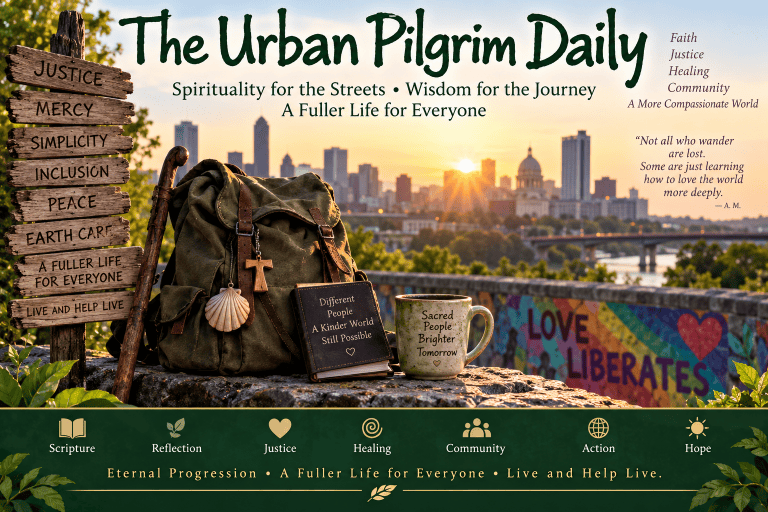
  • THE URBAN PILGRIM DAILY

    THE URBAN PILGRIM DAILY

    Wednesday, October 7, 2026

    Spirituality for the Streets • Wisdom for the Journey • A Fuller Life for Everyone

    Motto: Eternal Progression • A Fuller Life for Everyone • Live and Help Live


    SCRIPTURE FOR THE DAY

    “You shall not withhold the wages of poor and needy laborers.”

    — Deuteronomy 24:14

    Every shirt has a story.

    Someone grew the fiber.

    Someone spun it.

    Someone dyed it.

    Someone cut it.

    Someone stitched it.

    Someone transported it.

    The price tag tells you what the shirt costs.

    It doesn’t necessarily tell you what the shirt cost somebody else.


    FROM THE PILGRIM’S DESK

    Who Made What I’m Wearing?

    Today is World Cotton Day.

    Cotton is so ordinary that we hardly notice it.

    Shirts.

    Socks.

    Towels.

    Bandages.

    Bedding.

    Our daily lives are wrapped in somebody else’s labor.

    That makes today’s Urban Pilgrim exercise remarkably simple:

    Look at your clothes.

    Not to admire the brand.

    Look farther backward.

    Imagine the soil.

    The farmer.

    The mill.

    The factory.

    The sewing machine.

    The truck.

    The warehouse.

    The store.

    A garment is not merely an object.

    It is a web of relationships.

    Franciscan simplicity therefore asks something more interesting than:

    How little can I own?

    It asks:

    Can I learn to recognize the people hidden inside the things I own?


    TODAY’S SERMON

    THE HOLINESS OF ORDINARY WORK

    Deuteronomy 24:14–15

    “You shall not withhold the wages of poor and needy laborers.”

    There is nothing mysterious about this commandment.

    No angel.

    No miracle.

    No complicated doctrine.

    Someone worked.

    Pay them.

    Sometimes biblical ethics are refreshingly difficult to spiritualize away.

    Deuteronomy emerged from ancient Israel’s long process of remembering, interpreting and reformulating covenantal law.

    Its laws reflect an agrarian society profoundly different from ours.

    We should not pretend ancient Israel possessed modern employment law.

    It didn’t.

    But the ethical instinct in this passage remains startlingly recognizable.

    The worker is vulnerable.

    The employer possesses power.

    Therefore the community creates an obligation protecting the worker.

    The text continues by insisting that wages be paid promptly because the laborer depends upon them.

    That is important.

    The Torah recognizes something societies still struggle to admit:

    Economic relationships are power relationships.

    When someone controls the resources another person needs to survive, exploitation becomes possible.

    The biblical response isn’t:

    “Well, that’s just the market.”

    The biblical response is:

    There must be limits.

    That belongs to a much larger biblical tradition.

    Fields cannot be harvested completely; something must remain for vulnerable people.

    Debts face limits.

    Workers receive Sabbath.

    Prophets condemn those who accumulate wealth through exploitation.

    James later thunders against wealthy landowners who withhold wages.

    And Jesus repeatedly centers people pushed toward the economic margins.

    Biblical religion is surprisingly suspicious of an economy that forgets the worker.

    Today is World Cotton Day.

    Cotton makes this wonderfully tangible.

    Pick up a cotton shirt.

    We normally see:

    shirt.

    But historically and economically, the shirt contains an entire world.

    Someone prepared soil.

    Someone planted.

    Someone managed crops.

    Someone harvested.

    Someone processed fiber.

    Someone spun thread.

    Someone wove cloth.

    Someone dyed it.

    Someone cut patterns.

    Someone operated a sewing machine.

    Someone packaged it.

    Someone loaded it.

    Someone drove it.

    Someone stocked it.

    And finally:

    I bought it.

    The commodity appears in my hand while almost every human relationship producing it disappears.

    Karl Marx famously explored something related to this in his discussion of commodity fetishism: social relationships among people become obscured and appear instead as relationships among commodities.

    We see the object.

    We forget the people.

    Franciscan spirituality can interrupt that forgetting.

    Francis embraced material simplicity partly because possessions can possess us.

    But Franciscan simplicity isn’t hatred of material things.

    Francis loved materiality.

    Bread.

    Water.

    Fire.

    Earth.

    Clothing.

    Bodies.

    Animals.

    The problem isn’t matter.

    The problem is forgetting relationship.

    A shirt becomes spiritually interesting when I remember:

    Someone made this.

    Liberation theology then asks the uncomfortable question:

    Under what conditions?

    Were workers safe?

    Were they paid fairly?

    Did farmers have meaningful bargaining power?

    Did women performing labor receive equal dignity?

    Did environmental damage fall upon communities with the least political power?

    Did somebody’s cheap product depend upon somebody else’s expensive suffering?

    Those questions don’t have easy consumer solutions.

    Ethical shopping can matter.

    But justice cannot be reduced to shopping correctly.

    Poor people should not be blamed because they buy the inexpensive clothing they can afford.

    Responsibility belongs throughout economic systems—not merely with the individual standing in the checkout line.

    My anarcho-communist perspective pushes the question toward power.

    Workers collectively create enormous amounts of value.

    Yet decisions about workplaces, production and distribution can remain concentrated elsewhere.

    What might economic life look like if workers and communities possessed substantially more power over the systems their labor sustains?

    Cooperatives.

    Worker organizations.

    Mutual aid.

    Shared stewardship.

    Democratic workplaces.

    These aren’t magical solutions.

    Human beings can create hierarchy almost anywhere.

    Give us three people and by lunchtime somebody will invent a committee.

    But they represent experiments in organizing economic life around participation rather than domination.

    Feminist theology adds another important observation.

    Some of society’s most necessary labor has historically been undervalued precisely because women disproportionately performed it.

    Cooking.

    Cleaning.

    Childcare.

    Elder care.

    Emotional labor.

    Domestic work.

    Work does not become less valuable because capitalism struggles to attach a profitable price to it.

    Queer theology asks another question:

    Whose labor must remain invisible so respectable society can maintain its appearance?

    Queer communities know something about invisible labor.

    The emotional labor of survival.

    Chosen families caring for one another.

    Community members accompanying someone to an appointment.

    People teaching each other how to navigate institutions that weren’t designed for them.

    Much of what keeps people alive never appears on a balance sheet.

    And ecological theology reminds us that human labor isn’t the only labor hidden inside our clothing.

    Sunlight worked.

    Soil worked.

    Water worked.

    Microorganisms worked.

    Plants performed the astonishing alchemy of photosynthesis.

    Creation participated before the first human hand touched the cotton.

    The shirt is practically a community project involving half the biosphere.

    That should produce humility.

    It should also affect preparedness.

    Preparedness culture sometimes becomes gear culture.

    Buy this.

    Upgrade that.

    Acquire another gadget.

    But every object carries labor and ecological cost.

    Franciscan preparedness therefore asks:

    Can I maintain what I already own?

    Can I repair it?

    Can I learn another use for it?

    Can I share equipment?

    Can I develop skills rather than constantly acquiring products?

    The most sustainable backpack is often the backpack already hanging in your closet.

    And where is God in all this?

    I don’t imagine God as the divine factory owner supervising production from heaven.

    Caputo’s God has no celestial payroll department.

    God insists.

    The divine call happens in the worker saying:

    My labor has dignity.

    God insists when someone asks for fair wages.

    When workers organize.

    When a community refuses exploitation.

    When somebody repairs rather than discards.

    When someone finally notices the person who cleans the room after everyone else leaves.

    God cannot force the employer to pay.

    God cannot compel the consumer to notice.

    God cannot magically restructure the supply chain.

    The insistence remains weak.

    But persistent:

    See them.

    The cashier.

    The farmer.

    The janitor.

    The garment worker.

    The delivery driver.

    The caregiver.

    The sanitation worker.

    The person washing dishes behind the restaurant wall.

    The person whose name you never learned.

    Every functioning city rests upon millions of acts of labor.

    The Urban Pilgrim walks through that invisible cathedral every day.

    Today, notice it.

    Look at your shirt.

    Look at your shoes.

    Look at your breakfast.

    Look at the street.

    Then remember:

    Nothing here was made alone.

    Maybe gratitude begins there.

    Justice must go farther.

    Amen.


    THE WORLD OUTSIDE OUR DOOR

    Cotton Has Human Hands

    Reported facts: October 7 is World Cotton Day. United Nations materials note that cotton supports about 32 million growers—nearly half of them women—and benefits more than 100 million families across roughly 80 countries. The observance emphasizes cotton’s importance to livelihoods, poverty reduction, sustainable production and decent work.

    Recent international labor efforts in cotton-producing communities have also focused on strengthening fundamental rights at work and exploring community-based cooperative solutions for cotton farmers.

    Urban Pilgrim reflection: A cheap shirt can hide an extraordinarily complicated human story.

    From my anarcho-communist perspective, the central question isn’t whether workers deserve our pity.

    Workers deserve power, dignity and meaningful participation in the economic systems their labor makes possible.

    Franciscan simplicity adds another challenge:

    Buy thoughtfully when possible.

    Use things fully.

    Repair them.

    Share them.

    And never confuse a low price with a low cost.

    Somebody, somewhere, always paid something.


    SCHOLAR’S CORNER

    Why Pay the Worker Before Sunset?

    Deuteronomy 24:15 says the worker’s wages should be paid the same day.

    Why the urgency?

    Because the worker depends upon them.

    The law recognizes an imbalance of power between someone possessing resources and someone whose immediate survival depends upon receiving compensation.

    Biblical economic ethics often begin not with abstract theories of wealth but with the vulnerability of actual people.


    QUESTION EVERYTHING

    What Counts as Work?

    We readily recognize paid employment as work.

    But what about:

    raising children,

    caring for an elder,

    cooking,

    cleaning,

    volunteering,

    community organizing,

    emotional support,

    mutual aid?

    If civilization collapses without certain forms of unpaid labor, perhaps the problem isn’t that the work has no value.

    Perhaps our measurements are incomplete.


    CREATION IS OUR MONASTERY

    Wear It Longer

    Before replacing a piece of clothing, ask:

    Can I mend it?

    Patch it?

    Repurpose it?

    Donate it responsibly?

    Textiles require land, water, energy and human labor.

    Wearing something longer can become a tiny ecological practice.

    A patched shirt is not necessarily worn out.

    Sometimes it is simply carrying history.


    QUEER WISDOM

    Clothes Are Never Just Clothes

    Clothing can communicate gender, belonging, profession, resistance, safety and identity.

    For queer and transgender people especially, getting dressed can sometimes become an act of self-definition.

    Your body does not owe the world a costume designed to make other people comfortable.

    Wear what helps you inhabit yourself.

    And whenever possible, extend that same freedom to everybody else.


    ONE BIG IDEA

    Commodity Fetishism

    Karl Marx used the phrase commodity fetishism to describe how relationships among people involved in production can become obscured once goods appear in the marketplace as commodities.

    The Urban Pilgrim translation:

    You see a $10 shirt.

    Learn to see:

    soil + water + farmer + mill worker + garment worker + truck driver + store employee + planet.

    The object becomes relationship again.


    SAINT, HERETIC & TROUBLEMAKER OF THE DAY

    César Chávez

    César Chávez helped organize farmworkers and co-founded the organization that became the United Farm Workers.

    His legacy is complicated, as human legacies usually are, but his organizing helped force agricultural labor into public consciousness.

    Food does not magically appear in supermarkets.

    Clothing does not magically appear in stores.

    Workers put it there.

    Remembering that fact can itself become resistance to invisibility.


    WORDS FOR THE ROAD

    Gratitude notices the worker; justice refuses to leave the worker invisible.


    PILGRIM JOURNAL PROMPT

    Choose one object you use every day.

    Try to imagine every person who may have participated in bringing it to you.

    Then ask:

    What relationships are hidden inside my possessions?


    HOLY FOOLERY

    Me:

    “I practice Franciscan simplicity.”

    Also me:

    “I might need another backpack.”

    Francis:

    “You already have a backpack.”

    Me:

    “But this one has MOLLE webbing.”

    Francis:

    “I survived the thirteenth century with a rope.”

    Point taken, Brother Francis.


    PRAYER FOR PEACE ACROSS ALL FAITHS

    Sacred Mystery beyond every name,

    bless the hands that work.

    The farmer.

    The sewer.

    The builder.

    The caregiver.

    The cleaner.

    The driver.

    The cook.

    The teacher.

    The healer.

    The volunteer.

    Bless workers of every religion and none.

    Where labor is exploited,

    awaken justice.

    Where workers are invisible,

    awaken recognition.

    Where people are exhausted,

    make room for rest.

    Where wealth becomes domination,

    awaken cooperation.

    May everyone have enough.

    May every worker possess dignity.

    And may the work of our hands contribute to the flourishing of all.

    Amen.


    FRANCISCAN CLAREAN REFLECTION

    Mend the Habit

    Franciscan simplicity is not a competition to own the fewest objects.

    It is freedom from compulsive possession.

    Sometimes the most Franciscan thing you can do with an old object is:

    keep using it.

    Patch the tear.

    Sharpen the tool.

    Wash the bottle.

    Repair the strap.

    Learn maintenance.

    Clare did not need seasonal wardrobe drops.

    Neither does the Urban Pilgrim.

    Use what serves.

    Care for what you use.

    Share what you no longer need.


    THE HERBAL MINUTE

    Cotton Is a Plant Too

    We usually encounter cotton as fabric and forget that it begins as a plant in the genus Gossypium.

    Cotton reminds us that the boundary between agriculture and everyday life is thinner than it appears.

    The shirt on your body began in soil.

    A safety note: don’t treat cotton plants, seeds or cottonseed-derived products as DIY herbal medicines merely because cotton is botanical. Some parts contain compounds such as gossypol that can be harmful, and commercial edible cottonseed products require appropriate processing.

    Today’s herbal lesson:

    “Natural” describes an origin. It does not guarantee safety.


    URBAN PREPAREDNESS

    Learn to Repair One Thing

    Today’s preparedness assignment requires no shopping.

    Inspect something you depend upon:

    a backpack,

    coat,

    poncho,

    tent,

    shoe,

    or other piece of everyday equipment.

    Check seams.

    Buckles.

    Zippers.

    Straps.

    Loose threads.

    Small damage is usually easier to address before it becomes catastrophic damage.

    A basic repair kit might be nothing more than appropriate tape, needle, thread and a few simple replacement parts suited to your equipment.

    Preparedness isn’t owning endless backups.

    It is keeping useful things useful.

    Franciscan preparedness says:

    Maintain before replacing.


    OUTDOOR PILGRIM SKILL

    Keep Cotton in Its Lane

    Cotton is comfortable for ordinary city life.

    But outdoors, especially in cold or wet conditions, cotton clothing can retain moisture and lose insulating effectiveness.

    For conditions where getting wet could become dangerous, experienced hikers often favor appropriate wool or synthetic layers that manage moisture more effectively.

    That doesn’t mean cotton is universally “bad.”

    It means:

    Dress for conditions.

    Check the forecast.

    Understand your route.

    Carry appropriate layers.

    The Urban Pilgrim does not need an expensive technical wardrobe to walk around the neighborhood.

    But when weather becomes serious, clothing becomes equipment.

    Know what yours can—and cannot—do.


    PILGRIM PRACTICE FOR TODAY

    Thank One Invisible Worker

    Notice one person whose labor makes your day easier but whom people frequently overlook.

    A cleaner.

    Cashier.

    Bus driver.

    Maintenance worker.

    Delivery driver.

    Food-service worker.

    Caregiver.

    If appropriate, simply say:

    Thank you.

    Use their name if you know it.

    Then remember:

    Gratitude is not a substitute for fair wages or just working conditions.

    But justice should never make gratitude unnecessary either.

    We need both.


    CLOSING BLESSING

    May you recognize the hands hidden inside ordinary things.

    May your clothing remind you of soil.

    May your meals remind you of farmers.

    May your streets remind you of workers.

    May Francis teach you to possess without being possessed.

    May Clare teach you that simplicity can become freedom.

    May your preparedness depend increasingly upon skill rather than shopping.

    May your outdoor practice teach you to respect weather, materials and limits.

    May workers everywhere receive dignity, rest, safety and enough.

    And may the God who does not command from the executive suite,

    but insists within every cry for dignity,

    keep whispering through the work of human hands:

    Notice.

    Respect.

    Repair.

    Share.

    Organize.

    Cooperate.

    And never forget—

    nothing worthwhile is built alone.

    Eternal Progression • A Fuller Life for Everyone • Live and Help Live.