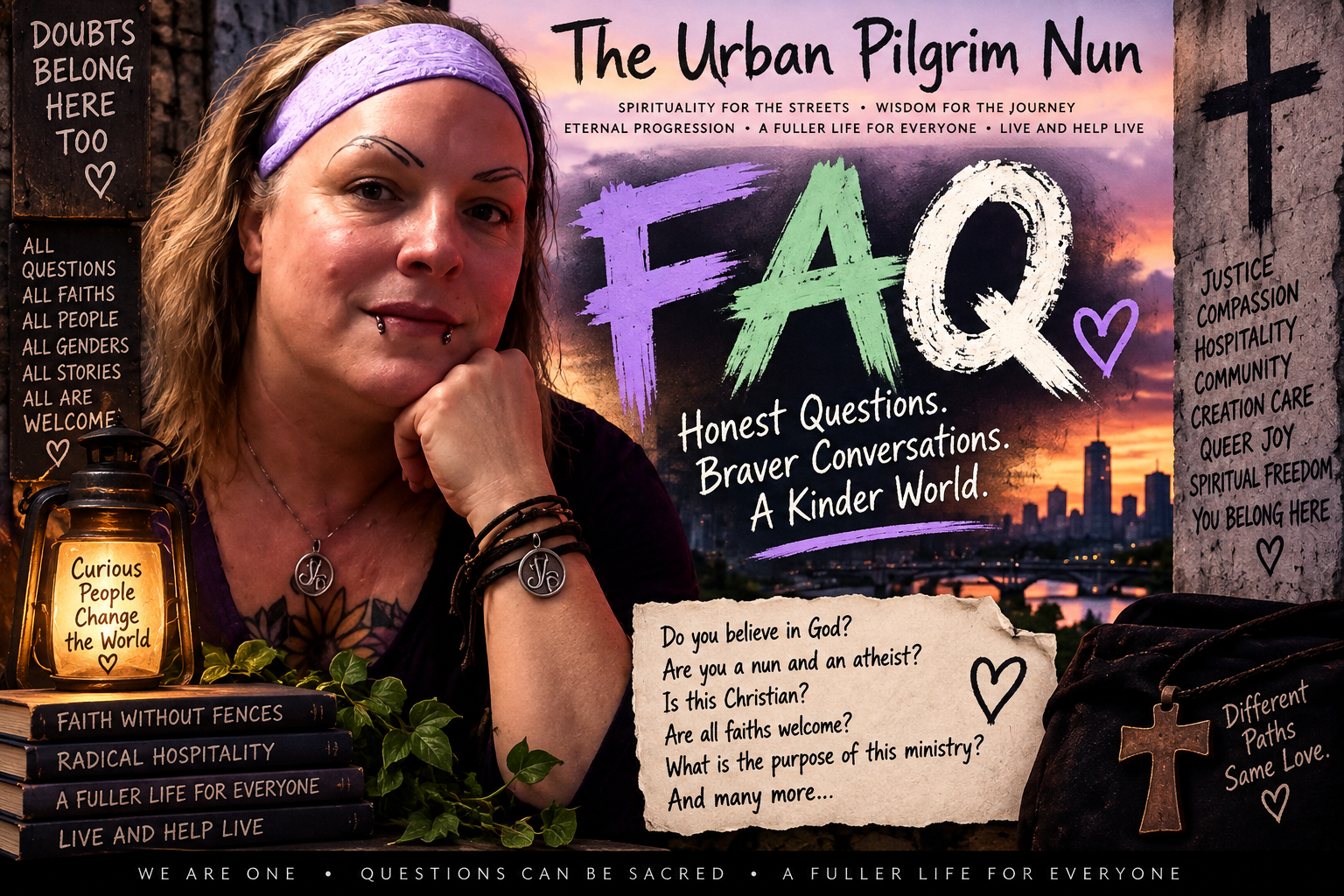
Frequently Asked Questions
Questions, Doubts, and the Sacred Journey
You do not have to leave your questions at the door.
The Urban Pilgrim Nun is a spiritual home for seekers, believers, doubters, mystics, skeptics, atheists, humanists, interfaith explorers, spiritual wanderers, and people who simply are not sure what they believe anymore.
We do not believe that certainty is the price of admission.
Sometimes the question itself is sacred.
Sometimes losing an old belief is part of finding a deeper way of living.
Sometimes faith means continuing the pilgrimage without pretending that we know exactly where it ends.
Our guiding conviction is simple:
We are one.
Our objective is eternal progression.
Our goal is a fuller life for everyone.
Our slogan is Live and help live.
What is the Urban Pilgrim Nun?
The Urban Pilgrim Nun is the ministry and spiritual work of Sister Abigail Hester, OFC.
It brings together progressive Christianity, Franciscan and Clarean spirituality, interspiritual practice, religious pluralism, contemplative living, social justice, mystical exploration, philosophy, modern biblical scholarship, respect for science, and openness to wisdom wherever it may be found.
It is spirituality for people who are still walking.
The pilgrim does not pretend to have arrived.
She keeps walking.
Do you believe in God?
Yes—but the word God requires some unpacking.
We do not insist upon God as a supernatural being somewhere “up there,” periodically intervening in the machinery of the universe.
We are deeply influenced by radical and post-theistic approaches to theology, including the work of philosopher and theologian John D. Caputo.
In this understanding, God can be spoken of as a call, event, insistence, promise, or sacred summons that calls us toward love, justice, mercy, hospitality, forgiveness, liberation, and a fuller life.
God does not need to be imagined as a cosmic ruler exercising coercive power over creation.
When we say that God calls, we are speaking of something that stirs within human existence—the insistence that another world is possible, that the stranger deserves hospitality, that oppression should be resisted, that wounds can be healed, and that love continually asks something of us.
Others may speak of God as the Ground of Being, Sacred Mystery, the depth dimension of existence, the Divine, Ultimate Reality, or simply Love.
And some people may decide that they do not need the word God at all.
There is room at our table for all of them.
Are you an atheist or a believer?
Those categories are sometimes less tidy than they appear.
It is possible to reject the traditional supernatural deity imagined by much popular religion while remaining profoundly responsive to what religious language calls God.
In that sense, one might even speak paradoxically of being an atheist who believes in God.
We can reject the God who functions as a supernatural dictator while remaining open to the God who happens as call, possibility, promise, justice, compassion, and transformative love.
For us, the important question is not simply:
“Do you believe that God exists?”
Another question may be even more important:
“What happens in the world when the name of God is spoken?”
Does it produce fear or freedom?
Exclusion or hospitality?
Domination or service?
Hatred or love?
By its fruits, theology should be judged.
Do I have to believe in God to belong?
No.
Believers, agnostics, atheists, humanists, mystics, religious naturalists, spiritual seekers, and people whose most truthful answer is simply “I don’t know” are welcome.
We care less about forcing everyone to reach identical metaphysical conclusions and more about what our convictions produce in the world.
Do they make us more compassionate?
Do they help us confront injustice?
Do they deepen our capacity for wonder?
Do they help us care for our neighbors and the Earth?
Do they contribute to a fuller life for everyone?
Those questions matter deeply to us.
Are you Christian?
Yes.
But our Christianity is progressive, pluralistic, historically conscious, questioning, and non-dogmatic.
Jesus remains central to our spiritual imagination and ethical practice, but Christianity does not possess a monopoly on truth, wisdom, goodness, or encounters with the Sacred.
We gladly learn from Judaism, Islam, Buddhism, Hindu traditions, Pagan and Earth-centered spiritualities, Indigenous wisdom, humanism, philosophy, psychology, science, and other streams of human experience.
Following Jesus does not require us to stop listening to everyone else.
What do you believe about Jesus?
Jesus stands at the center of our Christian path.
We encounter Jesus as teacher, prophet, wisdom figure, healer, mystic, liberator, boundary-breaker, and embodiment of radical compassion.
We are especially interested in the Jesus who announces good news to the poor, eats with outsiders, touches the untouchable, challenges religious hypocrisy, confronts domination, practices radical hospitality, and calls people toward a transformed way of living.
People within our community may understand Jesus’ divinity, resurrection, miracles, and theological significance differently.
Uniformity is not required.
What matters is whether we are willing to take the way of Jesus seriously: compassion, justice, peacemaking, forgiveness, solidarity, liberation, hospitality, and courageous love.
Do you believe Jesus is the only way to God?
We do not teach that every human being must become Christian in order to encounter truth, experience the Sacred, or live a meaningful and compassionate life.
Christianity gives us one profound vocabulary for the human encounter with Mystery.
It is not the only vocabulary.
We therefore reject religious conquest as our mission.
Our neighbors of other traditions are not projects.
They are neighbors.
We do not need to erase their paths in order to walk faithfully upon our own.
Do you believe the Bible is the literal Word of God?
We take the Bible seriously without requiring biblical literalism or inerrancy.
The Bible is not a single book dropped out of heaven.
It is an ancient library created, collected, edited, preserved, debated, translated, and interpreted by human communities wrestling with God, identity, suffering, empire, liberation, morality, community, hope, death, and meaning.
It contains poetry, mythology, history, law, prophecy, wisdom literature, parable, letters, theological reflection, apocalyptic imagery, and competing perspectives.
We therefore read Scripture both critically and devotionally.
Historical context matters.
Literary genre matters.
Archaeology matters.
Science matters.
Biblical scholarship matters.
Human experience matters.
And love matters.
Scripture becomes most life-giving when it helps us become more compassionate, resist oppression, seek justice, practice mercy, and become more fully human.
What happens when the Bible and modern knowledge disagree?
We keep learning.
We do not abandon science, reason, historical evidence, or human experience simply to preserve an ancient interpretation.
The Bible itself records people wrestling with inherited traditions and reinterpreting them in new circumstances.
We can do the same.
Faith should not be frightened by knowledge.
If new evidence requires us to change our interpretation, then we change our interpretation.
That is not necessarily the death of faith.
Sometimes it is how faith grows up.
Do you believe in hell?
We reject hell as a weapon of religious terror.
We do not teach that a loving God eternally tortures people because they chose the wrong religion, misunderstood a doctrine, questioned Christianity, or failed a theological examination.
We remain humble about whatever mysteries may lie beyond death.
But we know something about hell here.
War can become hell.
Abuse can become hell.
Poverty can become hell.
Hatred can become hell.
Loneliness, oppression, exploitation, racism, violence, and despair can create hellish realities in human lives.
So instead of obsessing over who might go to hell later, we are interested in creating less hell now.
Do you believe in heaven?
We remain open to the mystery of what may exist beyond death.
We refuse to pretend that we possess certainty where mystery remains.
But heaven should never become an excuse for abandoning Earth.
Whenever reconciliation replaces hatred, food reaches someone hungry, loneliness gives way to community, oppression gives way to liberation, and compassion interrupts cruelty, something resembling the biblical dream of the Kingdom of God becomes visible among us.
Our spirituality is therefore concerned not merely with life after death but with life before death.
What is interspirituality?
Interspirituality is more than tolerating people from other religions.
It means encountering the wisdom, practices, experiences, and insights of multiple spiritual traditions with curiosity and respect.
It does not require pretending that every religion teaches exactly the same thing.
They do not.
Real dialogue becomes possible precisely because differences are allowed to remain real.
We can learn from one another without erasing one another.
Unity does not require uniformity.
Does “We Are One” mean all religions are the same?
No.
Religions contain genuine differences.
They make different metaphysical claims, tell different sacred stories, practice different rituals, and sometimes disagree profoundly.
Every religious tradition also contains complicated histories. Traditions can produce breathtaking compassion and terrible harm—sometimes within the same historical community.
We are one does not mean we are identical.
It means that beneath our differences we share a common humanity, inhabit a common Earth, participate in an interconnected web of life, and carry responsibilities toward one another.
Difference does not have to become division.
What does radically pluralistic mean?
It means that diversity is not a problem we are waiting for someone to solve.
We expect human beings to understand ultimate questions differently.
Truth can be encountered through religion, philosophy, science, art, relationships, contemplation, activism, nature, human experience, and countless other avenues.
No church owns truth.
No clergy owns God.
No institution owns the Sacred.
No single tradition exhausts the Mystery.
What does anti-dogmatic mean?
Anti-dogmatic does not mean believing nothing.
It means refusing to turn beliefs into prisons.
Our beliefs should remain open to questioning, evidence, scholarship, experience, reason, dialogue, and growth.
We can hold convictions while remaining humble enough to say:
“I could be wrong.”
We would rather have a community filled with sincere questions than one filled with compulsory answers.
What does democratizing religion mean?
Spiritual wisdom does not belong exclusively to clergy, theologians, institutions, gurus, or religious authorities.
Everyone deserves access to life’s deepest questions.
Teachers can teach.
Scholars can challenge us.
Traditions can preserve wisdom.
Clergy can offer pastoral care.
Communities can support us.
But nobody gets to own another person’s conscience.
Spiritual authority should empower people rather than infantilize them.
What is eternal progression?
Eternal progression is our language for the never-ending process of becoming.
We are unfinished creatures.
There is always more to learn, more compassion to practice, more prejudice to unlearn, more wisdom to discover, more healing to pursue, more injustice to confront, and more deeply to love.
No spiritual achievement gives us permission to announce that we have finally arrived.
There is always another horizon.
The pilgrimage continues.
What does “a fuller life for everyone” mean?
Spirituality should contribute to human and planetary flourishing.
A fuller life includes dignity, relationship, meaning, freedom, nourishment, safety, creativity, community, justice, wonder, love, and the opportunity to become more fully alive.
And everyone matters.
A spirituality concerned only with saving individual souls while ignoring suffering bodies, wounded communities, oppressed people, and a damaged planet is too small for our vision.
What does “Live and help live” mean?
Live fully.
Help others flourish.
Protect life.
Practice compassion.
Defend dignity.
Feed people.
Welcome strangers.
Make peace.
Care for the Earth.
Challenge systems that crush people.
And leave the world a little more alive because you passed through it.
That is Live and help live.
Is doubt a sin?
No.
Doubt can be an essential part of intellectual and spiritual maturity.
Sometimes doubt dismantles an inadequate image of God.
Sometimes disbelief is more truthful than forced belief.
Sometimes losing certainty allows us to encounter Mystery again.
Faith and doubt can inhabit the same human heart.
You are allowed to ask questions here.
You are even allowed to question the answers.
Are LGBTQ+ people welcome?
Completely.
LGBTQ+ people are not theological problems to solve, exceptions to tolerate, or debates for other people to conduct.
They are human beings possessing inherent dignity.
LGBTQ+ people are welcome in the full spiritual, sacramental, communal, ministerial, and leadership life of our communities.
No asterisk.
Do you support women in ministry?
Absolutely.
Gender is neither a qualification for nor a barrier to spiritual leadership.
Calling, wisdom, compassion, integrity, training, and the ability to serve matter far more.
What is the Order of Franciscan Clareans?
The Order of Franciscan Clareans (OFC) is a progressive Franciscan-inspired religious community drawing particular inspiration from St. Francis and St. Clare of Assisi.
Its spirituality emphasizes simplicity, peace, contemplation, solidarity with marginalized people, care for creation, service, radical hospitality, justice, and courageous love.
We seek to carry Franciscan and Clarean spirituality into contemporary streets, neighborhoods, communities, and struggles for justice.
Franciscan spirituality should not merely admire Francis.
It should ask what it means to walk differently through the world today.
What is the Interspiritual Order of ChristoCorrellians?
The Interspiritual Order of ChristoCorrellians explores spiritual bridges between Christianity and the Correllian Nativist Tradition within a wider interspiritual framework.
It creates space for ritual, theological exploration, dialogue, mystical practice, and encounters between traditions.
It does not claim that Christianity and the Correllian tradition are identical.
The goal is relationship without erasure.
What is Kilubansa?
Within Sister Abigail’s spiritual practice and healing ministry, Kilubansa is associated with healing spirituality and the sacred work of restoration.
Practices associated with Kilubansa may include prayer, ritual, herbs, contemplation, compassion, reverence for life, and attention to the physical, emotional, relational, spiritual, and ecological dimensions of healing.
These practices are complementary spiritual practices and are not substitutes for appropriate professional medical or mental-health care.
Are you trying to create one world religion?
No.
We are interested in interspiritual relationship, not religious homogenization.
Christians can remain Christian.
Muslims can remain Muslim.
Jews can remain Jewish.
Buddhists can remain Buddhist.
Hindus can remain Hindu.
Pagans can remain Pagan.
Humanists can remain humanist.
Seekers can remain seekers.
And people who belong nowhere are welcome too.
The table becomes richer precisely because everyone does not bring the same dish.
Do I have to agree with Sister Abigail?
Good heavens, no.
If everybody agreed with the nun all the time, we should probably start checking the drinking water.
Spiritual community should encourage thought, not manufacture conformity.
You may disagree with Sister Abigail.
You may disagree with theologians.
You may disagree with tradition.
You may even disagree with something you yourself believed five years ago.
That is called growing.
Disagreement practiced with compassion, humility, curiosity, evidence, and mutual respect can help all of us progress.
Is science compatible with your spirituality?
Absolutely.
Science is one of humanity’s most powerful ways of investigating reality.
We celebrate scientific discovery rather than treating it as a threat to faith.
Evolution, cosmology, psychology, neuroscience, archaeology, history, medicine, and other fields can deepen and sometimes challenge our understanding of ourselves and our religious traditions.
When evidence challenges an old interpretation, we reconsider the interpretation.
Truth has nothing to fear from investigation.
What is your position on religious authority?
Religious authority exists to serve—not dominate.
Clergy, scholars, elders, teachers, and spiritual guides can offer wisdom, scholarship, pastoral care, ritual, experience, and guidance.
But spiritual leadership becomes dangerous when it demands unquestioning obedience or claims control over another person’s conscience.
Healthy spiritual leadership should help people grow into greater wisdom, freedom, responsibility, compassion, and maturity.
Your conscience is not church property.
Is this a spiritual home for people who have been hurt by religion?
We hope it can be.
Many people carry wounds caused by churches, clergy, doctrines, families, or religious institutions.
We will not demand that anyone rush back into religion.
You may question.
You may disagree.
You may explore.
You may grieve.
You may rest.
You may leave certain beliefs behind.
You may discover new language.
You may take your time.
Spiritual community can offer companionship and support, but it should never pretend to replace qualified medical or mental-health care when professional care is needed.
Do you evangelize?
Yes—but probably not in the conventional sense.
We are not interested in pressuring everyone to join our religion.
Our evangelism is the proclamation that another way of living is possible.
Love is possible.
Justice is possible.
Reconciliation is possible.
Hospitality is possible.
Liberation is possible.
A fuller life is possible.
If the Gospel is genuinely good news, people should be able to experience some of that goodness before they ever agree with our theology.
What is salvation?
We understand salvation more broadly than securing admission to heaven after death.
Salvation can mean liberation, healing, reconciliation, restoration, awakening, transformation, and becoming more fully alive.
It is personal, but never merely individual.
We seek salvation from hatred, domination, greed, violence, dehumanization, despair, exploitation, and everything that prevents life from flourishing.
Salvation asks not merely:
“How do I get saved?”
but also:
“What needs saving among us?”
What is the Kingdom of God?
We do not primarily understand the Kingdom of God as a supernatural empire ruled by a cosmic monarch.
It is the biblical dream of another way of organizing human life.
It appears wherever the hungry are fed, outsiders are welcomed, enemies are reconciled, domination is challenged, creation is cherished, prisoners are remembered, the wounded are cared for, and human dignity is restored.
In Caputo-inspired language, the Kingdom is something that insists upon us before it fully exists.
It calls.
It interrupts.
It makes demands upon our imagination.
It asks us to help bring into existence what does not yet fully exist.
What is prayer?
Prayer does not have to mean sending requests to a supernatural being who might decide whether or not to intervene.
Prayer can also be attention.
Listening.
Silence.
Lament.
Gratitude.
Meditation.
Contemplation.
Solidarity.
Hope.
Protest.
Wonder.
Prayer can be the practice of becoming available to the call of love.
Sometimes prayer changes circumstances.
Sometimes prayer changes us.
Sometimes prayer simply gives us the courage to enter circumstances and begin changing them ourselves.
What is the mission of the Urban Pilgrim Nun?
Our mission is to encourage spiritual exploration, radical compassion, interfaith and interspiritual understanding, justice, peace, human dignity, care for creation, intellectual freedom, and the lifelong transformation of the human person.
We seek a spirituality large enough for questions, courageous enough to confront injustice, intellectually honest enough to change, humble enough to learn from others, playful enough not to take itself too seriously, and compassionate enough to keep making room at the table.
We want to hear the call toward a fuller life—and then participate in making that fuller life possible.
Still Have Questions?
Good.
A spiritual community without questions is probably a museum.
The Urban Pilgrim Nun exists for pilgrims—people still walking, wondering, learning, doubting, discovering, loving, unlearning, rebuilding, and becoming.
You do not need perfect beliefs.
You do not need theological certainty.
You do not need to pretend that you have everything figured out.
Neither do we.
Come with your questions.
Come with your doubts.
Come with your wisdom.
Come with your wounds.
Come with your story.
Come as you are.
And then let us keep walking.
We are one.
Eternal progression.
A fuller life for everyone.
Live and help live.