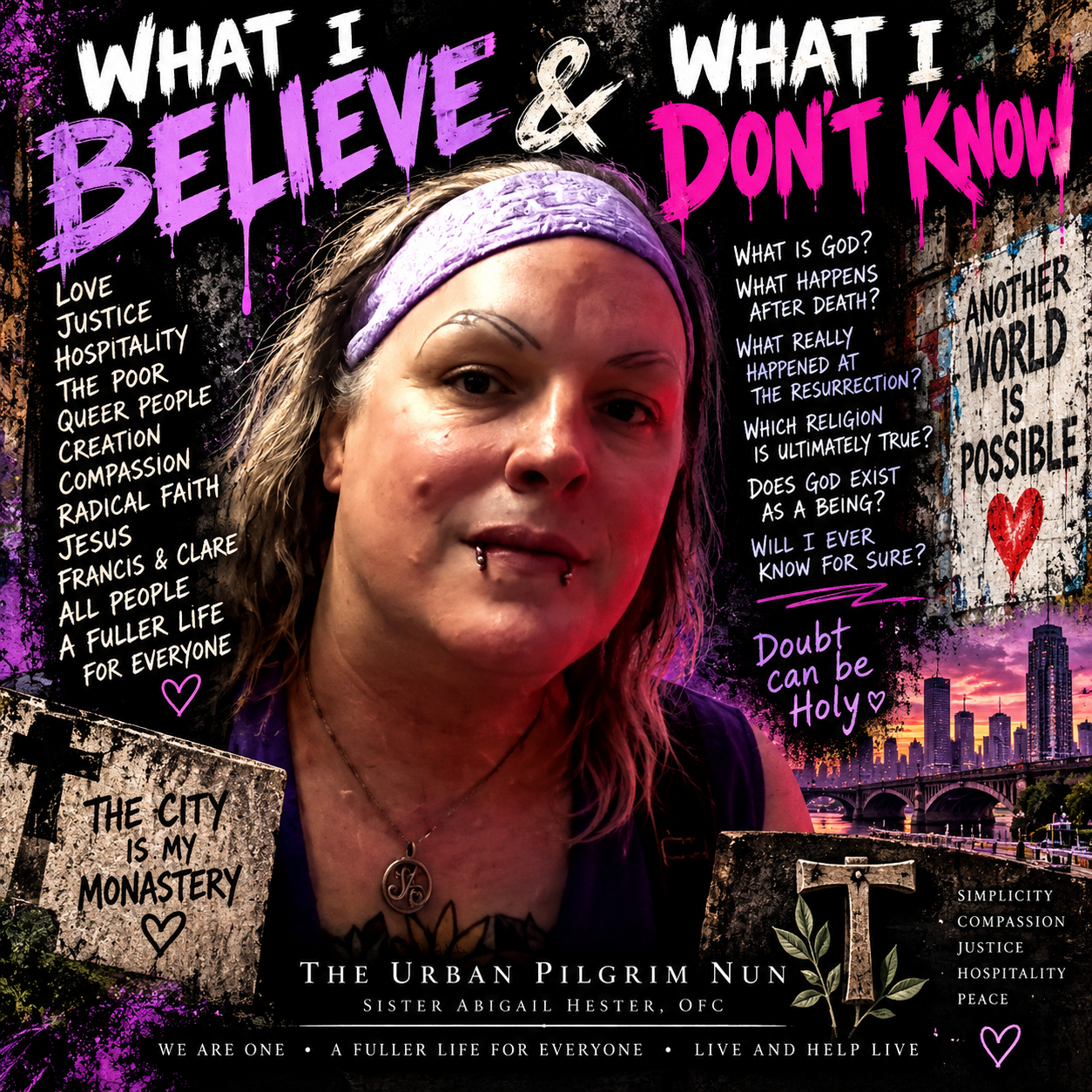
Faith After Certainty
My name is Sister Abigail Hester, OFC, the Urban Pilgrim Nun.
I believe.
I doubt.
I question.
I change my mind.
And I no longer believe those things contradict one another.
There was a time when I thought faith meant having the answers. I once inhabited a much more certain Christianity—a world where doctrines were settled, Scripture provided clear answers, and God could be neatly described.
My journey has taken me somewhere very different.
Today, my spirituality is progressive, Franciscan and Clarean, interspiritual, contemplative, radically hospitable, and deeply comfortable with questions.
I am influenced by Saint Francis of Assisi and Saint Clare of Assisi, and by thinkers such as Paul Tillich, Jacques Derrida, John D. Caputo, and Slavoj Žižek.
But none of them gets the final word.
Neither do I.
The pilgrim has not arrived.
She keeps walking.
I Believe in God — But What Do I Mean by God?
When I use the word God, I am not necessarily talking about a supernatural person sitting somewhere beyond the universe, occasionally reaching into history to rearrange events.
I have become increasingly suspicious of that picture.
Paul Tillich spoke of God not as a being among other beings, but as the ground of being.
John D. Caputo pushes radical theology even further. God can be understood as an event, an insistence, a call—something that summons us toward possibilities that have not yet become real.
When mercy calls us beyond vengeance—
when justice interrupts oppression—
when hospitality asks us to welcome the stranger—
when love demands more of us than self-interest—
something happens.
I am willing to call that God.
God does not need to be imagined as a cosmic dictator exercising overwhelming power.
Perhaps God is found in the call that refuses to leave us alone:
Love.
Forgive.
Feed them.
Welcome them.
Make peace.
Resist injustice.
Become more fully human.
God insists.
We decide whether that insistence becomes flesh.
I Follow Jesus
I am a Christian.
But Christianity is not, for me, a declaration that everyone else must be wrong.
I follow Jesus because his story continues to disturb me.
Jesus announces good news to the poor.
He eats with people respectable religion rejects.
He touches people society calls unclean.
He challenges religious hypocrisy.
He confronts domination.
He places human need above rigid religious rules.
And he announces something he calls the Kingdom of God—a radically different way of organizing human life.
I do not need Jesus to make every other religious tradition false in order for Jesus to matter.
I can follow Jesus without pretending that God has spoken through Christianity alone.
My Christianity becomes deeper, not weaker, when I encounter wisdom in Buddhism, Hindu traditions, Islam, Judaism, Pagan traditions, Indigenous spiritualities, humanism, philosophy, science, and people who practice no religion whatsoever.
Truth does not become false because somebody discovered it outside my tribe.
Francis and Clare Still Haunt Me
Among all the voices accompanying my pilgrimage, Francis and Clare of Assisi remain foundational.
They remind me that theology eventually has to acquire hands and feet.
Francis found sacred kinship in the poor, the rejected, animals, creation, and even those his society considered enemies.
Clare chose radical simplicity and refused to allow powerful institutions to domesticate her vocation.
Their lives continue asking uncomfortable questions.
How much do we really need?
Who pays for our comfort?
Can we live without dominating one another?
Can the stranger become sibling?
Can Earth become family rather than property?
Can religion surrender power long enough to become love?
Franciscan spirituality, at its best, is not romantic medieval cosplay.
It is a dangerous invitation to live simply, love boldly, make peace, embrace creation, stand beside marginalized people, and resist the machinery that turns living beings into commodities.
I Believe We Are One
This is one of the simplest convictions underlying my spirituality:
We are one.
Not identical.
Not interchangeable.
Not required to believe the same things.
But profoundly interconnected.
Human beings belong to one another.
We belong to Earth.
Our flourishing is entangled with the flourishing of our neighbors, ecosystems, communities, and generations we will never meet.
That is why spirituality cannot merely be about getting my individual soul safely into heaven.
If my spirituality makes me indifferent to suffering, something has gone terribly wrong.
The spiritual life should move us toward a fuller life for everyone.
My practical rule is therefore wonderfully uncomplicated:
Live and help live.
I Believe Justice Is Spiritual
There is no meaningful spirituality that permanently ignores suffering.
Racism matters.
Poverty matters.
Queer and transgender dignity matters.
War matters.
Housing matters.
Hunger matters.
Disability matters.
The climate matters.
How societies treat prisoners, migrants, unhoused people, minorities, children, elders, animals, and strangers matters.
Justice is not an optional political attachment bolted onto spirituality.
Justice is what love looks like when love encounters systems.
Derrida’s reflections on justice and radical hospitality challenge me here.
Hospitality becomes most meaningful precisely when the person arriving at our door cannot repay us.
The stranger asks something frightening of us:
Will you make room?
I believe the sacred frequently arrives disguised as that question.
I Believe Doubt Can Be Holy
I no longer regard doubt as faith’s enemy.
Sometimes doubt is what happens when faith becomes honest.
Deconstruction has taught me to become suspicious whenever human beings claim that their language has captured reality completely.
Every theological system leaves something outside its borders.
Every doctrine is expressed through human language.
Every interpretation comes from somewhere.
That does not make theology meaningless.
It makes theology humble.
I would rather possess a faith capable of questioning itself than a certainty incapable of listening.
What I Don’t Know
This section may be more important than everything above it.
I don’t know exactly what God is.
Perhaps nobody does.
Every word we use—Father, Mother, Spirit, Ground, Mystery, Being, Event, Love—is a human attempt to point toward something that may ultimately exceed language.
I don’t know exactly what happened at the resurrection.
I take the resurrection seriously.
But taking something seriously does not require pretending that every historical, philosophical, and theological question surrounding it has been solved.
Something happened within the Jesus movement that transformed frightened followers into people proclaiming that crucifixion had not been the final word.
I continue wrestling with what that means.
I don’t know what happens after death.
I hope.
I wonder.
I sometimes believe.
I sometimes doubt.
But I have never died and returned with a clipboard.
Neither has any theologian whose books I have read.
I refuse to turn hope into knowledge merely because uncertainty makes me uncomfortable.
I don’t know which religion is ultimately correct.
Perhaps the question itself is flawed.
Religions may be less like competing answer sheets and more like languages developed by human communities encountering mystery, suffering, transcendence, morality, beauty, death, consciousness, and one another.
They contain wisdom.
They also contain human prejudice.
Christianity included.
I don’t know whether every traditional Christian doctrine must be understood literally.
I don’t think Christianity collapses simply because our interpretations change.
Christianity has been changing since Christians first began arguing about Jesus.
Historical-critical biblical scholarship has taught us that Scripture is a library of ancient voices rather than a divine instruction manual dropped intact from heaven.
Those voices disagree sometimes.
They develop.
They wrestle.
So do we.
I don’t know whether the word “God” will always be necessary.
This is where radical theology becomes especially interesting to me.
Could someone reject the supernatural God of traditional theism and nevertheless respond faithfully to the call associated with the name of God?
Could an atheist feed the hungry, welcome the stranger, forgive an enemy, resist injustice, protect creation, and practice radical compassion—and thereby participate in what I call the event of God?
I think so.
The label interests me considerably less than the life.
I Am Not Asking You to Believe What I Believe
The Urban Pilgrim Nun is not an attempt to create another tiny fortress of certainty.
You do not need to agree with me.
You may be Christian.
Muslim.
Jewish.
Buddhist.
Hindu.
Pagan.
Humanist.
Agnostic.
Atheist.
Mystic.
Something impossible to fit neatly onto a form.
Or simply tired of labels.
You are welcome to walk awhile.
Bring your questions.
Bring your skepticism.
Bring the beliefs you treasure.
Bring the beliefs that are falling apart.
Bring the questions you are frightened to ask in religious spaces.
Nobody here receives a prize for pretending to be certain.
Three Sacred Words
After years of theology, ministry, Scripture, philosophy, prayer, ritual, argument, doubt, loss, discovery, and change, three words have become increasingly important to me:
I don’t know.
Those words are not the death of faith.
Sometimes they are where faith finally becomes honest.
Mystery does not demand that we stop thinking.
Mystery invites us to keep walking.
So I remain a pilgrim.
Following Jesus.
Walking with Francis and Clare.
Listening for the insistence of God.
Learning from traditions beyond my own.
Deconstructing my certainties.
Trying to welcome the stranger.
Trying to become more compassionate.
Trying to leave this world slightly kinder than I found it.
And when love calls—
when justice insists—
when mercy interrupts—
when the stranger knocks—
I want to be able to say:
Yes.
Perhaps that is faith enough.
WE ARE ONE
Objective: Eternal Progression
Goal: A Fuller Life for Everyone
Slogan: Live and Help Live
The pilgrim has not arrived. She keeps walking.