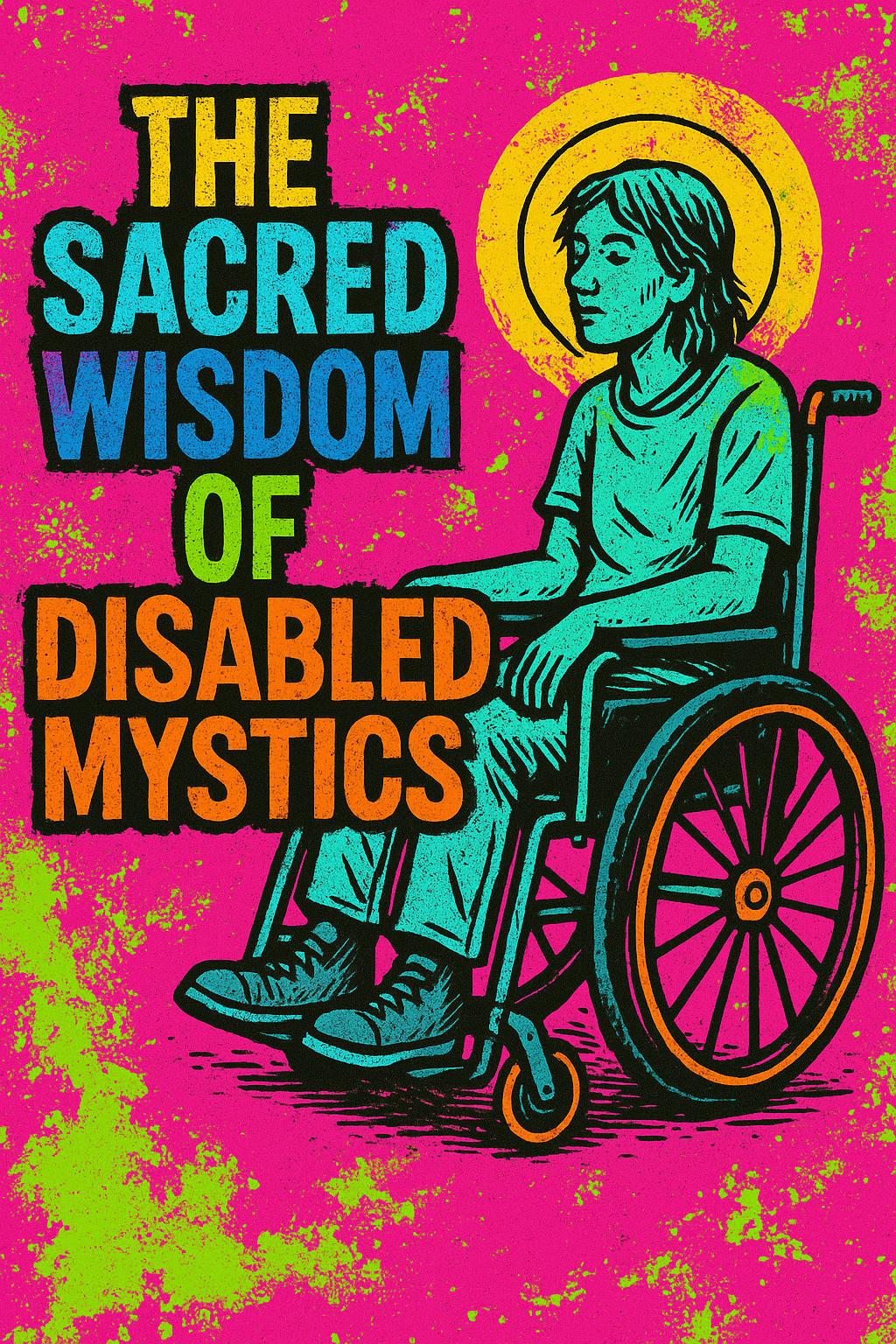
The Sacred Wisdom of Disabled Mystics
Throughout history, mystics have often been misunderstood — prophets dismissed as mad, visionaries branded heretics, and saints hidden behind walls of pain. Among these sacred souls, the disabled mystics stand out like candles flickering in the wind — fragile, yet defiantly bright. Their wounds became windows. Their limits became lenses through which divine light shone more clearly.
The Theology of the Broken Body
In a world obsessed with power, perfection, and performance, disabled mystics remind us that God’s glory is revealed in weakness. As Paul wrote, “My grace is sufficient for you, for My power is made perfect in weakness” (2 Corinthians 12:9). Many of the great mystics—Julian of Norwich, who suffered grave illness; Brother Lawrence, whose physical pain led him to practice the presence of God; or Therese of Lisieux, bedridden and frail—found the deepest communion not in their strength, but in their surrender.
Disability, in this sense, becomes not a curse but a calling — a way of living theology with one’s whole being. The body itself becomes sacred text. The wheelchair, the cane, the tremor, the memory lapse — all become syllables in the language of divine compassion.
The Prophetic Voice of Pain
Disabled mystics have always held a prophetic role in faith communities. They challenge the illusion that holiness looks like health or wholeness. They teach us that God doesn’t need a flawless vessel to pour out boundless love. Their existence dismantles ableist theology — the notion that God’s image is reserved for the strong, the productive, the “normal.”
As the world glorifies independence, the disabled mystic embodies interdependence, the divine dance of mutual care. They remind us that salvation was never meant to be a solo act.
Disability as a Doorway to Contemplation
Silence. Stillness. Waiting. These are the hallmarks of both disability and mysticism. The slow body mirrors the slow movement of grace. The loss of certain abilities can open new capacities for spiritual sight. When one’s world shrinks, the Spirit expands to fill every inch of it.
Julian of Norwich, confined to her cell by illness, could still proclaim, “All shall be well, and all shall be well, and all manner of thing shall be well.” That wasn’t denial — it was revelation. Her limited world was large enough to hold eternity.
The Modern Disabled Mystic
Today’s disabled mystics are still among us — chronic pain warriors, neurodivergent visionaries, blind poets, and bedridden prophets who livestream hope from hospital beds. They write, sing, and pray from bodies society often overlooks. They turn their suffering into solidarity. Their wheelchairs roll through holy ground. Their canes tap out the rhythm of prayer. Their assistive devices become instruments of sacred survival.
The modern disabled mystic isn’t asking for pity — they’re offering prophecy. They are the living embodiment of resurrection, proving again and again that new life rises from brokenness.
A Call to the Church
The Church must stop treating disabled people as objects of ministry and start recognizing them as ministers. The sanctuary is incomplete without their wisdom. They don’t need to be “fixed” to belong — they are the Body of Christ, bruised and glorified.
“The stone that the builders rejected has become the cornerstone” (Psalm 118:22).
In that same way, the disabled mystic becomes the cornerstone of a more compassionate, embodied, and truthful spirituality — one that refuses to separate holiness from humanity.
Closing Reflection:
To be disabled and mystical is to live at the crossroads of fragility and divine fire. It is to walk—or roll, or crawl—into the heart of mystery and find there a God who also bears scars.
Because maybe the greatest mystical truth is this:
God’s own body is disabled too.
 Sister Abigail Hester
Leave a comment