Category: Uncategorized

  • THE URBAN PILGRIM DAILY

    THE URBAN PILGRIM DAILY

    Tuesday, September 22, 2026

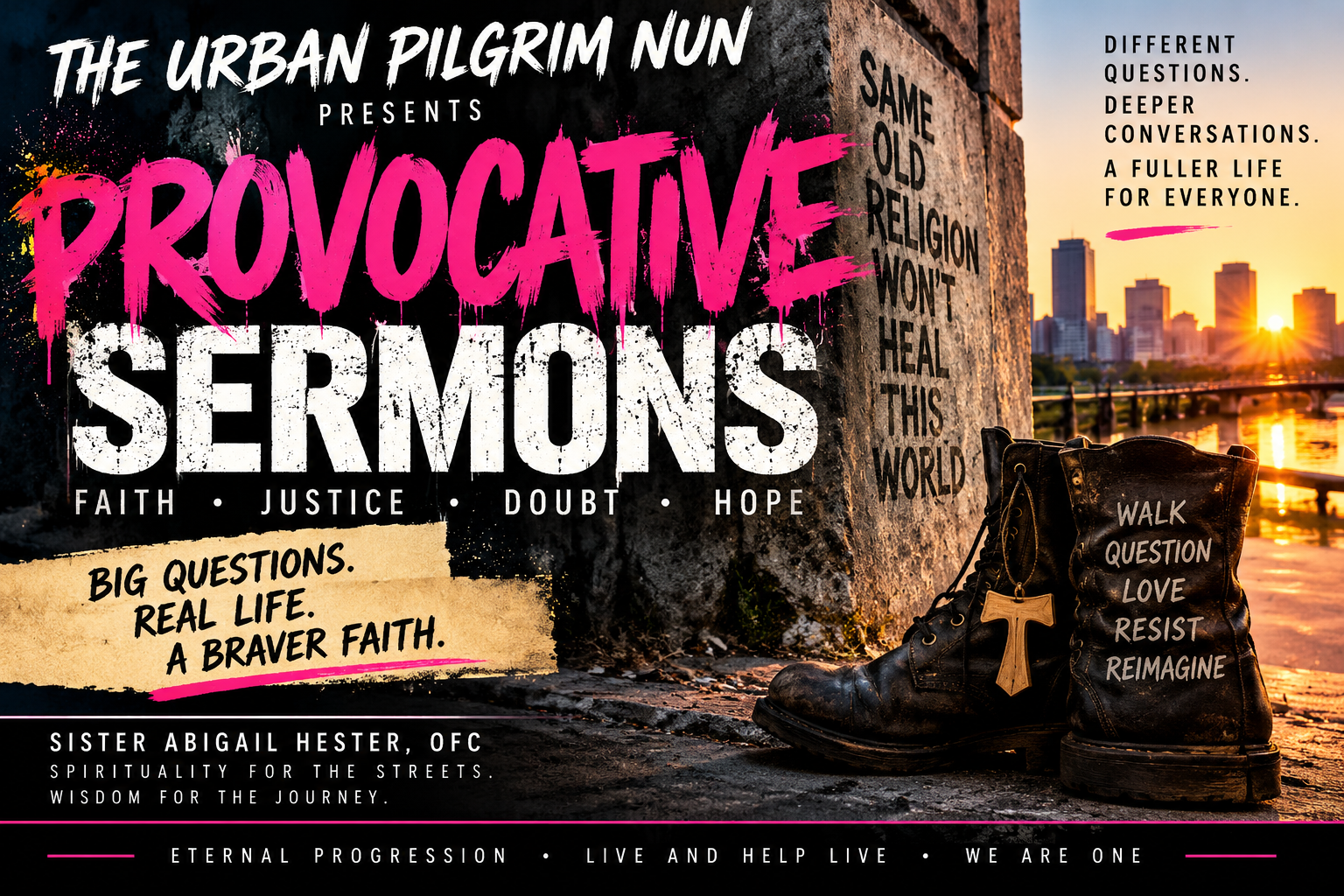
    Spirituality for the Streets • Wisdom for the Journey • A Fuller Life for Everyone

    Eternal Progression • A Fuller Life for Everyone • Live and Help Live


    Scripture for the Day

    “What does the Holy One ask of you but to practice justice, cherish mercy, and walk humbly with your God?”

    — Micah 6:8, adapted

    Sometimes religion becomes complicated because complicated religion keeps religious professionals employed.

    Micah ruins the business model.

    Practice justice.

    Love mercy.

    Walk humbly.

    That will preach.


    FROM THE PILGRIM’S DESK

    There is a temptation in spiritual life to keep looking for something spectacular.

    We want revelations.

    Signs.

    Mystical experiences.

    Perfect theological systems.

    Maybe even a booming voice from heaven saying, “Abigail, here is the answer to everything.”

    I am still waiting.

    Instead, most sacred moments seem embarrassingly ordinary.

    Someone needs food.

    Someone needs to be heard.

    Someone needs forgiveness.

    Someone needs protection.

    Someone needs somebody to sit beside them without trying to fix them.

    Perhaps holiness is not primarily about escaping ordinary life.

    Perhaps holiness happens when we finally become fully present within it.

    Today, don’t go looking for God in the clouds until you have looked for the sacred in the person standing beside you.


    TODAY’S SERMON

    “GOD DOESN’T NEED ANOTHER RELIGIOUS PERFORMANCE”

    Micah 6:6–8

    The prophet Micah asks one of the oldest religious questions:

    What does God actually want?

    The ancient world had plenty of answers.

    Sacrifices.

    Offerings.

    Temples.

    Priests.

    Rituals.

    Pilgrimages.

    Micah imagines somebody approaching God and escalating the religious offering.

    Should I bring burnt offerings?

    Thousands of rams?

    Rivers of oil?

    Then the rhetoric becomes horrifying:

    Should I offer my firstborn?

    Micah pushes religious logic until it becomes absurd.

    And then comes the answer.

    You already know what is good.

    Practice justice.

    Love mercy.

    Walk humbly.

    That passage becomes even more powerful when we remember that biblical prophets were not primarily fortune-tellers predicting events thousands of years into the future.

    They were social critics.

    They looked at their societies and said:

    Something is wrong here.

    Micah lived in the eighth century BCE, during a period of political instability, imperial expansion, economic inequality, and exploitation.

    His preaching repeatedly condemns powerful people who seize land and exploit vulnerable neighbors.

    Micah 2 describes people coveting fields and taking them.

    Micah 3 condemns rulers who should know justice but instead exploit the people.

    Then Micah 6 asks what faithful religion actually looks like.

    The answer is therefore not abstract morality.

    Justice means something concrete.

    It concerns land.

    Money.

    Power.

    Food.

    Housing.

    Courts.

    Workers.

    Neighbors.

    Bodies.

    Who gets protected.

    Who gets ignored.

    Who gets heard.

    Who gets pushed aside.

    And Micah delivers a devastating message to religious communities:

    You cannot compensate for injustice with worship.

    You cannot exploit someone Monday through Saturday and sing loudly enough on Sunday to make everything okay.

    You cannot mistreat queer people and then hide behind Bible verses.

    You cannot demean women and call it divine order.

    You cannot despise immigrants and then praise a refugee Christ.

    You cannot destroy the earth and call yourself grateful for creation.

    You cannot step over poor people on the way to the altar and imagine that God is impressed by your offering.

    Micah says:

    Do justice.

    That sounds remarkably Franciscan.

    Francis of Assisi did not merely develop ideas about poverty.

    He moved toward people his society had taught him to avoid.

    Clare of Assisi constructed a community around radical simplicity and solidarity.

    Their spirituality became embodied.

    That matters because Christianity sometimes becomes obsessed with believing the correct things.

    But Jesus repeatedly seems more interested in what people become.

    Feed the hungry.

    Welcome the stranger.

    Forgive.

    Heal.

    Share.

    Make peace.

    Love your neighbor.

    Love your enemy.

    These are not entrance-exam questions for heaven.

    They are invitations into another way of being human.

    And this is where my understanding of God becomes important.

    I do not imagine God primarily as a supernatural monarch sitting somewhere above the universe occasionally pulling cosmic strings.

    I increasingly encounter God in what theologian John D. Caputo describes as the insistence or call that happens within existence.

    God does not need to overpower us.

    Love calls.

    Justice calls.

    Mercy calls.

    The stranger calls.

    The wounded earth calls.

    The hungry child calls.

    And perhaps the name God names something happening within those calls.

    God insists.

    We respond.

    There is no divine police officer forcing us to become compassionate.

    Love remains vulnerable enough that we can refuse it.

    That may be why injustice survives.

    Not because God secretly desires suffering.

    Not because everything happens according to some hidden divine blueprint.

    But because love does not operate through domination.

    Love invites participation.

    And that changes prayer.

    Instead of praying:

    “God, fix the world,”

    we might hear the question coming back:

    Will you participate in its healing?

    You prayed for hungry people.

    There is a food pantry needing volunteers.

    You prayed for lonely people.

    There is a telephone beside you.

    You prayed for peace.

    There is someone you have dehumanized.

    You prayed for justice.

    There is an organization trying to protect vulnerable people.

    You prayed for creation.

    There is trash beside the river.

    The prayer may already contain its answer.

    Micah continues:

    Love mercy.

    The Hebrew word often translated mercy or kindness is hesed.

    It carries ideas of steadfast love, loyalty, covenantal kindness, and faithful care.

    Justice without mercy can become another machine of punishment.

    Mercy without justice can become sentimentality.

    Micah holds them together.

    Justice asks:

    What needs to change?

    Mercy asks:

    How do we refuse to stop loving people while changing it?

    Then comes the final instruction:

    Walk humbly.

    Not conquer.

    Not dominate.

    Not control.

    Walk.

    There is pilgrimage language hiding here.

    The spiritual life is movement.

    We are unfinished creatures.

    That means I can say:

    I believe deeply—and I might still be wrong.

    My theology is provisional.

    My interpretation is provisional.

    My understanding of God is provisional.

    My understanding of myself is still unfolding.

    Humility does not mean having no convictions.

    It means refusing to confuse our convictions with omniscience.

    That is particularly important in interfaith life.

    I am rooted in Christianity.

    I follow the way of Jesus.

    I am shaped by Francis and Clare.

    But I do not need Buddhism to be false for Christianity to contain truth.

    I do not need Hinduism to disappear.

    I do not need Judaism, Islam, Pagan traditions, Indigenous wisdom, humanism, or atheism to become Christianity before I can listen.

    The humble pilgrim can say:

    There may be wisdom here that I have not yet learned.

    And queer experience teaches something similar.

    Rigid systems love fixed boxes.

    Male/female.

    Sacred/secular.

    Believer/unbeliever.

    Orthodox/heretic.

    Insider/outsider.

    Pure/impure.

    But human beings keep overflowing the boxes.

    Life is wonderfully unruly.

    The Spirit, if we dare use that word, keeps showing up where religious gatekeepers insist the Spirit cannot possibly be.

    Micah therefore offers us a religion stripped down to its bones.

    Justice.

    Mercy.

    Humility.

    Maybe that is enough religion for today.

    You don’t have to save civilization before bedtime.

    Feed somebody.

    Listen to somebody.

    Forgive somebody.

    Challenge something unjust.

    Protect somebody vulnerable.

    Pick up some trash.

    Call someone lonely.

    And when you fail—and you will—begin again.

    That is pilgrimage.

    One ordinary step toward a fuller life.

    Then another.

    Then another.

    Perhaps somewhere within those footsteps we discover that God was never waiting at the end of the journey.

    God was happening in the walking.

    Amen.


    PRAYER FOR PEACE ACROSS ALL FAITHS

    Holy Mystery beyond every name and present within every sincere search for truth,

    May Christians become peacemakers.

    May Muslims know peace.

    May Jews know safety.

    May Hindus, Buddhists, Sikhs, Pagans, Indigenous peoples, humanists, atheists, seekers, and people whose spirituality has no convenient label flourish together.

    Where hatred builds walls, awaken hospitality.

    Where fear creates enemies, awaken curiosity.

    Where violence speaks loudly, teach us the stubborn courage of peace.

    And when we ask for peace, remind us that we must also become its practitioners.

    Amen.


    FRANCISCAN CLAREAN REFLECTION

    Enough

    Francis and Clare challenge a culture constantly whispering:

    More.

    More possessions.

    More prestige.

    More attention.

    More power.

    Today practice the sacred word:

    Enough.

    Look at something you already possess and say:

    “This is enough.”

    Then ask whether something you have could become abundance for somebody who has less.

    Simplicity is not deprivation.

    It is making room for life.


    CHRISTO-CORRELLIAN / INTERSPIRITUAL MOMENT

    The Sacred Flame

    If it is safe to do so, light a candle—or simply imagine a flame.

    Sit quietly for one minute.

    See the flame as a symbol of the Divine Mystery that traditions describe through countless names and images.

    Christ.

    Spirit.

    God.

    Goddess.

    Sacred Mystery.

    Life.

    Love.

    Do not force yourself to decide exactly what the flame represents.

    Simply breathe.

    Say quietly:

    “May the sacred fire within me become warmth rather than destruction, illumination rather than domination, and love made visible.”

    Then carry that intention into your day.


    KILUBANSA HEALING MOMENT

    Healing Through Presence

    Place your hands comfortably over your heart or rest them in your lap.

    Take three gentle breaths.

    With the first:

    May I receive healing.

    With the second:

    May those I love receive healing.

    With the third:

    May healing move through the world.

    Do not demand that healing mean cure.

    Healing can also mean comfort.

    Dignity.

    Connection.

    Rest.

    Courage.

    Acceptance.

    And accompaniment through what cannot presently be changed.


    THE HERBAL MINUTE

    Chamomile — The Little Flower of Rest

    Chamomile has a long history in traditional herbal practice, especially as a gentle tea associated with relaxation and digestive comfort.

    A simple chamomile infusion can be made by steeping the dried flowers in hot water, then straining them before drinking.

    But “natural” does not automatically mean “safe for everyone.”

    Chamomile may cause allergic reactions, particularly in people sensitive to plants in the daisy/ragweed family, and herbs can interact with medicines or medical conditions. Pregnancy, significant medical conditions, or regular medication use are good reasons to check with a qualified healthcare professional before using medicinal amounts of an herb.

    Herbalism works best when curiosity walks beside caution.

    Herbal wisdom for today: Sometimes the medicine is not doing more.

    Sometimes the medicine is permission to rest.


    PILGRIM PRACTICE FOR TODAY

    The Ten-Minute Justice Walk

    Take a ten-minute walk through your neighborhood, building, park, shelter, workplace, or wherever you happen to be.

    Don’t simply walk.

    Notice.

    Ask:

    Who seems forgotten here?

    What is beautiful?

    What is hurting?

    What needs cleaning?

    What could become more accessible?

    Where is life flourishing?

    What tiny thing could I do?

    Then do one thing you noticed.

    Pick up litter.

    Check on somebody.

    Share food.

    Move an obstruction.

    Send an encouraging message.

    Learn someone’s name.

    Ten minutes will not repair the world.

    But repairing the world has always required somebody to begin somewhere.


    CLOSING BLESSING

    May you walk gently today.

    May you disturb injustice without losing your capacity for tenderness.

    May you question certainty without surrendering wonder.

    May you discover holiness in ordinary places.

    May you recognize sacred worth in bodies and lives the world has pushed aside.

    May your hands become instruments of healing.

    May your table become longer.

    May your heart become wider.

    And when someone asks where God is,

    may your life quietly answer:

    Here—in every act that makes fuller life possible.

    Go in peace.

    Walk humbly.

    Love extravagantly.

    Resist what diminishes life.

    And help something flourish today.

    Eternal Progression • A Fuller Life for Everyone • Live and Help Live.

  • The Urban Pilgrim Newsletter

    The Urban Pilgrim Newsletter

    Daily Newsletter

    Monday, September 21, 2026

    Eternal Progression • A Fuller Life for Everyone • Live and Help Live

    “Let justice roll down like waters, and righteousness like an ever-flowing stream.” — Amos 5:24


    🌍 Interfaith Prayer for Peace

    Peace Must Have Hands

    Sacred Mystery, known by many names and encountered beyond every name,

    we have said the word peace so often that sometimes we forget how demanding it is.

    Peace is not merely silence after the shooting stops.

    Peace asks who has food.

    Who has shelter.

    Who receives healthcare.

    Whose labor is valued.

    Whose body is safe.

    Whose voice is heard.

    Who gets welcomed.

    Who gets forgotten.

    Today we join our hearts with Christians, Jews, Muslims, Hindus, Buddhists, Sikhs, Pagans, Baháʼís, followers of Indigenous traditions, humanists, seekers, doubters, agnostics, atheists, and everyone trying to build a world where dignity is not rationed.

    Where war destroys communities, strengthen peacemakers and protect civilians.

    Where hunger exists beside abundance, disturb our complacency.

    Where workers labor without enough to live, let solidarity grow stronger than exploitation.

    Where people sleep outside while buildings stand empty, awaken imagination and action.

    Where racism, sexism, ableism, transmisogyny, xenophobia, or religious hatred diminish human beings, make resistance persistent.

    Where loneliness hides behind ordinary doors, send neighbors.

    Where despair says nothing can change, send organizers, caregivers, teachers, healers, artists, troublemakers, and friends.

    And send us.

    Because perhaps the answer to prayer occasionally has our address.

    May our prayers grow hands.

    Hands that feed.

    Hands that heal.

    Hands that build.

    Hands that vote.

    Hands that organize.

    Hands that comfort.

    Hands that refuse violence.

    Hands that reach across boundaries.

    Peace within us.
    Peace between us.
    Justice among us.
    Solidarity through us.

    One Earth.
    One human family.
    Many paths.
    A shared future.

    May compassion become practice.

    May mercy become structure.

    May hospitality become home.

    May peace become something people can live inside.

    Amen. So may it be. Salaam. Shalom. Blessed be.

    Peace to all beings.


    🌿 Daily Kilubansa Healing Ritual

    The Healing Circle

    Place a bowl or cup of clean water before you.

    Beside it place three small natural objects—perhaps stones, leaves, seeds, or flowers.

    Let one represent yourself.

    One represent someone who supports you.

    And one represent someone you can support.

    Take three comfortable breaths.

    With the first say:

    I receive.

    With the second:

    I belong.

    With the third:

    I give.

    Invocation

    Sacred Source of Healing,

    Kilubansa, healing presence,

    remind us that healing rarely happens alone.

    Bodies need care.

    Minds need companionship.

    Communities need one another.

    Bless healthcare workers.

    Bless caregivers.

    Bless neighbors.

    Bless friends who answer the phone.

    Bless people who prepare meals.

    Bless those who help with medications, transportation, appointments, bathing, paperwork, childcare, accessibility, and the thousand ordinary tasks by which human beings keep one another alive.

    Bless also those who need help but find receiving it difficult.

    Teach us that interdependence is not failure.

    Healing Action

    Touch the first object.

    Say:

    This is me. My needs matter.

    Touch the second.

    Say:

    I am supported by others.

    Touch the third.

    Say:

    I can participate in someone else’s well-being.

    Now touch the water.

    Watch the ripples move outward.

    Say:

    Care travels.

    Ask yourself:

    What care do I need today?

    Then:

    Who could help me receive it?

    Then:

    What small care can I offer without exceeding my limits?

    Perhaps a message.

    A glass of water.

    A meal.

    A ride.

    A listening ear.

    Or simply:

    “I remembered you today.”

    Closing

    Place the three objects together.

    Say:

    Healing is personal, but it is never only personal.

    I will receive care without shame.
    I will offer care without controlling.
    I will respect my limits.
    I will seek appropriate help.

    We heal in relationship.

    I will live and help live.

    So may it be.

    Spiritual and community support can complement healthcare but should not replace professional evaluation or treatment when needed.


    🌱 Herbal Minute

    Mullein — The Fuzzy Leaf With One Very Important Rule

    Today’s herb is mullein, usually Verbascum thapsus.

    You have probably seen it without knowing its name: a tall plant with soft, fuzzy leaves and a flowering stalk that can look as though nature decided to manufacture its own fuzzy radio antenna.

    Mullein has a long history in European and North American folk herbalism. Its leaves and flowers have traditionally been prepared for respiratory comfort, especially for dry or irritated coughs.

    Traditional use, however, does not establish mullein as a treatment for pneumonia, asthma attacks, influenza, COVID-19, or other respiratory diseases.

    Simple Mullein-Leaf Tea

    Use dried mullein leaf intended for herbal tea from a reliable supplier.

    Add approximately 1–2 teaspoons to 8 ounces of hot water.

    Cover.

    Steep approximately 10–15 minutes.

    Then comes the important part:

    Strain it very carefully through a fine filter.

    Mullein leaves contain tiny hairs that can irritate the mouth and throat if they remain in the tea.

    A coffee filter, fine cloth, or similarly fine strainer can help remove them.

    Ironically, the herb traditionally used to soothe irritated throats can irritate yours if you forget the straining step.

    Plants enjoy keeping herbalists humble.

    Herbal Wisdom

    Mullein teaches today’s lesson:

    Preparation is part of safety.

    Knowing an herb’s name is not enough.

    You need to know:

    Which part?
    What preparation?
    What dose?
    What cautions?

    Tea.

    Tincture.

    Oil.

    Essential oil.

    Powder.

    Fresh plant.

    Dried plant.

    These are not automatically interchangeable.

    Traditional herbal knowledge includes how plants are prepared, not merely lists of conditions attached to plant names.

    Herbal Common Sense

    Research on mullein’s medicinal effectiveness and long-term safety in humans is limited.

    Allergic or skin reactions are possible.

    Information about medicinal use during pregnancy and breastfeeding is limited, so professional guidance is appropriate.

    People taking medications or living with significant medical conditions should discuss regular medicinal use with a pharmacist or qualified healthcare professional.

    And a special caution:

    Traditional mullein ear oil should never be placed into an ear when a ruptured eardrum is known or suspected, when tubes are present, or when there is significant pain, drainage, bleeding, sudden hearing loss, or another concerning ear problem without professional evaluation.

    Breathing difficulty, blue or gray lips, chest pain, confusion, coughing blood, or severe or worsening respiratory symptoms require medical attention rather than herbal tea.

    Today’s Herbal Minute

    Identify the plant.
    Know the plant part.
    Know the preparation.
    Strain mullein carefully.
    Know when tea isn’t enough.

    Good herbalism is not simply knowing which plant to reach for.

    It is knowing when not to reach for one.

    Herbal education complements rather than replaces appropriate medical care.


    ✝️ Order of Franciscan Clareans Reflection

    God Has No Hands But Ours

    Amos was furious.

    Not mildly disappointed.

    Not composing a strongly worded church newsletter.

    Furious.

    Israel possessed religious festivals.

    Songs.

    Offerings.

    Assemblies.

    Plenty of spirituality.

    And Amos imagines God responding:

    Stop singing.

    Why?

    Because worship had become disconnected from justice.

    Then comes the famous demand:

    “Let justice roll down like waters.”

    Historical-critical scholarship places Amos in the eighth century BCE, speaking amid prosperity for some and profound inequality for others.

    That matters.

    Amos is not primarily complaining that people have incorrect private beliefs.

    He is attacking a society where religious performance coexists comfortably with exploitation.

    That sounds uncomfortably contemporary.

    We can have enormous churches while neighbors cannot afford housing.

    We can sing about loving people while workers need multiple jobs to survive.

    We can post inspirational quotations while ignoring the systems determining who eats, who receives healthcare, who gets incarcerated, and whose neighborhoods receive investment.

    Amos says:

    God is not impressed by spirituality that leaves injustice untouched.

    That lands naturally within Franciscan spirituality.

    Francis of Assisi moved toward people his society pushed away.

    Clare of Assisi resisted economic arrangements that treated wealth and security as unquestionable goods.

    Their spirituality became material.

    Food.

    Community.

    Simplicity.

    Presence.

    Relationship.

    Creation.

    Dorothy Day later refused to separate prayer from hospitality and economic justice.

    Gustavo Gutiérrez insisted that theology must take seriously the concrete conditions of people experiencing poverty.

    James Cone demanded that Christian claims about God be accountable to liberation.

    Martin Luther King Jr. eventually described racism, economic exploitation, and militarism as interconnected evils.

    The Beloved Community requires more than nicer attitudes.

    It requires transformed relationships and institutions.

    And bell hooks reminds us that love is not merely feeling.

    Love involves care, responsibility, respect, commitment, and knowledge.

    Love does things.

    Now enter John D. Caputo.

    What if God does not arrive as supernatural force fixing injustice for us?

    What if God insists?

    Justice calls.

    The hungry person calls.

    The unhoused neighbor calls.

    The exploited worker calls.

    The refugee calls.

    The prisoner calls.

    The wounded Earth calls.

    God insists.

    We exist.

    The call needs bodies.

    That brings us to the saying often associated with Christian spirituality:

    God has no hands but ours.

    Whether or not we take that literally, radical theology hears something powerful in it.

    Waiting for divine intervention can become an excuse for human non-intervention.

    Jacques Derrida tells us justice is always to come.

    But “to come” does not mean sit on the sofa waiting for justice to find the address.

    The promise creates responsibility.

    And Paul Tillich reminds us that ultimate concern reveals itself through what actually organizes our lives.

    If we say justice matters but arrange society entirely around profit, convenience, status, and accumulation, our real theology has already spoken.

    Then Slavoj Žižek asks us to examine ideology—the stories that make contingent arrangements appear natural.

    Poverty is not weather.

    Homelessness is not gravity.

    Economic systems are human arrangements.

    Human arrangements can be changed.

    Our objective is Eternal Progression.

    Then institutions can progress too.

    Our goal is A Fuller Life for Everyone.

    Then economics, politics, religion, and community must be judged partly by whether they make fuller life possible.

    Our slogan is Live and Help Live.

    That is not sentimental.

    It is a social ethic.

    Feed people.

    House people.

    Protect people.

    Educate people.

    Care for people.

    Defend dignity.

    Share power.

    Repair harm.

    Protect the Earth.

    Justice is love with infrastructure.

    Perhaps God does not need another song nearly as much as the world needs another act of solidarity.

    Sing anyway.

    But when the song ends—

    roll up your sleeves.

    Live simply.
    Love boldly.
    Resist empire.
    Make justice material.


    ✨ Order of ChristoCorrellians Ritual

    The Four Directions of Solidarity

    Place a candle or electric candle before you.

    Beside it place a bowl of clean water and four small stones, leaves, seeds, or other natural objects.

    Take three slow breaths.

    Say:

    Sacred Mystery,
    God and Goddess,
    Christ and Holy Wisdom,
    Divine Feminine and Sacred Spirit,
    turn compassion into action.

    East — Air

    Face or visualize the East.

    Say:

    Sacred Air, open my mind to voices beyond my experience.

    Place one object down.

    Let me listen before speaking for others.

    South — Fire

    Turn toward the South.

    Look toward the candle.

    Say:

    Sacred Fire, give courage to resist injustice.

    Place the second object down.

    Let anger become disciplined love rather than hatred.

    West — Water

    Turn toward the West.

    Touch the water.

    Say:

    Sacred Water, deepen compassion.

    Place the third object down.

    Let another person’s suffering matter to me without requiring it to become my story.

    North — Earth

    Turn toward the North.

    Hold the final object.

    Say:

    Sacred Earth, make justice material.

    Place it down.

    Food.
    Housing.
    Healthcare.
    Safety.
    Education.
    Dignity.
    Community.

    Return to the Center

    Look toward the four objects.

    Say:

    Christ, call us toward the margins.

    Touch the water.

    Divine Mother, teach mutual care.

    Look toward the flame.

    Holy Spirit, disturb comfortable injustice.

    Place your hands over your heart.

    Say:

    Compassion must become practice.

    Then pray:

    May Christian wisdom teach love embodied in service and justice.

    May Correllian and Pagan wisdom teach reciprocity within the sacred web of life.

    May Jewish wisdom teach that justice belongs at the heart of communal responsibility.

    May Islamic wisdom teach generosity, mercy, and responsibility toward those in need.

    May Buddhist wisdom teach compassionate action and freedom from grasping.

    May Indigenous wisdom teach responsibility to land, community, ancestors, and future generations.

    May humanist wisdom teach solidarity grounded in shared human dignity.

    Raise your hands slightly.

    Air listens.
    Fire resists.
    Water cares.
    Earth provides.
    Christ calls.
    Wisdom acts.
    Sacred Mystery insists.

    May love become something people can live inside.

    I will live and help live.

    Amen and blessed be.


    🚶 The Urban Pilgrim’s Practice

    Make One Thing Material

    Choose one conviction you regularly express.

    I care about poverty.

    Then give something useful.

    I care about loneliness.

    Call somebody.

    I care about workers.

    Learn about a labor struggle or support worker-led organizing.

    I care about homelessness.

    Support a shelter, housing organization, street ministry, or mutual-aid effort.

    I care about the environment.

    Reduce one unnecessary consumption habit or participate in local conservation.

    I care about peace.

    Practice de-escalation somewhere conflict is growing.

    I care about my neighbor.

    Learn their name.

    You do not need to fix civilization before dinner.

    But today let one belief acquire:

    hands.


    📖 Pilgrim’s Blessing

    May the Sacred Mystery meet you where belief becomes action.

    May Christ interrupt every spirituality that walks past suffering.

    May the Divine Feminine nurture communities of mutual care.

    May the Spirit transform compassion into courage.

    May Brother Sun shine without charging admission.

    May Sister Water remind us that life depends upon common gifts.

    May Brother Wind cross boundaries human beings defend too fiercely.

    May Mother Earth expose the fantasy that anyone flourishes alone.

    May Francis move you toward the margins.

    May Clare teach you that simplicity can resist domination.

    May Dorothy Day make hospitality wonderfully inconvenient.

    May Howard Thurman protect the soul of resistance.

    May James Cone keep liberation at the center.

    May Gustavo Gutiérrez make theology answerable to the poor.

    May bell hooks remind you that love is a practice.

    May Martin Luther King Jr. keep the Beloved Community before us not as a dream we admire but as work we undertake.

    May Julia Serano sharpen our resistance to systems that punish femininity, gender difference, and transgender lives.

    May Hegel help us recognize that institutions are historical and therefore changeable.

    May Tillich expose our false ultimate concerns.

    May Derrida keep justice coming.

    May Žižek disturb the ideology whispering:

    “Nothing can be different.”

    May Caputo answer:

    Justice insists.

    And may we answer:

    Then let us give it existence.

    Pray.

    Then act.

    Contemplate.

    Then participate.

    Dream.

    Then organize.

    Love.

    Then build something love can live inside.

    Eternal Progression.
    A Fuller Life for Everyone.
    Live and Help Live.

    Remember:

    We Are One.

    Listen.

    Care.

    Act.

    Build.

    And tomorrow—

    We Walk Again.

    Amen. So may it be.

  • The Church Without a Throne

    The Church Without a Throne

    Can Christianity Survive Without Political Power?

    Primary Scripture: Philippians 2:5–11
    Supporting Scriptures: 1 Samuel 8:4–20; Mark 10:35–45; John 18:33–38; Acts 2:42–47; Revelation 13:1–10

    “Among you it will not be so.” — Mark 10:43

    Introduction: Christianity Has a Throne Problem

    Christianity began with a man executed by an empire.

    And somehow Christians eventually became fascinated with controlling empires.

    That should bother us.

    Jesus never occupied Caesar’s throne.

    He never commanded an army.

    He never established a police force.

    He never forced anyone to follow him.

    Rome killed him.

    And the earliest Christians proclaimed that this crucified Galilean revealed something profound about God.

    Then history performed one of its strangest reversals.

    The cross that Rome used to execute enemies eventually appeared on imperial banners.

    Christianity moved from the margins toward the palace.

    And ever since, Christians have struggled with a dangerous temptation:

    What if we could use political power to make everybody behave Christianly?

    Today I want to ask whether Christianity can finally surrender that temptation.

    Because perhaps Christianity does not need a throne.

    Perhaps Christianity becomes most dangerous to empire precisely when it refuses to become one.

    I. Israel Asked for a King

    The problem is older than Christianity.

    In 1 Samuel 8, Israel demands:

    “Give us a king to govern us.”

    Samuel warns them.

    The king will take.

    Your sons.

    Your daughters.

    Your fields.

    Your vineyards.

    Your animals.

    Your wealth.

    Samuel describes concentrated political power with remarkable realism.

    Kings promise security.

    But kings also accumulate power.

    Israel asks anyway.

    Why?

    They want to be:

    “like other nations.”

    That may be one of Scripture’s earliest critiques of political conformity.

    Sometimes people surrender freedom because power promises certainty.

    II. Jesus Refuses Caesar’s Model

    In Mark 10, James and John ask for positions of honor.

    Jesus responds by describing political domination:

    “Those whom they recognize as their rulers lord it over them.”

    Then comes the revolution:

    “But it is not so among you.”

    Jesus does not say:

    Become better rulers who dominate more compassionately.

    He challenges the structure itself.

    Greatness becomes service.

    Leadership becomes responsibility.

    Power moves downward.

    This is profoundly anti-imperial.

    III. Philippians Gives Us a God Who Descends

    Philippians 2 contains one of Christianity’s earliest hymns.

    Christ:

    “emptied himself, taking the form of a slave.”

    The theological word later associated with this is kenosis—self-emptying.

    Think about what this means.

    Traditional religion often imagines divinity as ultimate power.

    The biggest ruler imaginable.

    Cosmic Caesar.

    But Philippians points somewhere else.

    Downward.

    Toward vulnerability.

    Toward solidarity.

    Toward the enslaved.

    Toward the cross.

    Perhaps God is not Caesar multiplied by infinity.

    Perhaps the divine is disclosed precisely in the refusal of domination.

    IV. The Cross Is Rome’s Verdict

    Historical-critical scholarship helps us here.

    Crucifixion was Roman execution.

    Jesus did not simply “die for our sins” in an abstract theological drama detached from history.

    Rome crucified him.

    The cross therefore carries political memory.

    An empire executed someone whose proclamation of God’s Kingdom challenged existing arrangements of power, status and belonging.

    That does not require turning Jesus into a modern partisan.

    Jesus was a first-century Jewish teacher.

    But it does mean Christianity should become nervous whenever Christians become too comfortable beside Caesar.

    V. Constantine Changes Everything

    By the fourth century, Christianity’s relationship with imperial power changed dramatically.

    After Constantine, Christianity moved from persecuted religion toward privileged religion.

    Eventually emperors became deeply involved in church affairs.

    Christianity acquired buildings.

    Money.

    Influence.

    Legal privilege.

    And swords.

    The persecuted church gradually learned how to persecute.

    That is one of Christianity’s great historical tragedies.

    When the church gains Caesar’s sword, it eventually discovers someone it wants to use it against.

    Heretics.

    Jews.

    Pagans.

    Muslims.

    Queer people.

    Dissenters.

    Colonized peoples.

    History should make us humble.

    VI. Francis Walked Away From Power

    Francis of Assisi offers another possibility.

    Francis did not seek the throne.

    He sought the road.

    He embraced voluntary poverty.

    He lived among people society marginalized.

    He approached the Sultan during the Fifth Crusade not carrying a weapon but seeking encounter.

    Francis understood something Christianity repeatedly forgets:

    You can influence the world without controlling it.

    Maybe Christianity’s power is most authentically Christian when it stops trying to become powerful.

    VII. Clare Builds an Alternative Community

    Clare of Assisi also resisted conventional power.

    She did not conquer Assisi.

    She created another way of living within it.

    Community.

    Simplicity.

    Prayer.

    Shared life.

    Mutual care.

    Resistance does not always seize the palace.

    Sometimes resistance builds something the palace cannot imagine.

    A different economy.

    A different community.

    A different relationship with power.

    That may be closer to the early church.

    VIII. Acts Describes Shared Life

    Acts tells us:

    “All who believed were together and had all things in common.”

    We should not pretend Acts gives us a detailed modern economic program.

    But neither should we domesticate the passage.

    The early Christian imagination included economic sharing.

    People sold possessions.

    Resources were distributed according to need.

    The community attempted to ensure that people were cared for.

    That is much closer to mutual aid than imperial religion.

    Christianity began around tables before it acquired thrones.

    Perhaps its future does too.

    IX. Caputo: The Weakness of God

    John D. Caputo gives us language for this.

    God does not dominate.

    God insists.

    Justice calls.

    Mercy calls.

    Hospitality calls.

    Love calls.

    But the call cannot force itself into existence.

    God does not arrive with tanks.

    God arrives as possibility.

    That makes divine power strangely weak.

    Love cannot force someone to love.

    Hospitality cannot compel welcome.

    Justice cannot magically enact itself.

    Someone must respond.

    God insists.

    We exist.

    And perhaps Christianity loses God whenever it tries to make divine insistence into political coercion.

    X. Derrida: Democracy Must Remain Open

    Jacques Derrida spoke of democracy as something always to come.

    No political arrangement perfectly embodies justice.

    That is important for theology.

    The moment Christians claim:

    Our political system represents God

    criticism becomes blasphemy.

    But justice always exceeds institutions.

    Democracy remains unfinished.

    Christianity remains unfinished.

    The future remains open.

    That openness protects us from turning political arrangements into idols.

    XI. Hegel: Freedom Develops Through History

    Georg Wilhelm Friedrich Hegel understood history as a dynamic process in which contradictions can expose the inadequacy of existing forms and open new possibilities of freedom.

    We need not accept every part of Hegel’s philosophy to appreciate that insight.

    Christian history contains enormous contradiction.

    A religion centered on a crucified victim became associated with empires.

    A movement proclaiming human dignity sometimes defended slavery.

    A tradition teaching love sometimes persecuted dissent.

    Those contradictions should not simply embarrass us.

    They should teach us.

    History can become confession.

    And confession can become transformation.

    XII. Žižek: What Happens When the Big Other Disappears?

    Slavoj Žižek has provocatively interpreted Christianity as containing the collapse of the divine guarantee.

    At the cross Jesus cries:

    “My God, my God, why have you forsaken me?”

    The cosmic rescuer appears absent.

    Then what happens?

    Community.

    Spirit.

    Responsibility.

    Perhaps mature Christianity stops waiting for an authoritarian Father to fix history.

    No divine dictator arrives.

    We must become responsible for one another.

    That can produce a radically democratic Christianity.

    XIII. Christian Nationalism Gets Christianity Backwards

    Christian nationalism in its various forms attempts to fuse religious identity with national political identity.

    Its advocates differ considerably, and the term itself is debated.

    But whenever Christianity becomes a test of national belonging, Christians should become suspicious.

    Jesus never said:

    Blessed are the nations that give Christianity special legal status.

    He said:

    “Blessed are the peacemakers.”

    The church does not need government to force people to become Christian.

    If Christianity cannot survive without political privilege, perhaps Christianity has forgotten how to be Christianity.

    XIV. Religious Freedom Must Include Other Religions

    Real religious freedom cannot mean:

    Christians are free to control everyone else.

    It must protect Christians.

    Jews.

    Muslims.

    Hindus.

    Buddhists.

    Pagans.

    Atheists.

    Agnostics.

    Indigenous religions.

    And people who change their religion.

    Religious pluralism is not the enemy of Christianity.

    It can be the environment in which Christianity learns humility.

    I do not need government to force my neighbor to agree with me.

    I need government to protect our ability to disagree without destroying one another.

    XV. Christian Atheism After Christendom

    Christian atheism offers an interesting possibility here.

    If God is not a supernatural monarch, then Christianity loses its cosmic justification for authoritarianism.

    There is no divine dictator authorizing earthly dictators.

    Instead Christianity becomes fidelity to the event announced through Jesus:

    Love.

    Justice.

    Mercy.

    Solidarity.

    Hospitality.

    Liberation.

    The Kingdom becomes less like territory God controls and more like something waiting to happen between us.

    XVI. From the News: Religion, Power, and the Public Square

    The tension between faith and political power is not merely historical.

    Recent events in the United States have shown religious communities wrestling with questions of government authority, protest, conscience, immigration enforcement, religious liberty, Indigenous sovereignty, and pluralism.

    These conflicts do not yield simple conclusions.

    They do raise an important theological question:

    How should religious conviction behave when it encounters people who do not share it?

    My answer is not domination.

    It is encounter.

    Not coercion.

    Dialogue.

    Not supremacy.

    Pluralism.

    A Christianity worthy of Jesus should be able to enter the public square without demanding ownership of it.

    XVII. Democratic Socialism and the Democratization of Power

    This is also where democratic-socialist political thought can enter the conversation.

    At its democratic best, socialism asks a question Christianity should recognize:

    Who has power, and who gets a voice in decisions affecting their lives?

    That question applies to government.

    But also corporations.

    Workplaces.

    Housing.

    Healthcare.

    Technology.

    If political democracy matters, economic democracy deserves discussion too.

    Workers spend enormous portions of their lives inside workplaces.

    Should they have meaningful influence there?

    Different political traditions propose different solutions to these problems.

    A democratic-socialist perspective emphasizes collective bargaining, worker participation, strong public services and reducing concentrations of economic power.

    Market-oriented perspectives emphasize competition, entrepreneurship, private investment and individual choice.

    Those disagreements belong in democratic debate.

    But Christian ethics contributes a question deeper than any economic ideology:

    Does this arrangement allow people to flourish?

    The worker is not merely labor cost.

    The patient is not merely revenue.

    The tenant is not merely rent.

    The citizen is not merely a vote.

    Human beings are ends, not instruments.

    XVIII. Martin Luther King Jr.: The Beloved Community

    Martin Luther King Jr.’s later ministry increasingly connected racial injustice, poverty and militarism.

    King did not imagine the Beloved Community as theocracy.

    It was a moral vision of society transformed by justice, nonviolence and human dignity.

    That distinction matters.

    Christianity can contribute moral imagination to democracy without demanding religious control over democracy.

    We can advocate.

    Organize.

    March.

    Serve.

    Protest.

    Vote.

    Build institutions.

    Feed people.

    Challenge injustice.

    But our neighbors remain free.

    Love persuades.

    Empire compels.

    XIX. The Church Should Be a Laboratory of Another World

    Perhaps the church’s political task is not to capture the state.

    Perhaps it is to demonstrate another way of being human.

    Imagine churches where nobody goes hungry.

    Where queer people are safe.

    Where immigrants are welcomed.

    Where racial hierarchy is confronted.

    Where women possess equal dignity.

    Where disabled people belong.

    Where doubters are allowed to doubt.

    Where Muslims, Jews, Pagans, Buddhists, Hindus and atheists can enter without becoming projects.

    Where resources are shared.

    Where creation is protected.

    Where power is accountable.

    That community becomes political without becoming theocratic.

    It becomes a sign.

    A possibility.

    An event.

    XX. The Kingdom Without Domination

    Jesus said:

    “My kingdom is not from this world.”

    That does not necessarily mean:

    “My Kingdom is somewhere in heaven.”

    It means Jesus’ authority does not originate from the mechanisms by which worldly empires maintain control.

    Jesus tells Pilate:

    “If my kingdom were from this world, my followers would be fighting.”

    But they are not.

    That difference matters.

    The Kingdom does not arrive through domination.

    It arrives like mustard seed.

    Yeast.

    Table.

    Healing.

    Welcome.

    Forgiveness.

    Justice.

    Community.

    The Kingdom is weak enough to be rejected.

    And strong enough to keep returning.

    Conclusion: Get Christianity Off the Throne

    Maybe Christianity does not need another Christian empire.

    We tried that.

    History has receipts.

    Maybe Christianity needs something much stranger.

    A towel.

    A table.

    A loaf of bread.

    A community.

    A protest sign.

    A garden.

    A shelter.

    A union hall.

    A monastery.

    A street ministry.

    A place where strangers become neighbors.

    Jesus kneels and washes feet.

    Rome builds thrones.

    Which one looks like God?

    That may be the entire sermon.

    Christianity does not need control to have a voice.

    It does not need supremacy to have conviction.

    It does not need coercion to have courage.

    It does not need Caesar’s sword to practice justice.

    God does not need a throne.

    God insists.

    Justice insists.

    Mercy insists.

    Hospitality insists.

    Peace insists.

    The poor insist.

    The stranger insists.

    The Earth insists.

    And whenever someone answers—

    something happens.

    A worker discovers dignity.

    A hungry person receives food.

    A stranger becomes neighbor.

    An enemy becomes human again.

    A marginalized person discovers belonging.

    A community discovers solidarity.

    Perhaps that is where Christianity should seek power.

    Not power over.

    Power with.

    Power among.

    Power for.

    The power to create fuller life together.

    Francis left the marketplace.

    Clare resisted imposed authority.

    King dreamed of Beloved Community.

    Derrida kept justice open to what is still to come.

    Hegel reminds us that contradiction can push history toward new forms of freedom.

    Caputo reminds us that God does not dominate.

    God calls.

    And Jesus still says:

    “Among you it will not be so.”

    So church—

    come down from the throne.

    There are feet waiting to be washed.

    There are tables waiting to be enlarged.

    There are workers waiting to be heard.

    There are strangers waiting to be welcomed.

    There is a world waiting for another possibility.

    Perhaps Christianity’s future begins when it finally stops trying to rule the world—

    and starts serving it.

    Amen.

  • The Urban Pilgrim Newsletter

    The Urban Pilgrim Newsletter

    Daily Newsletter

    Wednesday, September 2, 2026

    Eternal Progression • A Fuller Life for Everyone • Live and Help Live

    “The kingdom of God is among you.” — Luke 17:21


    🌍 Interfaith Prayer for Peace

    Peace Has Neighbors

    Sacred Mystery, known by many names and encountered beyond every name,

    We sometimes imagine peace as something negotiated far away—in government buildings, international conferences, and rooms we will never enter.

    Those places matter.

    But peace also has an address.

    It lives in neighborhoods.

    It happens when strangers become familiar faces, when people share food across differences, when someone notices who has been forgotten, and when communities decide that nobody is disposable.

    Today we join our hearts with Christians, Jews, Muslims, Hindus, Buddhists, Sikhs, Pagans, Baháʼís, followers of Indigenous traditions, humanists, seekers, doubters, agnostics, atheists, and everyone seeking a fuller life for every being.

    May people living amid war find safety.

    May civilians be protected.

    May refugees and displaced people find welcome.

    May prisoners and hostages be treated humanely.

    May peacemakers possess courage.

    May leaders value human lives more than political victories.

    Where racism, religious hatred, misogyny, queerphobia, ableism, xenophobia, or other prejudices divide communities, raise up neighbors willing to stand beside those targeted.

    Where poverty isolates people, build communities of solidarity.

    Where loneliness hides behind apartment doors and suburban windows, help somebody knock.

    Where political disagreements fracture families and friendships, teach us that disagreement need not become dehumanization.

    Where religions distrust one another, let people meet before they debate.

    Where humanity has forgotten its kinship with Earth, teach us again to become good neighbors to forests, rivers, animals, soil, and generations yet unborn.

    Sacred Mystery, make peace local.

    Let it appear in grocery-store lines.

    Apartment hallways.

    Bus stops.

    Schools.

    Shelters.

    Hospitals.

    Churches.

    Mosques.

    Synagogues.

    Temples.

    Parks.

    Kitchen tables.

    And sidewalks.

    May peace find an address wherever we stand.

    Peace within us.
    Peace between us.
    Justice among us.
    Neighborliness through us.

    One Earth.
    One human family.
    Many paths.
    A shared future.

    May we stop waiting for somebody somewhere to create the world we could begin practicing here.

    Amen. So may it be. Salaam. Shalom. Blessed be.

    Peace to all beings.


    🌿 Daily Kilubansa Healing Ritual

    The Healing Circle

    Place a bowl of clean water before you.

    Beside it, place several small natural objects if available—stones, seeds, leaves, flowers, or familiar herbs.

    Arrange them loosely around the bowl.

    Take three slow breaths.

    With the first breath say:

    I belong to life.

    With the second:

    I receive care.

    With the third:

    I can participate in care.

    Invocation

    Sacred Source of Healing,

    Kilubansa, healing presence,

    meet us within the circle of relationship.

    We sometimes imagine healing as something we accomplish alone.

    But bodies live through relationship.

    We depend upon food grown by others.

    Knowledge discovered by others.

    Medicines developed by others.

    Water carried through systems built by others.

    Care offered by families, friends, professionals, and strangers.

    Even the air entering our lungs arrives through a planetary community of life.

    Remind us:

    Needing others is not a failure of independence.

    It is part of being alive.

    Bless those who need help today.

    Bless those who find asking difficult.

    Bless those living with illness, disability, pain, grief, exhaustion, uncertainty, or changing abilities.

    Bless those learning new ways of accomplishing familiar tasks.

    Bless those receiving medical treatment.

    Bless those waiting for answers.

    Bless caregivers.

    Bless physicians, nurses, pharmacists, therapists, counselors, healers, chaplains, aides, families, friends, and neighbors.

    And bless those whose essential care work goes unnoticed.

    Healing Action

    Touch the water.

    Say:

    Life supports life.

    Touch one of the objects surrounding the bowl.

    Say:

    I receive care.

    Touch another.

    Say:

    I offer care where I can.

    Touch your forehead.

    May I know when to ask for help.

    Touch your heart.

    May I receive help without shame.

    Touch your hands.

    May I offer help without controlling another person.

    Pause.

    Ask:

    Who belongs in my circle of care?

    Remember someone who supports you.

    Then ask:

    Who might need to know that they belong in mine?

    Perhaps send a message today.

    Nothing profound is required.

    “Thinking about you.”

    “How are you?”

    “Need anything?”

    Three tiny sentences have rescued more lonely afternoons than many theological treatises.

    Closing

    Say:

    I am not isolated from life.

    I receive appropriate care.
    I offer appropriate care.
    I respect boundaries.
    I honor dignity.
    I welcome community.

    May healing travel through the relationships that sustain us.

    I will live and help live.

    So may it be.

    This contemplative spiritual practice complements rather than replaces appropriate professional healthcare.


    🌱 Herbal Minute

    Thyme — The Tiny Leaf with a Big Aroma

    Today’s herb is thyme (Thymus vulgaris), another aromatic member of the mint family, Lamiaceae.

    Thyme has been valued for centuries as both food and traditional herbal medicine. Traditional European herbalism has used thyme preparations particularly for respiratory and digestive complaints, although traditional use does not establish that thyme can treat a particular illness.

    And sometimes the wisest herbal use of thyme is wonderfully ordinary:

    Put it in dinner.

    Simple Thyme Tea

    For a mild infusion, place approximately 1 teaspoon of dried thyme into a cup.

    Pour about 8 ounces of hot water over it.

    Cover and steep for approximately 5–10 minutes.

    Strain before drinking.

    The cup can be surprisingly aromatic because thyme contains volatile compounds responsible for its characteristic fragrance.

    Herbal Wisdom

    Thyme teaches today’s herbal principle:

    Your kitchen is already an herbal classroom.

    Herbalism does not begin with exotic powders purchased online.

    It begins by learning plants.

    Thyme.

    Ginger.

    Garlic.

    Mint.

    Rosemary.

    Basil.

    Cinnamon.

    Fennel.

    Learning culinary herbs teaches aroma, taste, plant families, preparation, and the differences between food-level use and concentrated medicinal preparations.

    A spice cabinet can teach quite a bit of botany if you stop treating it like a dusty parking garage for oregano.

    Herbal Common Sense

    Ordinary culinary use of thyme is different from using concentrated extracts or thyme essential oil.

    Essential oils are highly concentrated and should not be swallowed casually.

    Concentrated medicinal preparations can cause adverse effects or interact with medicines and may not be appropriate during pregnancy, breastfeeding, or with certain health conditions.

    Anyone considering regular medicinal use—particularly alongside prescription medications—should check with a pharmacist or other qualified healthcare professional.

    And remember:

    More concentrated does not automatically mean more therapeutic.

    Sometimes it simply means more concentrated.

    Today’s Herbal Minute

    Start with the plant.
    Learn the preparation.
    Distinguish food from medicine.
    Respect concentration.
    Stay curious.

    Herbal education complements rather than replaces appropriate medical care.


    ✝️ Order of Franciscan Clareans Reflection

    Nobody Follows Francis Alone

    The popular image of Francis of Assisi is wonderfully romantic.

    One barefoot saint.

    A bird on his shoulder.

    Maybe a wolf nearby behaving suspiciously well.

    But Franciscan spirituality was never really a solo project.

    Francis gathered companions.

    Clare built community.

    People cooked.

    Prayed.

    Argued.

    Served.

    Disagreed.

    Forgave.

    Organized.

    Cared for one another.

    And occasionally drove one another absolutely bonkers, because this is what human beings eventually do whenever they form communities.

    The Franciscan path is relational.

    Our culture loves the myth of the self-made person.

    But nobody is self-made.

    Someone fed us.

    Someone taught us language.

    Someone grew our food.

    Someone maintained the roads.

    Someone discovered medicines.

    Someone wrote the books.

    Someone built the buildings.

    Someone loved us.

    Someone challenged us.

    Someone helped us survive something.

    Even the hermit carries a civilization into the wilderness.

    Francis understood that Gospel life required community.

    Jesus likewise gathered a table.

    The earliest Christian movement called people into communities where resources were shared and social boundaries were challenged.

    That does not mean communities are automatically healthy.

    Some become controlling.

    Some become abusive.

    Some demand conformity.

    Franciscan Clarean community must therefore protect individuality, consent, questioning, boundaries, and human dignity.

    Healthy community does not say:

    Become like us.

    It says:

    Become more fully yourself among us—and help us become more fully human too.

    Our objective is Eternal Progression.

    We grow through relationships.

    Our goal is A Fuller Life for Everyone.

    Fullness cannot belong only to the powerful, healthy, wealthy, educated, conventional, or socially acceptable.

    Our slogan is Live and Help Live.

    That is community in four words.

    Live.

    And help another life flourish.

    Today notice the people holding pieces of your life together.

    Thank one.

    And notice someone whose life you might help hold together.

    Then show up.

    Live simply.
    Love boldly.
    Build community.
    Leave nobody disposable.


    ✨ Order of ChristoCorrellians Ritual

    The Sacred Web

    Place a candle or electric candle at the center of your space.

    Around it place several natural objects—stones, leaves, seeds, herbs, or flowers.

    Place a bowl of water nearby.

    Take three slow breaths.

    Say:

    Sacred Mystery,
    God and Goddess,
    Christ and Holy Wisdom,
    Divine Feminine and Sacred Spirit,
    awaken me to the web of relationships sustaining life.

    East — Air

    Face or visualize the East.

    Say:

    Sacred Air, the breath within me has traveled through forests, oceans, creatures, and generations.

    Teach me interdependence.

    South — Fire

    Turn toward the South.

    Say:

    Sacred Fire, one flame can kindle another without becoming smaller.

    Teach me generosity.

    West — Water

    Turn toward the West.

    Touch the water.

    Say:

    Sacred Water, you travel through cloud, river, soil, plant, animal, and body.

    Teach me that life circulates.

    North — Earth

    Turn toward the North.

    Touch one of the natural objects.

    Say:

    Sacred Earth, every meal reminds me that my life depends upon other life.

    Teach me gratitude and responsibility.

    Return to the Center

    Look toward the candle.

    Say:

    Christ, builder of tables, teach me radical hospitality.

    Touch the water.

    Divine Mother, bearer of life’s relationships, deepen my kinship with creation.

    Hold one of the natural objects.

    Holy Spirit, weave compassion through the places where division has torn community apart.

    Place your hands over your heart.

    Say:

    I belong within a web of life.

    Pause.

    Remember the people who helped make today possible.

    The person who grew your food.

    The person who transported it.

    The person who keeps water flowing.

    The person who maintains electricity.

    Teachers.

    Healthcare workers.

    Friends.

    Family.

    Strangers.

    Ancestors.

    And the countless living beings whose existence makes yours possible.

    Now pray:

    May Christian wisdom teach me communion.

    May Correllian and Pagan wisdom deepen my kinship with Earth.

    May Buddhist wisdom teach interdependence.

    May Indigenous traditions remind humanity that land is relationship rather than merely property.

    May humanist wisdom strengthen solidarity across differences.

    May science reveal the astonishing networks through which ecosystems sustain life.

    May experience teach me that independence and interdependence need not be enemies.

    Raise your hands slightly.

    Air connects.
    Fire shares.
    Water circulates.
    Earth sustains.
    Christ gathers.
    Spirit weaves.
    Sacred Mystery calls through relationship.

    Nothing lives entirely alone.

    We belong to one another.

    I will live and help live.

    Amen and blessed be.


    🚶 The Urban Pilgrim’s Practice

    Thank One Invisible Helper

    Choose one person whose work quietly makes your life easier.

    A cashier.

    Bus driver.

    Caregiver.

    Cleaner.

    Delivery worker.

    Nurse.

    Receptionist.

    Food-service worker.

    Maintenance worker.

    Neighbor.

    Teacher.

    Someone whose contribution normally disappears into the background.

    Look at them.

    Learn their name if appropriate.

    Say:

    Thank you.

    Not because gratitude replaces fair wages, justice, accessibility, or decent working conditions.

    It doesn’t.

    But people deserve both justice and recognition.

    Notice somebody today.


    📖 Pilgrim’s Blessing

    May the Sacred Mystery reveal the invisible threads holding your life together.

    May Christ keep expanding your table.

    May the Divine Feminine teach you the wisdom of relationship.

    May the Spirit weave friendship across boundaries.

    May Brother Sun remind you that everyone stands beneath the same light.

    May Sister Water remind you that life circulates between us.

    May Brother Wind carry kindness from stranger to stranger.

    May Mother Earth remind you that no creature exists outside relationship.

    May you know when to stand independently.

    May you know when to ask for help.

    May you give without controlling.

    May you receive without shame.

    May your community make room for difference.

    May your spirituality enlarge rather than shrink your circle of belonging.

    May nobody become invisible simply because their work happens quietly.

    And wherever you walk today, may peace discover another address.

    Eternal Progression.
    A Fuller Life for Everyone.
    Live and Help Live.

    Remember:

    We Are One.

    Notice.

    Connect.

    Give thanks.

    Show up.

    And tomorrow—

    We Walk Again.

    Amen. So may it be.

  • The Urban Pilgrim Newsletter

    Daily Newsletter

    Saturday, August 29, 2026

    Eternal Progression • A Fuller Life for Everyone • Live and Help Live

    “Consider the lilies, how they grow.” — Luke 12:27


    🌍 Interfaith Prayer for Peace

    Plant What You Hope to See

    Sacred Mystery, known by many names and encountered beyond every name,

    Today we pray for peace, knowing that prayer becomes most alive when it takes root in the way we live.

    We join our hearts with Christians, Jews, Muslims, Hindus, Buddhists, Sikhs, Pagans, Baháʼís, followers of Indigenous traditions, humanists, seekers, doubters, agnostics, atheists, and all who seek a fuller life for every being.

    Where war destroys communities, protect civilians and strengthen peacemakers, humanitarian workers, diplomats, healers, and all who labor for a just peace.

    Where children inherit hatred, may they encounter adults courageous enough to teach another way.

    Where refugees and displaced people search for safety, may strangers become neighbors.

    Where hunger exists beside abundance, may generosity grow into justice.

    Where racism, religious hatred, misogyny, queerphobia, ableism, and other forms of prejudice diminish human dignity, give us courage to resist.

    Where political disagreement becomes dehumanization, teach us to defend our convictions without surrendering our humanity.

    Where religious communities distrust one another, plant friendships across the boundaries.

    Where the Earth is exploited, awaken reverence for soil, water, forests, animals, climate, and generations yet to come.

    Sacred Mystery, teach us the patience of gardeners.

    We cannot force a seed to become a tree overnight.

    Neither can we build peace in a single day.

    But we can plant.

    Today, let us plant kindness where cruelty has grown.

    Plant curiosity where prejudice has grown.

    Plant justice where exploitation has grown.

    Plant generosity where greed has grown.

    Plant courage where indifference has grown.

    Plant friendship where suspicion has grown.

    Plant hope where despair has grown.

    And when we do not live long enough to sit beneath the trees we plant, may we plant them anyway.

    Peace within us.
    Peace between us.
    Justice among us.
    Hope through us.

    One Earth.
    One human family.
    Many paths.
    A shared future.

    May tomorrow inherit something beautiful because of what we planted today.

    Amen. So may it be. Salaam. Shalom. Blessed be.

    Peace to all beings.


    🌿 Daily Kilubansa Healing Ritual

    The Seed of Healing

    Place a bowl of clean water before you.

    Beside it, place a seed. If you do not have a seed, use a leaf, familiar herb, flower, or small stone.

    Take three slow breaths.

    With the first breath say:

    I am here.

    With the second:

    I am alive.

    With the third:

    Something new remains possible.

    Invocation

    Sacred Source of Healing,

    Kilubansa, healing presence,

    meet us within the small beginnings.

    A seed looks insignificant.

    Yet hidden within it is possibility.

    Teach us not to despise small beginnings.

    Healing is not always dramatic.

    Sometimes healing begins with drinking water.

    Taking prescribed medicine.

    Eating something nourishing.

    Calling the doctor.

    Accepting assistance.

    Getting enough sleep.

    Taking a short walk when appropriate.

    Talking with a counselor.

    Laughing with a friend.

    Or admitting:

    I need help.

    Bless those whose bodies need care.

    Bless those whose minds need gentleness.

    Bless those living with illness, disability, pain, grief, fear, uncertainty, or exhaustion.

    Bless those whose healing does not mean returning to an earlier version of themselves.

    May they discover dignity, adaptation, meaning, companionship, and possibilities within the life that is present now.

    Bless caregivers.

    Bless physicians, nurses, therapists, counselors, healers, chaplains, families, friends, neighbors, and communities.

    May those offering care remember that people are more than conditions to manage.

    Every person remains a whole human story.

    Healing Action

    Touch the water.

    Say:

    May healing be nourished.

    Hold the seed or natural object.

    Say:

    Small does not mean insignificant.

    Touch your forehead.

    May I give my mind patience.

    Touch your heart.

    May I allow hope without demanding certainty.

    Touch your hands.

    May I take the next useful step.

    Now ask:

    What small act could support my well-being today?

    Do not search for something impressive.

    Choose something possible.

    One glass of water.

    One phone call.

    One healthy meal.

    One medication taken as directed.

    One request for assistance.

    One moment outside.

    One hour of rest.

    One conversation.

    One laugh.

    One small beginning.

    Closing

    Say:

    I do not have to heal everything today.
    I do not have to understand everything today.
    I do not have to accomplish everything today.

    I will nurture what supports life.
    I will receive appropriate care.
    I will honor my limits.
    I will remain open to possibility.

    Small beginnings still matter.

    I will live and help live.

    So may it be.

    This contemplative spiritual practice complements rather than replaces appropriate professional healthcare.


    🌱 Herbal Minute

    Ginger — The Warming Root

    Today’s herb is ginger (Zingiber officinale).

    Technically, the familiar part we use is a rhizome, an underground stem rather than a true root. Herbalists and cooks have valued ginger across cultures for centuries.

    Traditionally, ginger has been used for digestive complaints, and modern evidence supports ginger for certain kinds of nausea, particularly pregnancy-associated nausea. Evidence for motion sickness is less certain.

    Simple Ginger Tea

    Thinly slice a few pieces of fresh ginger.

    Place them in a mug and pour hot water over them.

    Allow the ginger to steep for about 5–10 minutes, depending on how strong you like it.

    Strain if desired.

    Lemon can be added for flavor.

    The result is a pleasantly warming drink rather than a promise in a mug. Herbs are plants, not magic wands.

    Herbal Wisdom

    Ginger teaches an important herbal principle:

    Food and medicine sometimes overlap.

    An herb may be used as a culinary ingredient, a traditional remedy, or a concentrated supplement—and those forms are not automatically equivalent.

    A little ginger in dinner is very different from swallowing a highly concentrated extract.

    Good herbalism pays attention to plant, preparation, amount, person, and purpose.

    Herbal Common Sense

    Ginger can cause abdominal discomfort, heartburn, diarrhea, and mouth or throat irritation in some people.

    Because herbal products can interact with medicines and medical conditions, anyone considering concentrated or regular medicinal use—especially during pregnancy or while taking prescription medicines—should discuss it with a qualified healthcare professional.

    Do not assume that something is risk-free simply because it grows from the ground.

    Poison ivy also grows from the ground. Nature has a sense of humor.

    Today’s Herbal Minute

    Know the herb.
    Know the form.
    Know the amount.
    Respect the individual.

    Herbal education complements rather than replaces appropriate medical care.


    ✝️ Order of Franciscan Clareans Reflection

    The Gospel of Small Things

    We love dramatic stories.

    One person changes history.

    One speech changes a nation.

    One revelation changes everything.

    But most life doesn’t happen that way.

    Most life is built from small things repeated.

    Francis did not become Francis of Assisi in one spectacular afternoon.

    His transformation unfolded through encounters, choices, failures, prayer, relationships, service, and increasingly radical experiments in following Christ.

    Clare’s life likewise grew through ordinary faithfulness practiced within community.

    Jesus himself repeatedly used images of small things.

    Seeds.

    Yeast.

    Salt.

    Bread.

    A cup of water.

    A coin.

    Lilies.

    Birds.

    Ordinary things became windows into the sacred.

    Perhaps we overlook small things because they do not flatter our desire to feel important.

    We want to change the world.

    Jesus keeps pointing toward mustard seeds.

    That doesn’t mean large action is unnecessary.

    Systems must change.

    Injustice sometimes requires organized resistance.

    Communities need institutions, movements, advocates, and courageous leaders.

    But even movements are made of people performing thousands of ordinary acts.

    Someone makes the phone call.

    Someone prepares the food.

    Someone opens the meeting room.

    Someone listens.

    Someone cleans afterward.

    Someone checks on the person everyone else forgot.

    Someone plants the seed.

    Never underestimate ordinary faithfulness.

    A fuller life for everyone will not arrive because one heroic person saves humanity.

    It will emerge through communities where millions of people repeatedly choose practices that protect and enlarge life.

    Our objective is Eternal Progression.

    Progression rarely happens in giant leaps.

    Our goal is A Fuller Life for Everyone.

    Fullness is created through ordinary relationships.

    Our slogan is Live and Help Live.

    And sometimes helping life requires something very small.

    Feed someone.

    Listen.

    Share.

    Learn.

    Rest.

    Apologize.

    Plant.

    Vote.

    Welcome.

    Protect.

    Encourage.

    Begin again.

    You do not have to become famous.

    You do not have to become impressive.

    Become faithful to the life immediately around you.

    Francis picked up stones.

    Clare built community.

    Jesus talked about seeds.

    Perhaps the revolution is smaller—and larger—than we imagined.

    Live simply.
    Love boldly.
    Honor small beginnings.
    Keep planting.


    ✨ Order of ChristoCorrellians Ritual

    The Blessing of the Seed

    Place a candle or electric candle at the center of your sacred space.

    Place a seed beside it.

    If you do not have a seed, use a small stone, leaf, or flower.

    Place a bowl of water nearby.

    Take three slow breaths.

    Say:

    Sacred Mystery,
    God and Goddess,
    Christ and Holy Wisdom,
    Divine Feminine and Sacred Spirit,
    teach me the wisdom hidden within small beginnings.

    East — Air

    Face or visualize the East.

    Say:

    Sacred Air, breath of possibility, carry new ideas toward me.

    Give me curiosity enough to begin.

    South — Fire

    Turn toward the South.

    Say:

    Sacred Fire, spark of transformation, give me courage to take the first step.

    West — Water

    Turn toward the West.

    Touch the water.

    Say:

    Sacred Water, nourish what is beginning to grow.

    Teach me patience with processes that cannot be rushed.

    North — Earth

    Turn toward the North.

    Hold the seed.

    Say:

    Sacred Earth, receive every seed without demanding that it already be a tree.

    Teach me to honor becoming.

    Return to the Center

    Look toward the candle.

    Say:

    Christ, teller of stories about seeds and fields, teach me to recognize sacred possibility within ordinary life.

    Touch the seed.

    Divine Mother, womb of creation, nurture what is becoming.

    Touch the water.

    Holy Spirit, breathe possibility through the places within me that have become discouraged.

    Place both hands over your heart.

    Say:

    God and Goddess, Sacred Mystery, show me what I am being invited to plant.

    Pause.

    Imagine holding a seed.

    Perhaps it represents peace.

    Healing.

    Justice.

    Friendship.

    Creativity.

    Learning.

    Community.

    Forgiveness.

    A new beginning.

    You do not need to know what the mature plant will eventually look like.

    Say:

    I give myself permission to begin small.

    Now pray:

    May Christian wisdom teach me faithfulness in small things.

    May Correllian and Pagan wisdom deepen my reverence for the cycles of seed, growth, harvest, death, and renewal.

    May other spiritual traditions broaden the garden of my understanding.

    May science teach me how living systems actually flourish.

    May experience teach me patience.

    May I plant without demanding immediate harvest.

    May I nurture without controlling.

    May I know when something needs time.

    May what grows from my life contribute to a fuller life for others.

    Raise your hands slightly.

    Air carries the seed.
    Fire awakens possibility.
    Water nourishes.
    Earth receives.
    Christ teaches through the mustard seed.
    Spirit breathes through becoming.
    Sacred Mystery waits within possibilities we cannot yet see.

    Every forest began somewhere.

    Every journey begins somehow.

    Every fuller life is built one moment at a time.

    I will live and help live.

    Amen and blessed be.


    🚶 The Urban Pilgrim’s Practice

    Plant Something

    Today, plant something.

    Literally, if possible.

    A seed.

    An herb.

    A flower.

    A tree.

    Or plant something less visible.

    Plant encouragement by telling someone they are appreciated.

    Plant knowledge by teaching something useful.

    Plant friendship by introducing yourself.

    Plant justice by speaking when someone is mistreated.

    Plant peace by refusing unnecessary hostility.

    Plant curiosity by asking a sincere question.

    Plant healing by making an appointment you’ve been postponing.

    Plant rest by saying no to something you do not have the energy to carry.

    You may never see everything that grows from today’s actions.

    Plant anyway.

    The future needs gardeners.


    📖 Pilgrim’s Blessing

    May the Sacred Mystery bless the seeds you carry.

    May Christ teach you to recognize greatness hiding inside ordinary acts.

    May the Divine Feminine nurture what is still becoming.

    May the Spirit give you courage to begin before you know exactly how everything will end.

    May Brother Sun warm what you plant.

    May Sister Water nourish it.

    May Brother Wind carry possibility beyond the places you can reach.

    May Mother Earth teach you patience.

    May you plant peace without demanding immediate results.

    May you plant justice knowing others will continue the work.

    May you plant kindness where nobody applauds.

    May you plant questions that become wisdom.

    May you plant communities where difference can flourish.

    May you plant hope without denying reality.

    And may generations you will never meet someday rest beneath trees whose seeds were planted by people like you.

    Eternal Progression.
    A Fuller Life for Everyone.
    Live and Help Live.

    Remember:

    We Are One.

    Plant something.

    Nurture what matters.

    Trust the growing.

    And tomorrow—

    We Walk Again.

    Amen. So may it be.

  • The Urban Pilgrim Newsletter

    Daily Newsletter

    Wednesday, August 26, 2026

    Eternal Progression • A Fuller Life for Everyone • Live and Help Live

    “Be kind to one another, tenderhearted.” — Ephesians 4:32


    🌍 Interfaith Prayer for Peace

    Let Compassion Have the Last Word

    Sacred Mystery, known by many names and encountered beyond every name,

    Today we bring before you a world filled with beauty and pain, generosity and fear, friendship and division.

    We join our hearts with Christians, Jews, Muslims, Hindus, Buddhists, Sikhs, Pagans, Baháʼís, followers of Indigenous traditions, humanists, seekers, doubters, agnostics, atheists, and everyone who longs for a more peaceful and compassionate world.

    Where violence has become ordinary, awaken another possibility.

    Where people have learned to hate one another, create opportunities for encounter.

    Where war has separated families and destroyed communities, protect civilians, comfort the grieving, strengthen humanitarian workers, and give wisdom and courage to those seeking a just peace.

    Where refugees and displaced people search for safety, may doors open.

    Where hunger exists, may food be shared and unjust systems changed.

    Where prejudice tells someone they are less worthy of dignity, raise up communities willing to say:

    You belong.

    Where political disagreement becomes contempt, remind us that winning an argument is not worth losing our humanity.

    Where religious traditions have wounded one another, give us enough humility to acknowledge the past and enough imagination to create a different future.

    Where the Earth is wounded, teach us that peace includes the forests, rivers, oceans, animals, soil, and atmosphere upon which every human future depends.

    And begin within us.

    When anger arises, help us ask what justice requires rather than what revenge desires.

    When fear arises, help us become curious before becoming suspicious.

    When we make mistakes, give us courage to apologize.

    When others are hurting, give us courage to listen.

    When cruelty becomes fashionable, make kindness rebellious.

    We know compassion will not magically solve every conflict.

    But without compassion, no lasting peace can survive.

    So today:

    Let compassion interrupt hatred.
    Let justice interrupt oppression.
    Let curiosity interrupt prejudice.
    Let generosity interrupt scarcity.
    Let courage interrupt indifference.
    Let peace interrupt violence.

    And when everything else has spoken—

    Let compassion have the last word.

    Amen. So may it be. Salaam. Shalom. Blessed be.

    Peace to all beings.


    🌿 Daily Kilubansa Healing Ritual

    Healing Through Presence

    Place a bowl of clean water before you.

    Beside it, place a leaf, familiar herb, flower, seed, stone, or another simple object from nature.

    Sit comfortably.

    Take three slow breaths.

    With the first breath say:

    I arrive.

    With the second:

    I soften.

    With the third:

    I receive this moment.

    Invocation

    Sacred Source of Healing,

    Kilubansa, healing presence,

    meet us here.

    Not yesterday.

    Not tomorrow.

    Here.

    We spend so much time imagining what might happen next or remembering what has already happened that we sometimes overlook the life happening directly in front of us.

    Bring us gently into this moment.

    Bless those whose bodies need care.

    Bless those whose minds need gentleness.

    Bless those carrying grief, pain, uncertainty, exhaustion, or fear.

    Bless those adjusting to changes in their lives.

    Bless those learning new ways of doing familiar things.

    Bless those who need assistance with everyday tasks.

    May receiving help never diminish anyone’s dignity.

    Bless caregivers.

    Bless physicians, nurses, therapists, counselors, healers, chaplains, families, friends, neighbors, and communities.

    Give them patience when answers are uncertain.

    Give them rest when they are weary.

    Give them wisdom to recognize that sometimes healing begins not with fixing another person, but with being fully present beside them.

    Healing Action

    Touch the water.

    Say:

    This moment is here.

    Touch your forehead.

    I do not need to solve tomorrow today.

    Touch your heart.

    I welcome whatever I am feeling without judgment.

    Touch your hands.

    I will do what these hands can do today.

    Hold your natural object.

    Notice something about it that you had not noticed immediately.

    Its texture.

    Its temperature.

    Its shape.

    Its weight.

    Its scent.

    Let your attention rest there.

    Now notice three things around you.

    Listen for two sounds.

    Take one slow breath.

    Then say:

    I am here.

    Ask yourself:

    What does this moment need?

    Maybe it needs action.

    Maybe it needs rest.

    Maybe it needs help.

    Maybe it needs laughter.

    Maybe it needs tears.

    Maybe it needs food, water, medicine, companionship, or quiet.

    You do not need to answer every question about your future.

    Simply care for this moment.

    Closing

    Say:

    Yesterday has passed.
    Tomorrow has not arrived.
    This moment is where life meets me.

    I will care for the life that is here.
    I will receive the care that is offered.
    I will take the next gentle step.

    I will live and help live.

    So may it be.

    This contemplative spiritual practice complements rather than replaces appropriate professional healthcare.


    ✝️ Order of Franciscan Clareans Reflection

    The Ministry of Showing Up

    We sometimes imagine ministry as something dramatic.

    Preaching to hundreds.

    Building organizations.

    Writing books.

    Leading movements.

    Changing history.

    Those things can matter.

    But most ministry is much less glamorous.

    Most ministry looks suspiciously like showing up.

    Francis showed up among people society preferred to avoid.

    Clare showed up for the sisters with whom she shared ordinary life.

    Jesus repeatedly showed up at tables, roadsides, homes, villages, and places where suffering had interrupted somebody’s plans.

    Again and again, the Gospel shows Jesus noticing someone.

    A blind beggar shouting beside the road.

    A woman reaching through a crowd.

    Children whom adults considered an interruption.

    A grieving family.

    A hungry crowd.

    A religious outsider.

    A person everybody else had already judged.

    Jesus noticed people.

    That may be one of the simplest definitions of ministry.

    Notice people.

    Our world has become extremely skilled at turning people into categories.

    Consumers.

    Voters.

    Customers.

    Patients.

    Employees.

    Followers.

    Demographics.

    Problems.

    Cases.

    But nobody experiences themselves primarily as a demographic.

    Every person carries memories, fears, hopes, relationships, wounds, questions, jokes, contradictions, and dreams.

    Franciscan Clarean spirituality asks us to recover the sacred art of seeing the person.

    Sometimes ministry means preaching.

    Sometimes ministry means protesting injustice.

    Sometimes ministry means feeding people.

    Sometimes ministry means providing professional care.

    And sometimes ministry means sitting beside someone and saying:

    I’m here.

    No theological explanation.

    No spiritual cliché.

    No attempt to make suffering sound meaningful.

    Just presence.

    That kind of ministry cannot easily be measured.

    There may be no statistics.

    No photographs.

    No dramatic testimony afterward.

    Maybe nobody except the two people involved will ever know it happened.

    That does not make it insignificant.

    A fuller life requires communities where people know they will not disappear when they become inconvenient.

    Communities where people are still valued when they are sick.

    When they are poor.

    When they are confused.

    When they are grieving.

    When they cannot contribute as much as they once did.

    When they simply need somebody to stay.

    Our objective is Eternal Progression.

    Our goal is A Fuller Life for Everyone.

    Our slogan is Live and Help Live.

    And sometimes helping someone live requires nothing more complicated than refusing to leave them alone in a difficult moment.

    Show up.
    Pay attention.
    Listen deeply.
    Protect dignity.
    Stay awhile.

    That is ministry too.


    ✨ Order of ChristoCorrellians Ritual

    The Sacred Center

    Place a candle or electric candle at the center of your sacred space.

    Beside it, place a bowl of water and something representing Earth—a stone, plant, leaf, flower, seed, or soil.

    Take three slow breaths.

    Say:

    Sacred Mystery,
    God and Goddess,
    Christ and Holy Wisdom,
    Divine Feminine and Sacred Spirit,
    draw me into the sacredness of this moment.

    East — Air

    Face or visualize the East.

    Say:

    Sacred Air, breath moving through all living beings, clear my mind of unnecessary noise.

    Bring me into the present.

    South — Fire

    Turn toward the South.

    Say:

    Sacred Fire, flame of courage and transformation, awaken my heart.

    Help me respond to what life asks of me now.

    West — Water

    Turn toward the West.

    Touch the water.

    Say:

    Sacred Water, flowing through every living body, soften what has become rigid within me.

    Teach me to receive this moment without resistance.

    North — Earth

    Turn toward the North.

    Touch the natural object.

    Say:

    Sacred Earth, ground beneath every path, steady me.

    Remind me that wherever I stand can become sacred ground.

    Return to the Center

    Look toward the candle.

    Say:

    Christ, meet me in the ordinary places where people gather, suffer, laugh, eat, question, and love.

    Touch the Earth.

    Divine Mother, hold me within the great community of life.

    Touch the water.

    Holy Spirit, breathe through this ordinary moment.

    Place both hands over your heart.

    Say:

    God and Goddess, Sacred Mystery, teach me to stop searching for sacredness only somewhere else.

    Pause.

    Imagine a circle surrounding you.

    Within that circle are the four elements.

    Air.

    Fire.

    Water.

    Earth.

    Within it are the people who have shaped your life.

    Within it are animals, plants, ancestors, strangers, friends, teachers, caregivers, and communities.

    And within the center stands you.

    Not above the circle.

    Not beneath it.

    Within it.

    Say:

    I belong within the sacred web of life.

    Now pray:

    May Christianity teach me to recognize Christ in my neighbor.

    May Correllian and Pagan wisdom teach me to recognize sacred presence throughout the living Earth.

    May other spiritual traditions remind me that wisdom exceeds the boundaries of any single path.

    May science deepen my wonder for the universe in which I participate.

    May experience keep my spirituality grounded in actual life.

    May I recognize sacredness without needing to possess it.

    May I encounter difference without needing to conquer it.

    May I receive wisdom without claiming superiority.

    May I remain present to the life directly before me.

    Raise your hands slightly.

    Air above me.
    Earth beneath me.
    Fire within me.
    Water flowing through me.
    Christ beside me.
    Spirit breathing among us.
    Sacred Mystery surrounding everything.

    Here is sacred.

    Now is sacred.

    Life is sacred.

    I will live and help live.

    Amen and blessed be.


    🌱 The Urban Pilgrim’s Practice

    Give Someone Five Minutes

    Today, give another person five minutes of your undivided attention.

    No phone.

    No multitasking.

    No planning your response while they are speaking.

    No turning their story into your story.

    Listen.

    If nobody is available, give those five minutes to the living world.

    Watch a bird.

    Sit beside a tree.

    Observe clouds.

    Listen to rain.

    Notice insects moving through grass.

    Pay attention to something alive without demanding anything from it.

    Five minutes sounds insignificant.

    But attention has become one of the rarest gifts in modern life.

    Give some away.


    📖 Pilgrim’s Blessing

    May the Sacred Mystery meet you within ordinary moments.

    May Christ teach you to notice whoever stands beside the road.

    May the Divine Feminine hold you within the web of relationship.

    May the Spirit teach you the holiness of attention.

    May Brother Sun remind you to notice the light.

    May Sister Water teach you to receive each moment as it arrives.

    May Brother Wind bring you back to your breath.

    May Mother Earth steady you beneath your feet.

    May you notice people others overlook.

    May you listen without immediately trying to fix.

    May you receive care when you need it.

    May you offer presence when another needs yours.

    May you remember that you do not need to accomplish something spectacular for your life to matter.

    Sometimes love simply stays.

    Eternal Progression.
    A Fuller Life for Everyone.
    Live and Help Live.

    Remember:

    We Are One.

    Show up.

    Pay attention.

    Stay present.

    And tomorrow—

    We Walk Again.

    Amen. So may it be.

  • The Urban Pilgrim Newsletter

    Daily Newsletter

    Thursday, August 20, 2026

    Eternal Progression • A Fuller Life for Everyone • Live and Help Live

    “Let us not love in word or speech, but in truth and action.” — 1 John 3:18


    🌍 Interfaith Prayer for Peace

    Peace Is Something We Practice

    Sacred Mystery, known by many names and encountered beyond every name,

    We come today not merely asking for peace, but asking for the courage to practice peace.

    We join our hearts with Christians, Jews, Muslims, Hindus, Buddhists, Sikhs, Pagans, Baháʼís, followers of Indigenous traditions, humanists, seekers, doubters, agnostics, atheists, and everyone working for the flourishing of life.

    Teach us that peace is not passive.

    Peace feeds people.

    Peace shelters people.

    Peace listens before judging.

    Peace protects those pushed to the margins.

    Peace challenges injustice without surrendering to hatred.

    Peace refuses to turn another human being into an enemy simply because they belong to another nation, religion, culture, political community, or way of life.

    Where there is war, strengthen those seeking nonviolent paths toward justice and reconciliation.

    Where people have been displaced, open communities of welcome.

    Where children are hungry, let our prayers become bread.

    Where neighbors are lonely, let our prayers become companionship.

    Where prejudice diminishes human dignity, let our prayers become solidarity.

    Where religious traditions distrust one another, let our prayers become conversation.

    Where Earth is wounded, let our prayers become changed habits.

    Save us from believing that saying beautiful words about peace is the same as becoming peaceful people.

    Give us the courage to ask:

    What can I do with the small piece of the world entrusted to me?

    Perhaps I cannot end a war today.

    But I can refuse hatred.

    Perhaps I cannot eliminate poverty today.

    But I can share.

    Perhaps I cannot reconcile every religion.

    But I can respect my neighbor.

    Perhaps I cannot heal the entire Earth.

    But I can walk more gently upon her.

    Peace in our thoughts.
    Peace in our words.
    Peace in our actions.
    Justice in our communities.
    Compassion among religions.
    Healing for the Earth.

    May peace become something we do.

    Amen. So may it be. Salaam. Shalom. Blessed be.

    Peace to all beings.


    🌿 Daily Kilubansa Healing Ritual

    The Medicine of Gentle Things

    Place a bowl of clean water before you.

    Beside it, place a familiar herb, leaf, flower, seed, or stone.

    Take three slow breaths.

    With the first breath say:

    I release the demand to hurry.

    With the second:

    I receive this moment.

    With the third:

    I welcome gentleness.

    Invocation

    Sacred Source of Healing,

    Kilubansa, healing presence,

    Meet us within the ordinary things.

    Water.

    Breath.

    Plants.

    Earth.

    Rest.

    Food.

    Companionship.

    Laughter.

    Touch.

    Silence.

    Remind us that healing is not always dramatic.

    Sometimes healing arrives quietly.

    A glass of water.

    A nourishing meal.

    A needed nap.

    A doctor’s appointment.

    A friend’s telephone call.

    A medicine faithfully taken.

    A moment outside beneath the sky.

    A hand held during a frightening moment.

    Teach us not to overlook small forms of care while waiting for miracles.

    Bless those whose bodies need healing.

    Bless those whose minds are weary.

    Bless those living with pain.

    Bless those carrying grief.

    Bless those who are frightened about tomorrow.

    Bless caregivers whose ordinary acts of service become sacred medicine.

    Bless physicians, nurses, counselors, therapists, chaplains, healers, families, friends, and communities accompanying others through difficult seasons.

    May everyone seeking healing encounter dignity.

    Healing Action

    Hold your natural object.

    Notice its texture.

    Say:

    I receive the wisdom of small things.

    Touch the water.

    May gentleness flow through this day.

    Touch your forehead.

    May I speak gently to myself.

    Touch your heart.

    May I receive care without shame.

    Touch your hands.

    May I offer care without superiority.

    Now ask:

    What small act of care does life need from me today?

    Do not search for something impressive.

    Let it be simple.

    Drink some water.

    Eat.

    Rest.

    Take prescribed medicine.

    Call someone.

    Ask for assistance.

    Step outside.

    Offer kindness.

    Remain quietly for several breaths.

    Closing

    Say:

    I do not despise small beginnings.
    I do not measure healing only by dramatic change.
    I honor every act that helps life flourish.
    I will receive care.
    I will offer care.

    I will live and help live.

    So may it be.

    This contemplative spiritual practice complements rather than replaces appropriate professional healthcare.


    ✝️ Order of Franciscan Clareans Reflection

    The Revolution of Small Things

    Francis did not begin by creating an institution.

    He began by changing how he lived.

    Clare did not begin with political power.

    She began with a courageous decision to live differently.

    Jesus frequently described the reign of God through ridiculously small things:

    A mustard seed.

    A little yeast.

    A lost coin.

    A cup of water.

    A shared meal.

    Perhaps we underestimate small things because empire teaches us to admire spectacle.

    Bigger buildings.

    Bigger platforms.

    Bigger organizations.

    Bigger audiences.

    Bigger influence.

    But the Gospel keeps pointing toward something quieter.

    One hungry person fed.

    One lonely person accompanied.

    One enemy humanized.

    One stranger welcomed.

    One wounded creature protected.

    One person reminded that they belong.

    These things rarely make headlines.

    They can still change the world.

    Franciscan Clarean spirituality should resist the temptation to measure ministry only through numbers, institutions, money, or visibility.

    Sometimes the holiest thing you accomplish today will be something nobody applauds.

    Maybe you listen to someone.

    Maybe you share lunch.

    Maybe you pick up trash along the road.

    Maybe you forgive.

    Maybe you apologize.

    Maybe you rest instead of pushing yourself beyond your limits.

    Maybe you tell somebody:

    “I’m glad you’re here.”

    Small does not mean insignificant.

    A mustard seed is small.

    So is yeast.

    So is a spark.

    So is the first step of a pilgrimage.

    Our objective is Eternal Progression.

    Our goal is A Fuller Life for Everyone.

    Our slogan is Live and Help Live.

    None of those requires becoming famous.

    They require becoming faithful to the life directly in front of us.

    Live simply.
    Love boldly.
    Serve quietly.
    Question courageously.
    Never underestimate small acts of compassion.


    ✨ Order of ChristoCorrellians Ritual

    The Sacred Flame Within

    Place a candle or electric candle before you.

    Beside it, place a bowl of water and something representing Earth—a stone, leaf, flower, plant, or soil.

    Take three gentle breaths.

    Say:

    Sacred Mystery,
    God and Goddess,
    Christ and Holy Wisdom,
    Divine Feminine and Sacred Spirit,
    awaken the sacred flame within me.

    East — Air

    Face or visualize the East.

    Say:

    Sacred Air, awaken curiosity within my mind.

    May wisdom begin with my willingness to learn.

    South — Fire

    Turn toward the South.

    Say:

    Sacred Fire, awaken courage within my heart.

    May courage become compassionate action.

    West — Water

    Turn toward the West.

    Say:

    Sacred Water, awaken mercy within me.

    May compassion flow beyond the boundaries I have created.

    North — Earth

    Turn toward the North.

    Say:

    Sacred Earth, ground my spirituality in the living world.

    May my beliefs produce life rather than domination.

    Return to the Center

    Look toward the candle.

    Say:

    Christ, sacred flame of radical love, kindle compassion within me.

    Touch the Earth.

    Divine Mother, remind me that every creature belongs within the sacred community of life.

    Touch the water.

    Holy Spirit, flow through everything within me that has become rigid.

    Place both hands over your heart.

    God and Goddess, Sacred Mystery, teach me that transformation begins within ordinary lives.

    Imagine a tiny flame glowing within your heart.

    It is not enormous.

    It does not need to be.

    Say:

    One flame can light another.

    Imagine sharing that flame without your own growing smaller.

    One light becomes two.

    Two become four.

    Four become many.

    Say:

    Compassion multiplies when shared.

    Now pray:

    May Christianity teach me the radical love of Jesus.

    May Pagan wisdom deepen my relationship with the living Earth.

    May other traditions expand my understanding of the Sacred.

    May science keep my understanding grounded in evidence.

    May experience challenge ideas that no longer help life flourish.

    May questions remain welcome.

    May spiritual authority remain accountable.

    May love always remain larger than dogma.

    Pause in silence.

    Then say:

    I do not need to change the entire world today.

    I need only carry this flame faithfully.

    Raise your hands slightly.

    Air above me.
    Earth beneath me.
    Water around me.
    Fire within me.
    Christ beside me.
    Spirit breathing through me.
    Sacred Mystery embracing all.

    I carry the flame of compassion into the world.

    I will live and help live.

    Amen and blessed be.


    🌱 The Urban Pilgrim’s Practice

    Do One Small Good Thing

    Forget changing the whole world today.

    Pick one square foot of it.

    Send an encouraging message.

    Give someone your full attention.

    Share food.

    Thank a worker.

    Pick up litter.

    Check on a neighbor.

    Leave a generous tip if you can.

    Tell someone you appreciate them.

    Rest when your body asks for rest.

    Do something kind that nobody will ever know about.

    Then resist the temptation to dismiss it because it was small.

    The world is mostly made of small things.

    So are revolutions of compassion.


    📖 Pilgrim’s Blessing

    May the Sacred Mystery meet you within ordinary moments.

    May Christ remind you that a cup of water can become sacred.

    May the Divine Feminine teach you to nurture what is small and vulnerable.

    May the Spirit show you possibilities hidden inside ordinary life.

    May Brother Sun remind you that one sunrise illuminates an entire horizon.

    May Sister Water teach you that countless drops become rivers.

    May Brother Wind remind you that invisible things can move forests.

    May Mother Earth teach you that enormous trees begin as tiny seeds.

    May you never believe that you are too small to matter.

    May you never believe that compassion must be spectacular to be real.

    May one gentle action become another.

    And another.

    And another.

    Eternal Progression.

    A Fuller Life for Everyone.

    Live and Help Live.

    Remember:

    We Are One.

    Do the small good thing.

    Carry the flame.

    Tomorrow—

    We Walk Again.

    Amen. So may it be.

  • The Urban Pilgrim Newsletter

    Daily Newsletter

    Monday, August 17, 2026

    Eternal Progression • A Fuller Life for Everyone • Live and Help Live

    “Love one another with mutual affection; outdo one another in showing honor.” — Romans 12:10


    🌍 Interfaith Prayer for Peace

    The Peace of Radical Belonging

    Sacred Mystery, known through many names and encountered beyond every name,

    We begin this day remembering that we are one.

    Not one because our religions are identical. Not one because our cultures, beliefs, identities, or experiences should disappear.

    We are one because our lives are woven together.

    Today we join our hopes with Christians, Jews, Muslims, Hindus, Buddhists, Sikhs, Pagans, Baháʼís, followers of Indigenous traditions, humanists, seekers, doubters, agnostics, atheists, and all who labor for a more compassionate world.

    Where war teaches people to fear one another, raise up peacemakers.

    Where religion creates outsiders, inspire communities of radical welcome.

    Where poverty prevents people from living fully, transform generosity into justice.

    Where prejudice diminishes someone’s dignity, give us courage to stand beside them.

    Where loneliness convinces someone that they do not belong, let our presence answer:

    There is room for you here.

    Where creation suffers, remind us that humanity cannot flourish while the living Earth is wounded.

    Teach us a peace deeper than politeness.

    A peace willing to challenge injustice.

    A peace that listens.

    A peace that shares.

    A peace courageous enough to cross boundaries.

    May every spiritual path be judged not by how loudly it claims truth, but by the life it produces.

    Does it deepen compassion?
    Does it protect dignity?
    Does it liberate?
    Does it help life flourish?

    May our answer become visible through the way we live.

    We are one Earth.
    We are one human family.
    We share one future.

    May we live accordingly.

    Amen. So may it be. Salaam. Shalom. Blessed be.

    Peace to all beings.


    🌿 Daily Kilubansa Healing Ritual

    The Ritual of the Open Hands

    Place a small bowl of clean water before you. Beside it, place a leaf, flower, familiar herb, seed, or stone.

    Begin with your hands closed gently.

    Take three slow breaths.

    Say:

    I acknowledge what I carry.
    I honor what I need.
    I open myself to healing.

    Slowly open your hands.

    Invocation

    Sacred Source of Healing,

    Kilubansa, healing presence,

    meet us with open hands.

    Some things we carry because they belong to us.

    Some things we carry because someone needed help.

    Some burdens were placed upon us without our consent.

    And some things we continue carrying simply because we have forgotten that we are allowed to put them down.

    Teach us wisdom.

    May we hold what is ours with courage.

    May we share what should never have been carried alone.

    May we release what no longer gives life.

    Bless those seeking healing of body, mind, heart, memory, relationship, or spirit.

    Bless caregivers whose hands perform countless unnoticed acts of compassion.

    Bless physicians, nurses, therapists, healers, chaplains, families, friends, and communities who accompany others toward wholeness.

    And where cure is impossible, may care remain abundant.

    Healing Action

    Close your hands gently again.

    Imagine one burden you have been carrying.

    You do not need to name it aloud.

    Say:

    I acknowledge this burden.

    Slowly open your hands.

    Say:

    I do not have to carry everything alone.

    Touch the water.

    May I receive help when I need it.

    Touch your forehead.

    May wisdom guide what I keep and what I release.

    Touch your heart.

    May compassion include me too.

    Extend your hands outward.

    May the strength I have become strength shared with others.

    Remain quietly for several breaths.

    Closing

    Say:

    My hands are open.
    I receive without shame.
    I give without superiority.
    I release without guilt.
    I participate in the great circle of healing.

    I will live and help live.

    So may it be.

    This contemplative spiritual practice complements rather than replaces appropriate professional healthcare.


    ✝️ Order of Franciscan Clareans Reflection

    Nobody Has to Earn a Place at the Table

    Jesus repeatedly crossed boundaries respectable religion had constructed.

    Francis crossed boundaries too.

    He moved toward people his society had taught him to avoid.

    Clare challenged expectations about wealth, status, authority, and what a woman’s religious life could become.

    Again and again, their stories reveal something uncomfortable:

    Religion loves drawing lines. Love keeps crossing them.

    We decide who is orthodox enough.

    Respectable enough.

    Moral enough.

    Christian enough.

    Spiritual enough.

    Then somebody gets left outside.

    A Franciscan Clarean spirituality should be suspicious whenever belonging becomes a prize awarded by gatekeepers.

    Community isn’t a reward for passing a theological examination.

    Human dignity isn’t bestowed by clergy.

    The Sacred doesn’t become more present because somebody possesses the correct membership card.

    Jesus’ table fellowship points toward something radically democratizing:

    Come and eat.

    Bring your questions.

    Bring your doubts.

    Bring your wounds.

    Bring your strange theology.

    Bring your unfinished life.

    Bring the parts of yourself somebody told you needed hiding.

    There is room.

    Radical pluralism doesn’t require pretending every belief is equally helpful.

    Ideas should be questioned.

    Harmful doctrines should be challenged.

    Abusive systems should be resisted.

    But people remain worthy of dignity even when we disagree with them.

    That distinction matters.

    We can challenge ideas without destroying people.

    We can disagree without excommunicating humanity.

    We can pursue truth without pretending we own it.

    Perhaps rebuilding the church begins by making the table longer.

    Pull up another chair.

    Then another.

    And when somebody asks who authorized you to welcome everyone—

    offer them a chair too.

    Live simply.
    Love boldly.
    Question freely.
    Welcome radically.
    Keep the table open.


    ✨ Order of ChristoCorrellians Ritual

    The Circle With an Open Door

    Place a candle or electric candle at the center of your sacred space.

    Around it, if available, place symbols of Air, Fire, Water, and Earth.

    Leave a visible opening in the circle.

    Take three gentle breaths.

    Say:

    Sacred Mystery,
    God and Goddess,
    Christ and Holy Wisdom,
    Divine Feminine and Sacred Spirit,
    Presence within creation and beyond every definition,
    meet me within this circle.

    East — Air

    Face or visualize the East.

    Sacred Air, open my mind to wisdom wherever wisdom appears.

    South — Fire

    Turn toward the South.

    Sacred Fire, give me courage to challenge whatever diminishes life.

    West — Water

    Turn toward the West.

    Sacred Water, widen the boundaries of my compassion.

    North — Earth

    Turn toward the North.

    Sacred Earth, ground me in the truth that every person walks upon the same living world.

    Return to the center.

    Look toward the opening you deliberately left in the circle.

    Say:

    This circle has a door.

    Imagine people approaching along many paths.

    Some carry crosses.

    Some carry sacred texts.

    Some carry herbs.

    Some carry beads.

    Some carry questions.

    Some carry no religious symbols at all.

    Nobody is required to surrender their identity before entering.

    Say:

    The Sacred is larger than my tradition.
    Truth is larger than my understanding.
    Love is larger than my boundaries.

    Look toward the central light.

    Christ, teacher of radical love, keep the door open.

    Touch the Earth.

    Divine Mother, remind me that all beings belong within the community of creation.

    Touch the water.

    Holy Spirit, wash away fear of difference.

    Place your hands over your heart.

    God and Goddess, Sacred Mystery, make me courageous enough to learn from people unlike myself.

    Pause.

    Then pray:

    May Christianity deepen my commitment to radical love.

    May Pagan wisdom deepen my reverence for Earth.

    May other religions enlarge my understanding.

    May science correct what evidence shows to be mistaken.

    May human experience challenge harmful assumptions.

    May no doctrine become more sacred to me than compassion.

    May no institution become more important than people.

    May no spiritual authority silence honest questions.

    Raise your hands slightly.

    The circle remains sacred because the door remains open.

    Many paths.
    One Earth.
    Many voices.
    One human family.

    We are one.

    Amen and blessed be.


    🌱 The Urban Pilgrim’s Practice

    Make Room

    Today’s pilgrimage is simple.

    Notice who is standing at the edge.

    At work.

    At church.

    Online.

    At the dinner table.

    In your neighborhood.

    In your family.

    In society.

    Who isn’t being heard?

    Who seems uncomfortable?

    Who has been told directly or indirectly that they don’t belong?

    You don’t need to rescue them.

    Simply make room.

    Ask their name.

    Listen.

    Move over.

    Share the table.

    The revolution may begin with something as ordinary as:

    “There’s room beside me.”


    📖 Pilgrim’s Blessing

    May the Sacred Mystery make your heart larger than your certainty.

    May Christ lead you across every boundary built by fear.

    May the Divine Feminine teach you hospitality without domination.

    May the Spirit keep your questions alive.

    May Brother Sun shine upon everyone without discrimination.

    May Sister Water flow around every artificial boundary.

    May Brother Wind remind you that sacred breath cannot be monopolized.

    May Mother Earth remind you that nobody walks upon private sacred ground.

    May your spirituality make you freer.

    May your freedom help others become freer.

    May your healing help others heal.

    May your life help life flourish.

    Eternal Progression.
    A Fuller Life for Everyone.
    Live and Help Live.

    Keep the table long.

    Keep the circle wide.

    Keep the door open.

    And remember:

    We Are One.

    Tomorrow, the pilgrimage continues.

    Amen. So may it be.

  • Pilgrim Resources

    Tools for the Urban Pilgrim Journey

    You do not need to travel to Rome, Jerusalem, Mecca, India, or some distant mountaintop to become a pilgrim.

    Pilgrimage begins wherever you are.

    Urban pilgrimage is the practice of moving through the ordinary world with extraordinary attention—with curiosity, compassion, simplicity, and an openness to Mystery.

    Your pilgrimage might take you through crowded city streets, along a river, through a neighborhood park, onto a bus, or simply around the block.

    These resources are here to help you develop your own Urban Pilgrim practice.

    There is no perfect way to do it.

    There is only the invitation:

    Pay attention. Travel lightly. Stay curious. Walk on.


    The Urban Pilgrim Starter Kit

    Pilgrimage teaches simplicity.

    You do not need an enormous backpack stuffed with enough equipment to survive the apocalypse just to take a contemplative walk through town.

    Carry what you genuinely need.

    A simple Urban Pilgrim kit might include:

    • A comfortable backpack or daypack
    • Water
    • A small notebook and pen
    • A spiritual symbol, prayer beads, or another meaningful object
    • A snack or simple meal for longer journeys
    • Weather-appropriate clothing
    • A lightweight rain jacket
    • A flashlight or headlamp when traveling near darkness
    • Necessary medications or personal-care items
    • A charged phone and emergency contact information
    • Any mobility, navigation, accessibility, or safety tools you personally need

    The principle is simple:

    Carry enough to be prepared without carrying so much that your belongings become the pilgrimage.


    Practices for the Urban Pilgrim

    Urban pilgrimage is measured less by distance than by attention and intention.

    A one-mile walk undertaken with awareness may become a deeper pilgrimage than traveling halfway across the world while noticing nothing.

    Try incorporating these practices into your journeys.

    Walk Slowly

    You are not racing anyone.

    Slow down enough to experience where you actually are.

    Listen to traffic, conversations, birds, footsteps, music, wind, and silence.

    Feel the weather.

    Notice how the neighborhood changes from one street to another.

    Presence begins when we stop rushing past our own lives.

    Notice the Small Things

    Look for what normally disappears into the background.

    A flower growing through cracked concrete.

    A mural.

    An unusual doorway.

    A bird perched above a busy intersection.

    Someone helping another person.

    The smell of food from a neighborhood restaurant.

    Sunlight reflecting from a window.

    The world becomes much larger when we learn how to notice small things.

    Offer Quiet Blessings

    As you encounter people, silently wish them well.

    You do not need to know their religion.

    You do not need to know their story.

    You do not even need to believe in a supernatural God for this practice to matter.

    Simply think:

    May you be safe.

    May you know peace.

    May you experience kindness.

    May your life become fuller.

    A blessing can be prayer, intention, compassion, or simply an act of human solidarity.

    Pause Often

    Pilgrimage includes stopping.

    Find a bench.

    Sit beside the river.

    Rest beneath a tree.

    Spend a few minutes doing absolutely nothing productive.

    Breathe.

    Listen.

    Notice.

    You are allowed to experience the world without turning every moment into an accomplishment.

    Keep a Pilgrim Journal

    Carry a small notebook or use an accessible method that works for you, such as voice notes on your phone.

    Record what caught your attention.

    Ask yourself:

    What surprised me?

    What disturbed me?

    What gave me hope?

    Who did I encounter?

    What did I learn?

    Where did I experience the Sacred?

    Over time, these observations become a map—not simply of where you have walked, but of how you are changing.


    Micro-Adventures

    You do not need a vacation to have an adventure.

    A micro-adventure is a small exploration close to home undertaken with curiosity.

    Try:

    • Watching the sunrise from a safe overlook
    • Exploring a neighborhood you have never visited
    • Sitting beside water for twenty minutes
    • Visiting a local park you usually pass without entering
    • Taking public transportation somewhere unfamiliar
    • Looking for murals or public art
    • Walking a familiar route at a different time of day
    • Finding a pocket of urban wilderness
    • Watching the sunset
    • Taking a walk with no destination other than curiosity

    Adventure does not require distant wilderness.

    Sometimes adventure begins just outside your door.


    Interspiritual Reflection

    The Urban Pilgrim path does not belong exclusively to one religion.

    Wisdom is too large for that.

    Christianity can teach us radical love.

    Buddhism can teach us mindful awareness.

    Indigenous traditions can challenge us toward deeper relationships with land and community.

    Humanism can remind us of human dignity and responsibility.

    Earth-centered traditions can deepen our reverence for the living world.

    Mystical traditions can teach us to become comfortable with Mystery.

    And atheists, agnostics, skeptics, philosophers, artists, scientists, activists, and ordinary people can teach us things no religious institution could teach alone.

    The Urban Pilgrim approaches these traditions respectfully—not as spiritual souvenirs to collect, but as opportunities for genuine encounter and learning.

    Listen deeply.
    Learn humbly.
    Honor differences.
    Build bridges.


    The Pilgrim’s Backpack Rule

    Here is one of the simplest principles of Urban Pilgrim spirituality:

    Carry what helps you make the journey. Release what only weighs you down.

    This applies to more than backpacks.

    We carry possessions.

    But we also carry assumptions, grudges, fears, certainties, expectations, and identities.

    Sometimes pilgrimage asks:

    Do I still need to carry this?

    Traveling lightly can become both a practical discipline and a spiritual practice.

    The lighter the unnecessary burden, the more attention we can give to the road.


    Pilgrimage With Compassion

    An Urban Pilgrim does not merely observe the city.

    We participate in it.

    That means recognizing that the people we encounter are not scenery for our spiritual experience.

    They are neighbors.

    Treat people with dignity.

    Respect privacy.

    Do not photograph vulnerable people without permission.

    Do not treat poverty as something exotic.

    Support local communities when possible.

    Offer help without assuming you know what another person needs.

    Listen more than you preach.

    The purpose of pilgrimage is not to escape humanity. It is to become more deeply human.


    Make the Practice Accessible

    There is no requirement that an Urban Pilgrim walk a particular number of miles.

    Pilgrimage belongs to different bodies and different abilities.

    Walk.

    Roll.

    Ride.

    Use public transportation.

    Explore from a park bench.

    Take a short journey.

    Take a long journey.

    Adapt the practice to your body, energy, circumstances, and accessibility needs.

    Distance does not make the pilgrim. Intention does.


    Begin Your Journey

    You do not need special training.

    You do not need permission.

    You do not need expensive equipment.

    You do not need perfect beliefs.

    You do not even need certainty about what you are searching for.

    Begin where you are.

    Step outside.

    Slow down.

    Notice something you normally ignore.

    Listen to someone whose story is different from yours.

    Sit beneath a tree.

    Watch the river.

    Ask questions.

    Practice kindness.

    Allow yourself to wonder.

    The Sacred—however you understand that word—is already present in the world around you.

    The monastery has no walls.

    The road is waiting.

    One step is enough to begin.

    Travel lightly.
    Love fiercely.
    Stay curious.
    Walk on.

  • Micro-Adventures

    Discovering the Sacred in the City

    Adventure does not have to begin at an airport.

    Pilgrimage does not require traveling thousands of miles.

    Sometimes adventure begins when you walk out your front door and turn in a direction you have never explored before.

    Richmond, Virginia, is wonderfully suited to this kind of urban pilgrimage. Its hills, historic neighborhoods, murals, riverfront, parks, stairways, bridges, and unexpected green spaces invite us to slow down and pay attention.

    I call these journeys micro-adventures.

    A micro-adventure is a small, accessible journey close to home undertaken with curiosity and intention. It does not require expensive equipment, elaborate planning, or a distant destination.

    You simply need to begin.

    As the Urban Pilgrim Nun, I practice pilgrimage in the middle of everyday life.

    My monastery is the streets, and sometimes the best adventures are only a few blocks away.


    Sunrise at the James River

    There is something wonderfully rebellious about getting up early enough to watch the world wake.

    The James River offers countless opportunities to experience Richmond before the noise and hurry of the day take over.

    Find a safe place where you can experience the river.

    Stop.

    Listen.

    Feel the morning air.

    Notice the changing light.

    Watch the water move.

    You do not have to manufacture a profound spiritual experience. Simply be present for whatever happens.

    The river has been flowing through this landscape far longer than any of us have been here.

    For a few minutes, allow yourself to flow with it.

    Pilgrim practice: As the sun rises, ask yourself:

    What am I being invited to begin again?


    Climb Something

    Richmond has hills.

    Lots of hills.

    The Urban Pilgrim Nun occasionally considers this evidence that the universe has a sense of humor.

    Church Hill and other historic neighborhoods offer stairs and inclines that can turn an ordinary walk into a genuine physical micro-adventure.

    Take your time.

    Climb at a pace appropriate for you.

    Rest when necessary.

    The purpose is not proving anything.

    The hill becomes a reminder that progress does not always happen dramatically.

    Sometimes transformation looks like:

    one step,
    then another,
    then another.

    When you reach your stopping point, pause.

    Breathe.

    Notice how far you have come.


    Wander the Historic Streets

    Not every pilgrimage needs a destination.

    Choose a neighborhood and wander.

    Church Hill.

    Shockoe Bottom.

    Downtown.

    Or simply your own neighborhood.

    Move slowly enough to notice what you normally pass without seeing.

    Look for architecture, murals, street art, tiny gardens, unusual buildings, old signs, trees growing through concrete, neighborhood libraries, memorials, and the countless traces of human lives written into the landscape.

    But remember that history is complicated.

    Beautiful buildings can carry painful histories.

    Streets remember both celebration and injustice.

    Urban pilgrimage invites us to encounter the whole story rather than romanticizing the past.

    Walk. Notice. Question. Learn.

    Sometimes getting a little lost is exactly how we discover where we are.


    Sit Beside the River

    You do not always have to keep moving.

    Pilgrimage also includes stopping.

    Find a safe place beside the James River and sit for a while.

    Listen to water moving over rocks.

    Notice birds overhead.

    Feel the breeze.

    Let your thoughts come and go without chasing every one of them.

    Across cultures and spiritual traditions, water has represented cleansing, renewal, transformation, life, and change.

    The river offers a simple lesson:

    Everything moves.

    We can resist every change or learn how to move through life with greater flexibility.

    Sometimes wisdom sounds remarkably like water running over rocks.


    Take the Street You’ve Never Taken

    Here is one of my favorite forms of micro-adventure:

    Choose a safe street or path you have never explored.

    Then follow your curiosity.

    You might discover a mural.

    A tiny garden.

    An interesting building.

    A beautiful tree.

    A neighborhood business.

    A historical marker.

    Or absolutely nothing spectacular.

    That’s okay.

    The purpose of pilgrimage is not collecting impressive experiences.

    The practice is learning to notice.

    Curiosity transforms ordinary geography into unexplored territory.


    Take a Bus Somewhere New

    Urban pilgrimage does not have to happen entirely on foot.

    Public transportation can become part of the adventure.

    Choose a destination you have never explored. Ride there. Watch the neighborhoods change outside the window.

    Pay attention to the city as you travel through it.

    A bus route can reveal how communities connect—and sometimes how they remain divided.

    When you arrive, explore what is safely accessible to you.

    The pilgrimage begins long before you reach the destination.


    Find a Pocket of Wildness

    Cities are never completely concrete.

    Nature keeps sneaking back in.

    Find a park, community garden, riverbank, wooded trail, or even a stubborn patch of wildflowers growing somewhere nobody planted them.

    Sit nearby.

    Observe.

    What plants are growing?

    What birds can you hear?

    What insects are moving around you?

    What happens when you remain still for ten minutes?

    The Urban Pilgrim Nun remembers:

    The Earth is still beneath the pavement.


    Watch the City at Sunset

    Find a safe place where you can experience the evening sky.

    Then stop trying to accomplish anything.

    Watch.

    As daylight fades, reflect on the pilgrimage of the day.

    Ask yourself:

    What did I notice today?

    Who did I encounter?

    Where did I experience kindness?

    What challenged me?

    What surprised me?

    What did the world teach me?

    Then release the day.

    Tomorrow brings another road.


    Create Your Own Micro-Adventure

    Micro-adventures are intentionally simple.

    Pick something nearby.

    Give yourself a purpose—or deliberately have no purpose.

    Walk, roll, ride, take transit, or explore in whatever way works for your body and circumstances.

    Bring water.

    Carry what you genuinely need.

    Pay attention to your surroundings.

    Respect the neighborhoods and people you encounter.

    Leave places better than you found them.

    And remain curious.

    This is not tourism.

    It is a practice of presence.


    Pilgrimage in Everyday Life

    Modern life trains us to hurry past our own existence.

    Micro-adventures interrupt that pattern.

    They remind us that wonder is not necessarily somewhere else.

    The extraordinary hides inside the ordinary.

    The Sacred can appear beside a river, underneath a bridge, on a park bench, in a conversation with a stranger, in a mural painted across an old brick wall, or in the silence between footsteps.

    You do not need to cross the world to become a pilgrim.

    Sometimes the journey is ten miles.

    Sometimes it is ten blocks.

    Sometimes it is simply going outside and paying attention.

    Bring what you need.

    Bring a curious mind.

    Bring an open heart.

    Then begin.

    The city is sacred.
    The journey is holy.
    The path is open.

    Walk on.