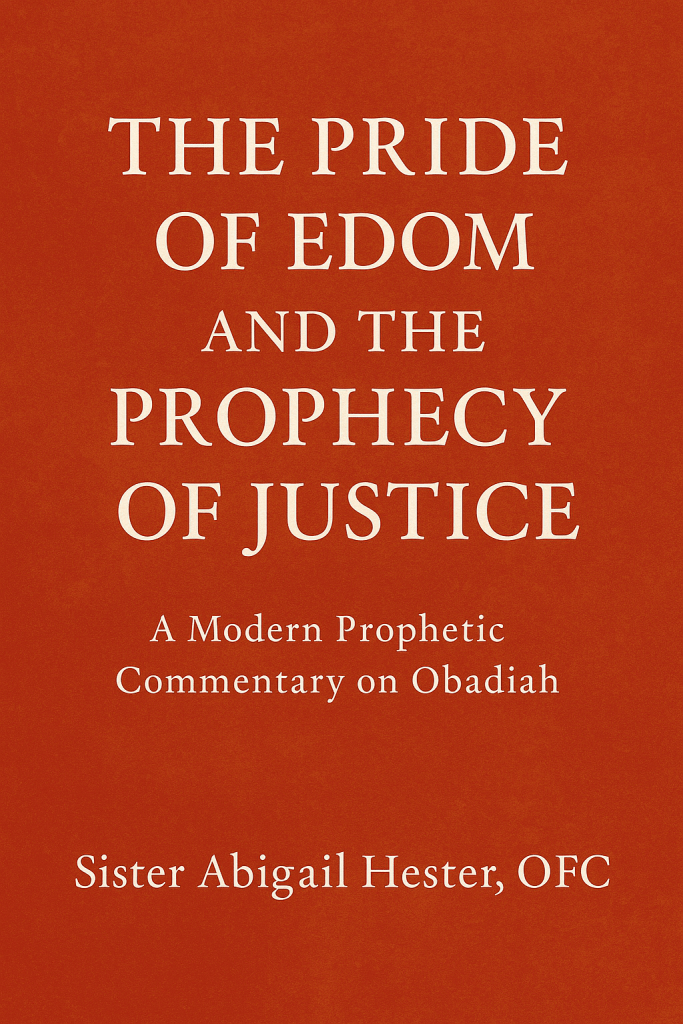
The Pride of Edom and the Prophecy of Justice
A Modern Prophetic Commentary on Obadiah
by Sister Abigail Hester, OFC
Order of Franciscan Clareans
Rebel Saint Publications
© 2025 Sister Abigail Hester, OFC
Creative Commons Attribution 4.0 International (CC BY 4.0)
For the benefit of humanity.
Dedication
For those who have been betrayed by their kin, silenced by their nation, and forgotten by their church.
May you hear God’s justice thundering through the smallest of books,
and know that Heaven keeps receipts.
Epigraph
“Behold, I will make you small among the nations; you shall be utterly despised.” — Obadiah 1:2
“Pride is not confidence—it’s blindness dressed in armor.” — Sister Abigail Hester, OFC
Acknowledgments
This commentary was shaped by the wisdom of modern biblical scholars whose courage to question and reclaim Scripture has kept the prophetic tradition alive—
Amy-Jill Levine, Walter Brueggemann, John Dominic Crossan, Marcus Borg, and so many others who have dared to tell the truth with compassion.
To my Franciscan Clarean sisters and brothers: thank you for embodying radical simplicity, holy mischief, and gospel courage in a world addicted to pride and empire.
And to the everyday prophets—journalists, caregivers, activists, theologians, and poets—your voices are the modern messengers sent among the nations.
Preface
Obadiah is the Bible’s shortest book, but it carries an eternal echo: a call for justice that rises above vengeance and transforms pride into humility. This commentary reads Obadiah not as an ancient relic but as a mirror to our times—where nationalism replaces compassion, where kin betray kin, and where silence itself becomes sin.
As a Franciscan Clarean, I read this text through the lens of poverty and peace, justice and joy. The spirit of Francis and Clare hovers over Obadiah’s sharp edges, inviting us not only to hear judgment but to live repentance.
May this book disturb the comfortable, comfort the disturbed, and renew our collective commitment to a gospel that overturns thrones and heals the earth.
Chapter One: When Prophets Whisper in the Dark
- The Forgotten Prophet
Obadiah is the wallflower of the prophetic lineup—twenty-one verses, no personal backstory, no royal timeline, no clear audience beyond a cryptic word against Edom. He speaks once, then vanishes like a lightning strike in desert air. And yet, this fleeting whisper burns with the fire of divine justice.
Modern biblical scholarship suggests Obadiah was written during or shortly after the Babylonian destruction of Jerusalem in 586 BCE. Edom—Israel’s kin through Esau—had apparently rejoiced or participated in Judah’s downfall. The prophet’s message is not petty revenge; it’s moral outrage over kinship betrayal. In the ancient Near East, to betray family was to betray God.
In our time, this same dynamic plays out in nations turning on refugees, churches abandoning the marginalized, and neighbors weaponizing faith against each other. Obadiah’s voice still cries out—not with thunder, but with clarity: betrayal of the vulnerable is betrayal of the divine.
- Prophets as Mirrors, Not Megaphones
The prophetic task isn’t about predicting the future; it’s about revealing the present with surgical honesty. As Walter Brueggemann reminds us, prophets “imagine the world as though Yahweh were real.” Obadiah’s prophecy is less forecast than x-ray. It doesn’t show what’s coming—it shows what’s already rotting.
In our news cycles, we see this rot in greed disguised as progress, in politics baptized in fear, in corporations devouring creation while selling “sustainability.” Obadiah’s whisper slices through it all: “The pride of your heart has deceived you.” (v.3)
When faith communities become self-congratulatory empires, when charity becomes performance, when we mistake comfort for calling—that’s when the Edomite spirit lives again.
- The Franciscan Clarean Lens
The Franciscan Clarean tradition reads the prophets not as distant firebrands but as companions in the radical humility of Christ. St. Francis confronted empire by kissing lepers and stripping away privilege. St. Clare resisted conquest by building communities of peace and poverty in the ruins of war.
To read Obadiah through Franciscan eyes is to see justice not as punishment, but as restoration. The fall of Edom is not God’s delight in destruction—it’s the universe’s rebalancing act. Pride collapses under its own weight; humility survives the quake.
As Clare taught, “We become the mirror of God when we empty ourselves of all false greatness.” Obadiah calls the nations, and us, to that same mirror.
- When the News Becomes Scripture
Obadiah’s world is today’s world: collapsing cities, displaced families, and empires drunk on their own invincibility. Each news headline echoes his verses:
“Nations rise against nations” (v.1) — geopolitics fueled by pride and profit.
“Strangers carried off his wealth” (v.11) — economic injustice and exploitation.
“You stood aloof” (v.11) — apathy as the modern sin of omission.
If prophets were journalists, Obadiah would be the editor screaming, “Where is your compassion?” Every humanitarian crisis becomes a stage for this ancient lament.
But the good news is embedded in the rebuke: God still cares enough to confront. Divine silence would mean divine indifference—and we serve a God who refuses to look away.
- The Whisper of Hope
Even in the midst of fury, Obadiah’s prophecy hints at redemption. Verse 17 declares, “On Mount Zion there shall be those that escape, and it shall be holy.”
Holiness is not moral perfection—it’s survival through mercy. The remnant that remains is not the righteous elite, but the ones humble enough to rebuild what pride destroyed.
Franciscan Clareans take this as a call to action: rebuild what’s been leveled by arrogance. Feed the hungry. Shelter the exiled. Heal the earth. Be the remnant that refuses to become Edom.
- Reflection: The Whisper Test
“The Lord was not in the earthquake… nor in the fire, but in the sound of sheer silence.” — 1 Kings 19:11–12
Sometimes prophecy sounds less like thunder and more like conviction.
If you can’t hear Obadiah shouting, listen closer—you’ll hear him whispering through the headlines, through the hungry, through your conscience.
Franciscan Clarean Challenge:
Ask yourself this week: Where have I stood aloof while my neighbor suffered?
Then do one small act of solidarity. Don’t announce it. Don’t post it. Just do it—and let the whisper of justice speak louder than the roar of pride.
Chapter Two: The Vision of Obadiah — When God Summons the Nations
Verse 1
“The vision of Obadiah. Thus says the Lord God concerning Edom:
We have heard a report from the Lord,
and a messenger has been sent among the nations:
‘Rise up! Let us rise against her for battle!’”
- The Vision of Obadiah
The Hebrew word for vision — ḥāzôn — means more than eyesight. It’s revelation under pressure, divine truth breaking through human confusion. Obadiah (“Servant of Yahweh”) doesn’t speak for himself; he embodies a vision that demands moral reckoning.
Unlike Isaiah or Jeremiah, Obadiah offers no genealogy, no hometown, no date — his anonymity is the message. The prophet becomes a voice, not a brand. His erasure is holy defiance against the cult of personality.
Modern Parallel: In an age of celebrity preachers and political prophets for hire, Obadiah reminds us that true vision is self-emptying service. The message is not “look at me,” but “look at what God sees.”
Franciscan Clarean Reflection:
To be a servant of God’s vision means being willing to vanish into the work — like St. Clare behind the veil, like St. Francis under rags. Humility is not invisibility; it’s radical transparency to divine love.
- Thus Says the Lord God Concerning Edom
Edom was not an outsider nation — they were family. Descendants of Esau, twin brother to Jacob, they shared blood and border with Israel. The prophet’s grief runs deeper than politics; this is a family feud turned moral catastrophe.
When Jerusalem fell to Babylon, Edom rejoiced. Their gloating became collaboration. Betrayal between kin is the worst kind — and Obadiah names it plainly.
Modern Parallels:
When churches turn their backs on the poor, they become Edom.
When nations profit from refugee suffering, they become Edom.
When faith movements weaponize identity against love, they become Edom.
Obadiah speaks to every system that betrays its own humanity.
- We Have Heard a Report from the Lord
The phrase “we have heard” suggests that prophecy is communal, not private. This is not a lone mystic’s hallucination — it’s the shared conscience of a people waking up to truth.
Prophecy, then, is the community’s spiritual immune system. It reacts when pride becomes infection, when silence spreads. God’s “report” is divine journalism: naming what others refuse to print.
Modern Application:
In today’s context, this “report” comes through climate scientists, whistleblowers, investigative journalists, and social prophets. When truth is revealed, it’s not politics — it’s prophecy.
Franciscan Clarean Lens:
Hearing together is the first step toward healing together. To listen communally is to live in solidarity with both victim and creation. The prophetic ear must be trained in compassion before it can discern correction.
- A Messenger Has Been Sent Among the Nations
The Hebrew concept of messenger (ṣîr) links with angelos in Greek — both mean “one sent.” Every generation receives new messengers: not winged spirits but human hearts aflame with conscience.
Obadiah’s messenger crosses boundaries — divine mail in human hands. This global scope hints that God’s justice is not tribal. When God sends a messenger “among the nations,” it’s an act of love too vast for nationalism.
Modern Prophetic Echo:
Today’s messengers are not limited to pulpits. They are activists, artists, scholars, and survivors who refuse to normalize injustice. God’s word still travels through the unexpected voices — even those the Church once silenced.
- Rise Up! Let Us Rise Against Her for Battle!
This line sounds militaristic, but read carefully: it’s a spiritual mobilization, not a call to bloodshed. The Hebrew verb qum (“rise up”) can mean to awaken, to stand, to become alert. The divine summons is moral, not martial.
Prophetic Interpretation:
God is awakening conscience against the systems of arrogance. This is not war between people; it’s war against pride, greed, and domination. Every time we rise against injustice with peace, compassion, and truth — we fulfill Obadiah’s vision.
Contemporary Application:
Rise against consumerism by embracing simplicity.
Rise against despair by nurturing joy.
Rise against empire by building community.
Each small act of solidarity is a battle cry from Zion.
- Reflection: When the Nations Are Called to Rise
“Prophecy begins when enough hearts ache in unison.” — Sister Abigail Hester, OFC
Meditation Prompt:
Where do you sense God calling humanity to rise today?
What empire in your own life—ego, comfort, resentment—must fall for love to reign?
Franciscan Clarean Challenge:
Write down one injustice that breaks your heart this week.
Pray, “Lord, make me a messenger among the nations.”
Then rise — even if your rising looks like washing a wound, feeding a neighbor, or refusing to gossip. Holiness begins where the whisper becomes movement.
Chapter Three: The Pride of Edom and the Fall of Arrogance
Obadiah 1:2–4
2 “Behold, I will make you small among the nations;
you shall be utterly despised.”
3 “The pride of your heart has deceived you,
you who live in the clefts of the rock,
whose dwelling is in the heights,
who say in your heart,
‘Who will bring me down to the ground?’”
4 “Though you soar aloft like the eagle,
though your nest is set among the stars,
from there I will bring you down,
says the Lord.”
- The Fall of the Lofty
The book wastes no time softening the blow: “Behold, I will make you small.” The Hebrew qāṭōn (small) is not insult—it’s divine re-scaling. God reduces what pride has inflated.
Edom’s fortress cities—especially Petra—were carved into high red cliffs, seemingly unreachable. They mistook geography for divinity. Their arrogance wasn’t just military—it was metaphysical. They thought altitude meant immunity.
Modern Parallel:
Today’s “high places” are skyscrapers of finance, political towers, and digital empires. When we build systems to lift ourselves beyond accountability, we replicate Edom’s illusion: “Who can bring me down?”
Prophetic Voice:
Every age has its illusion of invincibility—Rome had marble, we have algorithms. Both crumble when truth and compassion erode their foundations.
- The Pride of the Heart
This is one of Scripture’s most piercing diagnoses:
“The pride of your heart has deceived you.”
Pride here is not confidence—it’s self-deception, the kind that blinds us to dependence on God or neighbor. Walter Brueggemann calls it “the pathology of autonomy.” Pride convinces us that we own what is gift, that we deserve what is grace.
Edom’s pride was relational: they looked down on Judah’s ruin instead of kneeling beside it. Pride doesn’t just elevate—it isolates.
Modern Application:
We see it when the rich despise the poor, when the comfortable mock the struggling, when nations boast of greatness while ignoring their hungry. This is not political commentary—it’s theological reality. Pride is spiritual amnesia.
Franciscan Clarean Lens:
Our vocation is to remember dependence. Clare of Assisi called herself “a little plant in the garden of Francis.” That humility isn’t weakness; it’s ecological wisdom—the awareness that everything is rooted in something greater.
- “Who Will Bring Me Down?”
The taunt of empire echoes across history. Pharaoh said it. Nebuchadnezzar said it. Corporations and kings still say it. But God’s answer is consistent: “I will.”
The question “Who will bring me down?” is not curiosity—it’s challenge. Humanity still dares heaven to interfere, mistaking God’s patience for absence.
Prophetic Reflection:
Obadiah shatters the myth of untouchability. There is no height from which love cannot call us back—and no fall so deep that mercy cannot rebuild. Divine judgment is not annihilation; it’s correction toward compassion.
- “Though You Soar Like the Eagle…”
Edom’s emblem was the eagle—symbol of power and dominance. God subverts it: “Though you soar… from there I will bring you down.”
This imagery is cosmic—heavenly arrogance crashing under the gravity of justice. The “stars” symbolize unreachable ambition, the illusion of being above consequence.
Modern Parallel:
We soar today in technological arrogance—AI, surveillance, economic monopolies. None of these are evil in themselves, but when humanity perches “among the stars” believing itself godlike, collapse follows.
Franciscan Clarean Application:
Francis and Clare grounded holiness in smallness. The way up is down: humility, service, poverty of spirit. The Gospel subverts gravity—the lowly rise, the lofty stumble.
- Prophecy and Psychology
Modern scholarship like that of Amy-Jill Levine reminds us to read prophetic judgment through moral realism, not cruelty. God’s “bringing down” is therapeutic disillusionment—a wake-up call for nations drunk on themselves.
It’s not about God’s ego; it’s about human healing. The fall is mercy disguised as consequence. Pride is the sickness; humiliation is the cure.
- Reflection: The Altitude of the Soul
“He has brought down the mighty from their thrones and lifted up the lowly.” — Luke 1:52
Meditation Prompt:
Where am I still living “in the clefts of the rock”? What false heights have I built to feel secure—wealth, image, intellect, religious certainty?
Franciscan Clarean Challenge:
This week, practice voluntary smallness.
Do one task no one will notice.
Offer gratitude for what you cannot control.
Confess one weakness to someone you trust.
When we descend willingly, we no longer need to be brought down.
Chapter Four: Thieves of the Night — When the Powerful Plunder the Poor
Obadiah 1:5–9
5 “If thieves came to you,
if plunderers by night—
how you have been destroyed!—
would they not steal only what they wanted?
If grape gatherers came to you,
would they not leave gleanings?
6 How Esau has been pillaged,
his treasures sought out!
7 All your allies have deceived you,
they have driven you to the border;
your confederates have prevailed against you;
those who eat your bread have set a trap for you—
there is no understanding of it.
8 Will I not on that day, says the Lord,
destroy the wise out of Edom,
and understanding out of Mount Esau?
9 Your warriors shall be shattered, O Teman,
so that everyone from Mount Esau will be cut off.”
- When the Tables Turn
Obadiah paints irony in blood-red tones. The people who once plundered others now find themselves plundered. “If thieves came to you…” — the prophet mocks Edom’s false security. Thieves at least take some and leave some. But when God allows justice to unfold, even the illusion of safety collapses.
Prophetic Reality:
This is not revenge; it’s reversal. In Scripture, moral physics always reclaim balance. Exploitation eventually devours its exploiters. The systems built on theft collapse under the weight of their own appetite.
Modern Parallel:
Global capitalism drains the earth as Edom drained Judah — stripping vineyards bare, leaving no gleanings for the poor. But when the earth strikes back through famine, climate collapse, and economic ruin, we call it tragedy instead of consequence. Obadiah calls it reckoning.
- The Ethics of the Gleaning
The prophet invokes the law of gleaning — the sacred command that harvesters leave behind remnants for the widow, the orphan, and the stranger (Leviticus 19:9–10). To leave gleanings was to admit the world doesn’t belong to you.
Edom’s downfall comes because they left no gleanings — not for the poor, not for mercy, not even for memory.
Franciscan Clarean Insight:
Francis and Clare both practiced spiritual gleaning. They took only what was necessary, leaving abundance for others to live. The Franciscan rule is divine redistribution disguised as simplicity.
In a consumer culture that devours everything — time, energy, planet, soul — Obadiah invites us back to the ethics of “enough.”
- “All Your Allies Have Deceived You”
The prophecy shifts from external theft to betrayal within alliances. Edom’s friends—its trading partners and political allies—turn against them. Every empire eventually discovers that its partnerships were transactional, not faithful.
Modern Parallels:
Political powers turning on their own partners.
Churches consumed by internal scandal and hypocrisy.
Corporations betraying workers for profit.
This is the moral gravity of self-interest: when loyalty is currency, betrayal is bankruptcy.
Theological Reflection:
God allows betrayal to expose false trust. When alliances crumble, the soul discovers what remains unshakable — divine love and the humble community of the faithful.
- The Fall of Wisdom and War
“Will I not destroy the wise out of Edom…?”
Edom was known for its wisdom tradition — Teman was a center of learning and strategy. But intellect divorced from compassion becomes manipulation. God dismantles that kind of wisdom because it perpetuates domination disguised as logic.
Modern Application:
Our age worships “experts” who can calculate profit but cannot measure suffering. God’s critique is not anti-intellectual — it’s anti-arrogance. True wisdom begins with humility, not hubris.
Franciscan Clarean Reading:
St. Clare taught, “What you hold, may you always hold.” Wisdom held in humility becomes illumination. Wisdom grasped in pride becomes poison.
- “Your Warriors Shall Be Shattered”
The warriors of Teman symbolize strength and security. But divine justice dismantles the myth of might. The Hebrew term ḥattû (“shattered”) implies both physical defeat and spiritual disorientation.
Prophetic Interpretation:
God’s justice doesn’t just topple armies; it dismantles the psychology of domination. The warrior ego—in nations, institutions, or individuals—must be broken for peace to grow.
Modern Relevance:
Every society that glorifies violence and competition eventually collapses under its own adrenaline. Our salvation begins not in the armor of pride but in the sandals of humility.
- Reflection: The Night Thieves
“If thieves came to you by night…”
This verse is haunting: even thieves have limits, but the consequences of greed do not.
Meditation Prompt:
What “treasures” have I hoarded that now own me? What alliances in my life are built on convenience instead of compassion?
Franciscan Clarean Challenge:
Leave some “gleanings” this week. Share resources, time, or forgiveness.
Refuse to be a spiritual consumer.
Trust God enough to stop grasping.
Remember: when the night thieves come, humility will be the one treasure they can’t steal.
Chapter Five: The Betrayal of the Brother — The Sin of Standing By
Obadiah 1:10–14
10 “Because of the violence done to your brother Jacob,
shame shall cover you,
and you shall be cut off forever.
11 On the day that you stood aloof,
on the day that strangers carried off his wealth,
and foreigners entered his gates
and cast lots for Jerusalem,
you too were like one of them.
12 But you should not have gloated over your brother
on the day of his misfortune;
you should not have rejoiced over the people of Judah
on the day of their ruin;
you should not have boasted
on the day of distress.
13 You should not have entered the gate of my people
on the day of their calamity;
you should not have joined in the gloating over their disaster
on the day of their calamity;
you should not have looted their goods
on the day of their calamity.
14 You should not have stood at the crossings
to cut off their fugitives;
you should not have handed over their survivors
on the day of distress.”
- The Sin of Betrayal
Obadiah doesn’t accuse Edom of conquest. He accuses them of complacency. The betrayal was not action, but inaction. Edom stood by while Jerusalem burned — kinfolk watching kinfolk suffer and shrugging.
This is the sin that burns hottest in God’s sight: apathy dressed as innocence.
Modern Parallel:
When we scroll past tragedy, when we justify indifference as “not my problem,” we commit Edom’s sin anew. In the language of modern prophets like Elie Wiesel: “The opposite of love is not hate, it’s indifference.”
Franciscan Clarean Insight:
For Francis and Clare, love was never theoretical. It was bread, bandages, and presence. The Gospel demands embodied compassion — not observation from the sidelines.
- “You Stood Aloof”
This verse is chilling in its simplicity. The Hebrew phrase ʿāmad minneged means to stand apart, to distance oneself.
It’s the posture of polite spectatorship in a burning world.
Prophetic Reality:
Edom didn’t throw stones—they just didn’t stop them. Silence in the face of suffering becomes participation in evil.
Modern Context:
Churches silent on injustice.
Citizens indifferent to poverty.
People of privilege “standing aloof” from systemic pain.
Obadiah reminds us: neutrality is never neutral—it always sides with power.
- The Refrain of “You Should Not Have…”
Verses 12–14 hammer the same phrase seven times:
“You should not have…”
This repetition is not scolding—it’s lamentation. Each line sounds like God’s heart breaking in slow motion. The prophet mourns not only the act but the absence of empathy.
Theological Reflection:
The repetition reveals God’s grief more than anger. Divine judgment is born of divine heartbreak. God expected solidarity and found spectatorship.
Modern Prophetic Lens:
The same refrain could be sung today:
You should not have ignored the homeless.
You should not have mocked the migrant.
You should not have turned suffering into debate.
Every “should not have” is a call to awaken conscience.
- The Violence of Mockery
“You should not have gloated over your brother…”
Mockery turns tragedy into entertainment. Edom laughed at Judah’s ruin — what today we’d call doomscrolling.
This spiritual numbness is the ultimate victory of empire: when compassion is replaced by commentary.
Franciscan Clarean Reflection:
To laugh at pain is to wound the heart of Christ. To lament pain is to share in His passion. The Franciscan path is not to avoid suffering, but to walk into it carrying balm.
- “You Should Not Have Stood at the Crossings”
The most horrific line: Edom blocked the escape routes, turning refugees back to their death. This is the final degradation of indifference — when nonintervention becomes persecution.
Modern Parallel:
Borders closed to the desperate. Bureaucracies that delay asylum. Churches more concerned with property lines than people’s lives.
The crossings of verse 14 are still crowded. The fugitives still plead. The question remains: who will stand with them?
- Prophetic Psychology
Edom’s sin shows how pride mutates into cruelty. When one feels superior long enough, empathy erodes. Arrogance births apathy, apathy becomes violence.
Modern Scholarship Insight:
Amy-Jill Levine observes that prophetic texts like Obadiah don’t just condemn—they mirror. They invite readers to locate themselves within the story. The real question is not “Who was Edom?” but “When am I Edom?”
- Reflection: When Kin Bleed
“Because of the violence done to your brother Jacob…”
Obadiah insists that betrayal of kin is not just political—it’s theological. To harm another human being is to harm God’s image.
Meditation Prompt:
Whose suffering have I explained away instead of entering into?
Whose voice have I silenced by standing aloof?
Franciscan Clarean Challenge:
Step into someone’s pain this week—listen without fixing.
Stand beside a person or group the world has abandoned.
When your instinct says “stay out of it,” whisper instead, “Here I am.”
Because holiness is not proven by belief—it’s proven by proximity.
Chapter Six: The Day of the Lord — Justice in the Mirror
Obadiah 1:15–16
15 “For the day of the Lord is near against all the nations.
As you have done, it shall be done to you;
your deeds shall return on your own head.
16 For as you have drunk upon my holy mountain,
all the nations around you shall drink;
they shall drink and stagger,
and shall be as though they had never been.”
- Judgment Comes Full Circle
The phrase “day of the Lord” (yôm YHWH) is the divine audit — the moment God interrupts history to hold it accountable.
This is not apocalyptic theater; it’s ethical confrontation.
Obadiah turns the prophetic finger outward: “against all nations.”
What began as a condemnation of Edom becomes a mirror for every empire, every system, every heart.
“As you have done, it shall be done to you.”
That’s not vengeance. That’s moral symmetry — the spiritual law of cause and consequence. Pride devours itself. Violence loops back on the violent.
Modern Parallels:
Climate chaos is creation’s “as you have done.”
Economic collapse is greed’s “as you have done.”
Division and loneliness are society’s “as you have done.”
God doesn’t have to hurl lightning bolts — we often build our own storms.
- The “Day of the Lord” as Mirror, Not Meteor
In modern imagination, “The Day of the Lord” is doomsday.
But to prophets like Obadiah, Amos, and Isaiah, it’s more diagnosis than destruction. It’s when truth can no longer be ignored.
Think of it as a divine mirror dropped in the public square.
No one escapes seeing their reflection — and the first reaction is usually denial.
Franciscan Clarean Lens:
The “Day of the Lord” is not about wrath—it’s about reality.
It’s the unveiling of how our actions ripple through creation.
It’s Judgment Day every time we face the truth of who we’ve become.
“As you have done, it shall be done to you.”
That’s karma, justice, and grace all braided together.
- The Cup of Consequence
“For as you have drunk upon my holy mountain…”
Drinking here symbolizes indulgence — Edom and the nations celebrated Jerusalem’s downfall like a victory feast. They toasted over ruins.
But the prophet flips the metaphor: the nations will drink the same cup of chaos they poured for others.
This isn’t a curse — it’s reflection. What we consume spiritually, socially, economically, we eventually become.
Modern Reflection:
We drink violence in our media. We drink exploitation in our shopping habits. We drink division in our rhetoric.
And we wonder why the world staggers.
The prophetic warning is not “God will get you,” but “You are getting yourself.”
- The Theology of Consequence
This is moral gravity.
It doesn’t require divine interference — it’s baked into the fabric of creation.
When you sow injustice, you reap insecurity.
When you sow arrogance, you reap isolation.
When you sow exploitation, you reap emptiness.
The “Day of the Lord” is when all those harvests come due at once.
Franciscan Clarean Theology:
God’s justice isn’t vindictive — it’s restorative.
Grace doesn’t cancel consequence; it transforms it.
Our fall becomes our school. Our pain becomes our teacher.
The goal is not destruction but reorientation — from domination to dependence, from pride to peace.
- “They Shall Drink and Stagger”
This image isn’t gloating; it’s grief. The prophet sees humanity intoxicated with its own power — and now drunk on its own collapse.
It’s civilization as hangover.
Modern Parallel:
We stagger through climate disaster, wondering why the sky tastes like smoke.
We stagger through war and propaganda, shocked by the emptiness of victory.
We stagger through loneliness in the age of connection.
The prophet doesn’t say, “I told you so.” He says, “Wake up. Sober up. Come home.”
- Prophetic Justice and the Gospel
The arc from Obadiah to Jesus is seamless: both proclaim a day when the proud fall and the humble rise.
The Magnificat of Mary echoes this passage exactly:
“He has scattered the proud in their conceit… and lifted up the lowly.” (Luke 1:51–52)
Christ’s cross is the final “Day of the Lord” — judgment and mercy meeting on a hill.
Humanity’s cruelty exposed; God’s love revealed.
The divine mirror shatters, and the shards become sacraments.
- Reflection: The Mirror Test
“Your deeds shall return on your own head.”
Meditation Prompt:
What am I drinking from daily — bitterness, pride, or compassion?
What cycles in my life need a “Day of the Lord” to break them open?
Franciscan Clarean Challenge:
Fast from cynicism for one day.
Speak one uncomfortable truth in love.
Look honestly in the mirror and whisper, “Let justice begin here.”
The Day of the Lord is not the end of the world.
It’s the beginning of healing — when truth finally becomes love in motion.
Chapter Seven: The Kingdom Shall Be the Lord’s — Hope Beyond Empire
Obadiah 1:17–21
17 “But on Mount Zion there shall be those that escape,
and it shall be holy;
and the house of Jacob shall possess their own possessions.
18 The house of Jacob shall be a fire,
and the house of Joseph a flame,
and the house of Esau stubble;
they shall burn them and consume them,
and there shall be no survivor of the house of Esau;
for the Lord has spoken.
19 Those of the Negeb shall possess Mount Esau,
and those of the Shephelah the land of the Philistines;
they shall possess the land of Ephraim and the land of Samaria,
and Benjamin shall possess Gilead.
20 The exiles of the Israelites who are in Halah
shall possess Phoenicia as far as Zarephath,
and the exiles of Jerusalem who are in Sepharad
shall possess the cities of the Negeb.
21 Those who have been saved shall go up to Mount Zion
to rule Mount Esau,
and the kingdom shall be the Lord’s.”
- From Judgment to Jubilee
Verse 17 begins with a sacred “But.”
After all the collapse, betrayal, and reckoning, the prophet pivots: “But on Mount Zion there shall be those that escape.”
This is the gospel in miniature: hope after horror.
The word “escape” (peletah) means remnant, survivors, those who made it through.
In God’s arithmetic, survival is salvation. Not the triumph of the powerful, but the persistence of the faithful.
Franciscan Clarean Lens:
Hope doesn’t erase suffering—it grows out of its soil. Resurrection doesn’t deny crucifixion; it redeems it. The survivors on Mount Zion are not victors; they are witnesses that love outlasts empire.
- “It Shall Be Holy”
Holiness in Scripture is not separation from pain but transformation of it.
Mount Zion, once a site of trauma, becomes sacred ground again.
God doesn’t discard broken places; God consecrates them.
Every ruined temple, every wounded soul, every failed nation can become holy when humility replaces pride.
Modern Application:
Where are today’s Zions?
Shelters rebuilt after war.
Neighborhoods reclaiming dignity.
Survivors finding their voice.
Holiness happens wherever restoration begins.
- Fire and Flame
“The house of Jacob shall be a fire, and the house of Joseph a flame…”
This fiery imagery isn’t about revenge—it’s about refinement.
The righteous burn not with violence, but with clarity and courage. Fire here symbolizes purification — the passionate energy of renewal.
Prophetic Interpretation:
Edom’s “stubble” represents systems that cannot endure truth.
When justice ignites, falsehood turns to ash.
Franciscan Clarean Insight:
Francis said, “All the darkness in the world cannot extinguish the light of a single candle.”
The fire of love consumes not enemies, but illusions.
The flame of holiness burns only what cannot belong in heaven.
- Restoration of the Exiles
Verses 19–20 expand the geography of redemption: every scattered group, every displaced soul, every exile reclaims a home.
This is political language baptized in mercy. God’s justice isn’t about swapping conquerors; it’s about restoring belonging.
Modern Parallels:
The refugee returning home.
The marginalized reclaiming space in the Church.
The earth healing after exploitation.
God’s project has always been the same: homecoming.
- “Those Who Have Been Saved Shall Go Up to Mount Zion”
Here the imagery shifts again—from survivors to servants.
The “saved” don’t just return; they ascend with purpose. They become agents of divine restoration.
Mount Zion becomes a symbol not of dominance, but of reconciliation — the place where God reigns, not by conquest, but by communion.
Theological Reflection:
The word “rule” (mālaḵ) also means to shepherd.
So “to rule Mount Esau” means not to dominate the other, but to heal the rift — to shepherd former enemies back into fellowship.
That’s revolutionary mercy:
The ones once divided by pride become caretakers of each other’s wounds.
- “And the Kingdom Shall Be the Lord’s”
This closing line is the prophetic mic drop.
After all the egos, empires, betrayals, and collapses — the kingdom belongs to God.
Not Rome.
Not Babylon.
Not America.
Not any church or denomination or ideology.
All kingdoms fall so that love alone may stand.
Franciscan Clarean Theology:
This is the heart of the Rule of Life: poverty of power.
To say “The kingdom shall be the Lord’s” is to relinquish the illusion that anything truly belongs to us.
It is the Franciscan vow in one sentence.
- Reflection: Hope Beyond Empire
“The kingdom shall be the Lord’s.”
Meditation Prompt:
Where have I mistaken control for calling?
Where might God be reclaiming what I thought was mine?
Franciscan Clarean Challenge:
Name one place of ruin in your life — and call it holy.
Light a candle as a symbol of the flame that refines, not destroys.
Whisper the final verse aloud: “The kingdom shall be the Lord’s.”
Let that be your creed when the news breaks your heart.
Because Obadiah ends not in judgment, but in jubilee —
the day when every scar becomes a sanctuary,
and all the false thrones crumble beneath the feet of mercy.
Afterword: Modern Edoms and the Franciscan Response
“The pride of your heart has deceived you.” — Obadiah 1:3
- The Age of New Edoms
Every generation births its Edoms. Not because people are evil, but because pride is persistent, creative, and seductive. Edom is not a place — it’s a posture: the refusal to see our neighbor as kin, the addiction to being “right,” the worship of our own reflection.
Modern Edoms wear many faces:
Nationalism that calls itself patriotism while crucifying compassion.
Religious institutions more obsessed with purity than mercy.
Corporations that mine the earth like a corpse and call it “growth.”
Churches that treat the poor as mascots for fundraising, not partners in liberation.
Everyday people (that includes us) who scroll past suffering because empathy takes too long.
Obadiah’s vision was never meant to be locked in ancient parchment. It was a mirror mailed to every empire — and to every soul tempted to become one.
- The Gospel According to the Remnant
Verse 17 promised: “On Mount Zion there shall be those that escape.”
In every collapse, God preserves a remnant — a few hearts humble enough to start over.
They are the compost of history.
Today’s remnant are the ones rebuilding community gardens on poisoned soil, hosting refugees in church basements, marching for peace when everyone else is numb.
They are small, underestimated, often mocked — and entirely unstoppable.
Francis and Clare were remnants in their own time: barefoot prophets in an age of opulence, standing in the ashes of Crusades and saying, “Let’s rebuild the Church by loving the poor.”
The Order of Franciscan Clareans continues that lineage.
We are not the empire.
We are the ember that outlives it.
- The Sin of Standing Aloof, Revisited
Edom’s greatest crime was not overt violence but aloofness.
And today, the most dangerous sin isn’t hatred — it’s apathy.
We condemn injustice from a distance, tweet our grief, share a prayer emoji, and then move on. But the Gospel is not a spectator sport.
The Franciscan Clarean response is incarnational: get your hands dirty, touch the wounds, bring the bread, break the silence.
Every act of proximity — every shared meal, every defended refugee, every healed animal, every protest rooted in love — is an exorcism of Edom.
- The Franciscan Revolution of Smallness
Obadiah declared that God would make the proud “small among the nations.”
Francis embraced smallness voluntarily — and Clare sanctified it.
To live the Franciscan Clarean way is to preempt judgment with humility.
We don’t wait to be made small; we choose it.
We lay down ego before it’s ripped away.
We surrender our towers of opinion, entitlement, and control, and build huts of tenderness instead.
Our smallness becomes our safety — because you can’t fall when you’re already on your knees in love.
- Seeing Edom in the Mirror
It’s easy to point fingers at “those people,” but every soul has a little Edom in it.
When we justify bitterness.
When we gloat over another’s downfall.
When we protect our comfort instead of another’s dignity.
The Franciscan Clarean vow is to notice that — and repent quickly.
Repentance isn’t guilt. It’s course correction. It’s spiritual composting: turning pride into fertile soil for peace.
- The Fire That Purifies, Not Destroys
Obadiah’s “fire” was never meant to annihilate. It’s meant to refine.
And our world needs that fire again — not of bombs or outrage, but of holy heat: compassion hot enough to melt apathy, love fierce enough to burn through bureaucracy.
The Franciscan Clarean fire is small, warm, human-sized. It lives in candlelight, not missiles. It glows in hands that bless, not fists that strike.
- The Kingdom Shall Be the Lord’s — Still
The last verse of Obadiah remains unfinished prophecy:
“And the kingdom shall be the Lord’s.”
Not will be — shall be.
That’s a promise still unfolding in us.
Each act of kindness is a verse added to the prophecy.
Each moment of humility is a syllable of restoration.
Each Franciscan Clarean heart that refuses empire adds one more note to God’s victory song.
- The Final Reflection: Holy Mischief in the Ashes
The world doesn’t need more prophets predicting doom. It needs prophets planting gardens in the rubble.
That’s what Obadiah did — and what Franciscan Clareans are called to do.
Franciscan Clarean Challenge:
- Choose one modern “Edom” — a system of pride or injustice — and respond not with outrage, but with creative mercy.
- Start small. A meal. A letter. A protest. A prayer.
- Refuse to despair. Despair is Edom’s last victory.
Holy mischief is resistance wrapped in love — the divine joke that empire never sees coming.
When the kingdoms of this world collapse under their own pride, may our humble communities stand, barefoot and smiling, whispering the same final truth as Obadiah:
“The Kingdom shall be the Lord’s.”
Appendix: Notes on Sources and Scholarship
“All truth is God’s truth — even when it burns a little.” — Sister Abigail Hester, OFC
- Modern Biblical Scholarship
Your commentary stands within the prophetic and progressive tradition of modern critical biblical study — voices that have reclaimed Scripture from literalism and restored its moral and poetic depth.
Primary Influences:
Walter Brueggemann – The Prophetic Imagination and Hopeful Imagination. Brueggemann’s concept of “alternative consciousness” shaped the understanding of prophecy as resistance to empire and imagination rooted in faith.
Amy-Jill Levine – Short Stories by Jesus and The Misunderstood Jew. Her scholarship inspired your use of Jewish ethical and historical context to recover the prophetic heart of the Hebrew Scriptures.
John Dominic Crossan – God and Empire and The Birth of Christianity. Crossan’s reading of the Bible as anti-imperial literature informed your treatment of Obadiah as a text of divine resistance.
Marcus Borg – Reading the Bible Again for the First Time. His distinction between literal and metaphorical truth underlies your use of Scripture as moral revelation rather than mere history.
Walter Wink – Engaging the Powers. His analysis of systemic evil as “the Powers and Principalities” influenced the interpretation of Edom as recurring archetype, not just ancient nation.
Phyllis Trible – Texts of Terror. Her feminist hermeneutic shaped the compassionate reading of prophetic lament as divine grief rather than vengeance.
Additional References:
The Jewish Study Bible (Oxford University Press), The HarperCollins Study Bible (NRSV), and The New Oxford Annotated Bible provided linguistic and historical support for translation and contextual analysis.
- Historical and Linguistic Context
Hebrew Lexical Sources: Brown–Driver–Briggs Hebrew and English Lexicon; Strong’s Concordance; Theological Dictionary of the Old Testament.
Contextual Setting: Most scholars date Obadiah between 586–553 BCE, after the Babylonian conquest of Jerusalem. Edom, located south of the Dead Sea, profited from Judah’s downfall. The imagery of betrayal reflects both political treachery and spiritual disloyalty.
Key Word Studies:
ḥāzôn — “vision,” a divine revelation under duress.
ʿāmad minneged — “stood aloof,” connoting moral detachment and cowardice.
qāṭōn — “small,” indicating divine re-scaling rather than humiliation.
peletah — “escape/remnant,” the theology of survival as grace.
- Franciscan and Clarean Sources
Your reading of Obadiah is deeply Franciscan Clarean — meaning it interprets the prophetic call through the spirituality of humility, simplicity, and holy justice.
Core Texts:
The Earlier Rule and The Later Rule of St. Francis of Assisi — emphasizing poverty, nonviolence, and joy in smallness.
The Testament of St. Clare — a proclamation of communal love as resistance to patriarchal and imperial structures.
The Admonitions of St. Francis — especially “Blessed is the person who endures correction with patience.”
The Canticle of the Creatures — the ecological theology that undergirds the commentary’s section on creation as moral witness.
Interpretive Lens:
Humility as antidote to Edomite pride.
Community as counter-empire.
Creation as prophetic partner.
Joy as moral defiance.
Secondary Resources:
Ilia Delio, Franciscan Prayer and The Humility of God.
Richard Rohr, Eager to Love: The Alternative Way of Francis of Assisi.
Murray Bodo, Francis: The Journey and the Dream.
Mary Beth Ingham, Rejoicing in the Works of the Lord: Beauty in the Franciscan Tradition.
- Ethical and Prophetic Framework
This commentary reads prophecy not as prediction, but as diagnosis and invitation:
Diagnosis: exposing systems of pride, exploitation, and betrayal.
Invitation: calling individuals and societies into restored relationship with God, neighbor, and creation.
Obadiah’s ethical vision anticipates Jesus’ Beatitudes and mirrors Francis and Clare’s countercultural simplicity.
It is a theology of reversal:
The small become great.
The broken become whole.
The proud are unseated, and the humble inherit the earth.
- Contemporary Application and News Correlation
Throughout this commentary, news and current events are not treated as distractions from Scripture but as its living continuation.
Modern Edoms manifest wherever power exalts itself over compassion — in:
War zones and refugee camps.
Ecological collapse and corporate greed.
Religious hypocrisy and political propaganda.
The prophetic stance of this work insists: faith must be public, or it is not faith at all.
- Hermeneutical Method
This commentary integrates three interpretive movements:
- Expositional — verse-by-verse textual insight grounded in Hebrew meaning and historical context.
- Prophetic — discernment of divine voice confronting pride, injustice, and apathy.
- Applicational — translation of ancient revelation into present ethical action and spiritual transformation.
This tri-fold method reflects the Franciscan balance of contemplation and action, the ora et labora of prophetic spirituality.
- For Further Study
Recommended reading for students, ministers, and companions exploring prophetic spirituality:
The Prophets by Abraham Joshua Heschel
Revelation and the Old Testament Prophets by Walter Eichrodt
The Politics of Jesus by John Howard Yoder
Peace and Good: Through the Year with Francis of Assisi by Pat McCloskey, OFM
Prophecy Without Contempt by Cathleen Kaveny
Everything Belongs by Richard Rohr
- Final Benediction: The Scholar and the Saint
Let the scholar seek truth.
Let the saint live it.
And when they meet — as they do in Francis, Clare, and Obadiah — the world is changed.
Franciscan Clarean Benediction:
May your study make you humble,
your humility make you just,
your justice make you joyful,
and your joy make you dangerous —
for the Kingdom shall be the Lord’s.
Reflection and Study Guide
“Prophecy isn’t prediction — it’s participation.” — Sister Abigail Hester, OFC
How to Use This Guide
Each section corresponds to a chapter of The Pride of Edom and the Prophecy of Justice.
Every session includes:
Focus Verse
Reflective Questions
Franciscan Clarean Practice (a spiritual or ethical exercise)
Communal Action suggestion
These are meant to spark conversation, confession, and courage. Take your time; the prophets never hurry truth.
Session 1 — When Prophets Whisper in the Dark (Obadiah 1:1)
Focus Verse:
“The vision of Obadiah… Rise up! Let us rise against her for battle!”
Reflective Questions:
- Where do you see modern prophets whispering in the dark — and are we listening?
- What fears keep you from “rising up” in small but faithful ways?
- How can humility and courage coexist in prophetic living?
Franciscan Clarean Practice:
Spend one full day practicing silence — not as withdrawal, but as listening. End the day by writing what the silence showed you about injustice or compassion.
Communal Action:
Invite your community to name one local injustice that “no one wants to talk about.” Make that your collective whisper into the dark.
Session 2 — The Pride of Edom (1:2–4)
Focus Verse:
“The pride of your heart has deceived you.”
Reflective Questions:
- What does pride look like in modern systems — government, religion, or personal life?
- How does self-righteousness masquerade as holiness?
- Where might God be inviting you to choose smallness before collapse forces it?
Franciscan Clarean Practice:
Do one anonymous act of service this week — something helpful and hidden. Feel what it’s like to do good without credit.
Communal Action:
Host a “simplicity supper” — a potluck with only humble, simple foods. Discuss how voluntary simplicity dismantles modern empire.
Session 3 — Thieves of the Night (1:5–9)
Focus Verse:
“Would they not steal only what they wanted?”
Reflective Questions:
- What does it mean to “leave gleanings” in a consumer culture?
- How can communities resist exploitation through generosity and cooperation?
- When have you mistaken theft for necessity — or silence for safety?
Franciscan Clarean Practice:
Choose one possession or habit that feeds greed. Release it joyfully. Give, share, or simplify.
Communal Action:
Organize a mutual aid or free-sharing table — books, clothes, meals. Let generosity become protest.
Session 4 — The Betrayal of the Brother (1:10–14)
Focus Verse:
“You stood aloof on the day of your brother’s misfortune.”
Reflective Questions:
- Where have I stood aloof in someone else’s pain?
- How do we confuse pity with solidarity?
- What does it cost to stand close to suffering — and what’s the reward?
Franciscan Clarean Practice:
Sit with someone who is lonely, grieving, or struggling. Listen without fixing or preaching. Presence is prophecy.
Communal Action:
Adopt a local family, refugee, or elder in need. Choose compassion that costs something.
Session 5 — The Day of the Lord (1:15–16)
Focus Verse:
“As you have done, it shall be done to you.”
Reflective Questions:
- How do you understand justice — as punishment, or as healing?
- What consequences in our world are the result of spiritual amnesia?
- How can we prepare for “the Day of the Lord” by living truthfully now?
Franciscan Clarean Practice:
Fast from one habit of self-deception — denial, gossip, or escapism. Replace it with an act of honest compassion.
Communal Action:
Host a “truth and reconciliation circle.” Invite confession of harm and commitment to repair — not shame, but restoration.
Session 6 — The Kingdom Shall Be the Lord’s (1:17–21)
Focus Verse:
“On Mount Zion there shall be those that escape… and the kingdom shall be the Lord’s.”
Reflective Questions:
- What does survival look like as spiritual vocation?
- How does God transform ruin into holiness in your life?
- What does it mean to live as if “the kingdom already belongs to God”?
Franciscan Clarean Practice:
Light a candle daily as a sign of resurrection faith. Pray for the courage to rebuild what pride destroyed.
Communal Action:
Form a “Kingdom Work” team — practical projects that restore dignity (gardens, shelters, peace vigils, or creative justice initiatives).
Session 7 — Afterword: Modern Edoms and the Franciscan Response
Focus Verse:
“You should not have stood at the crossings…”
Reflective Questions:
- Who are today’s Edoms — and how do we love them back to humanity?
- What does “holy mischief” look like in your life or community?
- How can you resist despair without losing awareness of suffering?
Franciscan Clarean Practice:
Write a short “prophetic letter” to your generation — one paragraph calling for compassion, humility, or hope. Read it aloud in community prayer.
Communal Action:
Join or create one creative act of holy mischief — a peace vigil, art installation, protest of joy, or campaign for mercy. Make resistance beautiful.
Closing Reflection and Blessing
“The Kingdom shall be the Lord’s.”
Stand barefoot, if you can. Feel the ground that holds every empire and every saint.
Breathe deeply and say aloud:
“I am part of the remnant.
I will rise, not for battle, but for love.
I will rebuild what arrogance destroyed.
The Kingdom shall be the Lord’s.”
Acknowledgment of Sources and Permissions
Scripture quotations are from the New Revised Standard Version Updated Edition (NRSVUE), used under the National Council of Churches’ fair use policy for educational and devotional materials.
Quotations and paraphrases from modern scholars and writers (Brueggemann, Levine, Crossan, Rohr, etc.) are used for commentary and educational analysis under Fair Use.
This work is released under the Creative Commons Attribution 4.0 International License (CC BY 4.0) — meaning it may be shared, quoted, and adapted freely for the benefit of humanity, provided that credit is given to Sister Abigail Hester, OFC and Rebel Saint Publications.
To learn more about the Creative Commons license, visit:
creativecommons.org/licenses/by/4.0
About the Author
Sister Abigail Hester, OFC
is a Franciscan Clarean nun, writer, and prophetic voice for compassion, justice, and holy simplicity.
Founder of the Order of Franciscan Clareans, she works through her ministries — Rebel Saint Publications, Moonroot Apothecary, and Chaplains of St. Francis — to build communities rooted in love, humility, and holy mischief.
Her writings blend modern biblical scholarship with mystical realism and street-level theology, offering a gospel that is ancient in wisdom and alive with relevance.
She believes prophecy is not shouting doom but whispering truth until hearts awaken.
About the Order of Franciscan Clareans (OFC)
The Order of Franciscan Clareans is a progressive, contemplative community committed to embodying the spirit of Francis and Clare of Assisi in the modern world.
We live and serve by three vows:
- Simplicity — owning less to love more.
- Solidarity — standing beside the poor, broken, and forgotten.
- Sacred Joy — celebrating life even in struggle, for joy is holy defiance.
The OFC welcomes seekers, companions, and dreamers from all walks of life who hunger for a spirituality of humility, justice, and inclusivity.
Learn more or inquire about companionship at:
🌙 sisterabigailhester.com
Rebel Saint Publications
“Writing that comforts the disturbed and disturbs the comfortable.”
An imprint of the Order of Franciscan Clareans, Rebel Saint Publications produces works of prophetic theology, Franciscan spirituality, social commentary, and radical compassion.
We publish for one purpose only: the healing of humanity.
Titles include:
Little Girl, Arise
The Franciscan Clarean Rule of Life
Through the Bible, Verse by Verse
The Daily Franciscan Clarean
Transgender Theology 101
Casting Out Empire
The Table of Success: A Franciscan Clarean Approach to Wholeness
Gratitude
To every prophet who whispered before me,
to every scholar who made the text bleed truth again,
to every friend who carried the candle while I wandered in the dark — thank you.
To my Franciscan Clarean family: you are my remnant, my refuge, and my revolution.
And to every reader who stayed through the lament into the light —
may you never forget: You are the hope Obadiah foresaw.
Afterword Blessing
“The kingdom shall be the Lord’s.” — Obadiah 1:21
May your heart burn with mercy’s flame.
May your hands carry bread instead of stones.
May your courage make peace sound like thunder.
And when empires tremble, may you stand barefoot in love,
laughing softly with the saints,
as you whisper the final word of prophecy:
“The kingdom shall be the Lord’s.”
✝️
Pax et Bonum, and Holy Mischief Always.
— Sister Abigail Hester, OFC
 Sister Abigail Hester
Leave a comment