Introduction
In the history of Christian theology, the doctrine of the atonement has often been framed in the language of law, debt, and punishment. Anselm of Canterbury’s Cur Deus Homo (11th century) offered the satisfaction model: humanity’s sin dishonored God, and satisfaction was required through Christ’s death.^1 Later Protestant Reformers sharpened this into penal substitution: Jesus bore divine wrath in humanity’s place.
The Franciscan tradition, however, offers a radically different perspective. From St. Francis and St. Clare’s lived spirituality, to the speculative theology of St. Bonaventure and John Duns Scotus, Franciscans interpret the Incarnation and Cross not as reactions to sin but as the eternal expression of God’s love. For Franciscans, the atonement is not transaction but transformation, not appeasement but union.
The Incarnation as “Plan A”
At the heart of Franciscan atonement theology lies the Primacy of Christ. John Duns Scotus (1266–1308) argued that the Incarnation was not contingent upon human sin. God did not look down at Eden’s rebellion and scramble for a remedy. Rather, the Word-made-flesh was foreordained “before the foundation of the world” (Eph. 1:4).
Scotus writes: “If Adam had not sinned, Christ still would have become incarnate. For the Incarnation is the greatest glory of God, and it is fitting that God should will always what is best and most glorious.”^2 In other words, Christ is not plan B after human failure, but plan A from eternity.
This perspective reshapes the atonement: Jesus comes primarily to unite creation with God, not simply to fix sin.^3
Bonaventure and the Cross as Revelation of Love
St. Bonaventure (1217–1274), the “Seraphic Doctor,” emphasized the affective and mystical dimensions of the Cross. In his Tree of Life, he portrays Christ crucified as the burning heart of divine charity:
- The wood of the cross is the ladder to heaven.
- The wounds of Christ are windows into God’s mercy.
- The Crucified is not merely victim but lover.
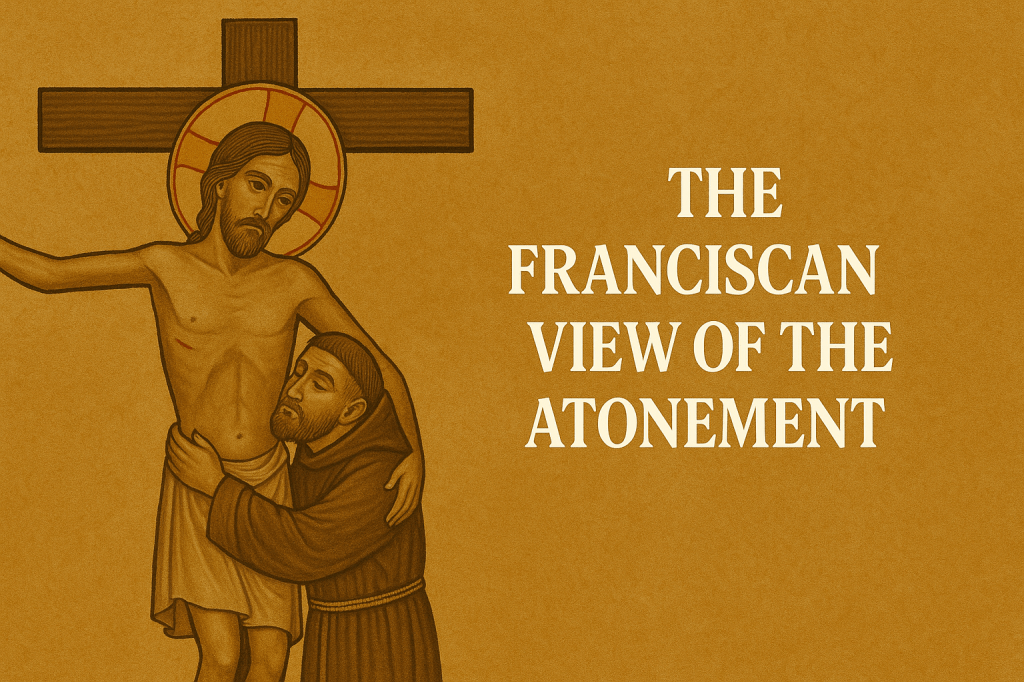
For Bonaventure, the Cross does not primarily satisfy wrath but enflames hearts with love, drawing humanity into compassionate union with the suffering Christ.^4 The Franciscan devotion to the Passion—embodied in Francis’s stigmata—reflects this mystical vision.
Francis and Clare: Lived Atonement in Poverty
Francis and Clare of Assisi did not write scholastic treatises, but their lives proclaimed a theology of atonement. By embracing radical poverty, humility, and solidarity with lepers and outcasts, they embodied Christ’s own descent into littleness.
For Francis, Christ saves not by power but by weakness. The Incarnation is God stooping down, and the Cross is God identifying with the crucified of the world.^5 To follow the Poor Christ is to share life with the poor and crucified of history.
Clare insisted that gazing upon the mirror of the crucified Christ transforms the soul. “Place your mind before the mirror of eternity, place your soul in the brilliance of glory, place your heart in the figure of the divine substance, and transform your entire being into the image of the Godhead through contemplation.”^6 For Clare, this contemplative seeing—not legal reasoning—was the path of atonement.
Theological Implications
- Union, Not Transaction
- Salvation is not a commercial exchange of debt and payment, but a personal union of love between God and creation.^7
- Solidarity with the Marginalized
- The Cross shows God standing with the oppressed. Thus, to live the atonement is to stand in solidarity with the poor, the queer, the crucified of every age.^8
- Cosmic Christology
- The Incarnation integrates not only humanity but the whole cosmos into Christ. Atonement thus includes creation itself, grounding Franciscan ecological spirituality.^9
- Transformation of Desire
- The Franciscan way emphasizes affectivity: the Cross changes the human heart, awakening love rather than fear.^10
Conclusion
The Franciscan opinion of the atonement is, at its core, a vision of divine love made visible in Christ. Against juridical models, Franciscans proclaim that God did not send Christ to change His own mind about humanity, but to change humanity’s mind about God.
The Incarnation was always the divine intention; the Cross reveals the cost of divine love in a violent world. For Francis and Clare, Bonaventure and Scotus, the atonement is not a courtroom verdict but a love song sung from eternity: God with us, God for us, God in us.
“Love is not loved,” Francis once lamented.^11 The Franciscan vision of the atonement dares to reply: on the Cross, Love is at last unveiled.
Footnotes
- Anselm of Canterbury, Cur Deus Homo, trans. Jasper Hopkins (Minneapolis: Arthur J. Banning Press, 1974).
- John Duns Scotus, Ordinatio III, d.7, q.3 (see Allan B. Wolter, Duns Scotus on the Incarnation, Franciscan Institute Publications, 2004), 55–60.
- Richard Rohr, Eager to Love: The Alternative Way of Francis of Assisi (Cincinnati: Franciscan Media, 2014), 183.
- Bonaventure, The Tree of Life, in Bonaventure: The Soul’s Journey into God, The Tree of Life, The Life of St. Francis, trans. Ewert Cousins (New York: Paulist Press, 1978), 135–150.
- Augustine Thompson, Francis of Assisi: A New Biography (Ithaca: Cornell University Press, 2012), 102–110.
- Clare of Assisi, Fourth Letter to Agnes of Prague, in Francis and Clare: The Complete Works, trans. Regis J. Armstrong and Ignatius Brady (New York: Paulist Press, 1982), 66.
- Zachary Hayes, Bonaventure: Mystical Writings (New York: Crossroad, 1999), 89–94.
- Ilia Delio, A Franciscan View of Creation: Learning to Live in a Sacramental World (St. Bonaventure, NY: Franciscan Institute, 2003), 72.
- Ilia Delio, Christ in Evolution (Maryknoll: Orbis Books, 2008), 121–126.
- Ewert Cousins, Bonaventure and the Coincidence of Opposites (Chicago: Franciscan Herald Press, 1978), 142.
- Francis of Assisi, The Admonitions, in Francis and Clare: The Complete Works, trans. Regis J. Armstrong and Ignatius Brady (New York: Paulist Press, 1982), 36.
 Sister Abigail Hester
Leave a comment