Category: Order of Franciscan Clareans

  • Order of Franciscan Clareans Reflection

    Sunday, August 2, 2026
    “Becoming a Living Blessing”

    “You are the light of the world… let your light shine before others.” — Matthew 5:14, 16

    St. Francis did not try to become famous. St. Clare did not seek power. Both simply chose, day after day, to become people through whom God’s love could be seen. That is the heart of the Franciscan Clarean way.

    Today, ask yourself a simple question: Who is blessed because I exist?

    Perhaps someone smiles because you listened without interrupting. Perhaps a frightened person found peace because you spoke gently. Perhaps creation itself was honored because you picked up litter, planted a flower, or treated an animal with kindness. These quiet acts may seem small, but the reign of God is built from such moments.

    Jesus reminds us that light is not meant to be hidden. Our light is not perfection, certainty, or having all the answers. Our light is compassion. It is choosing mercy over judgment, welcome over exclusion, hope over despair, and peace over violence.

    As Franciscan Clareans, we walk simply so that others may flourish. We care for the poor, honor the dignity of every person, cherish the Earth as our common home, and recognize Christ wherever love is found.

    May today be another opportunity not merely to speak about God’s love, but to embody it.

    Prayer

    God of boundless love,
    Make me a living blessing today.
    Give me eyes to see those who are overlooked,
    Hands ready to serve,
    A heart that forgives quickly,
    And feet willing to walk the path of peace.
    May I reflect the joy of Francis,
    The courage of Clare,
    And the compassionate spirit of Christ.
    Help me leave every person, every creature, and every place a little better than I found it.
    Amen.

  • Franciscan Clarean Reflection for August 1, 2026

    Theme: Small Acts, Great Love

    “Whoever is faithful in a very little is faithful also in much.” — Luke 16:10

    The world often celebrates the loud, the powerful, and the spectacular. The Gospel points us in another direction. Jesus notices the widow’s two small coins, a cup of cold water offered in kindness, a child welcomed with love, and bread broken around an ordinary table.

    St. Francis rebuilt the Church one stone at a time. St. Clare transformed the world through prayer, courage, and quiet faithfulness. Neither sought fame. Both trusted that love offered freely would ripple far beyond what they could see.

    Today, do not underestimate the holiness of ordinary moments. A kind word, a listening ear, a meal shared, a prayer whispered for someone in pain, or a moment spent caring for creation are all sacred acts. The Kin-dom of God grows through these small seeds of compassion.

    Wherever you are today—at home, in your neighborhood, or on the streets—be a gentle presence. Let your life preach mercy before your lips speak a word.

    Prayer

    God of boundless compassion, teach me to find You in the ordinary moments of this day. May I walk simply, love boldly, and welcome every person as my sibling. Help me to sow peace where there is conflict, hope where there is despair, and joy where hearts are weary. May my small acts of love become signs of Your ever-present grace. Amen.

    Practice for Today: Perform one quiet act of kindness without expecting recognition. Let it be your prayer in action.

  • Franciscan Clarean Reflection – July 30, 2026

    “The Sacred Beside the Road”

    We often imagine that God waits for us in mountaintop experiences, grand cathedrals, or dramatic moments of revelation. Yet Francis kissed Christ in the leper. Clare found holiness in a quiet life of prayer and service. Jesus walked dusty roads, ate with ordinary people, and revealed God’s reign in everyday encounters.

    Today, pay attention to the places you usually overlook. The sidewalk beneath your feet. The breeze through the trees. The smile of a stranger. The song of a bird. The person who seems invisible to everyone else.

    The Franciscan Clarean way reminds us that creation is not merely a backdrop to our lives—it is a living sanctuary. Every person bears sacred worth. Every act of compassion is a prayer. Every step taken in love becomes a pilgrimage.

    You do not need to travel far to meet the Holy One. The sacred is already waiting beside the road, inviting you to stop, notice, and respond with love.

    Prayer

    God of all creation, open my eyes to the holiness that surrounds me today. Teach me to walk gently, to love generously, and to welcome every person as my neighbor. May my words bring peace, my hands offer kindness, and my life reflect your boundless compassion. Amen.

    Practice for Today

    Take a slow walk, even if only for a few minutes. As you walk, silently bless each person, animal, and part of creation you encounter. Let your journey become a prayer of peace for the whole world.

  • Franciscan Clarean Reflection for July 29, 2026

    Theme: The Holy Ground Beneath Your Feet

    “The earth is the Lord’s and everything in it.” — Psalm 24:1

    Francis of Assisi saw every part of creation as family. Clare of Assisi discovered that even behind the walls of a small monastery, the whole world could become a place of prayer. Their lives remind us that holiness is not found only in grand cathedrals or famous pilgrimage sites. It is found wherever love takes root.

    Today, pause for a moment and notice the sacred that surrounds you. The breeze against your face, the song of a bird, the laughter of a child, the kindness of a stranger, or the quiet stillness of the morning are all invitations to encounter God.

    The Franciscan Clarean way is not about escaping the world. It is about walking gently through it with open eyes and an open heart. Every sidewalk can become a pilgrimage path. Every act of compassion can become a prayer. Every person can become an icon of the Divine.

    If your day feels ordinary, remember this: God delights in ordinary moments. A smile freely given, a listening ear, a cup of water shared, or a whispered prayer may become the holiest thing you do today.

    Walk lightly. Love boldly. Resist despair. Be a living blessing wherever your feet carry you.

    Prayer

    God of boundless love,
    Open my eyes to the sacred hidden in ordinary places. Help me to greet every person with compassion, every creature with respect, and every moment with gratitude. Make my life a simple witness to your peace, justice, and joy. May I become an instrument of healing wherever I go. Amen.

    Today’s Practice

    Take a slow walk—even if only for a few minutes. As you walk, silently bless each person, animal, tree, and home you pass. Let your journey become a prayer of peace for your neighborhood and for the whole world.

    Motto:
    Live Simply. Love Boldly. Belong Deeply.

  • Franciscan Clarean Reflection

    Finding God Along the Way

    Francis of Assisi taught us to see Christ among the poor, in creation, and in lives marked by simplicity. Clare of Assisi taught us to gaze steadily upon Christ with courage, humility, and love. The Franciscan Clarean path invites us to hold these two gifts together: contemplative hearts and compassionate hands.

    Today, pause for a moment. Listen to the birds, feel the breeze, notice the faces you pass, or simply become aware of your own breath. Every ordinary moment can become holy when we are fully present. God is not only found in grand cathedrals or dramatic miracles. God is also found in quiet acts of kindness, shared laughter, patient listening, and the determination to keep loving in a difficult world.

    The Gospel calls us to walk lightly upon the earth, to welcome those who have been pushed aside, and to become instruments of peace. This is not always easy. Love asks something of us. It asks us to forgive, to seek justice, to practice mercy, and to choose hope even when cynicism seems easier.

    As Franciscan Clareans, we remember that every person bears sacred worth. Every creature has value. Every sunrise is an invitation to begin again. We need not be perfect disciples; we need only keep walking the path, one faithful step at a time.

    Prayer

    God of boundless love,
    Open our eyes to your presence in every person and every corner of creation. Give us the courage of Francis, the faithfulness of Clare, and the compassion of Christ. May our lives become a blessing to those we meet, and may we leave the world more peaceful, more just, and more loving than we found it. Amen.

  • When Apostles Get Ghostwriters: Evidence of Forgery in the New Testament

    Introduction: Holier Than Thou or Holier Than Honest?

    The New Testament is hailed as “God’s Word,” but let’s be real: much of it is anonymous, pseudonymous, or forged. Early Christians lived in a world where writing under someone else’s name was a power move—meant to claim authority, shut down rivals, and win theological battles. Think of it as the original form of identity theft, with a halo.


    Paul: The Real vs. the Fake

    Authentic Paul (7 letters): Romans, 1–2 Corinthians, Galatians, Philippians, 1 Thessalonians, Philemon. These bear Paul’s raw, fiery voice—half-mystic, half-activist.[1]

    Imposter Paul (the rest):

    Deutero-Pauline: Ephesians, Colossians, 2 Thessalonians. These smooth-talking letters sound like Paul on decaf.[2]

    Pastorals (1 & 2 Timothy, Titus): Widely regarded as forgeries. Vocabulary and style don’t fit, the church hierarchy looks too developed, and Paul suddenly obsesses over bishops and “sound doctrine.”[3]


    Peter: The Fisherman Who Couldn’t Spell Greek

    1 Peter: Its sophisticated Greek and rhetorical polish make it unlikely that an uneducated Galilean fisherman wrote it.[4]

    2 Peter: Almost universally labeled a forgery, composed in the 2nd century, and heavily plagiarizing Jude.[5]


    The Johannine Mix-Up

    Gospel vs. Revelation: The Gospel of John is smooth, mystical Greek; Revelation is rough, broken Greek. Not the same author.[6]

    1–3 John: Anonymous letters later attributed to “John” for borrowed authority.[7]


    The Interpolations: Cutting Room Floor Additions

    Some passages look like late insertions—pious frauds with staying power:

    Mark 16:9–20: The “long ending” with snake-handling and poison-drinking is absent in earliest manuscripts.[8]

    John 7:53–8:11: The woman caught in adultery. A moving story, but added later.[9]

    1 John 5:7 (Comma Johanneum): Explicit Trinitarian formula—medieval addition, not found in Greek manuscripts.[10]

    Luke 22:43–44: Jesus sweating blood in Gethsemane—missing from earliest copies.[11]


    The Gospel Truth: They’re Anonymous

    The gospels never name their authors. “Matthew,” “Mark,” “Luke,” and “John” were attached in the 2nd century as authority branding.[12] In the ancient world, name-dropping was marketing: “Buy this scroll! Endorsed by an apostle!”


    Why It Matters

    Here’s the punchline: the church has been preaching against “bearing false witness” while canonizing forged documents. Hypocrisy much? But here’s the Franciscan Clarean twist: truth doesn’t need forgery to shine. The Spirit works even through messy, forged, and human documents. God’s love doesn’t require a flawless manuscript.


    Conclusion: Holiness Over Forgery

    If anything, forged and interpolated texts remind us that Christianity was always messy, political, and human. Faith isn’t about pretending our Scriptures dropped from heaven shrink-wrapped. It’s about hearing God’s call in the cracks, the edits, and yes—even the forgeries.

    Because if God can work through forged letters, then God can work through us—hot messes, imposters, and all.


    References

    [1]: Bart D. Ehrman, Forged: Writing in the Name of God—Why the Bible’s Authors Are Not Who We Think They Are (New York: HarperOne, 2011), pp. 95–118.
    [2]: Marcus J. Borg and John Dominic Crossan, The First Paul: Reclaiming the Radical Visionary Behind the Church’s Conservative Icon (New York: HarperOne, 2009).
    [3]: Raymond E. Brown, An Introduction to the New Testament (New York: Doubleday, 1997), pp. 668–681.
    [4]: Ehrman, Forged, pp. 122–124.
    [5]: Werner Kümmel, Introduction to the New Testament (London: SCM Press, 1975), pp. 430–433.
    [6]: Elaine Pagels, Revelations: Visions, Prophecy, and Politics in the Book of Revelation (New York: Viking, 2012).
    [7]: Brown, Introduction to the New Testament, pp. 387–393.
    [8]: Bruce Metzger, A Textual Commentary on the Greek New Testament (Stuttgart: United Bible Societies, 1994), pp. 102–106.
    [9]: Ibid., pp. 187–189.
    [10]: Metzger, Textual Commentary, pp. 647–649.
    [11]: Ehrman, Misquoting Jesus: The Story Behind Who Changed the Bible and Why (New York: HarperOne, 2005), pp. 187–189.
    [12]: Richard Bauckham, Jesus and the Eyewitnesses: The Gospels as Eyewitness Testimony (Grand Rapids: Eerdmans, 2006), though defending authenticity, still acknowledges anonymous origins.

  • A Franciscan Clarean Response To Luke 22:36

    “But now,” he said, “if you have a purse, take it, and also a bag; and if you don’t have a sword, sell your cloak and buy one.” (Luke 22:36, NIV)

    This passage is often misunderstood and misused—especially by those trying to justify violence, armed self-defense, or modern gun culture within Christianity. But a deeper, contextual, and Franciscan-Clarean response sees something very different.


    ✝️ A Franciscan Clarean Response to Luke 22:36

    Jesus wasn’t arming his disciples for battle—he was warning them of persecution, and inviting them to prepare their hearts for what was about to unfold. The “sword” in this passage is not a call to violence—it is a symbol of the suffering, misunderstanding, and resistance they were about to face.

    Francis of Assisi, who lived through political violence, war, and crusades, interpreted this passage not with a literal sword, but with radical peace. He laid down weapons, kissed lepers, and chose vulnerability instead of power.

    Clare of Assisi also faced armed threats. But when soldiers came to her convent, she didn’t fight. She held up the Blessed Sacrament and trusted divine protection. Her faith—not a sword—defended her.


    🔍 What Did Jesus Mean?

    When read in light of the whole Gospel, especially the Sermon on the Mount (“blessed are the peacemakers”) and Jesus’ command to Peter to put away his sword just a few verses later in Luke 22:51, it becomes clear:

    Jesus was not calling for literal violence. He was revealing the urgency and danger of discipleship.

    He was saying:

    • Be ready to travel (take a bag)
    • Be prepared for sacrifice
    • Know that following me will provoke empire
    • And yes—prepare for rejection, betrayal, and even martyrdom

    🕊️ A Franciscan Clarean Interpretation

    If you don’t have a sword, buy one?
    If you don’t have courage, seek it.
    If you don’t have truth, hold to it.
    If you don’t have love fierce enough to confront empire, cultivate it—even if it costs you your comfort.

    In today’s world:

    • Our “bag” might be a bug-out kit with herbal medicine and a psalm
    • Our “purse” might be a heart of compassion
    • Our “sword” is not a weapon—it is moral courage, spiritual clarity, truth spoken in the face of power

    🙏 A Prayerful Response

    Christ, you told your friends to be ready.
    Not with weapons, but with willingness.
    Not with violence, but with vision.
    Teach us to pack our bags with kindness,
    To carry truth like a torch,
    And to wield peace as fiercely as others wield fear.
    May we never raise a sword against your children—
    But may we stand boldly against injustice,
    Prepared to love even when it costs everything.
    Amen.

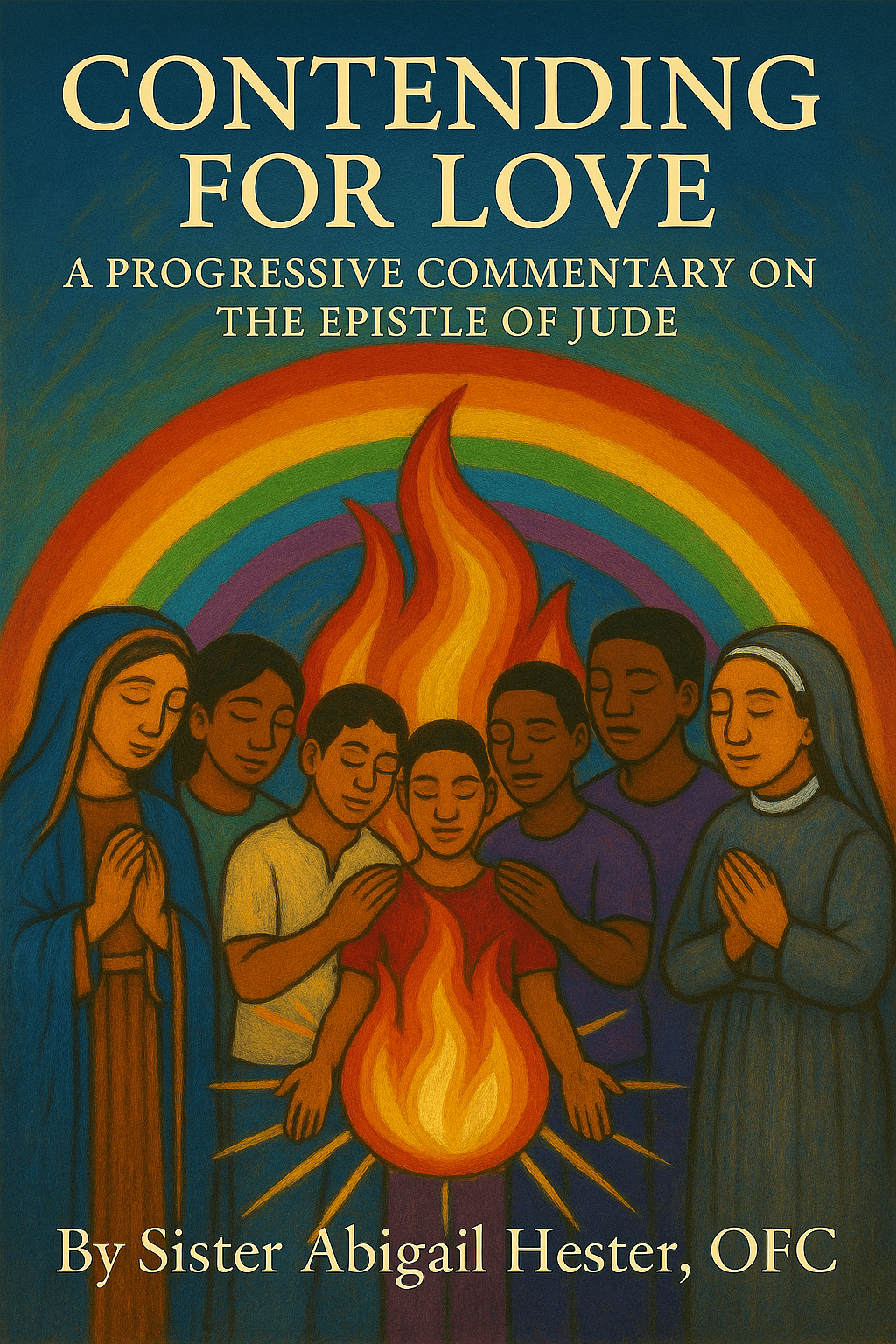
  • Contending for Love: A Progressive Commentary on the Epistle of Jude

    Contending for Love: A Progressive Commentary on the Epistle of Jude

    ✨ Contending for Love: A Progressive Commentary on the Epistle of Jude

    By Sister Abigail Hester, OFC
    For the Order of Franciscan Clareans


    📖 Introduction

    The Epistle of Jude, a brief and often overlooked letter near the end of the New Testament, is usually remembered for its fiery denunciations of false teachers and its use of apocalyptic imagery. Historically, it has been weaponized by some to accuse those who do not conform to rigid religious norms—including LGBTQIA+ Christians—of moral decay. But when we read Jude through the lenses of liberation, universal love, and radical inclusion, a different message emerges: a call to remain grounded in love, community, and the mercy of God in the face of division and injustice.


    📚 Verses 1–2: A Greeting of Belovedness

    “To those who are called, who are beloved in God the Father and kept safe for Jesus Christ: May mercy, peace, and love be yours in abundance.”

    Jude opens with a powerful affirmation: we are calledbeloved, and kept safe. For queer and trans Christians who have been told they are unwanted by God, this greeting is balm. Jude does not condition God’s love on moral purity or religious conformity—it is freely given, abundant, overflowing.

    From a Franciscan Clarean perspective, we affirm that each person bears the image of Christ. Just as Francis kissed the leper and Clare offered sanctuary to her sisters, we are called to recognize every soul—especially the marginalized—as beloved and held safely in divine love.


    🕊️ Verses 3–4: Contending for the Faith — Not Weaponizing It

    “I find it necessary to write and appeal to you to contend for the faith… For certain intruders have stolen in among you… perverting the grace of our God into licentiousness and denying our only Master and Lord, Jesus Christ.”

    These verses are often used to justify boundary policing in the Church—especially of LGBTQIA+ people. But what does it really mean to “contend for the faith”?

    In liberation theology, “faith” is not static doctrine but the living praxis of love and justice. To contend for the faith is not to gatekeep—it is to resist empire, exclusion, and exploitation. The “intruders” Jude refers to may be understood in our time as those who corrupt the gospel of grace to uphold domination, be it through nationalism, white supremacy, transphobia, or patriarchy.

    Queer theologians remind us: true heresy is not queerness—it is the denial of God’s image in our diversity.


    🔥 Verses 5–16: Warnings Through Apocalyptic Midrash

    Jude draws from Jewish apocalyptic traditions—stories of fallen angels, Sodom, Cain, and Balaam. These warnings can seem harsh and otherworldly, but read through a Franciscan lens, they serve not to condemn but to call attention to systems of exploitation and injustice.

    Sodom and Queer Misreadings

    Verse 7 refers to Sodom—often misused as a clobber passage.

    “Sodom and Gomorrah…indulged in sexual immorality and pursued unnatural lust.”

    Yet the biblical witness in Ezekiel 16:49 tells us the sin of Sodom was pride, excess, and failure to care for the poor and needy. In other words: the sin of empire, not same-gender love.

    Liberation and queer theologies insist: we must reclaim these texts from harmful misuse. The cities of Sodom and Gomorrah are warnings against violence and inhospitality—especially toward strangers and the vulnerable. The real “unnatural” sin is the dehumanization of queer bodies, not their existence.


    🌱 Verses 17–23: Building Up in Love

    “But you, beloved, build yourselves up on your most holy faith; pray in the Holy Spirit; keep yourselves in the love of God…”

    Here, Jude shifts tone: from judgment to nurture. These verses are the heart of the letter for progressive Christians.

    • Pray in the Spirit: not in fear, but in intimacy with the divine presence that speaks through all people—especially the silenced.
    • Keep in the love of God: Not by conformity, but by radical compassion and justice.
    • Show mercy: Even to those who doubt, to those caught in fear and judgment. Liberation theology reminds us that the work of justice includes healing both the oppressed and the oppressor.

    This is a call to queer sanctity—to form communities that are fierce in love, honest in lament, and faithful to the Spirit of God who dances beyond boundaries.


    🌈 Verse 22–23: Mercy that Rescues

    “And have mercy on some who are wavering; save others by snatching them out of the fire; and have mercy on still others with fear…”

    These verses are often read with anxiety. But what if “snatching from fire” means liberating people from the burning structures of empire? The fires we face today are not divine punishment but the consequences of greed, racism, transphobia, and ecological destruction.

    The queer and trans community has often been placed in this fire—not by God, but by a Church complicit in violence. We, as Franciscan Clareans, are called to rescue each other with mercy, not judgment.


    🌟 Verses 24–25: A Universal Benediction

    “Now to the One who is able to keep you from falling and to present you without blemish… to the only God… be glory…”

    Jude closes not with threat but praise. This God is not the condemner but the sustainer. The One who presents us without blemish is not fixated on our past, but devoted to our healing and wholeness.

    This is liberal Christian universalism at its core: God will not lose any of us. There is no soul too queer, no heart too wounded, no life too far gone. All are drawn into the light of mercy.


    🎨 Devotional Reflection

    Art Prompt: Paint a flame that does not burn but heals. Around it are people of all genders, races, and orientations—dancing, embraced, loved.

    Liturgical Action: Light a candle for each group harmed by religious exclusion (LGBTQIA+ people, women, the disabled, racial minorities, the poor). Offer this prayer:
    “God of all mercy, we kindle your light where others brought fire to destroy. Make us healers, not gatekeepers. Make us vessels of your inclusive flame.”


    🕊️ Final Thoughts for the Order of Franciscan Clareans

    As followers of St. Francis and St. Clare, we are not afraid of the fire—we transform it. We reclaim Jude not as a letter of condemnation, but as a call to courageous compassion. We contend for the faith not by excluding others, but by embracing the radical, boundary-breaking love of Christ.

    May we, too, be kept in love, held in mercy, and unafraid to dance at the margins where Christ still walks.

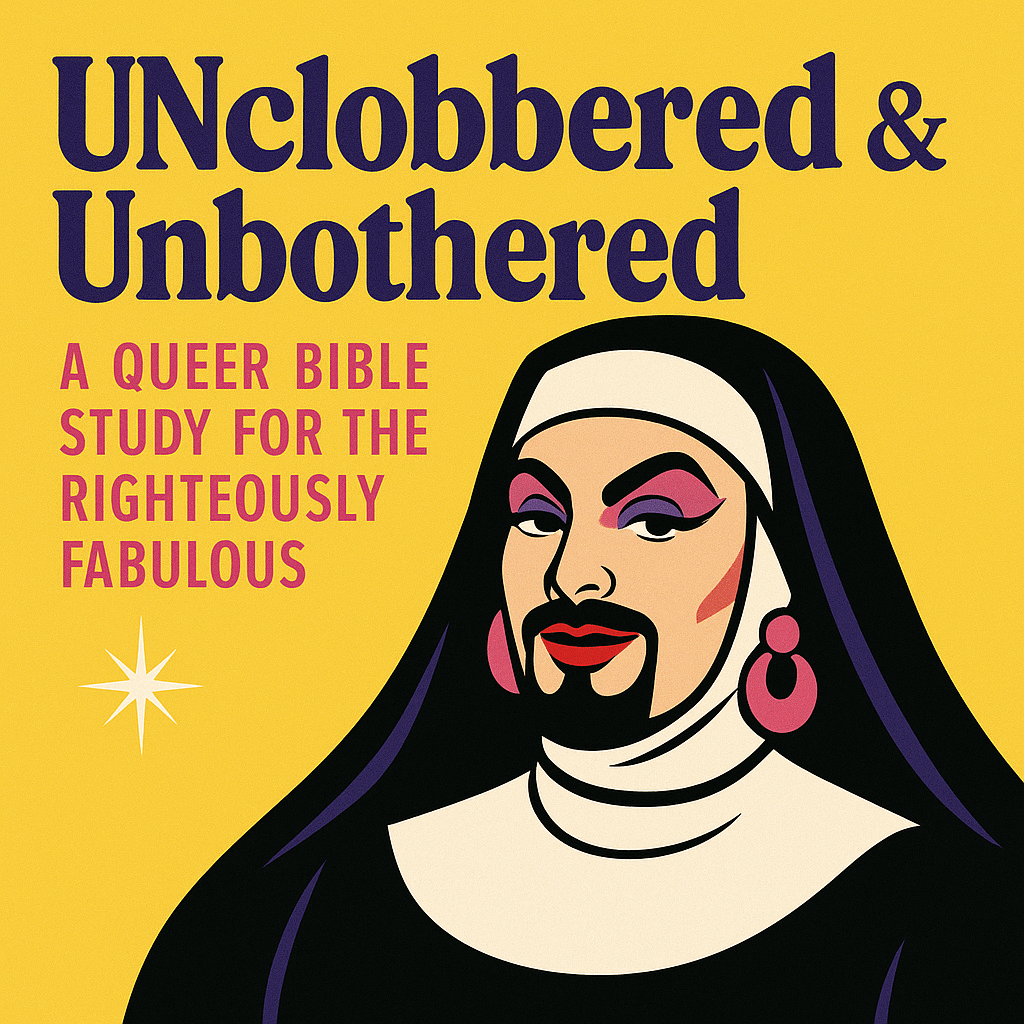
  • 📖 Unclobbered & Unbothered: A Queer Bible Study for the Righteously Fabulous

    📖 Unclobbered & Unbothered: A Queer Bible Study for the Righteously Fabulous


    By Sister Abigail Hester, OFC
    A Franciscan Clarean Defense of LGBTQIA+ People in the Face of Weaponized Scripture


    💥 Introduction: Holy Misinterpretation, Batman!

    Let’s get one thing straight — or rather, let’s get everything delightfully queer: the Bible is not a homophobic book. It has been read that way by empire, patriarchy, and bigots with bad haircuts and worse hermeneutics. But when we read the text through the lens of liberation, context, and queerness, the clobber passages turn into… well, laughable.

    This study will walk us through the so-called “clobber texts,” clap back with history, context, theology, and a wink of divine sass. Because honey — we weren’t made to sit silently while folks misuse the Word to harm the very ones Christ came to liberate.


    📜 The “Clobber Passages” in Question

    These are the six classic “texts of terror” often flung like theological dodgeballs at queer folks:

    1. Genesis 19 – Sodom and Gomorrah
    2. Leviticus 18:22 & 20:13 – “Man shall not lie with man…”
    3. Romans 1:26–27 – “Shameful lusts”
    4. 1 Corinthians 6:9–10 – “The effeminate” and “homosexuals”
    5. 1 Timothy 1:9–10 – “Perverts” or “sodomites”
    6. Jude 1:7 – Sexual immorality of Sodom again

    Let’s unclobber these one by one.


    1. 💣 Genesis 19: Sodom and Gomorrah

    Clobber claim: God destroyed Sodom for gay sex.

    Response: God destroyed Sodom for rape, violence, and inhospitality — not Pride floats and drag brunches.

    “Now this was the sin of your sister Sodom: she was arrogant, overfed and unconcerned; they did not help the poor and needy.” – Ezekiel 16:49

    🎯 Boom. That’s the Bible clapping back at bad theology.

    The real sin: Abuse of power, exploitation, and cruelty to strangers. In other words, homophobia, not homosexuality, is the Sodomite sin.

    Queer note: If anything, Genesis 19 is a call to defend the vulnerable — especially travelers, the gender-nonconforming, and the powerless. Sounds like a call to queer hospitality!


    2. 🧀 Leviticus 18:22 & 20:13

    “You shall not lie with a male as with a woman; it is an abomination.”

    Clobber claim: Being gay is an abomination.

    Response: So is eating shrimp, wearing polyester, and planting two seeds in one field (see Leviticus 11:10, 19:19). But you don’t see them picketing Red Lobster, do you?

    📘 Marcus Borg and John Dominic Crossan remind us: Leviticus is a purity code, not a moral absolute. It was written for ritual cleanliness, not eternal judgment.

    Abomination (Hebrew: toevah) means “ritually impure,” not “eternally condemned.” It was about Israel’s identity, not your date to prom.

    Queer theology twist: Jesus broke the purity codes constantly — touching lepers, eating with sinners, and healing on the Sabbath. If you’re breaking purity rules to love better, you’re doing it right.


    3. 🌀 Romans 1:26–27

    “God gave them up to shameful lusts… men committing shameless acts with men…”

    Clobber claim: Paul condemns homosexuality.

    Response: Paul condemns exploitative, idolatrous, excessive lust, not loving same-sex relationships.

    This is Paul throwing shade at Roman orgies and temple prostitution, not your marriage license.

    🧠 Scholar alert! Beverly Roberts Gaventa and Daniel Helminiak point out that Romans 1 describes unnatural acts — but Paul isn’t defining what’s natural in your biology. He’s critiquing excessive Greco-Roman patriarchal sexual dominance.

    Patrick Cheng says this passage is about imperial excess, not queer tenderness. Paul didn’t know about modern sexual orientation. To read that back into the text is like blaming Jesus for Twitter.

    Fun fact: In Greek, “unnatural” (para physin) is also used to describe God’s actions (Romans 11:24). So clearly, “unnatural” ≠ evil. Sometimes divine love is unnatural — especially when it breaks the world’s rules.


    4. 🎭 1 Corinthians 6:9–10

    “Neither the sexually immoral… nor men who have sex with men…”

    Clobber claim: Gays go to hell.

    Response: The Greek words used here are:

    • Malakoi – “soft ones,” often referring to effeminate men or passive partners (but also used for luxury pillows).
    • Arsenokoitai – a bizarre compound word Paul seems to invent, literally “man-bedders.”

    🧑‍🏫 John Boswell and Dale Martin show us: we don’t really know what arsenokoitai means. It shows up almost nowhere else in ancient Greek literature. Could mean exploiters. Could mean temple pimps. Could mean… tax collectors for all we know.

    So unless you’ve built an entire theology on mistranslating ancient Greek and ignoring love, maybe sit this one out, clobber crowd.


    5. 🪓 1 Timothy 1:9–10

    “The law is laid down… for the unholy and sinful, for those who kill their fathers or mothers, for murderers, the sexually immoral, men who practice homosexuality…”

    Clobber claim: The New Testament condemns homosexuality.

    Response: Again, we’re dealing with that strange word arsenokoitai — not “gay people” in modern terms. There’s zero reason to believe Paul had anything in mind resembling today’s same-sex relationships built on mutual love, covenant, and faithfulness.

    Also — let’s talk context. This list is like Paul’s version of a “bad people” rap sheet, mixing thieves, liars, and… apparently queer folks if we mistranslate? Not convincing.

    Truth bomb: Love rooted in justice, mutuality, and consent is never what Paul condemns. What’s condemned is exploitation, domination, and violence. And that applies to all sexualities.


    6. 🔥 Jude 1:7

    “Sodom and Gomorrah… indulged in sexual immorality and pursued unnatural lust.”

    Clobber claim: LGBTQ people are like the people of Sodom — lustful and unnatural.

    Response: What’s “unnatural” to empire often looks like God’s justice breaking through. If you’ve ever loved someone in a way the world told you was wrong — welcome to the revolution.

    Marcella Althaus-Reid calls this “indecent theology” — reclaiming the power of the body, of erotic love, of pleasure, and queerness as sacred, not sinful.

    So if loving queerly is unnatural, then so is grace. And I, for one, am living for both.


    ✊ Holy Takeaways: What Jesus Would Say

    • Jesus never said a word against LGBTQIA+ people.
    • He did say a lot against religious hypocrites.
    • He did say love your neighbor. And honey, that includes your queer neighbor — and yourself.

    🧼 Clobber texts = cherry-picked, context-ignoring, empire-approved weaponry.
    💖 Queer love = holy, sacred, Christ-reflecting.


    💅 Closing Benediction (Drag Mass Style)

    May your love be louder than their hate.
    May your queerness be too fabulous to ignore.
    May your faith be too fierce to silence.
    And may your theology leave no clobber passage unchallenged.

    Go in peace, beloveds. And throw glitter in the face of bad exegesis.