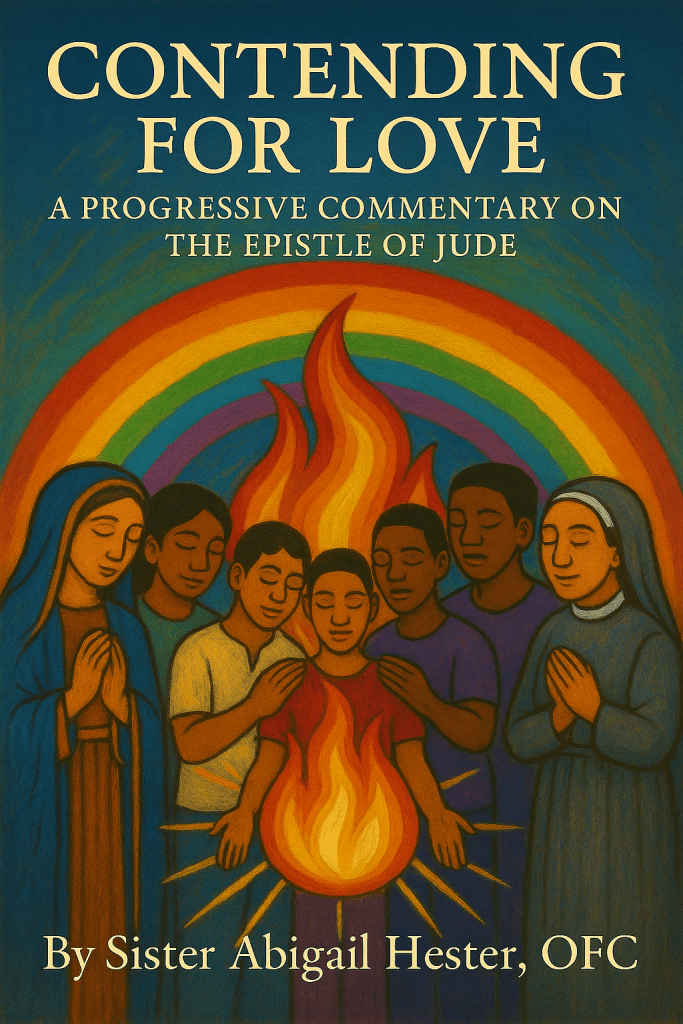
✨ Contending for Love: A Progressive Commentary on the Epistle of Jude
By Sister Abigail Hester, OFC
For the Order of Franciscan Clareans
📖 Introduction
The Epistle of Jude, a brief and often overlooked letter near the end of the New Testament, is usually remembered for its fiery denunciations of false teachers and its use of apocalyptic imagery. Historically, it has been weaponized by some to accuse those who do not conform to rigid religious norms—including LGBTQIA+ Christians—of moral decay. But when we read Jude through the lenses of liberation, universal love, and radical inclusion, a different message emerges: a call to remain grounded in love, community, and the mercy of God in the face of division and injustice.
📚 Verses 1–2: A Greeting of Belovedness
“To those who are called, who are beloved in God the Father and kept safe for Jesus Christ: May mercy, peace, and love be yours in abundance.”
Jude opens with a powerful affirmation: we are called, beloved, and kept safe. For queer and trans Christians who have been told they are unwanted by God, this greeting is balm. Jude does not condition God’s love on moral purity or religious conformity—it is freely given, abundant, overflowing.
From a Franciscan Clarean perspective, we affirm that each person bears the image of Christ. Just as Francis kissed the leper and Clare offered sanctuary to her sisters, we are called to recognize every soul—especially the marginalized—as beloved and held safely in divine love.
🕊️ Verses 3–4: Contending for the Faith — Not Weaponizing It
“I find it necessary to write and appeal to you to contend for the faith… For certain intruders have stolen in among you… perverting the grace of our God into licentiousness and denying our only Master and Lord, Jesus Christ.”
These verses are often used to justify boundary policing in the Church—especially of LGBTQIA+ people. But what does it really mean to “contend for the faith”?
In liberation theology, “faith” is not static doctrine but the living praxis of love and justice. To contend for the faith is not to gatekeep—it is to resist empire, exclusion, and exploitation. The “intruders” Jude refers to may be understood in our time as those who corrupt the gospel of grace to uphold domination, be it through nationalism, white supremacy, transphobia, or patriarchy.
Queer theologians remind us: true heresy is not queerness—it is the denial of God’s image in our diversity.
🔥 Verses 5–16: Warnings Through Apocalyptic Midrash
Jude draws from Jewish apocalyptic traditions—stories of fallen angels, Sodom, Cain, and Balaam. These warnings can seem harsh and otherworldly, but read through a Franciscan lens, they serve not to condemn but to call attention to systems of exploitation and injustice.
Sodom and Queer Misreadings
Verse 7 refers to Sodom—often misused as a clobber passage.
“Sodom and Gomorrah…indulged in sexual immorality and pursued unnatural lust.”
Yet the biblical witness in Ezekiel 16:49 tells us the sin of Sodom was pride, excess, and failure to care for the poor and needy. In other words: the sin of empire, not same-gender love.
Liberation and queer theologies insist: we must reclaim these texts from harmful misuse. The cities of Sodom and Gomorrah are warnings against violence and inhospitality—especially toward strangers and the vulnerable. The real “unnatural” sin is the dehumanization of queer bodies, not their existence.
🌱 Verses 17–23: Building Up in Love
“But you, beloved, build yourselves up on your most holy faith; pray in the Holy Spirit; keep yourselves in the love of God…”
Here, Jude shifts tone: from judgment to nurture. These verses are the heart of the letter for progressive Christians.
- Pray in the Spirit: not in fear, but in intimacy with the divine presence that speaks through all people—especially the silenced.
- Keep in the love of God: Not by conformity, but by radical compassion and justice.
- Show mercy: Even to those who doubt, to those caught in fear and judgment. Liberation theology reminds us that the work of justice includes healing both the oppressed and the oppressor.
This is a call to queer sanctity—to form communities that are fierce in love, honest in lament, and faithful to the Spirit of God who dances beyond boundaries.
🌈 Verse 22–23: Mercy that Rescues
“And have mercy on some who are wavering; save others by snatching them out of the fire; and have mercy on still others with fear…”
These verses are often read with anxiety. But what if “snatching from fire” means liberating people from the burning structures of empire? The fires we face today are not divine punishment but the consequences of greed, racism, transphobia, and ecological destruction.
The queer and trans community has often been placed in this fire—not by God, but by a Church complicit in violence. We, as Franciscan Clareans, are called to rescue each other with mercy, not judgment.
🌟 Verses 24–25: A Universal Benediction
“Now to the One who is able to keep you from falling and to present you without blemish… to the only God… be glory…”
Jude closes not with threat but praise. This God is not the condemner but the sustainer. The One who presents us without blemish is not fixated on our past, but devoted to our healing and wholeness.
This is liberal Christian universalism at its core: God will not lose any of us. There is no soul too queer, no heart too wounded, no life too far gone. All are drawn into the light of mercy.
🎨 Devotional Reflection
Art Prompt: Paint a flame that does not burn but heals. Around it are people of all genders, races, and orientations—dancing, embraced, loved.
Liturgical Action: Light a candle for each group harmed by religious exclusion (LGBTQIA+ people, women, the disabled, racial minorities, the poor). Offer this prayer:
“God of all mercy, we kindle your light where others brought fire to destroy. Make us healers, not gatekeepers. Make us vessels of your inclusive flame.”
🕊️ Final Thoughts for the Order of Franciscan Clareans
As followers of St. Francis and St. Clare, we are not afraid of the fire—we transform it. We reclaim Jude not as a letter of condemnation, but as a call to courageous compassion. We contend for the faith not by excluding others, but by embracing the radical, boundary-breaking love of Christ.
May we, too, be kept in love, held in mercy, and unafraid to dance at the margins where Christ still walks.
 Sister Abigail Hester
Leave a comment