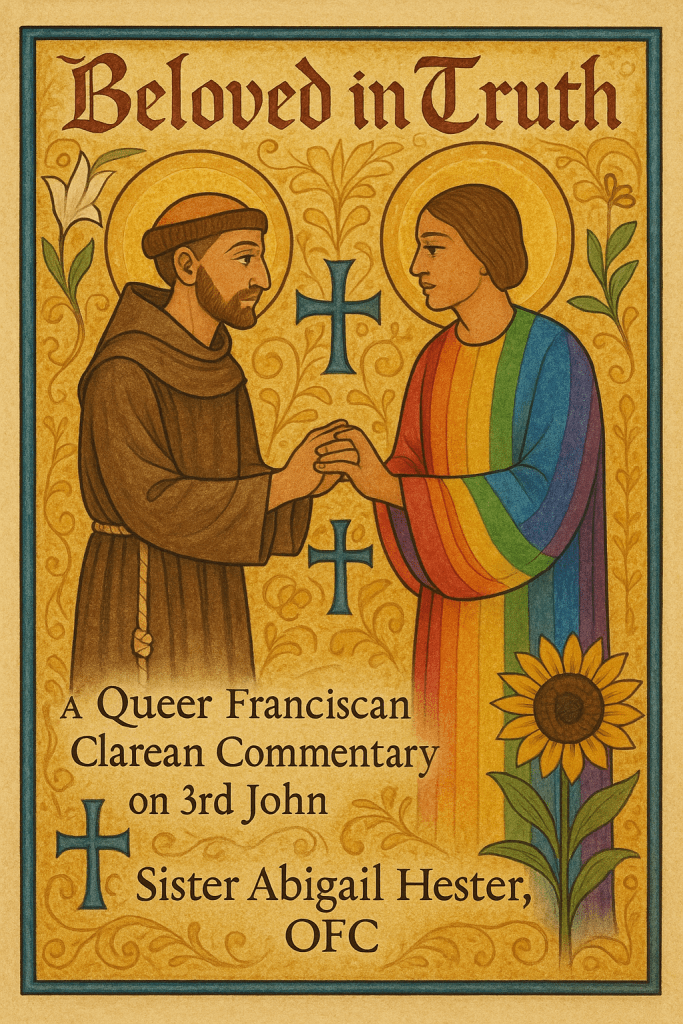
Beloved in Truth: A Queer Franciscan Clarean Commentary on 3rd John
by Sister Abigail Hester, OFC
Introduction: A Letter of Belovedness and Hospitality
The Third Epistle of John is the shortest book in the Bible, yet within its 219 words lies a powerful witness to the Franciscan Clarean way: love, hospitality, truth, nonviolence, and resistance to exclusion. This epistle offers not just early church correspondence, but a sacred mirror reflecting the beloved community God longs for—a community that centers welcome, integrity, and relational justice.
As Francis and Clare of Assisi abandoned wealth and privilege to live in solidarity with the poor and marginalized, so too does this text challenge us to examine who we honor, who we welcome, and how we live out truth and love in action. When read through the lenses of queer theology, liberation theology, and liberal Christian universalism, Third John becomes a testimony to sacred resistance against authoritarian gatekeeping and a defense of radical inclusion.
3 John 1:1 — “The elder to the beloved Gaius, whom I love in truth.”
Franciscan Clarean Reflection:
This epistle begins with deep affection: “whom I love in truth.” Not merely doctrinal truth, but relational truth—a truth rooted in mutual recognition, spiritual kinship, and unwavering love. For the Order of Franciscan Clareans, this echoes the holy intimacy between Francis and Clare—two souls bound not by institution but by the Spirit’s free movement.
Queer Theological Insight:
The language of “beloved” evokes the queer spiritual affirmation of chosen family. Gaius is not simply a church member—he is cherished, seen, and embraced. Queer and trans people, often cast out by religious institutions, can find hope in this epistle’s model of love rooted in truth and not conformity.
3 John 1:2 — “Beloved, I pray that all may go well with you and that you may be in good health, just as it is well with your soul.”
Liberation Theology Reflection:
Spiritual well-being cannot be separated from bodily health and justice. The writer prays for Gaius’s holistic wellness. In liberation theology, salvation is not merely future-tense or otherworldly—it is embodied liberation here and now. Health, dignity, safety—these are all signs of the Kingdom.
Franciscan View:
Francis, who kissed the leper and called even Sister Death his friend, recognized no separation between body and spirit, soul and society. May we too honor that our activism and prayer must nourish both body and soul.
3 John 1:3–4 — “I was overjoyed when some of the friends arrived and testified to your faithfulness to the truth… I have no greater joy than this, to hear that my children are walking in the truth.”
Clarean Vision:
Clare walked in truth not by wielding power but through contemplative solidarity, forming a community rooted in simplicity and mutual care. The joy in this passage reflects a mentor’s delight not in control, but in watching others blossom freely in Christ.
Universalist Insight:
The writer celebrates—not coerces. This is not the joy of conversion by fear, but of freely walking in divine truth. It reflects the universalist belief that God’s Spirit draws all into truth—not by force, but through joy and love.
3 John 1:5–8 — “Beloved, you do faithfully whatever you do for the friends, even though they are strangers to you… They have testified to your love before the church.”
Franciscan Hospitality:
Gaius is praised for offering hospitality to traveling Christians—those without status or security. Just as Francis opened his arms to lepers and outcasts, Gaius’s hospitality becomes a holy act of resistance against a gatekept religion.
Queer and Trans Application:
In today’s world, many queer Christians are still “strangers” to the institutional church. Gaius becomes a model for LGBTQ+ allies and clergy: open your doors, share your resources, and protect the vulnerable—even when others refuse.
3 John 1:9–10 — “I have written something to the church; but Diotrephes, who likes to put himself first, does not acknowledge our authority… he refuses to welcome the friends.”
Liberation Lens:
Here we see early church power struggles. Diotrephes is portrayed as authoritarian, exclusive, and controlling—hoarding authority and rejecting outsiders. Liberation theology reminds us that the Spirit works through the oppressed, not the self-appointed gatekeepers.
Franciscan Reversal:
Diotrephes is everything Francis rejected: prideful, possessive, hierarchical. True leadership in the Franciscan Clarean way is humble, communal, and welcoming—especially to the marginalized. Let us beware when religion becomes a mechanism of exclusion rather than incarnation.
3 John 1:11 — “Beloved, do not imitate what is evil but imitate what is good. Whoever does good is from God; whoever does evil has not seen God.”
Universalist Theology:
This verse emphasizes action over ideology. Doing good—not believing “correctly”—is the fruit of true divine relationship. Universalism affirms that God is known through acts of love, not doctrinal allegiance.
Clarean Wisdom:
Clare modeled spiritual discernment through gentle imitation of Christ. Her life was a constant “yes” to the good, even amid suffering and exclusion. We are invited to discern with our hearts and live in loving action.
3 John 1:12 — “Everyone has testified favorably about Demetrius, and so has the truth itself.”
Queer Affirmation:
Demetrius is publicly affirmed by “truth itself.” In a world where queer and trans people are often slandered, this verse speaks of the Spirit’s witness beyond gossip or institutional judgment. Let the fruit of our lives—joy, justice, peace—testify for us.
Franciscan Community Practice:
Testimony here is communal. Reputation is built in relationship, not isolation. Demetrius’s life is his gospel. In the Franciscan Clarean way, we too are called to preach with our lives.
3 John 1:13–15 — “I have much to write to you… Peace to you. The friends send you greetings. Greet the friends there, each by name.”
Sacred Belonging:
This ending breathes the air of intimacy, community, and connection. Each friend is greeted by name—no one forgotten, no one excluded. This is the heart of Franciscan community: a shared table where every name is sacred.
Queer Liturgical Insight:
Liturgies of resistance begin in relationships. This final greeting invites us to build networks of radical welcome, calling each other beloved, blessing one another in peace, and creating spiritual homes outside systems of exclusion.
Final Reflections for the Franciscan Clarean Way
3 John is not just a letter—it is a witness to what church can be.
- A church where love is stronger than hierarchy.
- A church where hospitality overrides doctrinal purity tests.
- A church where queer, poor, and exiled bodies are not just tolerated—but embraced as holy friends.
Let us, like Gaius, offer welcome.
Let us, like Francis and Clare, renounce control for kinship.
Let us, like the elder, speak truth in love.
Let us, like Christ, make room at the table for every child of God.
Amen and Amen.
 Sister Abigail Hester
Leave a comment