Blog

  • THE URBAN PILGRIM DAILY

    THE URBAN PILGRIM DAILY

    Monday, September 28, 2026

    Spirituality for the Streets • Wisdom for the Journey • A Fuller Life for Everyone

    Motto: Eternal Progression • A Fuller Life for Everyone • Live and Help Live


    SCRIPTURE FOR THE DAY

    “You will know the truth, and the truth will make you free.”

    — John 8:32

    Truth is not merely something we possess.

    Sometimes truth is the thing that interrupts what we thought we knew.

    That makes paying attention a spiritual discipline.


    FROM THE PILGRIM’S DESK

    Pack Curiosity

    An Urban Pilgrim carries useful things.

    Water.

    A flashlight.

    Medication.

    A power bank.

    Maybe a snack that was supposed to last until an emergency but mysteriously disappeared Tuesday afternoon.

    But there is another piece of everyday carry:

    curiosity.

    Before reacting:

    What actually happened?

    Who is telling the story?

    Whose voice is missing?

    Can I verify this?

    What don’t I know?

    Today is the International Day for Universal Access to Information, which makes those questions particularly appropriate.

    Information can liberate.

    It can also manipulate.

    The pilgrim therefore learns not only to find information, but to discern it.


    TODAY’S SERMON

    TRUTH WITHOUT A THRONE

    John 8:31–36

    “You will know the truth, and the truth will make you free.”

    Few biblical sentences have escaped their context as thoroughly as this one.

    It appears on libraries, universities, government buildings and motivational posters.

    But John wasn’t writing a slogan for fact-checking.

    The Fourth Gospel emerged near the end of the first century, probably through a complicated process involving a community’s traditions, theological reflection and conflict.

    John’s Jesus speaks differently from Jesus in Mark.

    Long speeches replace many short sayings and parables.

    Jesus speaks extensively about his identity.

    Historical-critical scholarship therefore cautions us against treating every Johannine speech as though someone secretly recorded Jesus with a first-century microphone.

    John gives us interpreted Jesus tradition.

    And yet its theological question remains powerful:

    What kind of truth liberates?

    The Greek word translated truth is alētheia.

    In John, truth is not merely correct information.

    Truth becomes relational.

    Embodied.

    Something encountered.

    That matters because people can possess enormous amounts of correct information and remain deeply unfree.

    An empire can have excellent statistics.

    A corporation can possess tremendous data.

    A church can memorize Scripture.

    A government can maintain enormous archives.

    Knowledge alone doesn’t guarantee liberation.

    The question is:

    Who controls knowledge, and what does knowledge serve?

    Throughout history, controlling information has been a way of controlling people.

    Who is educated?

    Who may read sacred texts?

    Who owns printing presses?

    Who controls newspapers?

    Who controls broadcasting?

    Who controls digital platforms?

    Whose history enters textbooks?

    Whose history disappears?

    These are questions of power.

    Liberation theology teaches us to ask where power sits.

    Feminist theology asks whose experience was excluded when supposedly universal truths were constructed.

    Queer theology asks who gets classified as normal or deviant—and who was allowed to create those categories.

    Postcolonial thought asks whose knowledge was dismissed as primitive while imperial knowledge declared itself objective.

    An anarcho-communist perspective asks another uncomfortable question:

    What happens when knowledge becomes concentrated within hierarchical institutions that ordinary people cannot meaningfully question?

    None of this means expertise is bad.

    Expertise matters enormously.

    I want trained engineers designing bridges.

    I want physicians practicing medicine.

    I do not want Brother Francis improvising nuclear-reactor maintenance because hierarchy makes him uncomfortable.

    Expertise and domination are not identical.

    The question is whether knowledge becomes shared capacity or concentrated power.

    Good knowledge empowers communities.

    That connects surprisingly well with Jesus.

    Jesus teaches ordinary people.

    Fishermen.

    Women.

    Laborers.

    People excluded from respectable religious society.

    He tells stories about farmers, bread, weeds, sheep, coins and household work.

    The sacred appears in ordinary knowledge.

    Francis does something similar centuries later.

    He doesn’t establish his movement around elaborate academic credentials.

    He learns from lepers.

    Birds.

    Poor people.

    Roads.

    Suffering.

    Scripture.

    Creation.

    Franciscan knowledge begins in attention.

    And perhaps that is where truth begins too.

    Pay attention.

    Look again.

    Listen to someone whose experience differs from yours.

    Admit:

    I may be wrong.

    Those four words can become spiritual practice.

    Religion often has difficulty saying them.

    We like certainty.

    Certainty feels secure.

    But certainty can become a fortress protecting us from reality.

    Radical theology invites another posture.

    John D. Caputo speaks of God less as an object we possess through correct propositions and more as an event—an insistence, a call, something happening within the name of God.

    God does not become information we control.

    God interrupts us.

    Justice interrupts us.

    The stranger interrupts us.

    The suffering body interrupts us.

    The earth interrupts us.

    Truth happens when the world refuses our convenient story.

    That makes truth dangerous.

    Suppose I believe poverty results primarily from laziness.

    Then I meet people working two jobs who still cannot afford housing.

    Reality interrupts my theory.

    Suppose I believe every family naturally protects its children.

    Then I listen to queer people describing rejection.

    Reality interrupts my theory.

    Suppose I believe humans stand above nature.

    Then ecological collapse reveals our dependence upon soil, water, insects, microorganisms and climate.

    Reality interrupts my theory.

    Truth makes us free because truth destroys some of our cages.

    But there is another side.

    Access matters.

    A person cannot act upon information deliberately withheld from them.

    Workers need information about workplace hazards.

    Communities need information about pollutants.

    Patients need understandable medical information.

    Citizens need information about decisions made in their name.

    People facing emergencies need reliable information about weather, evacuation routes, shelter and services.

    Information is therefore part of preparedness.

    During emergencies, rumors travel remarkably fast.

    Someone posts:

    “The water is contaminated.”

    Another person forwards it.

    Twenty minutes later half the neighborhood believes mutant alligators are coming through the faucets.

    Before sharing emergency information, pause.

    Check the source.

    Check the date.

    Check whether another reliable source confirms it.

    That tiny discipline can protect people.

    This is especially important in communities.

    Mutual aid depends upon trust.

    And trust depends upon truthfulness.

    If we organize horizontally, without coercive hierarchy, then reliable shared information becomes even more important.

    People need enough knowledge to participate meaningfully in decisions affecting them.

    Information becomes part of the commons.

    But truth also requires humility.

    Nobody sees everything.

    Not scientists.

    Not theologians.

    Not activists.

    Not clergy.

    Certainly not preachers with newsletters.

    Our perspectives remain partial.

    That doesn’t mean all claims are equally true.

    It means good discernment requires evidence, dialogue and willingness to revise ourselves.

    The Urban Pilgrim therefore walks with two commitments:

    Seek truth.

    And:

    Hold your certainty lightly enough for truth to surprise you.

    Jesus says:

    “You will know the truth, and the truth will make you free.”

    Maybe freedom begins when we stop demanding that reality agree with us.

    Look.

    Listen.

    Learn.

    Question.

    Verify.

    Change.

    And when truth calls from somewhere inconvenient—

    answer.

    Amen.


    THE WORLD OUTSIDE OUR DOOR

    The Right to Know

    Today, September 28, is UNESCO’s International Day for Universal Access to Information. UNESCO proclaimed the observance in 2015, and the U.N. General Assembly recognized it at the U.N. level in 2019. The observance emphasizes access to information as important for informed decision-making, inclusion and social progress.

    Today is also World Rabies Day. The World Health Organization’s 2026 theme is “Stronger Together,” emphasizing cooperation among communities, veterinary professionals, healthcare workers, governments and global partners. WHO also recently validated Bhutan as having eliminated dog-mediated human rabies as a public-health problem after years of vaccination, surveillance, free treatment and community participation.

    Urban Pilgrim reflection: These observances unexpectedly belong together.

    Reliable information can save lives.

    But information must be accessible, not merely technically available. A warning that people cannot read, hear, understand, afford to access or act upon is not adequate communication.

    From my anarcho-communist perspective, knowledge should empower communities rather than function primarily as something hoarded by institutions or used to control people.

    From my Franciscan perspective, knowledge becomes wisdom when it helps us care for our neighbors—including our animal neighbors.


    SCHOLAR’S CORNER

    John Is Not a Transcript

    The Gospel of John was probably composed toward the end of the first century and reflects substantial theological development.

    Its long speeches differ considerably from the shorter sayings and parables characteristic of the Synoptic Gospels.

    Historical-critical reading doesn’t make John worthless.

    It makes John interesting.

    Instead of asking only:

    “Did Jesus say these exact words?”

    we can also ask:

    “What did communities following Jesus come to understand about him?”

    Scripture becomes conversation rather than stenography.


    QUESTION EVERYTHING

    Is Doubt the Enemy of Faith?

    Maybe not.

    Doubt can become intellectual humility.

    Certainty says:

    I already know.

    Faith can say:

    I will keep walking even though I don’t know everything.

    A pilgrim doesn’t need to know the entire road.

    She needs enough light for the next few steps.


    CREATION IS OUR MONASTERY

    Learn One Name

    Choose one tree, bird, plant or insect you encounter today.

    Learn its name.

    Not because naming means possessing it.

    Because attention creates relationship.

    Yesterday it was “some bird.”

    Today it becomes a neighbor.


    QUEER WISDOM

    Listen to People About Their Own Lives

    One simple principle can dismantle a surprising amount of domination:

    People possess knowledge about their own experience.

    Queer and transgender people do not need outsiders to explain their own lives back to them.

    Listening does not require abandoning critical thought.

    It requires recognizing that lived experience is also a form of knowledge.

    Sometimes solidarity begins by shutting up long enough to learn something.


    ONE BIG IDEA

    Situated Knowledge

    Feminist philosopher Donna Haraway has challenged the fantasy of a completely disembodied observer looking at reality from nowhere.

    We always see from somewhere.

    Bodies.

    Histories.

    Cultures.

    Communities.

    Experiences.

    That does not mean truth is impossible.

    It means humility belongs inside knowledge.

    Ask:

    Where am I standing when I see this?


    SAINT, HERETIC & TROUBLEMAKER OF THE DAY

    Hypatia

    Hypatia taught philosophy and mathematics in Alexandria during late antiquity.

    She became an influential public intellectual before being murdered by a Christian mob in 415 CE amid political and religious conflict.

    Christians should remember stories like hers.

    Religion does not become holy merely because it believes itself correct.

    When certainty joins power and dehumanization, people can become dangerous while believing themselves righteous.

    The pilgrim chooses curiosity over the mob.


    WORDS FOR THE ROAD

    Truth does not fear questions; domination does.


    PILGRIM JOURNAL PROMPT

    What belief do I hold so tightly that I become defensive when someone questions it?

    Write:

    “What evidence could change my mind?”

    If the answer is nothing, ask whether you are holding a conclusion—or protecting an identity.


    HOLY FOOLERY

    A theologian announced:

    “I have finally figured God out.”

    God whispered:

    “That’s adorable.”


    PRAYER FOR PEACE ACROSS ALL FAITHS

    Sacred Mystery beyond every name,

    bless those seeking truth.

    Protect journalists.

    Protect teachers.

    Protect scientists.

    Protect librarians.

    Protect whistleblowers.

    Protect communities whose stories have been erased.

    Bless Christians, Jews, Muslims, Hindus, Buddhists, Sikhs, Pagans, Indigenous traditions, humanists, atheists and seekers.

    Where propaganda divides us,

    give discernment.

    Where ignorance creates fear,

    give understanding.

    Where knowledge becomes power over others,

    make it wisdom shared among neighbors.

    May truth serve liberation.

    May knowledge serve compassion.

    May wisdom serve peace.

    Amen.


    FRANCISCAN CLAREAN REFLECTION

    The Book of Creation

    Francis learned theology from Scripture.

    He also learned from creatures.

    Bird.

    Wolf.

    Water.

    Fire.

    Sun.

    Moon.

    The world itself became a book.

    Today practice Franciscan scholarship:

    Read one page of creation.

    Slowly.

    No footnotes required.


    CHRISTO-CORRELLIAN / INTERSPIRITUAL MOMENT

    The Lamp Within

    Light a candle safely, or imagine one.

    Say:

    May truth illuminate without blinding.

    May wisdom guide without dominating.

    May mystery remain larger than my certainty.

    Sit quietly.

    Let the flame remind you:

    Light reveals.

    It does not need to shout.


    KILUBANSA HEALING MOMENT

    Listen Before Fixing

    Place a hand comfortably over your heart.

    Ask:

    What is my body telling me today?

    Not:

    “What is wrong with me?”

    But:

    “What do I need?”

    Rest?

    Water?

    Food?

    Movement?

    Medical attention?

    Company?

    Quiet?

    Healing begins with listening.


    THE HERBAL MINUTE

    Rosemary — Memory in the Garden

    Rosemary (Salvia rosmarinus) has a long culinary and traditional herbal history and has culturally been associated with remembrance.

    The simplest use remains one of the best:

    food.

    Use rosemary to season vegetables, beans, soups or bread.

    Culinary amounts are different from concentrated extracts or essential oils. Rosemary essential oil should not casually be swallowed, and concentrated herbal products can carry medication, pregnancy or medical-condition considerations.

    The Urban Pilgrim herbal rule remains:

    Start with food before pretending your kitchen needs to become Hogwarts.


    URBAN PREPAREDNESS

    Verify Before You Share

    During an emergency, bad information can create its own emergency.

    Before forwarding a warning:

    1. Check the source.
    Is it an emergency-management agency, weather service, utility, transit authority or other credible source?

    2. Check the date and time.
    Old emergency posts routinely return from the dead.

    3. Confirm when possible.
    Look for another reliable source.

    4. Share the source, not merely the rumor.

    Accessibility matters too.

    If someone cannot easily read an alert, tell them.

    If someone cannot hear an announcement, show them.

    Community resilience depends upon information reaching everybody.

    Preparedness isn’t knowing everything.

    It’s knowing where to find trustworthy information when you need it.


    OUTDOOR PILGRIM SKILL

    Three Landmarks

    Navigation doesn’t begin with fancy equipment.

    It begins with noticing.

    During your next walk, deliberately identify three landmarks:

    a distinctive building,

    intersection,

    bridge,

    hill,

    tower,

    stream,

    trail junction,

    or other stable feature.

    Periodically look behind you.

    A route often looks surprisingly different in reverse.

    This practice builds an internal map of your surroundings.

    For visually impaired pilgrims, navigation may instead rely more heavily on tactile landmarks, sound cues, accessible GPS, familiar routes, orientation-and-mobility techniques, or a trusted companion.

    The principle remains:

    Know what tells you where you are.

    Pilgrimage requires wonder.

    It also helps to know how to get home.


    PILGRIM PRACTICE FOR TODAY

    Learn One Useful Thing

    Today learn one piece of information that increases your ability to care for yourself or somebody else.

    Your local emergency number or non-emergency service.

    A neighbor’s phone number.

    Where the nearest public library is.

    How to identify one local plant.

    Where your household water shutoff is.

    A transit route.

    A first-aid skill.

    Something small.

    Then share something useful you know with somebody else.

    Knowledge becomes community when it circulates.


    CLOSING BLESSING

    May your curiosity remain larger than your certainty.

    May knowledge make you useful rather than arrogant.

    May information become a commons rather than a weapon.

    May preparedness produce confidence rather than fear.

    May questions become doors rather than threats.

    May Francis teach you attention.

    May Clare teach you discernment.

    May Hypatia remind you what certainty joined to domination can destroy.

    May queer wisdom teach you to listen to lives that institutions have misunderstood.

    May creation remain a book you never finish reading.

    And may the God who refuses to become an answer we can possess continue to insist within every honest question:

    Look again.

    Listen deeper.

    Check your source.

    Love your neighbor.

    Change your mind when truth requires it.

    And keep walking.

    Eternal Progression • A Fuller Life for Everyone • Live and Help Live.
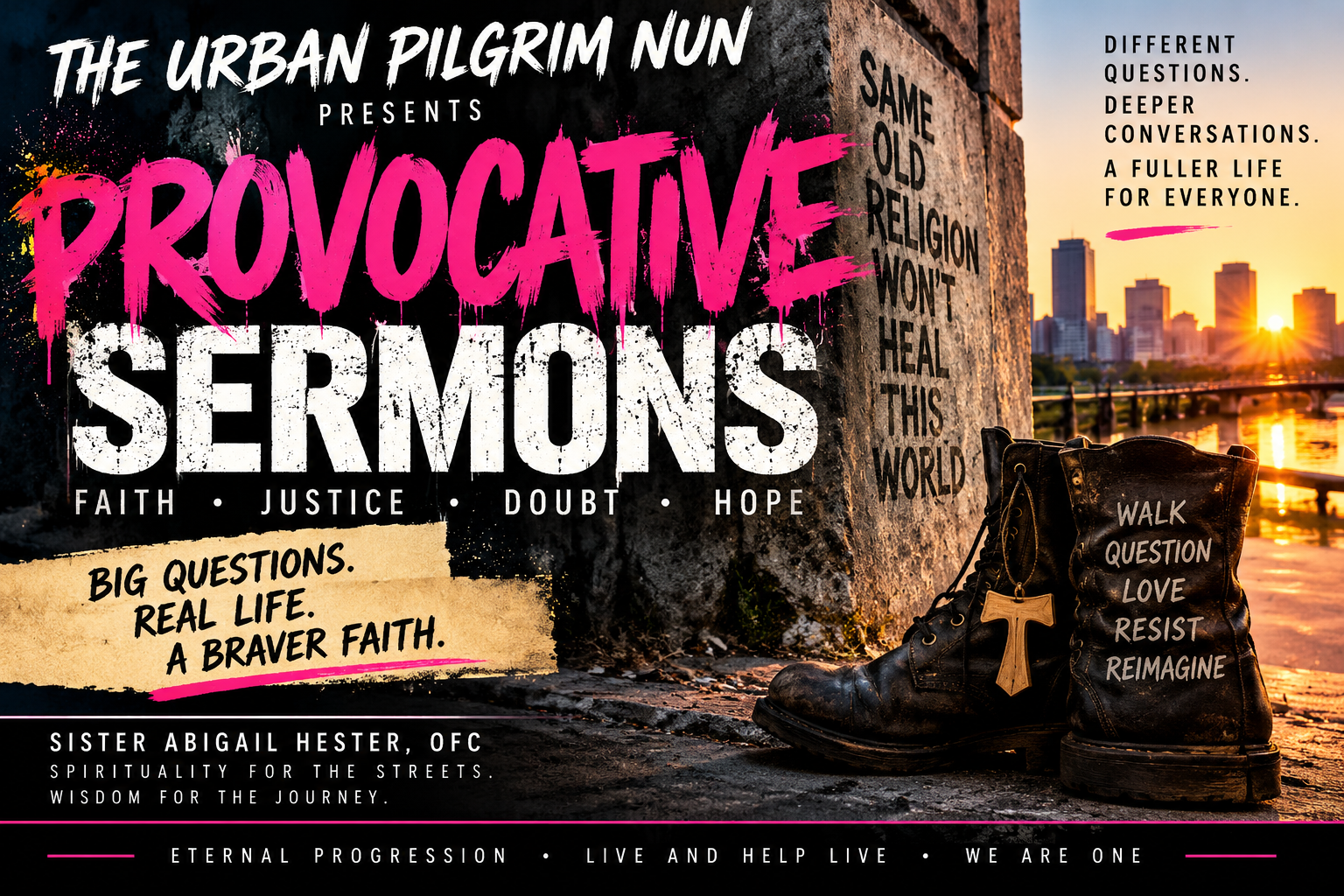
  • THE URBAN PILGRIM DAILY

    THE URBAN PILGRIM DAILY

    Sunday, September 27, 2026

    Spirituality for the Streets • Wisdom for the Journey • A Fuller Life for Everyone

    Motto: Eternal Progression • A Fuller Life for Everyone • Live and Help Live


    SCRIPTURE FOR THE DAY

    “The earth is the LORD’s and all that is in it, the world, and those who live in it.”

    — Psalm 24:1

    The psalmist makes a terrible real-estate agent.

    Apparently the final owner of everything is not us.

    That changes how pilgrims travel through the world.


    FROM THE PILGRIM’S DESK

    Walk Through the World as a Guest

    Today is World Tourism Day.

    That makes me think about the difference between a tourist and a pilgrim.

    A tourist can ask:

    What can I get from this place?

    A pilgrim asks:

    How should I encounter this place?

    Pilgrimage doesn’t require Jerusalem, Rome, Mecca, Bodh Gaya, or some distant mountain.

    Your pilgrimage may begin when you walk out your front door.

    But wherever we travel, another question follows:

    What do we leave behind?

    A pilgrim should leave more kindness than trash, more curiosity than judgment, and ideally fewer snack wrappers than she started with.

    Today, walk gently.

    The world isn’t scenery.

    It is community.


    TODAY’S SERMON

    THE EARTH DOES NOT BELONG TO US

    Psalm 24:1–6

    “The earth is the LORD’s.”

    We’ve heard those words so many times that their strangeness can disappear.

    Psalm 24 probably emerged within Israel’s worshipping tradition and contains imagery associated with entering sacred space.

    The worshipper asks:

    Who may ascend the hill of the LORD?

    But before anyone reaches the sanctuary, the psalm makes an enormous theological claim.

    The whole earth already belongs to God.

    Not merely the temple.

    Not merely Jerusalem.

    Not merely Israel.

    Earth.

    That should complicate religion.

    We build sacred buildings and then imagine God lives there.

    The psalmist kicks the doors open.

    God was outside before we arrived.

    The river was sacred before somebody built the church beside it.

    The forest did not become holy when a priest blessed it.

    The squirrel has apparently been attending worship without filling out a membership card.

    Francis of Assisi understood something like this intuitively.

    He spoke of Brother Sun, Sister Moon, Brother Wind, Sister Water, Mother Earth.

    That language can sound quaint until we realize what it does.

    Francis turns things into relatives.

    And relatives are difficult to reduce to commodities.

    You can put a price on lumber.

    It becomes harder to put a price on your sister.

    Our modern economies often train us to encounter the earth primarily through usefulness.

    A forest becomes timber.

    A river becomes water supply.

    Land becomes real estate.

    Animals become products.

    Human beings can suffer the same transformation.

    Workers become labor costs.

    Renters become revenue streams.

    Patients become billing opportunities.

    Tourists become customers.

    Even spirituality becomes content.

    Everything becomes something to extract value from.

    Psalm 24 interrupts:

    The earth isn’t yours.

    That is a theological claim with political consequences.

    My anarcho-communist convictions lead me to question arrangements where necessities of life can become concentrated under the control of relatively few people while others struggle for access.

    But there is also a specifically Franciscan challenge here.

    If creation is gift rather than absolute possession, then ownership cannot be morally unlimited.

    Having something creates responsibility.

    Land.

    Money.

    Food.

    Knowledge.

    Power.

    Even our own talents.

    The question changes from:

    “What am I legally permitted to do with this?”

    to:

    “What relationship of care does possessing this create?”

    That is stewardship.

    But I want to push further.

    Sometimes stewardship language still imagines humans standing above creation as benevolent managers.

    Francis gives us something more intimate.

    Kinship.

    We aren’t managers of Sister Water.

    We depend upon her.

    We aren’t supervisors of Mother Earth.

    We came from her.

    Our bodies are ecological events.

    The calcium in your bones came from somewhere.

    The oxygen entering your lungs was produced by other organisms.

    Your breakfast required soil, sunlight, water, microorganisms, plants, animals, farmers, transportation, labor, and countless relationships you will never see.

    The self-made person is biologically impossible.

    You are an ecosystem walking around pretending to be an individual.

    That should produce humility.

    It also gives us another way of hearing God.

    I don’t imagine God as a cosmic landlord holding the deed to planet Earth.

    John D. Caputo’s radical theology offers language I find more compelling.

    God insists.

    Creation calls.

    The polluted river calls.

    The exhausted soil calls.

    The displaced community calls.

    The endangered species calls.

    Future generations call.

    The divine insistence arrives as a question:

    Will you respond?

    God does not magically pick up our plastic.

    Apparently heaven has delegated litter duty.

    We respond.

    This is why ecological spirituality cannot end with admiring sunsets.

    A sunset asks very little of us.

    A poisoned watershed asks considerably more.

    Liberation theology teaches us to ask who suffers.

    Ecological justice adds:

    Who suffers first when ecosystems collapse?

    Usually people with the least economic and political power.

    People unable to relocate.

    People whose jobs require outdoor labor.

    People living near industrial pollution.

    Indigenous communities defending ancestral lands.

    Poor communities lacking resilient infrastructure.

    The ecological crisis is therefore also a justice crisis.

    And queer theology adds another interesting dimension.

    Queerness teaches suspicion toward rigid categories.

    Human/nature.

    Normal/abnormal.

    Pure/impure.

    Natural/unnatural.

    We often imagine ourselves separated from “nature,” as though humans arrived from another planet and built parking lots.

    But we are nature.

    Our extraordinary diversity is nature too.

    Creation is much queerer than people sometimes admit.

    Fungi refuse our tidy categories.

    Some animals change sex.

    Plants have reproductive strategies complicated enough to make certain church committees nervous.

    Creation isn’t obligated to fit our binaries.

    Perhaps ecological humility and queer humility begin in the same place:

    Reality exceeds our categories.

    So what does the pilgrim do?

    Walk.

    Notice.

    Carry what you need.

    Waste less.

    Learn the names of your neighbors—human and otherwise.

    Prepare for storms.

    Know where your water comes from.

    Share resources.

    Leave places better than you found them.

    And resist systems that treat communities and ecosystems as disposable.

    You do not need to save Earth today.

    Earth survived billions of years before you appeared.

    But you can change your relationship with the tiny piece of Earth beneath your feet.

    Psalm 24 says:

    The earth is the LORD’s.

    Perhaps today we might translate its ethical force:

    The earth does not belong to us.

    We belong to Earth.

    Walk accordingly.

    Amen.


    THE WORLD OUTSIDE OUR DOOR

    Climate, Life, Peace and Social Justice

    Thousands of people marched across France yesterday, September 26, in demonstrations connecting climate action with life, peace and social justice. Organizers reported roughly 120,000 participants across about 260 demonstrations; those figures are organizer estimates rather than an independently verified national count.

    The demonstrations follow a week in which climate questions have been prominent internationally. At the Vatican, Pope Leo XIV recently told the Pontifical Academy of Sciences that climate change is not merely an environmental challenge but a matter of justice, and emphasized scientific cooperation and responsibility.

    Urban Pilgrim reflection: From a Franciscan perspective, environmental destruction is inseparable from our relationship with one another. From my anarcho-communist perspective, ecological questions also require asking who controls resources, who receives the benefits of extraction, and who bears its costs.

    That interpretation is my ethical and political perspective, not a claim made by the demonstrators as a whole.

    Creation care becomes justice when we stop asking only:

    “How do we protect nature?”

    and begin asking:

    “How can human communities and the rest of creation flourish together?”


    SCHOLAR’S CORNER

    The Hebrew Word Eretz

    The Hebrew ’eretz in Psalm 24 can mean earth, land, or territory depending upon context.

    Here its scope is enormous:

    “The earth is YHWH’s and its fullness.”

    Ancient Israel did not possess our modern concept of environmentalism, but this theological claim places human ownership inside a larger reality.

    We possess things provisionally.

    Creation precedes our paperwork.


    QUESTION EVERYTHING

    What If Creation Doesn’t Need to Be Useful?

    Would a wetland still deserve protection if humans received no obvious economic benefit from it?

    Would an endangered creature matter if it provided us nothing?

    If creation only has value because humans find it useful, then our spirituality remains anthropocentric.

    Perhaps love sometimes means saying:

    You deserve to exist even when you do nothing for me.

    That applies surprisingly well to people too.


    CREATION IS OUR MONASTERY

    Meet One Neighbor

    During today’s walk, choose one nonhuman neighbor.

    A tree.

    Bird.

    Insect.

    Moss.

    Cloud formation.

    Do not photograph it immediately.

    Look first.

    Spend sixty seconds simply paying attention.

    Contemplation begins when something is allowed to exist without becoming content.


    QUEER WISDOM

    Nature Is Terrible at Respectability Politics

    Human beings love tidy categories.

    Creation apparently missed the memo.

    Life is full of variation, adaptation, interdependence and surprising forms.

    Queer wisdom reminds us that difference doesn’t need to justify itself before being welcomed.

    Sometimes liberation begins with three words:

    You may exist.


    ONE BIG IDEA

    Interbeing

    Thích Nhất Hạnh used the language of interbeing to illuminate radical interconnectedness.

    A sheet of paper contains rain, forests, sunlight, soil, workers and countless relationships.

    Nothing exists entirely by itself.

    Francis might have called that kinship.

    Ecology calls it interdependence.

    The pilgrim learns it simply by walking attentively.


    SAINT, HERETIC & TROUBLEMAKER OF THE DAY

    Wangari Maathai

    Wangari Maathai founded Kenya’s Green Belt Movement, linking tree planting with women’s empowerment, democracy and community development.

    Her work demonstrated something Urban Pilgrims should remember:

    Sometimes enormous political questions begin with extraordinarily practical actions.

    Plant a tree.

    Organize neighbors.

    Protect land.

    Teach someone.

    Repeat.


    WORDS FOR THE ROAD

    Walk through the world as though everything you meet belongs here too.


    PILGRIM JOURNAL PROMPT

    What place in my neighborhood have I treated merely as something to pass through?

    How might I begin treating it as somewhere I belong with, rather than somewhere that belongs to me?


    HOLY FOOLERY

    Francis looked at the birds and preached.

    The birds listened.

    Eight centuries later humans are still arguing in the comments section.

    Francis may have chosen his audience wisely.


    PRAYER FOR PEACE ACROSS ALL FAITHS

    Sacred Mystery beyond our naming,

    bless every path seeking peace.

    Bless Christians, Jews, Muslims, Hindus, Buddhists, Sikhs, Pagans, Indigenous traditions, humanists, atheists and seekers.

    Protect communities threatened by war.

    Protect people displaced by disaster.

    Protect forests, rivers, oceans and creatures unable to petition governments on their own behalf.

    Teach us cooperation instead of domination,

    enough instead of endless accumulation,

    and reverence instead of possession.

    May peace take root in Earth and in us.

    Amen.


    FRANCISCAN CLAREAN REFLECTION

    Sister Water

    Drink a glass of water slowly today.

    Think about what had to happen for it to reach you.

    Cloud.

    Rain.

    River.

    Reservoir.

    Pipe.

    Worker.

    Infrastructure.

    Glass.

    Body.

    Then say:

    Thank you, Sister Water.

    Gratitude becomes Franciscan when it changes how we treat what we receive.


    CHRISTO-CORRELLIAN / INTERSPIRITUAL MOMENT

    Four Directions

    Face each direction if you comfortably can—or simply imagine doing so.

    East: May I welcome beginnings.

    South: May courage warm me.

    West: May I release what has ended.

    North: May wisdom steady me.

    Then place your hand over your heart:

    Center: May I remember that wherever I travel, I remain within the sacred web of life.


    KILUBANSA HEALING MOMENT

    Ground Before You Go

    Place both feet securely on the ground if comfortable.

    Notice the support beneath you.

    Take three easy breaths.

    Say:

    Earth holds me.

    Breath moves through me.

    Community surrounds me.

    I do not have to hurry toward healing.

    Sometimes healing begins by becoming present enough to notice what we need.


    THE HERBAL MINUTE

    Peppermint — Familiar and Useful

    Peppermint (Mentha × piperita) has a long history of culinary and traditional herbal use, particularly around digestion.

    For most people, ordinary peppermint tea is a simple way to use it.

    Peppermint can aggravate reflux or heartburn in some people, and concentrated oils require considerably more caution than tea. Essential oils should not casually be swallowed simply because a bottle says “natural,” and significant symptoms deserve appropriate medical care.

    Pilgrim herbal rule: Know the ordinary plant well before becoming fascinated with the concentrated bottle.


    URBAN PREPAREDNESS

    Your Emergency Contact Card

    Phones are wonderful.

    Phones also run out of electricity, break, disappear and occasionally decide that installing an update is more important than civilization.

    Make a small paper emergency-information card.

    Include the information that would actually help you if your phone became unavailable: important contact numbers, essential medical or accessibility information you choose to carry, and a meeting location or other critical details relevant to your emergency plan.

    Keep it somewhere consistent and accessible.

    If visual accessibility is important, use large high-contrast print or another format you can reliably access.

    Then consider one mutual-aid question:

    Who should have a copy of information needed to help me, and whose information should I responsibly have?

    Preparedness isn’t hoarding equipment.

    It is reducing confusion before confusion arrives.


    OUTDOOR PILGRIM SKILL

    The Ten-Minute Turnaround Rule

    Before a walk or urban exploration, decide before leaving when you need to turn around.

    If you have two hours available, don’t walk outward for two hours.

    Reserve time and energy for the return.

    Watch:

    daylight,

    weather,

    water,

    energy,

    mobility,

    terrain,

    and transportation.

    If conditions deteriorate, turn around earlier.

    Turning back is not failure.

    Mountains, parks and city trails have no scoreboard.

    A wise pilgrim knows that reaching home safely is part of the journey.


    PILGRIM PRACTICE FOR TODAY

    Take a Neighborhood Pilgrimage

    Walk somewhere familiar today, even if only a short distance.

    Carry water.

    Notice one plant.

    Notice one accessibility barrier.

    Notice one place where someone could rest.

    Notice one piece of litter and safely remove it if practical.

    Notice one person you normally pass without seeing.

    Then return home and write one sentence:

    “Today my neighborhood taught me…”

    That’s pilgrimage.

    No airfare required.


    CLOSING BLESSING

    May the road beneath you become teacher.

    May the water beside you become sister.

    May the stranger become neighbor.

    May difference become wonder rather than threat.

    May preparedness make you useful rather than afraid.

    May simplicity leave room in your pack for generosity.

    May your politics resist domination without forgetting tenderness.

    May your spirituality escape the sanctuary often enough to get mud on its shoes.

    May Francis teach you kinship.

    May Clare teach you enough.

    May Thích Nhất Hạnh teach you interbeing.

    May Wangari Maathai remind you that planting something can be revolutionary.

    And may the God who does not dominate creation but insists within its call whisper through sidewalk, river, tree, stranger, bird and battered city block:

    Pay attention.

    You belong here.

    So does everyone else.

    Now shoulder your pack.

    Walk gently.

    Eternal Progression • A Fuller Life for Everyone • Live and Help Live.

  • THE URBAN PILGRIM DAILY

    THE URBAN PILGRIM DAILY

    Saturday, September 26, 2026

    Spirituality for the Streets • Wisdom for the Journey • A Fuller Life for Everyone

    Eternal Progression • A Fuller Life for Everyone • Live and Help Live


    SCRIPTURE FOR THE DAY

    “Blessed are the peacemakers, for they will be called children of God.”

    — Matthew 5:9

    Notice that Jesus doesn’t say:

    Blessed are the peace-lovers.

    He says:

    Peacemakers.

    Peace is something we practice.


    FROM THE PILGRIM’S DESK

    Peace Is Something You Do

    I like peaceful mornings.

    Coffee.

    Birds.

    A backpack beside the door.

    Maybe a trail.

    Maybe a city street before everyone wakes up.

    But peacefulness and peacemaking are different things.

    Peacefulness can be an atmosphere.

    Peacemaking is a discipline.

    It means learning how to interrupt violence without becoming violent ourselves.

    It means learning to disagree without dehumanizing.

    It means preparing communities for crises so fear doesn’t immediately become chaos.

    It means asking uncomfortable questions about systems built upon domination.

    And sometimes it means carrying a flashlight, knowing basic first aid, sharing your water, and checking whether the elderly neighbor downstairs is okay.

    The Urban Pilgrim doesn’t prepare because catastrophe is exciting.

    We prepare because people matter.


    TODAY’S SERMON

    BLESSED ARE THE PEACEMAKERS

    Matthew 5:1–12

    Jesus climbs a mountain.

    Matthew deliberately stages the scene.

    The Gospel repeatedly presents Jesus with imagery reminiscent of Moses: a threatened infant, Egypt, water, wilderness, mountain, teaching.

    Now Jesus sits and teaches.

    And the first people he calls blessed aren’t emperors.

    They aren’t conquerors.

    They aren’t wealthy patrons.

    They aren’t religious celebrities.

    They are people like:

    the poor in spirit,

    those who mourn,

    the meek,

    those hungry for justice,

    the merciful,

    the peacemakers,

    the persecuted.

    Matthew calls these people blessed.

    The Greek word is makarioi.

    It can carry the sense of fortunate, flourishing, or deeply favored.

    Jesus is announcing an alternative vision of the good life.

    That’s important because the Roman world already had definitions of greatness.

    Power.

    Honor.

    Status.

    Patronage.

    Military victory.

    Imperial authority.

    Rome even celebrated the Pax Romana—Roman Peace.

    But imperial peace often meant peace established through overwhelming power.

    Rome offered peace because Rome possessed the sword.

    Jesus offers another imagination:

    Blessed are the peacemakers.

    Not:

    Blessed are those powerful enough to frighten everybody else into submission.

    There is something radically non-coercive here.

    And it challenges Christianity whenever Christianity becomes obsessed with power.

    Church history contains beautiful peacemakers.

    It also contains crusades, inquisitions, religious persecution, colonialism, antisemitism, queer persecution, forced conversion, and alliances between altars and empires.

    Christians must be capable of saying:

    We have sometimes betrayed our own teacher.

    Francis of Assisi offers another possibility.

    During the Fifth Crusade, Francis crossed military lines and met Sultan al-Malik al-Kamil.

    We should resist romanticizing the encounter into a modern interfaith dialogue conference. Francis remained a medieval Christian missionary.

    But something remarkable still happened.

    In an age of holy war, Francis crossed the battlefield without an army.

    He encountered a Muslim ruler as a human being.

    He returned alive.

    Sometimes crossing the line is holier than defending it.

    This matters today because we remain fascinated by domination.

    Nations accumulate weapons because other nations possess weapons.

    People arm themselves because other people may be armed.

    Communities become suspicious because other communities appear threatening.

    Fear reproduces itself.

    The theological version works similarly.

    If God is imagined primarily as an omnipotent monarch ruling creation through coercive power, Christians can easily conclude that domination is divine.

    God dominates heaven.

    Kings dominate kingdoms.

    Husbands dominate wives.

    Clergy dominate congregations.

    Humans dominate nature.

    Straight people dominate queer people.

    Cisgender people dominate transgender people.

    The powerful dominate everyone else.

    Hierarchy becomes cosmology.

    But what if God is not the supreme bully?

    John D. Caputo gives me another vocabulary.

    God insists rather than dominates.

    Love calls.

    Justice calls.

    Hospitality calls.

    Peace calls.

    But they do not arrive with celestial police.

    God does not force the kingdom upon us.

    God calls us toward it.

    We can refuse.

    That makes peacemaking frighteningly dependent upon us.

    We cannot simply pray:

    God, bring peace.

    And then return to business as usual.

    Perhaps God’s answer is:

    I am calling you toward peace. What are you going to do?

    This is where peacemaking becomes political without becoming party politics.

    An anarcho-communist critique asks us to examine coercive hierarchy itself.

    Where is power concentrated?

    Who makes decisions?

    Who bears the consequences?

    Who owns resources?

    Who works?

    Who profits?

    Who gets protected?

    Who becomes disposable?

    Those are spiritual questions too.

    Because domination doesn’t stop being domination when someone places a flag or cross over it.

    But anarchism without compassion can become another ideology shouting at people.

    Franciscan spirituality adds something essential:

    gentleness.

    Voluntary simplicity.

    Humility.

    Care for creatures.

    Solidarity with poor people.

    Relationship before possession.

    Peace before prestige.

    And queer wisdom adds another warning:

    Peace cannot mean conformity.

    Sometimes institutions call something peaceful because marginalized people have been silenced.

    A family may look peaceful because the queer child has learned not to speak.

    A church may look peaceful because dissenters were expelled.

    A workplace may look peaceful because workers fear retaliation.

    Silence is not necessarily peace.

    Peacemaking sometimes makes noise.

    Martin Luther King Jr. understood this.

    Nonviolence was never merely being nice.

    It confronted unjust structures.

    It marched.

    Organized.

    Boycotted.

    Negotiated.

    Went to jail.

    Built coalitions.

    And refused to surrender the humanity of opponents.

    That is difficult.

    It is much easier to hate.

    Hatred provides emotional simplicity.

    There are good people.

    There are bad people.

    We are good.

    They are bad.

    Problem solved.

    Jesus ruins that simplicity.

    Love your enemies.

    Blessed are the peacemakers.

    Merciful are the merciful.

    Suddenly Christianity becomes inconvenient again.

    Peacemaking does not mean refusing boundaries.

    Sometimes love says:

    No.

    Sometimes peace requires leaving an abusive situation.

    Sometimes protecting vulnerable people means physically separating them from someone causing harm.

    Nonviolence should never become religious language forcing victims to remain available for abuse.

    Peacemaking means resisting the cycle where violence produces violence produces violence.

    It asks:

    How do we interrupt the cycle?

    Sometimes with protest.

    Sometimes diplomacy.

    Sometimes restorative justice.

    Sometimes mutual aid.

    Sometimes simply refusing to humiliate someone.

    And sometimes peacemaking begins long before conflict.

    That is why preparedness belongs here.

    A neighborhood that knows one another before the hurricane is stronger during the hurricane.

    A household with water, flashlights, medications, backup power, and a communication plan is less vulnerable to panic.

    Someone trained in first aid can respond instead of freezing.

    Preparedness is not necessarily fear.

    Preparedness can be love practiced ahead of time.

    The Urban Pilgrim carries what is useful.

    Not because the world is ending.

    Because ordinary things happen.

    Storms happen.

    Power fails.

    People fall.

    Phones die.

    Someone gets lost.

    Someone becomes thirsty.

    Someone needs help.

    Perhaps your backpack becomes a tiny monastery.

    Water.

    First-aid supplies.

    Flashlight.

    Rain protection.

    Snacks.

    Power bank.

    Notebook.

    Maybe prayer beads.

    Nothing dramatic.

    Just tools for staying present.

    Peacemaking works the same way.

    We practice before the crisis.

    Listening.

    De-escalation.

    Mutual aid.

    Nonviolence.

    Sharing.

    Boundaries.

    Forgiveness.

    Organization.

    Community.

    Then when conflict arrives, we aren’t beginning from zero.

    Jesus says:

    Blessed are the peacemakers.

    Not because peacemakers are passive.

    Because peacemakers are courageous enough to imagine security without domination.

    Today:

    Make peace somewhere.

    Between two people.

    Within yourself.

    With the earth.

    With someone you’ve misunderstood.

    Or simply within the ten feet surrounding you.

    The world does not need another empire.

    It needs people who know how to build tables.

    Blessed are the peacemakers.

    Amen.


    THE WORLD OUTSIDE OUR DOOR

    A WORLD STILL LIVING WITH THE BOMB

    Today, September 26, is the United Nations’ International Day for the Total Elimination of Nuclear Weapons. The observance was established by the U.N. General Assembly to promote public awareness and nuclear disarmament. The U.N. says more than 12,000 nuclear weapons remain worldwide and notes that New START expired in February 2026 without a successor agreement, leaving U.S. and Russian strategic nuclear arsenals without agreed limits for the first time since the 1970s. The General Assembly’s 2026 high-level meeting commemorating the observance is scheduled for September 29.

    Urban Pilgrim reflection: My Franciscan and anarcho-communist commitments make me deeply suspicious of the idea that accumulating ever greater capacities for destruction creates genuine human security. That is an ethical perspective, not a neutral description of the international debate; nuclear deterrence remains part of the security policy of nuclear-armed states and some allies.

    The alternative question worth carrying today is:

    What if security meant building conditions in which fewer people had reason to fear one another?

    Peace requires diplomacy between nations, but it also begins much closer to home—in how communities respond to fear, scarcity, difference, and conflict.


    SCHOLAR’S CORNER

    Peacemakers, Not Peacekeepers

    Matthew 5:9 uses the Greek eirēnopoioi—peacemakers.

    The word implies people who make peace.

    Biblical peace is therefore richer than simply avoiding arguments.

    Behind the New Testament vocabulary stands the Jewish concept of shalom:

    wholeness,

    well-being,

    right relationship,

    flourishing.

    Biblical peace asks more than:

    Has the fighting stopped?

    It asks:

    Can people flourish?


    QUESTION EVERYTHING

    Can God Be Omnipotent Without Being Coercive?

    Traditional theology frequently defines God through unlimited power.

    But Jesus reveals power strangely:

    feeding,

    healing,

    washing feet,

    forgiving,

    welcoming outsiders,

    and finally becoming vulnerable to imperial violence.

    Perhaps divine power isn’t the ability to control everything.

    Perhaps divine power is love’s inexhaustible ability to call everything toward transformation without becoming domination itself.


    CREATION IS OUR MONASTERY

    Listen Before Naming

    Go outside today for five minutes.

    Do not identify anything.

    Don’t say:

    oak,

    sparrow,

    weed,

    cloud.

    Simply notice.

    Shape.

    Movement.

    Sound.

    Temperature.

    Light.

    Our habit of naming can sometimes become a habit of possessing.

    Today let creation exist without needing to become useful to you.


    QUEER WISDOM

    Peace Is Not Respectability

    Marginalized people are often offered conditional belonging:

    You may belong if you become quiet enough.

    Normal enough.

    Respectable enough.

    Invisible enough.

    That isn’t peace.

    Belonging that requires disappearing is another form of exile.

    Queer liberation reminds us that genuine community makes room for difference without demanding erasure.


    ONE BIG IDEA

    King’s Negative Peace and Positive Peace

    Martin Luther King Jr. distinguished between a merely negative peace, characterized by the absence of overt tension, and a positive peace rooted in justice.

    That distinction remains useful.

    A community can appear calm while exploitation continues underneath.

    So ask:

    Is this situation genuinely peaceful—or merely quiet?


    SAINT, HERETIC & TROUBLEMAKER OF THE DAY

    Dorothy Day

    Dorothy Day combined Catholic faith, voluntary poverty, hospitality, nonviolence, journalism, labor solidarity, and radical criticism of social arrangements.

    She helped build the Catholic Worker movement around something wonderfully inconvenient:

    If we believe people deserve dignity, perhaps we should organize our lives accordingly.

    Houses of hospitality turned theology into beds, meals, conversation, and community.

    The question she leaves us:

    What does your theology look like after it becomes an address?


    WORDS FOR THE ROAD

    Peace is not the silence left behind when powerful people have won; peace is the space where everyone can breathe.


    PILGRIM JOURNAL PROMPT

    Where am I tempted to seek control when what I really need is relationship?

    Then ask:

    What would a non-coercive response look like?


    HOLY FOOLERY

    A Franciscan bought an emergency kit.

    His friend asked:

    “Preparing for the apocalypse?”

    The Franciscan replied:

    “No. Tuesday.”

    Honestly, Tuesday has a reputation.


    URBAN PREPAREDNESS

    The One-Day Power-Outage Test

    Imagine the electricity goes out right now and remains unavailable until tomorrow morning.

    Could you safely manage?

    Check four things today:

    Light: Do you have an easily accessible flashlight?

    Communication: Is your phone charged, and do you have a charged power bank?

    Water: Do you have drinking water available without relying immediately on electrically powered systems?

    Essential needs: Do you know where medications, accessibility supplies, important contact information, and basic first-aid items are?

    Don’t buy an enormous pile of tactical gadgets.

    Start with ordinary disruptions.

    Then think communally:

    Who nearby might need help during an outage?

    Preparedness becomes mutual aid when our plans extend beyond our own front door.


    OUTDOOR PILGRIM SKILL

    STOP When You’re Disoriented

    A useful outdoor principle is summarized by the mnemonic STOP:

    S — Stop.
    Don’t keep wandering simply because you’re anxious.

    T — Think.
    What was the last location you confidently recognized?

    O — Observe.
    Look at your surroundings, map, landmarks, weather, remaining daylight, supplies, and phone status.

    P — Plan.
    Choose your next action deliberately.

    The deeper lesson applies beautifully to pilgrimage:

    Confusion is not always a command to keep moving.

    Sometimes wisdom begins by standing still.


    PRAYER FOR PEACE ACROSS ALL FAITHS

    Mystery beyond every name,

    teach us peace without domination.

    Bless Christians, Jews, Muslims, Hindus, Buddhists, Sikhs, Pagans, Indigenous peoples, humanists, atheists, seekers, doubters, and everyone whose path cannot be contained by our labels.

    Where nations threaten destruction,

    awaken diplomacy.

    Where communities fear one another,

    create encounters.

    Where religion divides,

    raise bridge-builders.

    Where people are silenced,

    restore their voices.

    Where violence appears inevitable,

    awaken imagination.

    Make us not merely lovers of peace,

    but makers of it.

    Amen.


    FRANCISCAN CLAREAN REFLECTION

    Travel Light Enough to Help Someone

    Franciscan simplicity is not merely possessing fewer things.

    It is reducing whatever prevents us from becoming available to love.

    The pilgrim carries enough.

    Enough water.

    Enough food.

    Enough clothing.

    Enough equipment.

    But not so much that the pack becomes the pilgrimage.

    Ask today:

    What am I carrying that no longer helps me love?


    CHRISTO-CORRELLIAN / INTERSPIRITUAL MOMENT

    The Circle of Peace

    Stand or sit comfortably.

    Imagine a circle around you.

    Within it place:

    Earth beneath you.

    Air around you.

    Fire within you.

    Water moving through you.

    Then quietly say:

    Peace beneath me.

    Peace around me.

    Peace within me.

    Peace flowing through me.

    Remain silent for one minute.


    KILUBANSA HEALING MOMENT

    Healing Without Force

    Place your hands comfortably over your heart or lap.

    Breathe naturally.

    Say:

    I do not command my body to heal.

    I listen to what my body needs.

    I welcome rest, nourishment, medicine, care, community, and hope.

    Healing need not become another battlefield.

    Sometimes healing begins when we stop fighting ourselves.


    THE HERBAL MINUTE

    Chamomile — Gentle Doesn’t Mean Meaningless

    Chamomile has a long traditional history as a calming tea and digestive herb.

    A simple preparation is exactly what generations have done:

    steep chamomile flowers or an ordinary chamomile tea bag in hot water.

    But herbs can still cause adverse reactions. People allergic to plants in the daisy/ragweed family may react to chamomile, and medicinal use can interact with some medications.

    Herbalism should complement responsible healthcare rather than replace needed treatment.

    Today’s herbal wisdom:

    Gentleness can still have power.

    Apparently chamomile understood radical theology before the rest of us.


    PILGRIM PRACTICE FOR TODAY

    Make Peace Tangible

    Choose one:

    Check your emergency flashlight.

    Charge your power bank.

    Put water in your walking bag.

    Learn the STOP method.

    Check on a neighbor.

    Spend five silent minutes outdoors.

    Resolve one small conflict without trying to win.

    Or share something useful with somebody who needs it.

    Spirituality becomes pilgrimage when contemplation develops feet.


    CLOSING BLESSING

    May your feet know when to walk
    and when to stop.

    May your backpack contain enough
    without becoming too heavy.

    May your preparedness grow from love rather than fear.

    May your politics resist domination without surrendering compassion.

    May your spirituality make you useful in a crisis.

    May Francis teach you simplicity.

    May Clare teach you courage.

    May Dorothy Day teach you hospitality.

    May King teach you nonviolence with backbone.

    May queer communities teach you belonging without conformity.

    May the earth teach you that nothing survives alone.

    And when the world whispers,

    Be afraid, accumulate, dominate, protect only yourself—

    may another call insist within you:

    Share.

    Prepare.

    Welcome.

    Resist violence.

    Build community.

    Make peace.

    Then shoulder your pack.

    The pilgrimage continues.

    Eternal Progression • A Fuller Life for Everyone • Live and Help Live.

  • THE URBAN PILGRIM DAILY

    THE URBAN PILGRIM DAILY

    Friday, September 25, 2026

    Spirituality for the Streets • Wisdom for the Journey • A Fuller Life for Everyone

    Eternal Progression • A Fuller Life for Everyone • Live and Help Live


    SCRIPTURE FOR THE DAY

    “If one member suffers, all suffer together with it.”

    — 1 Corinthians 12:26

    Christianity sometimes asks, “Are you saved?”

    Paul asks another question:

    “Is your neighbor suffering?”

    Because apparently Paul never received the memo that spirituality was supposed to be an individual hobby.


    FROM THE PILGRIM’S DESK

    Nobody Is Self-Made

    The myth of the self-made person is one of our culture’s strangest fairy tales.

    Every human being begins completely dependent upon somebody else.

    Someone feeds us.

    Someone teaches us language.

    Someone grows our food.

    Someone maintains the water system.

    Someone stocks the grocery store.

    Someone collects the garbage.

    Someone cares for us when we are sick.

    Even the hermit in the wilderness depends upon soil, rain, microorganisms, sunlight, and knowledge inherited from other people.

    Dependency is not a defect in human existence.

    Interdependence is human existence.

    That realization changes spirituality.

    Maybe holiness isn’t becoming so spiritually powerful that we need nobody.

    Maybe holiness is learning to give and receive care without domination.


    TODAY’S SERMON

    NO ONE SURVIVES ALONE

    1 Corinthians 12:12–27

    Paul writes:

    “The body is one and has many members.”

    We hear that passage so often in churches that we can miss how radical it is.

    Paul’s congregation in Corinth was divided.

    People competed over spiritual gifts.

    Social status mattered.

    Wealth mattered.

    Honor mattered.

    Some people apparently thought their contribution made them more important than everybody else.

    Paul responds with a body.

    The eye cannot tell the hand:

    “I don’t need you.”

    The head cannot tell the feet:

    “I don’t need you.”

    Then Paul says something extraordinary.

    The members that appear weaker are indispensable.

    Not tolerated.

    Not charitable projects.

    Not inspirational stories.

    Indispensable.

    That sentence can explode entire hierarchies.

    Because domination depends upon convincing us that some lives matter more than others.

    The wealthy matter more than poor people.

    Citizens matter more than migrants.

    Able-bodied people matter more than disabled people.

    Straight people matter more than queer people.

    Cisgender people matter more than transgender people.

    Employers matter more than workers.

    Clergy matter more than laity.

    Humans matter more than the rest of creation.

    Paul says:

    No.

    The body needs its members.

    And perhaps the most vulnerable members reveal whether the body is healthy.

    This is where Paul’s strange little church metaphor becomes liberation theology.

    Imagine organizing society around the question:

    “What does the person with the least power need in order to flourish?”

    That would change things.

    It would change workplaces.

    Housing.

    Healthcare.

    Churches.

    Neighborhoods.

    Transportation.

    Food systems.

    Disability access.

    Our relationship with creation.

    And it challenges another assumption:

    Hierarchy is inevitable.

    We often assume somebody must always stand above somebody else.

    Someone commands.

    Someone obeys.

    Someone owns.

    Someone works.

    Someone decides.

    Everyone else adjusts.

    But human beings have repeatedly created other arrangements.

    Cooperatives.

    Commons.

    Mutual-aid networks.

    Intentional communities.

    Worker organizations.

    Neighborhood associations.

    Religious communities.

    Chosen families.

    People discover ways to coordinate life through cooperation rather than domination.

    That connects strongly with the anarcho-communist imagination.

    At its best, anarcho-communism asks:

    What if society were organized less around coercive hierarchy, accumulation, and competition and more around mutual aid, shared resources, voluntary cooperation, equality, and communal responsibility?

    That is a political philosophy.

    But there is a fascinating spiritual resonance with Franciscan life.

    Francis and Clare weren’t nineteenth-century anarchist theorists.

    We shouldn’t pretend they were.

    They lived within a very different medieval world.

    But their practices can still unsettle modern assumptions.

    They experimented with voluntary poverty.

    Shared life.

    Community.

    Care for marginalized people.

    Suspicion toward status.

    Enough rather than endless accumulation.

    Francis called the sun brother.

    The moon sister.

    Water sister.

    Earth mother.

    That vocabulary destroys the fantasy of absolute ownership.

    How exactly do you “own” your sister?

    Franciscan spirituality says:

    Receive creation as relationship before treating it as property.

    And Paul says something similar about human beings.

    We belong with one another before we belong over one another.

    That distinction matters.

    Because community can itself become oppressive.

    Religion has demonstrated that quite efficiently.

    Community without freedom becomes control.

    Unity without difference becomes conformity.

    Care without consent becomes paternalism.

    So genuine mutuality must make room for difference.

    That is where queer wisdom becomes important.

    Queer communities have repeatedly created chosen families because conventional institutions rejected them.

    When biological families said:

    “You cannot belong here as yourself,”

    people created another table.

    Someone offered a couch.

    Someone cooked dinner.

    Someone accompanied a friend to the hospital.

    Someone helped another person transition.

    Someone held the hand of a dying person.

    Someone buried someone whose family wouldn’t come.

    Those acts may never appear in theological textbooks.

    But I think they tell us something profound about God.

    Because I increasingly understand God not as a supernatural monarch controlling history from above, but through what John D. Caputo calls the insistence of God.

    God calls.

    Justice calls.

    Mercy calls.

    Hospitality calls.

    But the call doesn’t arrive with celestial police.

    It can be refused.

    That means God needs embodiment.

    Hungry people do not eat theological concepts.

    Someone must make bread.

    Lonely people aren’t comforted by doctrines about divine omnipotence.

    Someone must sit beside them.

    People without shelter cannot sleep beneath our prayers.

    Someone must open a door.

    Maybe that’s why Christianity calls itself the Body of Christ.

    Not the Admirers of Christ.

    Not the Jesus Appreciation Society.

    The Body.

    Hands.

    Feet.

    Eyes.

    Ears.

    Bodies do things.

    This also changes how we understand salvation.

    Western Christianity has often individualized salvation:

    Jesus saves me.

    But Scripture frequently imagines salvation communally.

    Liberation from slavery.

    Return from exile.

    Reconciliation.

    A renewed creation.

    A kingdom where hungry people eat.

    Salvation isn’t merely something happening privately inside my soul.

    Salvation is relationship being repaired.

    Between people.

    Between communities.

    Between humanity and creation.

    Maybe even within ourselves.

    That means mutual aid can become sacramental.

    Someone brings groceries to a neighbor.

    Someone shares medicine.

    Someone repairs a wheelchair ramp.

    Someone starts a community garden.

    Someone watches another person’s children.

    Someone gives a stranger a ride.

    Someone distributes food after a disaster.

    No priest raises a chalice.

    No organ plays.

    Nobody says the correct liturgical words.

    And yet:

    Take and eat.

    Take and drink.

    You are not alone.

    Perhaps Eucharist has escaped the church building.

    And here comes Paul’s final challenge:

    “If one member suffers, all suffer together.”

    Not:

    If one member suffers, explain why God allowed it.

    Not:

    If one member suffers, determine whether they deserve help.

    Not:

    If one member suffers, calculate whether assisting them will increase quarterly productivity.

    Paul says:

    Suffer together.

    Solidarity begins before solutions.

    Sometimes the most sacred words we can say are:

    “I don’t know how to fix this, but you will not face it alone.”

    And maybe that is today’s gospel.

    You do not have to save the world.

    You do not have to become indispensable.

    You do not have to carry everybody.

    But you can participate.

    Cook something.

    Share something.

    Listen.

    Organize.

    Protect.

    Repair.

    Welcome.

    Give.

    Receive.

    And when someone tells you that needing other people makes you weak,

    remember Paul’s ridiculous body.

    The eye needs the hand.

    The head needs the feet.

    The lungs need oxygen.

    Humans need ecosystems.

    And every one of us eventually needs somebody to bring the soup.

    No one survives alone.

    Thank God we were never supposed to.

    Amen.


    THE WORLD OUTSIDE OUR DOOR

    Preparedness Is Another Word for Caring Before Disaster

    Today the U.N. General Assembly is holding a high-level meeting on pandemic prevention, preparedness, and response. Its announced theme explicitly includes equity and solidarity, with attention to cooperation across generations and countries.

    That is the news.

    Here is the Urban Pilgrim commentary:

    A pandemic exposes the fiction that health is purely individual.

    Viruses cross property lines.

    A person’s ability to stay home may depend on wages.

    Access to healthcare, safe housing, food, information, clean water, and community support affects whether people can protect themselves and others.

    From an anarcho-communist perspective, this points toward mutual aid: communities organizing to meet one another’s needs directly rather than treating survival as an individual competition.

    From a Franciscan perspective, the language is different but the challenge overlaps:

    How do we become siblings to one another?

    Preparedness isn’t only stockpiling supplies.

    It is building relationships sturdy enough to survive trouble.


    SCHOLAR’S CORNER

    Paul Hijacked a Political Metaphor

    Greco-Roman writers sometimes compared society to a human body, and the image could be used to justify hierarchy: different social classes had their assigned places.

    Paul does something interesting with it.

    In 1 Corinthians 12, supposedly weaker members become indispensable, while members receiving less honor are given greater honor.

    Paul doesn’t simply celebrate difference.

    He rearranges dignity.

    Historical context can turn a familiar Sunday-school passage into something considerably more troublesome.

    Good.

    Troublesome Bible passages are often the fun ones.


    QUESTION EVERYTHING

    What if charity isn’t enough?

    Giving somebody dinner tonight is good.

    Do it.

    But another question remains:

    Why were they hungry?

    Charity responds to suffering.

    Justice investigates what repeatedly produces it.

    Mutual aid goes another step by asking how people can meet needs together, without dividing the world permanently into powerful givers and powerless recipients.

    Perhaps compassion becomes transformative when the person across the table stops being our project and becomes our neighbor.


    CREATION IS OUR MONASTERY

    The Forest Has No Self-Made Trees

    Look at a tree today.

    Beneath the soil lies an extraordinary world of roots, fungi, microorganisms, water, nutrients, decay, and regeneration.

    The tree appears individual.

    It isn’t.

    Neither are you.

    Creation whispers:

    Relationship comes first.


    QUEER WISDOM

    Chosen Family Is a Form of Resistance

    Sometimes the people assigned to us as family love us beautifully.

    Sometimes they don’t.

    Queer communities have long understood that kinship can also be created.

    Family can mean:

    the people who keep showing up.

    Chosen family challenges the idea that biology automatically produces belonging.

    Love does.


    ONE BIG IDEA

    Mutual Aid

    Peter Kropotkin argued that cooperation and mutual aid are important features of both human communities and the natural world.

    Mutual aid differs from paternalistic charity.

    Charity can say:

    “I have something you need.”

    Mutual aid says:

    “We need one another, so let’s build something together.”

    That little pronoun—

    we—

    changes everything.


    SAINT, HERETIC & TROUBLEMAKER OF THE DAY

    Peter Maurin

    Peter Maurin co-founded the Catholic Worker movement with Dorothy Day.

    Maurin envisioned houses of hospitality, communal farming, voluntary poverty, education, and communities practicing alternatives to an economic culture he believed diminished human dignity.

    His politics and theology don’t map neatly onto every modern category.

    That’s fine.

    Interesting people rarely fit neatly into boxes.

    His question still bites:

    What if Christians actually constructed communities that practiced the economy they preached?


    WORDS FOR THE ROAD

    Community begins when “your problem” becomes “something we can face together.”


    PILGRIM JOURNAL PROMPT

    Where in my life have I confused independence with strength?

    Then ask:

    What would healthy interdependence look like instead?


    HOLY FOOLERY

    A monk announced:

    “I need nobody but God.”

    God replied:

    “Excellent. I sent you twelve neighbors.”

    The monk asked:

    “Can I get a different miracle?”


    PRAYER FOR PEACE ACROSS ALL FAITHS

    Sacred Mystery beyond every name,

    teach us to care for one another before catastrophe forces us to.

    Bless Christians, Jews, Muslims, Hindus, Buddhists, Sikhs, Pagans, Indigenous traditions, humanists, atheists, seekers, and those who refuse every convenient label.

    Protect healthcare workers.

    Strengthen caregivers.

    Comfort the sick.

    Remember those whom systems overlook.

    Where resources are hoarded, awaken generosity.

    Where fear produces scapegoats, awaken solidarity.

    Where hierarchy silences people, awaken participation.

    Where isolation reigns, create community.

    May nobody face suffering alone.

    Amen.


    FRANCISCAN CLAREAN REFLECTION

    The Table Is Ours

    Franciscan poverty isn’t romanticizing deprivation.

    Poverty imposed upon people is suffering.

    Voluntary simplicity asks another question:

    How much do I actually need?

    Because perhaps abundance isn’t having everything.

    Perhaps abundance is having enough—

    and knowing the rest can circulate.

    Today look at something you possess and ask:

    Could this become useful to somebody else?


    CHRISTO-CORRELLIAN / INTERSPIRITUAL MOMENT

    The Sacred Circle

    Imagine a circle around you.

    Within it stand those who sustain your life:

    ancestors,

    friends,

    teachers,

    neighbors,

    animals,

    plants,

    waters,

    the earth beneath you.

    Breathe in:

    I receive.

    Breathe out:

    I give.

    Then say:

    “Nothing sacred exists alone.”

    Remain quietly within the imagined circle.


    KILUBANSA HEALING MOMENT

    Healing Together

    Place one hand over your heart and the other comfortably in your lap.

    Breathe slowly.

    Say:

    May I receive the care I need.

    May I offer the care I can.

    May nobody be ashamed of needing help.

    Healing is not always cure.

    Sometimes healing is discovering that somebody stayed.


    THE HERBAL MINUTE

    Ginger — The Kitchen Apothecary

    Ginger (Zingiber officinale) has a long history as both food and traditional medicine. It is commonly used for nausea and digestive discomfort, and research supports some uses for nausea.

    A simple preparation is ginger tea made by steeping sliced fresh ginger in hot water.

    But concentrated supplements aren’t automatically harmless. Ginger can cause digestive irritation and may be inappropriate in medicinal amounts for some people taking certain medications or managing particular medical conditions. Pregnancy-related nausea or regular medication use deserves individualized professional guidance rather than assuming that “natural” means universally safe.

    Today’s herbal wisdom:

    Your herbal cabinet does not need to resemble a wizard’s laboratory.

    Sometimes medicine smells suspiciously like dinner.


    PILGRIM PRACTICE FOR TODAY

    Start a Tiny Mutual-Aid Chain

    Do one thing for somebody today without turning them into a charity case.

    Share food.

    Offer transportation.

    Check on a neighbor.

    Give away something useful.

    Help with a task.

    Listen.

    Then add one important sentence:

    “Let me know when you can help somebody else.”

    Not repayment.

    Circulation.

    The goal isn’t creating debt.

    The goal is creating community.


    CLOSING BLESSING

    May you never become so independent that nobody can reach you.

    May you never become so helpful that you forget how to receive.

    May your table grow longer rather than your walls growing higher.

    May your spirituality loosen the grip of domination.

    May your abundance circulate.

    May your weakness find companionship.

    May your strength become service rather than control.

    May the Christ who gathered people around shared bread disturb every system that teaches us to hoard.

    May Francis teach you enough.

    May Clare teach you courage.

    May the prophets teach you justice.

    May queer communities teach you chosen belonging.

    May the earth teach you interdependence.

    And may the God who does not dominate but insists keep whispering through every neighbor:

    Love is calling.

    Go answer it.

    Eternal Progression • A Fuller Life for Everyone • Live and Help Live.

  • THE URBAN PILGRIM DAILY

    THE URBAN PILGRIM DAILY

    Thursday, September 24, 2026

    Spirituality for the Streets • Wisdom for the Journey • A Fuller Life for Everyone

    Eternal Progression • A Fuller Life for Everyone • Live and Help Live


    SCRIPTURE FOR THE DAY

    “Let justice roll down like waters, and righteousness like an ever-flowing stream.”

    — Amos 5:24

    Water is one of Scripture’s favorite images.

    Water creates.

    Water cleanses.

    Water liberates.

    Water destroys.

    Water sustains.

    And today Amos asks us to imagine something else flowing like water:

    justice.

    Not justice occasionally dripping from the faucet.

    Justice rolling.

    Justice flooding the streets.

    Justice reaching places respectability would rather keep dry.


    FROM THE PILGRIM’S DESK

    What Are We Building Above the Flood Line?

    We humans are wonderfully strange creatures.

    We can know something is coming and still behave as though knowing about it counts as solving it.

    Climate change is one example.

    Poverty is another.

    War.

    Loneliness.

    Injustice.

    Sometimes our civilization resembles somebody standing in a kitchen watching the sink overflow while reading a fascinating article titled:

    “Ten Warning Signs Your Sink May Be Overflowing.”

    Eventually somebody has to turn off the faucet.

    Spirituality should help us become that kind of somebody.

    Contemplation matters.

    Prayer matters.

    Theology matters.

    But if spirituality never eventually reaches our hands, feet, wallets, neighborhoods, institutions, and relationships, we have confused spiritual formation with spiritual entertainment.

    The pilgrim asks:

    What can I actually do next?


    TODAY’S SERMON

    WHEN THE WATERS RISE

    Amos 5:21–24

    There are Bible passages that behave politely.

    And then there is Amos.

    Amos walks into worship and announces that God cannot stand the worship service.

    That’s awkward.

    The prophet imagines God saying:

    I hate your festivals.

    I don’t want your offerings.

    Stop singing.

    Imagine saying that during church announcements.

    “Welcome, everyone. God would apparently prefer that we stop.”

    But Amos isn’t attacking music.

    He isn’t attacking worship.

    He is attacking the fantasy that worship can substitute for justice.

    The book of Amos emerged from the eighth century BCE, during a period when the northern kingdom of Israel experienced considerable prosperity alongside profound inequality.

    Some people were doing extremely well.

    Others weren’t.

    Amos describes luxurious houses, wealthy elites, corrupt courts, exploitation of poor people, and merchants impatient for religious observances to end so business can resume.

    Then these same communities worship.

    And Amos essentially says:

    God isn’t impressed.

    That’s uncomfortable because religion has always been tempted by substitution.

    Instead of doing justice, perform religion.

    Instead of changing society, sing about heaven.

    Instead of feeding somebody, tell them you’re praying.

    Instead of confronting prejudice, publish a statement saying everyone is welcome.

    Instead of changing exploitative structures, organize another charity drive to repair some of the damage those structures produce.

    Charity matters.

    But charity and justice are different questions.

    Charity asks:

    Who needs bread today?

    Justice asks:

    Why are people hungry in a society overflowing with food?

    Mercy asks:

    Who is sleeping outside tonight?

    Justice asks:

    Why is housing inaccessible while buildings sit empty?

    Compassion asks:

    Who is suffering?

    Justice asks:

    What keeps producing the suffering?

    Amos wants religion to ask the second question too.

    And then comes one of the great lines of prophetic literature:

    Let justice roll down like waters.

    Water does not politely request permission from the landscape.

    Water finds cracks.

    Water moves around barriers.

    Water reshapes stone.

    Water makes life possible.

    Justice should be like that.

    And today the metaphor becomes strangely literal.

    Around our world, actual waters are rising.

    For communities in low-lying coastal regions and small island states, sea-level rise isn’t primarily a future abstraction.

    It concerns homes.

    Fresh water.

    Agriculture.

    Infrastructure.

    Culture.

    Ancestral land.

    The question is not merely:

    “What happens to coastlines?”

    The human question is:

    What happens to people?

    That is where ecological theology becomes liberation theology.

    Because environmental harm does not occur in some separate category called “nature.”

    Humans live inside nature.

    Poor communities often have fewer resources for adaptation.

    Communities with greater wealth can sometimes relocate, rebuild, insure property, or construct defenses.

    Others cannot.

    So climate change raises an ancient prophetic question:

    Who bears the cost?

    The prophets would recognize that question immediately.

    And Francis of Assisi gives us another way to think about it.

    Francis called water Sister Water.

    That language sounds quaint until we understand what it does.

    It changes relationship.

    If water is merely a commodity, we ask:

    How can we use it?

    If water is kin, we ask:

    How should we live with it?

    Franciscan spirituality destabilizes the fantasy that creation exists merely as raw material for human consumption.

    Sun becomes brother.

    Moon becomes sister.

    Earth becomes mother.

    Water becomes sister.

    Suddenly creation is family.

    And families require relationship.

    This brings us to God.

    Many people were taught that environmental catastrophe raises the question:

    Why doesn’t God stop it?

    But my theology increasingly begins elsewhere.

    I don’t imagine God primarily as a cosmic engineer manipulating weather systems from outside the universe.

    Following the radical theological trajectory associated with John D. Caputo, I hear God as insistence.

    The call.

    The summons.

    The possibility that presses upon us without coercing us.

    When scientists warn us,

    something calls.

    When coastal communities say,

    “Our homes are disappearing,”

    something calls.

    When species vanish,

    something calls.

    When children ask what kind of planet they will inherit,

    something calls.

    I dare to name that call:

    God.

    Not God controlling the storm.

    God calling from within our responsibility.

    God does not magically force us toward justice.

    Justice must become flesh through us.

    That means prayer changes.

    Instead of:

    “God, save the earth,”

    perhaps prayer becomes:

    “God, make me available to the saving.”

    And perhaps even that language needs revision.

    Maybe creation does not need humans to become heroic saviors.

    Maybe humans need to remember we belong to creation.

    Indigenous traditions around the world have preserved forms of this wisdom despite centuries of colonial attempts to erase them.

    We are not standing above the earth.

    We are earth.

    Our bodies contain ancient water.

    The carbon in us was forged through cosmic history.

    Our breath depends upon relationships with plants and oceans.

    The boundary between “me” and “nature” is much thinner than modern culture pretends.

    Queer thought offers another interesting connection.

    Queer theory often challenges rigid boundaries and supposedly natural categories.

    Nature itself is gloriously resistant to simplistic boxes.

    Life proliferates.

    Adapts.

    Mutates.

    Collaborates.

    Changes.

    Evolution is basically creation refusing to sit still.

    Creation is becoming.

    That should humble theology.

    Perhaps God is not the divine guardian of permanent categories.

    Perhaps God is the lure toward deeper becoming.

    Catherine Keller has explored creation not simply as order imposed upon chaos but through relationship, becoming, and the fertile depths from which creation continually emerges.

    That is a beautiful image for our moment.

    We do not know exactly what humanity will become.

    The future remains open.

    That’s frightening.

    But openness is also possibility.

    We can build differently.

    Travel differently.

    Consume differently.

    Produce energy differently.

    Design cities differently.

    Share resources differently.

    Protect vulnerable communities differently.

    And perhaps most importantly:

    desire differently.

    Because ecological crisis isn’t merely technological.

    It is spiritual.

    A culture organized around endless consumption eventually encounters a planet with limits.

    Francis offers another imagination:

    enough.

    Enough can be beautiful.

    Enough can be freedom.

    Enough can mean somebody else gets to live too.

    So Amos stands beside the rising waters and shouts across twenty-eight centuries:

    Let justice roll.

    Let it roll into economics.

    Let it roll into environmental policy.

    Let it roll into churches.

    Let it roll into neighborhoods.

    Let it roll into our consumption.

    Let it roll into our theology.

    Let it roll into every place where someone has been told their suffering is simply the price of somebody else’s prosperity.

    And when the waters rise,

    may justice rise faster.

    Amen.


    THE WORLD OUTSIDE OUR DOOR

    The Rising Sea Is Not an Abstraction

    Today, September 24, the United Nations General Assembly is scheduled to hold a high-level meeting devoted specifically to the threats posed by sea-level rise.

    The meeting is focused particularly on international cooperation, resilience, and the consequences facing small island developing states and low-lying coastal areas.

    This comes during the General Assembly’s high-level week, where climate action, sustainable development, wars, humanitarian crises, global health, and international cooperation are all prominent subjects.

    Those are the reported events.

    Here is today’s Urban Pilgrim reflection:

    Climate change becomes morally concrete when we stop speaking only about centimeters of water and start talking about people.

    A coastline is also someone’s neighborhood.

    An island is someone’s homeland.

    A flooded cemetery contains someone’s ancestors.

    A damaged ecosystem sustains someone’s food.

    Environmental justice asks us to remember the human lives hidden inside statistics.


    SCHOLAR’S CORNER

    Amos Wasn’t Primarily Predicting Our Future

    Biblical prophets are frequently treated as fortune-tellers.

    Historically, prophets such as Amos were primarily interpreters and critics of their own societies.

    Amos addresses economic exploitation, corrupt justice, luxury amid poverty, religious hypocrisy, and national complacency.

    That changes how we read prophecy.

    The first question shouldn’t always be:

    “What event in 2026 did Amos predict?”

    A historically grounded question is:

    “What injustice in Amos’s world provoked this message?”

    Then comes the uncomfortable question:

    “What resembles it in ours?”


    QUESTION EVERYTHING

    What if saving souls while destroying the planet makes no sense?

    Some Christian traditions have treated Earth as a temporary waiting room before heaven.

    But biblical hope is far more earthly than that caricature suggests.

    Creation matters.

    Bodies matter.

    Land matters.

    Justice matters.

    Maybe salvation isn’t evacuation from creation.

    Maybe salvation includes learning how to belong within creation rightly.


    CREATION IS OUR MONASTERY

    Meet Sister Water

    Today, don’t merely drink water.

    Notice it.

    Feel its temperature.

    Watch rain if it comes.

    Notice a river, puddle, faucet, cloud, or condensation.

    Then remember:

    The water entering your body has traveled through a planetary cycle unimaginably older than you.

    Say:

    “Thank you, Sister Water.”

    Then use only what you need.


    QUEER WISDOM

    Nature Was Never as Binary as We Pretended

    Human cultures often build rigid categories and then claim nature invented them.

    Nature tends to be considerably messier.

    Variation, transition, adaptation, diversity, and surprising reproductive strategies appear throughout living systems.

    Queer wisdom does not require pretending humans and other species are identical.

    It simply invites humility whenever someone says:

    “Nature only works one way.”

    Creation has a habit of replying:

    “You haven’t been paying attention.”


    ONE BIG IDEA

    Becoming

    Philosopher Alfred North Whitehead helped inspire process philosophy and theology, where reality is understood less as a collection of permanently fixed things and more through events, relationships, and becoming.

    The universe isn’t merely being.

    It is happening.

    That changes spirituality.

    The question becomes not merely:

    “Who am I?”

    but:

    “What am I becoming—and what are we becoming together?”


    SAINT, HERETIC & TROUBLEMAKER OF THE DAY

    Rachel Carson

    Rachel Carson was a scientist and writer whose 1962 book Silent Spring helped transform public awareness of pesticide use and ecological interdependence.

    She faced fierce criticism from parts of the chemical industry.

    Yet her work helped generations understand a truth spirituality desperately needs:

    Nothing happens in isolation.

    Poison released somewhere eventually enters relationships elsewhere.

    So does healing.


    WORDS FOR THE ROAD

    The Earth does not need our domination; it needs us to remember that we belong to it.


    PILGRIM JOURNAL PROMPT

    Where does “more” control my life?

    More possessions?

    More food?

    More attention?

    More certainty?

    More productivity?

    More recognition?

    Then ask:

    What might “enough” look like today?


    HOLY FOOLERY

    Humanity: “We have dominion over creation!”

    Earth: “Excellent. You can start by cleaning your room.”

    Mother Earth has apparently discovered parenting.


    PRAYER FOR PEACE ACROSS ALL FAITHS

    Sacred Mystery known by countless names and beyond every name,

    bless the peoples of Earth.

    Bless Christians and Jews.

    Muslims and Hindus.

    Buddhists and Sikhs.

    Pagans and Indigenous traditions.

    Humanists, atheists, seekers, doubters, and everyone whose path has no convenient label.

    Where war destroys homes, raise peacemakers.

    Where rising waters threaten communities, raise protectors.

    Where greed consumes without limit, teach us enough.

    Where despair whispers that nothing can change, awaken courageous imagination.

    May our prayers become participation.

    Amen.


    FRANCISCAN CLAREAN REFLECTION

    Enough Is a Spiritual Practice

    Francis and Clare chose simplicity not because material existence was evil.

    Quite the opposite.

    Creation was precious.

    Possessions become dangerous when possessing replaces relationship.

    Today choose one thing you could consume but don’t actually need.

    Leave it.

    Then say:

    “Enough.”

    Not deprivation.

    Freedom.


    CHRISTO-CORRELLIAN / INTERSPIRITUAL MOMENT

    Blessing the Four Directions

    Face each direction if you are able, or simply imagine them.

    East — Air

    May my thoughts become clear.

    South — Fire

    May my courage serve love.

    West — Water

    May compassion flow through me.

    North — Earth

    May my life become grounded.

    Place your hands over your heart.

    Center — Christ within creation

    May all directions meet within love.

    Remain silent for several breaths.


    KILUBANSA HEALING MOMENT

    Water Blessing

    Pour a small glass of clean drinking water.

    Hold it gently.

    Take a breath.

    Say:

    May this water remind me that healing flows through relationship.

    Drink slowly.

    With each sip imagine healing not as magical certainty, but as nourishment, care, rest, connection, medicine, community, and hope working together.


    THE HERBAL MINUTE

    Peppermint — Familiar Doesn’t Mean Meaningless

    Peppermint (Mentha × piperita) has a long history of culinary and traditional herbal use, especially for digestive comfort. Peppermint tea is one of the simplest preparations: dried or fresh leaves steeped in hot water.

    Peppermint isn’t appropriate for everyone. It can worsen heartburn or reflux in some people, and concentrated preparations or essential oils require considerably more caution than ordinary tea. Essential oils should not casually be swallowed. People managing medical conditions, pregnancy, or regular medications should seek appropriate professional advice before using concentrated herbal products.

    Herbal wisdom for today:

    Good herbalism doesn’t require exotic plants.

    Sometimes useful medicine has been sitting quietly in the kitchen cupboard the entire time.


    PILGRIM PRACTICE FOR TODAY

    One Less, One More

    Do one less thing that consumes unnecessarily.

    Use less disposable plastic.

    Waste less food.

    Drive one unnecessary trip less.

    Buy one unnecessary object less.

    Then do one more thing that creates relationship.

    Check on a neighbor.

    Share something.

    Pick up litter.

    Refill a birdbath.

    Thank a worker.

    Help somebody.

    Ecological spirituality isn’t achieved through personal purity.

    It grows through millions of imperfect acts becoming culture.


    CLOSING BLESSING

    May Brother Sun warm you.

    May Sister Moon remind you to rest.

    May Brother Wind clear what has become stagnant.

    May Sister Water teach you how to move around obstacles without losing your nature.

    May Mother Earth remind you that you belong somewhere.

    May the Christ who refuses confinement to sanctuaries meet you in forests, sidewalks, kitchens, shelters, rivers, gardens, hospital rooms, city buses, and ordinary human kindness.

    May God insist within you—

    not as domination,

    but as invitation.

    May justice trouble you.

    May mercy soften you.

    May wonder enlarge you.

    May courage move you.

    And when somebody asks where the sacred can still be found,

    point toward whatever is struggling to live

    and help it flourish.

    Eternal Progression • A Fuller Life for Everyone • Live and Help Live.

  • The Urban Pilgrim

    The Urban Pilgrim

    Daily Newsletter

    Wednesday, September 23, 2026

    Eternal Progression • A Fuller Life for Everyone • Live and Help Live

    “Do not neglect to show hospitality to strangers.” — Hebrews 13:2


    🌍 Interfaith Prayer for Peace

    Make the Circle Wider

    Sacred Mystery, known through many names and encountered beyond every name,

    we are very good at drawing circles.

    Citizen and foreigner.

    Believer and unbeliever.

    Insider and outsider.

    Respectable and suspicious.

    Us and them.

    Then somebody arrives who does not fit our categories.

    May we resist making the person smaller just to preserve the circle.

    Today we join Christians, Jews, Muslims, Hindus, Buddhists, Sikhs, Pagans, Baháʼís, followers of Indigenous traditions, humanists, seekers, doubters, agnostics, atheists, and everyone trying to make this wounded world more hospitable.

    We remember people displaced by war.

    Refugees searching for safety.

    Migrants carrying hope across borders.

    People experiencing homelessness.

    Religious minorities.

    LGBTQ+ people excluded from families and communities.

    Disabled people navigating spaces never designed with them in mind.

    Prisoners whom society has decided are easier to forget.

    Elders living alone.

    Children who need somebody trustworthy.

    And everyone who has entered a room wondering:

    “Is there a place here for me?”

    May our answer become:

    “Yes. Come closer.”

    Teach us hospitality with wisdom.

    Hospitality with boundaries.

    Hospitality that protects vulnerable people.

    Hospitality that does not demand assimilation before belonging.

    Hospitality that listens.

    Hospitality that learns names.

    Hospitality that shares power.

    Hospitality that understands peace is impossible while whole groups of people are treated as disposable.

    Peace within us.
    Peace between us.
    Justice among us.
    Hospitality through us.

    One Earth.
    One human family.
    Many paths.
    A shared future.

    When our circle becomes too small for love,

    make the circle wider.

    Amen. So may it be. Salaam. Shalom. Blessed be.

    Peace to all beings.


    🌿 Daily Kilubansa Healing Ritual

    The Healing of Being Seen

    Place a bowl or cup of clean water before you.

    Beside it place a leaf, flower, seed, stone, or familiar herb.

    Take three comfortable breaths.

    With the first say:

    I am here.

    With the second:

    I am worthy of attention.

    With the third:

    I belong within the community of life.

    Invocation

    Sacred Source of Healing,

    Kilubansa, healing presence,

    meet those who feel invisible.

    Meet the person whose pain nobody understands.

    Meet the caregiver whose work goes unnoticed.

    Meet the person whose disability is dismissed.

    Meet the lonely.

    Meet the grieving.

    Meet the person struggling to find words.

    Meet those whose bodies or minds have changed.

    Meet those repeatedly required to explain themselves before their needs are believed.

    May they encounter someone willing to notice.

    Someone willing to listen.

    Someone willing to stay.

    Healing Action

    Touch the water.

    Say:

    My experience matters.

    Hold your natural object.

    Look closely at one detail you had not noticed immediately.

    A vein.

    A texture.

    A curve.

    A mark.

    A variation in shape.

    Say:

    Attention reveals what hurry misses.

    Now turn that same attention gently toward yourself.

    Ask:

    What have I been trying to tell myself?

    Perhaps:

    I am tired.

    I need help.

    I am lonely.

    I need food.

    I need rest.

    I need medical attention.

    I need company.

    I need a boundary.

    I need joy.

    Do not argue with the answer.

    Listen.

    Then ask:

    Who can safely hear what I need?

    If appropriate, tell them.

    Closing

    Touch the water again.

    Say:

    I will practice attention without judgment.

    I will listen to my body.
    I will respect my limits.
    I will seek appropriate care.
    I will notice others without trying to control them.

    To be seen is a form of care.

    I will live and help live.

    So may it be.

    Spiritual attention and supportive relationships can complement healthcare, but they do not replace appropriate professional evaluation or treatment.


    🌱 Herbal Minute

    Chickweed — Sometimes the Humble Plants Are the Teachers

    Today’s herb is chickweed, Stellaria media.

    Chickweed is a small, sprawling plant found in many temperate regions. Herbalists have traditionally used its fresh aerial parts both as food and in topical preparations.

    In folk herbalism, chickweed has often been associated with soothing irritated or itchy skin, while young, correctly identified plants have also been eaten as a green.

    These traditions are interesting.

    They are not proof that chickweed treats eczema, infections, allergic reactions, or other medical conditions.

    Simple Chickweed Preparation

    For people who already know how to identify chickweed confidently, young chickweed has traditionally been eaten fresh in small culinary quantities.

    For everyone else, purchasing correctly identified dried herb from a reputable supplier is much safer than playing:

    “This weed looks approximately right.”

    A simple tea can be made according to the supplier’s directions. A common folk preparation uses roughly 1–2 teaspoons of dried herb per 8 ounces of hot water, covered and steeped for about 10 minutes, then strained.

    Herbal Wisdom

    Chickweed teaches an important lesson:

    Common does not mean worthless.

    Herbalism can become obsessed with exotic plants arriving in expensive packages from the other side of the world.

    Meanwhile useful plants may be growing between sidewalk cracks.

    The Wise Woman approach associated with herbalists such as Susun Weed often encourages deeper relationships with familiar local plants rather than constantly chasing increasingly exotic remedies.

    There is ecological wisdom here.

    Learn your bioregion.

    Learn what grows nearby.

    Learn which plants are abundant.

    Learn which are threatened.

    Learn which are invasive.

    Learn which should simply be left alone.

    Herbalism can become a relationship with place rather than merely another shopping category.

    Herbal Common Sense

    Wild harvesting requires positive identification. Do not consume a plant merely because an app, photograph, or internet post says it resembles chickweed.

    Avoid plants from sprayed lawns, roadsides, contaminated soil, industrial areas, or places exposed to animal waste.

    Allergic reactions are possible.

    Reliable information about medicinal amounts during pregnancy and breastfeeding is limited, so professional guidance is appropriate.

    People taking medications, living with significant medical conditions, or considering regular medicinal use should consult a pharmacist or qualified healthcare professional.

    Serious or spreading skin reactions, signs of infection, difficulty breathing, facial swelling, or other severe symptoms require medical evaluation.

    Today’s Herbal Minute

    Know the plant.
    Know the place.
    Know the preparation.
    Harvest responsibly.
    And never let enthusiasm outrun identification.

    Sometimes herbal wisdom begins not with:

    “What can this plant cure?”

    but:

    “Who is this plant?”

    Herbal education complements rather than replaces appropriate medical care.


    ✝️ Order of Franciscan Clareans Reflection

    God Is the Knock at the Door

    Hebrews says:

    “Do not neglect to show hospitality to strangers.”

    Then it adds one of Scripture’s loveliest images:

    some people have entertained angels without knowing it.

    We usually imagine angels arriving with wings.

    The biblical imagination is considerably less convenient.

    The stranger arrives first.

    The sacred identity remains hidden.

    That changes hospitality.

    If we knew beforehand that the person knocking was Gabriel, somebody would probably locate the good coffee.

    But Hebrews gives us no such certainty.

    The stranger remains stranger.

    That is where hospitality begins.

    Saint Francis of Assisi repeatedly crossed boundaries his society considered obvious.

    Rich and poor.

    Healthy and sick.

    Christian and Muslim.

    Human and animal.

    Respectable and marginalized.

    His encounter with Sultan al-Malik al-Kamil during the Fifth Crusade remains especially striking.

    While Christians and Muslims were killing one another, Francis crossed the battle lines.

    The encounter did not erase their differences.

    It demonstrated that difference does not require dehumanization.

    Saint Clare created another kind of boundary-crossing community—women claiming religious agency and a form of life resistant to conventional expectations of wealth and status.

    Franciscan spirituality at its best keeps asking:

    Who has been left outside?

    Then Jacques Derrida makes hospitality even more difficult.

    Real hospitality confronts us with someone we cannot fully predict.

    If I welcome only people who already behave, believe, vote, dress, worship, love, speak, and think like me, I have not created radical hospitality.

    I have created a club.

    Useful things, clubs.

    But the kingdom of God appears to have terrible membership controls.

    Then John D. Caputo gives us the theological key.

    God is not necessarily the powerful landlord standing inside deciding who deserves admission.

    God may be the knock itself.

    The event.

    The interruption.

    The insistence.

    Someone arrives.

    A refugee.

    A queer teenager.

    An unhoused neighbor.

    A Muslim.

    An atheist.

    A transgender woman.

    A conservative relative.

    A person with dementia.

    A prisoner.

    Someone who makes our categories wobble.

    And something whispers:

    Make room.

    God insists.

    We exist.

    Hospitality becomes real only when someone opens the door.

    Paul Tillich might push us deeper.

    What are we ultimately protecting when we exclude others?

    Our safety?

    Sometimes boundaries genuinely protect safety, and healthy hospitality never requires tolerating abuse.

    But sometimes what we are protecting is simply certainty.

    Our worldview.

    Our tribe.

    Our identity as the people who are right.

    Queer theology knows something about this.

    Queerness exposes the instability of supposedly obvious categories.

    Judith Butler interrogates the norms determining whose bodies and identities become recognizable.

    Julia Serano exposes how femininity and transgender lives are socially interpreted, devalued, and policed.

    Hospitality therefore cannot merely mean:

    “You may enter if you become intelligible to me first.”

    Sometimes love says:

    I do not completely understand you.

    But I recognize your dignity.

    Sit down.

    Tell me your story.

    That is also religious pluralism at its best.

    We do not need to pretend all religions are identical.

    They aren’t.

    We do not need to erase disagreements.

    We shouldn’t.

    Hospitality means difference does not cancel relationship.

    Martin Luther King Jr.’s Beloved Community similarly refuses a peace built by eliminating difference.

    It seeks community through justice, reconciliation, and transformed relationships.

    Our objective is Eternal Progression.

    Then encounters with difference can teach us.

    Our goal is A Fuller Life for Everyone.

    Then belonging cannot be reserved for the familiar.

    Our slogan is Live and Help Live.

    Then the stranger’s life matters too.

    Perhaps God is knocking today.

    Do not waste too much time searching for wings.

    Check the doorstep.

    Live simply.
    Love boldly.
    Welcome wisely.
    Make the circle wider.


    ✨ Order of ChristoCorrellians Ritual

    The Circle With an Empty Place

    Place a candle or electric candle before you.

    Beside it place a bowl of clean water and four natural objects.

    Arrange the objects in a circle.

    Leave one visible space empty.

    Let that space represent:

    the stranger,

    the unexpected,

    the person not yet included,

    and wisdom not yet encountered.

    Take three slow breaths.

    Say:

    Sacred Mystery,
    God and Goddess,
    Christ and Holy Wisdom,
    Divine Feminine and Sacred Spirit,
    keep one place open in my circle.

    East — Air

    Face or visualize the East.

    Say:

    Sacred Air, bring unfamiliar voices.

    Teach me to listen without immediately defending myself.

    South — Fire

    Turn toward the South.

    Look toward the flame.

    Say:

    Sacred Fire, burn prejudice without burning people.

    Give me courage to protect those excluded from the circle.

    West — Water

    Turn toward the West.

    Touch the water.

    Say:

    Sacred Water, soften fear without washing away healthy boundaries.

    Teach compassionate relationship.

    North — Earth

    Turn toward the North.

    Touch one natural object.

    Say:

    Sacred Earth, remind me that every stranger stands upon the same ground.

    We belong to one living world.

    Return to the Center

    Look toward the empty space.

    Say:

    Christ, arrive through the unexpected neighbor.

    Touch the water.

    Divine Mother, widen the household.

    Look toward the flame.

    Holy Spirit, disturb every circle maintained through contempt.

    Place your hands over your heart.

    Say:

    Difference does not cancel dignity.

    Then pray:

    May Christian wisdom teach welcome of the stranger.

    May Correllian and Pagan wisdom teach sacred relationship within the web of life.

    May Jewish wisdom teach remembrance of the stranger and responsibility toward the vulnerable.

    May Islamic wisdom teach hospitality, mercy, and generosity.

    May Buddhist wisdom expand compassion beyond attachment to tribe and ego.

    May Indigenous wisdom teach relationship with land, community, ancestry, and future generations.

    May humanist wisdom defend human dignity without requiring religious agreement.

    Raise your hands.

    Air invites.
    Fire protects.
    Water connects.
    Earth holds.
    Christ arrives.
    Wisdom listens.
    Sacred Mystery exceeds the circle.

    Look again at the empty place.

    There is room for another.

    I will live and help live.

    Amen and blessed be.


    🚶 The Urban Pilgrim’s Practice

    Learn One Name

    Today’s pilgrimage is wonderfully uncomplicated.

    Learn someone’s name.

    The cashier.

    A neighbor.

    A shelter volunteer.

    Someone at church.

    A coworker.

    Someone you regularly pass but never actually meet.

    Ask:

    “What’s your name?”

    Then remember it if you can.

    If memory is difficult, write it down.

    Next time, use it.

    People are constantly transformed into categories:

    the homeless

    the elderly

    the disabled

    the immigrants

    the Christians

    the Muslims

    the trans people

    the conservatives

    the liberals

    Categories sometimes help us understand patterns.

    But nobody wakes up in the morning thinking:

    Ah yes, another beautiful day being a demographic.

    People have names.

    Stories.

    Favorite foods.

    Bad jokes.

    Fears.

    Pets.

    Memories.

    Dreams.

    Learn one name.

    That is where neighborliness begins.


    📖 Pilgrim’s Blessing

    May the Sacred Mystery meet you in unfamiliar faces.

    May Christ knock before you have finished deciding who belongs.

    May the Divine Feminine stretch your household beyond comfort.

    May the Spirit disturb every boundary built from contempt.

    May Brother Sun shine on people you understand and people you do not.

    May Sister Water cross borders without asking permission.

    May Brother Wind carry unfamiliar voices toward you.

    May Mother Earth remind you that every human border rests upon one shared planet.

    May Francis lead you across the boundaries fear constructed.

    May Clare teach you hospitality joined to courage.

    May Dorothy Day make welcome wonderfully inconvenient.

    May Howard Thurman help you recognize sacred depth in people pushed against the wall.

    May James Cone keep hospitality accountable to liberation.

    May Gustavo Gutiérrez remind you that welcome without material justice remains incomplete.

    May Martin Luther King Jr. keep the Beloved Community wider than your tribe.

    May Judith Butler sharpen your awareness of whose lives society recognizes.

    May Julia Serano expose the prejudices that police gender, femininity, and transgender existence.

    May Tillich draw you beneath labels toward the depth of encounter.

    May Derrida keep the door open for the one still arriving.

    May Caputo help you hear the insistence:

    Someone is knocking.

    Open wisely.

    Listen carefully.

    Protect courageously.

    Welcome generously.

    Learn their name.

    And whenever your circle becomes too small for another human being—

    do not shrink the human being.

    Widen the circle.

    Eternal Progression.
    A Fuller Life for Everyone.
    Live and Help Live.

    Remember:

    We Are One.

    Notice.

    Listen.

    Welcome.

    Belong.

    And tomorrow—

    We Walk Again.

    Amen. So may it be.

  • THE URBAN PILGRIM DAILY

    THE URBAN PILGRIM DAILY

    Tuesday, September 22, 2026

    Spirituality for the Streets • Wisdom for the Journey • A Fuller Life for Everyone

    Eternal Progression • A Fuller Life for Everyone • Live and Help Live


    Scripture for the Day

    “What does the Holy One ask of you but to practice justice, cherish mercy, and walk humbly with your God?”

    — Micah 6:8, adapted

    Sometimes religion becomes complicated because complicated religion keeps religious professionals employed.

    Micah ruins the business model.

    Practice justice.

    Love mercy.

    Walk humbly.

    That will preach.


    FROM THE PILGRIM’S DESK

    There is a temptation in spiritual life to keep looking for something spectacular.

    We want revelations.

    Signs.

    Mystical experiences.

    Perfect theological systems.

    Maybe even a booming voice from heaven saying, “Abigail, here is the answer to everything.”

    I am still waiting.

    Instead, most sacred moments seem embarrassingly ordinary.

    Someone needs food.

    Someone needs to be heard.

    Someone needs forgiveness.

    Someone needs protection.

    Someone needs somebody to sit beside them without trying to fix them.

    Perhaps holiness is not primarily about escaping ordinary life.

    Perhaps holiness happens when we finally become fully present within it.

    Today, don’t go looking for God in the clouds until you have looked for the sacred in the person standing beside you.


    TODAY’S SERMON

    “GOD DOESN’T NEED ANOTHER RELIGIOUS PERFORMANCE”

    Micah 6:6–8

    The prophet Micah asks one of the oldest religious questions:

    What does God actually want?

    The ancient world had plenty of answers.

    Sacrifices.

    Offerings.

    Temples.

    Priests.

    Rituals.

    Pilgrimages.

    Micah imagines somebody approaching God and escalating the religious offering.

    Should I bring burnt offerings?

    Thousands of rams?

    Rivers of oil?

    Then the rhetoric becomes horrifying:

    Should I offer my firstborn?

    Micah pushes religious logic until it becomes absurd.

    And then comes the answer.

    You already know what is good.

    Practice justice.

    Love mercy.

    Walk humbly.

    That passage becomes even more powerful when we remember that biblical prophets were not primarily fortune-tellers predicting events thousands of years into the future.

    They were social critics.

    They looked at their societies and said:

    Something is wrong here.

    Micah lived in the eighth century BCE, during a period of political instability, imperial expansion, economic inequality, and exploitation.

    His preaching repeatedly condemns powerful people who seize land and exploit vulnerable neighbors.

    Micah 2 describes people coveting fields and taking them.

    Micah 3 condemns rulers who should know justice but instead exploit the people.

    Then Micah 6 asks what faithful religion actually looks like.

    The answer is therefore not abstract morality.

    Justice means something concrete.

    It concerns land.

    Money.

    Power.

    Food.

    Housing.

    Courts.

    Workers.

    Neighbors.

    Bodies.

    Who gets protected.

    Who gets ignored.

    Who gets heard.

    Who gets pushed aside.

    And Micah delivers a devastating message to religious communities:

    You cannot compensate for injustice with worship.

    You cannot exploit someone Monday through Saturday and sing loudly enough on Sunday to make everything okay.

    You cannot mistreat queer people and then hide behind Bible verses.

    You cannot demean women and call it divine order.

    You cannot despise immigrants and then praise a refugee Christ.

    You cannot destroy the earth and call yourself grateful for creation.

    You cannot step over poor people on the way to the altar and imagine that God is impressed by your offering.

    Micah says:

    Do justice.

    That sounds remarkably Franciscan.

    Francis of Assisi did not merely develop ideas about poverty.

    He moved toward people his society had taught him to avoid.

    Clare of Assisi constructed a community around radical simplicity and solidarity.

    Their spirituality became embodied.

    That matters because Christianity sometimes becomes obsessed with believing the correct things.

    But Jesus repeatedly seems more interested in what people become.

    Feed the hungry.

    Welcome the stranger.

    Forgive.

    Heal.

    Share.

    Make peace.

    Love your neighbor.

    Love your enemy.

    These are not entrance-exam questions for heaven.

    They are invitations into another way of being human.

    And this is where my understanding of God becomes important.

    I do not imagine God primarily as a supernatural monarch sitting somewhere above the universe occasionally pulling cosmic strings.

    I increasingly encounter God in what theologian John D. Caputo describes as the insistence or call that happens within existence.

    God does not need to overpower us.

    Love calls.

    Justice calls.

    Mercy calls.

    The stranger calls.

    The wounded earth calls.

    The hungry child calls.

    And perhaps the name God names something happening within those calls.

    God insists.

    We respond.

    There is no divine police officer forcing us to become compassionate.

    Love remains vulnerable enough that we can refuse it.

    That may be why injustice survives.

    Not because God secretly desires suffering.

    Not because everything happens according to some hidden divine blueprint.

    But because love does not operate through domination.

    Love invites participation.

    And that changes prayer.

    Instead of praying:

    “God, fix the world,”

    we might hear the question coming back:

    Will you participate in its healing?

    You prayed for hungry people.

    There is a food pantry needing volunteers.

    You prayed for lonely people.

    There is a telephone beside you.

    You prayed for peace.

    There is someone you have dehumanized.

    You prayed for justice.

    There is an organization trying to protect vulnerable people.

    You prayed for creation.

    There is trash beside the river.

    The prayer may already contain its answer.

    Micah continues:

    Love mercy.

    The Hebrew word often translated mercy or kindness is hesed.

    It carries ideas of steadfast love, loyalty, covenantal kindness, and faithful care.

    Justice without mercy can become another machine of punishment.

    Mercy without justice can become sentimentality.

    Micah holds them together.

    Justice asks:

    What needs to change?

    Mercy asks:

    How do we refuse to stop loving people while changing it?

    Then comes the final instruction:

    Walk humbly.

    Not conquer.

    Not dominate.

    Not control.

    Walk.

    There is pilgrimage language hiding here.

    The spiritual life is movement.

    We are unfinished creatures.

    That means I can say:

    I believe deeply—and I might still be wrong.

    My theology is provisional.

    My interpretation is provisional.

    My understanding of God is provisional.

    My understanding of myself is still unfolding.

    Humility does not mean having no convictions.

    It means refusing to confuse our convictions with omniscience.

    That is particularly important in interfaith life.

    I am rooted in Christianity.

    I follow the way of Jesus.

    I am shaped by Francis and Clare.

    But I do not need Buddhism to be false for Christianity to contain truth.

    I do not need Hinduism to disappear.

    I do not need Judaism, Islam, Pagan traditions, Indigenous wisdom, humanism, or atheism to become Christianity before I can listen.

    The humble pilgrim can say:

    There may be wisdom here that I have not yet learned.

    And queer experience teaches something similar.

    Rigid systems love fixed boxes.

    Male/female.

    Sacred/secular.

    Believer/unbeliever.

    Orthodox/heretic.

    Insider/outsider.

    Pure/impure.

    But human beings keep overflowing the boxes.

    Life is wonderfully unruly.

    The Spirit, if we dare use that word, keeps showing up where religious gatekeepers insist the Spirit cannot possibly be.

    Micah therefore offers us a religion stripped down to its bones.

    Justice.

    Mercy.

    Humility.

    Maybe that is enough religion for today.

    You don’t have to save civilization before bedtime.

    Feed somebody.

    Listen to somebody.

    Forgive somebody.

    Challenge something unjust.

    Protect somebody vulnerable.

    Pick up some trash.

    Call someone lonely.

    And when you fail—and you will—begin again.

    That is pilgrimage.

    One ordinary step toward a fuller life.

    Then another.

    Then another.

    Perhaps somewhere within those footsteps we discover that God was never waiting at the end of the journey.

    God was happening in the walking.

    Amen.


    PRAYER FOR PEACE ACROSS ALL FAITHS

    Holy Mystery beyond every name and present within every sincere search for truth,

    May Christians become peacemakers.

    May Muslims know peace.

    May Jews know safety.

    May Hindus, Buddhists, Sikhs, Pagans, Indigenous peoples, humanists, atheists, seekers, and people whose spirituality has no convenient label flourish together.

    Where hatred builds walls, awaken hospitality.

    Where fear creates enemies, awaken curiosity.

    Where violence speaks loudly, teach us the stubborn courage of peace.

    And when we ask for peace, remind us that we must also become its practitioners.

    Amen.


    FRANCISCAN CLAREAN REFLECTION

    Enough

    Francis and Clare challenge a culture constantly whispering:

    More.

    More possessions.

    More prestige.

    More attention.

    More power.

    Today practice the sacred word:

    Enough.

    Look at something you already possess and say:

    “This is enough.”

    Then ask whether something you have could become abundance for somebody who has less.

    Simplicity is not deprivation.

    It is making room for life.


    CHRISTO-CORRELLIAN / INTERSPIRITUAL MOMENT

    The Sacred Flame

    If it is safe to do so, light a candle—or simply imagine a flame.

    Sit quietly for one minute.

    See the flame as a symbol of the Divine Mystery that traditions describe through countless names and images.

    Christ.

    Spirit.

    God.

    Goddess.

    Sacred Mystery.

    Life.

    Love.

    Do not force yourself to decide exactly what the flame represents.

    Simply breathe.

    Say quietly:

    “May the sacred fire within me become warmth rather than destruction, illumination rather than domination, and love made visible.”

    Then carry that intention into your day.


    KILUBANSA HEALING MOMENT

    Healing Through Presence

    Place your hands comfortably over your heart or rest them in your lap.

    Take three gentle breaths.

    With the first:

    May I receive healing.

    With the second:

    May those I love receive healing.

    With the third:

    May healing move through the world.

    Do not demand that healing mean cure.

    Healing can also mean comfort.

    Dignity.

    Connection.

    Rest.

    Courage.

    Acceptance.

    And accompaniment through what cannot presently be changed.


    THE HERBAL MINUTE

    Chamomile — The Little Flower of Rest

    Chamomile has a long history in traditional herbal practice, especially as a gentle tea associated with relaxation and digestive comfort.

    A simple chamomile infusion can be made by steeping the dried flowers in hot water, then straining them before drinking.

    But “natural” does not automatically mean “safe for everyone.”

    Chamomile may cause allergic reactions, particularly in people sensitive to plants in the daisy/ragweed family, and herbs can interact with medicines or medical conditions. Pregnancy, significant medical conditions, or regular medication use are good reasons to check with a qualified healthcare professional before using medicinal amounts of an herb.

    Herbalism works best when curiosity walks beside caution.

    Herbal wisdom for today: Sometimes the medicine is not doing more.

    Sometimes the medicine is permission to rest.


    PILGRIM PRACTICE FOR TODAY

    The Ten-Minute Justice Walk

    Take a ten-minute walk through your neighborhood, building, park, shelter, workplace, or wherever you happen to be.

    Don’t simply walk.

    Notice.

    Ask:

    Who seems forgotten here?

    What is beautiful?

    What is hurting?

    What needs cleaning?

    What could become more accessible?

    Where is life flourishing?

    What tiny thing could I do?

    Then do one thing you noticed.

    Pick up litter.

    Check on somebody.

    Share food.

    Move an obstruction.

    Send an encouraging message.

    Learn someone’s name.

    Ten minutes will not repair the world.

    But repairing the world has always required somebody to begin somewhere.


    CLOSING BLESSING

    May you walk gently today.

    May you disturb injustice without losing your capacity for tenderness.

    May you question certainty without surrendering wonder.

    May you discover holiness in ordinary places.

    May you recognize sacred worth in bodies and lives the world has pushed aside.

    May your hands become instruments of healing.

    May your table become longer.

    May your heart become wider.

    And when someone asks where God is,

    may your life quietly answer:

    Here—in every act that makes fuller life possible.

    Go in peace.

    Walk humbly.

    Love extravagantly.

    Resist what diminishes life.

    And help something flourish today.

    Eternal Progression • A Fuller Life for Everyone • Live and Help Live.

  • No One Is an Island

    No One Is an Island

    The Gospel of Belonging in an Age of Loneliness

    Primary Scripture: Acts 2:42–47
    Supporting Scriptures: Genesis 2:18; Psalm 68:5–6; Ecclesiastes 4:9–12; Mark 3:31–35; 1 Corinthians 12:12–27; Galatians 3:28

    “All who believed were together and had all things in common.” — Acts 2:44

    Introduction: Surrounded and Alone

    We have never been more connected.

    And sometimes we have never felt more alone.

    We carry devices capable of reaching almost anyone on Earth.

    Thousands of people can follow us.

    Hundreds can become our “friends.”

    We can know what somebody ate for breakfast three thousand miles away.

    We can watch strangers argue at two o’clock in the morning.

    We can send photographs across oceans instantly.

    And still someone can sit alone in an apartment thinking:

    Does anybody actually know me?

    There is a difference between being connected and belonging.

    A Wi-Fi signal is connection.

    Belonging is somebody noticing when you disappear.

    Connection says:

    I can contact you.

    Belonging says:

    Your absence changes the room.

    And perhaps one of Christianity’s greatest contributions to our fractured age is not another doctrine.

    Perhaps it is something much simpler.

    A table.

    A community.

    A place where somebody says:

    Sit here.


    I. “It Is Not Good”

    The first thing declared “not good” in the Bible is not sin.

    Genesis 2 says:

    “It is not good that the man should be alone.”

    Before murder.

    Before empire.

    Before idolatry.

    Before injustice.

    There is isolation.

    The story is mythic theology, not scientific anthropology.

    But its insight is profound.

    Human beings are relational creatures.

    We become ourselves through relationship.

    Nobody becomes human alone.


    II. The Myth of Radical Independence

    Modern culture frequently celebrates independence.

    The self-made person.

    The lone entrepreneur.

    The rugged individual.

    The person who needs nobody.

    But nobody is self-made.

    Someone delivered you.

    Someone fed you.

    Someone taught you language.

    Someone maintained roads.

    Someone grew food.

    Someone produced medicine.

    Someone built electrical systems.

    Someone cared for you when you could not care for yourself.

    Even the person declaring:

    I don’t need anybody

    is usually saying it using a language other people taught them.

    We are creatures of dependence.

    Or better:

    interdependence.


    III. Jesus Creates a New Kind of Family

    Someone tells Jesus:

    “Your mother and your brothers are outside, asking for you.”

    Jesus responds:

    “Who are my mother and my brothers?”

    Then he looks around.

    “Here are my mother and my brothers!”

    Jesus is not simply rejecting biological family.

    He is expanding kinship.

    Family can become something larger than blood.

    That matters enormously.

    Because not everybody finds safety in biological family.

    Some people find family in friendships.

    Congregations.

    Queer communities.

    Recovery groups.

    Neighborhoods.

    Monastic communities.

    Mutual-aid networks.

    Sometimes the people who save your life share none of your DNA.

    Jesus says:

    Family can be chosen into existence.


    IV. Acts Imagines an Alternative Community

    Acts describes the early Jesus movement:

    “They devoted themselves to the apostles’ teaching and fellowship, to the breaking of bread and the prayers.”

    Then:

    “All who believed were together.”

    Together.

    They ate together.

    Prayed together.

    Shared possessions.

    Helped people in need.

    Whatever historical idealization may exist in Luke’s portrait of the earliest church, the theological imagination is unmistakable.

    Christianity was never supposed to become:

    Me and Jesus.

    It was:

    Us.


    V. Salvation Was Never Supposed to Be Private

    Modern Christianity often reduced salvation to an individual transaction.

    Do I personally believe?

    Am I personally saved?

    Where will I personally go after death?

    But biblical salvation is frequently communal.

    Exodus liberates a people.

    The prophets imagine restored communities.

    Jesus announces a Kingdom.

    Paul creates assemblies.

    Revelation imagines a city.

    Christianity’s central image is not merely a saved individual.

    It is a body.

    Paul writes:

    “You are the body of Christ and individually members of it.”

    You are individual.

    But never isolated.


    VI. Paul Says We Belong to Each Other

    First Corinthians 12 gives us one of Scripture’s greatest images.

    A body.

    Hands.

    Feet.

    Eyes.

    Ears.

    Different parts.

    Different functions.

    One body.

    Then Paul says:

    “The eye cannot say to the hand, ‘I have no need of you.’”

    That may be one of the most important political, spiritual, and economic sentences in the Bible.

    I have no need of you.

    Individualism says that.

    Racism says that.

    Classism says that.

    Ableism says that.

    Nationalism can say that.

    Religious supremacy says that.

    Paul says:

    No.

    You need one another.


    VII. bell hooks: Love Requires Community

    bell hooks understood love as more than emotion.

    Love involves care.

    Responsibility.

    Commitment.

    Knowledge.

    Trust.

    Love must become practice.

    That means community cannot survive merely because people occupy the same room.

    You can be lonely in church.

    You can be lonely in marriage.

    You can be lonely inside a crowd.

    Belonging requires something deeper:

    I see you.

    I hear you.

    You matter here.


    VIII. Howard Thurman and the Search for Belonging

    Howard Thurman understood what happens when societies teach people that they do not belong.

    Oppression is not merely economic or political.

    It enters the interior life.

    People begin asking:

    Do I matter?

    Does anyone see me?

    Is there somewhere I can exist without defending my existence?

    Thurman’s spirituality sought an inner freedom capable of resisting the dehumanizing messages of society.

    But that inner freedom was never merely private.

    It moved toward community.

    Toward relationship.

    Toward what Martin Luther King Jr. would call the Beloved Community.


    IX. King Did Not Dream of Integration Alone

    Martin Luther King Jr.’s vision was larger than ending particular segregation laws.

    He spoke of Beloved Community.

    That means something beyond tolerance.

    Tolerance says:

    I will permit you to exist.

    Beloved Community says:

    Your flourishing concerns me.

    That is different.

    We do not simply coexist.

    We become responsible for one another.


    X. Francis Discovers Universal Kinship

    Francis of Assisi pushes belonging even further.

    Brother Sun.

    Sister Moon.

    Brother Fire.

    Sister Water.

    Francis refuses to stop kinship at the edge of humanity.

    Animals become kin.

    Earth becomes kin.

    Creation becomes family.

    Franciscan spirituality therefore asks:

    How large can belonging become?

    Can it include the poor?

    The stranger?

    The Muslim?

    The leper?

    The wolf?

    The river?

    The forest?

    The atmosphere?

    The Earth itself?

    Francis answers:

    Yes.


    XI. Clare Creates an Alternative Household

    Clare of Assisi built community outside many of the structures medieval society expected for women.

    Her community became a chosen household.

    Shared prayer.

    Shared resources.

    Shared responsibility.

    Shared life.

    There is something quietly revolutionary about people saying:

    We will belong to one another differently.

    Community becomes resistance.

    Because empire depends upon hierarchy.

    Markets can reduce people to consumers.

    Institutions can reduce people to categories.

    But community says:

    You have a name.


    XII. Queer Community Understands Chosen Family

    Queer people have long understood something Christianity should appreciate:

    Sometimes family must be created.

    When biological families reject people, others step forward.

    Friends become siblings.

    Older community members become parents.

    Neighbors become caregivers.

    Chosen family becomes survival.

    Queer theology therefore offers Christianity an important question:

    What makes a family sacred?

    Biology?

    Law?

    Or covenantal love?

    Jesus’ answer in Mark 3 should make churches think carefully.

    He redraws family around relationship.


    XIII. Caputo: God Happens Between Us

    John D. Caputo gives us another way to speak about God.

    God does not need to be imagined primarily as a supernatural individual somewhere above the universe.

    God insists.

    The lonely person calls.

    The excluded person calls.

    The stranger calls.

    The neighbor calls.

    And perhaps God happens in the response.

    When somebody says:

    Come sit with us.

    God happens.

    When someone remembers a birthday nobody else remembered:

    God happens.

    When someone brings food:

    God happens.

    When someone notices the empty chair:

    God happens.

    God is not merely above community.

    God happens between us.


    XIV. Derrida: The Other Always Exceeds My Categories

    Jacques Derrida teaches us to distrust closed categories.

    The other person always exceeds my description of them.

    Christian.

    Atheist.

    Muslim.

    Conservative.

    Socialist.

    Transgender.

    Straight.

    Disabled.

    Immigrant.

    Citizen.

    Rich.

    Poor.

    Every category tells us something.

    No category tells us everything.

    Hospitality begins when I allow the other person to be more than my label for them.

    Community dies when everyone becomes a category.

    Community lives when categories become names.

    And names become stories.


    XV. Today’s News: Loneliness Is Not Just a Private Problem

    Recent U.S. research suggests social disconnection deserves attention as a public concern.

    CDC materials published this year describe loneliness and social connection as meaningful dimensions of population well-being. A 2026 study analyzing a nationally representative 2024 survey estimated that roughly one in eight U.S. adults experienced frequent loneliness and about one in five frequently lacked social or emotional support.

    Recent research from George Washington University has also found an association between living in communities with little local-news infrastructure and greater reported loneliness, particularly in rural communities.

    That finding is fascinating.

    Because local news does something besides deliver information.

    It tells us:

    You live somewhere.

    There are people around you.

    Events are happening.

    Somebody opened a store.

    Someone died.

    The school board met.

    The high-school team played.

    A festival is coming.

    A road is closing.

    Your neighbor did something interesting.

    Community requires a shared story.

    When common institutions disappear, isolation can deepen.


    XVI. Loneliness Has Political Dimensions

    Loneliness is deeply personal.

    But it is not only personal.

    Community requires infrastructure.

    Parks.

    Libraries.

    Sidewalks.

    Public transportation.

    Community centers.

    Schools.

    Churches.

    Coffee shops.

    Local journalism.

    Affordable housing that allows people to remain near friends and family.

    Places where human beings encounter one another without being required to purchase expensive admission.

    A democratic-socialist perspective emphasizes this dimension of social life:

    community itself requires investment.

    Markets can create extraordinary things.

    But markets do not automatically create belonging.

    Sometimes the most important places in a city are places where nobody expects you to buy anything.

    A library.

    A park.

    A public square.

    A sidewalk.

    A community center.

    These are infrastructures of belonging.


    XVII. There Are Other Perspectives

    Market-oriented approaches may emphasize voluntary associations, entrepreneurship, religious institutions, families, private philanthropy, local businesses, and civic organizations rather than government provision.

    Those institutions can absolutely create community.

    The question does not have to become:

    Government or community.

    The deeper question is:

    What arrangements actually help people belong?

    Public institutions.

    Voluntary associations.

    Congregations.

    Businesses.

    Neighborhood organizations.

    Families.

    Mutual aid.

    We probably need all of them.

    Because loneliness is larger than ideology.


    XVIII. Social Media Is Not the Enemy

    It is tempting to blame everything on phones.

    That is too easy.

    Digital communities can create genuine relationships.

    Someone isolated geographically may discover friends online.

    Disabled people may gain access to communities otherwise unavailable.

    Queer teenagers may discover they are not alone.

    People with unusual interests may finally find one another.

    Technology can connect.

    The question is whether connection becomes relationship.

    Ten thousand followers cannot guarantee one person who will come when you call at three in the morning.

    We need both networks and neighbors.


    XIX. Religious Pluralism Means Building Bigger Tables

    A pluralistic society cannot build belonging by requiring everyone to become the same.

    Christianity should not demand:

    Become like us and then you can belong.

    The better invitation is:

    Bring your difference to the table.

    Muslim.

    Jew.

    Christian.

    Hindu.

    Buddhist.

    Pagan.

    Atheist.

    Agnostic.

    Humanist.

    Searching.

    Confused.

    Certain.

    Uncertain.

    The table becomes sacred precisely because nobody owns it.

    Unity is not uniformity.

    We are one without being the same.


    XX. Christian Atheism: Maybe God Is What Happens When Nobody Gets Abandoned

    Suppose there is no supernatural being orchestrating every human encounter.

    Fine.

    The lonely person still needs somebody.

    The elderly neighbor still needs a visitor.

    The grieving person still needs companionship.

    The stranger still needs welcome.

    The child still needs community.

    Perhaps Christian atheism can say:

    Stop waiting for God to create community.

    Become the community you are praying for.

    If God exists as insistence rather than intervention, then God’s question becomes:

    Who will go?

    And our answer becomes:

    Here we are.


    XXI. Process Theology: Community Is Always Becoming

    Process thought reminds us that relationships are not static.

    Community must continually be created.

    People arrive.

    People leave.

    People change.

    Traditions evolve.

    Conflicts happen.

    Forgiveness becomes necessary.

    New people challenge old assumptions.

    That is not necessarily community failing.

    Sometimes that is community.

    Living systems change.

    The alternative to changing community is not perfect community.

    It is usually dead community.


    XXII. International Day of Peace: Peace Begins Smaller Than Nations

    Today, September 21, is observed internationally as the International Day of Peace.

    When we hear the word peace, we often imagine treaties.

    Wars ending.

    Weapons falling silent.

    Those things matter enormously.

    But peace also begins somewhere much smaller.

    Two neighbors learning one another’s names.

    A Christian sharing a meal with a Muslim.

    A conservative and socialist refusing to dehumanize one another.

    A queer child discovering a safe community.

    A lonely elder receiving a visitor.

    A congregation making room for someone who does not believe exactly what everyone else believes.

    A stranger becoming neighbor.

    Global peace requires political institutions.

    But cultures of peace are built through relationships.

    Before nations can stop treating one another as abstractions, people must learn to stop treating one another as abstractions.


    Conclusion: Save Me a Seat

    Perhaps one of the most beautiful sentences anyone can hear is:

    We saved you a seat.

    It means:

    We expected you.

    We noticed you were coming.

    There is room.

    You belong.

    Imagine a church built around that sentence.

    Not:

    Do you believe everything correctly?

    But:

    We saved you a seat.

    Not:

    Are you respectable enough?

    But:

    We saved you a seat.

    Not:

    Are you Christian?

    But:

    Come eat.

    Not:

    Are you straight?

    Not:

    Are you cisgender?

    Not:

    Are you wealthy?

    Not:

    Are you sober?

    Not:

    Are you certain about God?

    Not:

    Did you vote like me?

    Simply:

    There is room.

    Maybe salvation looks more like that than we imagined.

    Not evacuation from Earth.

    Not admission into a celestial country club.

    But belonging.

    The lost finding community.

    The stranger becoming neighbor.

    The excluded receiving a chair.

    The lonely discovering their absence would be noticed.

    Acts says:

    “All who believed were together.”

    Together.

    That may be the word our age desperately needs.

    Not agreement.

    Together.

    Not sameness.

    Together.

    Not certainty.

    Together.

    Not domination.

    Together.

    Francis calls creation family.

    Clare creates alternative community.

    King dreams Beloved Community.

    hooks teaches love as practice.

    Derrida opens the door to the other.

    Caputo hears the insistence.

    And Jesus looks around the room and says:

    Here is my family.

    Perhaps God is not hiding somewhere above us.

    Perhaps God keeps happening in the space we create between us.

    God insists:

    Make room.

    Move over.

    Add another chair.

    Cook more food.

    Learn another name.

    Listen to another story.

    Notice who is missing.

    Go find them.

    And when they arrive—

    do not interrogate them at the door.

    Tell them:

    We saved you a seat.

    Because nobody is disposable.

    Nobody is merely an outsider.

    Nobody becomes fully human alone.

    We belong to one another.

    We are one.

    And perhaps peace on Earth begins when someone pulls out a chair and says:

    Sit with us.

    Amen.

  • The Urban Pilgrim Newsletter

    The Urban Pilgrim Newsletter

    Daily Newsletter

    Monday, September 21, 2026

    Eternal Progression • A Fuller Life for Everyone • Live and Help Live

    “Let justice roll down like waters, and righteousness like an ever-flowing stream.” — Amos 5:24


    🌍 Interfaith Prayer for Peace

    Peace Must Have Hands

    Sacred Mystery, known by many names and encountered beyond every name,

    we have said the word peace so often that sometimes we forget how demanding it is.

    Peace is not merely silence after the shooting stops.

    Peace asks who has food.

    Who has shelter.

    Who receives healthcare.

    Whose labor is valued.

    Whose body is safe.

    Whose voice is heard.

    Who gets welcomed.

    Who gets forgotten.

    Today we join our hearts with Christians, Jews, Muslims, Hindus, Buddhists, Sikhs, Pagans, Baháʼís, followers of Indigenous traditions, humanists, seekers, doubters, agnostics, atheists, and everyone trying to build a world where dignity is not rationed.

    Where war destroys communities, strengthen peacemakers and protect civilians.

    Where hunger exists beside abundance, disturb our complacency.

    Where workers labor without enough to live, let solidarity grow stronger than exploitation.

    Where people sleep outside while buildings stand empty, awaken imagination and action.

    Where racism, sexism, ableism, transmisogyny, xenophobia, or religious hatred diminish human beings, make resistance persistent.

    Where loneliness hides behind ordinary doors, send neighbors.

    Where despair says nothing can change, send organizers, caregivers, teachers, healers, artists, troublemakers, and friends.

    And send us.

    Because perhaps the answer to prayer occasionally has our address.

    May our prayers grow hands.

    Hands that feed.

    Hands that heal.

    Hands that build.

    Hands that vote.

    Hands that organize.

    Hands that comfort.

    Hands that refuse violence.

    Hands that reach across boundaries.

    Peace within us.
    Peace between us.
    Justice among us.
    Solidarity through us.

    One Earth.
    One human family.
    Many paths.
    A shared future.

    May compassion become practice.

    May mercy become structure.

    May hospitality become home.

    May peace become something people can live inside.

    Amen. So may it be. Salaam. Shalom. Blessed be.

    Peace to all beings.


    🌿 Daily Kilubansa Healing Ritual

    The Healing Circle

    Place a bowl or cup of clean water before you.

    Beside it place three small natural objects—perhaps stones, leaves, seeds, or flowers.

    Let one represent yourself.

    One represent someone who supports you.

    And one represent someone you can support.

    Take three comfortable breaths.

    With the first say:

    I receive.

    With the second:

    I belong.

    With the third:

    I give.

    Invocation

    Sacred Source of Healing,

    Kilubansa, healing presence,

    remind us that healing rarely happens alone.

    Bodies need care.

    Minds need companionship.

    Communities need one another.

    Bless healthcare workers.

    Bless caregivers.

    Bless neighbors.

    Bless friends who answer the phone.

    Bless people who prepare meals.

    Bless those who help with medications, transportation, appointments, bathing, paperwork, childcare, accessibility, and the thousand ordinary tasks by which human beings keep one another alive.

    Bless also those who need help but find receiving it difficult.

    Teach us that interdependence is not failure.

    Healing Action

    Touch the first object.

    Say:

    This is me. My needs matter.

    Touch the second.

    Say:

    I am supported by others.

    Touch the third.

    Say:

    I can participate in someone else’s well-being.

    Now touch the water.

    Watch the ripples move outward.

    Say:

    Care travels.

    Ask yourself:

    What care do I need today?

    Then:

    Who could help me receive it?

    Then:

    What small care can I offer without exceeding my limits?

    Perhaps a message.

    A glass of water.

    A meal.

    A ride.

    A listening ear.

    Or simply:

    “I remembered you today.”

    Closing

    Place the three objects together.

    Say:

    Healing is personal, but it is never only personal.

    I will receive care without shame.
    I will offer care without controlling.
    I will respect my limits.
    I will seek appropriate help.

    We heal in relationship.

    I will live and help live.

    So may it be.

    Spiritual and community support can complement healthcare but should not replace professional evaluation or treatment when needed.


    🌱 Herbal Minute

    Mullein — The Fuzzy Leaf With One Very Important Rule

    Today’s herb is mullein, usually Verbascum thapsus.

    You have probably seen it without knowing its name: a tall plant with soft, fuzzy leaves and a flowering stalk that can look as though nature decided to manufacture its own fuzzy radio antenna.

    Mullein has a long history in European and North American folk herbalism. Its leaves and flowers have traditionally been prepared for respiratory comfort, especially for dry or irritated coughs.

    Traditional use, however, does not establish mullein as a treatment for pneumonia, asthma attacks, influenza, COVID-19, or other respiratory diseases.

    Simple Mullein-Leaf Tea

    Use dried mullein leaf intended for herbal tea from a reliable supplier.

    Add approximately 1–2 teaspoons to 8 ounces of hot water.

    Cover.

    Steep approximately 10–15 minutes.

    Then comes the important part:

    Strain it very carefully through a fine filter.

    Mullein leaves contain tiny hairs that can irritate the mouth and throat if they remain in the tea.

    A coffee filter, fine cloth, or similarly fine strainer can help remove them.

    Ironically, the herb traditionally used to soothe irritated throats can irritate yours if you forget the straining step.

    Plants enjoy keeping herbalists humble.

    Herbal Wisdom

    Mullein teaches today’s lesson:

    Preparation is part of safety.

    Knowing an herb’s name is not enough.

    You need to know:

    Which part?
    What preparation?
    What dose?
    What cautions?

    Tea.

    Tincture.

    Oil.

    Essential oil.

    Powder.

    Fresh plant.

    Dried plant.

    These are not automatically interchangeable.

    Traditional herbal knowledge includes how plants are prepared, not merely lists of conditions attached to plant names.

    Herbal Common Sense

    Research on mullein’s medicinal effectiveness and long-term safety in humans is limited.

    Allergic or skin reactions are possible.

    Information about medicinal use during pregnancy and breastfeeding is limited, so professional guidance is appropriate.

    People taking medications or living with significant medical conditions should discuss regular medicinal use with a pharmacist or qualified healthcare professional.

    And a special caution:

    Traditional mullein ear oil should never be placed into an ear when a ruptured eardrum is known or suspected, when tubes are present, or when there is significant pain, drainage, bleeding, sudden hearing loss, or another concerning ear problem without professional evaluation.

    Breathing difficulty, blue or gray lips, chest pain, confusion, coughing blood, or severe or worsening respiratory symptoms require medical attention rather than herbal tea.

    Today’s Herbal Minute

    Identify the plant.
    Know the plant part.
    Know the preparation.
    Strain mullein carefully.
    Know when tea isn’t enough.

    Good herbalism is not simply knowing which plant to reach for.

    It is knowing when not to reach for one.

    Herbal education complements rather than replaces appropriate medical care.


    ✝️ Order of Franciscan Clareans Reflection

    God Has No Hands But Ours

    Amos was furious.

    Not mildly disappointed.

    Not composing a strongly worded church newsletter.

    Furious.

    Israel possessed religious festivals.

    Songs.

    Offerings.

    Assemblies.

    Plenty of spirituality.

    And Amos imagines God responding:

    Stop singing.

    Why?

    Because worship had become disconnected from justice.

    Then comes the famous demand:

    “Let justice roll down like waters.”

    Historical-critical scholarship places Amos in the eighth century BCE, speaking amid prosperity for some and profound inequality for others.

    That matters.

    Amos is not primarily complaining that people have incorrect private beliefs.

    He is attacking a society where religious performance coexists comfortably with exploitation.

    That sounds uncomfortably contemporary.

    We can have enormous churches while neighbors cannot afford housing.

    We can sing about loving people while workers need multiple jobs to survive.

    We can post inspirational quotations while ignoring the systems determining who eats, who receives healthcare, who gets incarcerated, and whose neighborhoods receive investment.

    Amos says:

    God is not impressed by spirituality that leaves injustice untouched.

    That lands naturally within Franciscan spirituality.

    Francis of Assisi moved toward people his society pushed away.

    Clare of Assisi resisted economic arrangements that treated wealth and security as unquestionable goods.

    Their spirituality became material.

    Food.

    Community.

    Simplicity.

    Presence.

    Relationship.

    Creation.

    Dorothy Day later refused to separate prayer from hospitality and economic justice.

    Gustavo Gutiérrez insisted that theology must take seriously the concrete conditions of people experiencing poverty.

    James Cone demanded that Christian claims about God be accountable to liberation.

    Martin Luther King Jr. eventually described racism, economic exploitation, and militarism as interconnected evils.

    The Beloved Community requires more than nicer attitudes.

    It requires transformed relationships and institutions.

    And bell hooks reminds us that love is not merely feeling.

    Love involves care, responsibility, respect, commitment, and knowledge.

    Love does things.

    Now enter John D. Caputo.

    What if God does not arrive as supernatural force fixing injustice for us?

    What if God insists?

    Justice calls.

    The hungry person calls.

    The unhoused neighbor calls.

    The exploited worker calls.

    The refugee calls.

    The prisoner calls.

    The wounded Earth calls.

    God insists.

    We exist.

    The call needs bodies.

    That brings us to the saying often associated with Christian spirituality:

    God has no hands but ours.

    Whether or not we take that literally, radical theology hears something powerful in it.

    Waiting for divine intervention can become an excuse for human non-intervention.

    Jacques Derrida tells us justice is always to come.

    But “to come” does not mean sit on the sofa waiting for justice to find the address.

    The promise creates responsibility.

    And Paul Tillich reminds us that ultimate concern reveals itself through what actually organizes our lives.

    If we say justice matters but arrange society entirely around profit, convenience, status, and accumulation, our real theology has already spoken.

    Then Slavoj Žižek asks us to examine ideology—the stories that make contingent arrangements appear natural.

    Poverty is not weather.

    Homelessness is not gravity.

    Economic systems are human arrangements.

    Human arrangements can be changed.

    Our objective is Eternal Progression.

    Then institutions can progress too.

    Our goal is A Fuller Life for Everyone.

    Then economics, politics, religion, and community must be judged partly by whether they make fuller life possible.

    Our slogan is Live and Help Live.

    That is not sentimental.

    It is a social ethic.

    Feed people.

    House people.

    Protect people.

    Educate people.

    Care for people.

    Defend dignity.

    Share power.

    Repair harm.

    Protect the Earth.

    Justice is love with infrastructure.

    Perhaps God does not need another song nearly as much as the world needs another act of solidarity.

    Sing anyway.

    But when the song ends—

    roll up your sleeves.

    Live simply.
    Love boldly.
    Resist empire.
    Make justice material.


    ✨ Order of ChristoCorrellians Ritual

    The Four Directions of Solidarity

    Place a candle or electric candle before you.

    Beside it place a bowl of clean water and four small stones, leaves, seeds, or other natural objects.

    Take three slow breaths.

    Say:

    Sacred Mystery,
    God and Goddess,
    Christ and Holy Wisdom,
    Divine Feminine and Sacred Spirit,
    turn compassion into action.

    East — Air

    Face or visualize the East.

    Say:

    Sacred Air, open my mind to voices beyond my experience.

    Place one object down.

    Let me listen before speaking for others.

    South — Fire

    Turn toward the South.

    Look toward the candle.

    Say:

    Sacred Fire, give courage to resist injustice.

    Place the second object down.

    Let anger become disciplined love rather than hatred.

    West — Water

    Turn toward the West.

    Touch the water.

    Say:

    Sacred Water, deepen compassion.

    Place the third object down.

    Let another person’s suffering matter to me without requiring it to become my story.

    North — Earth

    Turn toward the North.

    Hold the final object.

    Say:

    Sacred Earth, make justice material.

    Place it down.

    Food.
    Housing.
    Healthcare.
    Safety.
    Education.
    Dignity.
    Community.

    Return to the Center

    Look toward the four objects.

    Say:

    Christ, call us toward the margins.

    Touch the water.

    Divine Mother, teach mutual care.

    Look toward the flame.

    Holy Spirit, disturb comfortable injustice.

    Place your hands over your heart.

    Say:

    Compassion must become practice.

    Then pray:

    May Christian wisdom teach love embodied in service and justice.

    May Correllian and Pagan wisdom teach reciprocity within the sacred web of life.

    May Jewish wisdom teach that justice belongs at the heart of communal responsibility.

    May Islamic wisdom teach generosity, mercy, and responsibility toward those in need.

    May Buddhist wisdom teach compassionate action and freedom from grasping.

    May Indigenous wisdom teach responsibility to land, community, ancestors, and future generations.

    May humanist wisdom teach solidarity grounded in shared human dignity.

    Raise your hands slightly.

    Air listens.
    Fire resists.
    Water cares.
    Earth provides.
    Christ calls.
    Wisdom acts.
    Sacred Mystery insists.

    May love become something people can live inside.

    I will live and help live.

    Amen and blessed be.


    🚶 The Urban Pilgrim’s Practice

    Make One Thing Material

    Choose one conviction you regularly express.

    I care about poverty.

    Then give something useful.

    I care about loneliness.

    Call somebody.

    I care about workers.

    Learn about a labor struggle or support worker-led organizing.

    I care about homelessness.

    Support a shelter, housing organization, street ministry, or mutual-aid effort.

    I care about the environment.

    Reduce one unnecessary consumption habit or participate in local conservation.

    I care about peace.

    Practice de-escalation somewhere conflict is growing.

    I care about my neighbor.

    Learn their name.

    You do not need to fix civilization before dinner.

    But today let one belief acquire:

    hands.


    📖 Pilgrim’s Blessing

    May the Sacred Mystery meet you where belief becomes action.

    May Christ interrupt every spirituality that walks past suffering.

    May the Divine Feminine nurture communities of mutual care.

    May the Spirit transform compassion into courage.

    May Brother Sun shine without charging admission.

    May Sister Water remind us that life depends upon common gifts.

    May Brother Wind cross boundaries human beings defend too fiercely.

    May Mother Earth expose the fantasy that anyone flourishes alone.

    May Francis move you toward the margins.

    May Clare teach you that simplicity can resist domination.

    May Dorothy Day make hospitality wonderfully inconvenient.

    May Howard Thurman protect the soul of resistance.

    May James Cone keep liberation at the center.

    May Gustavo Gutiérrez make theology answerable to the poor.

    May bell hooks remind you that love is a practice.

    May Martin Luther King Jr. keep the Beloved Community before us not as a dream we admire but as work we undertake.

    May Julia Serano sharpen our resistance to systems that punish femininity, gender difference, and transgender lives.

    May Hegel help us recognize that institutions are historical and therefore changeable.

    May Tillich expose our false ultimate concerns.

    May Derrida keep justice coming.

    May Žižek disturb the ideology whispering:

    “Nothing can be different.”

    May Caputo answer:

    Justice insists.

    And may we answer:

    Then let us give it existence.

    Pray.

    Then act.

    Contemplate.

    Then participate.

    Dream.

    Then organize.

    Love.

    Then build something love can live inside.

    Eternal Progression.
    A Fuller Life for Everyone.
    Live and Help Live.

    Remember:

    We Are One.

    Listen.

    Care.

    Act.

    Build.

    And tomorrow—

    We Walk Again.

    Amen. So may it be.

  • Who Will Carry You?

    Who Will Carry You?

    Care, Dependence, and the Gospel of Human Need

    Primary Scripture: Mark 2:1–12
    Supporting Scriptures: Genesis 4:8–10; Psalm 41:1–3; Luke 10:25–37; 1 Corinthians 12:12–26; Galatians 6:2

    “Then some people came, bringing to him a paralyzed man, carried by four of them.” — Mark 2:3

    Introduction: Everybody Eventually Needs to Be Carried

    There is a lie at the center of modern life.

    It sounds like this:

    I can take care of myself.

    We admire independence.

    We praise the self-made person.

    We teach children to become self-sufficient.

    We sometimes speak about needing help as though dependence were an embarrassing defect we are supposed to overcome.

    But there is a problem.

    Nobody is independent.

    You entered this world completely dependent upon other people.

    Someone fed you.

    Someone cleaned you.

    Someone carried you.

    Someone taught you language.

    Someone kept you alive while you were unable to keep yourself alive.

    And someday, if you live long enough, you may again need someone to carry you.

    Between infancy and old age we temporarily experience enough independence to create the illusion that we are self-sufficient.

    We are not.

    We are interdependent.

    And perhaps that is not a defect in human existence.

    Perhaps it is something sacred.

    Today’s Gospel begins with a person who cannot reach Jesus by himself.

    So four people pick him up.

    And maybe the miracle begins before Jesus does anything.

    Maybe the first miracle is simply this:

    Somebody carried him.


    I. The Gospel Begins With Friends Carrying a Body

    Mark tells us that Jesus is teaching in a house in Capernaum.

    The place is packed.

    Then four people arrive carrying a paralyzed man.

    They cannot enter.

    So they climb onto the roof.

    They remove part of it.

    And they lower their friend down.

    Imagine preaching while pieces of someone’s roof start falling beside you.

    Jesus looks up.

    A mattress begins descending from the ceiling.

    This is one of the Bible’s wonderfully chaotic stories.

    But Mark tells us something extraordinary:

    “When Jesus saw their faith…”

    Their faith.

    Not simply his faith.

    The faith belongs to the community carrying him.

    Sometimes you cannot carry your own faith.

    Sometimes somebody else believes tomorrow is possible for you.

    Sometimes somebody else carries the stretcher.


    II. Christianity Has Over-Individualized Faith

    Modern Western Christianity often asks:

    Do you personally believe?

    Have you personally accepted Jesus?

    What is your personal relationship with God?

    Those questions can have meaning.

    But biblical religion is profoundly communal.

    Israel is a people.

    Jesus creates a community.

    Paul describes a body.

    The Lord’s Prayer begins:

    “Our Father.”

    Not:

    “My private spiritual provider.”

    Christianity was never supposed to become a solitary transaction between an individual soul and heaven.

    We belong to one another.


    III. Cain Asked the Wrong Question

    Genesis gives us one of humanity’s most haunting questions.

    After Cain kills Abel, God asks:

    “Where is your brother Abel?”

    Cain replies:

    “Am I my brother’s keeper?”

    The entire Bible may be answering that question.

    Yes.

    You are.

    And your sister’s keeper.

    And your neighbor’s keeper.

    And sometimes your enemy’s keeper.

    And the stranger’s keeper.

    Not because people belong to us.

    But because their well-being concerns us.

    The opposite of love is not always hatred.

    Sometimes it is:

    Not my problem.


    IV. Jesus Refuses the Theology of Blame

    In the ancient world, illness and disability could be interpreted morally or religiously.

    Even within the Gospel traditions we find people asking questions about sin and suffering.

    Who sinned?

    What caused this?

    Whose fault is it?

    Human beings still do this.

    Someone becomes sick and we ask:

    Did they eat correctly?

    Exercise enough?

    Take the right supplements?

    Pray enough?

    Think positively enough?

    Sometimes these questions become cruelty disguised as explanation.

    Historical-critical interpretation reminds us that ancient healing stories operate within ancient understandings of illness, purity, community and divine activity.

    We should not turn them into simplistic modern medical claims.

    But the ethical movement of Jesus is clear.

    Jesus repeatedly moves toward suffering bodies.

    Not away from them.


    V. Bodies Are Not Moral Report Cards

    Your body is not a spiritual performance review.

    Illness is not proof of moral failure.

    Disability is not evidence of insufficient faith.

    Aging is not defeat.

    Needing assistance is not shameful.

    Bodies are vulnerable because bodies are alive.

    Christianity’s obsession with perfect bodies has sometimes forgotten something fundamental:

    Jesus himself becomes wounded.

    Christianity places a wounded body at the center of its symbolism.

    Not a body untouched by vulnerability.

    A wounded body.


    VI. Paul Says the Weaker Members Are Indispensable

    Paul writes in 1 Corinthians:

    “The members of the body that seem to be weaker are indispensable.”

    That is revolutionary.

    He does not say:

    We tolerate weaker members.

    He says:

    Indispensable.

    A society built entirely around productivity asks:

    What can this person contribute?

    Paul asks another question:

    What kind of community would we become if we discarded part of ourselves?

    The answer is obvious.

    A wounded body.


    VII. Disability Theology Changes the Question

    Disability theologians have challenged churches to stop treating disabled people merely as objects of healing or charity.

    That matters enormously.

    A disabled person is not a sermon illustration.

    Not a tragedy.

    Not a theological puzzle.

    Not somebody waiting for a miracle so everyone else can applaud.

    Disabled people are teachers.

    Leaders.

    Theologians.

    Friends.

    Artists.

    Workers.

    Mystics.

    Neighbors.

    Members of the body.

    Sometimes the problem requiring healing is not the body.

    Sometimes it is the staircase.

    The inaccessible building.

    The prejudice.

    The poverty.

    The healthcare system.

    The social assumption that only certain bodies count as normal.

    Perhaps society needs healing too.


    VIII. Judith Butler: Vulnerability Is Shared

    Judith Butler has written extensively about vulnerability, precarity, bodies and which lives societies consider worthy of protection.

    Her work helps us see something Christianity should already know:

    Bodies depend upon social conditions.

    Food.

    Housing.

    Healthcare.

    Transportation.

    Relationships.

    Safety.

    A body never exists completely by itself.

    Vulnerability therefore becomes political.

    Who gets protected?

    Who receives care?

    Whose pain is believed?

    Whose life receives resources?

    Those are theological questions as much as political ones.


    IX. Julia Serano: Bodies Are Interpreted Socially

    Julia Serano’s work on gender also helps illuminate the ways bodies are not merely biological objects.

    Bodies are interpreted.

    People make assumptions about them.

    Gendered bodies are judged.

    Disabled bodies are judged.

    Fat bodies are judged.

    Old bodies are judged.

    Poor bodies are judged.

    Trans bodies are judged.

    Certain bodies are treated as normal.

    Others are treated as problems.

    Jesus repeatedly disrupts this sorting system.

    He touches bodies society considers unclean.

    He eats with people labeled morally suspect.

    He places marginalized bodies back inside community.

    That may be one of the deepest meanings of healing in the Gospels:

    restored belonging.


    X. Francis Embraces the Body He Feared

    Francis of Assisi famously remembered his encounter with people suffering from leprosy as transformative.

    He had feared and avoided them.

    Then something changed.

    The person Francis had learned to regard with disgust became the place where Francis discovered another way of being human.

    This is not a sentimental story about Francis becoming a heroic caregiver.

    The encounter changed Francis.

    The marginalized person became teacher.

    That reversal matters.

    Sometimes the person we think we are helping is actually revealing something about ourselves.


    XI. Clare Builds a Community of Care

    Clare’s spirituality was profoundly communal.

    Life was shared.

    Prayer was shared.

    Food was shared.

    Illness was shared.

    Responsibility was shared.

    Nobody became holy alone.

    This offers an alternative to the mythology of radical individualism.

    Human flourishing is communal.

    There will be days when I carry you.

    There will be days when you carry me.

    And perhaps neither position is superior.

    They are simply different moments within relationship.


    XII. Caputo: God Happens in the Act of Carrying

    John D. Caputo helps us reinterpret this Gospel without requiring a supernatural interventionist deity.

    God does not have to be imagined as a cosmic physician selectively deciding whose illness to cure.

    God insists.

    The suffering body calls.

    The hungry body calls.

    The exhausted caregiver calls.

    The abandoned elder calls.

    The overwhelmed nurse calls.

    The person without insurance calls.

    And God happens as that call becomes responsibility.

    Perhaps God is happening when four people pick up the stretcher.

    Not above them.

    Between them.

    In the carrying.

    God insists.

    Care responds.


    XIII. Whitehead: God Is the Fellow-Sufferer

    Alfred North Whitehead famously described God as:

    “the fellow-sufferer who understands.”

    That is profoundly different from imagining God as a distant ruler observing suffering from celestial safety.

    Process theology imagines God participating relationally in the world’s becoming.

    Every joy matters.

    Every pain matters.

    Every experience enters the ongoing life of reality.

    God does not escape suffering.

    God receives it.

    Perhaps divine compassion is not supernatural rescue from vulnerability.

    Perhaps it is the depth within vulnerability calling creation toward healing.


    XIV. Bonhoeffer: God Is Not the Explanation for What Medicine Cannot Explain

    Dietrich Bonhoeffer warned Christianity against pushing God into the gaps of human knowledge.

    That insight matters in healthcare.

    We should not use God to explain what medicine has not yet explained.

    Science should investigate.

    Doctors should study.

    Researchers should research.

    Medicine should improve.

    Faith does not compete with medical knowledge.

    The mystery of God does not shrink every time science learns something.

    Perhaps God is not hiding inside the unexplained.

    Perhaps God is happening within the human response:

    Research.

    Care.

    Presence.

    Compassion.

    Medicine.

    Solidarity.


    XV. From Today’s News: Who Will Care for the Caregivers?

    Today’s news makes this question urgent.

    The World Health Organization is warning of a global shortage of healthcare workers as populations and medical workforces age. Its recent analysis projects a worldwide shortfall of about 11.1 million health workers by 2030, with dozens of countries potentially unable to maintain current levels of care.

    Meanwhile, a recent U.S. survey found that about 70% of Generation Z healthcare workers were considering looking for another job within the next year, even though many also said they valued long-term employment stability.

    These are not merely employment statistics.

    They raise a human question:

    Who cares for the people who care for everybody else?

    Nurses need rest.

    Home-health aides need living wages.

    Doctors need sustainable workloads.

    Nursing assistants need dignity.

    Mental-health workers need support.

    Family caregivers need respite.

    Care cannot survive indefinitely on sacrifice.

    A society that applauds caregivers while exhausting them has confused gratitude with justice.


    XVI. Healthcare Is a Moral Question

    Political traditions disagree strongly about healthcare.

    Some emphasize market competition, consumer choice and private provision.

    Others emphasize public financing, universal coverage and healthcare as a social right.

    A democratic-socialist perspective argues that access to necessary healthcare should not depend primarily upon wealth, employment status or profitability.

    The theological reason is straightforward:

    Bodies are not commodities.

    Illness is not a luxury market.

    A heart attack does not wait for comparison shopping.

    Cancer does not negotiate according to income.

    A child with an infection does not become less deserving because their parents are poor.

    Healthcare inevitably raises the question:

    What do we owe one another simply because we share vulnerable bodies?


    XVII. There Are Political Disagreements About How

    We should distinguish the moral question from the policy question.

    People can agree that everyone deserves care while disagreeing about how healthcare should be financed and delivered.

    Single-payer systems.

    Public options.

    Private insurance.

    Employer coverage.

    Cooperative systems.

    Mixed systems.

    Different countries make different choices.

    Christianity does not supply an insurance actuarial table.

    But it does give us the Good Samaritan.

    The Samaritan does not ask:

    Is this wounded person in network?

    He sees suffering.

    And responds.

    That establishes at least a moral direction.


    XVIII. Today’s Drug-Pricing Debate Shows the Complexity

    Current healthcare policy also demonstrates that political labels do not always predict policy neatly.

    The Trump administration recently announced participation by all 50 states, the District of Columbia and Puerto Rico in a Medicaid drug-pricing initiative designed to tie prices for some medicines more closely to prices paid in other developed countries. Supporters argue it could produce substantial public savings, while pharmaceutical-industry critics warn about potential effects on access and future investment.

    The specific policy can and should be debated on its evidence and outcomes.

    But notice the underlying question.

    Should society simply accept whatever price the market produces for medicine?

    Or does public need justify collective bargaining and regulation?

    That question reaches beyond party identity.

    It concerns the relationship between markets and human need.


    XIX. A Democratic-Socialist Theology of Care

    Democratic socialism contributes a simple principle:

    Some goods are too fundamental to human flourishing to distribute solely according to purchasing power.

    Healthcare.

    Education.

    Housing.

    Food security.

    Basic utilities.

    Public transportation.

    Care for children.

    Care for elders.

    Care for disabled people.

    Different democratic-socialist traditions propose different institutions for achieving these goals.

    But the moral intuition is communal:

    Nobody should be abandoned simply because caring for them is unprofitable.

    That sounds remarkably close to Paul’s theology of the body.

    “If one member suffers, all suffer together with it.”

    Paul apparently did not believe suffering was merely a private matter.

    Neither should we.


    XX. Care Work Is Work

    Our economies frequently undervalue caregiving.

    Who raises children?

    Who cares for aging parents?

    Who cooks?

    Who cleans?

    Who provides emotional support?

    Who sits beside someone who cannot be left alone?

    Historically, much of this labor has been performed disproportionately by women, often unpaid or poorly paid.

    Feminist economics has forced societies to ask:

    If caregiving stopped tomorrow, how long would the rest of the economy function?

    Probably not very long.

    Care is not peripheral to the economy.

    Care makes the economy possible.

    Perhaps budgets should reflect that.


    XXI. bell hooks: Love Is Something We Do

    bell hooks repeatedly insisted that love is not merely feeling.

    Love requires practice.

    Care.

    Commitment.

    Responsibility.

    That fits beautifully with the Gospel.

    The four friends carrying the man do not merely say:

    We care about you.

    They pick him up.

    Love acquires muscles.

    Love climbs stairs.

    Love tears open roofs.

    Love finds transportation.

    Love makes appointments.

    Love brings meals.

    Love changes diapers.

    Love sits through chemotherapy.

    Love fills prescriptions.

    Love answers the phone at three in the morning.

    Love becomes material.


    XXII. Religious Pluralism and the Sacred Work of Care

    Christianity does not own compassion.

    Buddhist traditions cultivate compassion toward suffering beings.

    Judaism emphasizes care for community and the preservation of life.

    Islam places profound importance on mercy, charity and responsibility toward vulnerable people.

    Hindu traditions contain rich traditions of service.

    Sikh communities have demonstrated radical hospitality through practices such as langar, feeding people without regard to status or religion.

    Humanists care for people without requiring supernatural beliefs.

    Good.

    Let everyone carry the stretcher.

    If an atheist develops a lifesaving medicine, use it.

    If a Muslim nurse cares for a Christian patient, give thanks.

    If a Buddhist physician heals someone, rejoice.

    If a Christian caregiver serves an atheist, do not turn the bedside into a conversion opportunity.

    Care first.

    Theology can wait outside.


    XXIII. Christian Atheism: The Miracle May Be Us

    Suppose no supernatural hand comes through the ceiling.

    What then?

    Four people are still standing beside the stretcher.

    Perhaps Christian atheism asks us to stop waiting for heaven to perform responsibilities that belong to us.

    Someone needs food.

    Cook.

    Someone needs medicine.

    Provide it.

    Someone needs transportation.

    Drive.

    Someone is lonely.

    Visit.

    Someone is exhausted.

    Sit with them.

    Someone has fallen.

    Lift.

    Maybe the miracle is not that supernatural power interrupts nature.

    Maybe the miracle is that human beings interrupt indifference.


    XXIV. The Church as a Community That Carries

    Imagine church differently.

    Not primarily:

    A building where people agree about doctrines.

    But:

    A community that carries people.

    Someone loses a job.

    Carry them.

    Someone becomes sick.

    Carry them.

    Someone loses faith.

    Carry them.

    Someone cannot pay rent.

    Carry them.

    Someone is grieving.

    Carry them.

    Someone is exhausted from caregiving.

    Carry the caregiver.

    Someone cannot believe in God anymore.

    Do not throw them off the stretcher.

    Carry them anyway.

    Perhaps that is faith.

    Mark says Jesus saw their faith.

    Sometimes the community believes for us.


    Conclusion: Someday You Will Need the Stretcher

    There are seasons when you feel strong.

    Enjoy them.

    Use your strength.

    Carry somebody.

    But do not become arrogant.

    Because bodies change.

    Circumstances change.

    Life changes.

    Someday the person carrying may become the person carried.

    And that is not failure.

    That is humanity.

    We are born needing care.

    We live through relationship.

    We become sick.

    We recover.

    We age.

    We grieve.

    We depend.

    We carry.

    We are carried.

    We are one.

    The great spiritual illusion is independence.

    The great spiritual awakening is interdependence.

    Cain asks:

    “Am I my brother’s keeper?”

    The Gospel answers:

    Yes.

    But more beautifully:

    You are your brother’s brother.

    Your sister’s sister.

    Your neighbor’s neighbor.

    Part of one vulnerable body.

    So when someone falls—

    pick up the stretcher.

    When caregivers become exhausted—

    carry them too.

    When healthcare becomes inaccessible—

    change the system.

    When someone’s body does not fit society’s definition of normal—

    change the definition.

    When medicine becomes unaffordable—

    ask why.

    When profit conflicts with human life—

    choose life.

    Not because a supernatural ruler threatens punishment.

    Because suffering calls.

    And perhaps that call is what we mean when we say:

    God.

    God insists.

    The wounded body calls.

    The exhausted worker calls.

    The lonely elder calls.

    The overwhelmed caregiver calls.

    The uninsured patient calls.

    The disabled neighbor calls.

    And love answers:

    We are coming.

    Four people arrive.

    They cannot find the door.

    So they climb onto the roof.

    Religion says:

    You can’t do that.

    Love starts removing tiles.

    Because sometimes the most faithful thing you can do is tear a hole in the roof until everybody can get inside.

    And perhaps that is the church I still believe in:

    Not the church with the perfect doctrine.

    The church carrying the stretcher.

    Not asking first:

    What do you believe?

    But:

    Where does it hurt?

    Not promising:

    God will fix everything.

    But saying:

    You will not face everything alone.

    That is incarnation.

    That is solidarity.

    That is Beloved Community.

    That is Franciscan kinship.

    That is the Body of Christ.

    That is the insistence of God becoming flesh through human care.

    So carry one another.

    And when your turn comes—

    let somebody carry you.

    There is no shame in the stretcher.

    Sometimes the stretcher is where grace begins.

    Amen.