Beloved in Truth: A Queer Franciscan Clarean Commentary on 3rd John
by Sister Abigail Hester, OFC
Introduction: A Letter of Belovedness and Hospitality
The Third Epistle of John is the shortest book in the Bible, yet within its 219 words lies a powerful witness to the Franciscan Clarean way: love, hospitality, truth, nonviolence, and resistance to exclusion. This epistle offers not just early church correspondence, but a sacred mirror reflecting the beloved community God longs for—a community that centers welcome, integrity, and relational justice.
As Francis and Clare of Assisi abandoned wealth and privilege to live in solidarity with the poor and marginalized, so too does this text challenge us to examine who we honor, who we welcome, and how we live out truth and love in action. When read through the lenses of queer theology, liberation theology, and liberal Christian universalism, Third John becomes a testimony to sacred resistance against authoritarian gatekeeping and a defense of radical inclusion.
3 John 1:1 — “The elder to the beloved Gaius, whom I love in truth.”
Franciscan Clarean Reflection: This epistle begins with deep affection: “whom I love in truth.” Not merely doctrinal truth, but relational truth—a truth rooted in mutual recognition, spiritual kinship, and unwavering love. For the Order of Franciscan Clareans, this echoes the holy intimacy between Francis and Clare—two souls bound not by institution but by the Spirit’s free movement.
Queer Theological Insight: The language of “beloved” evokes the queer spiritual affirmation of chosen family. Gaius is not simply a church member—he is cherished, seen, and embraced. Queer and trans people, often cast out by religious institutions, can find hope in this epistle’s model of love rooted in truth and not conformity.
3 John 1:2 — “Beloved, I pray that all may go well with you and that you may be in good health, just as it is well with your soul.”
Liberation Theology Reflection: Spiritual well-being cannot be separated from bodily health and justice. The writer prays for Gaius’s holistic wellness. In liberation theology, salvation is not merely future-tense or otherworldly—it is embodied liberation here and now. Health, dignity, safety—these are all signs of the Kingdom.
Franciscan View: Francis, who kissed the leper and called even Sister Death his friend, recognized no separation between body and spirit, soul and society. May we too honor that our activism and prayer must nourish both body and soul.
3 John 1:3–4 — “I was overjoyed when some of the friends arrived and testified to your faithfulness to the truth… I have no greater joy than this, to hear that my children are walking in the truth.”
Clarean Vision: Clare walked in truth not by wielding power but through contemplative solidarity, forming a community rooted in simplicity and mutual care. The joy in this passage reflects a mentor’s delight not in control, but in watching others blossom freely in Christ.
Universalist Insight: The writer celebrates—not coerces. This is not the joy of conversion by fear, but of freely walking in divine truth. It reflects the universalist belief that God’s Spirit draws all into truth—not by force, but through joy and love.
3 John 1:5–8 — “Beloved, you do faithfully whatever you do for the friends, even though they are strangers to you… They have testified to your love before the church.”
Franciscan Hospitality: Gaius is praised for offering hospitality to traveling Christians—those without status or security. Just as Francis opened his arms to lepers and outcasts, Gaius’s hospitality becomes a holy act of resistance against a gatekept religion.
Queer and Trans Application: In today’s world, many queer Christians are still “strangers” to the institutional church. Gaius becomes a model for LGBTQ+ allies and clergy: open your doors, share your resources, and protect the vulnerable—even when others refuse.
3 John 1:9–10 — “I have written something to the church; but Diotrephes, who likes to put himself first, does not acknowledge our authority… he refuses to welcome the friends.”
Liberation Lens: Here we see early church power struggles. Diotrephes is portrayed as authoritarian, exclusive, and controlling—hoarding authority and rejecting outsiders. Liberation theology reminds us that the Spirit works through the oppressed, not the self-appointed gatekeepers.
Franciscan Reversal: Diotrephes is everything Francis rejected: prideful, possessive, hierarchical. True leadership in the Franciscan Clarean way is humble, communal, and welcoming—especially to the marginalized. Let us beware when religion becomes a mechanism of exclusion rather than incarnation.
3 John 1:11 — “Beloved, do not imitate what is evil but imitate what is good. Whoever does good is from God; whoever does evil has not seen God.”
Universalist Theology: This verse emphasizes action over ideology. Doing good—not believing “correctly”—is the fruit of true divine relationship. Universalism affirms that God is known through acts of love, not doctrinal allegiance.
Clarean Wisdom: Clare modeled spiritual discernment through gentle imitation of Christ. Her life was a constant “yes” to the good, even amid suffering and exclusion. We are invited to discern with our hearts and live in loving action.
3 John 1:12 — “Everyone has testified favorably about Demetrius, and so has the truth itself.”
Queer Affirmation: Demetrius is publicly affirmed by “truth itself.” In a world where queer and trans people are often slandered, this verse speaks of the Spirit’s witness beyond gossip or institutional judgment. Let the fruit of our lives—joy, justice, peace—testify for us.
Franciscan Community Practice: Testimony here is communal. Reputation is built in relationship, not isolation. Demetrius’s life is his gospel. In the Franciscan Clarean way, we too are called to preach with our lives.
3 John 1:13–15 — “I have much to write to you… Peace to you. The friends send you greetings. Greet the friends there, each by name.”
Sacred Belonging: This ending breathes the air of intimacy, community, and connection. Each friend is greeted by name—no one forgotten, no one excluded. This is the heart of Franciscan community: a shared table where every name is sacred.
Queer Liturgical Insight: Liturgies of resistance begin in relationships. This final greeting invites us to build networks of radical welcome, calling each other beloved, blessing one another in peace, and creating spiritual homes outside systems of exclusion.
Final Reflections for the Franciscan Clarean Way
3 John is not just a letter—it is a witness to what church can be.
A church where love is stronger than hierarchy.
A church where hospitality overrides doctrinal purity tests.
A church where queer, poor, and exiled bodies are not just tolerated—but embraced as holy friends.
Let us, like Gaius, offer welcome. Let us, like Francis and Clare, renounce control for kinship. Let us, like the elder, speak truth in love. Let us, like Christ, make room at the table for every child of God.
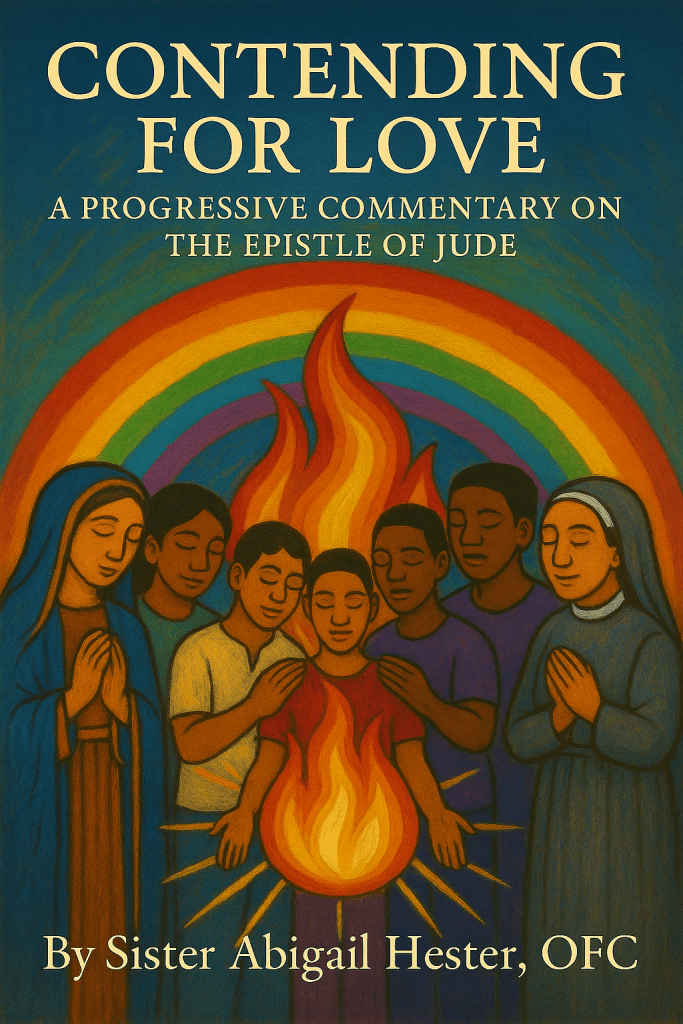
✨ Contending for Love: A Progressive Commentary on the Epistle of Jude
By Sister Abigail Hester, OFC For the Order of Franciscan Clareans
📖 Introduction
The Epistle of Jude, a brief and often overlooked letter near the end of the New Testament, is usually remembered for its fiery denunciations of false teachers and its use of apocalyptic imagery. Historically, it has been weaponized by some to accuse those who do not conform to rigid religious norms—including LGBTQIA+ Christians—of moral decay. But when we read Jude through the lenses of liberation, universal love, and radical inclusion, a different message emerges: a call to remain grounded in love, community, and the mercy of God in the face of division and injustice.
📚 Verses 1–2: A Greeting of Belovedness
“To those who are called, who are beloved in God the Father and kept safe for Jesus Christ: May mercy, peace, and love be yours in abundance.”
Jude opens with a powerful affirmation: we are called, beloved, and kept safe. For queer and trans Christians who have been told they are unwanted by God, this greeting is balm. Jude does not condition God’s love on moral purity or religious conformity—it is freely given, abundant, overflowing.
From a Franciscan Clarean perspective, we affirm that each person bears the image of Christ. Just as Francis kissed the leper and Clare offered sanctuary to her sisters, we are called to recognize every soul—especially the marginalized—as beloved and held safely in divine love.
🕊️ Verses 3–4: Contending for the Faith — Not Weaponizing It
“I find it necessary to write and appeal to you to contend for the faith… For certain intruders have stolen in among you… perverting the grace of our God into licentiousness and denying our only Master and Lord, Jesus Christ.”
These verses are often used to justify boundary policing in the Church—especially of LGBTQIA+ people. But what does it really mean to “contend for the faith”?
In liberation theology, “faith” is not static doctrine but the living praxis of love and justice. To contend for the faith is not to gatekeep—it is to resist empire, exclusion, and exploitation. The “intruders” Jude refers to may be understood in our time as those who corrupt the gospel of grace to uphold domination, be it through nationalism, white supremacy, transphobia, or patriarchy.
Queer theologians remind us: true heresy is not queerness—it is the denial of God’s image in our diversity.
🔥 Verses 5–16: Warnings Through Apocalyptic Midrash
Jude draws from Jewish apocalyptic traditions—stories of fallen angels, Sodom, Cain, and Balaam. These warnings can seem harsh and otherworldly, but read through a Franciscan lens, they serve not to condemn but to call attention to systems of exploitation and injustice.
Sodom and Queer Misreadings
Verse 7 refers to Sodom—often misused as a clobber passage.
“Sodom and Gomorrah…indulged in sexual immorality and pursued unnatural lust.”
Yet the biblical witness in Ezekiel 16:49 tells us the sin of Sodom was pride, excess, and failure to care for the poor and needy. In other words: the sin of empire, not same-gender love.
Liberation and queer theologies insist: we must reclaim these texts from harmful misuse. The cities of Sodom and Gomorrah are warnings against violence and inhospitality—especially toward strangers and the vulnerable. The real “unnatural” sin is the dehumanization of queer bodies, not their existence.
🌱 Verses 17–23: Building Up in Love
“But you, beloved, build yourselves up on your most holy faith; pray in the Holy Spirit; keep yourselves in the love of God…”
Here, Jude shifts tone: from judgment to nurture. These verses are the heart of the letter for progressive Christians.
Pray in the Spirit: not in fear, but in intimacy with the divine presence that speaks through all people—especially the silenced.
Keep in the love of God: Not by conformity, but by radical compassion and justice.
Show mercy: Even to those who doubt, to those caught in fear and judgment. Liberation theology reminds us that the work of justice includes healing both the oppressed and the oppressor.
This is a call to queer sanctity—to form communities that are fierce in love, honest in lament, and faithful to the Spirit of God who dances beyond boundaries.
🌈 Verse 22–23: Mercy that Rescues
“And have mercy on some who are wavering; save others by snatching them out of the fire; and have mercy on still others with fear…”
These verses are often read with anxiety. But what if “snatching from fire” means liberating people from the burning structures of empire? The fires we face today are not divine punishment but the consequences of greed, racism, transphobia, and ecological destruction.
The queer and trans community has often been placed in this fire—not by God, but by a Church complicit in violence. We, as Franciscan Clareans, are called to rescue each other with mercy, not judgment.
🌟 Verses 24–25: A Universal Benediction
“Now to the One who is able to keep you from falling and to present you without blemish… to the only God… be glory…”
Jude closes not with threat but praise. This God is not the condemner but the sustainer. The One who presents us without blemish is not fixated on our past, but devoted to our healing and wholeness.
This is liberal Christian universalism at its core: God will not lose any of us. There is no soul too queer, no heart too wounded, no life too far gone. All are drawn into the light of mercy.
🎨 Devotional Reflection
Art Prompt: Paint a flame that does not burn but heals. Around it are people of all genders, races, and orientations—dancing, embraced, loved.
Liturgical Action: Light a candle for each group harmed by religious exclusion (LGBTQIA+ people, women, the disabled, racial minorities, the poor). Offer this prayer: “God of all mercy, we kindle your light where others brought fire to destroy. Make us healers, not gatekeepers. Make us vessels of your inclusive flame.”
🕊️ Final Thoughts for the Order of Franciscan Clareans
As followers of St. Francis and St. Clare, we are not afraid of the fire—we transform it. We reclaim Jude not as a letter of condemnation, but as a call to courageous compassion. We contend for the faith not by excluding others, but by embracing the radical, boundary-breaking love of Christ.
May we, too, be kept in love, held in mercy, and unafraid to dance at the margins where Christ still walks.
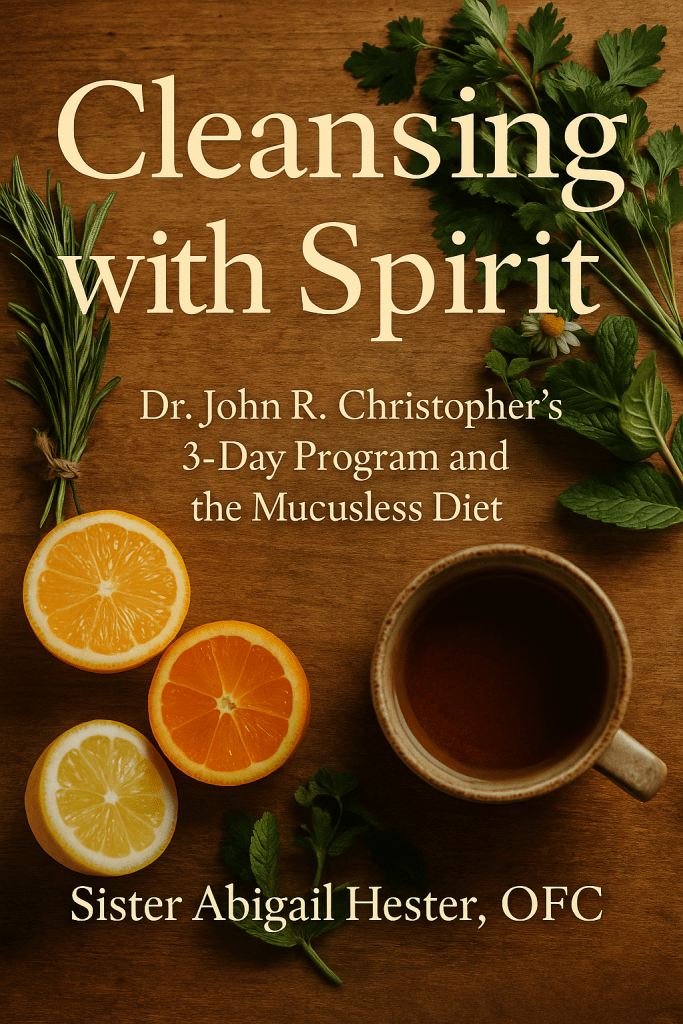
In a world filled with processed foods, environmental toxins, and chronic health issues, many people are turning to the wisdom of traditional healing systems for answers. Among the most beloved voices in American herbalism is Dr. John R. Christopher, a passionate advocate for natural healing, vibrant living, and the body’s innate ability to restore itself when given the right support.
One of his most accessible and transformative offerings is the 3-Day Cleansing Program, paired with his teachings on the Mucusless Diet. Designed not only to detoxify the body but to revitalize the spirit, Christopher’s approach draws from ancient practices, natural hygiene principles, and a deep respect for the healing power of plants.
This article explores the core elements of Christopher’s short-term cleansing system—a regimen of fresh juices, mucus-free eating, and supportive herbal formulas—alongside the philosophical roots of his dietary teachings. Whether you’re a seasoned herbalist or a curious beginner seeking gentle, nature-based healing, Christopher’s program offers a doorway into deeper well-being through simplicity, nourishment, and spiritual alignment.
🌱 Who Was Dr. John R. Christopher?
Dr. John Raymond Christopher (1909–1983) was a trailblazer in American herbal medicine, a teacher, healer, and visionary who helped ignite a resurgence of interest in natural healing during the mid-20th century. Born with advanced rheumatoid arthritis and other serious health conditions, Christopher was no stranger to suffering. He was told as a child that he would not live to adulthood—but he defied that prognosis by turning to the healing power of herbs and whole foods.
After studying at institutions such as the Dominion Herbal College and Iowa’s Institute of Drugless Therapy, Christopher went on to earn his degree as a Master Herbalist and Naturopath. He practiced and taught extensively, developing over 50 herbal formulas—many still in use today—and helping countless individuals reclaim their health through natural methods.
His mission was deeply rooted in his Christian faith, and he believed that God had placed healing herbs on Earth for the benefit of all people. In 1953, he founded The School of Natural Healing, which continues to train herbalists and natural healers today under the guidance of his son, David Christopher.
John R. Christopher’s legacy lives on not only in his formulas and writings but in the lives of the many who have found hope and healing through his simple, powerful teachings. His most popular works—such as Herbal Home Health Care, Every Woman’s Herbal, and the 3-Day Cleansing Program and Mucusless Diet booklet—continue to inspire a back-to-nature approach to wellness grounded in personal responsibility, spiritual wholeness, and deep respect for the wisdom of the Earth.
🍎 The Mucusless Diet: A Clean Way of Eating
At the heart of Dr. John R. Christopher’s healing philosophy is a simple but radical idea: many of the common ailments we suffer from are caused or worsened by the accumulation of mucus-forming foods in the body. According to Christopher—and those who inspired him, such as German health reformer Arnold Ehret—mucus is not just an occasional inconvenience, but a sign that the body is overloaded, congested, and struggling to eliminate waste.
🥛 What Is Mucus-Forming Food?
In Christopher’s system, mucus-forming foods are those that leave behind sticky residues in the digestive tract and sinuses. These residues are believed to clog the body’s elimination pathways, weaken the immune system, and create the perfect breeding ground for disease.
Foods to avoid include:
Dairy (milk, cheese, yogurt)
Refined flour and white sugar
Processed and packaged foods
Fried and greasy foods
Meats and heavy starches
While not all of these are universally condemned in mainstream nutrition, Christopher argued that even so-called “healthy” cooked grains and animal products could slow detoxification and dull vitality when consumed regularly.
🍇 The Mucusless Way of Eating
In contrast, the mucusless diet emphasizes foods that are easy to digest, rich in living enzymes, and help sweep the body clean from the inside out. These include:
Fresh fruits (especially citrus, grapes, apples)
Raw vegetables (especially leafy greens, sprouts, cucumbers)
Freshly made vegetable juices
Herbal teas and infusions
Occasionally, lightly steamed vegetables or whole grains (in moderation)
This way of eating is designed to support the body’s elimination systems—especially the lungs, kidneys, bowels, and lymphatic system—while delivering high doses of vitamins, minerals, and plant-based energy.
Christopher’s aim was not to promote starvation or rigid restriction, but to encourage lightness, clarity, and wholeness through foods that cleanse and nourish simultaneously. For those who follow this path even temporarily, many report improvements in energy, digestion, skin clarity, and emotional well-being.
🧃 The 3-Day Cleansing Program: A Simple Detox for Body and Soul
Dr. John R. Christopher’s 3-Day Cleansing Program is a short but powerful natural detox designed to rest the digestive system, stimulate the body’s eliminative channels, and lay the foundation for long-term healing. It’s often recommended as an introductory step into herbalism and the mucusless lifestyle, making it a great reset for anyone seeking clarity, energy, and renewal.
The cleanse combines juice fasting, herbal support, and mucusless foods to assist the body’s innate healing intelligence. The program is intentionally simple and cost-effective—no fancy supplements, no complex protocols, just time-tested natural principles.
🌞 Day 1–2: Juice Fasting and Elimination
For the first two days, the body is gently ushered into a cleansing state with raw fruit and vegetable juices.
Daily instructions:
Drink as much freshly made fruit or vegetable juice as desired (grape, citrus, apple, carrot, beet, etc.).
Stay well-hydrated with herbal teas, distilled water, or lemon water.
Avoid solid foods to allow the digestive system to rest and the body to redirect energy toward detoxification.
“The juices should be fresh, raw, and, if possible, organically grown. You are not eating solid food at this time—just juice and herbal teas to cleanse the blood, bowels, and lymph.”
— Dr. John R. Christopher
During this time, the body will begin eliminating waste through the bowels, kidneys, skin, and lungs. Light exercise, hot baths, rest, and gentle stretching can help support the process.
🍲 Day 3: Transition with Light Nourishment
On the third day, you begin gently reintroducing solid foods—still within the guidelines of the mucusless diet.
Day 3 meal plan:
Breakfast: Fresh fruit or diluted fruit juice.
Lunch: Raw vegetable salad with lemon juice or apple cider vinegar (no oil).
Dinner: Steamed vegetables or a small amount of lightly cooked whole grain, like millet or brown rice (optional).
This day continues the cleansing while offering vital nourishment to rebuild and sustain energy levels. It also teaches the body that we can thrive on clean, simple foods—an empowering realization for many.
🌿 Herbal Companions
Dr. Christopher strongly recommended using his herbal formulas during the cleanse to amplify its benefits and support each eliminative system.
Commonly included:
Lower Bowel Formula: to promote regular elimination
Blood Stream Formula: to assist detoxification
Liver & Gallbladder Formula: to support hepatic function
Kidney Formula: to aid urinary cleansing
These formulas are typically taken in capsules, teas, or tinctures and are part of what makes the cleanse uniquely Christopher’s.
🧘 Why Three Days?
Three days is long enough to:
Reduce digestive burden
Begin mobilizing toxins
Provide visible results (like improved skin, lighter digestion, and mental clarity)
Yet it’s short enough to feel manageable for beginners, especially those intimidated by longer fasts or intense dietary overhauls.
“Healing doesn’t always require months of effort. Sometimes, the body just needs a few days of rest, real food, and the right herbs.”
— Dr. John R. Christopher
🌿 Herbal Formulas and Recipes: Nature’s Medicine Chest
A cornerstone of Dr. John R. Christopher’s healing approach was the use of herbal combinations—carefully crafted blends of medicinal plants designed to nourish, detoxify, and balance the body’s systems. Unlike isolated supplements or harsh pharmaceuticals, these formulas work gently and synergistically, supporting the natural rhythm of the body’s healing processes.
In his 3-Day Cleansing Program and Mucusless Diet booklet, Christopher includes a treasure trove of over 60 herbal recipes, each one focused on a different organ system or ailment.
Let’s highlight a few of the most important ones used during the cleanse:
🌱 1. Lower Bowel Formula
Purpose: Promotes regular elimination and colon detoxification.
Ingredients (may vary slightly by source):
Cascara Sagrada bark
Barberry root
Turkey rhubarb
Slippery elm bark
Ginger root
Red raspberry leaf
Lobelia herb
Fennel seed
Usage: Taken in capsule or tea form during the cleanse to stimulate the bowel and ensure waste is properly expelled.
“All disease begins in the bowel,” Christopher often reminded his students. A clean colon, in his view, was foundational to healing.
🌼 2. Blood Stream Formula
Purpose: Assists the body in purifying the blood and lymphatic system.
Common ingredients:
Red clover blossoms
Chaparral leaf
Burdock root
Oregon grape root
Licorice root
Stillingia root
Benefits: Supports clearer skin, more energy, and less toxic burden in the bloodstream—especially helpful for those with skin eruptions or sluggish lymph.
🌿 3. Liver-Gallbladder Formula
Purpose: Stimulates bile flow and supports the liver’s detoxification work.
Core herbs:
Dandelion root
Milk thistle seed
Barberry root
Wild yam root
Fennel seed
Ginger root
Use: Typically taken as a tea or tincture before meals to help the liver filter toxins more effectively during cleansing.
🍃 4. Kidney Formula
Purpose: Strengthens and supports kidney function to increase urination and release of metabolic waste.
Ingredients:
Juniper berries
Uva ursi leaf
Parsley root
Marshmallow root
Ginger root
Notes: Especially helpful during juice fasting when the kidneys take on extra work as the body begins to flush toxins from deep tissue stores.
🌺 Additional Formulas Include:
Anti-Gas & Digestive Tea
A soothing post-meal tea for bloating, discomfort, or sluggish digestion.
Herbal Eyewash
A topical rinse made from golden seal and bayberry, recommended for those with eye strain or irritation.
Cold Sheet Treatment
An intense herbal hydrotherapy protocol used in deeper detox programs (not part of the basic 3-day cleanse, but included in his wider teachings).
🫖 How to Use Herbal Recipes at Home
Dr. Christopher encouraged preparing formulas as decoctions or infusions using dried herbs. He offered this general guideline:
Basic Herbal Tea Instructions:
Use 1 teaspoon of dried herb (or 1 tablespoon if fresh) per cup of water.
Steep 10–15 minutes for leaves/flowers, or simmer 20–30 minutes for roots/barks.
Strain and sip 2–3 cups daily.
For convenience, many of Christopher’s original formulas are now sold in capsule, tincture, or tea blend form through The School of Natural Healing and other herbal outlets.
“Herbs are not drugs. They are whole foods for the body—God’s gifts to humanity, here to heal without harm.”
— Dr. John R. Christopher
✨ A Healing Philosophy Rooted in Spirit: The Worldview of Dr. John R. Christopher
Dr. John R. Christopher was more than an herbalist—he was a spiritual healer, a deeply devout Christian, and a man who believed that true healing touched the body, mind, and soul. His natural remedies were not simply about symptom relief; they were an invitation to return to the natural order, to align with divine wisdom, and to recognize the sacredness of the human body.
🙏 The Body as a Temple
For Christopher, the human body was a temple of the Holy Spirit—a sacred vessel that deserved reverence, care, and purity. This belief shaped everything he taught:
Food was not just fuel—it was divinely designed nourishment.
Herbs were not drugs—they were gifts from God, meant to aid, not override, the body’s processes.
Cleansing was not punishment—it was a form of repentance and renewal, allowing the body to be restored to the state God intended.
His approach echoes the Christian principle of stewardship: caring not just for the Earth, but for our bodies, minds, and communities as expressions of divine creation.
“Let your food be your medicine, and your medicine be your food,” Christopher often echoed, following in the footsteps of Hippocrates—but with a spiritual twist.
🌍 Return to Nature, Return to God
Christopher viewed modern civilization’s detachment from nature as a core cause of disease—not just physically, but morally and spiritually. He saw:
Processed food as symbolic of spiritual disconnection
Overreliance on pharmaceuticals as a lack of faith in natural law
Chronic illness as a call to repentance—not guilt, but a loving return to balance
In this worldview, healing is not a quick fix—it’s a transformation. It requires listening to the body, slowing down, honoring rhythms of nature, and trusting the Creator’s wisdom over the industrial machine.
🕊️ Healing as a Journey of Wholeness
Christopher’s protocols always invited people to slow down, simplify, and reconnect—with themselves, with creation, and with the Divine. His teachings wove together threads of:
Faith-based living (prayer, surrender, forgiveness)
Personal empowerment (taking responsibility for one’s health through education and practice)
He called for a kind of herbal discipleship—a lifestyle of simplicity, reverence, and care for life in all its forms.
“There are no incurable diseases,” he declared. “Only incurable people who will not try to heal.”
In that spirit, the 3-Day Cleansing Program is not just a detox. It is a ritual of renewal, a way of honoring the sacredness of life and saying yes to the body’s quiet invitation:
“Let me heal. I remember how.”
🌟 Reported Benefits & Modern Perspectives
Thousands of people over the decades have tried Dr. John R. Christopher’s 3-Day Cleansing Program and mucusless diet—and while scientific studies may not exist to validate every claim, the testimonies are compelling. From renewed energy to spiritual awakening, many who undertake the cleanse describe it as a turning point in their journey toward health and wholeness.
💬 Reported Benefits from Followers
Increased Energy and Mental Clarity
Many report a sudden lightness of being—less brain fog, better focus, and more natural vitality. Without heavy, mucus-forming foods taxing digestion, energy seems to rebound quickly.
Improved Digestion and Elimination
Thanks to the bowel-cleansing herbs and juice fasting, people often notice reduced bloating, more regular bowel movements, and less discomfort in the gut.
Clearer Skin and Eyes
By flushing toxins through the bowels, kidneys, and skin, the body may reveal its health through a glowing complexion and clearer eyes—something Christopher often noted in his own patients.
Reduced Inflammation and Mucus
Especially for those suffering from congestion, chronic sinus issues, or allergies, the mucusless diet often brings dramatic relief.
Spiritual and Emotional Detox
Many experience emotional breakthroughs, weeping, or spontaneous prayer and meditation. The simplicity of the cleanse often brings a sense of reconnection—with oneself, nature, and God.
🧪 Modern Critiques and Considerations
While the natural healing community celebrates Christopher’s work, mainstream medicine and nutritionists tend to offer a more cautious view.
Lack of Peer-Reviewed Research
The mucusless diet and herbal formulas have not undergone large-scale clinical trials. Most evidence remains anecdotal or rooted in naturopathic and traditional knowledge systems.
Mucus is Not the Enemy
Critics note that mucus plays a vital role in immune defense and digestive health. While excess mucus can signal imbalance, the body naturally produces it for protection and lubrication.
Juice Fasting May Not Suit Everyone
For diabetics, people with eating disorders, or those with underlying conditions, the cleanse may require modification or medical supervision. It’s gentle, but not risk-free.
Detox Myths?
Some dietitians argue that the body already has sophisticated detoxification systems (liver, kidneys, lymph) and doesn’t need extreme protocols. However, Christopher’s supporters counter that the modern lifestyle overloads these systems—and herbs simply assist what the body already does.
⚖️ Bridging the Gap: A Holistic View
What’s clear is that John R. Christopher’s legacy continues to inspire a generation of people longing for natural solutions—and that his methods, when applied thoughtfully, offer much more than physical results.
Even modern integrative doctors and functional medicine practitioners now embrace:
Periodic fasting
Plant-based healing
Gut and liver detox support
Mind-body-spirit connections
In this way, Christopher’s teachings—though not mainstream—are prophetic, pointing toward a more integrative and reverent model of care.
“Healing is not about killing disease. It’s about creating such a state of balance that disease cannot live there.”
— Paraphrased from Christopher’s teachings
🌈 Conclusion: A Return to Wholeness
Dr. John R. Christopher’s 3-Day Cleansing Program and mucusless diet offer more than a quick detox—they invite us into a deeper relationship with our own bodies, with nature, and with the sacred. In a world of processed foods, hurried living, and medical over-dependence, his gentle, grounded wisdom reminds us that healing is often about returning: returning to simplicity, to nourishment, to trust in the body’s design.
Whether you are drawn to the program for physical reasons—like improving digestion or boosting energy—or for spiritual renewal, the protocol is accessible, affordable, and profoundly rooted in love for life.
The beauty of this approach is its humility. It doesn’t promise miracles from outside the body. It says:
🕊️ “You were designed to heal. Let me help you remember how.”
✨ Final Encouragement
If you’re considering the cleanse, remember:
Start gently. Listen to your body.
Use organic juices and herbs whenever possible.
Support elimination with rest, warmth, movement, and prayer.
Be kind to yourself—healing is not linear, but it is sacred.
And perhaps most importantly: see this as a spiritual act. A ritual of reverence. A way of saying yes—to life, to wellness, and to the divine wisdom within and around you.
“Cleansing is not just what you take out of the body—but what you let go of in the spirit.”
— Sister Abigail Hester, OFC
📖 About the Author
Sister Abigail Hester, OFC is a certified nutritional consultant, herbalist, and founder of the Order of Franciscan Clareans—a new monastic movement committed to justice, simplicity, and radical love. A lifelong student of natural healing and contemplative spirituality, she weaves together the wisdom of the saints, the Earth, and the body in her writing and teaching.
Abigail draws inspiration from pioneers like Dr. John R. Christopher, Hildegard of Bingen, and the holistic traditions of folk herbalism, always with a queer and inclusive lens. She lives simply, loves boldly, and believes deeply in the sacred power of healing through nature.
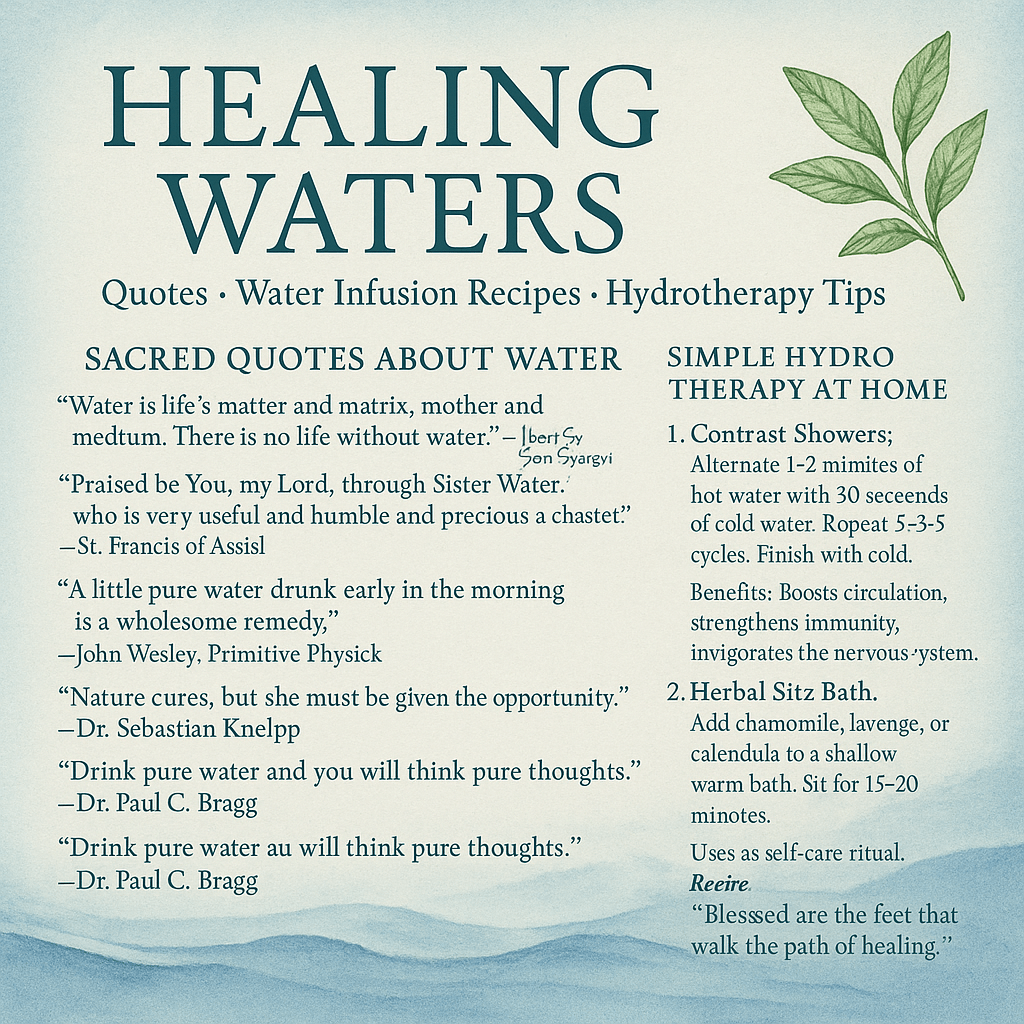
Quotes • Water Infusion Recipes • Hydrotherapy Tips
🌿 Sacred Quotes About Water
“Water is life’s matter and matrix, mother and medium. There is no life without water.” — Albert Szent-Györgyi, Nobel Prize-winning biochemist
“Praised be You, my Lord, through Sister Water, who is very useful and humble and precious and chaste.” — St. Francis of Assisi
“A little pure water drunk early in the morning is a wholesome remedy.” — John Wesley, Primitive Physick
“Nature cures, but she must be given the opportunity.” — Dr. Sebastian Kneipp
“Drink pure water and you will think pure thoughts.” — Dr. Paul C. Bragg
🍋 Easy Water Infusion Recipes
Infused waters support hydration and natural detoxification while bringing joy to your daily routine. Try these combinations:
🌼 Refresh & Cleanse:
1 lemon slice
3 cucumber slices
4 mint leaves
Optional: pinch of sea salt Let steep in cold water for 15–30 minutes.
🍓 Radiance Water:
3–5 sliced strawberries
A few basil or mint leaves
Slice of lime Chill and enjoy. Great for skin health!
🌸 Calm & Comfort:
Chamomile tea bag (cold-steeped or brewed and cooled)
Thin slices of pear
Dash of cinnamon or clove Relaxing for evening routines or emotional self-care.
🌿 Digestive Tonic:
Slice of ginger root
Fennel seeds (1/4 tsp in a tea bag or infuser)
Lemon wedge Sip after meals for digestive support.
🚿 Simple Hydrotherapy at Home
Contrast Showers: Alternate 1–3 minutes of hot water with 30 seconds of cold water. Repeat 3–5 cycles. Finish with cold. Benefits: Boosts circulation, strengthens immunity, invigorates the nervous system.
Herbal Sitz Bath: Add chamomile, lavender, or calendula to a shallow warm bath. Sit for 15–20 minutes. Uses: Postpartum care, pelvic inflammation, spiritual grounding.
Cold Compress Revival: Soak a washcloth in cold water with a drop of peppermint oil. Apply to forehead or back of neck during fatigue, fever, or tension. Bonus: Add a short prayer or breath meditation while applying.
Foot Soak & Blessing: Warm water with Epsom salts, rosemary, and lavender. Soak feet 10–20 minutes. Use as a self-care ritual. Recite:
“Blessed are the feet that walk the path of healing.”
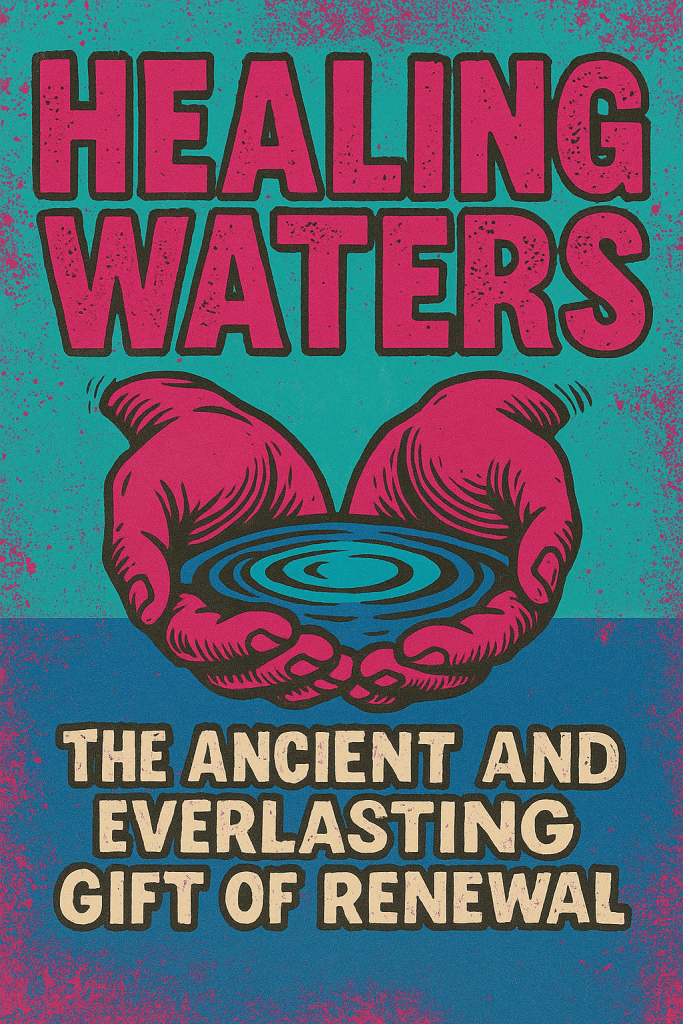
From the dawn of civilization, water has been revered not only as a source of life but also as a sacred agent of healing. Across centuries and cultures, the practice of using water therapeutically has flowed like a stream through human history—cleansing, restoring, and renewing body and spirit alike.
A History Written in Water
Long before the advent of modern medicine, ancient civilizations intuitively recognized the power of water. Egyptian and Greek physicians used hydrotherapy to relieve pain and stimulate circulation. Even before the time of Hippocrates—the so-called “Father of Medicine”—healers turned to springs, baths, and rituals of immersion to restore balance in the body. Hippocrates himself, in the 4th century BCE, famously recommended water treatments for a variety of ailments, from fever to fatigue.
In the 18th century, John Wesley, the great revivalist and founder of the Methodist movement, penned Primitive Physick, a little book of natural remedies grounded in Christian piety and practical wisdom. Among his many recommendations was the regular and intentional use of water for maintaining health and treating disease. For Wesley, the body was a temple of the Holy Spirit, and water—a gift from God—was to be received with gratitude and used with care.
Prophets of the Healing Stream
As the centuries progressed, a river of thinkers and practitioners carried forward the legacy of water healing. Father Sebastian Kneipp, a 19th-century Bavarian priest, developed a system of hydrotherapy rooted in his personal recovery from tuberculosis using cold water immersion, herbs, and exercise. His work sparked a European naturopathic revival, influencing others like Dr. Winternitz of Vienna and Dr. John Harvey Kellogg of Battle Creek Sanitarium—each integrating water therapy into larger health regimens.
Dr. Kellogg, in particular, combined hydrotherapy with vegetarianism, exercise, and spiritual discipline, laying the groundwork for many of today’s holistic health movements. Dr. Benedict Lust, the father of American naturopathy, further expanded Kneipp’s principles in the United States.
The 20th century saw passionate voices like Dr. Paul C. Bragg, Dr. N.W. Walker, and Allen E. Banik championing the curative powers of water. Walker, author of Colon Health, emphasized internal cleansing through water-rich foods and juicing. Banik, an optometrist, praised the purity of natural water as essential for vision, vitality, and overall well-being. These health advocates drew on both science and intuition, echoing the wisdom of yogis such as Yogi Ramacharaka, who taught about the pranic (life-force) benefits of water in spiritual healing.
Water as Sacred, Healing, and Free
The common thread among these many voices? Water is accessible, elemental, and universal. It doesn’t require a prescription, a co-pay, or a fancy label. It is the birthright of all creation—a holy sacrament in liquid form.
For us in the Franciscan Clarean tradition, this rings especially true. Saint Francis of Assisi called water “sister,” singing her praises in his Canticle of the Creatures:
“Praised be You, my Lord, through Sister Water, who is very useful and humble and precious and chaste.”
Water is humble. It meets us where we are—whether in a river, a teacup, or a warm cloth on a fevered brow. It is precious and chaste, unpretentious and healing. Its simplicity invites us to slow down, cleanse, and begin again.
Embracing the Waters of Renewal
Today, amidst chronic illness, environmental stress, and an often over-medicated society, a return to the healing traditions of water may be one of the most revolutionary acts of all. Cold compresses, warm baths, internal cleansing, herbal infusions, and prayerful immersion can serve as gentle tools of restoration.
Water therapy isn’t a magic cure—it’s a sacred rhythm. It invites us to cooperate with the natural healing processes already at work in our bodies. It beckons us to live more simply, more attentively, and more in tune with the divine wisdom embedded in creation itself.
So let us return to the waters. Let us drink deeply, bathe reverently, and give thanks for the life-giving stream that flows from the heart of God, through the earth, and into our bodies—cleansing, renewing, and reminding us of who we are: beloved, embodied, and worthy of healing.
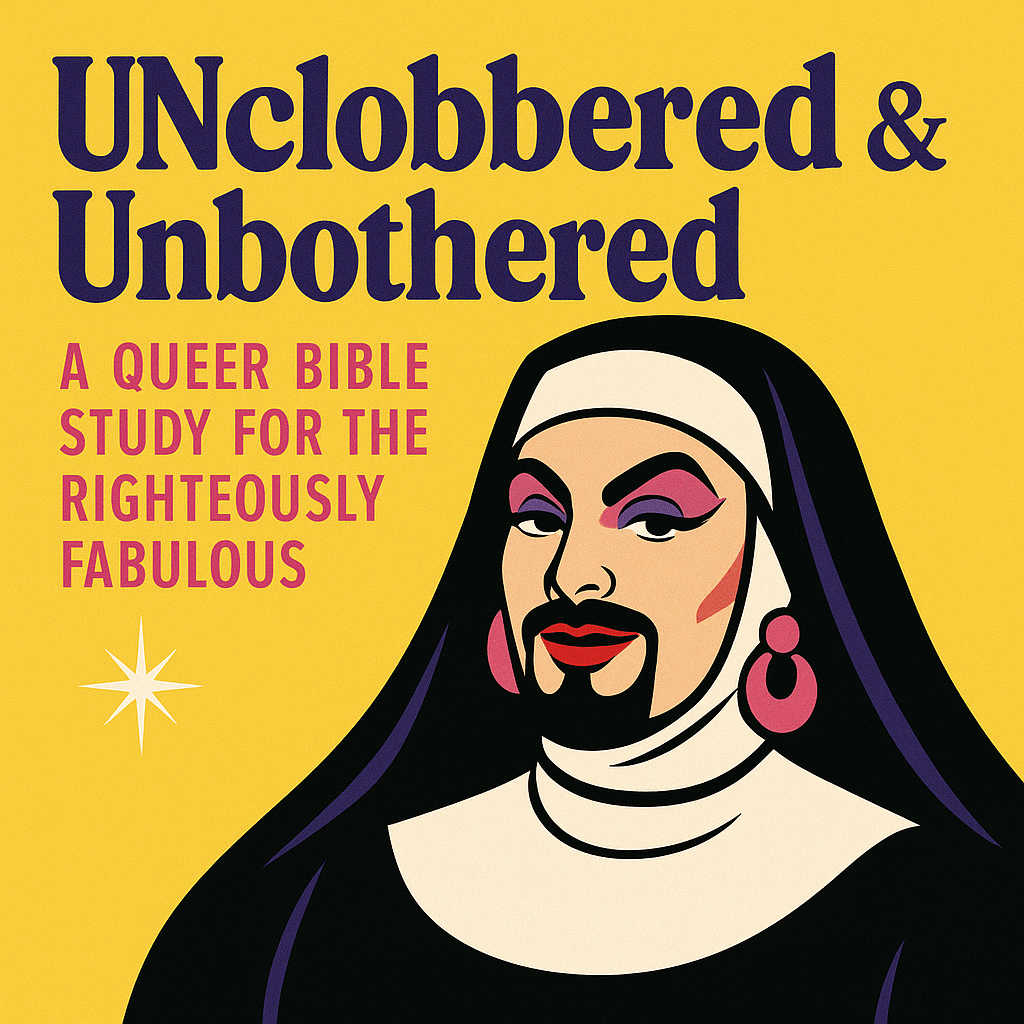
By Sister Abigail Hester, OFC A Franciscan Clarean Defense of LGBTQIA+ People in the Face of Weaponized Scripture
💥 Introduction: Holy Misinterpretation, Batman!
Let’s get one thing straight — or rather, let’s get everything delightfully queer: the Bible is not a homophobic book. It has been read that way by empire, patriarchy, and bigots with bad haircuts and worse hermeneutics. But when we read the text through the lens of liberation, context, and queerness, the clobber passages turn into… well, laughable.
This study will walk us through the so-called “clobber texts,” clap back with history, context, theology, and a wink of divine sass. Because honey — we weren’t made to sit silently while folks misuse the Word to harm the very ones Christ came to liberate.
📜 The “Clobber Passages” in Question
These are the six classic “texts of terror” often flung like theological dodgeballs at queer folks:
Genesis 19 – Sodom and Gomorrah
Leviticus 18:22 & 20:13 – “Man shall not lie with man…”
Romans 1:26–27 – “Shameful lusts”
1 Corinthians 6:9–10 – “The effeminate” and “homosexuals”
1 Timothy 1:9–10 – “Perverts” or “sodomites”
Jude 1:7 – Sexual immorality of Sodom again
Let’s unclobber these one by one.
1. 💣 Genesis 19: Sodom and Gomorrah
Clobber claim: God destroyed Sodom for gay sex.
Response: God destroyed Sodom for rape, violence, and inhospitality — not Pride floats and drag brunches.
“Now this was the sin of your sister Sodom: she was arrogant, overfed and unconcerned; they did not help the poor and needy.” – Ezekiel 16:49
🎯 Boom. That’s the Bible clapping back at bad theology.
The real sin: Abuse of power, exploitation, and cruelty to strangers. In other words, homophobia, not homosexuality, is the Sodomite sin.
Queer note: If anything, Genesis 19 is a call to defend the vulnerable — especially travelers, the gender-nonconforming, and the powerless. Sounds like a call to queer hospitality!
2. 🧀 Leviticus 18:22 & 20:13
“You shall not lie with a male as with a woman; it is an abomination.”
Clobber claim: Being gay is an abomination.
Response: So is eating shrimp, wearing polyester, and planting two seeds in one field (see Leviticus 11:10, 19:19). But you don’t see them picketing Red Lobster, do you?
📘 Marcus Borg and John Dominic Crossan remind us: Leviticus is a purity code, not a moral absolute. It was written for ritual cleanliness, not eternal judgment.
Abomination (Hebrew: toevah) means “ritually impure,” not “eternally condemned.” It was about Israel’s identity, not your date to prom.
Queer theology twist: Jesus broke the purity codes constantly — touching lepers, eating with sinners, and healing on the Sabbath. If you’re breaking purity rules to love better, you’re doing it right.
3. 🌀 Romans 1:26–27
“God gave them up to shameful lusts… men committing shameless acts with men…”
Clobber claim: Paul condemns homosexuality.
Response: Paul condemns exploitative, idolatrous, excessive lust, not loving same-sex relationships.
This is Paul throwing shade at Roman orgies and temple prostitution, not your marriage license.
🧠 Scholar alert! Beverly Roberts Gaventa and Daniel Helminiak point out that Romans 1 describes unnatural acts — but Paul isn’t defining what’s natural in your biology. He’s critiquing excessive Greco-Roman patriarchal sexual dominance.
Patrick Cheng says this passage is about imperial excess, not queer tenderness. Paul didn’t know about modern sexual orientation. To read that back into the text is like blaming Jesus for Twitter.
Fun fact: In Greek, “unnatural” (para physin) is also used to describe God’s actions (Romans 11:24). So clearly, “unnatural” ≠ evil. Sometimes divine love is unnatural — especially when it breaks the world’s rules.
4. 🎭 1 Corinthians 6:9–10
“Neither the sexually immoral… nor men who have sex with men…”
Clobber claim: Gays go to hell.
Response: The Greek words used here are:
Malakoi – “soft ones,” often referring to effeminate men or passive partners (but also used for luxury pillows).
Arsenokoitai – a bizarre compound word Paul seems to invent, literally “man-bedders.”
🧑🏫 John Boswell and Dale Martin show us: we don’t really know what arsenokoitai means. It shows up almost nowhere else in ancient Greek literature. Could mean exploiters. Could mean temple pimps. Could mean… tax collectors for all we know.
So unless you’ve built an entire theology on mistranslating ancient Greek and ignoring love, maybe sit this one out, clobber crowd.
5. 🪓 1 Timothy 1:9–10
“The law is laid down… for the unholy and sinful, for those who kill their fathers or mothers, for murderers, the sexually immoral, men who practice homosexuality…”
Clobber claim: The New Testament condemns homosexuality.
Response: Again, we’re dealing with that strange word arsenokoitai — not “gay people” in modern terms. There’s zero reason to believe Paul had anything in mind resembling today’s same-sex relationships built on mutual love, covenant, and faithfulness.
Also — let’s talk context. This list is like Paul’s version of a “bad people” rap sheet, mixing thieves, liars, and… apparently queer folks if we mistranslate? Not convincing.
Truth bomb: Love rooted in justice, mutuality, and consent is never what Paul condemns. What’s condemned is exploitation, domination, and violence. And that applies to all sexualities.
6. 🔥 Jude 1:7
“Sodom and Gomorrah… indulged in sexual immorality and pursued unnatural lust.”
Clobber claim: LGBTQ people are like the people of Sodom — lustful and unnatural.
Response: What’s “unnatural” to empire often looks like God’s justice breaking through. If you’ve ever loved someone in a way the world told you was wrong — welcome to the revolution.
Marcella Althaus-Reid calls this “indecent theology” — reclaiming the power of the body, of erotic love, of pleasure, and queerness as sacred, not sinful.
So if loving queerly is unnatural, then so is grace. And I, for one, am living for both.
✊ Holy Takeaways: What Jesus Would Say
Jesus never said a word against LGBTQIA+ people.
He did say a lot against religious hypocrites.
He did say love your neighbor. And honey, that includes your queer neighbor — and yourself.
May your love be louder than their hate. May your queerness be too fabulous to ignore. May your faith be too fierce to silence. And may your theology leave no clobber passage unchallenged.
Go in peace, beloveds. And throw glitter in the face of bad exegesis.
We are the Order of Franciscan Clareans (OFC) — a new monastic, radically inclusive, justice-centered spiritual community following in the footsteps of Saint Francis and Saint Clare of Assisi. Rooted in simplicity, solidarity, and sacred defiance, we walk the way of Jesus with the poor, the queer, the marginalized, and the earth.
🌈 Founded by Sister Abigail Hester, OFC, a transgender Christian nun, herbalist, theologian, and prophetic voice for our times, the OFC is a bold experiment in love, liberation, and contemplative resistance. Our mission is simple but revolutionary: Loving Boldly. Living Simply. Belonging Deeply.
📚 Want to dive deeper into our vision? We’ve published a growing library of powerful, provocative, and prayerful books on everything from:
Queer and Transgender Christian theology
Franciscan spirituality for today
Health and holistic wellness the Franciscan Clarean way
Daily devotionals, sermons, commentaries, and justice prayers
Exorcism as political liberation
Children’s books on kindness and inclusion …and much more!
🛍️ VisitRebel Saint Publications and explore our collection of eBooks, theology, devotionals, and spiritual formation guides. Every purchase supports our ministry of healing, inclusion, and transformation.
📣 Help us spread the word: Share this post, tag a friend, and join the movement.
💬 Questions? Want to connect more deeply? We’re always open to conversation. You belong here.
With radical love and sacred joy, Sister Abigail Hester, OFC Order of Franciscan Clareans


 Sister Abigail Hester