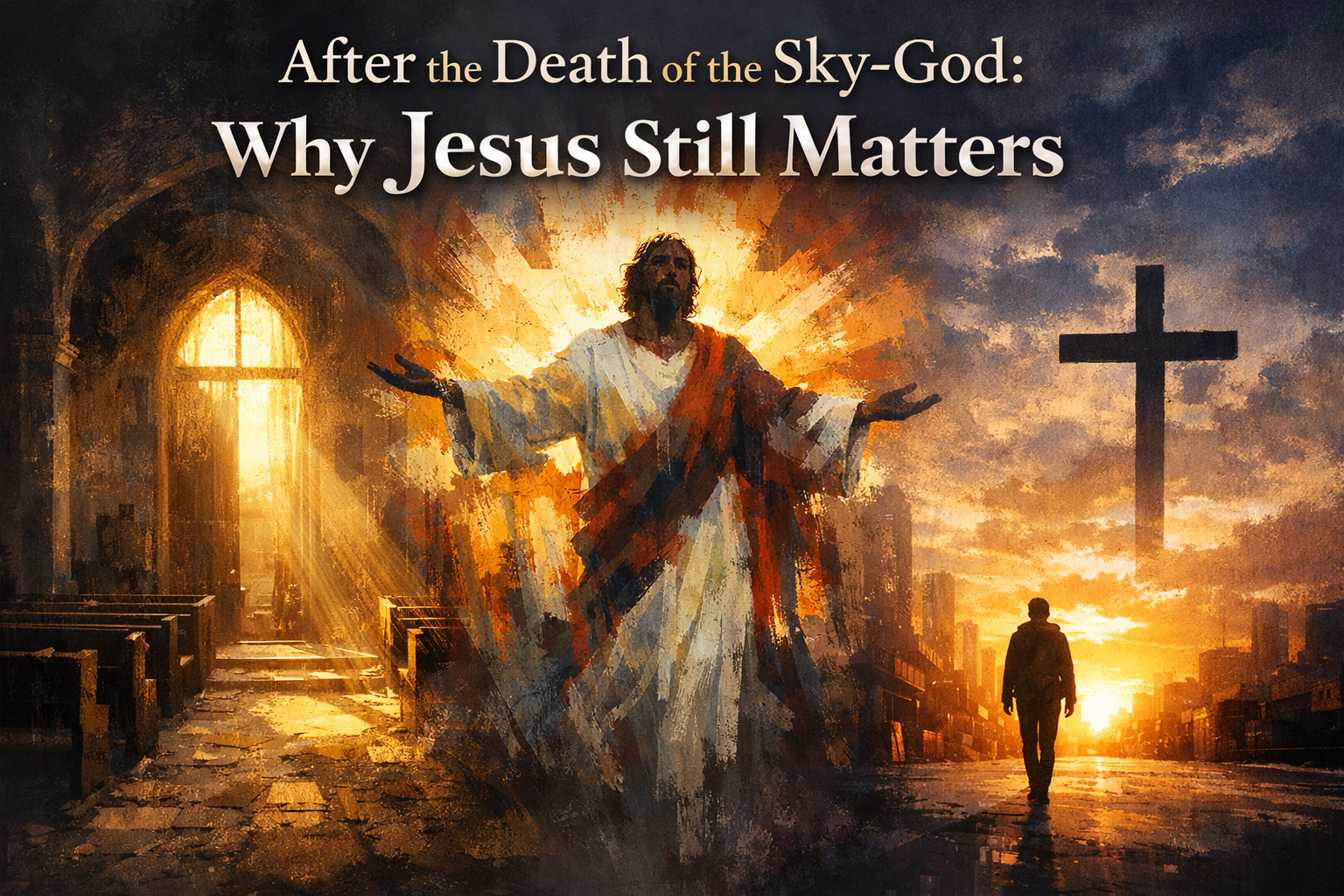
There’s a quiet confession happening all over the place.
People aren’t necessarily rejecting Jesus.
They’re rejecting the version of God they were handed.
The old framework—an elderly male deity floating somewhere above the clouds, intervening selectively, suspending physics when pleased—doesn’t survive long in a world shaped by telescopes, trauma psychology, and historical scholarship.
For many thoughtful people, that model collapsed.
And when that model collapsed, faith collapsed with it.
But here’s the real question:
What if the collapse wasn’t the end?
What if it was renovation?
When the Old God Stops Working
Modern people aren’t stupid. We know how biology works. We understand mythic language. We recognize that ancient writers weren’t drafting lab reports.
So when faith demands intellectual dishonesty—when belief requires pretending first-century cosmology is modern science—people walk.
Not because they hate God.
Because they can’t lie to themselves.
If Christianity is going to survive, it cannot demand intellectual suicide.
Reframing Jesus
Strip away the supernatural scaffolding for a moment.
What remains?
A first-century Jewish teacher whose life radiated radical inclusion.
A boundary-breaker who erased “unclean” categories.
A man whose love threatened religious power structures.
A life so open, so transparent to divine depth, that people experienced God through him.
Not a sky-magician.
A fully human being alive to the Depth of Being.
What if “God” is not a being up there—but the Ground of Being right here?
That shifts everything.
Salvation Without Escapism
In this reframed vision:
Salvation is not a heavenly evacuation plan.
Resurrection is not resuscitated tissue.
Atonement is not divine child abuse.
Instead:
Salvation is becoming fully alive.
Resurrection is the unkillable power of love.
Atonement is reconciliation with reality itself.
Death does not win when love refuses to disappear.
That’s not anti-faith.
That’s faith that can breathe.
Why This Matters for the Nonreligious
There are countless people who:
Can’t believe in miracles as physics violations
Don’t resonate with blood sacrifice theology
Feel allergic to rigid dogma
Yet still feel drawn to the figure of Jesus
They assume they must choose between intellect and spirituality.
That’s a false choice.
You can reject supernaturalism and still take Jesus seriously.
You can outgrow childish God-images without abandoning depth.
Sometimes faith doesn’t die.
Sometimes it molts.
The Risk
Let’s be honest.
Reframing faith is uncomfortable.
Traditionalists worry that metaphor drains power from doctrine. Conservatives fear the loss of certainty. Institutions don’t love structural demolition.
But clinging to a model that no longer holds? That’s not faithfulness. That’s fear.
If a belief system cannot survive questions, it was never strong to begin with.
After the Collapse
When the old image of God falls, you feel untethered.
Good.
Now you can rebuild without pretending.
Jesus, stripped of magical thinking, still stands:
Calling people into radical compassion
Refusing purity hierarchies
Breaking religious gatekeeping
Exposing injustice
Inviting people into fearless love
That’s not less powerful.
That’s terrifyingly powerful.
The Invitation
Maybe the future of Christianity isn’t defending ancient cosmology.
Maybe it’s daring to say:
The symbols were always pointing beyond themselves.
Maybe God was never the sky-manager.
Maybe God is the depth dimension of reality itself.
And maybe Jesus still matters—not because he suspends physics—but because he shows what fully human love looks like.
If that’s heresy, so be it.
If that’s evolution, even better.
The sky-god may be gone.
Love isn’t.
And that’s where I’m planting my flag.
Leave a Reply