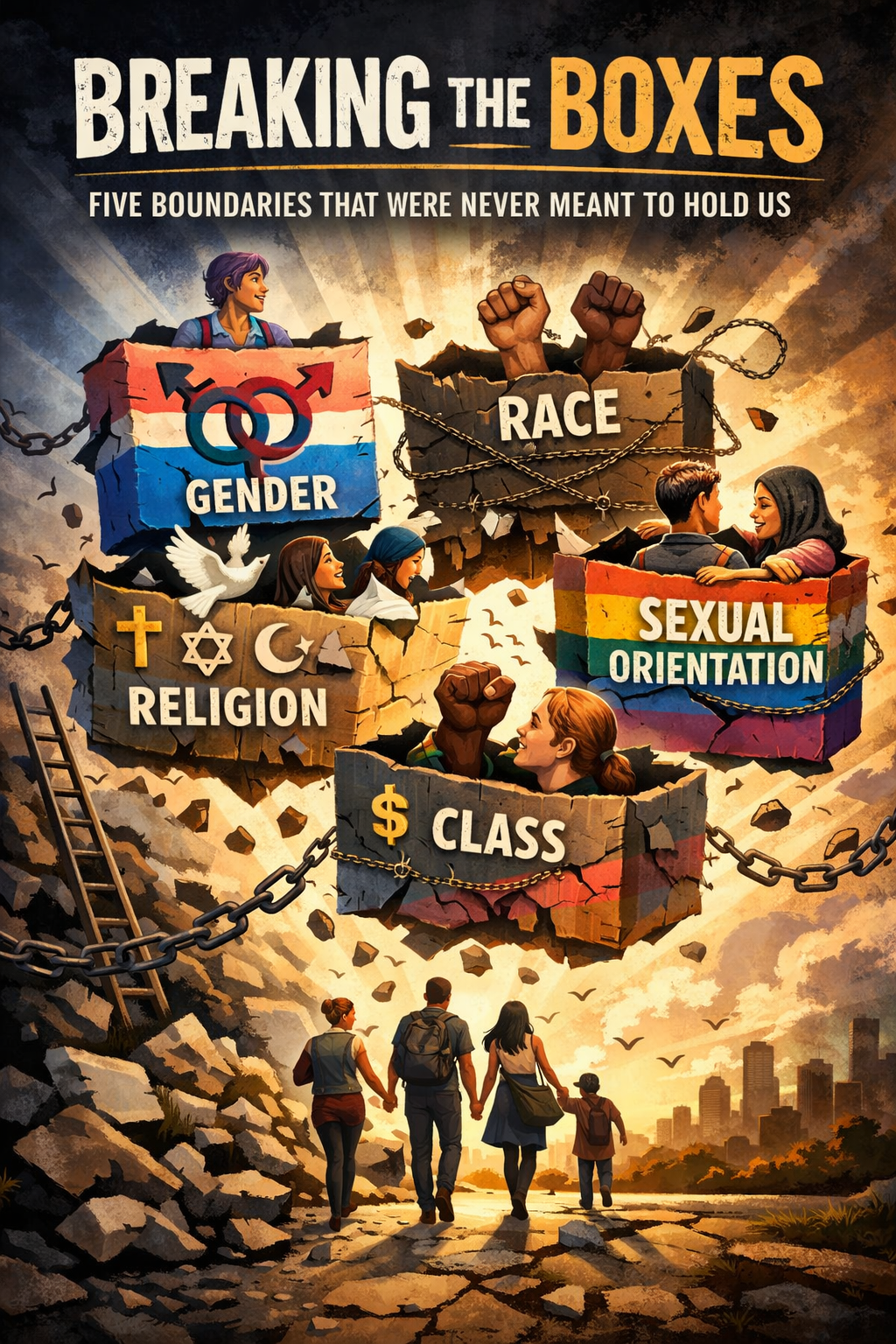
Human society loves categories.
We sort. We label. We organize. That’s not inherently bad — it’s how we make sense of the world. The problem begins when categories stop describing reality and start confining it.
Gender. Race. Religion. Class. Sexual orientation.
These are real aspects of human experience. But over time, they’ve hardened into boundaries that limit people instead of liberating them.
Let’s take a closer look.
Gender: When Biology Became a Script
For much of history, gender was treated as simple and fixed. Male or female. End of discussion. From that one designation flowed expectations about personality, clothing, occupation, emotional expression, and social roles.
But human experience has never been that tidy.
Today, there is growing recognition that biological sex and gender identity are not identical concepts. People experience and express gender in ways that don’t always align with the sex assigned at birth. That shift in understanding has challenged long-standing assumptions about what men and women are “supposed” to be.
Resistance is real. Social change that touches identity is always slow and often emotional. But expanding our understanding of gender does not erase anyone. It simply acknowledges that human lives are more complex than rigid categories allow.
Gender should describe a person’s experience — not dictate their destiny.
Race: When Difference Turned Into Hierarchy
Human beings differ physically. Skin tone, facial features, hair texture — these are visible realities. But societies didn’t stop at noticing difference. They built systems of meaning around those differences.
Race became more than appearance. It became expectation. It became stereotype.
It became hierarchy.
The idea that physical variation carries inherent moral, intellectual, or social value has caused immense harm. When we treat individuals as representatives of a racial category rather than as complex human beings, we shrink them.
Race as a social construct does not mean race is imaginary. It means the meaning attached to physical traits was constructed by societies — and constructed systems can be dismantled.
The boundary is not skin. It is the story attached to it.
Religion: When Faith Becomes Division
Religion has inspired compassion, charity, courage, and sacrifice. It has also fueled conflict, exclusion, and violence. The same force that can unite communities in love can divide them in certainty.
Ideally, religion helps people seek truth, cultivate virtue, and grow spiritually. But when traditions become tribal markers — when groups insist they alone possess ultimate truth — boundaries form.
The tragedy is not devotion. It is the weaponization of devotion.
Different religions may articulate their beliefs in different ways, yet many are grappling with similar human questions: meaning, suffering, morality, transcendence, hope.
Faith at its best expands compassion. When it narrows compassion, something has gone wrong.
Class: The Quiet Divider
Some societies claim to be classless. In reality, economic status, education, occupation, and social networks strongly shape opportunity.
Class boundaries are often unofficial but powerful. They determine who feels comfortable in certain spaces, who has access to resources, who is heard, and who is overlooked.
While mobility exists, patterns of wealth and advantage are frequently passed from one generation to the next. The idea that success is purely individual can obscure the structural realities at play.
Human dignity cannot be measured in income brackets.
When class becomes a measure of worth rather than a description of circumstance, it limits both individuals and the broader society.
Sexual Orientation: Policing Love
For centuries, heterosexuality was treated as the unquestioned norm. Those who crossed that boundary faced discrimination, violence, and exclusion from legal recognition.
In some countries, laws and attitudes have shifted significantly. In others, oppression remains severe. Even where progress has been made, cultural resistance continues.
At the heart of debates about sexual orientation is a simple question: Who gets to live openly and form relationships without fear?
When societies attempt to regulate love and identity, they create harm that extends far beyond individuals. They weaken trust, compassion, and freedom.
The Pattern Beneath It All
Across gender, race, religion, class, and sexual orientation, a common pattern emerges:
A real human difference exists.
Society assigns meaning to that difference.
That meaning solidifies into expectation.
Expectation becomes limitation.
Categories are not inherently harmful.
They can help us understand patterns and experiences. But when categories become cages, they prevent growth.
Transcending these boundaries does not mean pretending differences don’t exist. It means refusing to let difference determine value.
Knowledge exposes how these systems were formed. Courage challenges them. An open mind allows space for something better.
Human beings are more than the boxes they’ve been placed in.
And when we begin to live from that truth, the boundaries that once confined us start to lose their power.
Leave a Reply