

Sister Abigail Hester

Tag: theology

  • Queer and Trans Believers: The Gospel at the Margins

    Queer and Trans Believers: The Gospel at the Margins

    🌈 Queer and Trans Believers: The Gospel at the Margins

    By Sister Abigail Hester, OFC


    ✨ The Times Are Changing — and the Spirit Is Moving

    Across the world, the church is waking up to a truth long whispered in the hearts of queer and trans believers: you belong.

    More seminaries are rethinking outdated policies. Communities are learning to listen. And theologians are daring to read Scripture through the eyes of those who were long pushed aside.

    Even the Associated Press reports that evangelical seminaries are now debating how to welcome LGBTQ+ students more openly — the kind of breakthrough people once said was impossible.

    Meanwhile, queer and trans theologians are reclaiming sacred space and building lifelines for believers seeking a home inside Christianity rather than outside of it.

    This isn’t a niche issue. This is the Gospel unfolding in real time.


    📖 The Bible Still Speaks

    Genesis 1:27

    “So God created humankind in His image… male and female He created them.”
    This is not a box. It’s a blessing. Every human reflects divine beauty — beyond binary categories.

    Galatians 3:28

    “There is no longer Jew or Greek… male and female; for you are all one in Christ.”
    The Gospel dissolves hierarchies. If gender diversity can’t belong, then Paul’s declaration of unity is just ink on parchment.

    Colossians 3:14

    “Above all, clothe yourselves with love…”
    Love isn’t optional. It’s the Christian uniform.


    💔 When the Church Hurts

    Too many queer and trans believers have experienced sermons as weapons and fellowship as conditional hospitality.

    Research confirms what many already know in their bones: when faith communities reject a person’s core identity, psychological and spiritual injury follows.

    But exclusion is not the final word. Christ’s arms remain open even when church doors don’t.


    🌿 When the Margins Lead

    The question isn’t whether queer and trans Christians can belong.
    The question is what the body of Christ loses when their voices are silenced.

    Queer theology isn’t just a plea for a seat at the table.
    It’s an invitation to reimagine the table itself — larger, freer, more reflective of a God who transcends every box we create.


    🕊️ A Franciscan-Clarean Call

    In a Franciscan Clarean community, this becomes a lived commitment:

    Study circles exploring queer and trans theology.

    Sermons that proclaim belonging without apology.

    Community covenants that explicitly welcome all gender identities and orientations.

    Partnerships with affirming Christian groups doing this work on the ground.

    Hospitality is holy. Radical welcome is a spiritual discipline.


    🔥 The Prophetic Word

    To my queer and trans siblings:
    You are made in God’s image. Your identity is not an obstacle to holiness — it’s a window into divine creativity.

    To the broader church:
    The Spirit is waiting at the margins, still whispering, still blessing, still disrupting.

    And to all who seek Christ:
    Love is the beginning, middle, and end of the story.


    📚 References

    News & Cultural Commentary

    Associated Press. California evangelical seminary ponders changes that would make it more welcoming to LGBTQ students. AP News.

    Nursing Clio. Trans Theology: Reclaiming Christian Identity and Community Space for Trans People. NursingClio.org.

    PMC National Library of Medicine. Religion and Attitudes Toward Transgender People. PMC Article.

    The Reformation Project. Affirming Theology vs. Queer Theology.

    Q Christian Fellowship. Organization overview.

    Biblical Texts

    Genesis 1:27

    Galatians 3:28

    Colossians 3:14

    2 Corinthians 3:17

    Theological Resources

    St. Andrews Encyclopaedia of Theology: Queer Theology (Slater & Cornwall).

    QueerTheology.com — various articles on transgender Christian identity.
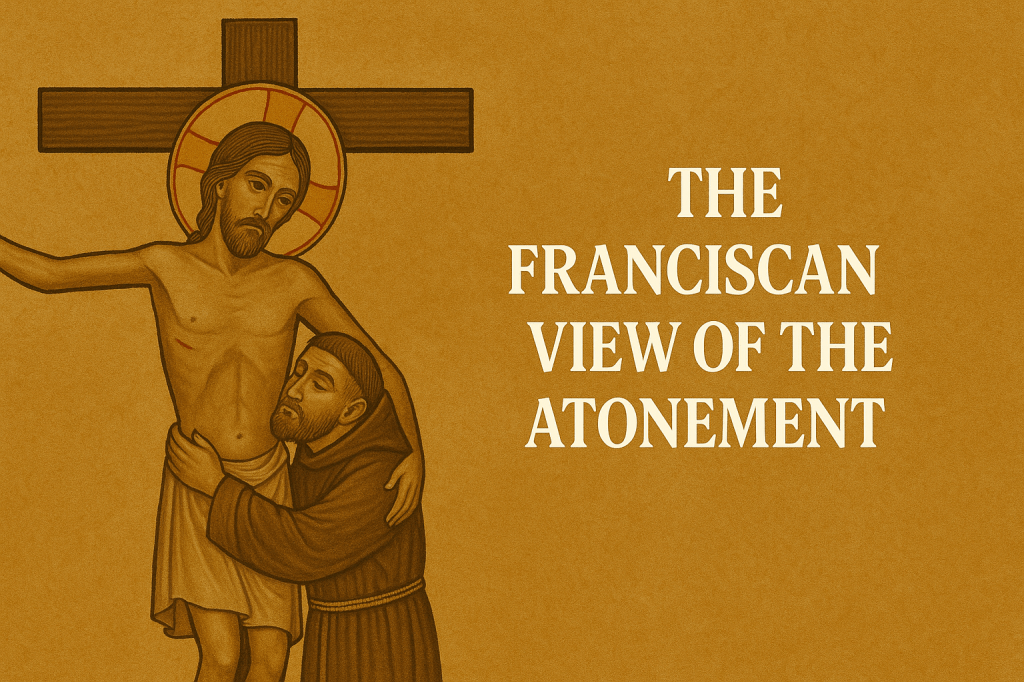
  • The Franciscan Vision of the Atonement: Love Before Law


    Introduction

    In the history of Christian theology, the doctrine of the atonement has often been framed in the language of law, debt, and punishment. Anselm of Canterbury’s Cur Deus Homo (11th century) offered the satisfaction model: humanity’s sin dishonored God, and satisfaction was required through Christ’s death.^1 Later Protestant Reformers sharpened this into penal substitution: Jesus bore divine wrath in humanity’s place.

    The Franciscan tradition, however, offers a radically different perspective. From St. Francis and St. Clare’s lived spirituality, to the speculative theology of St. Bonaventure and John Duns Scotus, Franciscans interpret the Incarnation and Cross not as reactions to sin but as the eternal expression of God’s love. For Franciscans, the atonement is not transaction but transformation, not appeasement but union.


    The Incarnation as “Plan A”

    At the heart of Franciscan atonement theology lies the Primacy of Christ. John Duns Scotus (1266–1308) argued that the Incarnation was not contingent upon human sin. God did not look down at Eden’s rebellion and scramble for a remedy. Rather, the Word-made-flesh was foreordained “before the foundation of the world” (Eph. 1:4).

    Scotus writes: “If Adam had not sinned, Christ still would have become incarnate. For the Incarnation is the greatest glory of God, and it is fitting that God should will always what is best and most glorious.”^2 In other words, Christ is not plan B after human failure, but plan A from eternity.

    This perspective reshapes the atonement: Jesus comes primarily to unite creation with God, not simply to fix sin.^3


    Bonaventure and the Cross as Revelation of Love

    St. Bonaventure (1217–1274), the “Seraphic Doctor,” emphasized the affective and mystical dimensions of the Cross. In his Tree of Life, he portrays Christ crucified as the burning heart of divine charity:

    • The wood of the cross is the ladder to heaven.
    • The wounds of Christ are windows into God’s mercy.
    • The Crucified is not merely victim but lover.

    For Bonaventure, the Cross does not primarily satisfy wrath but enflames hearts with love, drawing humanity into compassionate union with the suffering Christ.^4 The Franciscan devotion to the Passion—embodied in Francis’s stigmata—reflects this mystical vision.


    Francis and Clare: Lived Atonement in Poverty

    Francis and Clare of Assisi did not write scholastic treatises, but their lives proclaimed a theology of atonement. By embracing radical poverty, humility, and solidarity with lepers and outcasts, they embodied Christ’s own descent into littleness.

    For Francis, Christ saves not by power but by weakness. The Incarnation is God stooping down, and the Cross is God identifying with the crucified of the world.^5 To follow the Poor Christ is to share life with the poor and crucified of history.

    Clare insisted that gazing upon the mirror of the crucified Christ transforms the soul. “Place your mind before the mirror of eternity, place your soul in the brilliance of glory, place your heart in the figure of the divine substance, and transform your entire being into the image of the Godhead through contemplation.”^6 For Clare, this contemplative seeing—not legal reasoning—was the path of atonement.


    Theological Implications

    1. Union, Not Transaction
      • Salvation is not a commercial exchange of debt and payment, but a personal union of love between God and creation.^7
    2. Solidarity with the Marginalized
      • The Cross shows God standing with the oppressed. Thus, to live the atonement is to stand in solidarity with the poor, the queer, the crucified of every age.^8
    3. Cosmic Christology
      • The Incarnation integrates not only humanity but the whole cosmos into Christ. Atonement thus includes creation itself, grounding Franciscan ecological spirituality.^9
    4. Transformation of Desire
      • The Franciscan way emphasizes affectivity: the Cross changes the human heart, awakening love rather than fear.^10

    Conclusion

    The Franciscan opinion of the atonement is, at its core, a vision of divine love made visible in Christ. Against juridical models, Franciscans proclaim that God did not send Christ to change His own mind about humanity, but to change humanity’s mind about God.

    The Incarnation was always the divine intention; the Cross reveals the cost of divine love in a violent world. For Francis and Clare, Bonaventure and Scotus, the atonement is not a courtroom verdict but a love song sung from eternity: God with us, God for us, God in us.

    “Love is not loved,” Francis once lamented.^11 The Franciscan vision of the atonement dares to reply: on the Cross, Love is at last unveiled.


    Footnotes

    1. Anselm of Canterbury, Cur Deus Homo, trans. Jasper Hopkins (Minneapolis: Arthur J. Banning Press, 1974).
    2. John Duns Scotus, Ordinatio III, d.7, q.3 (see Allan B. Wolter, Duns Scotus on the Incarnation, Franciscan Institute Publications, 2004), 55–60.
    3. Richard Rohr, Eager to Love: The Alternative Way of Francis of Assisi (Cincinnati: Franciscan Media, 2014), 183.
    4. Bonaventure, The Tree of Life, in Bonaventure: The Soul’s Journey into God, The Tree of Life, The Life of St. Francis, trans. Ewert Cousins (New York: Paulist Press, 1978), 135–150.
    5. Augustine Thompson, Francis of Assisi: A New Biography (Ithaca: Cornell University Press, 2012), 102–110.
    6. Clare of Assisi, Fourth Letter to Agnes of Prague, in Francis and Clare: The Complete Works, trans. Regis J. Armstrong and Ignatius Brady (New York: Paulist Press, 1982), 66.
    7. Zachary Hayes, Bonaventure: Mystical Writings (New York: Crossroad, 1999), 89–94.
    8. Ilia Delio, A Franciscan View of Creation: Learning to Live in a Sacramental World (St. Bonaventure, NY: Franciscan Institute, 2003), 72.
    9. Ilia Delio, Christ in Evolution (Maryknoll: Orbis Books, 2008), 121–126.
    10. Ewert Cousins, Bonaventure and the Coincidence of Opposites (Chicago: Franciscan Herald Press, 1978), 142.
    11. Francis of Assisi, The Admonitions, in Francis and Clare: The Complete Works, trans. Regis J. Armstrong and Ignatius Brady (New York: Paulist Press, 1982), 36.