Sister Abigail Hester

Tag: herbs

  • The Herbal Healer: A Living Sacrament of Compassion

    The Herbal Healer: A Living Sacrament of Compassion

    🌿 The Herbal Healer: A Living Sacrament of Compassion

    by Sister Abigail Hester, OFC

    In every age, the Spirit raises up healers — those who listen not just to the pulse of the human heart but to the heartbeat of the earth itself. The herbal healer is one such soul, standing barefoot in the soil between heaven and humus, mediating between Creator and creation.

    For me, being an herbal healer isn’t about potions or superstition; it’s a sacred vocation. Each leaf and root is a prayer, each tincture a whispered “peace be with you” to a weary body. I see herbs not as commodities to be sold, but as companions in healing, part of a living sacrament through which God’s grace flows into flesh and bone.

    🌸 Healing as an Act of Love

    When I blend an herbal tea or craft a salve, I’m not just mixing plants — I’m participating in an ancient dialogue between creation and compassion. Francis of Assisi called the body “Brother Donkey,” simple and stubborn but beloved. To tend it with herbal medicine is to honor the holy in the humble. Healing is not conquest but kinship.

    Every herb I use carries a memory: lavender for peace, yarrow for courage, calendula for joy. These plants don’t just treat symptoms — they teach presence. They invite the wounded and the weary to slow down, breathe, and reconnect to the rhythms of life.

    🌿 The Franciscan Way of Healing

    As a Franciscan Clarean, I believe that healing begins with relationship: with the earth, with one another, and with God. Herbs are not tools of control — they are partners in the dance of renewal. The herbal healer is not a magician or a doctor, but a friend to creation.

    To walk this path is to live with radical simplicity. You learn to grow your medicine, to harvest with prayer, to waste nothing. Healing becomes an act of nonviolence — a small rebellion against systems that profit from illness. It’s holy mischief in a world that has forgotten how to rest.

    🌕 The Inner and Outer Apothecary

    There’s a wild apothecary outside in the garden, and another one inside the heart. A true healer tends both. Herbs help soothe the body, but love and laughter mend the soul. Sometimes the medicine someone needs most isn’t a tincture — it’s a cup of tea shared in silence, or a reminder that they are not broken beyond repair.

    I’ve learned that the best medicine often grows in the cracks — in the overlooked, the humble, the resilient. Much like grace itself.

    🌼 A Rebellious Mercy

    To be an herbal healer is to refuse despair. It’s to stand with the sick, the forgotten, and the earth herself, and say: You are still sacred. You still belong.

    I heal because I believe resurrection happens in small ways every day — in gardens, in kitchens, in tearful prayers, in the quiet courage of those who keep loving anyway.

    The herbal healer walks between worlds — rooted in soil, reaching toward the stars — reminding us that creation is still speaking, still healing, still holy.
  • 🌿 Nourishing Herbal Infusions: Ancient Wisdom for Modern Wellness


    Inspired by Susun Weed | By Sister Abigail Hester, CNC

    In the fast-paced chaos of our world, we need rituals that root us, nourish us, and connect us back to the Earth and our own inner rhythms. One of the simplest and most powerful ways to do that is with nourishing herbal infusions, a practice popularized by beloved herbalist Susun Weed.

    These are not your average tea bags. Infusions are strong, mineral-rich, deeply restorative brews that support whole-body vitality, especially for women, queer and trans folks, caregivers, and anyone recovering from chronic stress or depletion. And best of all? They’re affordable, safe, and easy to make at home.


    🌸 What Is a Nourishing Herbal Infusion?

    Unlike a light tea, a nourishing herbal infusion is made by steeping a full ounce (about one cup) of dried herb in a quart of boiling water for at least 4 hours or overnight. This longer steeping time extracts an abundance of vitamins, minerals, phytonutrients, and nourishing compounds that heal and rebuild the body over time.

    You strain the infusion in the morning, refrigerate it, and drink a cup or more throughout the day—hot, room temp, or chilled.


    🌿 Sister Abigail’s Top 5 Infusion Herbs

    Here are five classic infusion herbs Susun Weed recommends, and that I use in my own kitchen apothecary:

    1. Nettle Leaf (Urtica dioica)
      A powerhouse of chlorophyll, calcium, iron, protein, and trace minerals. Supports adrenal health, energy, and hair/skin health.
    2. Oatstraw (Avena sativa)
      Gentle and calming, oatstraw helps soothe the nervous system, restore depleted nerves, and ease anxiety and stress.
    3. Red Clover Blossoms (Trifolium pratense)
      Rich in phytoestrogens and cleansing for the lymphatic system. Great for hormone balance and breast health.
    4. Linden Flower (Tilia spp.)
      Soothing, heart-centered, and anti-inflammatory. Supports emotional healing, lowers blood pressure, and helps with grief.
    5. Comfrey Leaf (Symphytum officinale)
      Known as “knitbone,” comfrey is deeply nourishing to bones, joints, and tissues. Used safely in infusion (not root), it helps rebuild the body.

    🫖 How to Make a Nourishing Infusion

    You’ll need:

    • 1 oz dried herb (about 1 cup, loosely packed)
    • 1 quart (32 oz) boiling water
    • A quart-size mason jar or French press
    • Fine mesh strainer

    Instructions:

    1. Place the herb in your jar.
    2. Pour boiling water to fill the jar completely.
    3. Cap it and let it steep 4–10 hours (overnight is ideal).
    4. Strain into a clean jar. Compost the herb.
    5. Refrigerate and drink 1–4 cups daily. Best within 48 hours.

    🌈 Infusion Rituals for the Spirit

    As a Franciscan Clarean and a kitchen witch of sorts, I often turn infusions into sacred rituals. As you pour the boiling water, whisper a blessing. As the herbs steep, imagine the plant spirits whispering healing into your life. And as you sip, breathe in gratitude.

    You can also set intentions:

    • Nettle for strength and courage.
    • Oatstraw for emotional healing.
    • Red Clover for self-love and feminine balance.
    • Linden for peace and heart-centered living.
    • Comfrey for restoration and resilience.

    🧡 Final Thoughts

    Susun Weed teaches that “simple herbs used simply restore wholeness.” These infusions are not just drinks—they’re nourishment, empowerment, and medicine from the Earth herself. In a world that depletes us, let this be one of the ways you pour love back into your body.

    If you’d like to explore these infusions with me further, I’ll be sharing some daily infusion blends and a video tutorial for Insiders soon. Until then—steep slow, sip deep, and stay nourished.

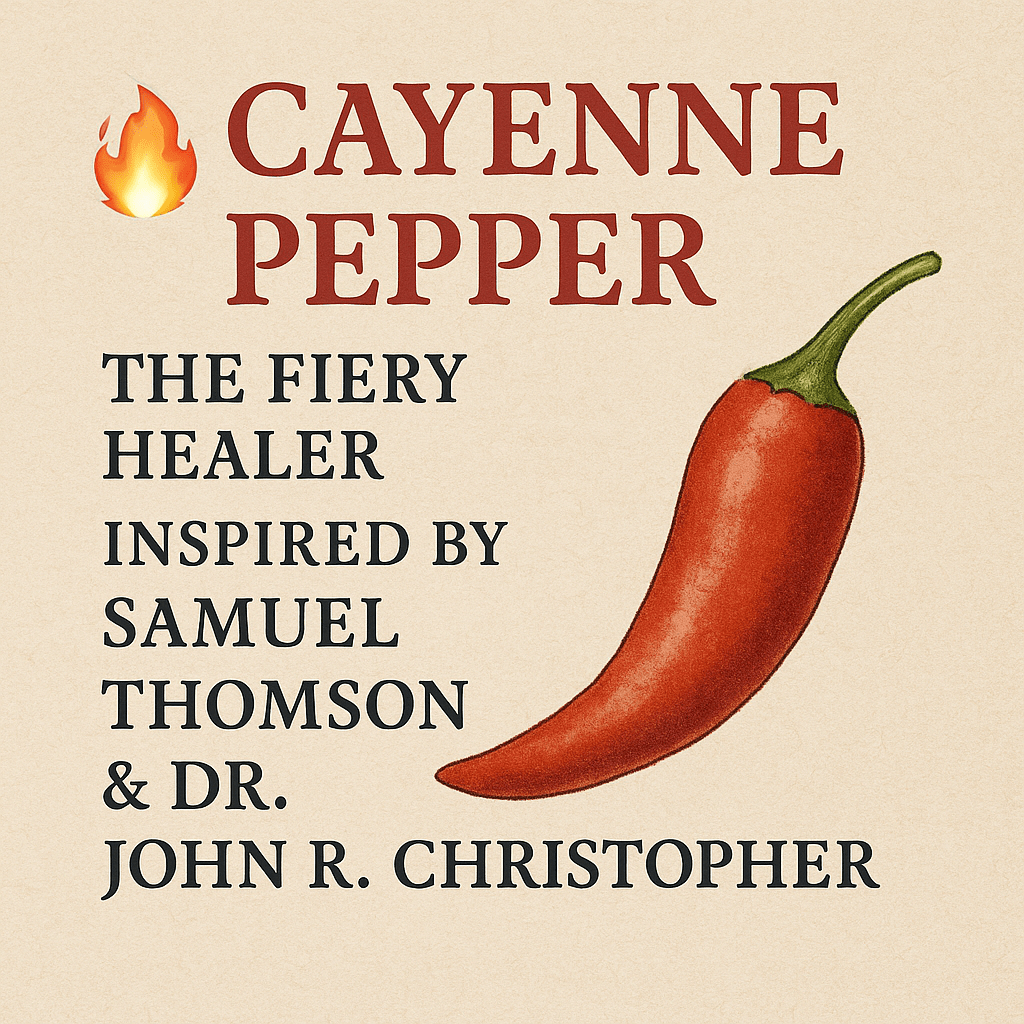
  • 🔥 Cayenne Pepper: The Fiery Healer Inspired by Samuel Thomson & Dr. John R. Christopher


    Cayenne pepper isn’t just a spice—it’s one of the most powerful herbal remedies in natural medicine, revered by pioneers like Samuel Thomson and Dr. John R. Christopher. These two legendary herbalists saw cayenne not only as food but as medicine for the people—accessible, effective, and life-saving.

    Samuel Thomson, often called the father of American herbalism, promoted cayenne as a key remedy to restore heat and vitality to the body. In his system, which emphasized keeping the body’s internal heat up to prevent disease, cayenne was used to stimulate circulation, break up stagnation, and invigorate weakened systems.

    Dr. John R. Christopher—beloved founder of The School of Natural Healing—called cayenne “the king of herbs.” He famously said that if he could only take one herb with him, it would be cayenne. Why? Because of its incredible versatility. Cayenne strengthens the heart, stops bleeding, improves digestion, relieves pain, reduces inflammation, and supercharges the entire circulatory system. It’s even been used in emergency situations for heart attack and shock!

    Modern studies now support what these herbalists knew intuitively: cayenne contains capsaicin, a compound that reduces pain, boosts metabolism, and enhances cardiovascular health. But beyond the science, cayenne invites us into deeper awareness of our own healing. It teaches us to wake up, to feel, and to circulate life within our bodies.

    When used wisely, cayenne can be a powerful ally in your healing journey. Below is a traditional method for gradually introducing cayenne into your daily routine.


    🌶️ Cayenne Dosage: A Gradual Introduction to the King of Herbs

    Start with a small amount and let your body adjust to the heat. Here’s how Dr. John R. Christopher recommended doing it:

    Begin with ¼ teaspoon of cayenne pepper mixed into a small glass of cold water. Drink it quickly, then follow with a full glass of cold water.

    Every three days, increase the dosage by another ¼ teaspoon—always mixed in a little cold water—until you reach a full 1 teaspoon, taken three times daily.

    This gradual build-up helps your system adjust to cayenne’s pungency while unlocking its many healing benefits. Don’t rush—listen to your body and go at a pace that feels right for you.


    ⚠️ Note: Always consult your healthcare provider if you have heart conditions, digestive ulcers, or other concerns. Cayenne is powerful—and like all powerful tools, it should be used with respect.

    Let this fiery herb warm your heart, your blood, and your spirit—just as it did for the generations of herbalists before us.