Sister Abigail Hester

Tag: faith

  • Contending for Love: A Progressive Commentary on the Epistle of Jude

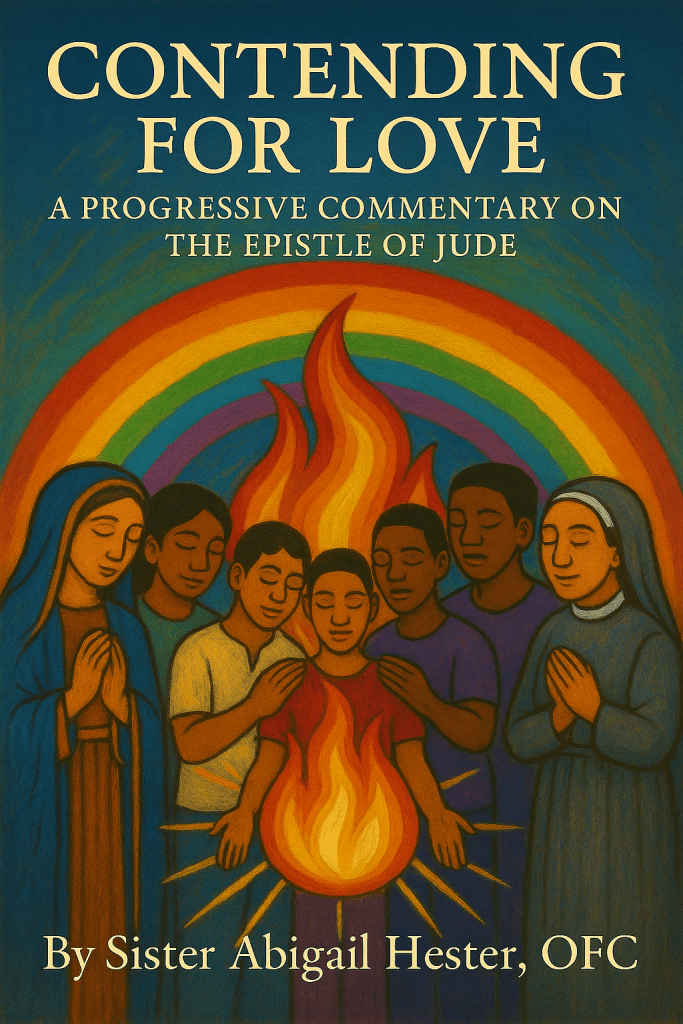
    ✨ Contending for Love: A Progressive Commentary on the Epistle of Jude

    By Sister Abigail Hester, OFC
    For the Order of Franciscan Clareans


    📖 Introduction

    The Epistle of Jude, a brief and often overlooked letter near the end of the New Testament, is usually remembered for its fiery denunciations of false teachers and its use of apocalyptic imagery. Historically, it has been weaponized by some to accuse those who do not conform to rigid religious norms—including LGBTQIA+ Christians—of moral decay. But when we read Jude through the lenses of liberation, universal love, and radical inclusion, a different message emerges: a call to remain grounded in love, community, and the mercy of God in the face of division and injustice.


    📚 Verses 1–2: A Greeting of Belovedness

    “To those who are called, who are beloved in God the Father and kept safe for Jesus Christ: May mercy, peace, and love be yours in abundance.”

    Jude opens with a powerful affirmation: we are calledbeloved, and kept safe. For queer and trans Christians who have been told they are unwanted by God, this greeting is balm. Jude does not condition God’s love on moral purity or religious conformity—it is freely given, abundant, overflowing.

    From a Franciscan Clarean perspective, we affirm that each person bears the image of Christ. Just as Francis kissed the leper and Clare offered sanctuary to her sisters, we are called to recognize every soul—especially the marginalized—as beloved and held safely in divine love.


    🕊️ Verses 3–4: Contending for the Faith — Not Weaponizing It

    “I find it necessary to write and appeal to you to contend for the faith… For certain intruders have stolen in among you… perverting the grace of our God into licentiousness and denying our only Master and Lord, Jesus Christ.”

    These verses are often used to justify boundary policing in the Church—especially of LGBTQIA+ people. But what does it really mean to “contend for the faith”?

    In liberation theology, “faith” is not static doctrine but the living praxis of love and justice. To contend for the faith is not to gatekeep—it is to resist empire, exclusion, and exploitation. The “intruders” Jude refers to may be understood in our time as those who corrupt the gospel of grace to uphold domination, be it through nationalism, white supremacy, transphobia, or patriarchy.

    Queer theologians remind us: true heresy is not queerness—it is the denial of God’s image in our diversity.


    🔥 Verses 5–16: Warnings Through Apocalyptic Midrash

    Jude draws from Jewish apocalyptic traditions—stories of fallen angels, Sodom, Cain, and Balaam. These warnings can seem harsh and otherworldly, but read through a Franciscan lens, they serve not to condemn but to call attention to systems of exploitation and injustice.

    Sodom and Queer Misreadings

    Verse 7 refers to Sodom—often misused as a clobber passage.

    “Sodom and Gomorrah…indulged in sexual immorality and pursued unnatural lust.”

    Yet the biblical witness in Ezekiel 16:49 tells us the sin of Sodom was pride, excess, and failure to care for the poor and needy. In other words: the sin of empire, not same-gender love.

    Liberation and queer theologies insist: we must reclaim these texts from harmful misuse. The cities of Sodom and Gomorrah are warnings against violence and inhospitality—especially toward strangers and the vulnerable. The real “unnatural” sin is the dehumanization of queer bodies, not their existence.


    🌱 Verses 17–23: Building Up in Love

    “But you, beloved, build yourselves up on your most holy faith; pray in the Holy Spirit; keep yourselves in the love of God…”

    Here, Jude shifts tone: from judgment to nurture. These verses are the heart of the letter for progressive Christians.

    • Pray in the Spirit: not in fear, but in intimacy with the divine presence that speaks through all people—especially the silenced.
    • Keep in the love of God: Not by conformity, but by radical compassion and justice.
    • Show mercy: Even to those who doubt, to those caught in fear and judgment. Liberation theology reminds us that the work of justice includes healing both the oppressed and the oppressor.

    This is a call to queer sanctity—to form communities that are fierce in love, honest in lament, and faithful to the Spirit of God who dances beyond boundaries.


    🌈 Verse 22–23: Mercy that Rescues

    “And have mercy on some who are wavering; save others by snatching them out of the fire; and have mercy on still others with fear…”

    These verses are often read with anxiety. But what if “snatching from fire” means liberating people from the burning structures of empire? The fires we face today are not divine punishment but the consequences of greed, racism, transphobia, and ecological destruction.

    The queer and trans community has often been placed in this fire—not by God, but by a Church complicit in violence. We, as Franciscan Clareans, are called to rescue each other with mercy, not judgment.


    🌟 Verses 24–25: A Universal Benediction

    “Now to the One who is able to keep you from falling and to present you without blemish… to the only God… be glory…”

    Jude closes not with threat but praise. This God is not the condemner but the sustainer. The One who presents us without blemish is not fixated on our past, but devoted to our healing and wholeness.

    This is liberal Christian universalism at its core: God will not lose any of us. There is no soul too queer, no heart too wounded, no life too far gone. All are drawn into the light of mercy.


    🎨 Devotional Reflection

    Art Prompt: Paint a flame that does not burn but heals. Around it are people of all genders, races, and orientations—dancing, embraced, loved.

    Liturgical Action: Light a candle for each group harmed by religious exclusion (LGBTQIA+ people, women, the disabled, racial minorities, the poor). Offer this prayer:
    “God of all mercy, we kindle your light where others brought fire to destroy. Make us healers, not gatekeepers. Make us vessels of your inclusive flame.”


    🕊️ Final Thoughts for the Order of Franciscan Clareans

    As followers of St. Francis and St. Clare, we are not afraid of the fire—we transform it. We reclaim Jude not as a letter of condemnation, but as a call to courageous compassion. We contend for the faith not by excluding others, but by embracing the radical, boundary-breaking love of Christ.

    May we, too, be kept in love, held in mercy, and unafraid to dance at the margins where Christ still walks.
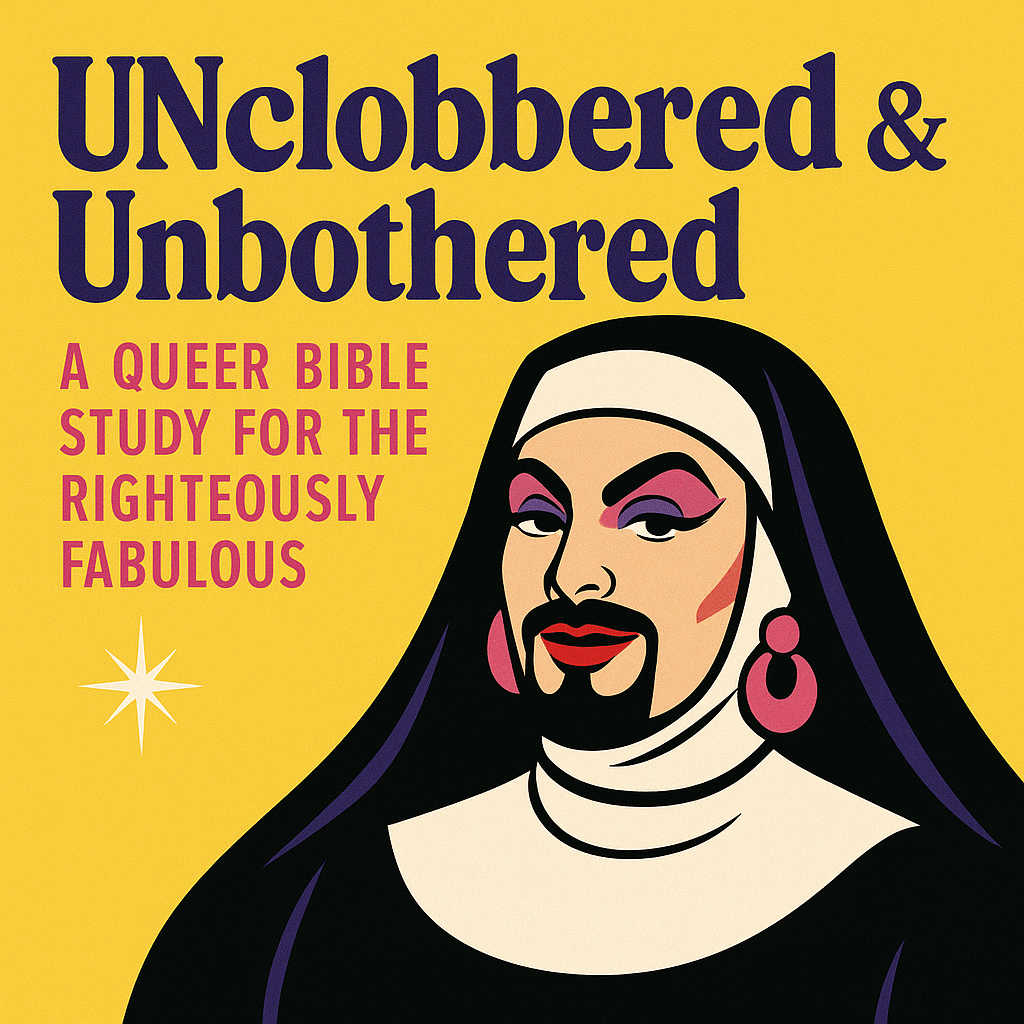
  • 📖 Unclobbered & Unbothered: A Queer Bible Study for the Righteously Fabulous


    By Sister Abigail Hester, OFC
    A Franciscan Clarean Defense of LGBTQIA+ People in the Face of Weaponized Scripture


    💥 Introduction: Holy Misinterpretation, Batman!

    Let’s get one thing straight — or rather, let’s get everything delightfully queer: the Bible is not a homophobic book. It has been read that way by empire, patriarchy, and bigots with bad haircuts and worse hermeneutics. But when we read the text through the lens of liberation, context, and queerness, the clobber passages turn into… well, laughable.

    This study will walk us through the so-called “clobber texts,” clap back with history, context, theology, and a wink of divine sass. Because honey — we weren’t made to sit silently while folks misuse the Word to harm the very ones Christ came to liberate.


    📜 The “Clobber Passages” in Question

    These are the six classic “texts of terror” often flung like theological dodgeballs at queer folks:

    1. Genesis 19 – Sodom and Gomorrah
    2. Leviticus 18:22 & 20:13 – “Man shall not lie with man…”
    3. Romans 1:26–27 – “Shameful lusts”
    4. 1 Corinthians 6:9–10 – “The effeminate” and “homosexuals”
    5. 1 Timothy 1:9–10 – “Perverts” or “sodomites”
    6. Jude 1:7 – Sexual immorality of Sodom again

    Let’s unclobber these one by one.


    1. 💣 Genesis 19: Sodom and Gomorrah

    Clobber claim: God destroyed Sodom for gay sex.

    Response: God destroyed Sodom for rape, violence, and inhospitality — not Pride floats and drag brunches.

    “Now this was the sin of your sister Sodom: she was arrogant, overfed and unconcerned; they did not help the poor and needy.” – Ezekiel 16:49

    🎯 Boom. That’s the Bible clapping back at bad theology.

    The real sin: Abuse of power, exploitation, and cruelty to strangers. In other words, homophobia, not homosexuality, is the Sodomite sin.

    Queer note: If anything, Genesis 19 is a call to defend the vulnerable — especially travelers, the gender-nonconforming, and the powerless. Sounds like a call to queer hospitality!


    2. 🧀 Leviticus 18:22 & 20:13

    “You shall not lie with a male as with a woman; it is an abomination.”

    Clobber claim: Being gay is an abomination.

    Response: So is eating shrimp, wearing polyester, and planting two seeds in one field (see Leviticus 11:10, 19:19). But you don’t see them picketing Red Lobster, do you?

    📘 Marcus Borg and John Dominic Crossan remind us: Leviticus is a purity code, not a moral absolute. It was written for ritual cleanliness, not eternal judgment.

    Abomination (Hebrew: toevah) means “ritually impure,” not “eternally condemned.” It was about Israel’s identity, not your date to prom.

    Queer theology twist: Jesus broke the purity codes constantly — touching lepers, eating with sinners, and healing on the Sabbath. If you’re breaking purity rules to love better, you’re doing it right.


    3. 🌀 Romans 1:26–27

    “God gave them up to shameful lusts… men committing shameless acts with men…”

    Clobber claim: Paul condemns homosexuality.

    Response: Paul condemns exploitative, idolatrous, excessive lust, not loving same-sex relationships.

    This is Paul throwing shade at Roman orgies and temple prostitution, not your marriage license.

    🧠 Scholar alert! Beverly Roberts Gaventa and Daniel Helminiak point out that Romans 1 describes unnatural acts — but Paul isn’t defining what’s natural in your biology. He’s critiquing excessive Greco-Roman patriarchal sexual dominance.

    Patrick Cheng says this passage is about imperial excess, not queer tenderness. Paul didn’t know about modern sexual orientation. To read that back into the text is like blaming Jesus for Twitter.

    Fun fact: In Greek, “unnatural” (para physin) is also used to describe God’s actions (Romans 11:24). So clearly, “unnatural” ≠ evil. Sometimes divine love is unnatural — especially when it breaks the world’s rules.


    4. 🎭 1 Corinthians 6:9–10

    “Neither the sexually immoral… nor men who have sex with men…”

    Clobber claim: Gays go to hell.

    Response: The Greek words used here are:

    • Malakoi – “soft ones,” often referring to effeminate men or passive partners (but also used for luxury pillows).
    • Arsenokoitai – a bizarre compound word Paul seems to invent, literally “man-bedders.”

    🧑‍🏫 John Boswell and Dale Martin show us: we don’t really know what arsenokoitai means. It shows up almost nowhere else in ancient Greek literature. Could mean exploiters. Could mean temple pimps. Could mean… tax collectors for all we know.

    So unless you’ve built an entire theology on mistranslating ancient Greek and ignoring love, maybe sit this one out, clobber crowd.


    5. 🪓 1 Timothy 1:9–10

    “The law is laid down… for the unholy and sinful, for those who kill their fathers or mothers, for murderers, the sexually immoral, men who practice homosexuality…”

    Clobber claim: The New Testament condemns homosexuality.

    Response: Again, we’re dealing with that strange word arsenokoitai — not “gay people” in modern terms. There’s zero reason to believe Paul had anything in mind resembling today’s same-sex relationships built on mutual love, covenant, and faithfulness.

    Also — let’s talk context. This list is like Paul’s version of a “bad people” rap sheet, mixing thieves, liars, and… apparently queer folks if we mistranslate? Not convincing.

    Truth bomb: Love rooted in justice, mutuality, and consent is never what Paul condemns. What’s condemned is exploitation, domination, and violence. And that applies to all sexualities.


    6. 🔥 Jude 1:7

    “Sodom and Gomorrah… indulged in sexual immorality and pursued unnatural lust.”

    Clobber claim: LGBTQ people are like the people of Sodom — lustful and unnatural.

    Response: What’s “unnatural” to empire often looks like God’s justice breaking through. If you’ve ever loved someone in a way the world told you was wrong — welcome to the revolution.

    Marcella Althaus-Reid calls this “indecent theology” — reclaiming the power of the body, of erotic love, of pleasure, and queerness as sacred, not sinful.

    So if loving queerly is unnatural, then so is grace. And I, for one, am living for both.


    ✊ Holy Takeaways: What Jesus Would Say

    • Jesus never said a word against LGBTQIA+ people.
    • He did say a lot against religious hypocrites.
    • He did say love your neighbor. And honey, that includes your queer neighbor — and yourself.

    🧼 Clobber texts = cherry-picked, context-ignoring, empire-approved weaponry.
    💖 Queer love = holy, sacred, Christ-reflecting.


    💅 Closing Benediction (Drag Mass Style)

    May your love be louder than their hate.
    May your queerness be too fabulous to ignore.
    May your faith be too fierce to silence.
    And may your theology leave no clobber passage unchallenged.

    Go in peace, beloveds. And throw glitter in the face of bad exegesis.