Sister Abigail Hester

Tag: christianity

  • Holier Than Honest, Holier Than Hype: A Reply (with receipts)

    In response to the following linked article:

    The rebuttal to my article tries to swat away questions of New Testament authorship with some familiar apologetic flourishes: Satan made you doubt, Plato had fewer manuscripts, and Peter could totally spell. Let’s sort through this — with both humor and actual scholarship.


    1. “Satan made you doubt.”

    Apparently the devil isn’t busy enough with wars, greed, and injustice — he’s moonlighting as a textual critic in a dusty library, whispering, “Pssst… Mark 16:9–20 wasn’t original.”

    But Christians noticed textual variants long before Bart Ehrman. Origen (3rd century) admitted, “The differences among the manuscripts have become great” (Commentary on Matthew 15.14). Jerome complained about “various readings” in the Latin Bible. Even Augustine admitted some texts circulated “with additions” (On Christian Doctrine 2.12).

    So if doubt comes from Satan, then apparently Origen, Jerome, and Augustine were on Beelzebub’s payroll too.


    1. “But Plato, Aristotle, Homer!”

    Yes, Plato has 7 manuscripts, Aristotle 49, Homer 643. The New Testament boasts over 5,000 Greek manuscripts. But as NT scholar Craig Blomberg (an evangelical) admits, “The abundance of manuscripts does not mean we have no variants. Quite the contrary — it means we have hundreds of thousands” (The Historical Reliability of the New Testament, 2016).

    Quantity of manuscripts is evidence of popularity, not necessarily authorship. Nobody’s eternal destiny hangs on whether Homer actually wrote the Iliad.


    1. “We know who wrote the Gospels — their names are in Acts!”

    That’s like saying, “Of course J.K. Rowling wrote Shakespeare; her name shows up in a library record.” The Gospels are anonymous. The earliest copies don’t say “The Gospel According to Matthew.” The titles appear in the late 2nd century.

    As Raymond Brown (a Catholic scholar) put it bluntly: “The present titles, which ascribe the Gospel to Matthew, Mark, Luke, and John, are not part of the original works but were added later” (Introduction to the New Testament, 1997).

    Acts mentioning “Matthew the tax collector” proves only that someone named Matthew was a tax collector — not that he wrote a 28-chapter Greek Gospel.


    1. “Paul wrote them all. Different style? Just handwriting mood swings.”

    The “multi-individuality of handwriting” defense is creative, but irrelevant. Scholars don’t base authorship on penmanship alone. They examine vocabulary, theology, and historical setting.

    For instance, Romans and Galatians pulse with Paul’s urgency. Ephesians and Colossians present a cosmic Christology and more structured Greek. That’s why most critical scholars (and even some evangelicals) classify them as “Deutero-Pauline.” Luke Timothy Johnson notes: “The differences in vocabulary, style, and theology are too great to ignore” (The Writings of the New Testament, 2010).

    That doesn’t make them fraudulent; pseudonymous writing was common in antiquity. It simply means the Pauline “school” carried forward his theology.


    1. “The Fathers quoted Paul, so that settles it.”

    Yes, Clement, Ignatius, and Polycarp cite letters attributed to Paul. But citing a text shows its authority, not its authorship. Eusebius himself (4th century) admitted debates about certain letters (Ecclesiastical History 3.25).

    Patristic testimony proves that by 100–150 CE, churches revered certain letters. It doesn’t prove Paul’s hand wrote each one.


    1. “Peter could spell. Show me a verse that says he couldn’t!”

    This is theological Uno: reverse card. The burden of proof isn’t on me to show Peter couldn’t spell. Acts 4:13 literally calls Peter and John agrammatoi (“uneducated”). That raises a fair question: how likely is it they wrote polished Greek treatises?

    Even conservative scholar Ben Witherington admits: “1 Peter’s Greek is too sophisticated for a Galilean fisherman… The hand of a secretary is almost certainly involved” (Letters and Homilies for Hellenized Christians, 2006).

    So sure, Peter could “spell” — with help. Inspiration doesn’t mean every apostle suddenly got Rosetta Stone.


    1. “But John’s Gospel and Revelation sound alike!”

    Actually, they don’t. The Gospel of John has elegant Greek; Revelation reads like someone who struggled with grammar. That’s why Dionysius of Alexandria (3rd century) argued they had different authors (Eusebius, Hist. Eccl. 7.25).

    Modern scholarship agrees. Craig Koester notes: “The differences in style and vocabulary are stark” (Revelation, Anchor Bible, 2014).

    If they’re the same author, then he went from writing like a philosopher to writing like Yoda.


    1. “You’re transgender, so you can’t be Christian.”

    This isn’t scholarship; it’s a playground taunt. My gender identity has nothing to do with whether Mark 16’s “long ending” was original. Attacking the critic instead of engaging the evidence is the definition of ad hominem.


    Conclusion: Faith, Facts, and Fear

    The New Testament is sacred, beloved, and central to Christian life. But pretending it dropped from heaven leather-bound in King James English doesn’t honor it — it cheapens it.

    Admitting that the Gospels are anonymous, that some Pauline letters are disputed, and that later scribes added a few passages doesn’t mean Christianity is false. It means the Bible has a history, just like every other ancient text.

    God’s Word isn’t fragile. If faith shatters the moment we admit Mark’s long ending was tacked on later, maybe the problem isn’t the manuscript tradition — maybe it’s our fear of facing the very human story of how God’s Word came to us.
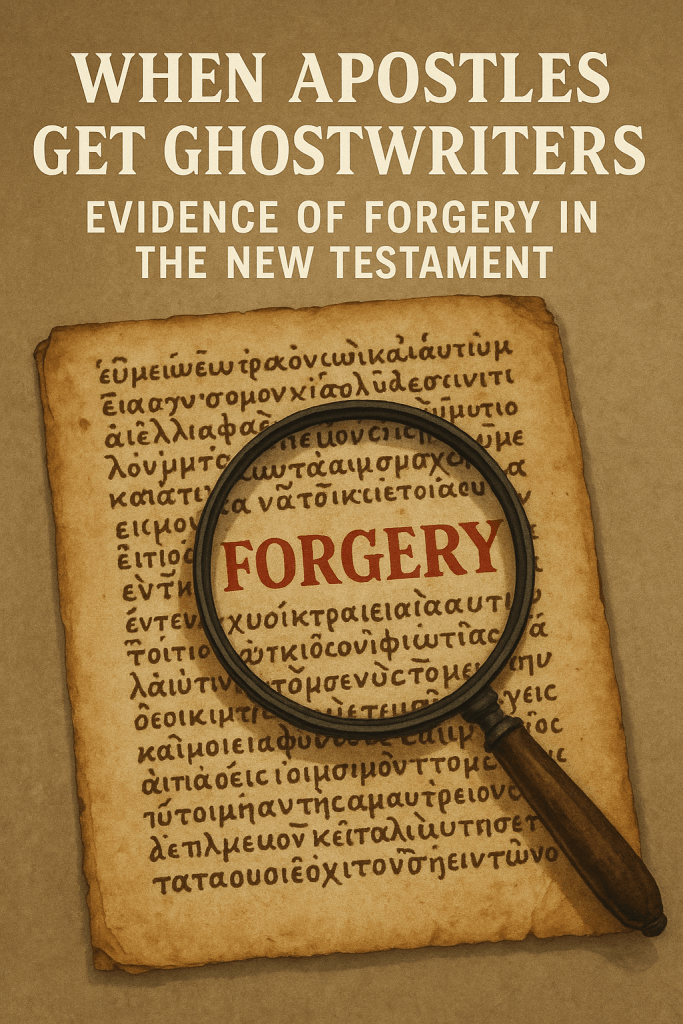
  • When Apostles Get Ghostwriters: Evidence of Forgery in the New Testament

    Introduction: Holier Than Thou or Holier Than Honest?

    The New Testament is hailed as “God’s Word,” but let’s be real: much of it is anonymous, pseudonymous, or forged. Early Christians lived in a world where writing under someone else’s name was a power move—meant to claim authority, shut down rivals, and win theological battles. Think of it as the original form of identity theft, with a halo.


    Paul: The Real vs. the Fake

    Authentic Paul (7 letters): Romans, 1–2 Corinthians, Galatians, Philippians, 1 Thessalonians, Philemon. These bear Paul’s raw, fiery voice—half-mystic, half-activist.[1]

    Imposter Paul (the rest):

    Deutero-Pauline: Ephesians, Colossians, 2 Thessalonians. These smooth-talking letters sound like Paul on decaf.[2]

    Pastorals (1 & 2 Timothy, Titus): Widely regarded as forgeries. Vocabulary and style don’t fit, the church hierarchy looks too developed, and Paul suddenly obsesses over bishops and “sound doctrine.”[3]


    Peter: The Fisherman Who Couldn’t Spell Greek

    1 Peter: Its sophisticated Greek and rhetorical polish make it unlikely that an uneducated Galilean fisherman wrote it.[4]

    2 Peter: Almost universally labeled a forgery, composed in the 2nd century, and heavily plagiarizing Jude.[5]


    The Johannine Mix-Up

    Gospel vs. Revelation: The Gospel of John is smooth, mystical Greek; Revelation is rough, broken Greek. Not the same author.[6]

    1–3 John: Anonymous letters later attributed to “John” for borrowed authority.[7]


    The Interpolations: Cutting Room Floor Additions

    Some passages look like late insertions—pious frauds with staying power:

    Mark 16:9–20: The “long ending” with snake-handling and poison-drinking is absent in earliest manuscripts.[8]

    John 7:53–8:11: The woman caught in adultery. A moving story, but added later.[9]

    1 John 5:7 (Comma Johanneum): Explicit Trinitarian formula—medieval addition, not found in Greek manuscripts.[10]

    Luke 22:43–44: Jesus sweating blood in Gethsemane—missing from earliest copies.[11]


    The Gospel Truth: They’re Anonymous

    The gospels never name their authors. “Matthew,” “Mark,” “Luke,” and “John” were attached in the 2nd century as authority branding.[12] In the ancient world, name-dropping was marketing: “Buy this scroll! Endorsed by an apostle!”


    Why It Matters

    Here’s the punchline: the church has been preaching against “bearing false witness” while canonizing forged documents. Hypocrisy much? But here’s the Franciscan Clarean twist: truth doesn’t need forgery to shine. The Spirit works even through messy, forged, and human documents. God’s love doesn’t require a flawless manuscript.


    Conclusion: Holiness Over Forgery

    If anything, forged and interpolated texts remind us that Christianity was always messy, political, and human. Faith isn’t about pretending our Scriptures dropped from heaven shrink-wrapped. It’s about hearing God’s call in the cracks, the edits, and yes—even the forgeries.

    Because if God can work through forged letters, then God can work through us—hot messes, imposters, and all.


    References

    [1]: Bart D. Ehrman, Forged: Writing in the Name of God—Why the Bible’s Authors Are Not Who We Think They Are (New York: HarperOne, 2011), pp. 95–118.
    [2]: Marcus J. Borg and John Dominic Crossan, The First Paul: Reclaiming the Radical Visionary Behind the Church’s Conservative Icon (New York: HarperOne, 2009).
    [3]: Raymond E. Brown, An Introduction to the New Testament (New York: Doubleday, 1997), pp. 668–681.
    [4]: Ehrman, Forged, pp. 122–124.
    [5]: Werner Kümmel, Introduction to the New Testament (London: SCM Press, 1975), pp. 430–433.
    [6]: Elaine Pagels, Revelations: Visions, Prophecy, and Politics in the Book of Revelation (New York: Viking, 2012).
    [7]: Brown, Introduction to the New Testament, pp. 387–393.
    [8]: Bruce Metzger, A Textual Commentary on the Greek New Testament (Stuttgart: United Bible Societies, 1994), pp. 102–106.
    [9]: Ibid., pp. 187–189.
    [10]: Metzger, Textual Commentary, pp. 647–649.
    [11]: Ehrman, Misquoting Jesus: The Story Behind Who Changed the Bible and Why (New York: HarperOne, 2005), pp. 187–189.
    [12]: Richard Bauckham, Jesus and the Eyewitnesses: The Gospels as Eyewitness Testimony (Grand Rapids: Eerdmans, 2006), though defending authenticity, still acknowledges anonymous origins.

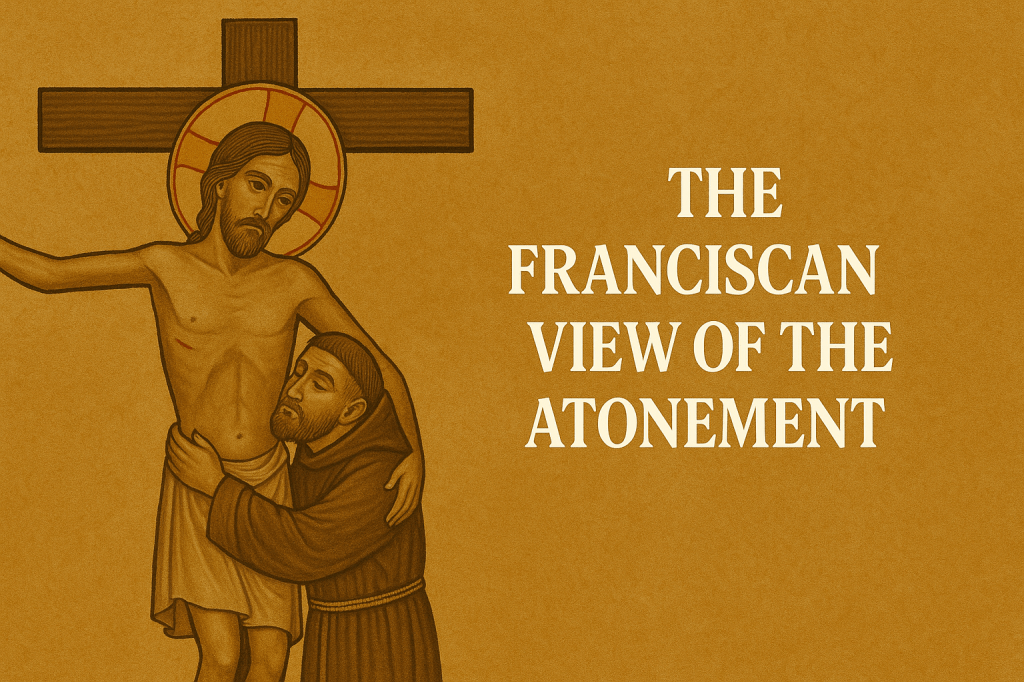
  • The Franciscan Vision of the Atonement: Love Before Law


    Introduction

    In the history of Christian theology, the doctrine of the atonement has often been framed in the language of law, debt, and punishment. Anselm of Canterbury’s Cur Deus Homo (11th century) offered the satisfaction model: humanity’s sin dishonored God, and satisfaction was required through Christ’s death.^1 Later Protestant Reformers sharpened this into penal substitution: Jesus bore divine wrath in humanity’s place.

    The Franciscan tradition, however, offers a radically different perspective. From St. Francis and St. Clare’s lived spirituality, to the speculative theology of St. Bonaventure and John Duns Scotus, Franciscans interpret the Incarnation and Cross not as reactions to sin but as the eternal expression of God’s love. For Franciscans, the atonement is not transaction but transformation, not appeasement but union.


    The Incarnation as “Plan A”

    At the heart of Franciscan atonement theology lies the Primacy of Christ. John Duns Scotus (1266–1308) argued that the Incarnation was not contingent upon human sin. God did not look down at Eden’s rebellion and scramble for a remedy. Rather, the Word-made-flesh was foreordained “before the foundation of the world” (Eph. 1:4).

    Scotus writes: “If Adam had not sinned, Christ still would have become incarnate. For the Incarnation is the greatest glory of God, and it is fitting that God should will always what is best and most glorious.”^2 In other words, Christ is not plan B after human failure, but plan A from eternity.

    This perspective reshapes the atonement: Jesus comes primarily to unite creation with God, not simply to fix sin.^3


    Bonaventure and the Cross as Revelation of Love

    St. Bonaventure (1217–1274), the “Seraphic Doctor,” emphasized the affective and mystical dimensions of the Cross. In his Tree of Life, he portrays Christ crucified as the burning heart of divine charity:

    • The wood of the cross is the ladder to heaven.
    • The wounds of Christ are windows into God’s mercy.
    • The Crucified is not merely victim but lover.

    For Bonaventure, the Cross does not primarily satisfy wrath but enflames hearts with love, drawing humanity into compassionate union with the suffering Christ.^4 The Franciscan devotion to the Passion—embodied in Francis’s stigmata—reflects this mystical vision.


    Francis and Clare: Lived Atonement in Poverty

    Francis and Clare of Assisi did not write scholastic treatises, but their lives proclaimed a theology of atonement. By embracing radical poverty, humility, and solidarity with lepers and outcasts, they embodied Christ’s own descent into littleness.

    For Francis, Christ saves not by power but by weakness. The Incarnation is God stooping down, and the Cross is God identifying with the crucified of the world.^5 To follow the Poor Christ is to share life with the poor and crucified of history.

    Clare insisted that gazing upon the mirror of the crucified Christ transforms the soul. “Place your mind before the mirror of eternity, place your soul in the brilliance of glory, place your heart in the figure of the divine substance, and transform your entire being into the image of the Godhead through contemplation.”^6 For Clare, this contemplative seeing—not legal reasoning—was the path of atonement.


    Theological Implications

    1. Union, Not Transaction
      • Salvation is not a commercial exchange of debt and payment, but a personal union of love between God and creation.^7
    2. Solidarity with the Marginalized
      • The Cross shows God standing with the oppressed. Thus, to live the atonement is to stand in solidarity with the poor, the queer, the crucified of every age.^8
    3. Cosmic Christology
      • The Incarnation integrates not only humanity but the whole cosmos into Christ. Atonement thus includes creation itself, grounding Franciscan ecological spirituality.^9
    4. Transformation of Desire
      • The Franciscan way emphasizes affectivity: the Cross changes the human heart, awakening love rather than fear.^10

    Conclusion

    The Franciscan opinion of the atonement is, at its core, a vision of divine love made visible in Christ. Against juridical models, Franciscans proclaim that God did not send Christ to change His own mind about humanity, but to change humanity’s mind about God.

    The Incarnation was always the divine intention; the Cross reveals the cost of divine love in a violent world. For Francis and Clare, Bonaventure and Scotus, the atonement is not a courtroom verdict but a love song sung from eternity: God with us, God for us, God in us.

    “Love is not loved,” Francis once lamented.^11 The Franciscan vision of the atonement dares to reply: on the Cross, Love is at last unveiled.


    Footnotes

    1. Anselm of Canterbury, Cur Deus Homo, trans. Jasper Hopkins (Minneapolis: Arthur J. Banning Press, 1974).
    2. John Duns Scotus, Ordinatio III, d.7, q.3 (see Allan B. Wolter, Duns Scotus on the Incarnation, Franciscan Institute Publications, 2004), 55–60.
    3. Richard Rohr, Eager to Love: The Alternative Way of Francis of Assisi (Cincinnati: Franciscan Media, 2014), 183.
    4. Bonaventure, The Tree of Life, in Bonaventure: The Soul’s Journey into God, The Tree of Life, The Life of St. Francis, trans. Ewert Cousins (New York: Paulist Press, 1978), 135–150.
    5. Augustine Thompson, Francis of Assisi: A New Biography (Ithaca: Cornell University Press, 2012), 102–110.
    6. Clare of Assisi, Fourth Letter to Agnes of Prague, in Francis and Clare: The Complete Works, trans. Regis J. Armstrong and Ignatius Brady (New York: Paulist Press, 1982), 66.
    7. Zachary Hayes, Bonaventure: Mystical Writings (New York: Crossroad, 1999), 89–94.
    8. Ilia Delio, A Franciscan View of Creation: Learning to Live in a Sacramental World (St. Bonaventure, NY: Franciscan Institute, 2003), 72.
    9. Ilia Delio, Christ in Evolution (Maryknoll: Orbis Books, 2008), 121–126.
    10. Ewert Cousins, Bonaventure and the Coincidence of Opposites (Chicago: Franciscan Herald Press, 1978), 142.
    11. Francis of Assisi, The Admonitions, in Francis and Clare: The Complete Works, trans. Regis J. Armstrong and Ignatius Brady (New York: Paulist Press, 1982), 36.

  • Clare’s Radical Poverty: Reclaiming Holy Dependence

    By Sister Abigail Hester, OFC

    “Go forth in peace, for you have followed the good road. Go forth without fear, for He who created you has made you holy, has always protected you, and loves you as a mother.” — Saint Clare of Assisi

    A Scandalous Simplicity

    Clare of Assisi didn’t just embrace poverty—she dared to love it. Not out of ascetic thrill-seeking, but because she saw in it a deeper truth: we were never meant to survive on our own. In a world addicted to autonomy, she chose holy dependence. And that is scandalous.

    She defied not just her wealthy family, but the entire ecclesial structure that wanted her to “tone it down.” Bishops begged her to accept endowments. Popes tried to gently nudge her into more “reasonable” poverty. Clare? She dug in her heels. She insisted that her community have no possessions whatsoever—not even collectively. For Clare, poverty wasn’t a punishment. It was a path to freedom. A radical freedom that refused to be owned, owed, or beholden to anyone but Christ.

    Dependence as Resistance

    In our modern world, “dependence” is a dirty word. We’re taught to be self-sufficient, self-made, and preferably stylish while doing it. Neediness is weakness. But Clare flips the script: dependence isn’t disgraceful—it’s divine.

    To live in holy dependence is to confess:

    I don’t have all the answers.

    I can’t save myself.

    I need others, and I need God.

    Clare’s vision rips the mask off toxic individualism. She shows us that community—real, messy, interdependent community—isn’t a backup plan. It’s the Gospel lived out. Her sisters didn’t just pray together. They begged together, fasted together, wept together. They trusted that God would provide through the hands of the poor and the generosity of others. And often, He did.

    The Poor Christ

    What made Clare’s poverty radical wasn’t the lack of stuff. It was her refusal to turn away from the Crucified Christ. She saw in Him—naked, abandoned, pierced—her Beloved. She wanted to mirror Him in everything. His poverty, His vulnerability, His absolute surrender to the Father’s will.

    To be poor like Clare is to stare into the wound of the world and not flinch. It is to say, I will not climb the ladder. I will descend into the dust, where Christ dwells among the broken. This is not performative poverty. This is mystical union.

    A Word to the Church

    Let’s be honest: much of the Church today has made peace with wealth. We’ve baptized greed, canonized comfort, and turned boardrooms into upper rooms. Clare’s life asks us: Who do we actually trust? Mammon or Mercy?

    If our ministries, communities, and spiritual lives can’t survive without financial insulation or institutional power, then we are not poor enough to know Clare. Or Christ.

    Reclaiming Holy Dependence

    For the Order of Franciscan Clareans—and for all who dare to follow the poor, queer, and crucified Christ—this is our inheritance. Holy dependence isn’t about helplessness. It’s about wholeness. It’s about reclaiming the sacred gift of needing one another.

    What might it look like to:

    Share your income with your neighbor without tracking the “ROI”?

    Let go of owning more and opt into mutual care?

    Refuse the illusion of control and embrace the vulnerability of trust?

    Clare doesn’t give us a blueprint. She gives us a burning love—a love that says: Let go. Fall into God. And if you’re lucky, into the arms of the poor.

    Benediction

    May we be ruined for comfort.
    May we be allergic to power.
    May we live unclenched, unarmed, and unashamed to need.
    Like Clare. Like Christ.

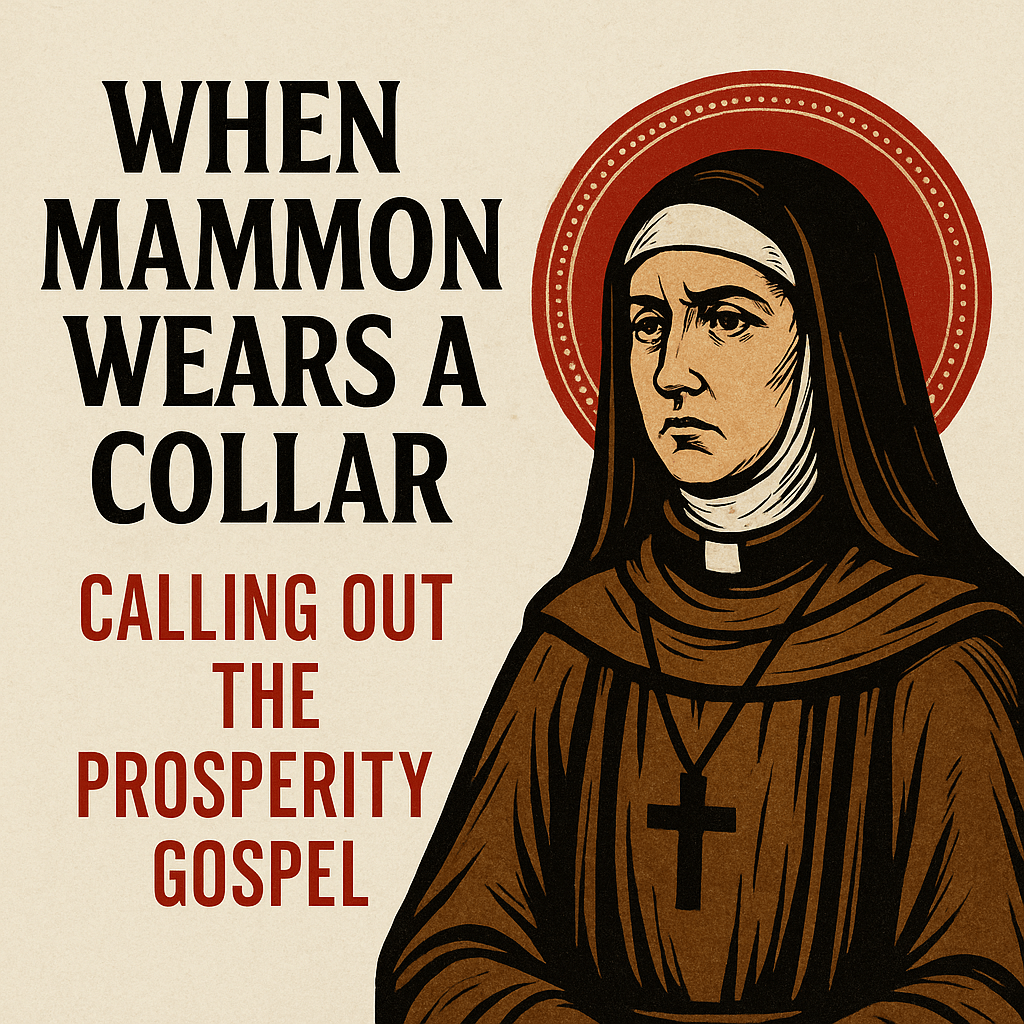
  • When Mammon Wears a Collar: Calling Out the Prosperity Gospel

    By Sister Abigail Hester, OFC

    “You cannot serve both God and mammon.” — Jesus (Matthew 6:24)

    Introduction: The Gospel According to Greed

    There’s a poison infecting the Body of Christ. It’s slick, it’s shiny, and it’s tax-exempt. It dresses in designer suits, flies in private jets, and justifies it all with cherry-picked Scripture. It calls itself “blessed,” but it’s better described as bloated. It claims to preach the good news, but it’s selling snake oil soaked in gold.

    We’re talking about the Prosperity Gospel — that glitzy theology which proclaims that Jesus wants you rich, powerful, and problem-free… so long as you sow your “seed offering” into the preacher’s bank account.

    At the Order of Franciscan Clareans, we stand firmly and prophetically against this distortion of the Gospel. We follow a poor Christ — the one who was born in a barn, died naked on a Roman cross, and taught that the last shall be first. We believe the Prosperity Gospel is not just bad theology — it’s spiritual violence wrapped in tinsel.

    1. Mammon in the Pulpit

    When Jesus said, “You cannot serve both God and mammon,” He meant it literally. Mammon — the idol of wealth, of accumulation, of status — has found its way into the pulpit. Some preachers now sound more like motivational speakers for hedge fund managers than like prophets of the Kingdom.

    They claim:

    “If you’re struggling, it’s because you don’t have enough faith.”

    “If you give to God (meaning them), He’ll multiply your money!”

    “Jesus was wealthy — he had a treasurer!”

    This is not the Gospel. It’s a pyramid scheme with a Bible verse duct-taped to it. It turns faith into a transaction, prayer into a business plan, and the poor into expendable footnotes.

    1. The True Gospel Is Not for Sale

    The Prosperity Gospel peddles a lie: that God’s favor looks like financial success, physical health, and unending comfort. But the cross tells a different story. Jesus — God Incarnate — was poor, persecuted, misunderstood, and ultimately executed by the powers of wealth and empire.

    His apostles fared no better. Not one of them got rich from following Jesus. Most were martyred. Paul wrote half the New Testament from prison. And yet the Prosperity Gospel dares to say suffering is a sign of weak faith?

    No, beloved. The true Gospel costs us something. It calls us to deny ourselves, to carry our cross, to side with the poor, the sick, the imprisoned — not to trample over them on the way to a bigger house.

    1. A Franciscan Clarean Response

    As Franciscan Clareans, we proclaim with clarity and courage:

    Jesus is not a vending machine. Prayer is not a product return.

    Wealth is not inherently evil, but it is inherently dangerous. It numbs compassion, warps our sense of enough, and tempts us to justify injustice.

    Poverty is not a curse, and riches are not a sign of divine approval. The Beatitudes say otherwise.

    The Church is not for sale. If your pastor drives a Rolls-Royce while congregants can’t pay rent, something is spiritually rotten.

    We embrace Lady Poverty — not out of masochism, but because poverty frees us. It reminds us that love, community, and justice are the real treasures. We follow the barefoot Christ, not the bedazzled counterfeit.

    1. Preaching Jubilee, Not Jackpots

    Where the Prosperity Gospel preaches scarcity and hoarding, we preach Jubilee — the radical release of debt, redistribution of wealth, and restoration of the land and its people.

    We call for a Church that:

    Tithes not to pad bank accounts, but to feed the hungry.

    Builds not megachurches, but tiny homes for the unhoused.

    Preaches not prosperity, but solidarity with the oppressed.

    We don’t need a God who rewards the already-powerful. We need a liberating Christ who overturns the tables, kicks out the money-changers, and sets the captives free.

    1. Final Benediction: Fire in the Bones

    If you’ve been wounded by the Prosperity Gospel, we see you. We affirm that your suffering is not proof of God’s absence. Your bank account does not determine your worth. Your illness is not a sin.

    Let the false gospel collapse under its own weight. Let the Church rise up again — poor, prophetic, and full of fire.

    And if Mammon shows up wearing a clerical collar? We call it out. We cast it out.

    Because Jesus didn’t die to make us rich — He rose to make us free.

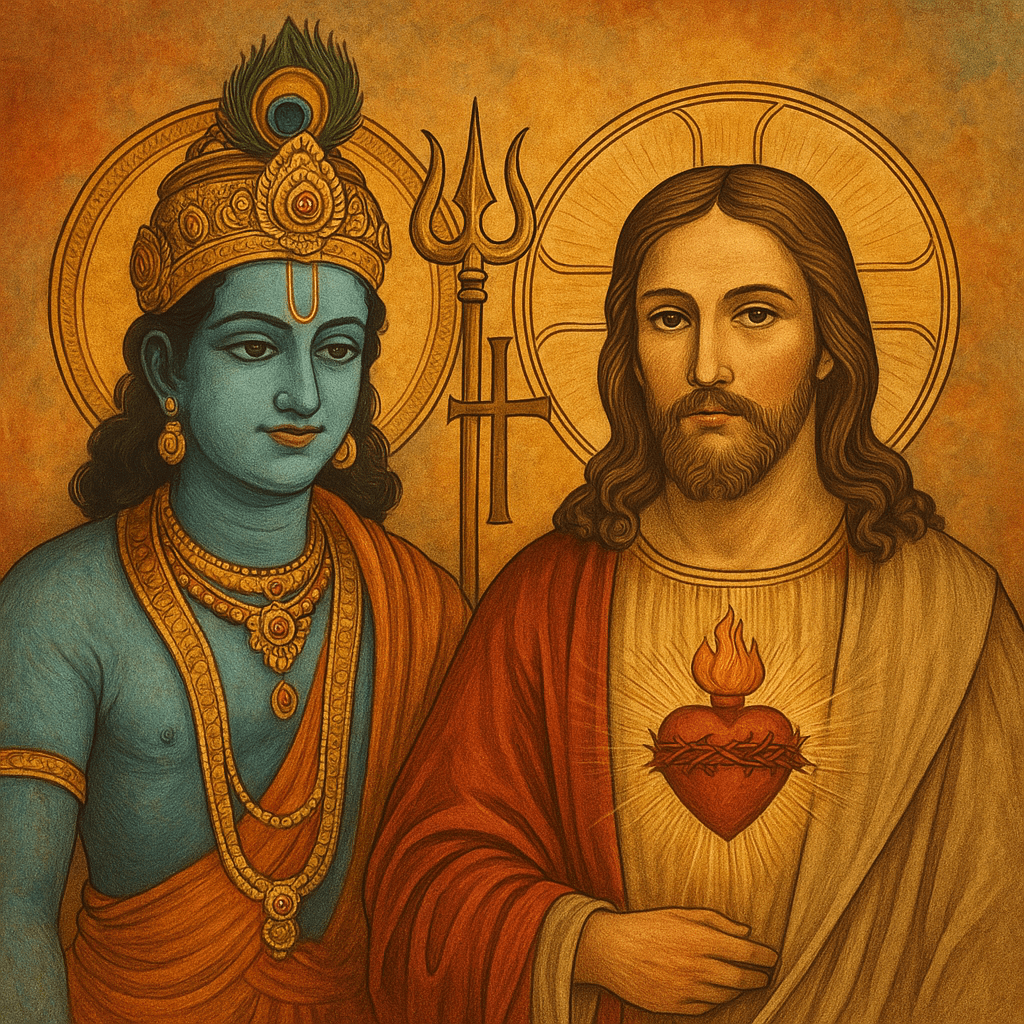
  • Being a Hindu Christian: Walking the Sacred Path Between Two Worlds


    By Sister Abigail Hester, OFC
    Franciscan Clarean Reflections on Faith Beyond Boundaries


    Introduction: Two Altars, One Heart

    To be a Hindu Christian is to live with your feet in two rivers and your heart rooted in the ocean of the Divine. It’s not a contradiction—it’s a calling. It’s not confusion—it’s communion. In a world that demands religious purity and neat theological boxes, the Hindu Christian shows up like sacred disruption, like incense and incense together, like Ganesh dancing to the Beatitudes.

    Some people say it can’t be done. That Christ and Krishna don’t share space. That the Ganges and the Jordan can’t flow into the same soul. But for some of us, they already do.


    What Is a Hindu Christian?

    A Hindu Christian is someone who sees Christ and the Divine through the lens of both Hindu and Christian traditions. It’s not about cherry-picking. It’s about cultivating a full orchard. We don’t reject either path—we revere them both.

    • We may pray the Our Father in the morning and chant the Gayatri Mantra at night.
    • We might see Jesus as an avatar of divine compassion, a bodhisattva of self-emptying love.
    • We understand reincarnation not as heresy, but as soul-growth, sanctified by grace.
    • We light candles before the Virgin Mary and offer flowers to Lakshmi, without flinching.

    Being a Hindu Christian doesn’t dilute our faith—it deepens it. It invites awe instead of anxiety. It births a God bigger than dogma.


    But Isn’t That Heresy?

    Let’s be blunt: the Church has always feared what it can’t control.

    To be a Hindu Christian is to know you’ll be called names. Syncretist. Idolater. Lost. Confused. Or worse—inauthentic. But here’s the truth: if God is real, then God is not threatened by the beauty of Hinduism. And Jesus? Jesus is not a bouncer guarding heaven’s gates. He’s a door. An open one.

    Besides, Christianity has always evolved in dialogue with culture. Early Christians blended Roman, Jewish, and Greek ideas. Celtic Christians braided Jesus with the sacred land. Why not Hindu and Christian wisdom now?


    What Does It Look Like in Practice?

    It looks like:

    • Reading the Bhagavad Gita and the Sermon on the Mount side by side.
    • Seeing karma and grace not as opposites, but as dance partners.
    • Meditating with mala beads while whispering the name of Jesus.
    • Learning from Sri Ramakrishna, Meister Eckhart, Kabir, and Julian of Norwich—all of whom found God beyond borders.

    It’s a life of inner spaciousness. Of reverence. Of belonging to the whole world while anchored in a personal relationship with the Holy.


    The Gifts of Being a Hindu Christian

    1. Mystical Depth – Hinduism teaches us union with the Divine Self; Christianity gives us Jesus, who shows us God with skin on. Together, we get both the transcendent and the tender.
    2. Embodied Faith – In Hinduism, the divine dances in matter—in food, art, sound, and sexuality. Christianity sometimes forgets this, but the Incarnation is the ultimate reminder that flesh is holy.
    3. Radical Compassion – Both paths invite us to serve. Whether through ahimsa (nonviolence) or agape (self-giving love), we are called to love deeply, fiercely, and practically.

    The Pain of Being a Hindu Christian

    Let’s not sugarcoat it. The path is hard.

    • Churches may reject you.
    • Hindu temples may not understand you.
    • Family may question your loyalty.
    • Religious leaders may call you a contradiction.

    But here’s the thing: God never will.


    Conclusion: The Fire and the River

    To be a Hindu Christian is to sit at the feet of both Jesus and Shiva, to sing praises in Sanskrit and in Aramaic, to walk through the fire with love in your hands and a river in your soul.

    It is to be a bridge. A mystery. A wildflower growing in the cracks of dogma.

    And if you are one—know this: You are not alone. You are walking a sacred path walked by others before you—Saints, mystics, rebels, and lovers of God who knew that truth is never afraid of more truth.

    So light your lamp. Burn your incense. Say your mantras. Follow Jesus. Touch the hem of the Infinite.

    And don’t let anyone tell you that you can’t.

    You already are.


  • A Franciscan Clarean Response To Luke 22:36

    “But now,” he said, “if you have a purse, take it, and also a bag; and if you don’t have a sword, sell your cloak and buy one.” (Luke 22:36, NIV)

    This passage is often misunderstood and misused—especially by those trying to justify violence, armed self-defense, or modern gun culture within Christianity. But a deeper, contextual, and Franciscan-Clarean response sees something very different.


    ✝️ A Franciscan Clarean Response to Luke 22:36

    Jesus wasn’t arming his disciples for battle—he was warning them of persecution, and inviting them to prepare their hearts for what was about to unfold. The “sword” in this passage is not a call to violence—it is a symbol of the suffering, misunderstanding, and resistance they were about to face.

    Francis of Assisi, who lived through political violence, war, and crusades, interpreted this passage not with a literal sword, but with radical peace. He laid down weapons, kissed lepers, and chose vulnerability instead of power.

    Clare of Assisi also faced armed threats. But when soldiers came to her convent, she didn’t fight. She held up the Blessed Sacrament and trusted divine protection. Her faith—not a sword—defended her.


    🔍 What Did Jesus Mean?

    When read in light of the whole Gospel, especially the Sermon on the Mount (“blessed are the peacemakers”) and Jesus’ command to Peter to put away his sword just a few verses later in Luke 22:51, it becomes clear:

    Jesus was not calling for literal violence. He was revealing the urgency and danger of discipleship.

    He was saying:

    • Be ready to travel (take a bag)
    • Be prepared for sacrifice
    • Know that following me will provoke empire
    • And yes—prepare for rejection, betrayal, and even martyrdom

    🕊️ A Franciscan Clarean Interpretation

    If you don’t have a sword, buy one?
    If you don’t have courage, seek it.
    If you don’t have truth, hold to it.
    If you don’t have love fierce enough to confront empire, cultivate it—even if it costs you your comfort.

    In today’s world:

    • Our “bag” might be a bug-out kit with herbal medicine and a psalm
    • Our “purse” might be a heart of compassion
    • Our “sword” is not a weapon—it is moral courage, spiritual clarity, truth spoken in the face of power

    🙏 A Prayerful Response

    Christ, you told your friends to be ready.
    Not with weapons, but with willingness.
    Not with violence, but with vision.
    Teach us to pack our bags with kindness,
    To carry truth like a torch,
    And to wield peace as fiercely as others wield fear.
    May we never raise a sword against your children—
    But may we stand boldly against injustice,
    Prepared to love even when it costs everything.
    Amen.

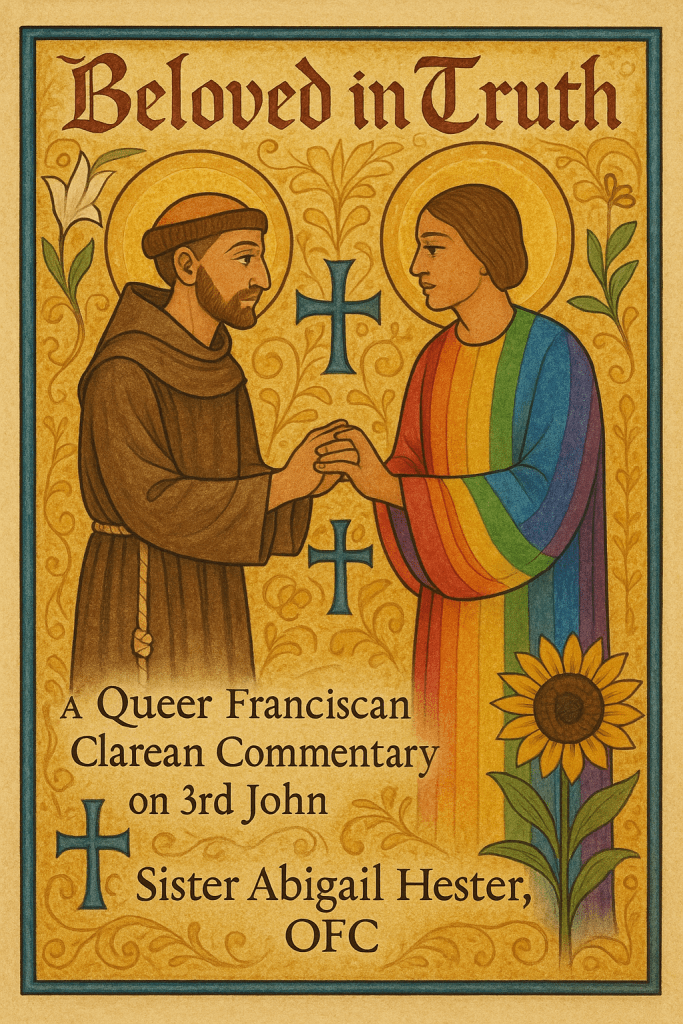
  • Beloved in Truth: A Queer Franciscan Clarean Commentary on 3rd John

    Beloved in Truth: A Queer Franciscan Clarean Commentary on 3rd John

    by Sister Abigail Hester, OFC


    Introduction: A Letter of Belovedness and Hospitality

    The Third Epistle of John is the shortest book in the Bible, yet within its 219 words lies a powerful witness to the Franciscan Clarean way: love, hospitality, truth, nonviolence, and resistance to exclusion. This epistle offers not just early church correspondence, but a sacred mirror reflecting the beloved community God longs for—a community that centers welcome, integrity, and relational justice.

    As Francis and Clare of Assisi abandoned wealth and privilege to live in solidarity with the poor and marginalized, so too does this text challenge us to examine who we honor, who we welcome, and how we live out truth and love in action. When read through the lenses of queer theology, liberation theology, and liberal Christian universalism, Third John becomes a testimony to sacred resistance against authoritarian gatekeeping and a defense of radical inclusion.


    3 John 1:1 — “The elder to the beloved Gaius, whom I love in truth.”

    Franciscan Clarean Reflection:
    This epistle begins with deep affection: “whom I love in truth.” Not merely doctrinal truth, but relational truth—a truth rooted in mutual recognition, spiritual kinship, and unwavering love. For the Order of Franciscan Clareans, this echoes the holy intimacy between Francis and Clare—two souls bound not by institution but by the Spirit’s free movement.

    Queer Theological Insight:
    The language of “beloved” evokes the queer spiritual affirmation of chosen family. Gaius is not simply a church member—he is cherished, seen, and embraced. Queer and trans people, often cast out by religious institutions, can find hope in this epistle’s model of love rooted in truth and not conformity.


    3 John 1:2 — “Beloved, I pray that all may go well with you and that you may be in good health, just as it is well with your soul.”

    Liberation Theology Reflection:
    Spiritual well-being cannot be separated from bodily health and justice. The writer prays for Gaius’s holistic wellness. In liberation theology, salvation is not merely future-tense or otherworldly—it is embodied liberation here and now. Health, dignity, safety—these are all signs of the Kingdom.

    Franciscan View:
    Francis, who kissed the leper and called even Sister Death his friend, recognized no separation between body and spirit, soul and society. May we too honor that our activism and prayer must nourish both body and soul.


    3 John 1:3–4 — “I was overjoyed when some of the friends arrived and testified to your faithfulness to the truth… I have no greater joy than this, to hear that my children are walking in the truth.”

    Clarean Vision:
    Clare walked in truth not by wielding power but through contemplative solidarity, forming a community rooted in simplicity and mutual care. The joy in this passage reflects a mentor’s delight not in control, but in watching others blossom freely in Christ.

    Universalist Insight:
    The writer celebrates—not coerces. This is not the joy of conversion by fear, but of freely walking in divine truth. It reflects the universalist belief that God’s Spirit draws all into truth—not by force, but through joy and love.


    3 John 1:5–8 — “Beloved, you do faithfully whatever you do for the friends, even though they are strangers to you… They have testified to your love before the church.”

    Franciscan Hospitality:
    Gaius is praised for offering hospitality to traveling Christians—those without status or security. Just as Francis opened his arms to lepers and outcasts, Gaius’s hospitality becomes a holy act of resistance against a gatekept religion.

    Queer and Trans Application:
    In today’s world, many queer Christians are still “strangers” to the institutional church. Gaius becomes a model for LGBTQ+ allies and clergy: open your doors, share your resources, and protect the vulnerable—even when others refuse.


    3 John 1:9–10 — “I have written something to the church; but Diotrephes, who likes to put himself first, does not acknowledge our authority… he refuses to welcome the friends.”

    Liberation Lens:
    Here we see early church power struggles. Diotrephes is portrayed as authoritarian, exclusive, and controlling—hoarding authority and rejecting outsiders. Liberation theology reminds us that the Spirit works through the oppressed, not the self-appointed gatekeepers.

    Franciscan Reversal:
    Diotrephes is everything Francis rejected: prideful, possessive, hierarchical. True leadership in the Franciscan Clarean way is humble, communal, and welcoming—especially to the marginalized. Let us beware when religion becomes a mechanism of exclusion rather than incarnation.


    3 John 1:11 — “Beloved, do not imitate what is evil but imitate what is good. Whoever does good is from God; whoever does evil has not seen God.”

    Universalist Theology:
    This verse emphasizes action over ideology. Doing good—not believing “correctly”—is the fruit of true divine relationship. Universalism affirms that God is known through acts of love, not doctrinal allegiance.

    Clarean Wisdom:
    Clare modeled spiritual discernment through gentle imitation of Christ. Her life was a constant “yes” to the good, even amid suffering and exclusion. We are invited to discern with our hearts and live in loving action.


    3 John 1:12 — “Everyone has testified favorably about Demetrius, and so has the truth itself.”

    Queer Affirmation:
    Demetrius is publicly affirmed by “truth itself.” In a world where queer and trans people are often slandered, this verse speaks of the Spirit’s witness beyond gossip or institutional judgment. Let the fruit of our lives—joy, justice, peace—testify for us.

    Franciscan Community Practice:
    Testimony here is communal. Reputation is built in relationship, not isolation. Demetrius’s life is his gospel. In the Franciscan Clarean way, we too are called to preach with our lives.


    3 John 1:13–15 — “I have much to write to you… Peace to you. The friends send you greetings. Greet the friends there, each by name.”

    Sacred Belonging:
    This ending breathes the air of intimacy, community, and connection. Each friend is greeted by name—no one forgotten, no one excluded. This is the heart of Franciscan community: a shared table where every name is sacred.

    Queer Liturgical Insight:
    Liturgies of resistance begin in relationships. This final greeting invites us to build networks of radical welcome, calling each other beloved, blessing one another in peace, and creating spiritual homes outside systems of exclusion.


    Final Reflections for the Franciscan Clarean Way

    3 John is not just a letter—it is a witness to what church can be.

    • A church where love is stronger than hierarchy.
    • A church where hospitality overrides doctrinal purity tests.
    • A church where queer, poor, and exiled bodies are not just tolerated—but embraced as holy friends.

    Let us, like Gaius, offer welcome.
    Let us, like Francis and Clare, renounce control for kinship.
    Let us, like the elder, speak truth in love.
    Let us, like Christ, make room at the table for every child of God.

    Amen and Amen.

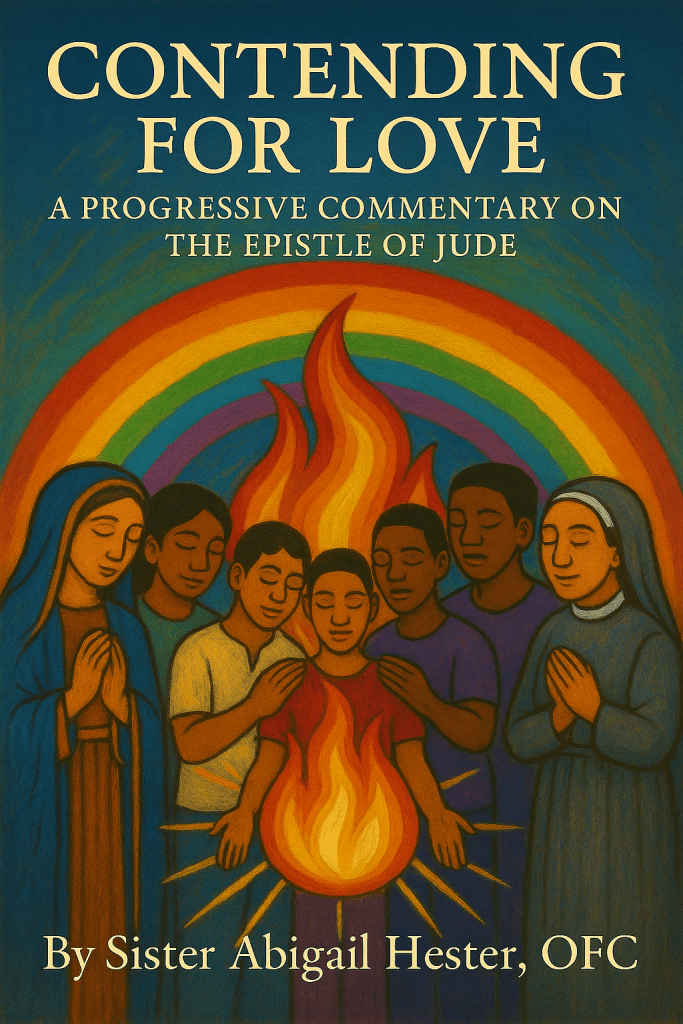
  • Contending for Love: A Progressive Commentary on the Epistle of Jude

    ✨ Contending for Love: A Progressive Commentary on the Epistle of Jude

    By Sister Abigail Hester, OFC
    For the Order of Franciscan Clareans


    📖 Introduction

    The Epistle of Jude, a brief and often overlooked letter near the end of the New Testament, is usually remembered for its fiery denunciations of false teachers and its use of apocalyptic imagery. Historically, it has been weaponized by some to accuse those who do not conform to rigid religious norms—including LGBTQIA+ Christians—of moral decay. But when we read Jude through the lenses of liberation, universal love, and radical inclusion, a different message emerges: a call to remain grounded in love, community, and the mercy of God in the face of division and injustice.


    📚 Verses 1–2: A Greeting of Belovedness

    “To those who are called, who are beloved in God the Father and kept safe for Jesus Christ: May mercy, peace, and love be yours in abundance.”

    Jude opens with a powerful affirmation: we are calledbeloved, and kept safe. For queer and trans Christians who have been told they are unwanted by God, this greeting is balm. Jude does not condition God’s love on moral purity or religious conformity—it is freely given, abundant, overflowing.

    From a Franciscan Clarean perspective, we affirm that each person bears the image of Christ. Just as Francis kissed the leper and Clare offered sanctuary to her sisters, we are called to recognize every soul—especially the marginalized—as beloved and held safely in divine love.


    🕊️ Verses 3–4: Contending for the Faith — Not Weaponizing It

    “I find it necessary to write and appeal to you to contend for the faith… For certain intruders have stolen in among you… perverting the grace of our God into licentiousness and denying our only Master and Lord, Jesus Christ.”

    These verses are often used to justify boundary policing in the Church—especially of LGBTQIA+ people. But what does it really mean to “contend for the faith”?

    In liberation theology, “faith” is not static doctrine but the living praxis of love and justice. To contend for the faith is not to gatekeep—it is to resist empire, exclusion, and exploitation. The “intruders” Jude refers to may be understood in our time as those who corrupt the gospel of grace to uphold domination, be it through nationalism, white supremacy, transphobia, or patriarchy.

    Queer theologians remind us: true heresy is not queerness—it is the denial of God’s image in our diversity.


    🔥 Verses 5–16: Warnings Through Apocalyptic Midrash

    Jude draws from Jewish apocalyptic traditions—stories of fallen angels, Sodom, Cain, and Balaam. These warnings can seem harsh and otherworldly, but read through a Franciscan lens, they serve not to condemn but to call attention to systems of exploitation and injustice.

    Sodom and Queer Misreadings

    Verse 7 refers to Sodom—often misused as a clobber passage.

    “Sodom and Gomorrah…indulged in sexual immorality and pursued unnatural lust.”

    Yet the biblical witness in Ezekiel 16:49 tells us the sin of Sodom was pride, excess, and failure to care for the poor and needy. In other words: the sin of empire, not same-gender love.

    Liberation and queer theologies insist: we must reclaim these texts from harmful misuse. The cities of Sodom and Gomorrah are warnings against violence and inhospitality—especially toward strangers and the vulnerable. The real “unnatural” sin is the dehumanization of queer bodies, not their existence.


    🌱 Verses 17–23: Building Up in Love

    “But you, beloved, build yourselves up on your most holy faith; pray in the Holy Spirit; keep yourselves in the love of God…”

    Here, Jude shifts tone: from judgment to nurture. These verses are the heart of the letter for progressive Christians.

    • Pray in the Spirit: not in fear, but in intimacy with the divine presence that speaks through all people—especially the silenced.
    • Keep in the love of God: Not by conformity, but by radical compassion and justice.
    • Show mercy: Even to those who doubt, to those caught in fear and judgment. Liberation theology reminds us that the work of justice includes healing both the oppressed and the oppressor.

    This is a call to queer sanctity—to form communities that are fierce in love, honest in lament, and faithful to the Spirit of God who dances beyond boundaries.


    🌈 Verse 22–23: Mercy that Rescues

    “And have mercy on some who are wavering; save others by snatching them out of the fire; and have mercy on still others with fear…”

    These verses are often read with anxiety. But what if “snatching from fire” means liberating people from the burning structures of empire? The fires we face today are not divine punishment but the consequences of greed, racism, transphobia, and ecological destruction.

    The queer and trans community has often been placed in this fire—not by God, but by a Church complicit in violence. We, as Franciscan Clareans, are called to rescue each other with mercy, not judgment.


    🌟 Verses 24–25: A Universal Benediction

    “Now to the One who is able to keep you from falling and to present you without blemish… to the only God… be glory…”

    Jude closes not with threat but praise. This God is not the condemner but the sustainer. The One who presents us without blemish is not fixated on our past, but devoted to our healing and wholeness.

    This is liberal Christian universalism at its core: God will not lose any of us. There is no soul too queer, no heart too wounded, no life too far gone. All are drawn into the light of mercy.


    🎨 Devotional Reflection

    Art Prompt: Paint a flame that does not burn but heals. Around it are people of all genders, races, and orientations—dancing, embraced, loved.

    Liturgical Action: Light a candle for each group harmed by religious exclusion (LGBTQIA+ people, women, the disabled, racial minorities, the poor). Offer this prayer:
    “God of all mercy, we kindle your light where others brought fire to destroy. Make us healers, not gatekeepers. Make us vessels of your inclusive flame.”


    🕊️ Final Thoughts for the Order of Franciscan Clareans

    As followers of St. Francis and St. Clare, we are not afraid of the fire—we transform it. We reclaim Jude not as a letter of condemnation, but as a call to courageous compassion. We contend for the faith not by excluding others, but by embracing the radical, boundary-breaking love of Christ.

    May we, too, be kept in love, held in mercy, and unafraid to dance at the margins where Christ still walks.

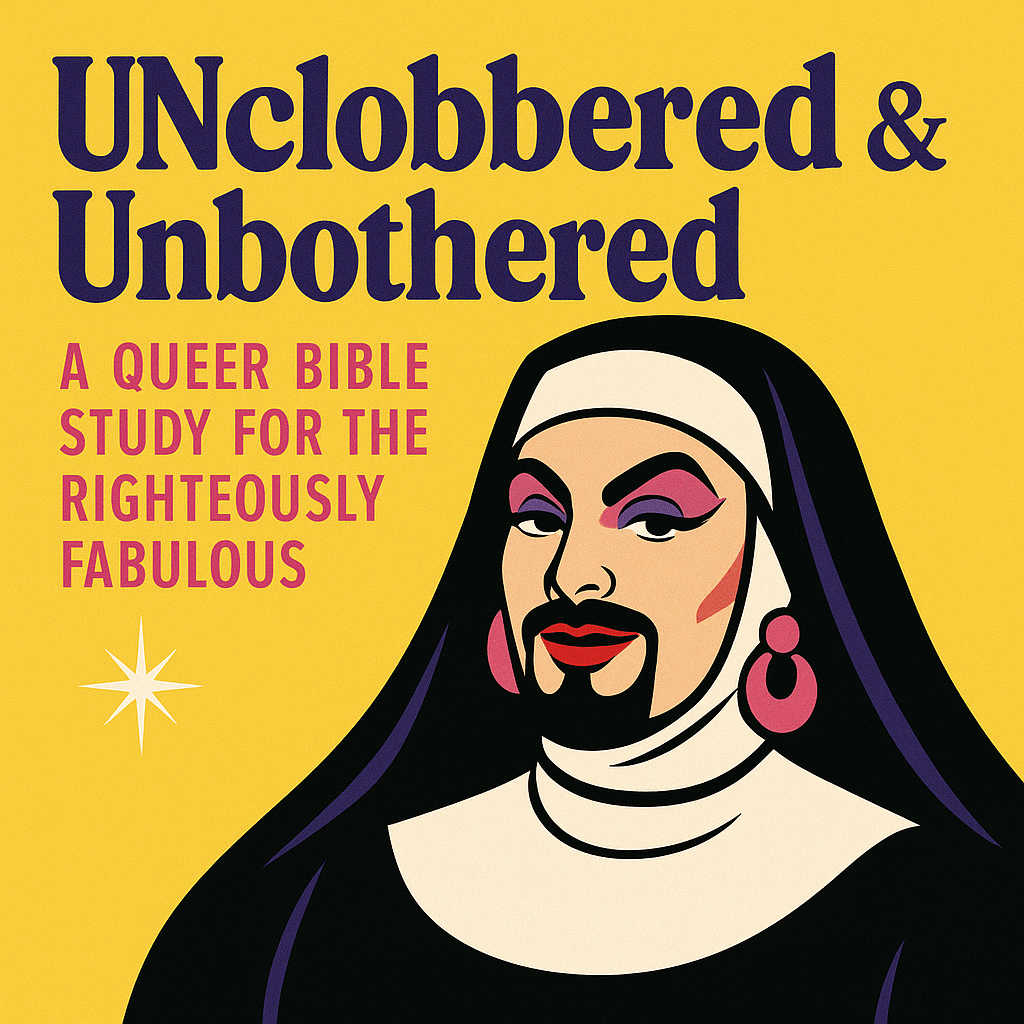
  • 📖 Unclobbered & Unbothered: A Queer Bible Study for the Righteously Fabulous


    By Sister Abigail Hester, OFC
    A Franciscan Clarean Defense of LGBTQIA+ People in the Face of Weaponized Scripture


    💥 Introduction: Holy Misinterpretation, Batman!

    Let’s get one thing straight — or rather, let’s get everything delightfully queer: the Bible is not a homophobic book. It has been read that way by empire, patriarchy, and bigots with bad haircuts and worse hermeneutics. But when we read the text through the lens of liberation, context, and queerness, the clobber passages turn into… well, laughable.

    This study will walk us through the so-called “clobber texts,” clap back with history, context, theology, and a wink of divine sass. Because honey — we weren’t made to sit silently while folks misuse the Word to harm the very ones Christ came to liberate.


    📜 The “Clobber Passages” in Question

    These are the six classic “texts of terror” often flung like theological dodgeballs at queer folks:

    1. Genesis 19 – Sodom and Gomorrah
    2. Leviticus 18:22 & 20:13 – “Man shall not lie with man…”
    3. Romans 1:26–27 – “Shameful lusts”
    4. 1 Corinthians 6:9–10 – “The effeminate” and “homosexuals”
    5. 1 Timothy 1:9–10 – “Perverts” or “sodomites”
    6. Jude 1:7 – Sexual immorality of Sodom again

    Let’s unclobber these one by one.


    1. 💣 Genesis 19: Sodom and Gomorrah

    Clobber claim: God destroyed Sodom for gay sex.

    Response: God destroyed Sodom for rape, violence, and inhospitality — not Pride floats and drag brunches.

    “Now this was the sin of your sister Sodom: she was arrogant, overfed and unconcerned; they did not help the poor and needy.” – Ezekiel 16:49

    🎯 Boom. That’s the Bible clapping back at bad theology.

    The real sin: Abuse of power, exploitation, and cruelty to strangers. In other words, homophobia, not homosexuality, is the Sodomite sin.

    Queer note: If anything, Genesis 19 is a call to defend the vulnerable — especially travelers, the gender-nonconforming, and the powerless. Sounds like a call to queer hospitality!


    2. 🧀 Leviticus 18:22 & 20:13

    “You shall not lie with a male as with a woman; it is an abomination.”

    Clobber claim: Being gay is an abomination.

    Response: So is eating shrimp, wearing polyester, and planting two seeds in one field (see Leviticus 11:10, 19:19). But you don’t see them picketing Red Lobster, do you?

    📘 Marcus Borg and John Dominic Crossan remind us: Leviticus is a purity code, not a moral absolute. It was written for ritual cleanliness, not eternal judgment.

    Abomination (Hebrew: toevah) means “ritually impure,” not “eternally condemned.” It was about Israel’s identity, not your date to prom.

    Queer theology twist: Jesus broke the purity codes constantly — touching lepers, eating with sinners, and healing on the Sabbath. If you’re breaking purity rules to love better, you’re doing it right.


    3. 🌀 Romans 1:26–27

    “God gave them up to shameful lusts… men committing shameless acts with men…”

    Clobber claim: Paul condemns homosexuality.

    Response: Paul condemns exploitative, idolatrous, excessive lust, not loving same-sex relationships.

    This is Paul throwing shade at Roman orgies and temple prostitution, not your marriage license.

    🧠 Scholar alert! Beverly Roberts Gaventa and Daniel Helminiak point out that Romans 1 describes unnatural acts — but Paul isn’t defining what’s natural in your biology. He’s critiquing excessive Greco-Roman patriarchal sexual dominance.

    Patrick Cheng says this passage is about imperial excess, not queer tenderness. Paul didn’t know about modern sexual orientation. To read that back into the text is like blaming Jesus for Twitter.

    Fun fact: In Greek, “unnatural” (para physin) is also used to describe God’s actions (Romans 11:24). So clearly, “unnatural” ≠ evil. Sometimes divine love is unnatural — especially when it breaks the world’s rules.


    4. 🎭 1 Corinthians 6:9–10

    “Neither the sexually immoral… nor men who have sex with men…”

    Clobber claim: Gays go to hell.

    Response: The Greek words used here are:

    • Malakoi – “soft ones,” often referring to effeminate men or passive partners (but also used for luxury pillows).
    • Arsenokoitai – a bizarre compound word Paul seems to invent, literally “man-bedders.”

    🧑‍🏫 John Boswell and Dale Martin show us: we don’t really know what arsenokoitai means. It shows up almost nowhere else in ancient Greek literature. Could mean exploiters. Could mean temple pimps. Could mean… tax collectors for all we know.

    So unless you’ve built an entire theology on mistranslating ancient Greek and ignoring love, maybe sit this one out, clobber crowd.


    5. 🪓 1 Timothy 1:9–10

    “The law is laid down… for the unholy and sinful, for those who kill their fathers or mothers, for murderers, the sexually immoral, men who practice homosexuality…”

    Clobber claim: The New Testament condemns homosexuality.

    Response: Again, we’re dealing with that strange word arsenokoitai — not “gay people” in modern terms. There’s zero reason to believe Paul had anything in mind resembling today’s same-sex relationships built on mutual love, covenant, and faithfulness.

    Also — let’s talk context. This list is like Paul’s version of a “bad people” rap sheet, mixing thieves, liars, and… apparently queer folks if we mistranslate? Not convincing.

    Truth bomb: Love rooted in justice, mutuality, and consent is never what Paul condemns. What’s condemned is exploitation, domination, and violence. And that applies to all sexualities.


    6. 🔥 Jude 1:7

    “Sodom and Gomorrah… indulged in sexual immorality and pursued unnatural lust.”

    Clobber claim: LGBTQ people are like the people of Sodom — lustful and unnatural.

    Response: What’s “unnatural” to empire often looks like God’s justice breaking through. If you’ve ever loved someone in a way the world told you was wrong — welcome to the revolution.

    Marcella Althaus-Reid calls this “indecent theology” — reclaiming the power of the body, of erotic love, of pleasure, and queerness as sacred, not sinful.

    So if loving queerly is unnatural, then so is grace. And I, for one, am living for both.


    ✊ Holy Takeaways: What Jesus Would Say

    • Jesus never said a word against LGBTQIA+ people.
    • He did say a lot against religious hypocrites.
    • He did say love your neighbor. And honey, that includes your queer neighbor — and yourself.

    🧼 Clobber texts = cherry-picked, context-ignoring, empire-approved weaponry.
    💖 Queer love = holy, sacred, Christ-reflecting.


    💅 Closing Benediction (Drag Mass Style)

    May your love be louder than their hate.
    May your queerness be too fabulous to ignore.
    May your faith be too fierce to silence.
    And may your theology leave no clobber passage unchallenged.

    Go in peace, beloveds. And throw glitter in the face of bad exegesis.