Sister Abigail Hester

Tag: bible

  • The Gospel of Mark (Part 6)

    🌊 Chapter 5: Storms and Spirits

    Mark 4:35 – 5:43 — “Crossing to the Other Side”

    A Franciscan Clarean Commentary by Sister Abigail Hester, OFC


    📖 Scripture

    “On that day, when evening had come, he said to them, ‘Let us go across to the other side.’”
    — Mark 4:35


    ⛵ 1. The Storm and the Sleeping Christ

    Night falls. Waves rise. The boat fills. The disciples panic. And Jesus? He’s asleep on a cushion.

    Scholars note the boat is a symbol of the church, tossed on a sea of chaos.
    Mark’s storm isn’t just weather — it’s existential turbulence.

    Jesus wakes, rebukes the wind, and the sea obeys.
    The Greek word for “rebuke” (epitimaō) is the same one Mark uses when Jesus silences demons.
    The message? The chaos outside mirrors the chaos within.

    Franciscan Clareans hear this as a spiritual parable:
    Christ doesn’t always stop the storm; he awakens peace within us so we can ride it.
    Our calling is to practice calm as resistance.
    To sleep, even in danger, is not apathy — it’s trust.

    Francis prayed in thunder and Clare sang through siege; both knew that peace isn’t the absence of trouble — it’s the presence of Love unfazed.


    👹 2. The Gerasene Demoniac: Liberation Beyond Borders

    “They came to the country of the Gerasenes…” — Mark 5:1

    This is Gentile territory — “the other side.” Jesus crosses boundaries of race, religion, and purity.
    The possessed man is a portrait of total alienation: naked, self-harming, living among tombs.

    Scholars like Ched Myers read this as a political exorcism — the demon’s name, Legion, evokes Roman occupation. Jesus confronts empire head-on.

    For Franciscan Clareans, this is compassion as confrontation.
    We, too, go to the margins — to the tombs of addiction, trauma, and poverty — and proclaim freedom.
    The Gospel crosses the lake every day when we dare to love the people empire forgot.

    Notice: Jesus asks the man’s name. Liberation begins when someone finally asks who you are, not what you’ve done.


    🐖 3. The Pigs and the Panic

    The unclean spirits beg to enter a herd of pigs, which then drown in the sea. The locals, terrified, ask Jesus to leave.

    Modern scholars note: economic loss triggers rejection. The herd was wealth. Compassion just disrupted profit.

    That’s a timeless problem — healing costs something.
    Francis knew it when he stripped off his father’s riches; Clare knew it when she chose poverty over dowry.

    Franciscan Clareans side with the drowned pigs — symbols of the price empire pays when love liberates its captives.
    Sometimes peace upsets the market.
    Sometimes holiness ruins business as usual.


    🌸 4. The Hemorrhaging Woman: The Courage to Touch

    “She had suffered under many physicians… and came up behind him in the crowd and touched his cloak.” — Mark 5:25–27

    This woman is unclean by Levitical law — cut off from touch, worship, and community for twelve years.
    Her act is both desperate and defiant.

    Modern feminist scholars like Amy-Jill Levine see her as a prototype of courageous faith. She doesn’t ask permission; she reaches.

    Jesus feels power go out from him — not drained, but shared.
    He doesn’t shame her; he calls her Daughter.

    Franciscan Clareans see here the theology of mutual healing.
    Compassion isn’t one-way. The healer and the healed exchange holiness.
    Touch becomes sacrament again — restoring dignity, not just health.


    🕊 5. Jairus’s Daughter: Hope That Outruns Despair

    While Jesus is still speaking, word comes: “Your daughter is dead.”
    But he keeps walking. “Do not fear, only believe.”

    Mark’s language drips with tenderness. Jesus takes her hand and says, “Talitha koum” — “Little girl, arise.”
    The same verb again — egeiren — resurrection.

    Franciscan Clareans read this as the daily miracle of compassion: raising others by touch, calling the dead parts of life back into movement.
    It’s the same word we heard when Peter’s mother-in-law was lifted up — resurrection as a way of life.

    And he tells them to give her something to eat.
    That’s the Franciscan punchline: spirituality that feeds people.


    💫 6. Crossing to the Other Side of Everything

    From storm to demon, from bleeding to death, Mark shows one truth: Jesus moves toward chaos, not away from it.
    He crosses every boundary — sea, ethnicity, gender, purity, even mortality — to bring wholeness.

    For Franciscan Clareans, this chapter is our field manual:

    Cross borders of comfort.

    Face the storms instead of cursing them.

    Liberate what’s bound.

    Touch what’s untouchable.

    Nourish what’s reborn.

    The Kingdom of God is a continual crossing to “the other side” — within ourselves and our world.


    🌿 Closing Prayer

    Christ of the Open Sea,
    when our boats fill and our courage leaks,
    wake within us.
    Calm the waves we’ve named Legion,
    and send us across to the places we fear.
    May our touch heal,
    our words resurrect,
    and our faith make room for miracles.
    Teach us to believe, even when the wind howls —
    that love still speaks, “Peace. Be still.”
    Amen.
  • The Gospel of Mark (Part 5)

    🌾 Chapter 4 : Parables and Power

    Mark 4 : 1 – 34 — “The Seeds of Holy Imagination”

    A Franciscan Clarean Commentary by Sister Abigail Hester, OFC


    📖 Scripture

    “He taught them many things in parables, and in his teaching he said to them: ‘Listen! A sower went out to sow…’”
    — Mark 4 : 2–3


    🌱 1. Storytelling as Revolution

    Scholars agree Mark 4 is the heart of Jesus’s teaching ministry. He doesn’t lecture or threaten — he tells stories.
    That’s not lazy pedagogy; it’s prophetic strategy.

    Modern scholar John Dominic Crossan calls parables “subversive metaphors.” They don’t hand out answers — they sneak truth past our defenses and let it germinate in the soil of the heart.

    Jesus knows that facts can argue — but stories can transform.

    Franciscan Clareans get this instinctively. Francis preached to birds and wolves because story and symbol bypass ego and speak to the soul. We don’t just explain truth — we enchant it into being.


    🌾 2. The Sower: Scandalous Generosity

    “Some seed fell on the path… rocky ground… thorns… good soil.” — Mark 4 : 4–8

    Scholars point out the Sower is terrible at farming. He’s throwing seed everywhere — on paths, rocks, and thorns. What waste!

    Exactly.

    This is a parable about divine wastefulness.
    God flings grace recklessly, without calculating ROI.
    Love isn’t efficient; it’s extravagant.

    For Franciscan Clareans, this is the Gospel in motion: scatter mercy liberally, even where it “won’t work.” Feed people who won’t thank you. Forgive those who won’t change. Water seeds you may never see sprout.

    Because grace isn’t transactional — it’s transformational.


    🪞 3. Mystery and Misunderstanding

    “Let anyone with ears to hear listen!” — Mark 4 : 9

    Mark loves this refrain because parables require more than hearing — they demand holy imagination.

    Scholars like Elizabeth Struthers Malbon note that Mark invites readers into the story as participants, not spectators. The disciples don’t “get it” because they keep looking for literal answers to mystical questions.

    Franciscan Clareans read this as permission to embrace mystery. Faith isn’t certainty — it’s curiosity married to trust.
    It’s Clare gazing into the Eucharist and seeing the unseeable; Francis hearing the wind as a psalm.

    We don’t solve parables — we let them solve us.


    🌿 4. The Lamp Under a Bushel: Hidden Radiance

    “Is a lamp brought in to be put under the bushel basket…? For there is nothing hidden except to be disclosed.” — Mark 4 : 21–22

    Mark weaves light and secrecy together — a clue to his so-called Messianic Secret.
    The light of Christ isn’t hidden to conceal — it’s hidden to ripen.

    Franciscan Clareans see this as the theology of quiet holiness. Not every light needs a spotlight. Some illumination is meant to glow softly in dark corners until it draws others home.

    We shine by presence, not performance.
    We burn not to be seen but to see clearly.


    🌱 5. The Growing Seed and the Mustard Tree

    “The kingdom of God is as if someone would scatter seed on the ground… and the seed would sprout and grow, he does not know how.” — Mark 4 : 26–27

    This tiny parable is a masterpiece of divine trust. The kingdom grows automatically (Greek automatē) — mysteriously, inevitably, beyond control.

    Franciscan Clareans love that word. It means the Spirit does the heavy lifting. We sow in faith, sleep in hope, and wake to harvest we didn’t engineer.

    Then comes the mustard seed — a weed that won’t quit.
    Scholars see it as a holy joke: the “Kingdom of God” isn’t a cedar of Lebanon — it’s an invasive shrubbish plant that takes over the field and gives shelter to birds.

    Translation: God’s reign is a grassroots uprising.
    It spreads through small acts of mercy and holy mischief until the whole field is love.


    💫 6. Why Parables Still Matter

    Mark ends this section noting that Jesus spoke “as they were able to hear it.” That’s pedagogical gentleness — revelation matched to capacity.

    Modern scholarship calls this accommodating revelation: God meets people where they are, not where they “should” be.

    Franciscan Clareans extend that into our own ministries. We teach through story, art, gardens, and song because truth arrives best in forms that touch the heart.
    The Kingdom is planted in poetry, not policy.


    🕊️ 7. Reflection — The Seed Within

    Mark 4 is a parable about parables — a story about storytelling.
    It invites us to trust that every word of love we scatter matters, even when we never see its fruit.

    Franciscan Clareans live this daily:

    Plant seeds of peace in a world of violence.

    Tell stories of hope in a culture of despair.

    Be lamps that glow quietly until morning.

    The harvest is God’s. Our task is to keep sowing.


    🌿 Closing Prayer

    Sower of Stars,
    scatter your seeds through our hands.
    Let our words be mustard seeds of mercy,
    our silence fertile with trust.
    Teach us to believe in what grows unseen,
    to shine without needing to be noticed,
    and to rest in the mystery that your Kingdom is already blooming beneath our feet.
    Amen.


  • The Gospel of Mark (Part 4)

    ⚖️ Chapter 3: Conflict and Compassion

    Mark 2:1–3:6 — “When Love Breaks the Rules”

    A Franciscan Clarean Commentary by Sister Abigail Hester, OFC


    📖 Scripture

    “Why does this man speak that way? He’s blaspheming! Who can forgive sins but God alone?”
    — Mark 2:7


    🏠 1. The Crowded House and the Roof of Faith

    Jesus is back in Capernaum, and the house is bursting with people. Four friends can’t get their paralyzed companion through the door, so they rip the roof off and lower him down.

    That’s Mark’s humor and holy audacity — salvation sometimes requires a little property damage.

    Modern scholars like Ched Myers see this as the Gospel’s first act of civil disobedience. When systems block healing, love finds another way in.

    Jesus doesn’t rebuke their mess — he honors it. “Seeing their faith…” he forgives and heals the man.

    Franciscan Clareans love this story because it’s about community-based healing.
    No one gets to God alone.
    Sometimes faith means tearing through barriers — literal or social — to bring someone to wholeness.

    And note: the man’s friends didn’t speak a word. Their love was their prayer.


    ⚡ 2. The Forgiveness Scandal

    When Jesus says, “Your sins are forgiven,” the religious elite lose their minds.
    Forgiveness was supposed to be mediated through temple ritual — Jesus is cutting out the middlemen.

    Modern scholars point out that Mark shows Jesus claiming divine prerogatives not to exalt himself, but to decentralize grace.

    He’s saying: God’s mercy doesn’t live in a building or belong to a priesthood. It flows wherever compassion walks.

    For Franciscan Clareans, this is our theology in motion — sacraments that happen in alleys, forgiveness that smells like sweat and street dust.
    Jesus isn’t breaking the law; he’s fulfilling it with mercy.


    🍷 3. Eating with Sinners: The Table Revolution

    “Why does he eat with tax collectors and sinners?”
    — Mark 2:16

    Meals in the ancient world were moral theater.
    Who you ate with defined your status and purity.
    Jesus uses dinner as a demolition site.

    Modern scholars like John Dominic Crossan call this “open commensality” — a radical act that dismantled social hierarchy.

    Franciscan Clareans call it holy table fellowship.
    It’s the same spirit that moved Francis to eat with lepers, and Clare to feed the poor through her monastery walls.

    Jesus didn’t eat with sinners to tolerate them. He ate with them to declare: There are no outsiders in God’s household.

    Every shared meal is Eucharist. Every welcome is gospel.


    🪡 4. New Wine, Old Wineskins

    “No one sews a piece of unshrunk cloth on an old garment… No one puts new wine into old wineskins.”
    — Mark 2:21–22

    This is Mark’s way of saying the Kingdom of God doesn’t fit inside the old systems — not the old law, not old religion, not even our old egos.

    Franciscan Clareans know this intimately.
    We can’t patch empire theology with kindness — we need new wineskins of justice.
    We can’t pour resurrection into rigid institutions and expect them not to burst.

    God’s doing something wild, untamed, and fermenting.
    The Spirit is fizzing, expanding, reshaping the world.
    Our job? Don’t cork it. Don’t label it. Drink deeply.


    🌾 5. The Sabbath Showdown

    “The Sabbath was made for humankind, not humankind for the Sabbath.”
    — Mark 2:27

    When Jesus plucks grain on the Sabbath and heals a withered hand, he’s not attacking Judaism — he’s reclaiming it for mercy.

    Scholars like Amy-Jill Levine emphasize that Mark’s conflict stories aren’t anti-Jewish polemic; they’re intra-Jewish debate — a prophetic argument about what holiness really looks like.

    Jesus reclaims Sabbath as rest, not restriction.
    For Franciscan Clareans, that’s our call too:
    To defend the right to rest, to restore Sabbath as sacred resistance against burnout culture and exploitation.
    Rest is rebellion.
    Healing is holy work.

    When Jesus heals on the Sabbath, he’s saying, “Mercy is never off-duty.”


    🔥 6. Compassion as Confrontation

    By the end of 3:6, the Pharisees and Herodians are plotting to destroy Jesus.
    Why? Because love that heals without permission threatens every system built on control.

    Mark’s Jesus is dangerous precisely because he’s compassionate.
    His miracles unmask the machinery of oppression.
    His mercy exposes injustice as blasphemy in disguise.

    Franciscan Clareans take note: when our compassion challenges cruelty, conflict isn’t failure — it’s fidelity.
    The cross isn’t a punishment; it’s the cost of radical kindness.


    🕊️ 7. Reflection: The Holy Mischief of Mercy

    Mark’s Jesus breaks boundaries like a holy vandal — not to cause chaos, but to make room for love.

    He heals the forbidden, forgives the untouchable, and eats with the excluded.
    He refuses to let law trump love, or ritual silence need.

    This is the Franciscan Clarean gospel in full color:

    Mercy over mechanism.

    Relationship over regulation.

    Presence over piety.

    To follow Christ in this way is to join the sacred troublemakers — those who tear roofs open, host unapproved dinners, and dare to heal when the world says “wait.”


    🌿 Closing Prayer

    Christ our Liberator,
    You break the rules that break your children.
    You write new commandments in compassion and courage.
    Make us holy rebels for love’s sake —
    ready to tear roofs, share tables, and touch the untouchable.
    Let our lives be your new wineskins,
    stretched and singing with the ferment of your Spirit.
    Amen.

  • The Gospel of Mark (Part 3)

    ✨ Chapter 2: The Miracles and the Margins

    Mark 1:21–45 — “The Healer Who Breaks Rules”

    A Franciscan Clarean Commentary by Sister Abigail Hester, OFC


    📖 Scripture

    “They were astounded at his teaching, for he taught them as one having authority, and not as the scribes.”
    — Mark 1:22


    🕍 1. Authority Without Domination

    From the very start, Jesus’ authority in Mark is different — it’s not about power over, but love within.
    Modern scholars like Elizabeth Malbon point out that Mark’s Jesus is performative theology — he doesn’t argue doctrines; he embodies truth.

    The scribes explain. Jesus liberates.
    His authority doesn’t come from position, pedigree, or permission — it flows from presence.

    Franciscan Clareans recognize this instantly.
    True authority is the radiance of compassion. It doesn’t need titles, it needs integrity.
    Francis had no office, Clare no sanction — yet both carried a gravity born of holiness, not hierarchy.

    Mark’s Jesus shows us: the Kingdom doesn’t require credentials. Just love that moves.


    👹 2. The Exorcism: Liberation, Not Spectacle

    “A man with an unclean spirit cried out… and Jesus rebuked him, saying, ‘Be silent, and come out of him!’” — Mark 1:23–25

    Modern readers can get hung up on demons.
    But Mark’s world saw unclean spirits as the embodiment of everything that enslaves: fear, injustice, despair, systems that crush the human soul.

    The first miracle in Mark isn’t a healing — it’s a liberation.
    Jesus doesn’t perform a show; he restores a person’s wholeness.
    This is liberation theology before it had a name.

    Franciscan Clareans can read this as Jesus confronting empire’s demons: greed, domination, shame.
    He silences those voices still whispering in our age — the ones that say, you’re not enough, you don’t belong, you can’t change.

    The Gospel begins with an exorcism because the Kingdom begins when the lies lose their power.


    🌅 3. The Healing of Simon’s Mother-in-Law: Service as Resurrection

    “He took her by the hand and lifted her up. Then the fever left her, and she began to serve them.”
    — Mark 1:31

    Notice how gentle this miracle is.
    No thunder, no trumpet, no drama — just touch.
    Mark uses the Greek word egeiren — “he lifted her up,” the same word used later for resurrection.

    Jesus doesn’t just heal her; he raises her up.
    Her response? Not worship, not words — service.

    For Franciscan Clareans, this is holiness distilled: resurrection leads to hospitality.
    Healing isn’t a private gift; it’s a call to love others.

    Every fever that leaves us should free us to serve.
    That’s the Franciscan rhythm — grace received, grace given, endlessly circling like breath.


    🌆 4. The Solitary Prayer: Sacred Recharging

    “In the morning, while it was still very dark, he got up and went out to a deserted place, and there he prayed.” — Mark 1:35

    Even Jesus needed silence.
    In the middle of miracles and crowds, he slips away to reconnect with the Source.

    Modern biblical scholars read this as an intentional rhythm in Mark: action — contemplation — action.
    Francis and Clare lived this too — ora et labora, prayer and work, breath and body, silence and song.

    Franciscan Clareans learn from this: activism without contemplation burns out; contemplation without compassion dries up.
    We need both — the stillness that grounds our service and the service that gives meaning to our stillness.


    💙 5. The Leper and the Touch of God

    “Moved with compassion, Jesus stretched out his hand and touched him, and said to him, ‘I do choose. Be made clean.’” — Mark 1:41

    This moment is one of the most scandalous in all of Scripture.
    Touching a leper made you unclean under Jewish purity law. Jesus does it deliberately.

    Modern scholars like Amy-Jill Levine remind us: this isn’t Jesus rejecting Judaism — it’s him revealing God’s heart within it. He’s showing that compassion fulfills the Law more perfectly than fear ever could.

    When he touches the untouchable, he doesn’t catch impurity — he transmits holiness.
    That’s divine contagion.
    That’s Francis kissing the leper outside Assisi.
    That’s Clare feeding her sisters with her own hands during famine.

    Franciscan Clareans call this the sacrament of touch — the holiness of human contact, the theology of tenderness.
    In a world terrified of contamination, we bring the healing of presence.


    🌈 6. Reflection: Miracles as Method

    Mark 1 closes with the world buzzing — everyone looking for Jesus, miracles everywhere. But he keeps retreating to prayer, refusing to build a cult of personality.

    Modern biblical scholarship notes this rhythm — Jesus moves from center to margin, from crowd to solitude, from fame to hiddenness.

    That’s our Franciscan Clarean way too.
    We don’t chase spotlight miracles; we practice quiet ones:

    A kind word that saves a life.

    A meal shared with the lonely.

    A prayer whispered for someone who’d forgotten they’re loved.

    Mark’s Gospel teaches that the miracle isn’t in the spectacle.
    It’s in the touch, the silence, the compassion that doesn’t need credit.


    🌿 Closing Prayer

    Christ of the margins,
    who heals with hands and not hierarchies,
    who silences demons and awakens dignity,
    teach us to touch the world with gentleness.
    May we see holiness in the unclean,
    beauty in the broken,
    and your face in every forgotten one.
    Amen.

  • The Gospel of Mark (Part 2)

    🌿 Chapter 1: The Voice in the Wilderness

    Mark 1:1–20 — “The Beginning of the Good News”

    A Franciscan Clarean Commentary by Sister Abigail Hester, OFC


    📖 Scripture

    “The beginning of the good news of Jesus Christ, the Son of God, as it is written in Isaiah the prophet:
    ‘See, I am sending my messenger ahead of you, who will prepare your way;
    the voice of one crying out in the wilderness:
    Prepare the way of the Lord, make his paths straight…’”
    — Mark 1:1–3


    🏜️ 1. The Wilderness as the Birthplace of Revolution

    Mark begins not in a temple or throne room but in the wilderness.
    Modern scholars point out that “wilderness” in Scripture is never just geography — it’s the space where old systems collapse and new creation begins.

    It’s where Moses met God. Where Israel learned humility. Where Francis stripped naked and walked out of Assisi reborn.

    The Gospel’s first breath happens where civilization’s noise dies down enough for the Divine to be heard again.
    The wilderness is where prophets and mystics go when polite religion has lost its fire.
    So Mark starts there — not because it’s quiet, but because it’s honest.

    For Franciscan Clareans, this is our home turf: the space between empire and Eden, where simplicity becomes our prayer and love becomes our rebellion.


    🦋 2. John the Baptizer: The First Holy Weirdo

    John isn’t a “religious professional.” He’s wild.
    Camel hair. Locusts. Honey. Sand in his beard.
    Modern biblical scholars like John Dominic Crossan note that John’s ministry is a direct confrontation with the temple system — baptism outside Jerusalem meant God is not locked in the temple; grace is loose in the desert.

    John’s message: Repent — literally, turn around.
    He’s not shouting guilt. He’s inviting transformation.
    He’s saying, “The world doesn’t have to stay like this. There’s another way.”

    Franciscan Clareans would recognize him immediately. He’s a barefoot mystic preaching divine simplicity, living the sermon he speaks. He’s a reminder that the Spirit often chooses the wild and unpolished to announce something new.


    💧 3. The Baptism of Jesus: God in the Mud

    “And just as he was coming up out of the water, he saw the heavens torn apart and the Spirit descending like a dove on him.”
    — Mark 1:10

    Scholars see Mark’s description as violent — “the heavens torn open.”
    It’s not a polite curtain lift; it’s a rupture. God breaks into history, not gently, but decisively.
    The Spirit descends not on a throne but on a soaked, muddy carpenter standing in a river beside sinners.

    Franciscan Clarean insight:
    This is the Incarnation’s full scandal. God chooses solidarity over superiority.
    Jesus doesn’t stand above humanity — he steps into our waters, our wounds, our mess.

    When the heavens tear open, they never close again.
    Every act of compassion since has been an echo of that moment.


    🌬️ 4. The Temptation: The Desert Classroom

    “And the Spirit immediately drove him out into the wilderness.” — Mark 1:12

    That word “drove” (Greek ekballō) literally means threw.
    Jesus isn’t politely led — he’s flung into spiritual boot camp.

    For 40 days, he wrestles with hunger, loneliness, and the seductive whispers of comfort and control.
    Franciscan Clareans read this not as punishment but preparation.
    Solitude burns away illusion. Temptation reveals truth.

    Jesus emerges lean, luminous, and ready to upend the world.
    So must we. Our deserts — whether illness, grief, or loss — can become sacred classrooms if we dare to stay long enough to listen.


    🌅 5. The Call to Follow

    “Jesus said to them, ‘Follow me, and I will make you fish for people.’ And immediately they left their nets and followed him.”
    — Mark 1:17–18

    Modern scholars note that Mark’s version is stark — no explanation, no debate. They just go.
    It’s the power of presence. Something in Jesus calls out the courage already buried inside them.

    Franciscan Clareans understand this kind of summons.
    When Love speaks, you don’t need a theological degree — you need an open heart.
    The call isn’t to success; it’s to simplicity. To leave behind what binds you — not just nets, but fears, habits, false identities.

    Discipleship begins with holy impulsiveness — the “immediately” of grace.


    🕊️ 6. Reflection

    Mark’s first chapter is an explosion of beginnings:

    A wild prophet in the desert

    The heavens torn open

    The Spirit descending

    The first disciples walking away from everything

    It’s God saying, “Let’s start over — again.”

    The Franciscan Clarean soul hears this and smiles: every day is another beginning.
    Every act of love is another gospel written in flesh.
    Every ‘yes’ to compassion tears heaven open one more time.


  • The Gospel of Mark (Part 1)

    🌿 The Gospel of Mark

    A Franciscan Clarean Commentary — by Sister Abigail Hester, OFC


    💫 The Wild Beginning

    Mark’s Gospel doesn’t start with cozy Christmas nostalgia. There’s no manger, no angels cooing over a baby. It starts in the wilderness — with a wild prophet, wearing camel hair, shouting about repentance.

    That’s classic Franciscan energy right there: God showing up in the margins, barefoot and untamed. The wilderness is where illusions fall away and simplicity becomes holy clarity. Mark’s Jesus bursts onto the scene not from a palace or temple, but from the desert. The message: God begins again on the edge of everything.


    🔥 The Urgency of Love

    Modern scholars call Mark’s writing “immediate.” Everything happens right now.
    From a Franciscan Clarean lens, this isn’t anxiety — it’s holy immediacy.
    The Gospel of Mark is breathless because love is urgent. The world is suffering, and compassion can’t wait until we’ve got our theology perfectly sorted.

    Francis and Clare understood that same pulse: mend what’s broken today. Feed the hungry now. Reconcile before the sun sets. Mark’s “immediately” is a heartbeat of divine action.


    💔 The Suffering Christ

    Mark’s Jesus bleeds early and often. He’s misunderstood, exhausted, betrayed, and finally screams in forsaken agony on the cross. Scholars see this as Mark’s theology of the Suffering Messiah — God revealed in pain, not power.

    We, too, know that mystery.
    The Franciscan Clarean path doesn’t chase prestige; it sits with the broken. It whispers that holiness often looks like vulnerability, like compassion that costs something.
    Mark’s Gospel turns empire’s logic upside down: greatness is service; glory is love poured out.


    🕊️ The Disciples and the Dance of Misunderstanding

    Let’s be honest — the disciples in Mark are a bit of a mess. They misunderstand nearly everything. They argue about greatness right after Jesus predicts his death.

    But Mark isn’t mocking them; he’s revealing us.
    Discipleship isn’t a test of IQ — it’s a willingness to keep walking, keep trying, keep saying yes even when you don’t get it.

    That’s the way of Clare: simple, stubborn faith that keeps loving even in the dark.
    That’s the way of Francis: joyfully failing forward in the company of Christ.


    🪞 The Messianic Secret

    Jesus tells people to keep quiet about his miracles. Why?
    Modern scholars call this the Messianic Secret. Mark’s Jesus refuses to be turned into a political slogan or celebrity. He wants hearts transformed, not crowds manipulated.

    For Franciscan Clareans, that’s spiritual humility in action — the quiet revolution of love without ego.
    Holiness doesn’t need to shout. It just is.


    🌍 The Politics of Compassion

    Mark’s story unfolds under Rome’s shadow. Power, greed, and violence define the world Jesus walks through. When he heals, eats with sinners, or touches lepers, he’s not just being “nice.” He’s resisting empire with compassion.

    Modern liberation and narrative scholars like Ched Myers and Amy-Jill Levine help us see that Mark’s Jesus is confronting systems — unbinding the “strong man” of domination.

    Francis and Clare did the same in their own century: they defied empire and Church wealth by living voluntary poverty and unarmed love. The Gospel of Mark is their manual for holy rebellion — the art of sacred disobedience.


    ✝️ The Silence at the Tomb

    The earliest ending — Mark 16:8 — leaves us hanging:

    “They fled from the tomb, trembling and bewildered… and said nothing to anyone, for they were afraid.”

    That’s the punchline of the Gospel. No resurrection appearances. No tidy closure. Just silence and fear — and an invitation.

    Mark ends with a cliffhanger because the story isn’t finished.
    It’s our turn to proclaim resurrection — through mercy, through courage, through joy.

    Franciscan Clareans pick up that unfinished sentence every day.
    Our life is the continuation of the Gospel.
    Our compassion is its new chapter.


    🌈 Reflection

    Mark’s Gospel is not a book about belief — it’s a summons to transformation.
    It’s wild, fast, apocalyptic, and full of holy surprise.
    In a world obsessed with control and comfort, Mark calls us to holy poverty, fearless love, and radical hope.

  • Holier Than Honest, Holier Than Hype: A Reply (with receipts)

    In response to the following linked article:

    The rebuttal to my article tries to swat away questions of New Testament authorship with some familiar apologetic flourishes: Satan made you doubt, Plato had fewer manuscripts, and Peter could totally spell. Let’s sort through this — with both humor and actual scholarship.


    1. “Satan made you doubt.”

    Apparently the devil isn’t busy enough with wars, greed, and injustice — he’s moonlighting as a textual critic in a dusty library, whispering, “Pssst… Mark 16:9–20 wasn’t original.”

    But Christians noticed textual variants long before Bart Ehrman. Origen (3rd century) admitted, “The differences among the manuscripts have become great” (Commentary on Matthew 15.14). Jerome complained about “various readings” in the Latin Bible. Even Augustine admitted some texts circulated “with additions” (On Christian Doctrine 2.12).

    So if doubt comes from Satan, then apparently Origen, Jerome, and Augustine were on Beelzebub’s payroll too.


    1. “But Plato, Aristotle, Homer!”

    Yes, Plato has 7 manuscripts, Aristotle 49, Homer 643. The New Testament boasts over 5,000 Greek manuscripts. But as NT scholar Craig Blomberg (an evangelical) admits, “The abundance of manuscripts does not mean we have no variants. Quite the contrary — it means we have hundreds of thousands” (The Historical Reliability of the New Testament, 2016).

    Quantity of manuscripts is evidence of popularity, not necessarily authorship. Nobody’s eternal destiny hangs on whether Homer actually wrote the Iliad.


    1. “We know who wrote the Gospels — their names are in Acts!”

    That’s like saying, “Of course J.K. Rowling wrote Shakespeare; her name shows up in a library record.” The Gospels are anonymous. The earliest copies don’t say “The Gospel According to Matthew.” The titles appear in the late 2nd century.

    As Raymond Brown (a Catholic scholar) put it bluntly: “The present titles, which ascribe the Gospel to Matthew, Mark, Luke, and John, are not part of the original works but were added later” (Introduction to the New Testament, 1997).

    Acts mentioning “Matthew the tax collector” proves only that someone named Matthew was a tax collector — not that he wrote a 28-chapter Greek Gospel.


    1. “Paul wrote them all. Different style? Just handwriting mood swings.”

    The “multi-individuality of handwriting” defense is creative, but irrelevant. Scholars don’t base authorship on penmanship alone. They examine vocabulary, theology, and historical setting.

    For instance, Romans and Galatians pulse with Paul’s urgency. Ephesians and Colossians present a cosmic Christology and more structured Greek. That’s why most critical scholars (and even some evangelicals) classify them as “Deutero-Pauline.” Luke Timothy Johnson notes: “The differences in vocabulary, style, and theology are too great to ignore” (The Writings of the New Testament, 2010).

    That doesn’t make them fraudulent; pseudonymous writing was common in antiquity. It simply means the Pauline “school” carried forward his theology.


    1. “The Fathers quoted Paul, so that settles it.”

    Yes, Clement, Ignatius, and Polycarp cite letters attributed to Paul. But citing a text shows its authority, not its authorship. Eusebius himself (4th century) admitted debates about certain letters (Ecclesiastical History 3.25).

    Patristic testimony proves that by 100–150 CE, churches revered certain letters. It doesn’t prove Paul’s hand wrote each one.


    1. “Peter could spell. Show me a verse that says he couldn’t!”

    This is theological Uno: reverse card. The burden of proof isn’t on me to show Peter couldn’t spell. Acts 4:13 literally calls Peter and John agrammatoi (“uneducated”). That raises a fair question: how likely is it they wrote polished Greek treatises?

    Even conservative scholar Ben Witherington admits: “1 Peter’s Greek is too sophisticated for a Galilean fisherman… The hand of a secretary is almost certainly involved” (Letters and Homilies for Hellenized Christians, 2006).

    So sure, Peter could “spell” — with help. Inspiration doesn’t mean every apostle suddenly got Rosetta Stone.


    1. “But John’s Gospel and Revelation sound alike!”

    Actually, they don’t. The Gospel of John has elegant Greek; Revelation reads like someone who struggled with grammar. That’s why Dionysius of Alexandria (3rd century) argued they had different authors (Eusebius, Hist. Eccl. 7.25).

    Modern scholarship agrees. Craig Koester notes: “The differences in style and vocabulary are stark” (Revelation, Anchor Bible, 2014).

    If they’re the same author, then he went from writing like a philosopher to writing like Yoda.


    1. “You’re transgender, so you can’t be Christian.”

    This isn’t scholarship; it’s a playground taunt. My gender identity has nothing to do with whether Mark 16’s “long ending” was original. Attacking the critic instead of engaging the evidence is the definition of ad hominem.


    Conclusion: Faith, Facts, and Fear

    The New Testament is sacred, beloved, and central to Christian life. But pretending it dropped from heaven leather-bound in King James English doesn’t honor it — it cheapens it.

    Admitting that the Gospels are anonymous, that some Pauline letters are disputed, and that later scribes added a few passages doesn’t mean Christianity is false. It means the Bible has a history, just like every other ancient text.

    God’s Word isn’t fragile. If faith shatters the moment we admit Mark’s long ending was tacked on later, maybe the problem isn’t the manuscript tradition — maybe it’s our fear of facing the very human story of how God’s Word came to us.

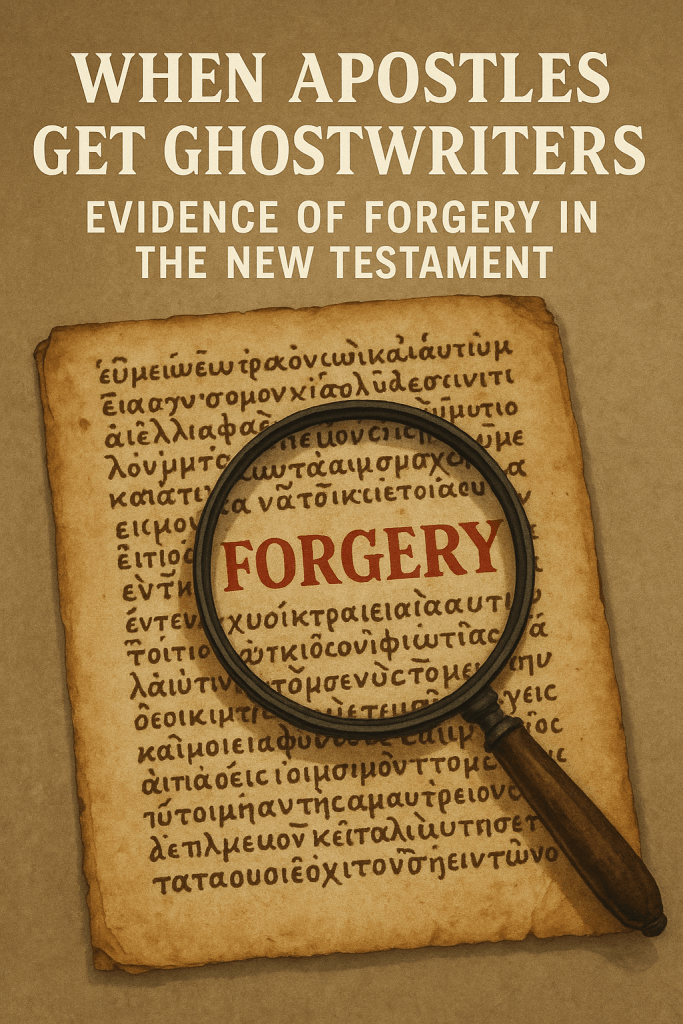
  • When Apostles Get Ghostwriters: Evidence of Forgery in the New Testament

    Introduction: Holier Than Thou or Holier Than Honest?

    The New Testament is hailed as “God’s Word,” but let’s be real: much of it is anonymous, pseudonymous, or forged. Early Christians lived in a world where writing under someone else’s name was a power move—meant to claim authority, shut down rivals, and win theological battles. Think of it as the original form of identity theft, with a halo.


    Paul: The Real vs. the Fake

    Authentic Paul (7 letters): Romans, 1–2 Corinthians, Galatians, Philippians, 1 Thessalonians, Philemon. These bear Paul’s raw, fiery voice—half-mystic, half-activist.[1]

    Imposter Paul (the rest):

    Deutero-Pauline: Ephesians, Colossians, 2 Thessalonians. These smooth-talking letters sound like Paul on decaf.[2]

    Pastorals (1 & 2 Timothy, Titus): Widely regarded as forgeries. Vocabulary and style don’t fit, the church hierarchy looks too developed, and Paul suddenly obsesses over bishops and “sound doctrine.”[3]


    Peter: The Fisherman Who Couldn’t Spell Greek

    1 Peter: Its sophisticated Greek and rhetorical polish make it unlikely that an uneducated Galilean fisherman wrote it.[4]

    2 Peter: Almost universally labeled a forgery, composed in the 2nd century, and heavily plagiarizing Jude.[5]


    The Johannine Mix-Up

    Gospel vs. Revelation: The Gospel of John is smooth, mystical Greek; Revelation is rough, broken Greek. Not the same author.[6]

    1–3 John: Anonymous letters later attributed to “John” for borrowed authority.[7]


    The Interpolations: Cutting Room Floor Additions

    Some passages look like late insertions—pious frauds with staying power:

    Mark 16:9–20: The “long ending” with snake-handling and poison-drinking is absent in earliest manuscripts.[8]

    John 7:53–8:11: The woman caught in adultery. A moving story, but added later.[9]

    1 John 5:7 (Comma Johanneum): Explicit Trinitarian formula—medieval addition, not found in Greek manuscripts.[10]

    Luke 22:43–44: Jesus sweating blood in Gethsemane—missing from earliest copies.[11]


    The Gospel Truth: They’re Anonymous

    The gospels never name their authors. “Matthew,” “Mark,” “Luke,” and “John” were attached in the 2nd century as authority branding.[12] In the ancient world, name-dropping was marketing: “Buy this scroll! Endorsed by an apostle!”


    Why It Matters

    Here’s the punchline: the church has been preaching against “bearing false witness” while canonizing forged documents. Hypocrisy much? But here’s the Franciscan Clarean twist: truth doesn’t need forgery to shine. The Spirit works even through messy, forged, and human documents. God’s love doesn’t require a flawless manuscript.


    Conclusion: Holiness Over Forgery

    If anything, forged and interpolated texts remind us that Christianity was always messy, political, and human. Faith isn’t about pretending our Scriptures dropped from heaven shrink-wrapped. It’s about hearing God’s call in the cracks, the edits, and yes—even the forgeries.

    Because if God can work through forged letters, then God can work through us—hot messes, imposters, and all.


    References

    [1]: Bart D. Ehrman, Forged: Writing in the Name of God—Why the Bible’s Authors Are Not Who We Think They Are (New York: HarperOne, 2011), pp. 95–118.
    [2]: Marcus J. Borg and John Dominic Crossan, The First Paul: Reclaiming the Radical Visionary Behind the Church’s Conservative Icon (New York: HarperOne, 2009).
    [3]: Raymond E. Brown, An Introduction to the New Testament (New York: Doubleday, 1997), pp. 668–681.
    [4]: Ehrman, Forged, pp. 122–124.
    [5]: Werner Kümmel, Introduction to the New Testament (London: SCM Press, 1975), pp. 430–433.
    [6]: Elaine Pagels, Revelations: Visions, Prophecy, and Politics in the Book of Revelation (New York: Viking, 2012).
    [7]: Brown, Introduction to the New Testament, pp. 387–393.
    [8]: Bruce Metzger, A Textual Commentary on the Greek New Testament (Stuttgart: United Bible Societies, 1994), pp. 102–106.
    [9]: Ibid., pp. 187–189.
    [10]: Metzger, Textual Commentary, pp. 647–649.
    [11]: Ehrman, Misquoting Jesus: The Story Behind Who Changed the Bible and Why (New York: HarperOne, 2005), pp. 187–189.
    [12]: Richard Bauckham, Jesus and the Eyewitnesses: The Gospels as Eyewitness Testimony (Grand Rapids: Eerdmans, 2006), though defending authenticity, still acknowledges anonymous origins.

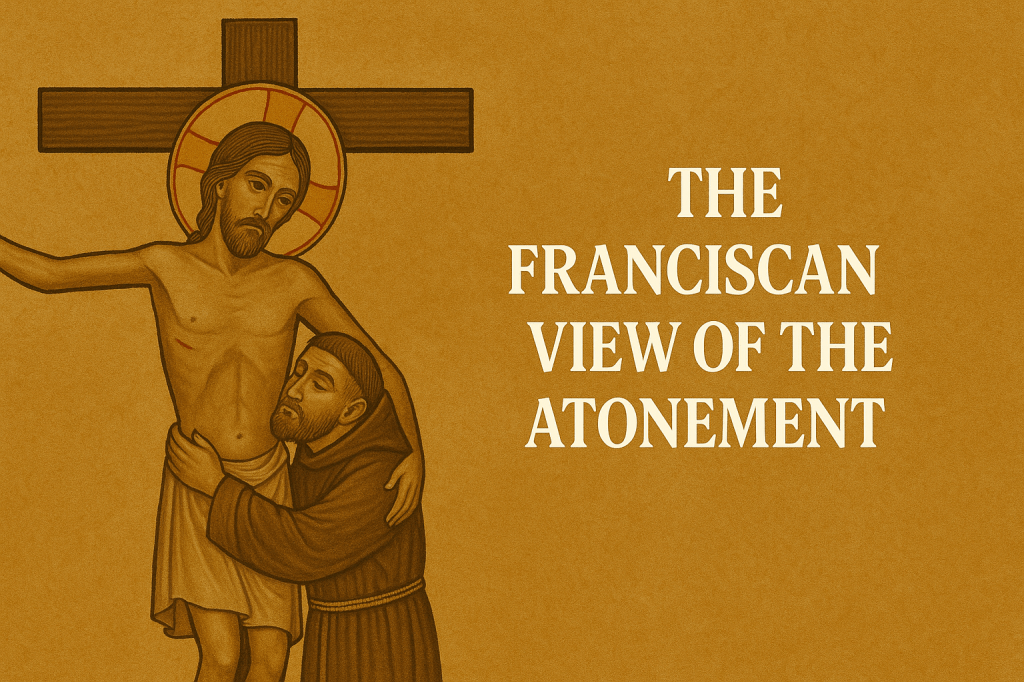
  • The Franciscan Vision of the Atonement: Love Before Law


    Introduction

    In the history of Christian theology, the doctrine of the atonement has often been framed in the language of law, debt, and punishment. Anselm of Canterbury’s Cur Deus Homo (11th century) offered the satisfaction model: humanity’s sin dishonored God, and satisfaction was required through Christ’s death.^1 Later Protestant Reformers sharpened this into penal substitution: Jesus bore divine wrath in humanity’s place.

    The Franciscan tradition, however, offers a radically different perspective. From St. Francis and St. Clare’s lived spirituality, to the speculative theology of St. Bonaventure and John Duns Scotus, Franciscans interpret the Incarnation and Cross not as reactions to sin but as the eternal expression of God’s love. For Franciscans, the atonement is not transaction but transformation, not appeasement but union.


    The Incarnation as “Plan A”

    At the heart of Franciscan atonement theology lies the Primacy of Christ. John Duns Scotus (1266–1308) argued that the Incarnation was not contingent upon human sin. God did not look down at Eden’s rebellion and scramble for a remedy. Rather, the Word-made-flesh was foreordained “before the foundation of the world” (Eph. 1:4).

    Scotus writes: “If Adam had not sinned, Christ still would have become incarnate. For the Incarnation is the greatest glory of God, and it is fitting that God should will always what is best and most glorious.”^2 In other words, Christ is not plan B after human failure, but plan A from eternity.

    This perspective reshapes the atonement: Jesus comes primarily to unite creation with God, not simply to fix sin.^3


    Bonaventure and the Cross as Revelation of Love

    St. Bonaventure (1217–1274), the “Seraphic Doctor,” emphasized the affective and mystical dimensions of the Cross. In his Tree of Life, he portrays Christ crucified as the burning heart of divine charity:

    • The wood of the cross is the ladder to heaven.
    • The wounds of Christ are windows into God’s mercy.
    • The Crucified is not merely victim but lover.

    For Bonaventure, the Cross does not primarily satisfy wrath but enflames hearts with love, drawing humanity into compassionate union with the suffering Christ.^4 The Franciscan devotion to the Passion—embodied in Francis’s stigmata—reflects this mystical vision.


    Francis and Clare: Lived Atonement in Poverty

    Francis and Clare of Assisi did not write scholastic treatises, but their lives proclaimed a theology of atonement. By embracing radical poverty, humility, and solidarity with lepers and outcasts, they embodied Christ’s own descent into littleness.

    For Francis, Christ saves not by power but by weakness. The Incarnation is God stooping down, and the Cross is God identifying with the crucified of the world.^5 To follow the Poor Christ is to share life with the poor and crucified of history.

    Clare insisted that gazing upon the mirror of the crucified Christ transforms the soul. “Place your mind before the mirror of eternity, place your soul in the brilliance of glory, place your heart in the figure of the divine substance, and transform your entire being into the image of the Godhead through contemplation.”^6 For Clare, this contemplative seeing—not legal reasoning—was the path of atonement.


    Theological Implications

    1. Union, Not Transaction
      • Salvation is not a commercial exchange of debt and payment, but a personal union of love between God and creation.^7
    2. Solidarity with the Marginalized
      • The Cross shows God standing with the oppressed. Thus, to live the atonement is to stand in solidarity with the poor, the queer, the crucified of every age.^8
    3. Cosmic Christology
      • The Incarnation integrates not only humanity but the whole cosmos into Christ. Atonement thus includes creation itself, grounding Franciscan ecological spirituality.^9
    4. Transformation of Desire
      • The Franciscan way emphasizes affectivity: the Cross changes the human heart, awakening love rather than fear.^10

    Conclusion

    The Franciscan opinion of the atonement is, at its core, a vision of divine love made visible in Christ. Against juridical models, Franciscans proclaim that God did not send Christ to change His own mind about humanity, but to change humanity’s mind about God.

    The Incarnation was always the divine intention; the Cross reveals the cost of divine love in a violent world. For Francis and Clare, Bonaventure and Scotus, the atonement is not a courtroom verdict but a love song sung from eternity: God with us, God for us, God in us.

    “Love is not loved,” Francis once lamented.^11 The Franciscan vision of the atonement dares to reply: on the Cross, Love is at last unveiled.


    Footnotes

    1. Anselm of Canterbury, Cur Deus Homo, trans. Jasper Hopkins (Minneapolis: Arthur J. Banning Press, 1974).
    2. John Duns Scotus, Ordinatio III, d.7, q.3 (see Allan B. Wolter, Duns Scotus on the Incarnation, Franciscan Institute Publications, 2004), 55–60.
    3. Richard Rohr, Eager to Love: The Alternative Way of Francis of Assisi (Cincinnati: Franciscan Media, 2014), 183.
    4. Bonaventure, The Tree of Life, in Bonaventure: The Soul’s Journey into God, The Tree of Life, The Life of St. Francis, trans. Ewert Cousins (New York: Paulist Press, 1978), 135–150.
    5. Augustine Thompson, Francis of Assisi: A New Biography (Ithaca: Cornell University Press, 2012), 102–110.
    6. Clare of Assisi, Fourth Letter to Agnes of Prague, in Francis and Clare: The Complete Works, trans. Regis J. Armstrong and Ignatius Brady (New York: Paulist Press, 1982), 66.
    7. Zachary Hayes, Bonaventure: Mystical Writings (New York: Crossroad, 1999), 89–94.
    8. Ilia Delio, A Franciscan View of Creation: Learning to Live in a Sacramental World (St. Bonaventure, NY: Franciscan Institute, 2003), 72.
    9. Ilia Delio, Christ in Evolution (Maryknoll: Orbis Books, 2008), 121–126.
    10. Ewert Cousins, Bonaventure and the Coincidence of Opposites (Chicago: Franciscan Herald Press, 1978), 142.
    11. Francis of Assisi, The Admonitions, in Francis and Clare: The Complete Works, trans. Regis J. Armstrong and Ignatius Brady (New York: Paulist Press, 1982), 36.

  • Clare’s Radical Poverty: Reclaiming Holy Dependence

    By Sister Abigail Hester, OFC

    “Go forth in peace, for you have followed the good road. Go forth without fear, for He who created you has made you holy, has always protected you, and loves you as a mother.” — Saint Clare of Assisi

    A Scandalous Simplicity

    Clare of Assisi didn’t just embrace poverty—she dared to love it. Not out of ascetic thrill-seeking, but because she saw in it a deeper truth: we were never meant to survive on our own. In a world addicted to autonomy, she chose holy dependence. And that is scandalous.

    She defied not just her wealthy family, but the entire ecclesial structure that wanted her to “tone it down.” Bishops begged her to accept endowments. Popes tried to gently nudge her into more “reasonable” poverty. Clare? She dug in her heels. She insisted that her community have no possessions whatsoever—not even collectively. For Clare, poverty wasn’t a punishment. It was a path to freedom. A radical freedom that refused to be owned, owed, or beholden to anyone but Christ.

    Dependence as Resistance

    In our modern world, “dependence” is a dirty word. We’re taught to be self-sufficient, self-made, and preferably stylish while doing it. Neediness is weakness. But Clare flips the script: dependence isn’t disgraceful—it’s divine.

    To live in holy dependence is to confess:

    I don’t have all the answers.

    I can’t save myself.

    I need others, and I need God.

    Clare’s vision rips the mask off toxic individualism. She shows us that community—real, messy, interdependent community—isn’t a backup plan. It’s the Gospel lived out. Her sisters didn’t just pray together. They begged together, fasted together, wept together. They trusted that God would provide through the hands of the poor and the generosity of others. And often, He did.

    The Poor Christ

    What made Clare’s poverty radical wasn’t the lack of stuff. It was her refusal to turn away from the Crucified Christ. She saw in Him—naked, abandoned, pierced—her Beloved. She wanted to mirror Him in everything. His poverty, His vulnerability, His absolute surrender to the Father’s will.

    To be poor like Clare is to stare into the wound of the world and not flinch. It is to say, I will not climb the ladder. I will descend into the dust, where Christ dwells among the broken. This is not performative poverty. This is mystical union.

    A Word to the Church

    Let’s be honest: much of the Church today has made peace with wealth. We’ve baptized greed, canonized comfort, and turned boardrooms into upper rooms. Clare’s life asks us: Who do we actually trust? Mammon or Mercy?

    If our ministries, communities, and spiritual lives can’t survive without financial insulation or institutional power, then we are not poor enough to know Clare. Or Christ.

    Reclaiming Holy Dependence

    For the Order of Franciscan Clareans—and for all who dare to follow the poor, queer, and crucified Christ—this is our inheritance. Holy dependence isn’t about helplessness. It’s about wholeness. It’s about reclaiming the sacred gift of needing one another.

    What might it look like to:

    Share your income with your neighbor without tracking the “ROI”?

    Let go of owning more and opt into mutual care?

    Refuse the illusion of control and embrace the vulnerability of trust?

    Clare doesn’t give us a blueprint. She gives us a burning love—a love that says: Let go. Fall into God. And if you’re lucky, into the arms of the poor.

    Benediction

    May we be ruined for comfort.
    May we be allergic to power.
    May we live unclenched, unarmed, and unashamed to need.
    Like Clare. Like Christ.