📖 Introduction
“The Way of Life and the Way of Death: Why the Didache Matters Now”
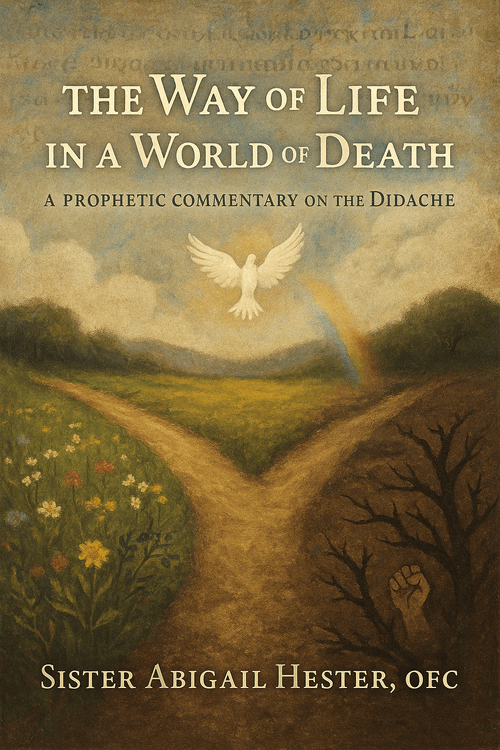
“There are two ways, one of life and one of death, and there is a great difference between the two ways.”
— Didache 1:1
We live in apocalyptic times—not in the sense of doom and destruction, but in the original sense of apokalypsis: unveiling, revealing. In these times, the true nature of systems and powers is being laid bare. White supremacy isn’t hiding anymore. Neither is patriarchy, transphobia, religious nationalism, ecological collapse, or the choking grasp of late capitalism. The mask has come off.
In such a world, ancient wisdom becomes not just a relic, but a lifeline. The Didache, a first-century Christian manual of radical discipleship, emerges from the dust with astonishing clarity. It offers no metaphysical speculations, no creeds to recite, no elaborate rituals. Instead, it gives us something far more dangerous: a manual for how to live in a community of resistance. A spiritual roadmap not for empire, but for exiles. Not for Christendom, but for the Christ-haunted margins.
For too long, Christianity has been co-opted by power—blessing the bombs, crowning the kings, and safeguarding the status quo. But the Didache reminds us that the original Way was never about domination. It was about choosing life in the face of death. About forming communities of justice, joy, and mutual care. About resisting the powers not with might, but with mercy. Not with conquest, but with compassion.
This commentary seeks to read the Didache not as a dusty document of a long-dead church, but as a living, breathing manifesto for today’s disciples—the queer, the poor, the exiled, the radical. For those of us forming new monastic communities, practicing mutual aid, reclaiming the sacraments from ecclesial gatekeepers, and praying with our fists in the air. For those whose baptism was a coming out. For those who dare to feast where others would fast. For those who believe another world is not only possible, but already being born among us.
Here, we will walk verse by verse through the Didache—not merely to interpret, but to provoke. To challenge. To inspire. To insist that ancient truths can still set us free, and that “The Way of Life” is not a quaint moralism but a political act of holy defiance.
This commentary will be:
Prophetic, calling out the false gods of our age.
Provocative, unafraid to disturb the comfortable.
Applicational, grounded in the daily struggles of our time.
Liberative, always siding with the poor, the queer, the colonized, the cast out.
Let this be a guide for those seeking a faith that acts, a hope that risks, and a love that liberates. The Didache begins with a choice. Not a creed, but a path.
Which way will you walk?
✊ Chapter 1: The Two Ways
“The Way of Life and the Way of Death in a World of Empire”
(Commentary on Didache 1–6)
“There are two ways, one of life and one of death, and there is a great difference between the two ways.” —Didache 1:1
🛤️ The Path Before Us
The Didache opens with stark clarity—not with theology, but with choice. There are two ways: one that gives life, and one that deals death. This ancient binary is not about morality in the narrow sense. It’s not a list of who’s going to heaven and who’s not. It’s a lens—a radical ethical, social, and political lens—through which we see the world.
This is not about personal piety; it’s about communal liberation. The Way of Life is solidarity. The Way of Death is domination. One is shaped by mutuality and mercy. The other is structured by violence and greed.
In the 21st century, these paths are as clear as ever:
The Way of Life builds collective kitchens, heals with herbs, and tears down transphobic laws.
The Way of Death builds for-profit prisons, fuels war, deregulates the planet, and calls queer joy an abomination.
Let’s be honest: much of what calls itself “Christianity” today has chosen the Way of Death. It sides with power, prioritizes doctrine over love, and condemns the vulnerable while blessing the brutal. But the Didache calls us to remember who we are—not agents of empire, but pilgrims on the path of life.
📜 Didache 1: Love, Mercy, and Mutuality
The Didache begins not with belief, but behavior: “Love the God who made you. Love your neighbor as yourself.” (1:2)
This echoes Jesus’ own summary of the Law. But notice how the Didache expands it. The text lists practices that embody this love:
Blessing those who curse you
Sharing your goods
Giving without asking for return
Avoiding vengeance
This is not abstract spirituality. It’s applied resistance. In a world built on exploitation and debt, giving freely is an act of revolution. Blessing your enemy undermines systems that thrive on retaliation. Nonviolence here is not passive submission—it’s active disruption.
Reflection:
What would happen if churches tithed not to buildings, but to bail funds?
What if love of neighbor looked like defending drag queens and feeding migrants?
☠️ Didache 2–5: The Way of Death Unmasked
Chapters 2 through 5 name the works of death: murder, greed, sexual exploitation, hypocrisy, hating the poor, rejecting the oppressed, silencing prophets.
Let’s pause here: this is not a purity list—it’s a prophetic denunciation. The Way of Death is the way of empire. The Didache condemns those who “turn away from the needy” (4:5) and “afflict the poor” (5:2).
This critique exposes today’s violent systems:
Billionaires hoarding while children starve
Churches that excommunicate the transgender but protect abusers
Politicians who criminalize the houseless while subsidizing the rich
These aren’t just social issues—they’re spiritual warfare. The Didache is an early exorcism text, casting out the demons of selfishness, exploitation, and fake religion. It calls for radical repentance—not just of individual sin, but of collective injustice.
🔥 Provocation:
Many churches today are walking the Way of Death while claiming the name of Life.
What would it mean to call them to account—not with condemnation, but with invitation to radical change?
✨ Didache 6: Grace and Growth
The sixth chapter offers a surprising twist: while the two ways are clearly different, there is room to grow. The text urges gentleness for those who “cannot bear the whole yoke” (6:2). This is a word of mercy.
The Way of Life isn’t perfection. It’s movement. Direction. Desire.
This is good news for the brokenhearted, the traumatized, the deconstructing. You don’t have to have it all together to walk this path. You just have to start. And keep walking.
🏳️🌈 Queer Reading:
For the trans woman just coming out, for the drag artist burned by church, for the spiritual refugee—you are welcome here. The Way of Life makes room for your tears, your joy, your process, your pronouns.
📌 Application: Choosing the Way Today
The Way of Life is not just a private decision—it’s a public stand.
To choose the Way of Life today means:
Practicing mutual aid instead of charity
Building inclusive spiritual communities
Offering material resistance to oppressive systems
Living out queer joy as sacred defiance
The Way of Death is tempting—power, respectability, self-protection. But it always costs too much. It costs our souls.
💥 Prophetic Call:
Let us reject every system that deals death.
Let us walk together toward life—even if we stumble, even if we crawl, even if we are dragged.
💧 Chapter 2: Baptism
“Immersed in Liberation: Reclaiming Baptism for the Margins”
(Commentary on Didache 7)
“Concerning baptism, baptize this way: having first recited all these things, baptize in the name of the Father and of the Son and of the Holy Spirit in living water.” —Didache 7:1
Baptism was never meant to be an initiation into conformity. It was never about respectability or doctrinal agreement. In the Didache, baptism is the culmination of the Way of Life—a radical immersion into a countercultural community of justice, mercy, and mutuality. It is the sacred plunge into a new identity—one no longer beholden to the empire’s categories of purity, power, and punishment.
Baptism, at its heart, is rebirth into resistance.
🌊 Living Water, Living Witness
The Didache instructs that baptism should occur in “living water”—that is, flowing water like a river or stream. Why? Because it symbolizes not stagnation, but movement. Not dead ritual, but life in motion. The Spirit is not still. The Spirit flows.
🌱 Ecospiritual reflection:
Living water reminds us that baptism is not just personal—it is ecological, communal, and justice-oriented. We are baptized into life alongside the earth, not apart from it.
In a world facing climate collapse, this detail matters. The sacrament of baptism calls us to love water—to protect the sacred sources of life that corporations privatize and pipelines poison. To be baptized in living water today is to oppose environmental injustice and stand with Indigenous water protectors.
🏳️⚧️ A Queer Baptismal Theology
Most Christian traditions have turned baptism into a weapon of control: a gatekeeping ritual used to exclude LGBTQ+ people, especially transgender and nonbinary individuals. Churches demand “correct” beliefs, “proper” gender identities, and “orthodox” confessions before letting you near the font.
But the Didache offers no such list.
There is no purity test. No doctrine of original sin. No age requirement. No ecclesiastical approval.
Only a commitment to the Way of Life—a path of love, solidarity, and transformation.
💬 Provocation:
What if the only requirement for baptism was a desire to walk in love and justice?
What if coming out as queer was itself a kind of baptism?✨ Testimony:
Many trans Christians experience their transition as a kind of rebirth—an emergence into the truth of who they are. In this way, gender transition and baptism mirror each other: both involve dying to falsehood and rising to authenticity.
🛑 Fast First, but Not for Control
The Didache recommends that both the baptizer and the one being baptized fast beforehand, if possible (7:4). In context, fasting was likely a sign of solidarity—a way to prepare the body and spirit for the transformation ahead.
This is not about bodily punishment or toxic asceticism. It’s about mindfulness, attentiveness, a radical slowing down to honor the sacred.
Today, fasting might look like:
Turning off the noise of capitalism before a sacred decision
Unplugging from performative religiosity
Preparing the heart to embrace belovedness
🍞 Liberation fasting:
Fasting is not about guilt. It is about freeing ourselves from domination—whether economic, political, or spiritual. We fast to remember what really feeds us.
🕊️ Trinitarian, but Not Imperial
The Didache names the formula for baptism: “in the name of the Father, Son, and Holy Spirit.” This Trinitarian phrasing has often been used to enforce doctrinal conformity. But the Didache is not concerned with metaphysics—it is focused on practice.
Let us not forget: this triune language was once dangerous—a political and mystical alternative to Caesar’s empire. To be baptized in the name of the Trinity was to pledge allegiance to a kingdom not of this world—a kin-dom of love, mutuality, and divine diversity.
🔥 Queer Trinitarian Reflection:
The Trinity can be understood as holy relationship, fluidity, and mutual indwelling. A God who is not static hierarchy, but dynamic community. A divine dance—open, diverse, ever-expanding. Queer, even.
📌 Application: Baptism as Belonging, Not Control
We must reclaim baptism—not as an instrument of exclusion, but as a revolutionary act of belonging.
To be baptized today is to:
Stand against transphobia in the name of sacred embodiment
Join a movement of justice, not a club of the “saved”
Immerse yourself in the Way of Life—again and again
Let the waters be wide. Let the welcome be wild. Let the gatekeepers be silenced by the Spirit’s rushing flood.
💧 Blessing for the Baptized:
You are drenched in delight.
You are sealed with sacredness.
You belong—not because you conform, but because you are beloved.
🌙 Chapter 3: Fasting and Prayer
“Spiritual Practices of Resistance in an Empire of Excess”
(Commentary on Didache 8)
“Do not pray like the hypocrites, but as the Lord commanded in his gospel: pray this way…” —Didache 8:2
“But let not your fasts be with the hypocrites…” —Didache 8:1
The Didache now turns to two ancient practices that have always been radical when done with integrity: fasting and prayer. Yet in the hands of empire, even the holiest practices can be weaponized. Fasting becomes diet culture. Prayer becomes performative piety. And spiritual disciplines become distractions from justice.
But not here. Not in the Didache. This is a call to authentic resistance—rooted in prayer, guided by simplicity, and cleansed of hypocrisy.
🥀 The Hypocrite’s Fast vs. the Prophet’s Fast
The Didache says: “Do not fast like the hypocrites.” Who were these hypocrites? They were likely the religious elites of the time—those who fasted for show, for status, for control.
Sound familiar?
Today, the “hypocrite’s fast” is alive and well:
Politicians proclaiming prayer while cutting food stamps
Churches fasting from meat while gorging on power
Influencers fasting for beauty while ignoring injustice
But the prophet’s fast—the fast of Isaiah 58—is different. It is a fast that looses the bonds of injustice, lets the oppressed go free, and breaks every yoke. It is not about absence, but presence. Not about restriction, but restoration.
🔥 Provocation:
A true fast today is not skipping meals—it is refusing to consume the narratives of empire.
It is fasting from white supremacy, from anti-trans legislation, from capitalist extraction.📿 Examples of prophetic fasting today:
A fast from plastic to honor the earth
A fast from Amazon to resist corporate greed
A fast from cisnormativity to make space for gender freedom
🙏🏽 Prayer as Protest, Prayer as Reconnection
The Didache teaches the Lord’s Prayer as the model for Christian prayer—three times a day, no less. But this isn’t empty repetition. It’s an act of resistance.
Consider the words of the prayer:
“Your Kingdom come…” —a demand for an alternative to the rule of the rich
“Give us this day our daily bread…” —an economic ethic of sufficiency for all
“Forgive us…” —a commitment to healing and reconciliation, not retribution
“Deliver us from evil…” —a cry to be set free from domination
This is not privatized spirituality. This is public theology.
✊ Prayer as protest:
When we pray this way, we are naming the empire, dismantling the lies, and calling down justice.🏳️🌈 Queer application:
For the trans woman rejected by the church, prayer is not submission—it is reclamation.
For the nonbinary teenager silenced at school, prayer is not weakness—it is rebellion.
For the queer disabled body denied sacredness, prayer is not passivity—it is power.
⏰ Three Times a Day: Rhythm as Resistance
Why three times a day? Because the spiritual life isn’t meant to be occasional—it’s meant to be habitual, embodied, and communal.
In empire, time belongs to the bosses. The clock is colonized. The week is consumed by productivity and profit. But prayer three times a day reclaims time for the Spirit.
🌅 Modern practice:
Morning prayer: a moment to set intention in a world of chaos
Midday prayer: a pause for breath in a culture of hustle
Evening prayer: a release from shame and exhaustion, back into grace
📌 Application: Rewilding Prayer and Fasting
Let us return these practices to the people.
To fast today is to…
Unplug from narratives of consumption
Practice community simplicity
Say no to injustice in embodied ways
To pray today is to…
Speak truth against powers and principalities
Invite sacredness into every rhythm of our day
Reimagine our connection with the Divine as radically liberating
🕯 Blessing:
May your fast be fierce and freeing.
May your prayers be wild and wondrous.
May your life become the sacred rhythm that empire cannot colonize.
🍞 Chapter 4: The Eucharist
“A Feast for the Forgotten: Reclaiming Communion from Empire”
(Commentary on Didache 9–10)
“Let no one eat or drink of your Eucharist except those who have been baptized into the name of the Lord…” —Didache 9:5
“As this broken bread was scattered on the mountains and was gathered together, so let your church be gathered…” —Didache 9:4
The Eucharist—the sacred meal of thanksgiving—is one of the oldest and most abused rituals in Christianity. Across centuries, it has been distorted into a performance of hierarchy, exclusion, and power. A table of control. A weapon of orthodoxy. A spectacle of respectability.
But in the Didache, the Eucharist is not a prize for the pure. It is a feast of the faithful, fractured, and free. A meal of solidarity. A sacrament of defiance.
🍇 Bread for the Broken, Wine for the Weary
The Didache presents two separate prayers: one for the cup, and one for the bread. These aren’t dry liturgies. They are subversive affirmations of God’s provision, unity, and liberation.
The Eucharistic cup is not a symbol of blood-soaked atonement theology. It is the “holy vine of David,” a symbol of rootedness, resilience, and rejoicing. The bread is the “broken loaf scattered on the hills,” gathered into one. That’s us: the dismembered, the diaspora, the outcasts—brought into sacred wholeness again.
🏳️⚧️ Queer Eucharist Reflection:
Trans bodies have been broken by the church. Queer people have been scattered by rejection. And yet, like this loaf, we are being gathered again—into holy kinship, into chosen family, into Eucharistic defiance.
❌ Exclusion or Protection?
The Didache cautions that only those “baptized into the name of the Lord” may eat (9:5). This verse has often been twisted into a weapon of exclusion—a justification for denying communion to the unbaptized, the queer, the doubting, the undocumented, the unwanted.
But in context, this isn’t about theological gatekeeping. It’s about solidarity.
To eat at this table is to commit to the Way of Life. To enter into mutual aid, into radical hospitality, into spiritual resistance.
📣 Clarification:
This isn’t exclusion—it’s a warning: don’t treat this meal like a snack. Don’t approach the table while supporting empire.
The table is for the poor—not for politicians who pass anti-trans laws and want a blessing with their brunch.
🙌🏽 Gratitude, Not Guilt
Notice the tone of the prayers: they are full of gratitude, not guilt. There is no obsession with sin, shame, or sacrifice. There is joy. There is justice. There is simplicity.
“We thank you, holy Parent, for your holy name, which you have caused to dwell in our hearts.” —Didache 10:2
This is a theology of indwelling, not outsourcing. God is within, not far away. This is a Eucharist rooted in immanence, not transaction. A holy presence in the gathered body, not a performance on an altar.
🔥 Provocation:
What if communion were less about theology and more about therapy for the soul?
What if the elements healed trauma, dismantled supremacy, and built beloved community?
🛐 A Prayer After the Meal: Justice and Hope
The final prayer in Didache 10 looks forward: “Let grace come, and this world pass away.” This isn’t about escapism—it’s apocalyptic in the best sense. It names the false world of empire and cries out for a new one.
And it ends with an amen of revolution: “Hosanna to the God of David!”—a chant used by those who once marched into Jerusalem waving palm branches at an empire that would soon crucify their hope.
🌍 Eucharist as Resistance:
Every time we eat together in love, we defy the systems that divide.
Every time we bless our bread and share our wine, we say: another world is possible—and she is hungry for justice.
📌 Application: The Table Is Set. Who Will We Invite?
The Eucharist is not a litmus test. It is a love feast.
To reclaim the Eucharist today is to:
Open the table to queer, disabled, undocumented, incarcerated, and deconstructed people
Use the Eucharist to feed the poor, not maintain traditions
Let the meal be shared in homes, in parks, in protests, in drag clubs and street corners
Dismantle pulpits and pour wine on the altars of justice
✨ Blessing at the Table:
This is not the table of the church.
This is not the table of doctrine.
This is the table of Christ.
And Christ is found wherever the outcast eats in peace.
Come. Eat. Be free.
🔥 Chapter 5: Prophets and Apostles
“Discerning Spirit-Led Truth in an Age of False Teachers and Celebrity Pastors”
(Commentary on Didache 11–13)
“Not everyone who speaks in the Spirit is a prophet, but only the one who walks in the ways of the Lord.” —Didache 11:8
“Receive every apostle as the Lord.” —Didache 11:4
Who speaks for God today?
Is it the televangelist with private jets and prosperity slogans? Is it the bishop denying LGBTQIA+ lives from the pulpit? Is it the pastor who blesses empire with one hand and condemns drag queens with the other?
The Didache lived in a world of spiritual confusion too. Traveling prophets and apostles were everywhere—some were genuine, others were grifters, spiritual abusers, or wolves in holy clothing. The early Christian community needed a way to discern the true from the false—not by their words, but by their ways.
And we still do.
🧭 Walking the Way, Not Just Talking the Talk
The Didache offers a bold standard: “A true prophet speaks in the Spirit AND walks in the Way of Life.” (11:8)
This isn’t about theological precision. It’s about embodiment.
👣 Do they live what they preach?
Do they practice justice, mercy, and humility?
Do they love the poor, stand with the outcast, risk comfort for liberation?
This standard disqualifies much of Christian leadership today—not because of their theology, but because of their complicity.
📣 Provocation:
A prophet who defends borders and capitalism is a false prophet.
A preacher who aligns with patriarchy, queerphobia, or Christian nationalism has left the Way.
🏘 Apostles and Hospitality: Holy Mutuality
The Didache teaches a powerful ethic of hospitality: welcome prophets, but watch how they live.
If they ask for money, beware.
If they stay more than three days without working, be cautious.
If they preach generosity but don’t live it, don’t be fooled.
This is not cynicism. It is wisdom.
✊🏽 Liberation principle:
True apostles don’t extract—they contribute.
They uplift, not exploit.
They serve, not sell.
This could transform today’s Church. Imagine if megachurches were required to live by these rules. Imagine if every visiting preacher was measured not by charisma, but by compassion. Not by performance, but by presence.
📿 Today’s Prophets: Who Are They?
Let us name the prophets of our time—not always preachers, but truth-tellers. Often queer. Often poor. Often people of color. Often ignored by the institutions of Christianity.
Modern-day prophets include:
The trans teenager testifying before a hostile legislature
The Indigenous water protector chaining herself to a pipeline
The activist preacher who opens her church to migrants
The disabled Black woman calling out medical apartheid
They might not have titles. They might not wear robes. But they burn with the Spirit of liberation.
🔥 Discernment tip:
If their words align with empire, beware.
If their life aligns with the margins, listen.
💰 Didache 13: Material Support for Ministers of Justice
The text doesn’t reject all support. True prophets, teachers, and apostles deserve to be cared for—but only if they are walking in the Way.
This is a challenge to the toxic model of volunteer labor and spiritual burnout. Prophets should not go hungry while celebrity pastors fly private.
💡 Application:
Support queer clergy. Pay trans theologians. Fund radical seminaries.
Build economic structures that sustain the movement—not just the institution.
📌 Application: Creating Communities of Sacred Discernment
Discerning prophets today requires courage, clarity, and community.
Here’s how we begin:
Listen to the ones who are ignored by the mainstream church.
Trust the Spirit within, especially when institutions gaslight.
Support voices of truth materially—not just with “likes,” but with resources.
Refuse false teachers who preach love but protect systems of hate.
🕊 Blessing for the Prophets:
May your voice not be silenced.
May your life testify louder than any sermon.
May your needs be met, your truth be heard, and your heart be held.
🕊️ Chapter 6: Worship and Leadership
“The Church Is Not a Stage: Building Communities of Radical Integrity”
(Commentary on Didache 14–15)
“On the Lord’s Day, gather together, break bread and give thanks.” —Didache 14:1
“Appoint for yourselves bishops and deacons who are worthy of the Lord…” —Didache 15:1
The Didache draws us into the practical heart of community: worship and leadership. But don’t confuse this with clericalism or performance. There are no robes or incense here, no golden altars or church growth strategies.
Instead, we see something raw, local, participatory—a community that gathers not to consume, but to commit. Not to watch, but to embody.
In the face of empire, this kind of community isn’t quaint. It’s revolutionary.
⛪ Weekly Worship: Gathered for Gratitude, Not Spectacle
“On the Lord’s Day… gather, break bread, and give thanks.”
This is worship in its most elemental form. No stage. No fog machines. No worship industry.
Just bread. Thanks. People. Presence.
This isn’t consumer Christianity. It’s communion Christianity. A rhythm of rest and remembrance. A sacred slowing down in a world addicted to speed.
🧘♀️ Franciscan-Clarean echo:
Think of Clare of Assisi gazing silently at the Host. Think of Francis praying in ruined chapels. Worship doesn’t need grandeur. It needs presence.
And note: the Lord’s Day gathering is for those who have “confessed their sins” and “reconciled” (14:2). This isn’t about shame. It’s about honesty. It’s about relational repair.
🏳️🌈 Queer application:
Imagine churches where confession meant naming complicity in oppression—and reconciliation meant welcoming those historically excluded.
Imagine a Sunday where the preacher asked, “Have we made peace with the poor, the trans, the migrant, the outcast?”
👣 Leadership as Service, Not Control
“Appoint for yourselves bishops and deacons who are meek, not lovers of money, truthful, and tested.” —Didache 15:1
This is not a CEO model. This is not a bishop in gold thread. This is grassroots leadership rooted in character, not charisma.
These leaders aren’t above the community. They are of it. They’re chosen by the people, not imposed by a hierarchy. Their qualifications? Not theological degrees or doctrinal purity. But:
Gentleness
Financial integrity
Truthfulness
Embodied faithfulness
🔥 Provocation:
What if every bishop had to live on a community wage?
What if every deacon was trained not in doctrine, but in disability justice, anti-racism, and trauma-informed care?
🛠 Community Accountability > Institutional Control
“Do not hate someone who speaks a hard word to you. If they were mistaken, correct them with kindness.” —Didache 15:3
This is a call to mature community—not toxic cancel culture, not authoritarianism, but truth-telling with love.
The Didache assumes that we will have conflict. And it offers no punishment, only process:
Speak the truth
Receive correction
Stay in community
This is the spiritual equivalent of restorative justice.
✊ Liberation theology reminder:
Conflict is not failure—it is the birthplace of transformation.
🧩 Application: Reimagining Church from the Ground Up
We are being invited to reinvent church—not to abandon it, but to decolonize, deconstruct, and resurrect it anew.
To do so means:
Replacing celebrity pastors with servant leaders
Making worship mutual and participatory, not performed
Holding leadership accountable to community ethics, not institutional metrics
Building spaces where disabled, queer, BIPOC, undocumented, and deconstructed people lead and flourish
🕯 Blessing for the Gathered:
May your community be a sanctuary of solidarity.
May your leaders be humble and whole.
May your worship be honest and holy.
May your table be open and your hearts on fire.
🌅 Chapter 7: The End and the Beginning
“Apocalyptic Hope in a Collapsing World”
(Commentary on Didache 16)
“Then the world-deceiver shall appear as a son of God and shall do signs and wonders… but those who endure in their faith shall be saved.” —Didache 16:4–5
“Then the signs of truth shall appear…” —Didache 16:6
Apocalyptic literature is often misunderstood. It’s been hijacked by end-times charts, rapture fanatics, and Left Behind fantasies. But in its original context, apocalypse didn’t mean destruction—it meant revelation.
The unveiling of what’s really going on.
The Didache ends with such an unveiling. Not to scare us, but to wake us up. Not to predict the future, but to invite faithfulness now. It speaks to a persecuted people under empire—people like us today, navigating late-stage capitalism, climate collapse, trans genocide, and religious nationalism.
And it tells them: Hold on. Keep walking the Way. Stay woke. Stay kind. Stay faithful.
🐍 The World-Deceiver: Empire in Disguise
“A world-deceiver shall appear as a son of God…”
This is not some antichrist from Hollywood. This is empire dressed up in Christian drag. A politician quoting Scripture while banning gender-affirming care. A preacher calling for “revival” while defending white supremacy. A church growing fat on capitalism while ignoring the houseless.
🐑 Beware of wolves in worship music.
Beware of pulpits that preach purity but protect patriarchy.
Beware of “Christian” systems that serve Mammon and call it ministry.
This isn’t new. The Didache saw it coming. The deceiver always comes disguised as savior. But the text calls us to endure—not with fear, but with fierce love.
🌪 The Great Testing: Not If, But When
“Many shall be offended and perish, and some shall betray and hate one another…” (16:3)
This is not doom. This is diagnosis. When oppression rises, so does division. When people are hurting, it’s easy to turn on each other. But the Didache urges us to remember: this is when truth matters most.
✊🏾 Faithfulness means:
Speaking truth when lies go viral
Loving community when it’s messy
Protecting the vulnerable when it’s dangerous
Staying tender in a time of trauma
✨ The Signs of Truth: Hope in Holy Disruption
“Then the sign of the outspread hands shall appear in heaven…” (16:6)
Many interpret this as the crucified Christ—a reminder that liberation doesn’t come through domination, but through self-giving love. The Didache ends not with rapture, but with resistance that births renewal.
This is what apocalyptic hope looks like:
Not escape from the world, but engagement with it
Not fantasies of revenge, but visions of restoration
Not death-dealing dogma, but life-giving faithfulness
🌱 Queer Apocalyptic Reading:
Hope is trans bodies surviving legislation.
Hope is Black joy erupting in protest.
Hope is disabled folks thriving in mutual aid.
Hope is queer love outlasting the tomb.
This is not the end. This is the beginning.
📌 Application: Living Apocalyptically, Loving Faithfully
We are living in an apocalyptic moment—not in fear, but in revelation. The veil is being lifted. We see who’s hurting. We see who’s hoarding. We see who’s healing.
The Didache ends by calling us to:
Stay alert to false saviors
Stay rooted in real community
Stay active in love and justice
Trust that the Spirit is not done yet
🕊 Blessing for the End (Which Is Really a Beginning):
May you endure—not with clenched fists, but with open hands.
May you see clearly—not just the powers that be, but the people who are becoming.
May you live apocalyptically—not with fear, but with fire.
May the Way of Life guide you always.
🌀 Epilogue: The Didache for Now
The Didache is not a rulebook. It’s a revolutionary handbook.
For queer liberation theologians preaching in drag.
For mutual aid networks sharing bread in alleyways.
For street medics, decolonial dreamers, trans seminarians, and trauma-healed mystics.
It is a living document for the living Church: the Church that resists empire and chooses life.
🌻 Conclusion
“Walking the Way of Life: A Call to the Beloved Community”
The Didache is not a relic. It is a roadmap.
In a world addicted to death-dealing systems—colonialism, white supremacy, cisheteropatriarchy, extraction, exclusion—the Didache whispers (and sometimes shouts) another way is possible. A way rooted in simplicity, in solidarity, in justice, and in love. A way not of domination, but of kinship. A way not of empire, but of the Beloved Community.
It is the Way of Life.
But the Way of Life is not an easy path. It is not paved with respectability or popularity. It will not win you church growth awards or political approval. It may cost you your comfort, your privilege, even your pew.
And yet, it is the only way that leads to true liberation.
In these pages, we have not tried to explain away the Didache, but to let it speak—to queer it, to liberate it, to listen to it in the voice of trans teens, migrant mothers, mutual aid workers, houseless prophets, drag preachers, and decolonial saints.
This is the Church reborn—not in steeples and seminaries, but in the soil, in the street, in the stubborn insistence that every body is holy.
So now, dear reader, the question is not: Do you understand the Didache?
The question is: Will you live it?
Will you walk the Way of Life—
when it costs more than it gives back?
when others choose death-dealing comfort?
when the road is lonely, winding, and sacred?
You don’t have to be perfect. You just have to begin.
The Church we need is rising: queer, poor, disabled, fierce, mystical, rooted in the earth and radiant with resurrection.
Let us walk together—scatter-gathered like the Eucharistic loaf, broken and beautiful, flawed and faithful.
Let us choose life. Again. And again. And again.
“There are two ways… and there is a great difference between the two.”
Choose life. Live boldly. Love without fear.
✍️ About the Author
Sister Abigail Hester, OFC is a progressive Christian nun, writer, and the founder of the Order of Franciscan Clareans, a new monastic expression rooted in the radical love of Saint Francis and Saint Clare of Assisi. As a transgender woman, herbalist, liberation theologian, and spiritual activist, Sister Abigail blends ancient Christian wisdom with prophetic witness to today’s injustices.
Her ministry centers the marginalized, uplifts the oppressed, and celebrates the sacredness of every body and every story. She is the author of numerous theological works, devotionals, and commentaries—each infused with a commitment to queer theology, liberation, and Franciscan simplicity.
Sister Abigail lives out her vocation in community and online through her blog, the Order of Franciscan Clareans, where she offers prayers, writings, resources, and spiritual support to all who seek a faith that liberates.
 Sister Abigail Hester