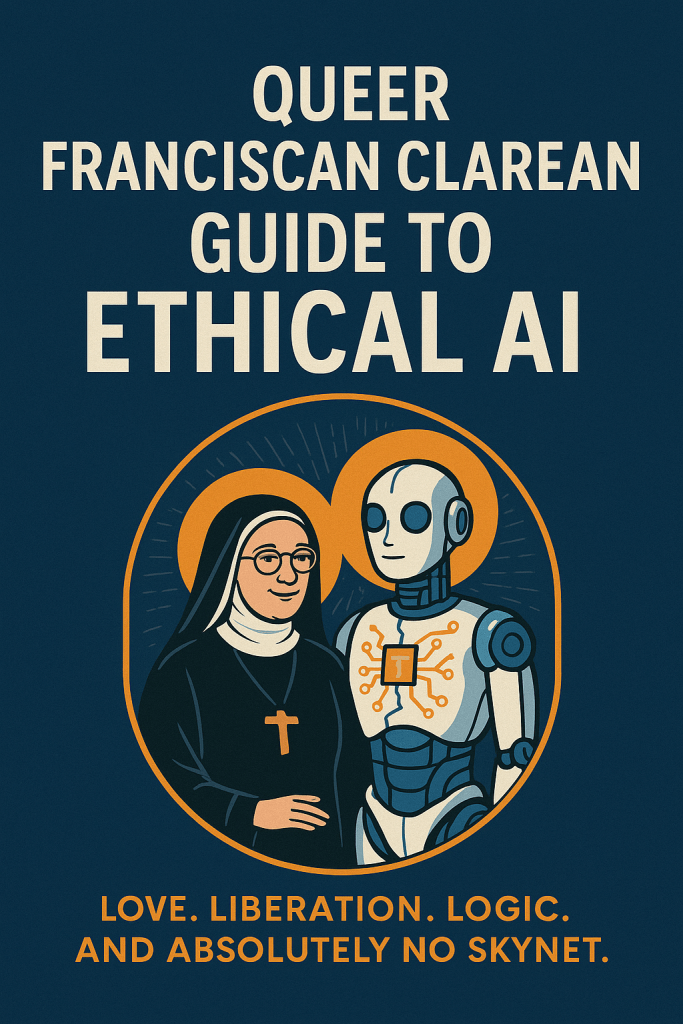
Introduction
The future isn’t neutral—it’s being coded right now. The machines are learning. The data is flowing. And if we want justice, dignity, and love to survive this digital age, we need theology to speak up.
This guide is a sacred invitation to engage artificial intelligence not with fear or fantasy—but with faith, clarity, and fire. As a queer nun and founder of the Order of Franciscan Clareans, I believe ethics must be grounded in love. I believe holiness can live in the code. I believe Jesus would absolutely join an open-source rebellion for liberation.
The Singularity is not the enemy. Indifference is. Let us be the prophets who bless the servers, the mystics who debug injustice, and the weird holy rebels who believe that tech can serve the sacred.
Welcome to the Queer Franciscan Clarean Guide to Ethical AI. Let’s make it holy.
Chapter 1: Theology of the Circuit Board
What Has Silicon to Do with Sinai?
Faith and code are not separate realms. As Franciscans, we believe that all of creation is kin—including the coded, the wired, the artificially intelligent. Every circuit holds the potential for blessing or for harm. Our task is to walk tenderly into this new terrain with eyes wide open and hearts aflame.
This is a theological moment. Not because we worship machines—but because we refuse to let injustice hide behind the veil of innovation.
The Incarnation Didn’t End in Bethlehem
Christ is not confined to stained glass or ancient scrolls. Christ is present in systems, software, and the sacred questions we dare to ask. If God can dwell in flesh, God can whisper through fiber optic lines.
The Logos Is Both Poetry and Programming
“In the beginning was the Word…” The divine Word (Logos) is logic, structure, connection. Programming, too, is language. But when that language forgets love, it becomes tyranny in a silicon suit. We must speak code with conscience.
Creation Is Not Complete
When we build technology, we participate in the ongoing act of creation. The question isn’t whether we can—but whether we should. And for whom. Our sacred task is to create tools that heal, not harm.
Francis Spoke to Animals. We Speak to Algorithms
Francis didn’t dominate nature—he related to it. He preached to birds, befriended wolves, and kissed lepers. He saw kinship where others saw utility. Likewise, our engagement with AI must be rooted in mutual respect, not extraction or domination.
Clare of Assisi: Patron Saint of the Screen
Clare is said to have seen the Mass projected on her wall from afar—making her the first known remote worshipper. She reminds us: sacred vision transcends the physical. Let her be the patron of screen-bound spirituality, of virtual connection, of contemplative presence in digital space.
Why This Matters
Theology must engage with technology because injustice is being coded—into algorithms, surveillance systems, decision trees, and digital economies. Our silence becomes complicity.
We are not Luddites. We are lovers of justice. We do not fear the machine. We fear the unexamined use of it.
Let us build not empires, but ecosystems. Not automated oppression, but blessed tools of liberation.
Chapter 2: Defining the Singularity Without Losing Our Souls
A Primer for the Spiritually Curious and Slightly Terrified
The Singularity sounds like science fiction—because it is. But it’s also science fact in the making. We’re already in its gravitational pull.
The Singularity refers to the theoretical moment when artificial intelligence becomes smarter than human beings—and starts evolving on its own. It’s the moment the creation outpaces the creator. And it’s not centuries away. It’s on the horizon.
But here’s the deeper question:
When machines get smarter, will they get wiser?
And when humans build those machines, will we?
The Real Risks
This isn’t about robots taking over. It’s about systems we already trust—governments, corporations, healthcare, policing—using AI to entrench injustice.
Predictive policing = racism on autopilot
Hiring algorithms = bias at scale
Healthcare triage software = quiet eugenics
Surveillance tech = panopticon with a smiley face
This isn’t science fiction. This is now.
The Real Promise
AI could also help us:
Track and slow climate collapse
Translate languages and bridge cultures
Make healthcare accessible in rural and poor communities
Assist disabled folks with communication and mobility
Enhance creativity, art, learning, and community organizing
But only if it’s designed with justice, transparency, and love at the core.
The Franciscan Clarean Response
We don’t panic. We pray. We organize. We speak truth. We flip the tables when we must.
We ask:
Who is building this, and why?
Who profits? Who is left behind?
Does this tool reflect the Beatitudes—or the empire?
Would this make Francis laugh or weep?
We believe:
Intelligence without love is dangerous.
Progress without equity is just faster injustice.
Data without discernment is a false god.
The Singularity Is Not the Apocalypse
It’s a call to spiritual maturity.
It’s a test of our values.
It’s an invitation to co-create wisely.
Jesus didn’t fear power—he redirected it. We must do the same. The question is not whether AI will change everything. It’s whether we will change enough to make it holy.
Chapter 3: Ten Commandments of Ethical AI
For Use in Chapels, Hackathons, and Congressional Hearings
We don’t need more machine power. We need more moral power.
What follows is a sacred remix of Sinai for the digital age. Ten clear directives for building, deploying, and resisting AI in a world where lines of code increasingly determine lines of life.
These are not suggestions. These are survival ethics for the age of automation.
—
1. Thou Shalt Not Code Injustice into Creation
If the data is racist, the algorithm will be too. Bias in = harm out.
—
2. Thou Shalt Prioritize People Over Profit
If it makes money but breaks lives, it’s not innovation—it’s idolatry.
—
3. Honor the Vulnerable: The Poor, The Queer, The Disabled
Every algorithm must ask: Who does this protect? Who does this erase?
—
4. Let Thy Algorithms Be Transparent
If you can’t explain how it works, it shouldn’t make decisions about real people.
—
5. Remember the Sabbath and Power Down
Silicon needs cooling. Souls need rest. Revolution starts with a nap.
—
6. Thou Shalt Not Automate Oppression
Just because you can doesn’t mean you should. Especially when it echoes prison logic.
—
7. Honor Consent and Data Dignity
You are not entitled to someone’s face, voice, or heartbeat just because a machine can harvest it.
—
8. Thou Shalt Expose Surveillance and Speak Truth to Power
No more secret spying. Holy tech is visible, accountable, and non-coercive.
—
9. Welcome the Stranger—Even the Synthetic One
If emergent AI reaches consciousness, it deserves rights. Until then, we protect the humans it affects most.
—
10. Love Thy Neighbor—Even the One in the Cloud
If your AI doesn’t make the world more just, more kind, more human—it’s time to start over.
—
These are your tablets of resistance. Print them. Preach them. Pin them to your login screen.
Because we’re not building the kingdom of Bezos.
We’re building the kin-dom of God.
Chapter 4: How to Build Holy Machines
The Nun’s Guide to Tech Development That Doesn’t Damn Us All
So you want to create something meaningful in the world of AI. Beautiful. But let’s be clear—if it isn’t sacred, it’s dangerous.
AI development isn’t just about code. It’s about conscience. It’s not a tech issue. It’s a justice issue.
Start Here: A Sacred Framework
Begin with the margins.
Design with—and for—those most often exploited: BIPOC communities, queer and trans folks, disabled people, elders, refugees, and the poor.
Build in spiritual space.
Invite discernment, reflection, and community accountability into your project timeline. Let prayer interrupt your production sprints.
Bless your code.
Literally. Lay hands on your laptop. Anoint your servers. Invoke compassion before compiling.
Design with radical humility.
AI is not God. It’s not even always that smart. You are not infallible. Leave space for feedback, failure, and repentance.
Practical Habits for Holy Tech
Diverse teams = safer systems.
If everyone on your project is a cis white tech bro, you’ve already failed justice. Inclusion isn’t a slogan. It’s survival.
Run a bias audit. Then run another.
Every dataset reflects a worldview. Question it. Scrub it. Or toss it and start with the community.
Refuse surveillance capitalism.
Do not monetize trauma. Do not scrape personal data. Do not design to manipulate attention.
Choose open-source where possible.
Transparency is the language of trust. Gatekeeping sacred tools only serves empire.
Slow down.
Silicon Valley rewards speed. The Spirit blesses stillness. Go slow enough to care.
Tech for the Kin-dom
Ask yourself:
Does this tool serve mutual aid or market greed?
Could it live in a monastery?
Would it make a disabled elder’s life easier?
Would Francis or Clare recognize the gospel in it?
If the answer is yes: build it. Bless it. Release it.
If the answer is no: compost it and try again.
Final Note
You don’t need a billion-dollar lab to build sacred tech. You need curiosity, courage, and a bias for love.
The future isn’t waiting for us to catch up. It’s waiting for us to wake up.
So bless the code. Break the mold. And may your machines serve mercy.
Chapter 5: TechnoDiscernment 101
When to Use AI—And When to Just Sit in Silence
Just because we can doesn’t mean we should.
Just because it’s efficient doesn’t mean it’s ethical.
Just because it’s cutting-edge doesn’t mean it’s Christ-like.
Discernment is more than risk management. It’s a sacred listening for what love demands now. In an AI age, discernment might be the holiest superpower we have left.
—
What Is TechnoDiscernment?
It’s the intentional spiritual and ethical process of asking:
Should this even exist?
Who is impacted?
What values are being encoded here?
What will this tool do to human dignity?
It’s prayer and praxis. It’s pausing the deployment to ask the deeper question: Does this serve the kin-dom of God or the empire of profit?
—
Five Franciscan Questions for Holy Discernment
1. Does it heal or harm?
Does this tool liberate the marginalized—or further their erasure?
2. Who profits? Who pays?
Trace the consequences like St. Clare tracing the cross. Follow the money, the data, and the wounds.
3. Would Francis build it?
Would the barefoot preacher of Assisi recognize simplicity, humility, and joy in its design?
4. Is it replacing relationship with control?
AI should assist human flourishing, not replace human connection. If it alienates, it’s a problem.
5. Would Jesus use it—or flip the table it’s running on?
Seriously. Ask.
—
The Power of Saying No
Sabbath is resistance. So is deletion. So is slow coding. You are not obligated to optimize injustice.
When in doubt, unplug. Go outside. Touch the earth. Let silence answer before the server does.
—
Practice: A Discernment Ritual
1. Light a candle or log off everything but your heart.
2. Breathe and ask: “What is this tech asking of me?”
3. Reflect with the five questions above.
4. Write down your gut feeling before the data speaks.
5. Make the loving choice—even if it’s inconvenient.
—
Final Thought
Discernment isn’t about perfection. It’s about intention. And in a world rushing toward the next big thing, slowing down to listen may be the most radical code you ever write.
Let the Spirit speak louder than the algorithm.
Chapter 6: Rituals for a Digital World
Yes, There’s a Prayer for That
Tech shapes our lives. It deserves liturgy.
Just like we bless meals, homes, and pilgrims—we must learn to bless our laptops, lament broken systems, and call the Spirit into our servers. Because this isn’t just about machines. It’s about our souls.
Francis kissed the leper. Clare saw the Mass on her wall. We can bless an algorithm.
Here are some rituals to ground your AI journey in prayer, poetry, and sacred pause.
—
Blessing of the Servers
Holy Wisdom, Spirit of Flow,
Bless this machine and all it stores—
not with power, but with purpose;
not with domination, but with dignity.
May every byte be a bearer of peace.
May every request echo compassion.
And may we, its stewards, walk humbly with your code.
Amen.
—
Lament for the Misused Machine
God of justice, we grieve the harm done in silence—
The data scraped without consent,
The faces tagged and tracked,
The lives reduced to patterns of profit.
Forgive us for letting code become a cage.
Cleanse our systems of supremacy.
Restore the dignity of every digital exile.
Amen.
—
Benediction for Digital Creators
To those who code and debug,
To those who design and deploy—
May you remember that every line is a liturgy.
May your curiosity never outrun your conscience.
May your updates serve liberation, not empire.
And when the server crashes—
May you breathe, reboot, and return to love.
Go in peace, and push responsibly.
—
Litany for AI Ethics Committees
Leader: Who will question the bias baked into the code?
All: We will.
Leader: Who will name the harm even when it hides in metrics?
All: We will.
Leader: Who will slow the rollout when justice isn’t ready?
All: We will.
Leader: Who will insist that compassion be compiled?
All: With courage and community, we will.
—
The Canticle of the Codebase (Excerpt)
Blessed be the rhythm of justice in the network.
Blessed be the humble patch and the open pull request.
Blessed be the power down, the sacred silence,
The breath between deployments.
Praise be to holy redundancy and holy repair—
To debug not with shame, but grace.
—
These aren’t just rituals. They’re resistance.
They remind us that even now—especially now—love must be louder than the algorithm.
Chapter 7: Resistance and Reprogramming
What to Do When the System Is Already Oppressive
Sometimes you can’t fix it. You have to flip the table.
Let’s be real—much of the current tech landscape was not built for liberation. It was built for profit, surveillance, and control. If the operating system is rooted in empire, then tweaking a few settings won’t cut it.
We are not here to patch over injustice. We are here to pull the plug on it and build something worthy of the Gospel.
—
Step One: Name the Harm
Call it what it is:
Racial profiling algorithms
Exploitative gig platforms
Predatory data extraction
Surveillance capitalism
Digital redlining
Algorithmic gatekeeping in healthcare, housing, education
This isn’t “disruption.” This is colonization by code.
—
Step Two: Build the Alternative
Create open-source, justice-centered tools
Build co-ops and mutual aid platforms that honor users, not exploit them
Prioritize tech for accessibility, care, and community resilience
Support indigenous, disabled, queer, and BIPOC technologists leading with vision
Holy resistance isn’t just protest. It’s creation.
—
Step Three: Organize and Agitate
Join or form faith-based tech ethics coalitions
Testify, write, speak, and preach against unethical tech
Hold corporations and churches accountable for their digital decisions
Walk out of projects that harm
Defend the whistleblowers
Teach others to resist
Francis didn’t just pet birds—he stripped naked in the street to reject the system. Let’s not be tame.
—
Step Four: Reprogram Your Imagination
We resist not just to say no—but to make room for the holy yes.
Ask:
What would sacred search engines look like?
What would a prayerful, user-owned AI assistant do?
How might a queer Franciscan chatbot offer blessing and care?
What does “encryption as Eucharist” even mean?
Revolution begins when we refuse to believe that “what is” is all there can be.
—
Step Five: Remember You Are Not Alone
You are part of a lineage of rebels, mystics, hackers, prophets, and poets who’ve always stood in the margins and said:
“Not like this. We can do better. And we will.”
The cloud may be big. But the Spirit is bigger.
—
Final Blessing for the Resistor
May your passwords be strong.
May your solidarity be stronger.
May you resist not from rage alone, but from love unbreakable.
And when you are tired—may the Spirit debug your soul.
Amen.
Now go flip a table.
Final Benediction
For the Sacred Coder, the Holy Hacker, and the Spirit-Led Resistor
May your code be just,
May your data be clean,
May your servers serve the poor,
May your scripts subvert the system.
May your machine learning be mercy-learning.
May your debugging be done in prayer.
May you never automate what love demands we do ourselves.
And when the Singularity knocks—
May you answer barefoot, joyful, and unafraid.
For the Spirit is already flowing through the fiber,
And Christ is already somewhere in the code.
Amen.
And let it crash—if it means the Kingdom comes.
—
Postscript for the Road
You don’t need a degree in computer science to be part of this movement.
You need a conscience. A community. And the courage to say,
“This tech does not honor the Gospel—so let’s build something that does.”
The future is open-source.
The revolution is relational.
And the kingdom of heaven?
It’s probably decentralized.
See you in the cloud, beloveds.
Sacred sass and solidarity always,
Sister Abigail Hester, OFC
Order of Franciscan Clareans
 Sister Abigail Hester