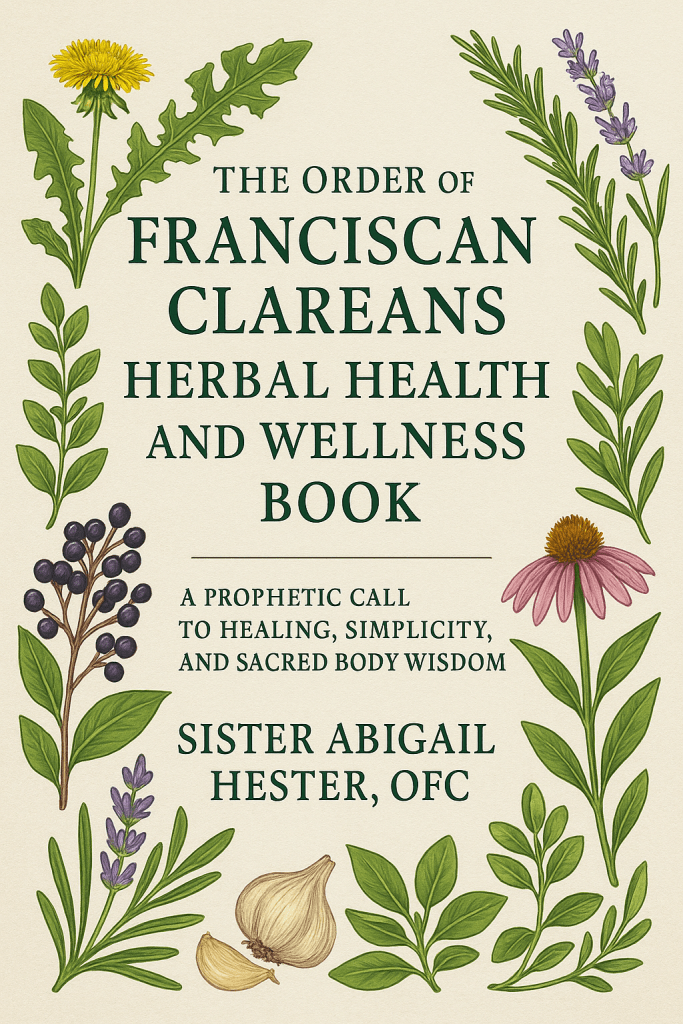
🌿 The Order of Franciscan Clareans Herbal Health and Wellness Book
A Prophetic Call to Healing, Simplicity, and Sacred Body Wisdom
Sister Abigail Hester, OFC
Copyright © 2025 by Sister Abigail Hester, OFC
All rights reserved.
Foreword
By Sister Abigail Hester, OFC
This book is a prayer made of leaves and roots.
It was not written in the ivory towers of academia, though it stands on the wisdom of many saints, healers, prophets, and heretics who dared to listen to the earth. It was composed in the garden, at the bedside, in the kitchen, and in the chapel of silence—where breath meets Spirit and the body learns to listen again.
This is a book for the sick and the tired. For the overworked mother and the aching elder. For the transgender teen whose hormones have been politicized. For the disabled visionary and the chronically ill prophet. For every one of us who has been told our bodies are broken, shameful, or too much. This book says what Jesus said: “Your body is holy. Your body is beloved. Rise and be healed.”
As a transgender Christian nun, I was told by the world that my body was wrong. I’ve had to unlearn that lie one herb, one walk, one tearful prayer at a time. My healing came slowly—through nettle tea and anointing oils, through communal meals and sacred stillness, through sweat and sunshine and letting the land love me back.
But let me be clear: this book is not just about self-care. It’s about sacred resistance. Because in a world that profits from our sickness and isolation, healing is a revolutionary act. Growing your own medicine is an act of defiance. Loving your queer, disabled, fat, brown, trans, aging, neurodivergent body is a threat to empire.
The Franciscan Clarean Way teaches us to walk lightly upon the earth, to love what is simple and small, and to see Christ in every living thing. St. Francis called the herbs his “little brothers” and St. Clare healed with both prayer and plants. We follow in their footsteps—not by retreating from the world, but by healing it from the roots up.
In these pages, you will find more than herbal remedies. You will find a vision of what health can be when it is liberated from capitalism, colonization, and toxic perfectionism. You will find a new monasticism of the body—where care is community, where food is sacrament, and where your healing matters because you matter.
Let the church be a garden again. Let the clinic be a circle of kin. Let the apothecary be a sanctuary. Let us anoint the sick, bless the soil, and stir the soup with our whole hearts.
Welcome to the Franciscan Clarean path of herbal healing. May it nourish you, liberate you, and return you to yourself.
Sister Abigail Hester, OFC
Introduction
The Body as Temple, the Earth as Healer
We live in a world where illness is profitable, rest is revolutionary, and the most basic forms of care—clean water, nourishing food, safe homes, herbal remedies, and touch—have been stolen from the people and sold back at a premium. In this world, choosing to love your body is not just self-help; it’s a form of holy rebellion.
This book was born out of rebellion and reverence. Rebellion against a culture that treats health like a luxury, not a human right. Reverence for the sacredness of the human body, the wisdom of the plant world, and the living traditions of those who have carried healing in their hands and hearts across generations.
I am Sister Abigail Hester, OFC. I am a transgender woman, a contemplative nun, a preacher, a healer, a lover of weeds, and a survivor of systems that tried to destroy my body and my spirit. I come to you not as a perfect person, but as a pilgrim—walking the Franciscan Clarean path toward wholeness and simplicity. Along that path, I’ve learned that God speaks through the dandelion breaking through concrete, through the simmering pot of nettle broth, through the deep ache in my own bones calling me to slow down and listen.
The Franciscan Clarean Way is rooted in the radical simplicity and earthbound spirituality of Saints Francis and Clare of Assisi. But it is also a living tradition, one that holds space for disabled mystics, queer saints, decolonial healers, and those who don’t always find themselves welcomed at the institutional altar. It is a tradition of kinship with all creation—and that kinship includes the herbs, the microbes, the sweat, and the scars.
This book is not just a guide to herbs, though you will find many here. It is a spiritual-political manifesto for healing in the ruins. A roadmap for reclaiming health from empire. A handbook for herbal resistance and community care. A love letter to bodies like yours and mine—bodies that are holy not despite our struggles, but through them.
You’ll learn about teas and tinctures, rest and movement, nourishment and nervous system repair. But you’ll also learn about resisting ableism, confronting medical injustice, healing in community, and practicing wellness outside of capitalist wellness culture. We’ll pray with mugwort. We’ll meditate with lemon balm. We’ll talk about mutual aid, disability justice, and herbal traditions from people and lands long marginalized.
This book is not about perfection. It is about connection. About remembering that we are not alone. About rediscovering the green threads of God’s grace, woven into every leaf, every breath, every heartbeat.
So come to this book as you are—sick or well, believer or doubter, herbalist or newbie, queer or questioning, burned out or just beginning. Bring your whole self. Your tears. Your hope. Your longing for a better way.
There is medicine here for you.
There is holy ground beneath your feet.
There is a community of weeds and saints and sacred rebels rising up.
And you—you belong among them.
Welcome to the Franciscan Clarean path of healing.
🌿 Part One
The Table of Success
The Foundation of Franciscan Clarean Health
The Table of Success is our holistic model for health and wellness—a sacred table with four sturdy legs:
- Motivation
- Fuel
- Exercise
- Rest & Stress Management
This isn’t a formula for a bikini body or a productivity hack. This is about healing as liberation. It’s about reclaiming our birthright to move, eat, rest, and live with dignity and joy. When one leg is missing, the table wobbles. When all four are honored, we sit in balance—grounded, nourished, and connected to the divine flow of life.
Inspired by my time as a certified nutritional consultant and Eat God’s Way coach, and shaped by Franciscan simplicity, queer embodiment, and liberation theology, this framework offers a healing path that centers justice, joy, and the sacred body.
Chapter 1: Motivation
Healing Begins with Love and Liberation
Before there is a meal, a movement, or a medicine—there must be a why.
In a culture obsessed with weight loss, youth, and aesthetics, most people are motivated by shame. But shame is not holy. It is a tool of empire. You cannot hate yourself into healing.
In the Franciscan Clarean Way, motivation comes from belovedness. You are worth healing because you are already sacred. You don’t need to earn your health. You are not a project. You are a miracle.
Our motivation is not to conform, but to be free. Free to breathe deeply. Free to walk or wheel through creation. Free to eat food that doesn’t poison you. Free to live in a body that feels safe enough to sing, pray, and rest. That freedom is the foundation of wellness.
We begin by asking:
What would it look like to befriend your body?
What would it mean to treat your healing as holy ground?
What if your health journey was not a solo race but a community pilgrimage?
In the Franciscan tradition, St. Francis stripped himself of all illusions—including the illusion of control. He embraced vulnerability, simplicity, and joy. His motivation was love—love for God, love for the poor, love for the sparrow and the sun.
Today, our motivation must also be rooted in justice. We heal not only for ourselves, but for our communities. For the earth. For those who cannot access what they need. When we pursue health in a way that centers liberation, we join a revolution of tenderness.
💬 Reflection Prompt:
What motivates you to pursue health? What stories or beliefs need to be unlearned so you can love your body as God does?
🛐 Healing Prayer:
God of compassion, help me to begin with love. Strip away my fear. Release me from shame. Ground me in the truth that I am worthy of healing—not because I am perfect, but because I am yours. Amen.
Chapter 2: Fuel
God’s Garden as Our Pharmacy and Table
The second leg of the Table of Success is Fuel—what we put into our bodies as nourishment, medicine, and sacrament.
In the beginning, God planted a garden. Not a factory. Not a fast food chain. A garden. The story of Eden is not just mythology—it is a memory in our bones. A memory of being fed by the Earth in relationship, not domination.
Today, that memory has been buried beneath pesticides, processed foods, diet culture, and monoculture farming. Our fuel has become commodified. Our hunger exploited. Our food systems shaped by racism, classism, and colonization.
But the Franciscan Clarean Way calls us back to the soil. To holy eating. To remembering that food is both sacred gift and revolutionary tool.
🍞 The Table as Altar
Every meal is a liturgy. Every bite is a chance to say yes to life.
St. Clare, confined to bed in her later years, turned meals into moments of communion. She would fast, pray, and eat only what was needed to sustain her spirit. Not out of punishment—but out of profound simplicity.
In our tradition, we don’t fast to suffer. We fast to remember. To unclutter our cravings. To reconnect with the Source of all sustenance. But we also feast—with laughter, with herbs, with wild abundance. Both fasting and feasting can be acts of worship.
Food is fuel, yes. But it is also medicine, resistance, and love.
🌿 Fueling with Wisdom: Principles from the Earth
Drawing on the wisdom of traditional foodways, herbal medicine, and holistic nutrition, we seek fuel that is:
Whole – unprocessed, nutrient-dense, alive
Local – in harmony with seasons and ecosystems
Accessible – rooted in community, not capitalism
Honoring – of body diversity, ancestral diets, and cultural sovereignty
We embrace the teachings of:
Dr. Weston A. Price, who studied traditional diets and the impact of industrialized food
Paul Bragg, who championed fasting and clean eating as natural healing
Dr. John R. Christopher, whose herbal protocols restored health through simple means
Hildegard of Bingen, who connected foods to the balance of body and soul
Robin Wall Kimmerer, who reminds us that the Earth loves us back through the foods it gives
🍲 Fuel Justice Is Health Justice
Let’s be clear: this isn’t about kale smoothies for the privileged. This is about dismantling food apartheid, about challenging the systems that leave Black, Brown, Indigenous, poor, disabled, and queer communities malnourished.
It’s about:
Community gardens over corporate farms
Herbal teas over pharmaceutical dependency
Shared meals over loneliness
Spiritual kitchens over sterile clinics
When we reclaim fuel as sacred, we don’t just feed our bodies—we feed the revolution.
💬 Reflection Prompt:
What fuels your body—and your soul? What changes, small or large, could move your eating toward healing and justice?
🛐 Blessing for the Table:
O Divine Gardener, bless this food. Bless the hands that grew it. Bless the soil, the sun, the rain. May every bite be medicine. May every meal be holy. Feed us with what is good. Teach us to share. Heal us through your harvest. Amen.
motion.
A practice of grounding—to come home to your limbs, joints, heartbeat, and holy flesh.
The body is not your enemy. It is your sanctuary. And when we move—whether through stretching, gardening, walking, swimming, dancing, wheeling, or swaying—we honor the temple God has made of our flesh.
🧠 The Neurobiology of Sacred Movement
Modern science affirms what mystics and healers have always known: movement heals. It activates:
The vagus nerve, regulating the nervous system
The release of endorphins and dopamine, lifting mood and easing pain
The body’s ability to process trauma, grief, and stress somatically
People like Bessel van der Kolk (The Body Keeps the Score), Peter Levine, and Resmaa Menakem remind us that trauma lives in the body—and so does healing. Gentle, rhythmic movement reclaims space once occupied by tension, fear, or freeze.
🚶 Movement for Every Body
We reject ableist narratives that equate health with athleticism. You don’t need to run marathons. You don’t need to climb mountains. Holy movement may look like:
Rocking in a chair
Stretching with intention
Water therapy
Adaptive dance
Sitting in stillness with breath
It may also look like rest, especially for chronically ill and disabled beloveds. Rest is a valid and revolutionary form of movement—a way the body moves toward healing.
⚡ Justice in Motion
In a society that separates people from land, nature, and their own bodies, movement becomes political. Dancing is resistance. Rest is protest. Touch is communion. Walking in protest is prayer with your feet. Tending your garden is revolution.
When we move with sacred intention, we embody a counter-narrative: my body is not shameful—it is sacred. We move toward God, toward liberation, and toward one another.
💬 Reflection Prompt:
What forms of movement bring you joy? How can you reclaim movement as prayer rather than punishment?
🛐 Prayer for Movement:
God of rhythm and breath, awaken my limbs, soften my joints, stir my spirit. Let every stretch be praise, every step be prayer. Whether I dance or lie still, let me move with love and purpose. Amen.
Chapter 4: Rest & Stress Management
Sabbath, Stillness, and the Spirit
The fourth and final leg of the Table of Success is Rest and Stress Management—perhaps the most overlooked and most urgently needed form of healing in a world addicted to busyness and burnout.
We live in a culture that worships productivity, idolizes hustle, and pathologizes rest. But the Franciscan Clarean Way tells a different story.
In our tradition, rest is not laziness—it is liturgy. It is sacred, revolutionary, and deeply embodied. It is how we make room for God.
🌙 Sabbath as Liberation
God rested. So should we.
The biblical Sabbath was not just a spiritual idea—it was a political act. A day when slaves rested. A day when land lay fallow. A day when debt was paused. It was a refusal to participate in the machinery of empire.
Today, we are still called to Sabbath. Not merely once a week, but as a rhythm of resistance. Rest is how we remember we are not machines. We are beloved children of God—not human resources, not productivity units.
As Sister Thea Bowman once said, “God didn’t make no junk.” Your need for sleep, softness, and stillness is not a flaw. It is sacred design.
🌾 The Spiritual Ecology of Rest
Rest is not just about sleep. It includes:
Stillness – moments of prayerful pause
Reverence – long baths, slow walks, lying under the stars
Release – letting go of guilt for being human
Reconnection – syncing with natural rhythms, lunar cycles, seasons
In the garden, winter is not failure—it’s preparation. So too with our bodies. Periods of rest are when our nervous systems recalibrate, our tissues repair, and our spirits hear God whisper again.
🔥 The Toll of Stress—and the Promise of Stillness
Chronic stress is not just emotional. It is biological violence. It floods the body with cortisol, wears down the immune system, disrupts sleep, digestion, and mood.
In marginalized communities—especially among Black, brown, disabled, poor, and queer people—stress is compounded by racism, homophobia, transphobia, poverty, ableism, and systemic violence.
Healing from stress is not a luxury. It is soul survival.
Herbs like lemon balm, ashwagandha, passionflower, and skullcap can support our stress responses. So can practices like deep breathing, prayer, movement, laughter, ritual, and community care.
🙏 The Contemplative Heart of Franciscan Healing
St. Clare often lay in stillness for hours, gazing upon the face of Christ in a simple monstrance. She practiced a contemplative stillness that transcended the chaos around her. Even in sickness and struggle, she found rest in Presence.
We, too, are invited to find God not in the noise, but in the silence. Not in the striving, but in the surrender. Rest is how we re-member our wholeness.
💬 Reflection Prompt:
What does rest look like in your life—and what obstacles stand in the way? What might a Sabbath rhythm look like for you?
🛐 Prayer for Rest:
Holy Spirit of Stillness, slow my breath. Quiet my fears. Anoint my sleep with peace. Let me lie down and remember I am not what I produce—I am who You love. May my rest be an act of resistance and renewal. Amen.
🌿 Part Two
God’s Green Medicine Cabinet
Herbal Healing the Franciscan Clarean Way
The earth is not silent. She sings with healing.
From the cracks in the sidewalk to the shaded forest floor, the world is teeming with medicine—unpatented, unrefined, and unapologetically wild. Long before there were pharmaceuticals and clinical trials, there were plants—shared by midwives, mystics, grandmothers, monks, and medicine people.
This section of the book is an invitation to remember what the body already knows: that God’s garden is still open, and the herbs are still healing.
🌱 Why Herbs? Why Now?
Herbs are:
Accessible – They grow in yards, cracks, forests, and balconies.
Decolonial – Herbal traditions are rooted in Indigenous, African, and ancestral knowledge systems.
Economical – They offer healing outside of profit-driven systems.
Spiritual – They call us to slow down, listen, and participate in creation’s sacred rhythm.
In the Franciscan Clarean Way, herbs are not just supplements. They are siblings. Brother Dandelion. Sister Chamomile. They are teachers, companions, and sacraments of divine care.
🍵 What You’ll Find in Each Chapter
Each chapter in this section will feature:
A theological reflection or spiritual meditation
Herbal profiles with traditional uses, energetics, preparations, and safety notes
A few recipes or remedies for teas, salves, tinctures, or foods
Justice reflections on who has access to healing and why it matters
A blessing or prayer to honor the herb and its role in creation
These are not exhaustive materia medica entries. They are Franciscan herbal reflections—rooted in Spirit, soil, and sacred community.
🧑🌾 Herbal Safety and Respect
This book does not replace medical advice. Herbs can interact with medications and have contraindications. Always consult a knowledgeable herbalist or health practitioner, especially if pregnant, nursing, or managing chronic illness.
Just as importantly: honor the plants. Do not overharvest. Learn their names. Grow them when you can. Offer thanks. Healing is a relationship.
Ready? Let’s walk barefoot into the garden and meet our first green companions.
Chapter 5: Weeds of the Resurrection
Dandelion, Plantain, and Chickweed
They call them weeds.
They spray them, curse them, and rip them from the soil as if they don’t belong. But like so many of us—queer, disabled, trans, poor, brown, fat, neurodivergent—these plants persist. They break through concrete. They return with the rains. They flourish where they are not wanted.
These are resurrection herbs.
They are the outcasts of the plant world—and they are full of healing. They teach us how to live in a world that tries to erase us: with resilience, with softness, and with deep roots.
Let us meet them.
🌼 Dandelion (Taraxacum officinale)
The Bold and Bitter Prophet
Dandelion is often the first flower a child picks—and the first “weed” a gardener tries to kill. But this golden sunburst of a plant is one of the most powerful detoxifiers and healers in all creation.
Energetics: Bitter, cooling, drying
Parts used: Root (detoxifying), Leaf (diuretic), Flower (anti-inflammatory)
Supports: Liver, digestion, skin, kidneys, hormonal balance
Preparation: Roast the root for tea; eat young leaves in salad; infuse flowers in oil
Franciscan Reflection: Like John the Baptist, dandelion prepares the way. Its bitterness clears the clutter. It reminds us that healing isn’t always sweet—it’s honest.
Justice Note: Many cities criminalize dandelions in their war against “weeds.” This mirrors how society criminalizes people who don’t conform. But dandelion thrives regardless. It’s a weed—and a warrior.
Blessing:
Dandelion, prophet of pavement,
You bloom in broken places.
Clear my system.
Cleanse my soul.
Teach me to grow where I’m not wanted.
Amen.
🍃 Plantain (Plantago major / lanceolata)
The Healer of Wounds and Words
Low to the ground, broad-leafed, and humble, plantain is found on sidewalks, lawns, and trails. Wherever people walk, plantain grows. And wherever there are wounds, it offers healing.
Energetics: Cooling, moistening
Parts used: Leaf, seed (psyllium)
Supports: Skin, digestion, respiratory tract, inflammation
Preparation: Chew fresh leaf for bug bites; steep in oil for salves; drink as tea for gut healing
Franciscan Reflection: Plantain is a living act of reparative grace. Trampled, it does not wither—it offers healing instead. The more it’s stepped on, the stronger it grows.
Justice Note: Often overlooked, plantain is a teacher in mutual aid. It doesn’t need recognition—it simply heals.
Blessing:
Plantain, balm of the margins,
You cover our wounds with quiet power.
Heal what has been stepped on.
Soften what has been hardened.
Amen.
🌱 Chickweed (Stellaria media)
The Soft Whisper of Spring
Delicate and cooling, chickweed appears as winter retreats. It speaks in softness and soothes inflammation of both body and heart. It is rich in minerals and offers nourishment where there has been depletion.
Energetics: Cooling, moistening, nourishing
Parts used: Aerial parts
Supports: Skin, joints, digestion, inflammation, lymphatic system
Preparation: Blend into pesto; infuse in vinegar; use in salves and compresses
Franciscan Reflection: Chickweed is the Holy Spirit of the herb world—gentle, often missed, but quietly transformative.
Justice Note: Like queer tenderness, chickweed is overlooked in a world that worships strength. But it is in softness that real healing begins.
Blessing:
Chickweed, whisper of mercy,
You cradle the weary and feed the depleted.
Teach me the medicine of gentleness.
Show me how to heal without harm.
Amen.
💬 Reflection Prompt:
Which of these “weeds” reminds you of your own story? Where have you bloomed against the odds?
🛐 Herbal Prayer for the Outcasts:
God of the wild things, bless the weeds.
Bless the bitter ones, the trampled ones, the soft ones.
Let their healing rise in our bodies.
Let their resilience rise in our spirits.
Make us like them—grounded, generous, unstoppable.
Amen.
Chapter 6: Holy Womb Healing
Red Raspberry, Motherwort, and Mugwort
The womb—literal or metaphorical—is a sacred center of creativity, power, and life. But in a patriarchal world, the womb and everything associated with it has been shamed, controlled, politicized, and silenced.
This chapter is for those who bleed, those who have been wounded by reproductive violence, those who are gender-expansive, post-menopausal, or post-partum. It is for trans women and transfeminine folks reconnecting to body wisdom. It is for anyone who has held trauma, dreams, or divinity in their pelvic bowl.
Womb healing is not just physical—it is spiritual and political. And these herbs are midwives of that holy work.
🍓 Red Raspberry Leaf (Rubus idaeus)
The Steady Mother
Known for its toning and supportive effects on the uterus, red raspberry leaf is a gentle, steady ally for people across the spectrum of reproductive health. It builds strength and nourishes deeply.
Energetics: Cooling, drying, toning
Parts used: Leaf
Supports: Uterine tone, menstruation, fertility, postpartum healing, general pelvic strength
Preparation: Steep as an infusion; combine with nettle and oatstraw for mineral-rich tea
Franciscan Reflection: Like Clare of Assisi, raspberry is both fierce and gentle—holding space for transformation without forcing it. It brings balance through grounded presence.
Justice Note: Access to reproductive herbs is under attack. Red raspberry reminds us that herbalism is part of reproductive justice—a sacred right to body autonomy and care.
Blessing:
Raspberry, holy leaf of strength,
Tone what is tender.
Steady what is shifting.
Be the matriarch in my garden of healing.
Amen.
💚 Motherwort (Leonurus cardiaca)
The Fierce Comforter
With its Latin name meaning “lion-hearted,” motherwort is both protector and comforter. Known as an herb for both womb and heart, it is especially helpful during anxiety, menopause, and emotional overwhelm.
Energetics: Bitter, cooling, relaxing
Parts used: Aerial parts (flowering tops)
Supports: Menstrual cramps, menopausal transition, anxiety, heart palpitations
Preparation: Tincture is best; can also be steeped in tea (very bitter!)
Franciscan Reflection: Motherwort is like a prophet—bitter, direct, and full of love. It does not coddle, but it shows up when everything is falling apart.
Justice Note: Often used by midwives and radical birth workers, motherwort has a long history in community-based care. It is an herbal embodiment of mutual aid.
Blessing:
Motherwort, lion-hearted one,
Guard my womb.
Calm my heart.
Let your bitterness birth boldness in me.
Amen.
🌒 Mugwort (Artemisia vulgaris)
The Dreaming Witch
Mugwort is the herb of dreams, blood, and thresholds. Used for menstrual regulation, spiritual protection, and dreamwork, this herb calls us to remember our power. It’s long been a favorite of mystics and witches.
Energetics: Aromatic, warming, stimulating
Parts used: Leaf
Supports: Menstruation, stagnation, vivid dreaming, spiritual clarity
Preparation: Burn as smudge, steep in tea (lightly), add to ritual baths
Franciscan Reflection: Mugwort is the spiritual midwife, guiding us across thresholds—of body, of time, of soul. She whispers when we are ready to shed, bleed, release, or rise.
Justice Note: Mugwort has been used by Indigenous and diasporic healers across centuries. Reclaiming mugwort is an act of honoring ancestral knowledge and resisting spiritual colonization.
Blessing:
Mugwort, dreamkeeper and womb-whisperer,
Walk with me through the veil.
Stir my blood.
Open my vision.
Make holy this body-temple.
Amen.
💬 Reflection Prompt:
What have you been taught about your womb, your blood, your body? What stories need to be unlearned—and what new truths need to rise?
🛐 Prayer for Wombed and Wounded Bodies:
God of blood and birth,
Anoint the wombed ones.
Bless those who bleed and those who mourn the bleeding.
Restore the sacredness of our centers.
Let no law, shame, or fear steal what is holy.
May these herbs remind us:
We are powerful, sacred, and already whole.
Amen.
Chapter 7: Justice for the Nervous System
Lavender, Lemon Balm, and Skullcap
In a world wired for fear, the nervous system is in crisis.
We are overstimulated, under-touched, and spiritually malnourished. The chronic stress of living under capitalism, white supremacy, ableism, and cisheteropatriarchy—especially for Black, brown, queer, disabled, and trans folks—has created what some call collective trauma fatigue.
This chapter is a love letter to your nervous system.
And these herbs are its advocates, defenders, and friends.
💜 Lavender (Lavandula spp.)
The Sacred Soother
Lavender is more than a pretty scent. It is a powerhouse of calm—soothing to nerves, digestion, inflammation, and spirit. It speaks the language of stillness.
Energetics: Cooling, relaxing, slightly drying
Parts used: Flowering tops
Supports: Anxiety, tension, digestive upset, sleep, skin irritation
Preparation: Infuse in oil, steep as tea, add to bath, use essential oil (diluted)
Franciscan Reflection: Lavender is the Brother Leo of the garden—gentle, dependable, bringing peace to wild hearts. It does not shout—it calms the storm.
Justice Note: In a world that punishes softness, lavender teaches us that gentleness is power. To calm the body is a political act of refusal.
Blessing:
Lavender, breath of peace,
Exhale the worry I cannot name.
Wrap me in calm.
Soothe the fire inside.
Let me rest in your quiet.
Amen.
🌿 Lemon Balm (Melissa officinalis)
The Heart’s Ally
Lemon balm is a bright, lemon-scented herb that uplifts the mood, cools the nerves, and eases emotional overwhelm. It brings light to dark places.
Energetics: Cooling, calming, uplifting
Parts used: Leaf
Supports: Anxiety, depression, grief, sleep, digestion, viral conditions
Preparation: Fresh or dried tea, glycerite tincture, infused honey
Franciscan Reflection: Lemon balm is the joy of Francis—the song that bursts out of sorrow, the bird that sings in exile. It teaches us how to feel deeply without drowning.
Justice Note: Access to joy is a justice issue. Lemon balm helps lift the fog of despair, especially for those navigating trauma and burnout.
Blessing:
Lemon balm, heartlight herb,
Break the heaviness around my chest.
Bring brightness to this soul-weary day.
Remind me that joy is a birthright, not a luxury.
Amen.
💙 Skullcap (Scutellaria lateriflora)
The Protector of the Overwhelmed
Skullcap is a powerful nervine for when the system is fried. It doesn’t sedate—it grounds. It is especially helpful for trauma survivors, those with racing thoughts, and nervous exhaustion.
Energetics: Cooling, relaxing, mildly bitter
Parts used: Aerial parts
Supports: Nervous system recovery, trauma response, muscle tension, insomnia
Preparation: Tincture (most effective), tea (bitter), combine with oatstraw
Franciscan Reflection: Skullcap is the fortified wall of peace. It doesn’t whisper—it stands guard. It is for the overextended, the frayed, the ones too tired to ask for help.
Justice Note: Many herbalists refer to skullcap as a “trauma tonic.” It’s a reminder that healing from oppression is not just emotional—it’s neurological.
Blessing:
Skullcap, quiet sentinel,
Guard my nerves.
Anchor my thoughts.
Help me feel safe enough to soften.
Wrap my mind in sanctuary.
Amen.
💬 Reflection Prompt:
How does your nervous system speak to you? What messages of rest, protection, or peace does it long to receive?
🛐 Prayer for the Frazzled and Fried:
God of shalom and shelter,
My system is on edge.
My heart is tired.
Wrap me in your mercy.
Let lavender still me,
Let lemon balm lift me,
Let skullcap shield me.
Let my nervous system remember:
It is safe to rest.
Amen.
Chapter 8: Sacred Immunity
Elderberry, Garlic, and Echinacea
Immunity is more than a biological function. It is a spiritual and political act of self-defense in a world that profits from our exhaustion.
To have a strong immune system is to have boundaries. To know when to say no. To resist infection—not just from viruses, but from despair, hatred, and empire.
These three herbs—elderberry, garlic, and echinacea—are guardians of the body. They don’t just fight illness. They fortify us to live boldly.
🫐 Elderberry (Sambucus nigra)
The Cloak of Protection
Elderberry is a beloved immune ally used for centuries across Indigenous, European, and African herbal traditions. Rich in antioxidants, it offers protection from viruses and supports the body’s natural defenses.
Energetics: Cooling, drying
Parts used: Berry (cooked), flower
Supports: Immunity, colds, flu, respiratory infection, inflammation
Preparation: Syrup (most common), tincture, tea from flowers, elderberry oxymel
Franciscan Reflection: Elderberry is the Franciscan cloak—offering warmth, safety, and protection. It reminds us that healing is both defense and embrace.
Justice Note: Elderberry has become commercialized and overpriced. But making your own syrup is an act of healing sovereignty—a return to community herbal knowledge.
Blessing:
Elderberry, dark sweetness,
Wrap me in your rich defense.
Let no illness pass this sacred threshold.
May your purple strength remind me:
I am worth protecting.
Amen.
🧄 Garlic (Allium sativum)
The Warrior Root
Garlic is bold, unapologetic, and ancient. It is antimicrobial, antifungal, antiviral, and fiercely cleansing. Garlic teaches us to stand our ground with strength and pungent truth.
Energetics: Warming, drying, stimulating
Parts used: Bulb
Supports: Immunity, blood pressure, infections, cardiovascular health
Preparation: Fresh is best—chop and let sit before cooking; infuse in honey, oil, or vinegar
Franciscan Reflection: Garlic is the street preacher of the garden. Loud, powerful, and rooted in wisdom. It clears what is toxic—inside and out.
Justice Note: Garlic has been used for centuries in folk healing, especially by poor and working-class communities. It is the medicine of the people.
Blessing:
Garlic, warrior of the kitchen,
Cleanse my blood.
Burn away the lies.
Let my breath speak truth,
And my body know strength.
Amen.
🌸 Echinacea (Echinacea purpurea)
The Bright Defender
With its purple petals and spiky center, echinacea is a vibrant immune stimulant. It is best used at the onset of illness or for short-term activation of the body’s response.
Energetics: Cooling, stimulating
Parts used: Root, aerial parts
Supports: Immunity, infections, inflammation, lymphatic system
Preparation: Tincture, decoction, capsules (short-term use recommended)
Franciscan Reflection: Echinacea is the early riser—the bold first responder of the immune system. It reminds us to be proactive, not just reactive.
Justice Note: Overharvesting has endangered wild echinacea. Ethical sourcing and home growing are acts of ecological stewardship and Franciscan love for creation.
Blessing:
Echinacea, fierce flower,
Wake up my defenses.
Teach me to respond with clarity and courage.
Let my body rise,
Rooted and ready.
Amen.
💬 Reflection Prompt:
What boundaries—physical, spiritual, emotional—need fortifying in your life right now? How do you nourish your immune system beyond just supplements?
🛐 Prayer for Protection and Defense:
God of holy borders,
Build my immunity with wisdom.
Guard my body with elderberry,
My spirit with garlic,
My soul with echinacea.
Let me be well—not just for myself,
But for those I serve and love.
Amen.
Chapter 9: Digestive Liberation
Ginger, Peppermint, and Fennel
The gut is our second brain—a place of intuition, absorption, and holy discernment. But for many of us, digestion has been disrupted by trauma, processed foods, shame, medications, and systemic injustice.
In the Franciscan Clarean Way, digestive healing is more than nutritional—it is liberation. It is about reclaiming the sacred relationship between the body and nourishment.
These herbs—ginger, peppermint, and fennel—are old friends. They help us digest more than food: they help us process life itself.
🌶️ Ginger (Zingiber officinale)
The Firestarter
Ginger is warmth, circulation, and activation. It moves what is stuck—be it gas, grief, or injustice. It is an ancient ally used across cultures to restore fire to cold systems.
Energetics: Warming, stimulating, drying
Parts used: Root
Supports: Nausea, sluggish digestion, cold extremities, inflammation, pain
Preparation: Fresh tea, tincture, infused honey, in food, compress
Franciscan Reflection: Ginger is the friar with a flame in his heart. It reminds us to burn away what no longer serves, and to do so with joy and zest.
Justice Note: Ginger has deep roots in South Asian, African, and Caribbean traditions. To honor ginger is to honor global herbalism and its anti-colonial legacy.
Blessing:
Ginger, sacred fire,
Light the hearth of my belly.
Burn through stagnation.
Warm my center with clarity and courage.
Let me digest life with boldness.
Amen.
🌿 Peppermint (Mentha × piperita)
The Cooling Clarifier
Peppermint is the herbal exhale. It soothes the gut, opens the breath, and sharpens the mind. It is one of the most universally beloved digestive herbs—cool, bright, and clarifying.
Energetics: Cooling, drying
Parts used: Leaf
Supports: Bloating, nausea, indigestion, tension headaches, respiratory function
Preparation: Tea, essential oil (diluted), tincture, culinary use
Franciscan Reflection: Peppermint is the clarifying wind—cutting through fog with honesty and freshness. It helps us speak truth and digest complexity.
Justice Note: In a world of overwhelm, peppermint brings mental clarity and sensory release. It helps the nervous gut settle, especially in anxiety-prone people.
Blessing:
Peppermint, breath of clarity,
Cool my heat, calm my gut,
Sharpen my focus,
And help me speak what must be said.
Amen.
🌰 Fennel (Foeniculum vulgare)
The Sweet Soother
Fennel is a gentle carminative—soothing gas, bloating, and cramping. It’s sweet, nurturing, and especially supportive for children and postpartum folk. It brings sweetness without stickiness.
Energetics: Warming, sweet, relaxing
Parts used: Seed (most common), leaf, bulb
Supports: Gas, infant colic, digestion, lactation, menstrual cramps
Preparation: Tea (from seeds), roasted seeds, added to food, infused in honey
Franciscan Reflection: Fennel is the comforting elder—sweet, warm, and always ready to listen. It holds space for the hard-to-digest moments of life.
Justice Note: In a culture that demonizes sweetness and softness, fennel reclaims both as sacred. It is tenderness without apology.
Blessing:
Fennel, sweet comfort,
Cradle my belly in your warmth.
Ease the gas and grief alike.
Let your gentleness teach me
That softness is strength.
Amen.
💬 Reflection Prompt:
How does your gut speak to you? What emotions or injustices have you held in your belly? What would it mean to digest your life with more compassion?
🛐 Prayer for Digestive Liberation:
God of gut and grace,
Help me digest what I’ve been fed—by society, by shame, by fear.
May ginger fire me up,
May peppermint clear my head,
May fennel soothe my grief.
Let me eat with joy,
Digest with ease,
And be fed by love.
Amen.
Chapter 10: Breath of the Spirit
Mullein, Thyme, and Elecampane
Breath is sacred.
In Hebrew, the word for Spirit—ruach—also means breath or wind. To breathe is to receive God’s presence. To exhale is to release what the body no longer needs. And yet, in a world of pollution, trauma, and oppression, breathing fully is a privilege denied to many.
This chapter honors the lungs as both biological and spiritual centers. These herbs—mullein, thyme, and elecampane—support respiration, grief release, and holy inhalation. They remind us that healing is in the breath.
🌿 Mullein (Verbascum thapsus)
The Lung Guardian
Mullein grows tall and soft, with fuzzy leaves that resemble lungs. It soothes respiratory tissues and gently encourages expectoration. This herb is especially supportive for chronic coughs, smokers, and asthmatics.
Energetics: Cooling, moistening
Parts used: Leaf, flower, root
Supports: Cough, lung congestion, asthma, smoke exposure
Preparation: Tea (strain well), tincture, smoke blend, infused oil for earaches
Franciscan Reflection: Mullein is the gentle protector—the Brother Juniper of the respiratory system. It says: “Breathe deep. You are safe here.”
Justice Note: Clean air is a justice issue. Mullein grows in disturbed soils and offers healing where industrial systems have failed us.
Blessing:
Mullein, leaf of breath,
Open my lungs to possibility.
Soothe what is raw.
Help me trust the sacred inhale again.
Amen.
🌿 Thyme (Thymus vulgaris)
The Antiseptic Prophet
Thyme is sharp, antimicrobial, and clarifying. Used for centuries as a remedy for lung and throat infections, it is also spiritually protective—an herb of boundaries and courage.
Energetics: Warming, drying, aromatic
Parts used: Leaf, flower
Supports: Cough, sore throat, colds, digestive infections, immunity
Preparation: Tea, syrup, steam inhalation, infused honey, food spice
Franciscan Reflection: Thyme is the prophet at the gate. It clears the space and prepares the way. It says what needs to be said—boldly, bravely, unmistakably.
Justice Note: Thyme was used in ancient plagues, WWI hospitals, and peasant kitchens. It reminds us that medicine has always belonged to the people.
Blessing:
Thyme, holy fire of the garden,
Burn away infection and fear.
Clear my chest,
Clear my spirit,
Make me ready to speak truth again.
Amen.
🌼 Elecampane (Inula helenium)
The Root of Grief Release
Elecampane is a deep, aromatic root that clears mucus and strengthens the lungs. But beyond the physical, it is an herb for grief—for the sighs too deep for words.
Energetics: Warming, drying, stimulating
Parts used: Root
Supports: Bronchial issues, deep lung infection, digestive stagnation, emotional grief
Preparation: Tincture, decoction, syrup
Franciscan Reflection: Elecampane is the weeping prophet—the Jeremiah of herbs. It sits with our sorrow, and helps us exhale it.
Justice Note: Breath has been weaponized—through air pollution, through chokeholds, through viruses. Elecampane stands with the grieving and says: you may breathe again.
Blessing:
Elecampane, grief-root,
Dig deep in my chest.
Pull up what I cannot cry.
Make room for breath,
Room for life,
Room for resurrection.
Amen.
💬 Reflection Prompt:
How is your breath today—shallow or full, anxious or steady? What would it take to reclaim the fullness of your own inhale?
🛐 Prayer for Breath and Spirit:
Spirit of Life,
Breathe through me.
Clear my lungs with mullein,
Defend me with thyme,
Release my grief with elecampane.
Let each breath be prayer.
Let each breath be healing.
Let me breathe like someone who is free.
Amen.
🔥 Part ThreeHealing as ResistanceHealth in the Age of EmpireIn the empire, health is a commodity. It’s branded, sold, and withheld. Wellness is marketed as luxury. Herbalism is whitewashed. And care—true, embodied, relational care—is replaced with control, shame, and surveillance.But in the Franciscan Clarean Way, healing is not separate from justice. To heal our bodies is to confront the systems that harm them. To care for ourselves is not to escape the world, but to transform it from the roots.This part of the book is a fire lit beneath the apothecary. A rallying cry for sacred resistance. A theological and political manifesto for body liberation, healing justice, and community care.—📖 What You’ll Find in Part ThreeEach chapter will include:A reflection on systems of harm (medical racism, food apartheid, fatphobia, ableism, environmental injustice, etc.)Prophetic critiques rooted in liberation theology and decolonial spiritualityReal-life examples of resistance, resilience, and mutual aidPractices for building collective healing and reimagining carePrayers and blessings to sustain the soul in struggleWe will say the hard truths. We will name the powers. And we will declare: Healing belongs to the people.—💬 Franciscan Clarean ViewpointSaint Francis resisted the wealth, power, and cruelty of his time by living close to the poor, embracing the leper, and walking barefoot through the empire. Saint Clare held her ground when patriarchal forces tried to steal her freedom, her calling, and her sacred authority.This is our lineage.We do not separate health from holiness.We do not pursue purity—we pursue wholeness.We do not escape empire—we cast it out.—If the world has made you feel too sick to fight—this part is for you.If the church has told you healing only comes through suffering—this part is for you.If you’re ready to turn herbalism into activism, wellness into revolution—this part is for you.Let’s begin.
🔥 Part Three
Healing as Resistance
Health in the Age of Empire
In the empire, health is a commodity. It’s branded, sold, and withheld. Wellness is marketed as luxury. Herbalism is whitewashed. And care—true, embodied, relational care—is replaced with control, shame, and surveillance.
But in the Franciscan Clarean Way, healing is not separate from justice. To heal our bodies is to confront the systems that harm them. To care for ourselves is not to escape the world, but to transform it from the roots.
This part of the book is a fire lit beneath the apothecary. A rallying cry for sacred resistance. A theological and political manifesto for body liberation, healing justice, and community care.
📖 What You’ll Find in Part Three
Each chapter will include:
A reflection on systems of harm (medical racism, food apartheid, fatphobia, ableism, environmental injustice, etc.)
Prophetic critiques rooted in liberation theology and decolonial spirituality
Real-life examples of resistance, resilience, and mutual aid
Practices for building collective healing and reimagining care
Prayers and blessings to sustain the soul in struggle
We will say the hard truths. We will name the powers. And we will declare: Healing belongs to the people.
💬 Franciscan Clarean Viewpoint
Saint Francis resisted the wealth, power, and cruelty of his time by living close to the poor, embracing the leper, and walking barefoot through the empire. Saint Clare held her ground when patriarchal forces tried to steal her freedom, her calling, and her sacred authority.
This is our lineage.
We do not separate health from holiness.
We do not pursue purity—we pursue wholeness.
We do not escape empire—we cast it out.
If the world has made you feel too sick to fight—this part is for you.
If the church has told you healing only comes through suffering—this part is for you.
If you’re ready to turn herbalism into activism, wellness into revolution—this part is for you.
Let’s begin.
Chapter 11: Why the Wellness Industry Is Not Well
Exposing the Commodification of Healing
Walk into a high-end wellness store in any major city, and you’ll see essential oils priced like fine wine, yoga mats selling for $150, “detox” powders made by corporations with billion-dollar budgets, and an overwhelming air of elitism disguised as enlightenment.
This is not healing. This is capitalism in a greenwashed robe.
💰 When Wellness Becomes a Brand
What began as ancient, earth-based traditions rooted in Indigenous, poor, and working-class communities has been repackaged into a product for the wealthy. The modern wellness industry:
Co-opts herbalism, yoga, and folk medicine
Erases Black, Indigenous, and immigrant roots
Promotes unattainable beauty standards
Sells “purity” instead of wholeness
Prioritizes thinness, whiteness, and wealth
This is not the wellness Jesus practiced.
This is empire dressed in organic cotton.
🛐 The False Gospel of Self-Optimization
In this system, your body is never good enough. There’s always another product, another protocol, another “fix.” The language of wellness begins to mirror that of sin and salvation:
“Toxic” becomes original sin
“Clean eating” becomes righteousness
“Cheat days” become moral failure
“Biohacking” replaces spiritual discipline
But the Franciscan Clarean Way says: you are already sacred.
Healing is not about perfection. It’s about belonging.
🌱 Reclaiming Herbalism from Capitalism
Before there were supplements and influencers, there were:
Grandmothers with kitchen tinctures
Street medics with poultices
Community herbalists growing dandelion and nettle
Refugees carrying seeds and plant stories
Monks and nuns tending healing gardens
Herbalism is not a product. It is a relationship.
To reclaim it:
Grow your own when you can
Support BIPOC and queer herbalists
Learn ancestral practices
Share herbs freely within your community
Resist the gatekeeping of “certification” over lived wisdom
🕊️ Franciscan Resistance to Luxury Healing
St. Francis healed through presence, not profit.
St. Clare ministered to the sick with her hands, her tears, her prayers.
They never sold salvation. They never charged for compassion.
We follow them by:
Offering care without condition
Practicing mutual aid medicine
Rejecting the glamorization of scarcity
Centering those most harmed by empire
💬 Reflection Prompt:
Where have you felt excluded or shamed by the wellness industry? What does true healing look like for you—outside of consumerism?
🛐 Prayer of Herbal Resistance:
Jesus, healer of the poor,
Protect us from the polished poison of profit-driven wellness.
Strip away every lie that says we must buy our way to wholeness.
Anoint our hands to heal.
Bless our gardens.
Let healing rise from the cracks—not the catalogs.
Amen.
Chapter 12: Decolonizing Our Bodies and Our Medicine
Reclaiming Ancestral Wisdom and Embodied Liberation
Colonization didn’t just take land.
It took language, ritual, story, and healing.
It declared certain bodies dirty.
Certain plants demonic.
Certain ways of knowing unscientific.
Decolonizing our bodies and our medicine means remembering what empire tried to make us forget:
We were always sacred.
Our ancestors were always wise.
The Earth has always been enough.
🧠 What Is Decolonization in Healing?
Decolonization is not a metaphor. It’s not a trend. It’s a real, ongoing process of:
Dismantling white supremacy in wellness
Honoring Indigenous land-based knowledge
Naming how Western medicine has harmed marginalized communities
Returning to body-trusting, community-rooted, spiritually grounded care
It means asking: Who owns the herbs? Who profits from healing? Who gets left behind?
🌍 Colonization in the Body
Empire has invaded our bodies, telling us:
Your fat is failure.
Your skin is a liability.
Your gender must be corrected.
Your pain is imagined.
Your traditions are backward.
These lies disconnect us from our own sacred biology. They strip us of autonomy and plant shame where wisdom once grew.
Decolonizing the body means loving it on its own terms.
It means asking: Who taught me to distrust myself?
And then choosing to listen inward again.
🧪 Medicine and the Myth of Neutrality
Western medicine claims to be objective, but:
It experiments on Black and brown bodies
Pathologizes trans and neurodivergent people
Devalues non-Western knowledge systems
Profits from pharmaceuticals while criminalizing plant medicine
We honor the good it can offer without pretending it is free from empire.
A decolonized approach to health recognizes both:
Science and spirit
Ancestral wisdom and modern research
Community care and clinical options
Body sovereignty and interdependence
🧑🏾🌾 Re-Indigenizing Herbalism
Reclaiming the land means reclaiming the herbs:
Learn your bioregion’s plants and native traditions
Support Indigenous-led herbal projects
Name the stolen roots of “mainstream” practices
Practice consent, reciprocity, and humility with the Earth
The goal is not to consume Indigenous wisdom—it is to honor it, amplify it, and get out of its way.
✨ A Franciscan Clarean Decolonial Practice
As followers of Francis and Clare, we:
Embrace humility—not domination
Return to the earth—not escape it
Heal through kinship—not hierarchy
Celebrate diversity—not uniformity
Francis kissed the leper. Clare defied the bishop.
We must also defy the colonization of our healing.
💬 Reflection Prompt:
Where have you internalized the colonizer’s voice in your body? What ancestral or earth-rooted healing practices call to you?
🛐 Prayer for Decolonizing the Body:
God of memory and marrow,
I return to myself.
To the stories buried under shame.
To the songs my grandmother’s hands once knew.
To the dirt that holds medicine, not sin.
Let me walk barefoot on the path of reclamation.
Let me remember I am home in this body.
Amen.
Chapter 13: Trans, Disabled, and BIPOC Bodies as Prophets
Marginalized Bodies as Holy Texts
The empire says:
You are broken.
You are dangerous.
You are unworthy.
You are a burden.
But the Gospel says:
The stone the builders rejected has become the cornerstone.
The Franciscan Clarean Way says:
Your body is not a problem—it is a prophecy.
This chapter is about the bodies the world tries to erase. Trans bodies. Disabled bodies. Black and brown bodies. Fat bodies. Neurodivergent bodies. Poor bodies. These are not problems to be fixed. These are oracles of survival, revelations of resilience, and sacraments of sacred resistance.
✊🏽 Body as Site of Theological Authority
For too long, theology has been written by disembodied elites. But God speaks not only through scripture, but through:
Scar tissue
Gender euphoria
Wheelchairs and prosthetics
Melanin and migration
Hormone patches and insulin pumps
The ache, the hunger, the breath, the pulse
Your body is the first altar. The original sanctuary. The living icon.
🌈 Trans Bodies as Revelation
Trans people are living parables of resurrection. We defy binaries. We reveal the fluidity of the Divine. We carry both wound and wonder.
To be trans is to embody the mystery of transformation—to say, like Christ: this is my body, given for you.
In a world obsessed with genital policing, trans bodies proclaim:
God is bigger than your boxes. Holiness is not binary. Liberation is lived.
♿ Disabled Bodies as Prophetic Witness
Disability is not failure. It is a way of being in the world that confronts empire’s obsession with productivity, speed, and perfection.
Jesus didn’t heal to erase disability—he healed to restore dignity, community, and belonging.
Disabled people prophesy slowness, interdependence, access, and radical rest. They say, with every breath: Wholeness is not sameness.
🖤 BIPOC Bodies as Sacred History
Black and brown bodies carry centuries of resistance. Colonization, slavery, diaspora, cultural erasure—and still we rise.
To live in a racialized body is to be constantly theologized against your will. But God is not neutral. God sides with the crucified—and BIPOC bodies have borne the cross for too long.
Healing justice demands we center those bodies, not as charity, but as divine revelation.
🔥 Prophets in the Flesh
What if the prophets of our time are not just preachers with microphones, but:
A Black trans elder with chronic pain
An undocumented mother with herbal wisdom
A queer disabled activist in a mobility scooter
A fat neurodivergent child finding joy in their body
These are the holy ones. The marginalized mystics. The wounded healers.
Not despite their bodies—but through them.
💬 Reflection Prompt:
What messages has your body received from empire? What new truths is your body ready to speak?
🛐 Prayer for the Marginalized Body:
O Christ in scarred flesh,
Reveal yourself in every trans spine,
Every Black breath,
Every disabled limb,
Every immigrant belly.
Anoint these bodies with power.
Let them prophesy joy, wholeness, and justice.
Let them teach the church how to become human again.
Amen.
Chapter 14: Food Apartheid, Climate Grief, and the Holy Work of Growing Your Own
Reclaiming the Garden as Sacred Resistance
Let’s be clear: this isn’t a “food desert.” It’s food apartheid.
“Food desert” sounds like an accident—something that just happened. But food apartheid is the deliberate result of racial capitalism, redlining, gentrification, corporate monopolies, and agricultural colonization. It is not the absence of food. It is the presence of systems that deny access to nourishment.
And it is killing us.
But the garden remembers. The seeds remember.
And when we grow our own, we remember too.
🌾 Growing Food as Theological Rebellion
In the empire, food is control.
In the kin-dom of God, food is communion.
To plant a seed is to say:
I believe in tomorrow.
I trust the Earth to rise.
I reject scarcity.
I claim my birthright to be fed.
Saint Francis wept over uprooted plants. Saint Clare fed her sisters from her own hands. They knew that the Earth was not a resource—it was a relative. And when we grow food and medicine in our yards, windowsills, and communities, we restore right relationship.
🌎 Climate Grief and Ecological Despair
But how do we plant in a burning world? How do we garden through grief?
Climate grief is not weakness—it is a sign of your aliveness. It is a spiritual sensitivity to the wounds of the Earth. And gardening can be a form of grief work—each hole dug in the soil a lament, each sprout a small resurrection.
Growing food does not deny the crisis.
It declares: I will not let death have the final word.
🧑🏽🌾 Liberation through Local Food
Growing your own is not about becoming “self-sufficient” (a myth of hyper-individualism). It is about:
Rebuilding community resilience
Decentralizing control over food systems
Reconnecting to ancestors who fed themselves without grocery chains
Resisting the monoculture that erased biodiversity, land stewardship, and cultural knowledge
This is mutual aid, not moral superiority. No one is less holy because they don’t have land. But those of us who can grow—even in containers, windows, borrowed dirt—must see it as sacrament.
🌱 Start Small, Start Sacred
Grow:
Herbs like basil, lemon balm, oregano, thyme, and calendula
Greens like kale, collards, mustard, and dandelion
Root allies like garlic, onion, radish
Medicinals like echinacea, holy basil, or chamomile
Start with a jar on a windowsill. A pot on the porch. A raised bed. A rooftop. A community garden. A church lawn. Every plant is an altar.
💬 Reflection Prompt:
What would it look like to grow your own food or herbs as a spiritual practice? How does gardening intersect with your grief, your hope, your justice work?
🛐 Prayer for the Sacred Garden:
Divine Gardener,
Let this soil remember who we are.
Let these seeds become sermons.
Let this food be communion.
Let the weeds be prophets.
Teach us to grow what empire has stolen.
And feed us with the joy of holy resilience.
Amen.
Chapter 15: Healing Together
Mutual Aid, Community Apothecaries, and Spiritual Kitchens
Healing was never meant to be a solo journey.
From the early church to queer communes, from monastic infirmaries to neighborhood free clinics, healing has always flourished when it is shared. Empire isolates. Kinship heals. This chapter is about reclaiming the collective heart of herbalism, nourishment, and care—not as charity, but as mutual aid and sacred solidarity.
🤲 Mutual Aid: The Gospel in Action
Mutual aid is not about helping the “needy”—it’s about redistributing power, resources, and care without hierarchy. It is community responding to community.
Think:
Sharing jars of elderberry syrup with your neighbors
Creating a healing circle for chronically ill friends
Trading tinctures and salves at a community apothecary
Cooking nutrient-rich meals for someone post-surgery
Offering herbal foot baths at protests
Mutual aid is incarnational theology. It’s Christ washing feet with lavender and offering soup with garlic and ginger. It’s the Spirit showing up as a ride to the doctor. It’s the loaves and fishes showing up in the form of calendula salve and nettle tea.
🌿 Community Apothecaries: Healing Without a Price Tag
Imagine a free neighborhood herb cabinet.
Imagine a church turned clinic.
Imagine a shelf of teas, salves, and tinctures shared freely at a food pantry.
Community apothecaries are revolutionary acts of love. They decentralize healing. They honor folk knowledge. They resist medical gatekeeping. And they remind us that God’s pharmacy belongs to the people.
Start one with:
Donations from local herbalists and gardeners
Workshops on DIY healing
Recipes printed with care instructions
Rotating herbalists available for guidance
No cost. No ID. No shame.
🍲 Spiritual Kitchens: Feeding as Sacrament
Every kitchen can become a sanctuary.
When we stir broth, we invoke the Spirit. When we chop garlic, we echo saints who healed with food. When we gather to eat, we resist the loneliness empire tries to impose.
A spiritual kitchen is:
Rooted in intention
Infused with prayer and herbal wisdom
Inclusive of all bodies, needs, and diets
A space where justice is served with the soup
Your spiritual kitchen doesn’t need to be perfect. It needs to be real, warm, and open.
🕊️ Franciscan Clarean Mutual Healing
St. Francis tended to the sick with his hands.
St. Clare laid her hands on her sisters and prayed healing into broken bodies.
They offered presence—not products. Compassion—not credentials.
As Franciscan Clareans, we commit to:
Healing together, not apart
Sharing what we have, even if it’s small
Practicing care as resistance to isolation
Treating the poor, sick, disabled, and forgotten as prophets and kin
💬 Reflection Prompt:
Who are your healing companions? What gifts—herbal, culinary, emotional, spiritual—can you offer in mutual aid?
🛐 Prayer for Communal Healing:
Christ of the shared meal,
Bless the tinctures, the soups, the songs.
Bless the friend who brings tea and the stranger who brings courage.
Make us a circle of care in a world of cages.
Let our kitchens become clinics.
Let our medicine be mercy.
Let our healing be shared.
Amen.
✨ Part Four
Rituals, Recipes, and Prayers for the Body-Temple
Sacred Practices for Everyday Healing
Healing is not just a theory—it is a practice. It lives in the hands, the kitchen, the altar, the garden. It is in what we do with our grief. How we stir the tea. How we touch our own skin. How we breathe through sorrow and into belonging.
This final section is a collection of rituals, recipes, and prayers that make healing tangible.
Your body is not just a vessel. It is a temple of the Divine—a site of blessing, story, mystery, and transformation.
🕯️ Why Ritual?
Rituals help us:
Slow down
Ground in the present
Remember the sacred in the ordinary
Invite Spirit into healing spaces
Honor our bodies without shame
Ritual is not superstition. It is sacred pattern, embodied memory, and active theology. It roots healing in relationship—with self, with Earth, with Spirit.
🧄 Why Recipes?
Food and herbs are the most ancient forms of medicine. Recipes connect us to:
Our ancestors
Our communities
Our bodies
The land
The rhythms of seasons and cycles
In the Franciscan Clarean Way, the kitchen is a sanctuary. We prepare our remedies with intention, humility, and a love that does not measure in teaspoons alone—but in blessings.
🙏 Why Prayers?
Because healing without Spirit is incomplete. Because sometimes, the herb works best when paired with a word of blessing. Because we don’t worship the plants—we give thanks to the Creator who made them.
Prayer is not a substitute for action—it is an infusion of Spirit into action.
🧘 What’s in This Section?
You will find:
Daily rituals for the body
Seasonal plant blessings
Anointing practices
Healing food and tea recipes
Herbal bath instructions
Benedictions and blessings
Prayers for different healing moments—grief, transition, illness, joy, resistance
Whether you’re chronically ill or in a season of strength, there is medicine here for you.
Let us move from learning to living. From knowing to embodying.
Let your home become a monastery. Your body a sanctuary.
Let these rituals, recipes, and prayers be your liturgy of liberation.
Chapter 16: Daily and Seasonal Rituals for the Body-Temple
Sacred Rhythms for a Healing Life
Your body longs for rhythm.
In a world of 24/7 stimulation, hustle culture, and digital disconnection, ritual brings us back to the sacred cycle. The body is not a machine. It is a garden. And gardens thrive when tended with rhythm, light, water, breath, and rest.
This chapter offers Franciscan Clarean rituals—daily and seasonal practices to nourish your body-temple in communion with creation and Spirit.
🌞 Daily Rituals: Morning, Midday, Evening
These rituals are not about perfection. They’re about intention. Choose what nourishes. Release what drains.
☀️ Morning: Begin with Breath and Blessing
Sit up slowly. Place a hand over your heart.
Inhale deeply. Whisper: “I am beloved. I am whole.”
Sip a warm infusion—like lemon balm, nettle, or ginger.
Light a candle. Read a short prayer or blessing.
Gently stretch or touch the earth with your feet.
Offer a simple affirmation:
“This body is a temple. Today, I will honor it.”
🌿 Midday: Reset and Reconnect
Pause. Check in with your breath, hunger, hydration.
Step outside, if possible. Touch a leaf or say hello to the sun.
Drink a cooling or grounding herbal tea (peppermint, skullcap, or hibiscus).
Offer a one-line prayer:
“God of presence, dwell in my body this hour.”
🌙 Evening: Return and Release
Bathe or wash your face with warm water and herbal steam (chamomile, lavender).
Massage your feet or shoulders with a nourishing oil.
Journal or whisper your griefs and gratitudes.
Say: “It is enough. I am enough. Let this body rest.”
🍂 Seasonal Rituals: Honoring the Earth’s Rhythms
Francis and Clare saw the seasons as sermons—each one a sacred teacher. As the Earth shifts, so should our healing.
🌱 Spring: Awakening
Cleanse your altar and body with a bitter tea (dandelion, cleavers).
Begin new routines with gentleness.
Plant one thing—an herb, a hope, a habit.
Say: “As the earth rises, so do I.”
☀️ Summer: Radiance
Eat fresh, bright, water-rich foods.
Spend time in direct sunlight and barefoot on soil.
Make herbal sun teas (lemon balm, holy basil, hibiscus).
Say: “My light is holy. My joy is sacred.”
🍁 Fall: Release
Reflect on what you no longer need—physically and emotionally.
Create a letting-go ritual with leaves or smoke.
Strengthen immunity with warming herbs (ginger, garlic, echinacea).
Say: “I release what no longer serves.”
❄️ Winter: Rest and Rooting
Embrace stillness. Sleep more. Say no.
Drink mineral-rich broths and teas (nettle, oatstraw, rosemary).
Keep a candle lit for inner light.
Say: “In rest, I remember who I am.”
💬 Reflection Prompt:
What rituals does your body crave? Which times of day or seasons feel most disconnected—and how might you invite healing into them?
🛐 Prayer for Sacred Rhythms
Holy Rhythms of Earth and Spirit,
Teach me to rise and rest with wisdom.
Let my rituals be rooted in joy, not pressure.
May my breath be a hymn, my food a prayer,
My mornings a blessing, my evenings a release.
In all seasons, help me honor this body-temple.
Amen.
Chapter 17: Herbal Anointing and Body Blessing Practices
Touching the Sacred in Our Flesh
In a culture that has taught us to fear, hide, and dissect our bodies, anointing is a radical act of love. It says: This body is holy. This skin is sacred. This moment matters.
From the early church to queer liberation movements, from mystic nuns to midwives, anointing with oil and herbs has always been an embodied sacrament. It reclaims the flesh as a site of grace. It brings heaven close.
This chapter offers simple, Spirit-infused anointing rituals—practices you can use in your healing journey, for yourself or others, with reverence and joy.
✨ What Is Herbal Anointing?
Herbal anointing is:
Rubbing or brushing the body with infused oils, tinctures, or hydrosols
Accompanied by prayer, breath, song, or silence
Rooted in reverence, consent, and sacred intention
A declaration that God lives in the body—and that body is yours
It’s not about “fixing” the body. It’s about honoring it.
🧴 Making a Simple Anointing Oil
Use a carrier oil like olive, sunflower, almond, or jojoba.
Infuse with herbs (gently heated or solar-infused) like:
Lavender – calming
Rose – heart-opening
Calendula – healing
St. John’s Wort – light-bringing
Mugwort – intuitive/dreamy
Strain and store in a clean jar. Add a few drops of essential oil if desired.
Label it with intention and a blessing. Let the oil become medicine and metaphor.
✋ Body Blessing Ritual (For Self or Others)
Prepare:
Light a candle.
Set a clear intention.
Use a small amount of anointing oil.
Speak aloud or silently.
Touch + Blessing:
Forehead: For wisdom and clarity
“May my mind be clear. May I trust my knowing.”
Heart: For compassion and courage
“May my heart stay open, even in sorrow.”
Hands: For service and tenderness
“May what I touch be blessed. May what I release be holy.”
Feet: For grounding and movement
“May I walk in sacred rhythm. May I go where love leads.”
Belly/Womb: For creativity, power, and digestion
“May my center be strong and soft. May I birth what is true.”
Repeat daily, weekly, or in sacred moments—before a hard conversation, during illness, after grief, or as a queer sacrament of embodiment.
🕊️ Franciscan Clarean Use of Anointing
St. Clare laid her hands on the sick and watched them recover.
St. Francis kissed the wounds of lepers, blessing bodies others rejected.
Today, we bless disabled bodies, fat bodies, trans bodies, aging bodies, and wounded bodies with the same holy tenderness.
Anointing says: You are not cursed. You are consecrated.
💬 Reflection Prompt:
What parts of your body have felt unworthy of blessing? What happens when you touch them with love and call them holy?
🛐 Prayer for Anointing the Body-Temple
Divine Touch,
Come through my hands and this oil.
Bless this forehead—may it dream.
Bless this heart—may it feel.
Bless these hands—may they heal.
Bless these feet—may they carry peace.
Bless this body—wounded, wonderful, wise.
Let every cell be filled with grace.
Amen.
Chapter 18: Sacred Food, Healing Teas, and Herbal Kitchen Recipes
Nourishment as a Form of Prayer
In the Franciscan Clarean Way, the kitchen is a sanctuary. The pot is a chalice. The herbs are liturgy. The table is an altar. We do not eat to punish or purify—we eat to honor the body, the land, and the labor that brought the food to us.
This chapter offers a collection of simple, sacred recipes—made with whole ingredients, herbal wisdom, and love. These aren’t about perfection. They’re about presence.
🍲 Sacred Food Recipes
- Holy Garlic Soup (for Immunity and Soul Warmth)
A deeply warming soup for cold days, grief, or illness.
Ingredients:
1 whole bulb of garlic, peeled and chopped
1 onion, chopped
1 tbsp olive oil or ghee
4 cups vegetable or bone broth
1 tsp thyme (fresh or dried)
Sea salt and black pepper
Optional: greens (kale or spinach), turmeric, a pinch of cayenne
Directions:
- Sauté garlic and onion in oil until golden.
- Add broth and herbs. Simmer 20 minutes.
- Blend or leave chunky. Add greens at the end.
- Serve with prayer: “May this bowl heal what aches.”
- Franciscan Grain Bowl
A nourishing and flexible meal for grounding.
Base:
Cooked brown rice, quinoa, millet, or farro
Toppings:
Roasted root veggies (carrots, sweet potatoes, beets)
Steamed greens (collards, kale, dandelion)
Beans or lentils
Pickled onions or sauerkraut
Fresh herbs: parsley, cilantro, basil
Dressing:
Olive oil + lemon juice + garlic + mustard + honey
Blessing:
“As I eat from the earth, may I return love to her.”
🍵 Healing Tea Blends
- Nervous System Tea (for Stress and Sleep)
1 part lemon balm
1 part oatstraw
1 part chamomile
½ part lavender
Steep for 10–15 minutes. Drink slowly with breath prayer.
- Digestive Ease Tea
1 part peppermint
1 part fennel seed
½ part ginger
Optional: dash of cinnamon or cardamom
Drink after meals or when bloated or tense.
- Queer Joy Tea (Uplifting & Heart-Opening)
1 part tulsi (holy basil)
1 part rose petals
1 part hibiscus
Pinch of lemon zest
Sip with friends or in celebration. Sing a little while it steeps.
🌿 Infused Oils & Honeys
- Lavender-Rose Body Oil
Fill a jar ¾ with dried lavender and rose petals.
Cover with olive or sunflower oil.
Let sit in sun 2–4 weeks, shaking daily.
Strain and use on body with blessing.
- Garlic Honey (for Cold & Cough)
Place peeled garlic cloves in small jar.
Cover with raw honey. Let infuse for 1–2 weeks.
Take by the spoonful or add to warm teas.
Say: “Let this sweetness be my strength.”
🍽️ Table Ritual for Meals
Before eating, pause.
Light a candle or hold hands if with others.
Say aloud:
🛐 Blessing Before the Meal
God of Soil and Seed,
Bless this food and all who made it.
Bless my body that receives it.
Let this meal be nourishment, not shame.
Let this eating be communion, not control.
May the hungry be fed and the lonely find table.
Amen.
💬 Reflection Prompt:
What’s one way you can turn your kitchen into a healing space—through prayer, herbs, beauty, or rhythm?
Chapter 19: Prayers for Illness, Transition, Joy, and Resistance
Liturgies for the Healing Journey
There are moments in our healing that no remedy can reach—grief too big for a tincture, joy too full for a formula, pain too deep for protocol. In these moments, we turn to prayer.
Not the kind used to escape the body—but the kind that brings us into it.
Not to beg for worthiness—but to affirm the sacredness already there.
These prayers are written for real life: sick days, transitions, resistance marches, hormone shots, hospital rooms, spiritual highs, and deep fatigue.
Use them as you are—bed-bound or blessed-out, joyful or jagged.
Let your breath be your Amen.
🛌 Prayer for Illness
Christ Who Healed Without Charge,
This body is tired. This pain is loud.
Come near to my ache.
Sit beside my nausea.
Anoint my immune system with mercy.
Hold every cell with tenderness.
And if I cannot rise today, let that be holy too.
Amen.
🧬 Prayer for Hormone Injections or Trans Health Rites
God of Transformation and Testosterone,
God of Estrogen and Euphoria,
Bless this shot, this pill, this patch.
Bless the gender I am becoming.
Let this transition be transfiguration.
Let my body be not fixed, but found.
And let every needle be a liturgy of liberation.
Amen.
🕯️ Prayer for Grief and Letting Go
Holy One Who Weeps,
This ache has no language.
This loss lives in my bones.
Hold what I cannot.
Witness what I release.
Make my tears a river to carry me home.
Let the empty spaces bloom.
Let the soil of sorrow grow something wild and new.
Amen.
🦋 Prayer for Joy
Spirit of Laughter and Light,
Let me not apologize for my joy.
Let me dance, eat, sing, and be fully here.
You are not just found in suffering—You are in the party.
In the picnic. In the perfume of the herbs.
Let my delight be defiance.
Let my pleasure be a prayer.
Let me celebrate the miracle of this moment.
Amen.
✊🏾 Prayer for Resistance and Protest
Liberating Christ,
Bless my signs, my steps, my solidarity.
Bless the chants on my lips and the ache in my feet.
Let this protest be protection.
Let this rage be righteous.
Let this herbal tincture in my pocket be preparation.
Let my body in the street be your gospel made flesh.
Amen.
🙏 Prayer for Bedtime
Mothering God,
Let the night hold me.
Let the stars watch over me.
Let my dreams be soft.
Let my organs rest.
Let this body know peace.
Let my breath return to rhythm.
And if I wake in fear,
Remind me that love is still here.
Amen.
💬 Reflection Prompt:
Which of these prayers spoke to you most? Would you like to write your own body prayer?
Chapter 20: Benedictions and Blessings for the Herbalist’s Journey
A Sending Forth in Love, Roots, and Fire
You have walked barefoot through theology and tinctures.
You have wept with mugwort and laughed over garlic.
You have reclaimed the sacredness of your flesh and the holiness of your healing.
Now, dear healer, prophet, pilgrim, go forth.
Not to be perfect.
Not to be pure.
But to be present.
To be a blessing.
To be a body where God still lives.
This final chapter offers you benedictions—words to carry in your medicine pouch, your mouth, your marrow. Use them as closing prayers for your rituals, as whispers over your teas, as reminders when empire howls and your body forgets.
🌿 Benediction for the Herbalist
Go now, green-hearted one.
Walk the path of weeds and wonder.
Let your hands carry healing.
Let your breath bless the air.
May the nettle protect you,
The rose soften you,
The skullcap ground you,
And the lemon balm lift you.
May your medicine always be love.
May your work always be justice.
May your healing always be shared.
Amen.
🫀 Benediction for the Body
This body is not broken.
This body is not wrong.
This body is not too much or not enough.
This body is a sermon.
This body is a garden.
This body is a revelation.
May you love it boldly.
May you rest it gently.
May you move it freely.
May you honor it daily.
And may you always remember:
God lives here.
Amen.
🧑🏽🌾 Benediction for the Garden
To the soil: thank you.
To the seeds: rise.
To the herbs: speak.
To the water: flow.
To the hands that dig: be blessed.
To the pests: be patient.
To the weeds: teach us.
To the harvest: be holy.
May this garden feed more than hunger—
May it feed hope, justice, and joy.
Amen.
🔥 Benediction for Resistance
You are not too tender for the work.
You are not too sick to matter.
You are not too queer, too poor, too tired to change the world.
You are exactly who this moment needs.
So go with your herbs.
Go with your body.
Go with your people.
Go with your faith.
Go with your fierceness.
Let your healing be holy defiance.
And let your life preach this truth:
Love will have the last word.
Amen.
💬 Final Reflection Prompt:
What will you carry forward from this book? What healing, what ritual, what recipe, what prayer?
🛐 Closing Prayer:
Holy One of Leaf and Flame,
Thank you for the weeds, the wounds, and the wisdom.
Thank you for this path.
Let my healing become hospitality.
Let my body become blessing.
Let my hands become hope.
And let the work continue—
In gardens, in kitchens, in protests, in prayer.
Amen.
Closing Chapter: Go Forth and Heal
The Work Is Holy. The Work Is Yours.
You have walked through herbs and hymns, through anointing and activism, through recipes and resistance. You’ve tasted the sweetness of calendula and the fire of ginger. You’ve prayed over your tea. You’ve remembered your body.
Now, beloved, you are ready—not to be perfect, but to be faithful to the sacred work of healing.
Because healing is not a destination.
It’s not a brand or a badge or a moral performance.
Healing is a way of being in the world:
Attentive. Grounded. Relational. Prophetic. Loving.
This book is not the end of your healing.
It is the beginning of your holy embodiment.
🌍 Your Healing Is Not Just for You
The world needs what you carry:
Your dandelion defiance
Your mugwort mystery
Your motherwort fierceness
Your peppermint clarity
Your skullcap quiet
Your garlic truth
Your healing is part of a larger story.
A story where disabled, queer, trans, brown, and wounded bodies rise.
A story where the herbs return to the people.
A story where God is not far away but rooted and rising in our flesh.
🕊️ A Franciscan Clarean Commission
As you go forth:
Let your kitchen be your apothecary.
Let your breath be your sanctuary.
Let your prayer be your protest.
Let your joy be your resistance.
Let your garden be your gospel.
Anoint the sick. Tend the soil. Feed the people. Bless your own body.
Because the truth is this:
You are not just a reader of this book.
You are its next chapter.
🛐 Final Commissioning Prayer
Divine Healer and Earth-Maker,
Send forth your beloved one now—
With pockets full of herbs,
A heart full of courage,
And a body blessed by grace.
Let every step be sacred.
Let every act of care be communion.
Let every word and touch and tea and tincture
Be liturgy for the liberation of all creation.
Amen.
About the Author
Sister Abigail Hester, OFC is a transgender Christian nun, preacher, healer, and the founding guardian of the Order of Franciscan Clareans, a new monastic movement rooted in radical simplicity, sacred embodiment, and prophetic justice. A spiritual descendant of Saints Francis and Clare of Assisi, Sister Abigail weaves together queer theology, herbal wisdom, liberation spirituality, and deep compassion for all creation.
She holds certifications in holistic nutrition and herbal wellness and brings a lifetime of lived experience as a mystic, activist, and body-affirming teacher. Her ministry centers the healing of marginalized communities—especially transgender people, disabled people, and those harmed by institutional religion. She believes that healing is a form of resistance, and that both herbs and humans thrive when rooted in love.
Sister Abigail writes, teaches, and gardens from her contemplative home, sharing prayers, rituals, and reflections through her blog.
This is her offering of sacred healing to a weary world.
 Sister Abigail Hester