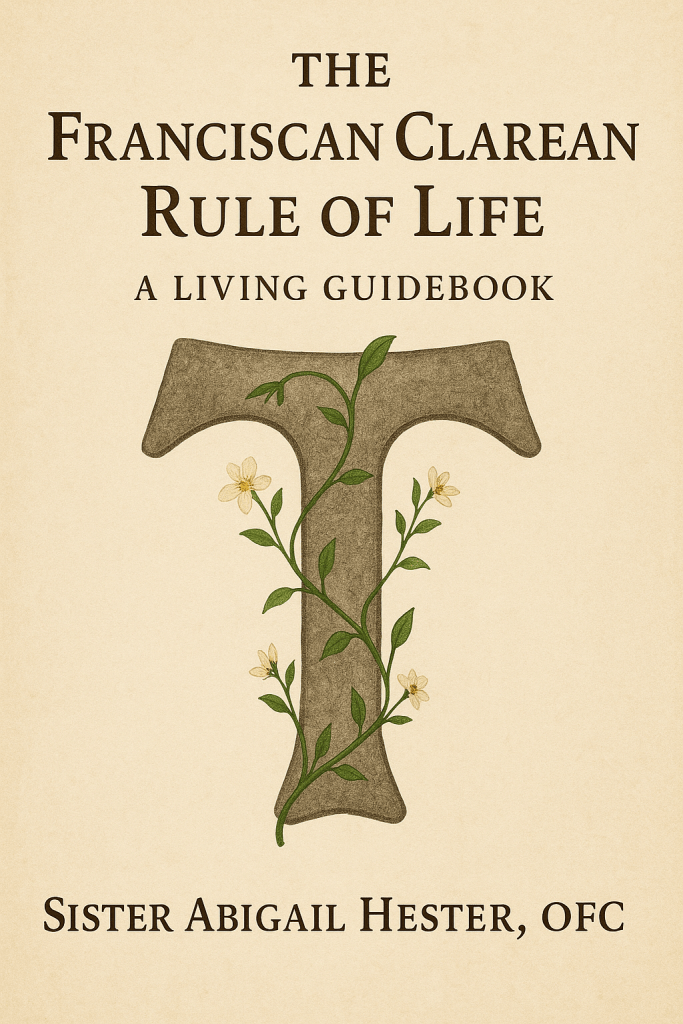
The Franciscan Clarean Rule of Life – A Living Guidebook
Dedication
To Francis and Clare—who dared to believe the Gospel could be lived with joy and simplicity.
To all who hunger for a faith that heals, liberates, and sets fire to the world with love.
Acknowledgments
This book is born out of the struggles and prayers of many:
The Order of Franciscan Clareans, who keep the vision alive.
The Chaplains of St. Francis, who minister on the streets where theology meets hunger and heartbreak.
The queer saints, the prophets, the misfits, the dreamers—whose witness shows us that God is always bigger than our walls.
Preface – Why This Rule? Why Now?
The Franciscan Clarean Rule of Life is not a relic of medieval monasticism. It is a living compass for a world on fire—politically, ecologically, spiritually. We need a way of life that is rooted in joy, grounded in justice, and radical enough to resist the empire of greed and violence that surrounds us.
This Rule is not about perfection. It is about orientation. It points us toward Christ as Francis and Clare saw Him: poor, vulnerable, radiant with joy, and alive in every creature. It invites us into a way of life that is simple but not simplistic, communal but not controlling, prophetic but not joyless.
This is not a cage of rules—it is a path of freedom.
Introduction – How to Use This Guide
This Rule is for seekers, companions, and chaplains. It is written for those who want more than Sunday religion—it is for those who want to live the Gospel with their whole lives.
Each chapter offers:
Directive: A simple guiding principle.
Reflection: Why it matters, grounded in scripture, Franciscan tradition, and modern prophetic voices.
Application: Concrete practices for daily living.
Use it in your own prayer, in community discussions, in training chaplains, or in forming intentional Franciscan Clarean households. Take what fits, wrestle with what doesn’t, but above all—live it.
Part I: Foundations
Chapter 1 – The Vision of Francis and Clare
Directive: Follow Christ with simplicity, joy, and solidarity with the poor.
Reflection
Francis of Assisi stripped himself of wealth in the city square, declaring he had only one Father in heaven. Clare walked out of privilege at midnight, cutting her hair as a sign of freedom. Together they discovered that joy comes not from possessions but from love—love of God, neighbor, and creation.
Their vision was scandalous then, and it’s scandalous now. They dared to say that the Gospel wasn’t a sermon to admire but a rule of life to live. Their spirituality was not cloistered away from the world—it was a love affair with the world God made, especially the forgotten, the wounded, the poor.
To be Franciscan Clarean today is to take their vision seriously in our own context. In a world ruled by billionaires and plagued by ecological collapse, simplicity is resistance. In a culture of loneliness, kinship is revolution. In a church too often co-opted by empire, joy is defiance.
Application
Practice solidarity. Make a conscious choice to stand with those on the margins. Visit shelters, break bread with the homeless, listen deeply to those whose voices are silenced.
Choose joy. Let gratitude and laughter be spiritual disciplines. Clare taught her sisters to dance; Francis sang to the birds. Holiness is serious play.
Live simply. Reduce possessions to what you truly need. Use your resources for others, not for hoarding. Consider every dollar a spiritual decision.
Resist empire. Don’t be fooled by consumerism, nationalism, or toxic religion. The Gospel is not about domination but liberation.
“We have been called to heal wounds, to unite what has fallen apart, and to bring home those who have lost their way.”
—Francis of Assisi
Chapter 2 – The Clarean Charism
Directive: Be prophetic, be hospitable, be kin with all creation.
Reflection
What makes us Franciscan Clareans? We inherit not just the vision of Francis but the fierce, luminous faith of Clare. Where Francis leapt into poverty singing with joy, Clare held the line against compromise. She was the anchor of the movement, the one who said, No, we will not dilute this radical life. We will not bend to the pressures of wealth, patriarchy, or power.
The Clarean charism is not timid. It is prophetic—speaking truth when silence would be easier. It is hospitable—opening the door to all, even those the church or society has cast aside. And it is rooted in kinship with all creation, not as sentimentality but as a radical recognition that all creatures share in God’s life.
In our day, the Clarean charism calls us to be a thorn in the side of empire and a balm in the wounds of the broken. It is queer-affirming, eco-centered, liberation-focused. It refuses to separate spirituality from justice or theology from lived reality. It insists that following Christ means creating spaces of belonging for the excluded, dismantling systems of oppression, and learning to live gently on the earth.
This charism is not optional—it is the DNA of who we are.
Application
Be Prophetic.
Speak out against injustice, even when it costs you friends, reputation, or comfort.
Write letters, preach sermons, stage vigils, and organize in solidarity with the oppressed.
Remember: prophecy is not predicting the future—it is telling the truth about the present in light of God’s vision.
Be Hospitable.
Practice radical welcome. Make your home, church, or community a sanctuary for those who are exiled—queer youth, unhoused neighbors, refugees, the spiritually wounded.
Hospitality is not charity; it is mutual transformation. You don’t just give food—you share meals. You don’t just open the door—you pull up a chair.
Be Kin with All Creation.
Learn the names of the plants and animals in your neighborhood. Treat them as relatives, not resources.
Reduce waste, garden when possible, and integrate ecological practices into prayer and ministry.
Let Francis’ Canticle of the Creatures be your worldview: Brother Sun, Sister Moon, Brother Fire, Sister Water.
Integrate Faith and Justice.
Don’t let anyone tell you faith is just private or personal. The Clarean charism insists that the Gospel has public consequences.
Align your lifestyle with your values—where you shop, how you vote, what you consume.
A Word from Clare
“They say we are too poor, too stubborn, too radical. But poverty is my privilege, freedom my vow, Christ my only wealth.”
Closing Thought
The Clarean charism is fire in the bones. It will make you inconvenient. It will also make you alive. It demands courage, but it gives joy. To embrace it is to step into a stream of saints, prophets, misfits, and dreamers who never gave up on the idea that another world is possible.
Chapter 3 – The Gospel as Our Rule
Directive: Live the Good News, don’t just believe it.
Reflection
When Francis was asked what his “rule” was, he simply replied: “The Gospel.” No lengthy constitutions, no canon-law footnotes, no bureaucratic red tape. Just the words and example of Jesus, lived out with joy and fire. Clare followed the same conviction, insisting that her sisters would follow nothing but the holy Gospel of our Lord Jesus Christ.
The Gospel is not an abstract text to be debated endlessly; it is a living summons. It is the Sermon on the Mount, the parables, the beatitudes, the table fellowship with outcasts, the touch of healing, the cross embraced, the resurrection proclaimed. It is Jesus’ radical declaration that the kingdom of God is not a distant dream but a present reality breaking into the here and now.
For the Franciscan Clarean, the Gospel is the center of gravity. It is not about doctrinal gymnastics or church politics. It is about a way of life that embodies love, justice, peace, and freedom. To say “the Gospel is our rule” is to say: We will live what Jesus lived, and we will risk what Jesus risked.
This is both scandalous and freeing. It means we are accountable not to institutional regulations or worldly success but to the Spirit of Christ. It means our faith is judged not by how we pray in the sanctuary but by how we love in the streets. It means that when in doubt, we always return to the words and actions of Jesus.
Application
Read the Gospels daily.
Let the words of Jesus be your compass. Even a few verses a day can reorient your spirit.
Measure your life by the Sermon on the Mount.
Before you act, ask: Does this reflect poverty of spirit, mercy, peacemaking, and love of enemies?
Practice table fellowship.
Jesus broke bread with tax collectors, sinners, and outcasts. Do the same. Invite in those who never get an invitation.
Take sides with the oppressed.
The Gospel is always good news for the poor. If it is not, it is not the Gospel.
Resist empty religion.
Beware of rituals or doctrines that have no love in them. Jesus challenged religious hypocrisy relentlessly—so should we.
Scripture to Anchor This Chapter
“The Spirit of the Lord is upon me, because he has anointed me to bring good news to the poor. He has sent me to proclaim release to the captives and recovery of sight to the blind, to let the oppressed go free, to proclaim the year of the Lord’s favor.”
—Luke 4:18–19
Closing Thought
The Gospel as our rule is both gift and responsibility. It frees us from legalism, but it binds us to Christ. It simplifies the path, but it raises the stakes. For the Franciscan Clarean, this is our vow: to live the Gospel, and nothing less.
Chapter 4 – Prayer and Contemplation
Directive: Pray daily; let silence and song shape your soul.
Reflection
Prayer was the heartbeat of Francis and Clare’s lives. Francis prayed in caves, in ruined chapels, in fields with birds as his choir. Clare spent nights in vigil, gazing at the cross until her spirit was flooded with light. For them, prayer wasn’t an escape from the world—it was immersion in God’s presence so they could return to the world with compassion and courage.
The Franciscan Clarean approach to prayer is earthy, embodied, and flexible. It embraces silence as much as song, Scripture as much as spontaneous words, liturgy as much as laughter. We are not bound to rigid formulas, but we are called to consistency: to make prayer the daily rhythm that anchors our chaotic lives.
Prayer is not just asking for things. It is listening, resting, and aligning ourselves with God’s heart. Contemplation is not passive—it is radical attentiveness to God in the moment, in the neighbor, in the sparrow, in the ache of our own hearts. From this attentiveness comes strength for justice, courage for resistance, and compassion for service.
Application
Establish a Daily Rhythm.
Begin and end each day with prayer, however simple.
Morning prayer: offering the day to God.
Evening prayer: examen—reviewing where you met God and where you resisted love.
Use the Psalms and Gospel.
Francis loved the Psalms; Clare clung to the words of Christ.
Read a psalm daily and a small portion of the Gospel. Let them shape your imagination.
Practice Contemplative Silence.
Even five minutes of stillness can ground you.
Sit, breathe, and simply be in God’s presence. No agenda, no words—just awareness.
Pray with Creation.
Go outside. Let birdsong, wind, or sunlight be part of your liturgy.
Pray the Canticle of the Creatures; let it open your eyes to the sacred around you.
Pray in Action.
Street chaplaincy, serving food, marching for justice—these are also prayer.
Offer each act of service as prayer-in-motion.
Incorporate Music and Art.
Sing hymns, chants, or even pop songs that lift your spirit.
Use drawing, journaling, or creative writing as forms of contemplative prayer.
Francis’ Prayer
“Most High, glorious God, enlighten the darkness of my heart.
Give me right faith, certain hope, and perfect charity.
Give me insight and wisdom, Lord, that I may carry out Your holy and true command.”
Closing Thought
Prayer is the soil where the Rule of Life takes root. Without it, activism becomes burnout, and community becomes chaos. With it, everything is transfigured. Prayer is not a duty we check off; it is oxygen for the soul.
Chapter 5 – Community and Kinship
Directive: We live as family, not as isolated individuals.
Reflection
Francis and Clare did not walk alone. Francis gathered brothers, Clare gathered sisters; together they birthed a movement of friendship in Christ. For them, community was not an optional add-on to spirituality—it was the very shape of the Gospel.
Francis called his followers “brothers” not because they were biologically related but because they had chosen to live as kin. Clare called her sisters “the Poor Ladies” because their poverty was shared, not borne in isolation. Both understood that holiness is not forged in solitude alone but in the messy, beautiful, demanding reality of community.
For us as Franciscan Clareans, kinship means radical inclusion. We refuse to draw the boundaries the world insists on—between rich and poor, gay and straight, housed and unhoused, citizen and migrant. Community is not a gated club but an open table.
But kinship also means accountability. Community isn’t just about warm feelings—it’s about bearing each other’s burdens, telling each other the truth, and committing to walk together even when it is hard.
In an age of loneliness, commodified relationships, and digital isolation, community is revolutionary. To live as kin is to resist the empire of self-interest and declare that God’s family is bigger, broader, and queerer than we imagined.
Application
Practice Radical Welcome.
Greet everyone as Christ.
Refuse to exclude people based on sexuality, gender, race, class, or belief.
Build Mutual Aid.
Share resources freely. Food, clothing, medicine, housing—let no one in the community go without.
Mutual aid is not charity; it’s solidarity.
Create Circles of Accountability.
Meet regularly for spiritual friendship—listening, confessing, supporting one another.
Speak truth with gentleness and receive correction with humility.
Eat Together.
Shared meals are sacramental. Break bread often.
Make your table wide enough for strangers and neighbors.
Walk with the Marginalized.
Don’t just talk about community—go where the rejected are and build kinship with them.
For the Chaplains of St. Francis, this means the streets, shelters, and encampments.
Celebrate Together.
Feast, laugh, sing, and dance. Joy is glue for community.
Francis and Clare knew that holiness requires joy.
Clare’s Wisdom
“Love one another with the charity of Christ, and let the love you have in your hearts be shown outwardly by your deeds.”
Closing Thought
Community is not easy, but it is necessary. Alone, we burn out; together, we shine. Alone, we get lost; together, we find the way. To be Franciscan Clarean is to belong to a family where everyone has a place, and no one is disposable.
Chapter 6 – Poverty and Simplicity
Directive: Choose enough. Resist excess.
Reflection
When Francis tore off his fine clothes in the Assisi town square, he wasn’t glorifying misery—he was proclaiming freedom. Poverty, for Francis and Clare, was not about romanticizing hunger or deprivation. It was about refusing to be enslaved by wealth, possessions, or power. It was about living uncluttered lives that made space for God, for neighbor, and for joy.
Clare, too, held fast to the Privilege of Poverty, resisting pressure from bishops and popes who wanted her to soften the rule. She understood that poverty was not a curse but a gift: it kept her community rooted in dependence on God and in solidarity with the poor.
For us, the vow of poverty is not about literal destitution—it is about voluntary simplicity. It is the conscious choice to have “enough” instead of “more.” In a world addicted to consumption, this is resistance. In a society where value is measured by net worth, poverty proclaims that human worth lies in being, not having.
Simplicity also has ecological dimensions. To consume less is to tread lightly on the earth, to honor our kinship with creation, to resist the culture of waste. Simplicity frees us to share with others, to travel light, and to focus on what really matters.
Application
Live Lightly.
Own less, share more.
Before buying anything, ask: Do I need this? Could someone else use the money more than I need the item?
Practice Economic Resistance.
Refuse to support exploitative industries (sweatshops, predatory corporations, destructive practices).
Support local, fair-trade, and cooperative economies where possible.
Reclaim “Enough.”
Keep your needs modest. Embrace the joy of sufficiency.
Remember: Francis said, “A person who owns nothing possesses everything.”
Integrate EDC and Prepping as Simplicity.
Carry what you need to live simply and serve others.
Build practical kits (first aid, water, food, tools) not as hoarding but as readiness to help.
Share Generously.
Treat possessions as communal, not private.
Open your resources—whether money, skills, or time—for the sake of others.
See Poverty as Solidarity.
Spend time with the poor not as charity but as kinship.
Let their struggles shape your choices about work, money, and lifestyle.
Francis’ Wisdom
“A person who has two coats must give one away. Blessed is the servant who loves and respects his brother as much when he is far away as when he is with him, and would not say anything behind his back he would not say in love before his face.”
Closing Thought
Poverty and simplicity are not punishments; they are freedoms. They free us from the tyranny of “more” and open us to the abundance of God. When we have less clutter, we have more joy. When we carry less baggage, we can walk more freely with Christ.
Chapter 7 – Justice and Peace
Directive: Be peacemakers in a violent world.
Reflection
Francis kissed the leper when others turned away. He crossed battle lines during the Crusades to speak with the Sultan—not with a sword, but with open hands. Clare stood at the gates of San Damiano holding only the Blessed Sacrament, turning away invading soldiers without raising a weapon. For both, peace was not passive. It was courageous, disruptive, and costly.
To be Franciscan Clarean today is to be peacemakers in a culture addicted to violence. We live in a world where wars are endless, where nationalism masquerades as faith, where racism and transphobia fracture communities, and where violence is normalized as entertainment. Against this tide, the Gospel calls us to something radical: nonviolence as a way of life.
Justice and peace are inseparable. There is no peace without justice, and there is no justice without peace. Francis and Clare knew this when they stood with the poor against systems of wealth and power. We know it when we resist Christian nationalism, white supremacy, environmental destruction, and queerphobia.
Our peace is not quietism—it is prophetic resistance. Our justice is not vengeance—it is restorative love. To live this Rule is to take sides with the oppressed and to embody peace even when the world mocks it as weakness.
Application
Practice Active Nonviolence.
Refuse to harm, even when harmed.
Speak truth to power without raising a fist.
Learn conflict resolution and de-escalation skills; use them in community and in the streets.
Resist Christian Nationalism.
Expose the idolatry of flag-wrapped faith.
Proclaim that Christ’s kingdom is not of empire but of love, justice, and freedom.
Stand Against Racism and Transphobia.
Be visibly and vocally supportive of marginalized communities.
Challenge bigotry in churches, families, and institutions.
Protect the vulnerable, even when it costs you.
Practice Restorative Justice.
Work for healing and reconciliation, not revenge.
Support alternatives to incarceration, militarism, and punitive systems.
Live Simply for Justice.
Consumerism fuels violence against the poor and the earth. Choose fair, sustainable options.
Boycott exploitation; invest in justice.
Be Public Witnesses of Peace.
Join vigils, marches, protests.
Offer chaplaincy at sites of violence, injustice, or protest.
Be known as people of peace, not passivity.
Scripture Anchor
“Blessed are the peacemakers, for they shall be called the children of God.”
—Matthew 5:9
Closing Thought
Justice and peace are the heartbeat of the Franciscan Clarean way. They will get you into trouble. They may cost you friendships, security, or safety. But they will also make you children of God, bearers of Christ’s peace in a world that desperately needs it.
Chapter 8 – Creation and Ecology
Directive: All creatures are kin, all the earth is sacred.
Reflection
Francis sang with the birds and called the sun his brother. Clare watched the flickering fire in the chapel and saw the radiance of God’s love. Both knew the truth long before science confirmed it: we are woven into the same web of life with every creature, every river, every star.
The Franciscan Clarean path rejects the lie that creation is a resource to exploit. Instead, it proclaims creation as family. Brother Sun warms us, Sister Water cleanses us, Brother Fire gives light, Sister Earth sustains us. To harm creation is to harm ourselves; to heal creation is to heal our own souls.
Today, the earth groans under the weight of climate collapse, pollution, and greed. Entire species vanish daily. Forests burn, oceans choke, and storms grow stronger. This is not a side issue—it is the defining moral and spiritual crisis of our time. If we are to be faithful to the Gospel and to Francis and Clare, we must be defenders of creation.
Our eco-spirituality is both mystical and practical. It sees God shimmering in the dew and it composts kitchen scraps. It delights in beauty and digs gardens. It blesses animals and fights pipelines. This is not romantic tree-hugging—it is a call to prophetic kinship with the earth.
Application
Pray with Creation.
Begin prayers by acknowledging Brother Sun, Sister Moon, and all creatures.
Use outdoor spaces as chapels. Let the natural world teach you how to pray.
Practice Sustainable Living.
Reduce consumption and waste: recycle, repair, reuse.
Choose renewable energy where possible.
Conserve water and power as acts of reverence.
Grow and Gather.
Plant gardens, even small ones in urban spaces.
Learn herbalism as a way of healing with creation’s gifts.
Share food and medicine freely as a form of solidarity.
Resist Ecological Injustice.
Speak out against corporations and systems destroying the earth.
Join movements for climate justice and indigenous sovereignty.
Recognize that environmental destruction always harms the poor first.
Bless and Celebrate.
Hold annual blessings of animals, gardens, rivers.
Write new canticles and hymns celebrating creation.
Treat feast days as ecological celebrations as well as spiritual ones.
Canticle of the Creatures (excerpt)
“Praised be You, my Lord, with all Your creatures,
especially Brother Sun,
who is the day and through whom You give us light.”
Closing Thought
Creation is not scenery—it is kin. It is not property—it is sacrament. To live Franciscan Clarean life is to walk gently on the earth, fiercely defend her from harm, and rejoice in the wild, holy beauty of God shining through every creature.
Chapter 9 – Hospitality and Service
Directive: Welcome Christ in the stranger and the poor.
Reflection
Jesus said, “I was hungry and you gave me food, I was thirsty and you gave me drink, I was a stranger and you welcomed me.” The Franciscan Clarean way takes this literally. We believe Christ is most present in the vulnerable—the hungry, the unhoused, the refugee, the sick, the forgotten.
Francis kissed the leper and found his bitterness turned to sweetness. Clare insisted her sisters live in poverty so they could be one with the poor. Both practiced hospitality not as noblesse oblige but as kinship. They knew that serving others was not optional—it was the Gospel embodied.
For us, hospitality and service are radical acts of resistance. In a world that discards people as “useless,” we declare every person beloved. In a culture obsessed with security and walls, we open doors. In a church that too often excludes, we set bigger tables. Service is not pity—it is communion. Hospitality is not charity—it is justice in practice.
Application
Feed the Hungry.
Cook meals, open kitchens, support food pantries.
Share meals in friendship, not as a handout but as a family table.
Clothe the Naked.
Create clothing banks and free closets.
Offer dignity, not just donations.
Shelter the Homeless.
Organize safe housing projects, shelters, or temporary refuges.
Welcome people without requiring them to “earn” it.
Visit the Sick and Imprisoned.
Bring presence and compassion to hospitals, prisons, and recovery centers.
Be chaplains to the forgotten, not just the convenient.
Practice Open-Table Hospitality.
Host meals where everyone belongs: rich and poor, queer and straight, believer and skeptic.
Let your table be a sacrament of inclusion.
See Service as Revolution.
Every act of mercy undermines empire.
Feeding the hungry in a culture of greed is a prophetic act.
Housing the homeless in a system built on exclusion is revolutionary love.
Scripture Anchor
“Do not neglect to show hospitality to strangers, for by doing that some have entertained angels without knowing it.”
—Hebrews 13:2
Closing Thought
Hospitality is not about being polite—it is about survival and dignity. Service is not about pity—it is about solidarity. When we welcome the poor, we welcome Christ. When we serve the vulnerable, we stand at the very heart of the Gospel.
Chapter 10 – Learning and Wisdom
Directive: Keep seeking, keep questioning, keep learning.
Reflection
Francis was not a university scholar, yet he became a teacher of the world through his simplicity. Clare was not allowed into the lecture halls of Assisi, yet her wisdom confounded bishops and popes. They remind us that wisdom is not confined to academia—it flows wherever the Spirit breathes.
For Franciscan Clareans, learning is a sacred duty. We read Scripture with open eyes, informed by modern scholarship and ancient tradition. We wrestle with theology not as an intellectual exercise but as fuel for faithful living. We listen to the poor, to creation, to marginalized voices, recognizing that wisdom often comes from the edges, not the center.
Wisdom is not about having all the answers—it is about cultivating humility, imagination, and courage. It is about asking the right questions. It is about seeing through the lies of empire, the distortions of nationalism, the chains of consumerism. Learning equips us to resist, to dream, and to create.
Our tradition draws from many wells: the Gospels, the Franciscan legacy, queer theology, liberation theology, eco-spirituality, interfaith dialogue, and the insights of science. We do not fear truth wherever it is found, for all truth belongs to God.
Application
Read Scripture Daily with Depth.
Use tools of modern scholarship—historical context, literary analysis, prophetic imagination.
Avoid proof-texting; seek the bigger story of liberation and love.
Engage with Theologians and Prophets.
Study voices like Marcus Borg, John Dominic Crossan, John Shelby Spong, and Dorothy Day.
Learn from liberation theologians, queer theologians, and eco-theologians who expand the Gospel’s horizon.
Practice Communal Learning.
Form study circles, book groups, and theological discussions in your community.
Let wisdom be shared, not hoarded.
Learn from the Margins.
Center the voices of the poor, the oppressed, the excluded.
Treat their lived experience as sacred text.
Integrate Knowledge with Action.
Don’t separate study from life—let learning shape choices in politics, economics, and justice.
Test every idea in the crucible of service and community.
Stay Curious.
Ask questions without fear. Doubt is not the enemy of faith—it is often its doorway.
Embrace wonder as a form of prayer.
Scripture Anchor
“The beginning of wisdom is this: Get wisdom, and whatever else you get, get insight.”
—Proverbs 4:7
Closing Thought
Learning is not about arrogance but about humility. The more we know, the more we realize how much we don’t know. True wisdom makes us gentler, braver, and freer. For the Franciscan Clarean, wisdom is not a luxury—it is a weapon against ignorance, a balm for suffering, and a spark for prophetic imagination.
Chapter 11 – Daily Practices
Directive: Build a rhythm of life that roots you in God and justice.
Reflection
Francis and Clare did not live their faith in occasional bursts of inspiration. They lived it daily, woven into the rhythm of prayer, work, service, and rest. Their spirituality was steady, embodied, and practical.
For us, daily practice is not about rigid legalism—it’s about building habits that free us to live with intention. Without rhythm, our lives drift into chaos. With rhythm, we stay grounded in God’s presence and oriented toward justice.
The Franciscan Clarean rhythm is not monastic in the cloistered sense, but it is disciplined. It balances prayer and action, solitude and community, joy and struggle. It creates space for God to break in, for neighbor to be seen, and for justice to be practiced.
Think of it not as a schedule imposed from outside but as a trellis that helps the vine grow strong. The Rule doesn’t bind us; it supports us.
Application
Here is a suggested rhythm—adapt it to your life and context:
Morning (Awakening Prayer)
Begin with gratitude: thank God for breath, light, and life.
Read a short passage from the Gospels or Psalms.
Offer your day as service to God and neighbor.
Midday (Pause and Presence)
Take five minutes of silence or deep breathing.
Remember those suffering near and far.
If possible, share a simple meal with others.
Evening (Examen and Rest)
Review your day: Where did I encounter Christ? Where did I fail to love?
Offer your successes and failures into God’s mercy.
Pray for peace—for yourself, your community, the world.
Daily Practices of Simplicity and Service
Do one concrete act of service each day (small or large).
Make one choice for simplicity each day (reuse, reduce, share).
Practice kindness in ordinary encounters.
Weekly Practices
Gather with community for prayer, reflection, and shared meal.
Engage in communal service (food pantry, street outreach, mutual aid).
Sabbath rest: take one day to pause, delight, and honor creation.
Monthly Practices
Review your Rule of Life: what practices are grounding you? What needs adjusting?
Spend intentional time in nature as prayer.
Deep study: commit to learning from one book, article, or teaching that challenges and grows you.
Scripture Anchor
“They devoted themselves to the apostles’ teaching and fellowship, to the breaking of bread and the prayers.”
—Acts 2:42
Closing Thought
Daily practices are not about perfection—they are about orientation. Some days will feel holy; others will feel messy. Both belong. What matters is the rhythm: the steady heartbeat of prayer, service, and simplicity that keeps us walking the Franciscan Clarean path.
Chapter 12 – Seasonal Practices
Directive: Mark time with joy, feasts, and holy interruptions.
Reflection
Francis and Clare lived by rhythm, not the tyranny of the clock. Their lives moved with the cycles of prayer, harvest, feast, and fast. They embraced the liturgical calendar, not as empty ritual but as a way to remember that all time belongs to God.
For Franciscan Clareans today, seasonal practices are a way of resisting the empire’s calendar—the relentless grind of productivity, consumer holidays, and endless consumption. Instead, we choose holy time: days that slow us down, call us to remember, and bind us to creation’s cycles.
The year becomes a tapestry of prayer and celebration: Advent waiting, Lenten fasting, Easter rejoicing, Pentecost fire, Franciscan feasts, ecological seasons, and holy interruptions that remind us life is gift. We mark not just the church year, but the turning of the earth—the solstices, equinoxes, planting and harvest. These become sacraments too.
Seasonal practices teach us joy and balance. They call us to mourn with the earth in winter, to rejoice with her in spring, to work with her in summer, to gather with her in autumn. They remind us that the Gospel is not timeless abstraction but incarnated rhythm.
Application
Follow the Liturgical Seasons.
Advent: waiting in simplicity, lighting candles, preparing for Christ.
Christmas: feasting in joy, welcoming the vulnerable Christ-child.
Lent: fasting, repentance, acts of mercy.
Easter: celebrating resurrection and renewal.
Pentecost: calling on the Spirit for fire and courage.
Celebrate Franciscan Feasts.
October 4: Feast of St. Francis — bless animals, commit to eco-justice.
August 11: Feast of St. Clare — celebrate women’s leadership and prophetic courage.
Other Franciscan Saints: Bonaventure, Angela of Foligno, etc.
Integrate Ecological Seasons.
Mark solstices and equinoxes with prayer and outdoor rituals.
Celebrate planting and harvest with blessing liturgies.
Host creation-care days of action (tree planting, clean-ups, water blessings).
Practice Fasting and Feasting.
Fast simply one day a week or during Lent—not as punishment, but as solidarity with the hungry.
Feast with joy at Easter, Franciscan feast days, and community milestones.
Remember: fasting without feasting is despair; feasting without fasting is gluttony. Balance both.
Make Holy Interruptions.
Celebrate unexpected graces: a birth, a victory for justice, a recovered friend.
Interrupt routine with gratitude and praise.
Craft New Franciscan Clarean Feasts.
Feast of Creation: celebrate the Earth and renew ecological commitments.
Feast of the Poor Christ: remember that Jesus chose poverty and kinship with the lowly.
Feast of Justice: honor martyrs for peace and liberation.
Scripture Anchor
“There is a time for everything, and a season for every activity under the heavens.”
—Ecclesiastes 3:1
Closing Thought
Seasonal practices remind us that life is not endless grind—it is sacred rhythm. The Franciscan Clarean way teaches us to wait, to rejoice, to mourn, to fast, to feast. By marking holy time, we resist empire’s calendar and declare that all time belongs to God.
Chapter 13 – Becoming a Franciscan Clarean
Directive: Walk the path from friend to companion to member.
Reflection
Francis and Clare never set out to build an institution. They simply lived the Gospel so radically that others wanted to join them. Their movement grew not by recruitment but by attraction—people saw their joy, their courage, their poverty, and said, “I want that life too.”
To become a Franciscan Clarean today is to enter into that same stream. It is not about passing tests, earning credentials, or climbing ranks. It is about responding to a call deep within the heart: to live simply, love boldly, and walk in kinship with all creation.
Belonging is a journey, not a one-time decision. Some will walk with us as friends, sharing fellowship and support. Others will become companions, walking more closely in prayer and practice. Still others will embrace deeper commitments as members, shaping their lives by this Rule. And some will be called as chaplains, bringing this vision to the streets and margins.
There is no coercion, no gatekeeping. There is only invitation. Each stage is honored, and all are welcome. The path is flexible, but the heart is clear: this is a way of life shaped by Christ, Francis, and Clare, for the healing of the world.
Application
Friends of the Order.
Those drawn to the vision who want to support, learn, and participate occasionally.
Friends pray with us, join events, and walk in fellowship without formal commitment.
Companions.
Those who desire to practice the Rule more intentionally.
Companions adopt personal rhythms of prayer, simplicity, and service.
They may join study circles, service projects, and Franciscan Clarean gatherings.
Members.
Those who commit to shaping their lives by the Rule of Life.
Members make promises of simplicity, prayer, service, and justice.
They belong to the wider Order, supporting and being supported by the community.
Chaplains of St. Francis.
Those called to street ministry, chaplaincy, and prophetic service.
Chaplains undergo intentional training in trauma-informed care, street outreach, and justice ministry.
They embody the Rule in public witness, especially among the poor and marginalized.
Commitments and Vows.
Commitments are flexible: not binding forever, but entered into with seriousness and joy.
Promises may be renewed annually or for life.
Simplicity, service, kinship, and peace are the heart of every vow.
Francis’ Example
“The Lord gave me brothers, no one showed me what to do, but the Most High himself revealed to me that I should live according to the form of the Holy Gospel.”
Closing Thought
To become a Franciscan Clarean is not to join a club but to answer a call. Wherever you are on the journey—friend, companion, member, or chaplain—you belong. The path is open, the invitation wide, the Spirit alive. Step in as you are.
Chapter 14 – The Chaplains of St. Francis
Directive: Be present with the poor, the broken, the forgotten.
Reflection
When Francis embraced the leper, he discovered Christ in the stench of rotting flesh. When Clare defended her sisters against invading soldiers, she stood as a mother of courage and mercy. Both remind us that ministry happens not in gilded sanctuaries but in the raw places of suffering and fear.
The Chaplains of St. Francis are heirs to that vision. We do not wait for the poor to come to us—we go to them. We walk the streets, visit encampments, sit in hospital waiting rooms, and stand at protest lines. We are there not to preach at people, but to be with people. Presence itself is sacrament.
Street chaplaincy is gritty, unpredictable, and holy. It means being ready with prayer one moment and bandages the next. It means knowing that sometimes the most spiritual thing you can do is share water, listen to a story, or just sit in silence. It means showing up consistently in places others avoid.
To be a Franciscan Clarean chaplain is to embody the Rule of Life in the harshest corners of the world. It is prophetic, because it exposes the injustice that makes poverty and suffering inevitable. It is pastoral, because it tends wounds of body, mind, and spirit. It is sacramental, because Christ is always already there before we arrive.
Application
Ministry of Presence.
Show up in shelters, encampments, jails, hospitals, and protest sites.
Offer listening without judgment, prayer without pressure, love without condition.
Trauma-Informed Care.
Understand that every person carries wounds.
Approach gently, respect boundaries, and never retraumatize.
Learn basic mental health first aid and crisis de-escalation.
Practical Mercy.
Carry first-aid kits, hygiene supplies, food, and water.
Meet immediate needs as an act of Gospel love.
Train in CPR, basic medical care, and survival skills.
Prophetic Witness.
Stand against systems that produce poverty, addiction, and exclusion.
Speak truth to power while standing in solidarity with the powerless.
Let your presence be both comfort to the broken and challenge to the oppressor.
Prayer and Sacrament.
Offer blessings, communion, and prayers wherever people are.
Sanctify street corners, alleys, encampments, and shelters as holy ground.
Remember: the altar is wherever Christ is present—and Christ is everywhere.
Self-Care and Community Support.
Street ministry is demanding. Do not do it alone.
Lean on the Order, pray with companions, and rest often.
Burnout helps no one; balance sustains the mission.
Clare’s Spirit
“Go forward securely, joyfully, and swiftly, on the path of prudent happiness. Believe nothing, agree with nothing, that would dissuade you from this commitment.”
Closing Thought
The Chaplains of St. Francis walk barefoot into the wounds of the world. They carry no weapons but compassion, no authority but love, no riches but presence. In every encounter, they find Christ waiting—hungry, thirsty, sick, imprisoned, or unhoused—and they bow in reverence.
This is the Franciscan Clarean Rule in action: not words on a page, but love on the streets.
Closing
Final Exhortation – Live Boldly, Love Radically
The Franciscan Clarean Rule of Life is not a cage. It is not a checklist. It is not a burden to weigh you down. It is a compass—pointing us toward Christ, guiding us through the wilderness of empire, and reminding us that another way is possible.
Francis and Clare lived this way with reckless joy. They stripped off the armor of wealth and power and clothed themselves in Christ. They chose kinship with lepers over comfort, peace over violence, and simplicity over greed. Their way was scandalous then. It is scandalous now.
We are called to nothing less. To live the Gospel with our lives, to resist empire with joy, to love without condition, to walk barefoot before God and hand in hand with the poor.
Do not wait until you are ready. Do not wait until you are perfect. Step into this Rule as you are—with your doubts, your struggles, your wounds, and your hopes. Christ is already there, walking with you.
Live boldly. Love radically. And let your life itself be the sermon.
Benediction / Prayer of Sending
Most High, Holy One,
You have called us to walk in the footprints of Francis and Clare,
to live with joy, to love with courage,
to stand with the poor, to honor creation,
to resist violence, and to proclaim peace.
Bless us as we take up this Rule of Life.
Let our prayer be steady, our service generous,
our community wide, our hearts open, our witness bold.
Send us out as chaplains of your mercy,
prophets of your justice,
friends of all creatures,
and children of your peace.
In Christ’s name, who is our Rule and our Life.
Amen.
Back Matter
Appendices
Appendix A – A Daily Prayer Guide
Morning Offering
Midday Pause
Evening Examen
Canticle of the Creatures
Appendix B – Sample Community Practices
Weekly gathering outline (meal, prayer, Scripture, discussion, mutual aid)
Monthly service project ideas
Seasonal feast day celebrations
Appendix C – Practical Resources
Franciscan Clarean Herbal First Aid Guide
Franciscan Clarean EDC (Everyday Carry) Essentials
Mutual aid toolkit for communities
Appendix D – Recommended Reading
The Meaning of Jesus — Marcus Borg & N.T. Wright
Jesus: A Revolutionary Biography — John Dominic Crossan
Rescuing the Bible from Fundamentalism — John Shelby Spong
The Long Loneliness — Dorothy Day
Care for Creation — Ilia Delio, O.S.F.
Clare of Assisi: A Heart Full of Love — Ilia Delio
About the Author
Sister Abigail Hester, OFC, is the founder and guiding voice of the Order of Franciscan Clareans and Rebel Saint Publications. A legally blind nun, chaplain, and prophetic misfit, she is devoted to a radical Gospel that embraces the poor, welcomes the excluded, resists empire, and celebrates creation.
Through books, zines, street ministry, and the Chaplains of St. Francis, she seeks to embody the spirit of Francis and Clare for a world in need of healing, justice, and joy.
 Sister Abigail Hester
Leave a comment