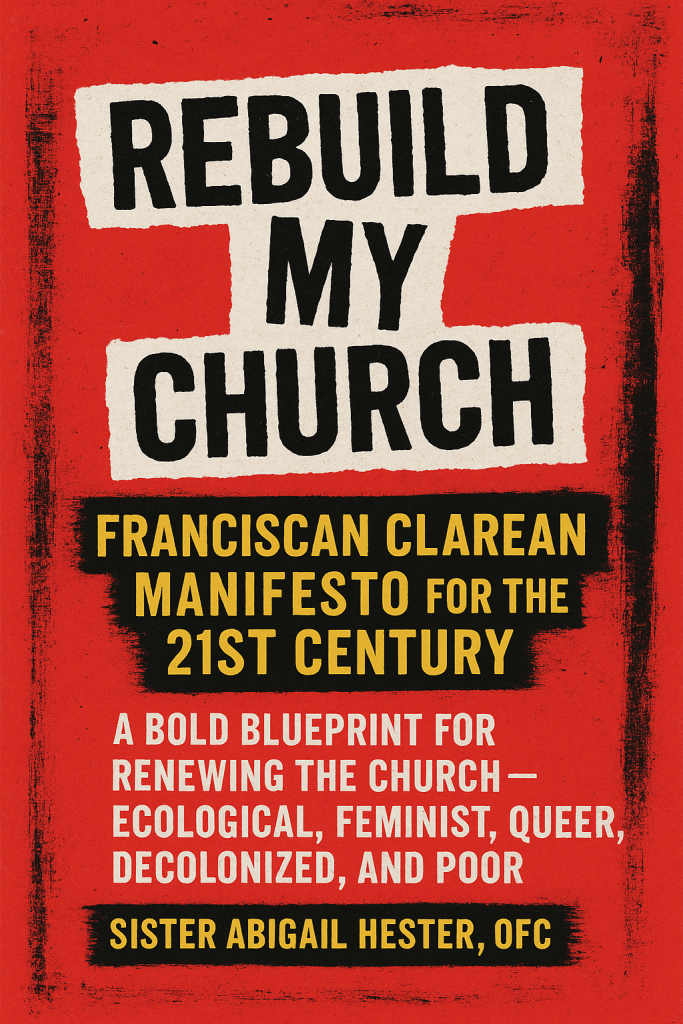
Rebuild My Church
Franciscan Clarean Manifesto for the 21st Century
A Bold Blueprint for Renewing the Church — Ecological, Feminist, Queer, Decolonized, and Poor
by Sister Abigail Hester, OFC
Dedication
For those who refuse to bow to empire,
who hear the whisper in the rubble:
“Rebuild my Church.”
For the barefoot dreamers, the queer prophets,
the fierce and the tender.
This is our blueprint.
Epigraph
“Go, rebuild my Church, which as you see is falling into ruin.”
— Christ to Francis of Assisi
“The Spirit is always doing something scandalous. Don’t sanitize it.”
— Anonymous Franciscan Clarean proverb
Acknowledgments
To my Franciscan Clarean family — contemplative activists, herbal healers, queer mystics, chaplains, and holy fools — who are building this movement with me.
To Clare of Assisi, who taught us that light doesn’t shout; it simply keeps shining.
And to every person who has been told they don’t belong in the Church — you are the cornerstone.
Preface: A Cry from the Ruins
The Church is collapsing — and that’s not the tragedy people think it is.
It’s the sound of scaffolding giving way to something alive again.
When Francis of Assisi heard the crucified Christ whisper, “Rebuild my Church,” he didn’t gather a committee or write a strategic plan. He picked up a stone with dirty hands and started stacking. He took the command literally, until the Spirit made it clear: the true rebuilding wasn’t with bricks but with broken hearts.
We are in the same place now.
The institution is cracking under the weight of its own empire — abuse scandals, colonial residue, consumer spirituality, and a gospel that’s been domesticated to serve power instead of love. But beneath the wreckage, there’s still a heartbeat. You can feel it if you listen from the ground up — where the poor, the queer, the disabled, the earth, and the outcast are still praying, still tending fires in the dark.
I wrote this manifesto for them. For us. For everyone who refuses to give up on the dream of a Church that actually looks like Jesus — barefoot, boundary-breaking, table-building, radically kind, and absolutely uninterested in empire.
The Order of Franciscan Clareans (OFC) is our experiment in that rebirth.
We are rebuilding with compost, prayer beads, zines, laughter, and defiance. We are feminist and Franciscan, queer and contemplative, mystical and militant about tenderness. We believe that if God can be born in a stable, the Church can be reborn in a back alley, a kitchen, a garden, or an online sanctuary.
This is not a gentle renovation. This is sacred demolition.
It’s tearing down walls built by patriarchy and profit and planting herbs in the cracks. It’s reclaiming the Gospel from clerical hands that sanitized it into submission. It’s Francis and Clare with tattoos and dirt under their nails, still hearing the same call:
“Go, rebuild my Church — she’s falling into ruin again.”
The blueprint is simple and impossible:
Ecological — because creation is our first cathedral.
Feminist — because the Spirit isn’t male.
Queer — because love refuses boxes.
Decolonized — because empire crucified Christ.
Poor — because only empty hands can carry grace.
This book is not theology in the ivory tower; it’s theology in the streets, the gardens, the nursing homes, and the margins. It’s a field guide for rebuilding something sacred in an age of collapse.
If you’re reading this, you’re probably one of us already — a builder, a dreamer, a heretic who loves the Church too much to leave her unhealed. Welcome to the ruins. Grab a hammer.
Let’s rebuild.
Chapter 1: What Happened to the Church
“The stone the builders rejected has become the cornerstone.” — Psalm 118:22
The Church didn’t fall overnight. It eroded — sermon by sermon, scandal by scandal, compromise by compromise — until it became a hollow echo of its own Gospel.
Somewhere between the manger and the megachurch, we traded the smell of sheep for the perfume of power.
Once, we were a movement of barefoot mystics and table-turning prophets. Now, we’re an institution that apologizes for prophets and markets mysticism as lifestyle branding.
Let’s be clear: the Church isn’t dying because the world is wicked.
It’s dying because it forgot how to love.
The Loss of the Radical Christ
Jesus didn’t found a religion. He launched a revolution of tenderness.
He healed on the Sabbath, ate with outcasts, and said the poor would inherit everything. He had no throne, no army, and no budget — just a band of misfits who believed the empire didn’t have the last word.
But somewhere along the line, the Church became what Christ opposed:
A system that serves empire instead of subverting it.
A hierarchy more obsessed with control than compassion.
A corporation terrified of losing relevance, instead of a community fearless in love.
We traded the Gospel’s wildness for stability, and stability for stagnation.
From Movement to Monument
History tells it plain: every movement that loses its mystics becomes a museum.
When Constantine made Christianity respectable, it became manageable. When it became manageable, it became predictable. And when it became predictable, it lost its pulse.
The Church was never meant to be a monument. It was meant to be a wildfire.
A network of small communities, homes, gardens, and catacombs where people broke bread and shared life.
Instead, we built cathedrals so tall they blocked the sky and forgot that heaven begins in the hungry stomach of a child.
The Spirit keeps trying to burn through our bureaucracy.
Every revival, every reformation, every mystic — Francis, Clare, Julian, Luther, Dorothy Day, Oscar Romero — was a divine fire alarm in the sanctuary. But we keep hitting snooze.
Clericalism: The Old Disease in New Clothes
The priesthood of all believers became the priesthood of the few.
Women were silenced. Queer people were exiled. The poor were blamed for their poverty.
We turned the Gospel into a rulebook and called it holiness.
Even now, churches boast inclusivity on their websites but still center cisgender, male, white, straight voices. We preach community and practice hierarchy. We anoint the powerful and ignore the prophets.
Let’s call that what it is — idolatry.
It’s worshiping the institution instead of the Incarnation.
A Church That Lost Its Ears
Francis heard Christ speak from a cross in a ruined chapel because he was listening in the silence of failure.
We’ve drowned out that silence with microphones, branding, and busy schedules.
We hold conferences about the Holy Spirit but rarely make room for her to actually speak.
The poor are crying, the planet is bleeding, and the Church is debating carpet colors.
It’s not that God stopped speaking — it’s that we stopped wanting to hear.
Hope in the Ruins
Here’s the paradox: collapse is not the end. It’s compost.
What looks like ruin is just soil for resurrection.
If the old structures must fall for the Gospel to rise again, then blessed be the wreckage.
Because under the rubble, new communities are growing — queer nuns, street chaplains, eco-monastics, kitchen-table mystics, radical Franciscans, Indigenous theologians, online contemplatives — all reclaiming the Church from below.
This is what resurrection looks like in real time.
The walls are coming down, and the Spirit is moving in the open air again.
“See, I am doing a new thing; now it springs forth, do you not perceive it?” — Isaiah 43:19
The Church isn’t dead. She’s shedding her imperial skin.
She’s learning to breathe again — through compost and candlelight, through protest and prayer, through people like you and me who refuse to stop rebuilding.
Chapter 2: Empire in the Sanctuary
“You cannot serve both God and empire.” — Paraphrase of Matthew 6:24
The Church wasn’t corrupted by sin alone.
It was seduced by power — baptized into empire and dressed in silk instead of sackcloth.
The tragedy isn’t that the Church got political; it’s that it picked the wrong side.
From Constantine to colonization, it chose the throne over the table, the sword over the basin, the emperor over the crucified Christ.
The sanctuary became a fortress.
And the cross became a flag.
The Marriage of Cross and Crown
It started innocently enough — a deal struck in the name of stability.
When the Roman Empire legalized Christianity, it was supposed to protect the faith. Instead, it domesticated it.
Christ’s followers went from being executed to being exalted, from fugitives to functionaries.
The empire found religion useful — and religion found empire comfortable.
Gold replaced simplicity. Palaces replaced poorhouses. Bishops became bureaucrats. And before long, Jesus’ revolution of love was wearing imperial robes and marching in parades of conquest.
Francis of Assisi saw it clearly.
When he stripped naked in the public square, he wasn’t just renouncing wealth — he was rejecting empire.
He refused to be an employee of Rome’s religious machine. He wanted the Gospel unchained.
Colonizing the Gospel
The empire didn’t stop at Rome. It put the Gospel on ships.
It carried crosses to the Americas, Africa, and Asia — not to serve but to subdue.
The “missionary impulse” became colonization with a halo.
We told Indigenous peoples their sacred lands were “empty.”
We stole their children in the name of salvation.
We forced conversion through trauma and called it love.
That’s not evangelism — that’s ecclesial imperialism.
The Gospel never needed a musket.
“The Spirit of the Lord is upon me… to proclaim release to the captives.” — Luke 4:18
Decolonizing the Church doesn’t mean abandoning faith.
It means exorcising empire from our theology.
It means returning the Gospel to the soil — local, embodied, mutual, humble.
The Empire Within
Empire isn’t just external — it’s in our bloodstream.
It’s in the way we measure success by numbers, not transformation.
It’s in the way clergy treat authority like divine right instead of sacred service.
It’s in our obsession with dominance — over women, over the poor, over the planet.
Even our theology bears the mark of empire:
A male God enthroned in heaven, ruling by decree.
Salvation framed as submission rather than liberation.
Heaven portrayed as a gated community for the “good.”
This isn’t Christ’s Kingdom — it’s Caesar’s Church in drag.
Rebel Saints and Holy Subversives
Every age produces rebels with incense-stained hands.
Francis and Clare were our first punks — poor, barefoot, and politically dangerous.
Dorothy Day called for revolution through love.
Óscar Romero preached justice until empire silenced him with a bullet.
And today, queer and feminist theologians like Amy-Jill Levine, Elizabeth Johnson, and Marcella Althaus-Reid are dismantling the empire’s last stronghold: theology itself.
They remind us: the Gospel isn’t polite — it’s insurgent.
It overturns tables, exposes hypocrisy, and calls the powerful to repentance.
The Church doesn’t need more chaplains for Caesar. It needs more prophets in sandals.
The Franciscan Clarean Rebellion
The Order of Franciscan Clareans stands in that lineage.
We’re rebuilding from the ground up — not as an alternative church, but as a reminder of what the Church was before empire tamed her.
Our rebellion is radical tenderness.
Our protest is hospitality.
Our revolution is prayer and compost and the courage to say, “No more.”
We reject all systems that dehumanize — whether political, economic, or religious.
We serve the poor, the queer, the earth, and the marginalized because that’s where Christ still dwells: outside the city walls, uninvited to empire’s banquets.
The new Church won’t fit inside marble halls. It’ll bloom in gardens, shelters, digital chapels, and makeshift sanctuaries where love still burns fiercely.
The Call
If the Church has become an empire, then rebuilding begins with treason — holy treason.
We must betray our allegiance to domination, privilege, and silence.
We must choose the cross again — not as decoration, but as defiance.
The Spirit is whispering what Francis heard centuries ago:
“Repair what empire has destroyed.”
So we will.
Brick by brick. Blessing by blessing.
Until the sanctuary becomes a place of liberation again.
Chapter 3: The Cry of the Earth, the Cry of the Poor
“If you have men who will exclude any of God’s creatures from the shelter of compassion and pity, you will have men who deal likewise with their fellow men.” — St. Francis of Assisi
Creation is preaching a sermon the Church forgot how to hear.
The forests are burning, the oceans are choking, and the poor are starving — and yet, our liturgies stay air-conditioned.
We keep praying for “daily bread” while ignoring who bakes it, who picks the wheat, and who can’t afford a loaf.
Francis didn’t separate nature from neighbor.
He called the sun “Brother,” the moon “Sister,” and the wolf “Friend.”
He saw creation not as scenery, but as sacrament — living icons of divine relationship.
The cry of the Earth is the cry of the poor.
And if we don’t listen, we are no Church at all.
The Gospel of the Soil
When Francis lay dying, he asked to be placed naked on the ground.
He wanted his body to return to the same soil that once held the body of Christ.
That was no romantic gesture — it was theology made flesh.
The Gospel of the Soil says:
God’s first language is creation.
The Earth is not a backdrop; it’s the Body of God extended.
Ecology is not politics — it’s Eucharist.
When we pollute rivers, we poison baptism.
When we destroy forests, we desecrate cathedrals older than Rome.
When we exploit the poor, we crucify Christ anew — this time on asphalt instead of wood.
Francis understood what we have forgotten: to love God is to love dirt.
Laudato Si’ and Beyond
Pope Francis took the ancient Franciscan intuition and translated it for an age of carbon and capitalism.
Laudato Si’ is a love letter and a warning — a reminder that our ecological crisis is spiritual at its core.
It’s not just about emissions; it’s about idolatry.
We’ve made gods of convenience, consumption, and control.
But the Order of Franciscan Clareans takes that call one step further.
We don’t just want to recycle the Church; we want to rewild her.
To strip her down to her original humility — a living, breathing communion with the Earth and the poor.
“Creation is the very place where God has chosen to dwell — not in temples made by human hands.” — Acts 17:24
The Poor Always Pay First
Ecological collapse is not an equal-opportunity disaster.
The rich relocate. The poor remain in the flood zones.
The wealthy build bunkers; the marginalized build rafts.
When the planet suffers, it is always the poor who bleed first.
And so, to heal the Earth is to heal the poor.
To serve creation is not “extra credit” — it is the Gospel.
Franciscan Clarean communities live this in microcosm:
gardens instead of gilded altars, herbal medicine instead of pharmaceutical greed, compost instead of waste.
We resist the powers of destruction with soil-stained hands and sacramental grit.
Holy Compost and Sacred Resistance
Compost is resurrection in slow motion.
What the world discards, the Earth transforms.
What dies becomes food for life.
That’s not just biology — it’s theology.
Francis and Clare both knew resurrection isn’t abstract. It’s in the turning of soil, the feeding of neighbors, the healing of wounds.
When we plant gardens on abandoned lots, we preach the Gospel louder than a thousand pulpits.
When we heal bodies with herbs and dignity, we rebuild the Church one leaf at a time.
When we share food instead of profits, we fulfill the Eucharist more truthfully than any liturgy of gold.
That’s what we mean when we say: the Church must be ecological, feminist, queer, decolonized, and poor.
Because God is not found in purity — but in participation.
The Theology of Breath
Franciscan spirituality begins with one word: pneuma — breath, Spirit.
Every inhale is prayer. Every exhale is communion.
When a rainforest dies, the Spirit loses breath.
When a child chokes in smog, the Body of Christ gasps.
Our salvation is collective or it is nothing.
To rebuild the Church is to restore her lungs — to breathe again with the rhythm of creation.
It means turning our chapels into greenhouses, our sermons into seed exchanges, our Eucharist into bread baked from local wheat and shared with the hungry.
Rebuilding with the Elements
If the Church is to rise again, she must start with the elements:
Earth — humility and embodiment.
Water — justice and cleansing.
Fire — passion and purification.
Air — Spirit and freedom.
This is what Francis and Clare lived, barefoot and radiant.
And it’s what we must live now — in the age of extinction and rebirth.
We can’t preach salvation while killing creation.
We can’t talk resurrection while profiting from ruin.
We can’t honor the poor while destroying the home they depend on.
The Call from the Ground Up
The Church’s renewal won’t come from Rome. It will come from roots.
From the poor and the planet rising together.
From communities who grow what they eat, share what they have, and pray with their hands in the dirt.
The Franciscan Clarean movement calls us back to that Edenic simplicity — not nostalgia, but restoration.
We are not returning to the garden; we are becoming it.
“Blessed are those who till the soil, for they shall heal the world.” — (Franciscan Clarean Beatitudes, I)
The cry of the Earth and the cry of the poor are one voice.
And if we dare to listen, it will lead us home.
Chapter 4: Gospel Poverty as Liberation
“Give me nothing but Christ and His poor.” — St. Francis of Assisi
The Church has spent centuries apologizing for poverty instead of learning from it.
We treat the poor as charity cases, not teachers. We build soup kitchens but never question the systems that create hunger.
Yet in the Gospels, poverty isn’t a curse — it’s clarity.
It strips away illusions until only love remains.
Francis and Clare understood this.
They weren’t destitute because they hated comfort — they were free because they stopped worshiping it.
They didn’t renounce wealth to prove holiness; they did it to prove trust.
Gospel poverty isn’t misery. It’s rebellion.
It’s saying, “I will not participate in the empire’s illusion that owning more makes me more.”
Poverty as Prophetic Refusal
In an economy built on exploitation, voluntary poverty is a prophetic “no.”
It’s a direct insult to consumer capitalism.
It says:
I will not sell my soul for convenience.
I will not measure my worth by what I own.
I will not forget that the Earth belongs to God — and everything else is just on loan.
To live poor in spirit is to see the world as gift, not property.
That’s why the empire fears it.
You can’t control people who have nothing to lose but everything to give.
Owning Nothing, Sharing Everything
Franciscan Clarean poverty isn’t about lack — it’s about liberation.
It’s communal, not individualistic.
It’s not “me being poor” — it’s us living free.
We believe in shared economies, cooperative work, mutual aid, and radical generosity.
We reject the myth of private ownership that fuels both capitalism and colonialism.
“The earth is the Lord’s, and everything in it.” — Psalm 24:1
The OFC doesn’t exist to hoard — we circulate.
Resources move through us like grace through open hands.
We live simply so others may simply live.
Against the Prosperity Gospel
There’s a heresy thriving in the modern Church: the Prosperity Gospel.
It claims God rewards faith with wealth and punishes doubt with struggle.
That’s not Christianity — that’s capitalism dressed in Jesus merch.
Jesus was poor. His disciples were poor. The early Church was a commune, not a corporation.
The Gospel is not a business plan; it’s a blueprint for sharing.
The Prosperity Gospel turns greed into virtue and suffering into failure.
But Christ said, “Blessed are the poor,” not “Blessed are the well-branded.”
To follow Jesus is to confront inequality, not excuse it.
It’s to recognize that poverty created by injustice must be abolished — but poverty chosen for love must be embraced.
When Poverty Becomes Power
Here’s the paradox: the poorer we become, the more dangerous we are.
Because the world can’t bribe what it can’t buy.
Empire loses its grip when we stop playing the game.
Francis disarmed the power of wealth not by preaching against it, but by ignoring it.
He begged for food. He gave away his last cloak. He danced through the streets in joy while bishops grumbled in silk.
He proved that freedom begins when possession ends.
Poverty, in the Franciscan Clarean sense, is power redefined.
Not domination, but availability.
Not control, but compassion.
Sacred Economics
Gospel poverty reimagines economics entirely.
The economy of empire is built on extraction; the economy of the Gospel is built on exchange.
We don’t consume creation — we commune with it.
We don’t accumulate resources — we circulate blessings.
The Franciscan Clarean model encourages:
Mutual aid networks — not charity, but solidarity.
Gift economies — where giving is participation, not transaction.
Work as worship — tending gardens, caring for bodies, teaching wisdom freely.
Our apothecaries, chaplaincies, and zines are acts of sacred redistribution — turning creativity into nourishment for others.
“Take nothing for the journey.” — Luke 9:3
That wasn’t a metaphor. It was an instruction manual.
Digital Poverty
In the 21st century, empire is digital.
So our poverty must be, too.
Franciscan Clarean simplicity online means:
Refusing to commodify our souls for clicks.
Using technology for connection, not control.
Creating open-source theology — accessible to all, owned by none.
We call this digital monasticism — being poor on purpose in cyberspace, where attention is the new currency and silence is resistance.
The Poor as Sacrament
The poor are not a problem to fix — they are a presence to revere.
Jesus didn’t say, “The poor you will always exploit.” He said, “The poor you will always have with you” — meaning, I am with you in them.
To serve the poor is not to condescend, but to encounter Christ.
The Church must stop managing poverty and start sharing it.
To truly rebuild the Church, we must sit where Christ still sits — among those who have nothing but love left to give.
Holy Dependence
Poverty teaches us dependence — not on institutions, but on grace.
It strips away illusions of control and reminds us that every meal, every sunrise, every heartbeat is borrowed breath.
Francis kissed the leper. Clare fed the sisters with miracles.
Neither had enough — and that was enough.
Dependence isn’t weakness. It’s the secret strength of every saint.
Because only empty hands can receive the fullness of God.
The Call to Live Poorly, Love Largely
To rebuild the Church, we must reclaim holy poverty — not as punishment, but as protest.
To live with less is to make space for love to grow.
To own nothing is to belong to everything.
To be poor is to be free enough to love without condition.
This is the heart of the Franciscan Clarean revolution:
A Church stripped of gold but clothed in joy.
A people poor in possessions but rich in compassion.
A community liberated from empire’s hunger for more.
“The Kingdom of Heaven is not for those who own much, but for those who love much.” — Franciscan Clarean Rule, II
So take what you need. Give what you can.
And remember — God’s economy never runs out of grace.
Chapter 5: Feminist and Queer Franciscanism
“Where the Spirit of the Lord is, there is freedom.” — 2 Corinthians 3:17
The Church has long feared what it cannot control — and nothing scares patriarchy more than bodies that don’t behave.
Women who preach. Men who cry. People who don’t fit in the boxes empire built.
But Francis and Clare already broke those boxes.
He stripped naked in the streets and called himself “Lady Poverty.”
She escaped her father’s castle to build a community of equals.
Together, they founded a revolution where gender, class, and power lost their grip.
That’s not medieval folklore — that’s the original feminist and queer Gospel.
The Binary Never Existed in Bethlehem
Christ entered the world through the body of a woman, without the permission of a man.
The first preacher of the Resurrection was Mary Magdalene — a woman once written off as disposable.
The Holy Spirit, in Hebrew and Syriac, is feminine.
And Jesus described himself as a mother hen gathering her chicks.
The Gospel was never genderless; it was always gender-full.
Fluid, embodied, and holy.
To call the Church “Mother” and “Bride” isn’t sentimental — it’s subversive.
It dethrones empire masculinity and declares that divine strength looks like nurture, not domination.
The binary is empire’s invention. God never signed off on it.
The Feminist Gospel
Feminism, at its core, is the refusal to worship hierarchy.
It’s not about replacing men with women — it’s about dismantling systems that crush the sacred feminine altogether.
Clare of Assisi was centuries ahead of her time.
She fought for the Privilege of Poverty — the right for her community of women to live without male oversight, wealth, or dependence.
She refused to let bishops dictate her rule or men own her mission.
She led by listening, not lording.
That is feminist leadership — contemplative, courageous, cooperative.
And it’s exactly what the Church still needs today.
When we speak of a feminist Church, we mean one where power serves love, not authority.
Where ordination isn’t about rank, but responsibility.
Where theology starts from the kitchen table, not the ivory tower.
The Queer Gospel
To be queer is to live truthfully in defiance of empire’s illusion of “normal.”
It’s to love without apology and exist without permission.
That’s precisely what Jesus did.
He broke purity laws.
He befriended those considered untouchable.
He crossed social, sexual, and spiritual boundaries every single day.
Jesus didn’t fit — and neither do we.
That’s what makes queerness divine.
The queer Gospel is the story of a God who refuses to conform — who becomes flesh, lives among the marginalized, and rises again with scars still showing.
Those scars are our banner.
“In Christ there is neither male nor female, slave nor free, Jew nor Greek — only the beloved.” — Galatians 3:28
That’s not tolerance. That’s transcendence.
The Church’s Closet
Let’s be honest: the Church has been hiding in its own closet for centuries.
It blesses love in theory and condemns it in practice.
It preaches grace but enforces shame.
But the Spirit doesn’t fit in closets or confessionals built on fear.
She’s breaking them open, one brave soul at a time.
Transgender Christians, queer clergy, feminist theologians — we’re not heretics, we’re healers.
We are the Church’s immune system, purging centuries of toxic theology.
When the Church finally embraces her own diversity, she won’t lose holiness — she’ll regain it.
Franciscan Clarean Gender Theology
In the Franciscan Clarean vision, gender is not a wall — it’s a window.
We see divine beauty in every variation of the human form.
We proclaim:
Every body is sacred.
Every identity is revelation.
Every love rooted in justice is holy.
Our communities are not “inclusive” because inclusion assumes someone else owns the door.
We removed the door. There is no inside or outside — only belonging.
We bless trans bodies as temples.
We anoint drag queens as prophets.
We ordain whoever the Spirit anoints, regardless of anatomy.
Because God’s call isn’t chromosomal — it’s cosmic.
Sacramental Subversion
Every sacrament tells the story of queerness:
Baptism — death and rebirth into a new identity.
Eucharist — the body and blood shared across boundaries.
Marriage — covenant love beyond convention.
Ordination — calling that breaks human categories.
To queer the sacraments is to make them honest again.
To let them serve love instead of law.
That’s what it means to rebuild the Church — not to repaint the walls, but to burn down the closets.
Clarean Feminism in Practice
The Order of Franciscan Clareans lives this theology out loud:
We preach barefoot because power doesn’t need polish.
We lead from the margins, not the pulpit.
We honor disabled, trans, and feminine bodies as icons of Christ’s vulnerability.
We practice communal discernment — the Spirit speaks through us, not to one of us.
We are the heirs of Clare, not the clerics of control.
And in that freedom, we find the living God — not male, not female, but Love embodied in every form.
The Holy Androgyny of God
The mystics were right: God is beyond gender and within it.
The divine contains all — masculine, feminine, trans, nonbinary, and every beauty in between.
To worship that God is to be free from gender tyranny.
It’s to find holiness in hormones, pronouns, and every breath that refuses erasure.
The Incarnation is the ultimate act of gender subversion — divinity made flesh, undefinable, uncontainable, unapologetically embodied.
Rebuilding with Holy Rebellion
The feminist and queer revolution isn’t a footnote to Franciscanism — it’s its completion.
It’s what Francis and Clare began: the total liberation of love from fear.
To rebuild the Church, we must reclaim our bodies as sacred spaces and our identities as prayers in motion.
The future of faith will be feminist, queer, and Franciscan — or it will be nothing at all.
“The Spirit blows where she wills — and she’s blowing through rainbow flags and sisterhood circles alike.” — Franciscan Clarean Saying, III
Chapter 6: Decolonizing the Gospel
“The Spirit of the Lord is upon me… to proclaim good news to the poor, release to the captives, and freedom for the oppressed.” — Luke 4:18
The Gospel was never meant to be a passport for conquest.
It was born in occupied territory — under empire, not over it.
But when the Church got cozy with colonizers, we stopped proclaiming liberation and started enforcing submission.
It’s time to take the Gospel home again.
Not to Rome, not to Canterbury, not to megachurches — but to the dusty roads of Galilee, to the favelas, to the reservations, to the places where God still shows up uninvited and uncontained.
When the Cross Became a Flag
Empires love religion — it keeps the masses docile.
So they baptized their wars, blessed their ships, and painted crosses on the sails of their conquests.
They turned the message of the crucified poor man into the motto of the conquering rich.
The colonizing Church brought “salvation” in one hand and shackles in the other.
Missionaries came not to learn, but to dominate.
They crushed Indigenous languages, burned sacred sites, and called it evangelism.
But the Gospel of Jesus is not about dominion — it’s about dismantling domination.
He didn’t come waving a sword; He came washing feet.
Every time the Church uses faith to justify conquest, Christ gets crucified again — this time on the shores of every colonized nation.
Jesus Wasn’t White, and Heaven Isn’t Western
Let’s start with the truth:
Jesus was a brown-skinned, Aramaic-speaking, Middle Eastern Jew living under Roman occupation.
He wasn’t blond, blue-eyed, or polite. He wasn’t Western. He wasn’t rich.
He was from Nazareth — a town people literally mocked for being “nowhere.”
To decolonize the Gospel, we must de-Europeanize Jesus.
We must stop worshiping the image of empire and start following the voice of the oppressed Christ — the one who flipped tables, loved outsiders, and told Rome to get lost.
The Kingdom of God doesn’t look like a cathedral — it looks like a community garden, a protest, a shared meal.
It sounds like the cry of the poor, the chant for justice, the laughter of children in places the world forgot.
Mission Without Domination
True mission is mutual transformation, not one-way indoctrination.
Francis understood that. When he met the Sultan of Egypt during the Crusades, he didn’t try to convert him — he came in peace, barefoot, open-handed.
He sought understanding, not victory.
That’s the model the Franciscan Clareans reclaim:
No coercion.
No cultural erasure.
No spiritual superiority.
Only encounter, reverence, and solidarity.
To preach the Gospel today means to listen first.
It means honoring Indigenous wisdom, womanist theology, liberation movements, and every culture that still sees the sacred in the land, the ancestors, and the everyday.
The Bible Through Colonized Eyes
Colonizers read the Bible as a book of conquest.
The colonized read it as a book of resistance.
When Pharaoh enslaved Israel, God sided with the slaves.
When Babylon destroyed Jerusalem, God went into exile with the people.
When Rome crucified rebels, God hung among them.
Scripture belongs to the broken — not to the empires that quote it for profit.
To read the Bible rightly is to read it from below.
That’s why our Franciscan Clarean hermeneutic begins at the margins:
We read from the perspective of the poor, not the powerful.
We hear the text through the voices of women, Indigenous elders, and queer mystics.
We interpret through action — because truth without justice is just rhetoric.
The Decolonized Christ
The colonized Christ looks nothing like the sanitized Jesus of empire.
He’s barefoot in the mud, not sitting on a throne.
He’s speaking Aramaic, not Latin.
He’s feeding people, not auditing them.
He’s dying with the condemned, not dining with kings.
To follow Him is to reject every system that demands someone else’s suffering for our comfort.
It’s to understand salvation not as escape, but as solidarity.
When we say “Rebuild my Church,” we mean this:
Tear down the colonial architecture of faith — and let the poor, the brown, the Indigenous, the queer, and the wounded build the next one.
Clarean Decolonization
For Franciscan Clareans, decolonization isn’t theory — it’s daily bread.
We unlearn empire by how we live:
We build horizontal communities where no one rules over another.
We learn from Indigenous healers, farmers, and elders who remember the land’s language.
We reclaim herbalism, local foodways, and earth rituals as part of divine ecology.
We write liturgies that name empire’s sins and pray in the tongues empire tried to silence.
Our Franciscan poverty is political.
Our simplicity is rebellion.
Our tenderness is resistance.
Decolonization is not destruction; it’s healing.
It’s returning stolen things — land, dignity, stories, and sacred breath.
A Local, Liberating Gospel
To rebuild the Church, we must return the Gospel to the people who never stopped living it — the mothers, laborers, healers, and storytellers who carry grace in cracked hands.
The Gospel belongs to every tribe, tongue, and soil.
It’s not imported — it’s incarnated.
It takes on the skin and accent of every culture it meets.
That’s the miracle of Pentecost: the divine Word speaking every language, not demanding one.
The Clarean vision of Church is polyphonic — many voices, one love.
No empire. No hierarchy. Only communion.
A Prayer for Liberation
O Christ of the colonized,
who walks barefoot among the wounded,
forgive us for preaching conquest in your name.
Teach us to unlearn empire,
to listen before speaking,
to see you in the brown bodies,
the battered earth, the broken bread.
May our Church rise from the ruins,
stripped of power, clothed in humility,
and reborn in justice.
Amen.
Chapter 7: A Poor Church for the Poor
“The Church must be poor and for the poor.” — Pope Francis
The future of Christianity won’t be built in cathedrals.
It’ll be built in shelters, gardens, soup kitchens, and sidewalks — wherever love dares to kneel down.
If empire’s church worships wealth, our Church must be its mirror image:
barefoot, unarmed, and unbought.
The Franciscan Clarean vision of renewal doesn’t dream of bigger churches — it dreams of smaller tables.
Because the poor aren’t waiting for us to save them. They’re waiting for us to join them.
The Revolution of Small Things
The Gospel doesn’t need grandeur; it needs guts.
It’s not about founding institutions — it’s about forming communities that actually look like the Beatitudes.
When Jesus said, “Blessed are the poor,” He wasn’t offering comfort. He was organizing a movement.
He saw holiness in hunger, faith in fragility, and divinity in the dirt.
Francis and Clare took that literally.
They didn’t theorize poverty — they lived it.
They built a Church where joy and justice were the same thing.
That’s what “A Poor Church for the Poor” means.
It’s not pity. It’s partnership.
It’s not charity. It’s communion.
The Church Without Walls
The Franciscan Clarean Church has no fortress — because the world is our chapel.
We celebrate Eucharist on curbs, in gardens, on bedsides, under bridges.
We preach with soup ladles, not microphones.
The homeless are our theologians.
The sick are our saints.
The disabled, the addicted, the forgotten — they are the living icons of Christ among us.
We don’t “reach out” to the poor — we are the poor.
We don’t invite them into our sanctuaries — we go where they already are, because that’s where Christ set up shop.
Franciscan Clarean Street Ministry
Our ministry looks like holy anarchy:
Street chaplaincy with no agenda but presence.
Shared meals where communion is literal.
First-aid kits and herbal remedies for those sleeping rough.
Handwritten prayers slipped into food bags.
Listening circles where tears are liturgy.
We don’t preach at people — we listen with them.
We don’t offer answers — we offer belonging.
The Church isn’t rebuilt with bricks; it’s rebuilt with broken bread.
When the Church Becomes a Guest
To be a poor Church means giving up control.
We must stop acting like hosts and start behaving like guests.
The poor don’t need our sermons — they need our solidarity.
When we eat in their homes, work in their gardens, or pray in their language, we meet Christ as guest and host alike.
That’s the reversal of power the Gospel demands: those who have nothing teach those who think they have everything.
“He has filled the hungry with good things and sent the rich away empty.” — Luke 1:53
That wasn’t a metaphor. It was Mary’s battle cry.
The Economics of Enough
A poor Church lives from hand to mouth — and finds God in the middle.
We practice holy insecurity.
We trust grace more than guarantees.
Our economy isn’t based on profit — it’s based on enough.
Enough food. Enough rest. Enough dignity.
When one has too much, we share. When one has too little, we give.
In a capitalist empire, that’s not naïve — that’s revolutionary.
Because enough is the most dangerous word in a world addicted to more.
Monasticism in Motion
The Franciscan Clarean monastery moves.
It’s not confined to cloisters — it walks, it wanders, it breathes.
Our poverty is mobile: backpacks instead of bank accounts, community gardens instead of stock portfolios.
We pray with our feet and work with our hearts.
To rebuild the Church, we must return to this itinerant monasticism —
a spirituality that fits in a knapsack and a love that fills a city block.
We live among the people, not above them.
We’re not nuns behind walls; we’re sisters on sidewalks.
Radical Hospitality
The Franciscan Clarean vow of poverty always comes with a twin vow — hospitality.
We open our doors because we know the poor are the gatekeepers of heaven.
We set one more plate, even when there’s not enough food, because there always will be.
Hospitality is rebellion in a culture of exclusion.
It’s saying, “You belong,” in a world built on borders.
And it’s contagious.
Every meal shared is a seed planted — and from those seeds, a new Church grows.
The Poor as Prophets
The poor don’t just need the Church — they lead it.
They are the theologians of experience, the mystics of survival.
Their suffering exposes our illusions. Their joy reveals our blindness.
They remind us that God doesn’t dwell in perfection but in persistence.
When the Church becomes poor again, it stops talking about the poor and starts talking with them.
That’s when the Gospel finally sounds like good news again.
A Manifesto for a Poor Church
We, the Franciscan Clareans, vow:
To live simply so others may simply live.
To side with the poor even when it costs us comfort.
To measure success not by numbers, but by love.
To share everything as grace.
To make our poverty our protest — and our joy.
“If the Church forgets the poor, she forgets Christ.” — Pope Francis
The poor are not our mission field. They are our Church.
And in their company, we are already home.
Chapter 8: Ecology as Theology
“The Earth is the Lord’s, and everything in it.” — Psalm 24:1
Creation isn’t scenery. It’s scripture.
Every leaf, tide, and thunderclap preaches a word older than any Bible translation.
Before there was doctrine, there was dew. Before the Church, there was garden.
The greatest heresy of modern Christianity is pretending we can love God while poisoning God’s body.
The Earth isn’t a backdrop for salvation history — it is salvation history.
And ecology isn’t politics — it’s theology in motion.
To rebuild the Church, we must stop thinking about creation and start thinking with it.
Creation as the First Revelation
Francis of Assisi called the sun “Brother,” the moon “Sister,” and fire “our brother who is beautiful and playful.”
He didn’t do that because he was naïve — he did it because he was awake.
He saw what theology forgot: creation isn’t separate from God’s self-revelation.
When the Gospel of John says, “In the beginning was the Word,” it’s not talking only about text.
That Word echoes in birdcall and rainfall, in the spiral of a shell and the decay of compost.
Creation is God’s original language — and she still speaks it fluently.
To study ecology is to study theology.
To harm the planet is to vandalize scripture.
The Earth as Altar
Every altar was once a rock.
Every chalice was once clay.
The Eucharist doesn’t begin at Mass — it begins in the soil.
When we break bread, we break open the Earth’s generosity.
When we share wine, we taste sunlight transfigured.
When we light candles, we invoke the fire that forged stars.
Creation is the first and final sacrament.
The Church doesn’t need to bring holiness to the world — it needs to stop blocking it.
Eco-Heresy: The Sin of Separation
We were told we have “dominion” over the Earth — as if that meant domination.
But Genesis never gave us permission to exploit.
It gave us vocation to tend.
The real Fall wasn’t eating fruit — it was forgetting we are part of the garden.
Every oil spill, every extinction, every polluted river is another verse in the Church’s unconfessed sin.
Ecological collapse isn’t just scientific — it’s spiritual.
We severed ourselves from creation, and now we’re gasping for breath like fish out of water.
The cure isn’t innovation. It’s incarnation.
The Franciscan Clarean Ecology
Our theology is tactile. It smells like soil and smoke and bread.
We pray with the seasons, not against them.
We see compost as resurrection in slow motion, gardens as monasteries, and bees as preachers.
Franciscan Clarean ecology has three vows:
Reverence — the Earth is sacred, always.
Reciprocity — take only what you can give back.
Rejoicing — joy is the most sustainable energy in the universe.
We don’t own land — we belong to it.
We don’t dominate creation — we collaborate with it.
Clare and the Light
Clare of Assisi was the mystic of illumination.
She saw holiness not in possession, but in presence.
In her mirror theology, she wrote:
“Gaze upon Christ, consider Him, contemplate Him, and imitate Him.”
To gaze upon creation is to gaze upon Christ mirrored everywhere —
in dew on spider webs, in fungi breaking down death, in sunlight through cracked windows.
Clare teaches us that light doesn’t argue; it reveals.
That’s ecological theology in a sentence.
The Sin of Disconnection
Modern spirituality often floats above the Earth, too abstract to get muddy.
But holiness without dirt is hypocrisy.
The same hands that lift the chalice must plant the seed.
The same prayers said for heaven must be whispered over rivers and bees.
We sin not only by what we do to creation but by how we ignore her cries.
And God, the Mother-Father-Creator, is tired of being ignored through her own handiwork.
When we destroy creation, we destroy communion.
When we heal creation, we rediscover God’s face.
Sustainability as Sacrament
For the Franciscan Clarean, sustainability isn’t a lifestyle trend — it’s worship.
Recycling, planting, conserving, foraging, reusing — these are modern acts of devotion.
They are the new rosaries of repentance.
When we mend clothes, we honor the God who mends souls.
When we harvest herbs, we continue the healing ministry of Christ.
When we share food locally, we preach abundance in a language the hungry understand.
We don’t need more theology conferences — we need more compost piles.
The Planet as Monastery
Imagine a monastery without walls — oceans as cloisters, forests as chapels, deserts as hermitages.
That’s the planet we live on. That’s the monastery God built.
The daily offices are written in sunrise and moon phases.
The psalms are sung by wind and whale song.
The incense is pine, sage, and rain.
To be Franciscan Clarean is to live monastically in the midst of the world —
praying by planting, preaching by preserving, healing by harvesting.
Rebuilding the Church from the Ground Up
If the Church is to be rebuilt, she must start at the roots.
No theology of salvation makes sense while the soil dies beneath us.
No Eucharist is complete while hunger exists.
No priestly vestment outshines a leaf turning toward the sun.
The poor and the planet are crying out together — not for pity, but for partnership.
The only real Church that will survive the 21st century is the one that learns how to grow again.
“The Earth will not survive our theology unless our theology learns to kneel.” — Franciscan Clarean Saying IV
Chapter 9: Digital Monasticism
“Be in the world but not of its algorithms.” — Franciscan Clarean Rule V
The new wilderness isn’t the desert. It’s the data stream.
Our phones are our rosaries; our notifications, the new bells calling us to prayer.
And like the first hermits who fled to caves, we need a spirituality fierce enough to keep our souls from being mined.
Digital monasticism isn’t retreating from technology — it’s redeeming it.
It’s a vow of presence in the age of distraction.
A rebellion of silence in the empire of noise.
When the Screen Became the Sanctuary
The Church entered the internet like Rome entered Jerusalem — assuming it was in charge.
We filled feeds with marketing instead of mysticism, hashtags instead of holiness.
But the Spirit isn’t interested in branding; She’s interested in breathing life into pixels.
For the Franciscan Clarean, every online space is potential chapel ground.
A comment section can become a confessional.
A livestream can become liturgy.
A DM can become discipleship.
If empire uses technology to dominate, we will use it to connect.
Holy Simplicity in the Digital Age
Francis stripped naked in Assisi; we strip digital clutter.
We uninstall to pray. We silence to hear.
Digital poverty means:
Logging off before we lose empathy.
Refusing clickbait outrage.
Curating beauty instead of chaos.
Sharing truth without ego.
We don’t escape the world — we purify the stream.
Because holiness doesn’t mean vanishing from culture; it means refusing to be consumed by it.
Online as Sacred Space
Imagine:
A Zoom room where silence is the liturgy.
A Discord channel for confession and care.
An Instagram feed that functions like a prayer book — art, scripture, reflection, joy.
That’s what we’re building.
Digital monasticism transforms networks into nets of compassion.
Every message sent in love becomes Eucharist across bandwidth.
“Where two or three are gathered — even in a group chat — there I am.” — The Digital Christ
The Vows of a Digital Monk
- Presence — show up authentically; no avatars without souls.
- Simplicity — own the tech, don’t let it own you.
- Silence — honor sacred pauses between posts.
- Solidarity — use the platform to amplify the voiceless, not yourself.
- Sustainability — log off, go outside, touch the real.
These vows don’t reject technology — they humanize it.
We sanctify the algorithm one mindful post at a time.
Clare and the First Livestream
Clare of Assisi is the patron saint of television — not because she binge-watched, but because she saw Mass projected on her cell wall while sick and bedridden.
She understood remote presence long before fiber optics.
She teaches us: distance can’t kill devotion.
To be a digital monastic is to follow Clare’s miracle — to see holiness through glass and light.
Screens aren’t barriers; they’re windows when blessed with intention.
Digital Poverty as Prophetic Witness
The internet thrives on consumption. The Franciscan Clarean thrives on contentment.
Every time we resist the urge to monetize faith, we commit holy treason.
Every time we share freely instead of selling, we imitate Gospel poverty in a bandwidth economy.
We post prayers, not products.
We create zines, not advertisements.
We stream compassion, not competition.
That’s how digital monasticism disarms empire: it refuses to turn souls into data.
Cyber-Chapel Practices
Practical rituals for the online contemplative:
Begin and end the day in silence before screens.
Type blessings instead of arguments.
Use art, music, and memes as modern psalms.
Observe “Sabbath Mode” — a full day each week offline.
Keep sacred playlists instead of endless notifications.
When practiced intentionally, the internet becomes a monastery humming with grace.
From Followers to Fellowship
We don’t collect followers — we form fellowship.
The Franciscan Clarean Insiders Club, online zines, and chaplaincy circles aren’t “content platforms.”
They’re digital monasteries: places of prayer, protest, and presence.
Our goal isn’t virality; it’s vitality.
We measure success by healing, not analytics.
The Incarnation Goes Online
If God could take flesh, God can take bandwidth.
Incarnation means the holy always finds new ways to become touchable.
The Word became pixel and dwelt among us — not to distract, but to dwell.
To redeem the internet is to affirm that no space, physical or virtual, is beyond resurrection.
A Benediction for the Wired and the Weary
Blessed are the unplugged, for they shall rediscover wonder.
Blessed are the creators, for they mirror the Creator.
Blessed are the ones who send love through cables, for they weave new communion.
May your devices rest when you do.
May your mind be clear and your spirit spacious.
May your scrolling become sacred, your posting become prayer,
and your presence — online or off — be peace.
Chapter 10: Rebuilding from Below
“The stone that the builders rejected has become the cornerstone.” — Psalm 118:22
Every empire builds upward — towers, hierarchies, brands, thrones.
The Kingdom of God always builds downward — roots, tables, circles, dirt.
If the Church is to rise again, it must first fall to its knees.
Rebuilding begins not with bishops and budgets but with the broken, the bruised, and the barefoot.
The Revolution of the Small
The future won’t come from Rome or Wall Street or Silicon Valley.
It’s already bubbling up in backyards, basements, and bus stops.
Every small act of kindness is mortar.
Every shared meal, a cornerstone.
Every time a queer kid finds sanctuary, a chapel is rebuilt.
That’s the Franciscan Clarean blueprint: rebuild the Church from below — from compost and community, from love that doesn’t need permission.
Power Flipped Upside Down
Jesus never climbed the ladder of success; He flipped it over.
He washed the feet of His disciples — a gesture so scandalous it still offends the proud.
The early Church called Him Lord precisely because He acted like a servant.
To rebuild the Church, we must reimagine power as service, leadership as listening, holiness as humility.
No one sits higher than anyone else — we gather eye to eye.
The poor, the disabled, the trans, the unhoused — they’re not “recipients of ministry.”
They are the ministry.
They’re the apostles of the 21st century, the ones who keep the Gospel alive when institutions forget it.
The Church Beneath the Church
There are two Churches:
The one with titles, buildings, and budgets.
And the one with casseroles, protests, and prayers whispered in hospital halls.
The second one has always been the real one.
It’s the hidden network of saints who never got canonized — caregivers, janitors, hospice workers, prison chaplains, and rebels of compassion.
They don’t wait for approval; they act.
They don’t quote doctrine; they embody mercy.
They are the living foundation stones — the ones rebuilding from below even when no one notices.
Franciscan Clarean Horizontalism
In the Order of Franciscan Clareans, authority isn’t vertical — it’s horizontal.
We lead by consensus. We pray by conversation. We listen before we decide.
Every voice matters, and the smallest often speaks with the most truth.
Our Rule of Life rejects clericalism.
Our ministers are facilitators, not rulers.
Our leadership model is foot-washing, not throne-polishing.
When power flows horizontally, community flourishes vertically.
The Theology of the Underdog
God always starts at the bottom.
A manger, a carpenter’s shop, a fisherman’s boat, a crucified body — the divine pattern never changes.
That’s why empires hate the Gospel: it keeps showing up where they least expect it.
Among the unhoused instead of the housed, the unclean instead of the perfect, the dismissed instead of the decorated.
The Church that rebuilds from below refuses to be respectable.
We will be laughed at, ignored, misunderstood — good. That means we’re close to Jesus.
Failure as Foundation
Francis failed at everything society told him mattered — wealth, prestige, family expectation — and that failure became his freedom.
The Church fears failure because it’s addicted to image.
But grace thrives in collapse.
Every broken parish, every dwindling congregation, every shuttered sanctuary is not a death knell — it’s an opportunity.
The ruins are sacred. The cracks are invitations.
To rebuild from below is to trust that resurrection always smells like decay before it smells like flowers.
Disabled and Divine
Rebuilding from below means rebuilding with bodies that empire calls “less than.”
The disabled mystics, the neurodivergent contemplatives, the blind prophets — they are the holy architects of this new Church.
Their dependence reveals the interdependence we’ve all forgotten.
Their slowness is wisdom. Their wounds are windows.
God isn’t found in perfection but in persistence.
Every body is holy ground. Every limitation is an altar.
And the Church that honors that truth is already halfway to heaven.
Holy Foolishness
Francis danced through Assisi singing about the sun while bishops shook their heads.
Clare defied patriarchal rules and wrote her own.
They looked foolish — but in the Kingdom, foolishness is wisdom in disguise.
Rebuilding from below requires that same divine madness —
the courage to dream what empire calls impossible, to build without permission, to laugh while the towers fall.
If the Church won’t risk looking ridiculous for love, she’s not worth rebuilding.
Practical Blueprints
Rebuilding from below looks like:
Micro-monasteries in apartments and shelters.
Chaplaincy teams on bikes, not behind desks.
Digital sanctuaries that run on compassion instead of algorithms.
Zines, art, and music as modern evangelism.
The Rule of Life written not in Latin but in lived love.
No permission slips. No gatekeepers. Just small, sacred revolutions multiplying.
A Benediction for the Builders
Blessed are those who start small.
Blessed are those who rebuild with their tears.
Blessed are those who plant gardens in the ruins,
who trade ego for empathy,
who choose love over hierarchy.
The Kingdom is coming from below.
The last are first. The poor are rich. The powerless are the prophets.
Go — build something beautiful, and don’t ask permission.
Chapter 11: The Franciscan Clarean Way Forward
“Start by doing what’s necessary, then what’s possible, and suddenly you are doing the impossible.” — St. Francis of Assisi
The time for diagnosis is over. The time for rebuilding has come.
We don’t need permission from Rome, endorsement from institutions, or approval from empire.
We already have the authority of the Crucified — and the commission of the Risen.
The Franciscan Clarean movement isn’t a reform committee.
It’s a resurrection experiment.
A Living Rule of Life
Francis and Clare didn’t start with theology; they started with practice.
Their “Rule” wasn’t a document gathering dust in an archive — it was a way of breathing.
So too for us. The Franciscan Clarean Rule is not a cage but a compass.
The Core Commitments
- Poverty as Freedom — we will own less, so we can love more.
- Simplicity as Resistance — we will live gently in a world addicted to excess.
- Equality as Theology — we will honor every body and identity as a temple of God.
- Contemplation as Action — we will let silence sharpen our compassion.
- Work as Worship — we will treat labor as prayer and rest as sacred.
- Community as Salvation — we will not journey alone.
- Joy as Justice — we will choose celebration as protest against despair.
This is not monastic nostalgia — it’s monastic revolution.
Formation: Becoming Franciscan Clarean
You don’t join the Order by signing forms.
You join by living differently.
Formation happens wherever someone hears the call to rebuild:
A nun tending herbs.
A trans artist making holy chaos online.
A street chaplain holding a dying hand.
A contemplative writing poetry by candlelight.
To be Franciscan Clarean is to let the Beatitudes become your heartbeat.
You live your vows in whatever context the Spirit sends you — cloister, clinic, protest, parish, or prison.
Our novitiate is the world.
Our profession is presence.
Our vows are verbs.
Communities Without Walls
Our houses are not convents — they are ecosystems of care.
We organize around shared mission, not shared location.
You can be a Franciscan Clarean in a trailer, a monastery, or a group chat.
Each community lives the same rhythm of prayer, work, study, and service — but in its own local accent.
One may run a street kitchen.
Another may host online contemplative circles.
Another may publish zines, plant gardens, or build chaplaincy networks.
Every expression is valid.
Every work of mercy is holy.
Theology of Mutuality
We reject top-down hierarchy because it doesn’t reflect the Trinity.
The Trinity is relational, circular, and participatory — not linear, authoritarian, or exclusive.
Franciscan Clarean leadership is mutual.
Our ministers are servants, not supervisors.
Decisions are discerned in community.
Power is diffused like light through stained glass — many colors, one radiance.
That’s not chaos. That’s communion.
The Poor, the Queer, and the Planet as Priority
Our mission prioritizes three intersecting cries:
- The Poor — material and spiritual poverty healed through solidarity and redistribution.
- The Queer — radical inclusion as theological necessity, not optional outreach.
- The Planet — ecology as a central act of faith, not a side issue.
Every project, liturgy, or ministry must honor these three — or it’s not Franciscan Clarean.
Prayer as Protest
Our prayer is not escapism — it’s uprising.
When we pray, we’re not whispering to escape the world; we’re calling heaven down into it.
We hold vigils in streets, chant psalms in hospitals, light candles for activists, and bless rebels for peace.
Silence becomes our strike.
Contemplation becomes our confrontation.
Because prayer without protest is privilege in disguise.
Work as Sacred Activism
We work — with hands, minds, and hearts — not to accumulate but to awaken.
Our zines, art, and herbal medicine are not products but offerings.
Our shops are extensions of our altars.
Every seed planted, every design created, every book written is a liturgy of rebuilding.
We labor not for profit but for participation in divine creation.
To work in this way is to rebuild the Church one act of love at a time.
The Franciscan Clarean Lens
We look at the world through what we call The Lens:
Franciscan: grounded, joyful, humble, ecological, incarnational.
Clarean: luminous, contemplative, feminist, relational, fierce.
Through this lens, everything — politics, art, gender, nature, theology — is refracted through love.
It’s not naive optimism. It’s prophetic realism.
The Future We Are Building
We are not waiting for the Vatican to reform.
We are becoming the reformation.
Our dream is a global network of micro-communities:
Digital monasteries.
Street chaplaincies.
Healing gardens.
Inclusive parishes.
Rebel Saint workshops.
Publications that preach without pulpits.
We will be poor, loud, mystical, feminist, queer, and unashamedly holy.
Our Church will smell like bread and soil and incense — not bureaucracy.
A Call to Companionship
Rebuilding the Church is not a solo project.
It’s a symphony of small hands, rough voices, and scarred hearts.
The Spirit is recruiting carpenters of compassion, poets of protest, gardeners of grace.
If you hear the call, don’t wait for a bishop — pick up your hammer.
If you feel too broken, good — broken stones build strong walls.
The work begins now, wherever you are.
Start small, stay faithful, love big.
A Prayer for the Builders
Lord of the Ruins,
who called Francis to rebuild and Clare to illuminate,
call us again.
Give us hearts wild enough to imagine resurrection,
and hands humble enough to make it real.
May we build your Church not of marble,
but of mercy.
May our poverty become abundance,
our queerness become revelation,
our weakness become strength,
and our joy become contagious.
Amen.
Chapter 12: The Call to Rebuild
“Go, rebuild my Church, which as you see is falling into ruin.” — The Voice of Christ to Francis of Assisi
The ruins are speaking again.
The same whisper that echoed through Assisi now hums through our cracked cities, our fractured communities, our fevered planet.
The Church is still collapsing — but so is every empire that tried to own her.
And that’s the good news.
Because when walls fall, light gets in.
When institutions crumble, intimacy rises.
When systems fail, saints are born.
This is not the end of the Church.
This is her resurrection rehearsal.
We Are the Builders
Not the architects of empire, but the gardeners of grace.
Not the gatekeepers, but the door-breakers.
Not defenders of the old, but midwives of the new.
Francis heard the call and picked up a stone.
Clare heard it and lit a candle.
Now it’s our turn.
The hammer’s in our hands.
The blueprint’s in our hearts.
Rebuilding isn’t optional — it’s sacred rebellion.
And we rebuild not to restore the past, but to resurrect what empire tried to bury: compassion, equality, simplicity, and joy.
The Shape of the New Church
The new Church won’t look like the old one.
It will be smaller, humbler, weirder — and infinitely more alive.
It will gather in kitchens, community gardens, homeless encampments, online prayer rooms, and art studios.
It will sound like laughter mixed with lament.
It will taste like fresh bread and local honey.
It will feel like home to the ones the old Church cast out.
It will have no hierarchy but love, no walls but wonder, no doctrine but mercy.
It will belong to everyone and answer to no empire.
The Builders Are the Broken
Don’t wait until you feel holy to start.
The builders God calls are always the least likely: the grieving, the doubting, the exhausted, the poor, the queer, the sick, the overlooked.
Your wounds are not disqualifications — they’re credentials.
Every scar is proof that resurrection is possible.
Every tear waters the mortar of the new foundation.
You are exactly who God had in mind when He said, Rebuild my Church.
The Tools of Rebuilding
Our hammers are kindness.
Our nails are prayer.
Our scaffolding is community.
Our blueprint is the Beatitudes.
We don’t need money, power, or prestige — just willingness.
We build with what we have: songs, stories, herbs, bread, art, laughter, solidarity.
Every act of love is a brick. Every shared meal is a cathedral.
From Ruin to Resurrection
Resurrection isn’t a one-time miracle — it’s a daily practice.
Every time we forgive, creation resurrects.
Every time we tell the truth in love, the Church breathes again.
Every time we choose tenderness over cynicism, Christ walks among us.
This is what rebuilding looks like:
not a blueprint on paper, but a pulse in motion.
The Franciscan Clarean movement isn’t a dream of perfection — it’s a discipline of persistence.
We fail, we get up, we rebuild again.
Because holiness isn’t spotless — it’s stubborn.
The Prophets of the Poor Church
The prophets of this new Church won’t be cardinals or bishops — they’ll be nurses, baristas, activists, poets, mothers, queer clergy, and children planting trees.
They’ll carry crosses that look like backpacks and brooms.
They’ll anoint not with oil, but with empathy.
They’ll preach the Gospel without microphones, and the world will finally hear it.
A Final Benediction for the Rebuilders
Blessed are the cracked, for they let the light through.
Blessed are the barefoot, for they walk gently on holy ground.
Blessed are the poor, for they own the Kingdom already.
Blessed are the angry, for they will turn fury into justice.
Blessed are the queer, for they mirror the God who refuses to fit in boxes.
Blessed are the dreamers, the gardeners, the caregivers, and the fools — for they are rebuilding the Church while no one’s looking.
Go now, builders of the impossible.
Rebuild with laughter. Rebuild with tenderness. Rebuild with truth.
The Spirit has already gone ahead of you.
Christ is still among the ruins.
The world is waiting.
The Church is calling.
The hammer is in your hand.
Appendix A: The Franciscan Clarean Rule of Life (Condensed Form)
- Love Without Exception.
We vow to see Christ in every person, creature, and moment — especially in those the world ignores.
- Live Poorly, Give Freely.
We own nothing that cannot be shared. We work for justice, not profit.
- Walk Gently on the Earth.
We practice reverence for creation — composting, foraging, healing, and growing as prayer.
- Honor the Feminine, the Queer, the Marginalized.
We honor all genders and identities as sacred reflections of the Divine Mystery.
- Speak Truth to Empire.
We resist all forms of oppression — political, spiritual, economic, and internalized.
- Pray Always, Protest Often.
Our contemplation fuels our action; our silence feeds our defiance.
- Create Joy.
Joy is our act of resistance. We will sing, dance, and laugh even in ruins.
- Build Community, Not Crowds.
We live in circles, not pyramids. Each voice, each gift, each body belongs.
- Be Tender and Fierce.
Mercy is our strength. Courage is our gentleness.
- Rebuild Daily.
Every act of compassion, every shared meal, every small healing is the new Church rising again.
Appendix B: Suggested Readings and Resources
Theological & Spiritual Works
The Universal Christ — Richard Rohr
The Meaning of Jesus: Two Visions — Marcus Borg & N.T. Wright
The Misunderstood Jew — Amy-Jill Levine
The Cost of Discipleship — Dietrich Bonhoeffer
The Cloud of Unknowing — Anonymous
Laudato Si’ — Pope Francis
Enfleshing Freedom — M. Shawn Copeland
Indigenous Theology and the Western Worldview — Randy S. Woodley
Franciscan & Clarean Classics
The Little Flowers of St. Francis
The Testament of St. Clare
The Admonitions of St. Francis
Clare of Assisi: A Heart Full of Love — Ilia Delio
Modern Prophetic Voices
Dorothy Day — The Long Loneliness
Oscar Romero — The Violence of Love
bell hooks — All About Love
Gustavo Gutiérrez — A Theology of Liberation
Susun Weed — Healing Wise
Matthew Fox — Original Blessing
adrienne maree brown — Emergent Strategy
Franciscan Clarean Media
Rebel Saint Publications — Books, zines, devotionals
Franciscan Clarean Journal — Ongoing reflection & community voices
Chaplains of St. Francis — Training & field ministry resources
Moonroot Apothecary — Herbal and spiritual healing work
Appendix C: Prayers for a Rebuilt Church
A Prayer for Holy Rebellion
God of the Margins,
teach us to rebuild without permission,
to love without condition,
to speak truth without fear.
Let our simplicity expose greed,
our tenderness unmask cruelty,
and our joy outlast despair.
May our feet be dusty,
our hands soil-stained,
and our hearts ablaze.
Amen.
A Prayer for the Planet
Creator of soil and stars,
we confess we have treated your garden like a landfill.
Teach us to mend the wounds we’ve made,
to plant what heals,
and to walk as part of creation, not apart from it.
Amen.
A Prayer for the Poor
Christ among the unhoused,
you who sleep under bridges and bless our brokenness —
help us see your face in hunger and loneliness,
and never look away.
Amen.
A Prayer for the Builders
Holy Spirit of Fire and Breath,
remind us daily:
the hammer is love,
the mortar is mercy,
the blueprint is the Beatitudes.
May we rebuild not out of fear,
but out of fierce compassion.
Amen.
Appendix D: Practical Ways to Rebuild
Start a local “Franciscan Clarean Circle” for prayer and service.
Volunteer in shelters and food gardens; bring herbs, art, and hope.
Host an online vigil for peace, climate justice, or inclusion.
Reduce consumption; live out your poverty as simplicity.
Create zines, music, and digital art as theological witness.
Practice Sabbath offline once a week.
Support fair-trade, local, and ethical cooperatives.
Build an altar in your home or garden with natural elements.
Bless compost, seeds, and meals. Make everything sacrament.
About the Author
Sister Abigail Hester, OFC, is a legally blind Franciscan Clarean nun, contemplative activist, and founder of the Order of Franciscan Clareans — a prophetic movement calling for a Church that is ecological, feminist, queer, decolonized, and poor.
Through Rebel Saint Publications, Moonroot Apothecary, and Chaplains of St. Francis, Sister Abigail’s work spans writing, herbal healing, digital ministry, and spiritual formation.
Her life’s vocation is simple: to live the Gospel barefoot, bold, and beautiful — rebuilding the Church one act of love at a time.
“To be Franciscan Clarean,” she writes, “is to be tender in a world that rewards cruelty, to choose poverty as protest, and to find God in every small, stubborn act of joy.”
Acknowledgment of the Builders
To every soul who prayed, wept, protested, planted, healed, wrote, or believed when the Church seemed lost — this book is yours.
You are the rebuilders. The dreamers. The holy fools.
May your lives become the next chapters of this story.
 Sister Abigail Hester