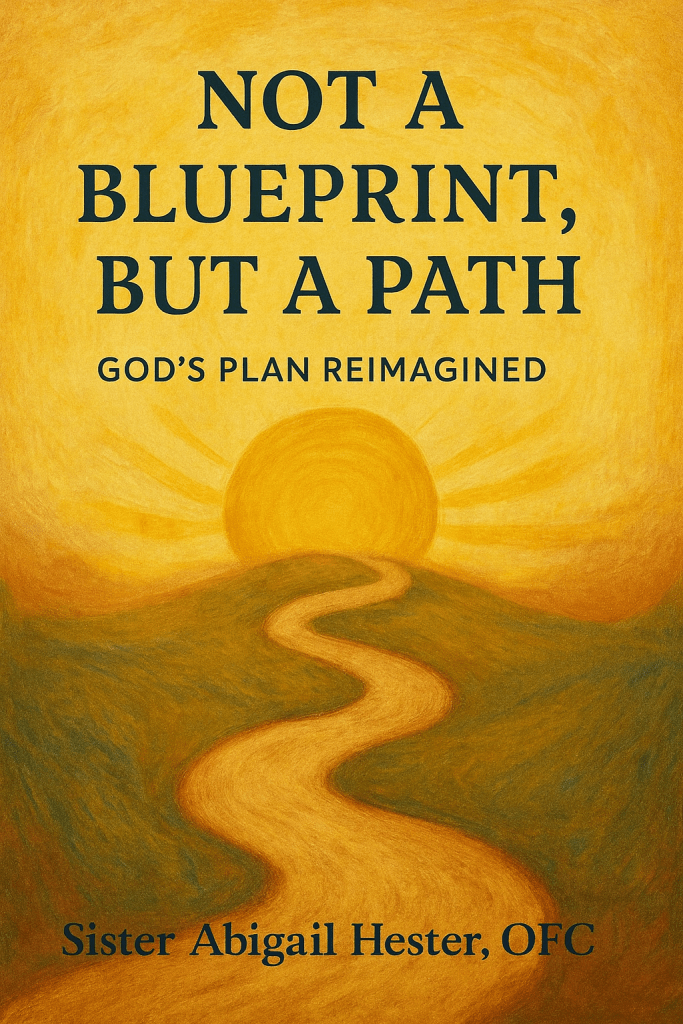
Not a Blueprint, But a Path
God’s Plan Reimagined
Sister Abigail Hester, OFC
Dedication
For those who have been told that God’s plan was already written,
and for those who’ve dared to pick up the pen anyway.
Epigraph
“The Kingdom of God is what the world would look like if God were in charge.”
— John Dominic Crossan
Preface
When I was younger, I believed God had a very detailed plan for my life — as if Heaven’s office had a thick, spiral-bound instruction manual with my name on it. Every decision, every turn, every heartbreak was supposedly already mapped out. My job was simply to figure out the plan and stick to it.
But here’s the problem: that theology kept me passive. It told me that life was a guessing game where the prize was “being right” and the punishment was “missing God’s will forever.” I lived more afraid of messing up than I did excited about living fully.
This book is a love letter to those who have been given a God of control and fear — and who are ready to meet the God of freedom, love, and partnership. Drawing from the wisdom of John Shelby Spong, Marcus Borg, and John Dominic Crossan, I hope to offer a reimagined vision of God’s “plan” — not as a blueprint, but as a path. Not as a control mechanism, but as an invitation to walk with God in co-creation.
Acknowledgments
To the teachers who have shaped my theology: Bishop John Shelby Spong, who taught me to love questions more than answers; Marcus Borg, who taught me that God’s dream is for transformation, not transaction; and John Dominic Crossan, who reminded me that the Kingdom is not a someday hope but a present reality.
To the companions in the Order of Franciscan Clareans, who walk the path of the poor, the queer, and the crucified Christ with me.
And to the God who walks with me — never forcing my steps, but always inviting me forward.
Introduction — When God’s Plan Isn’t a Script
If you’ve been in church for more than five minutes, you’ve probably heard it:
“God has a wonderful plan for your life.”
It’s usually said with a tone of comfort, as if those words can soothe the sting of disappointment, heartbreak, or uncertainty. But for many of us, that phrase has become more trap than treasure. Because it doesn’t take long before “God’s plan” gets tangled up with every bad thing that’s ever happened to us — every loss, every injustice, every grief.
If God’s plan is a perfect blueprint, then every tragedy must be part of it. And if every tragedy is part of it, then what kind of God are we talking about?
I can’t follow a God who sits in some celestial drafting room, pen in hand, deciding in advance who gets cancer, who loses a child, or who lives their life in poverty while others swim in luxury. That’s not a God of love. That’s a tyrant with good PR.
From Blueprint to Path
Marcus Borg often spoke of God’s dream — not an individual blueprint for each life, but a vision for the world: compassion instead of cruelty, peace instead of violence, justice instead of oppression. In this dream, our lives matter not because we’ve stuck to a pre-approved script, but because we’ve joined in the great work of making the dream real.
John Dominic Crossan takes it even further: the Kingdom of God isn’t somewhere else, some other time — it’s what the world would look like if God were in charge here and now. If we want to “follow God’s plan,” we don’t look for a hidden map of our personal destiny. We step into that Kingdom work.
And Bishop Spong? He called us to grow up — to stop clinging to the supernatural micromanager God and start walking with the God who empowers us to create, to decide, to risk, and to love.
Your Life as Co-Creation
The truth is, you’re not a passive character in a divine play. You’re a co-author. God hands you the pen and says, “Let’s write something beautiful together.”
Sometimes that beauty will look like joy and success. Other times, it will look like grit and survival. But in all of it, you are free — and in all of it, you are loved.
So no, God’s plan for your life isn’t a secret document you have to decode before you die. It’s a path you walk with God, step by step, shaping the journey together.
That’s what this book is about:
Leaving behind the blueprint theology that keeps us small.
Discovering the God who invites, not controls.
Learning how to discern a path that aligns with God’s dream for the world — and your unique role in it.
The road won’t always be clear. But here’s the promise: you don’t walk it alone.
Chapter 1 — The Problem with the Puppet-Master God
Somewhere along the way, Christianity picked up a view of God that looks suspiciously like a cosmic control freak. In this telling, God is a grand puppeteer pulling the strings of the universe — deciding in advance who marries whom, who wins the lottery, who survives the car crash, and who doesn’t.
It’s tidy. It’s predictable. It’s also deeply damaging.
Where the Blueprint God Came From
The idea of a divinely pre-scripted life didn’t fall out of the sky; it grew out of a mix of ancient fatalism, imperial politics, and certain readings of Scripture. The Stoics of the Greco-Roman world believed everything unfolded according to an unbreakable fate. Early Christian communities, swimming in that cultural water, sometimes blended this fatalism with Hebrew understandings of God’s sovereignty.
Over centuries, this morphed into the “blueprint God” — the one with every moment already written down. Add Augustine’s doctrine of predestination and Calvin’s double-down on it, and you get a God who supposedly chooses some for eternal bliss and others for eternal damnation before they’re even born.
The Real-World Fallout
In pastoral life, I’ve seen blueprint theology leave two main kinds of wreckage:
- Passivity Disguised as Faith
People avoid making decisions or taking risks because they’re terrified of “missing God’s will.” They pray for signs, wait for perfect clarity, and sometimes never move at all. - Spiritualized Trauma
Survivors of abuse, racism, poverty, and illness are told, “This is part of God’s plan.” That’s not comfort — that’s cruelty dressed up in religious language. It doesn’t heal wounds; it pours salt in them.
Why This View Can’t Hold
If we believe God is love — not just loving, but love itself — then we can’t also believe God micromanages every tragedy. A God of love doesn’t orchestrate cancer or genocide. A God of love doesn’t “plan” your assault so you can “learn something from it.”
Marcus Borg put it plainly: the blueprint God is not the God of Jesus. Jesus revealed a God who heals, forgives, liberates, and feeds. A God who moves toward the brokenness of the world, not the author of it.
The God Jesus Knew
John Dominic Crossan reminds us that in the Gospels, Jesus talks about God’s Kingdom in the present tense — as something breaking into reality here and now through acts of justice, mercy, and radical inclusion. That’s not a static blueprint. That’s a dynamic movement.
Bishop Spong called this the call to “live fully, love wastefully, and be all that you can be.” That’s not about following a pre-cut path; it’s about engaging life with courage, compassion, and creativity.
Where We Go From Here
This book won’t spend time defending the blueprint God — plenty of other voices do that. Instead, we’re going to take a hard look at what happens when we trade that blueprint for a living, breathing partnership with God.
Because the truth is, the only strings God pulls are the ones attached to our hearts — and even then, not to control, but to draw us into love.
Chapter 2 — God’s Dream, Not God’s Script
The blueprint model says: Your life is already mapped. Just figure out the directions and don’t mess it up.
God’s dream says: Your life is a path we create together, and the journey matters as much as the destination.
This is the pivot — the move from seeing God as a cosmic architect to seeing God as a loving co-creator.
Marcus Borg and the Language of God’s Dream
Marcus Borg often spoke of God’s dream for the world — a vision of justice, compassion, and peace. In this vision, the measure of our lives isn’t whether we ticked off the right career, marriage, or zip code. It’s whether we’ve joined the great work of healing creation.
God’s dream isn’t about a divine to-do list; it’s about alignment. It’s about living in such a way that we move with, not against, the current of divine love.
Crossan’s Kingdom Vision
John Dominic Crossan reframes the Kingdom of God not as “heaven after you die” but as “what the world would look like if God were in charge.”
That means God’s “plan” isn’t something hidden in the clouds; it’s happening wherever people feed the hungry, welcome the outsider, challenge injustice, and practice peace.
Your calling — your purpose — is to join that work in your own way. Not because you were assigned a secret role from birth, but because you are uniquely equipped to help bring God’s dream into reality.
The Role of Freedom
Bishop Spong reminded us that God’s gift is not control, but freedom. God wants mature partners, not obedient robots. That means you’re free to choose — and yes, that freedom comes with risk.
God’s dream is big enough to include your detours, your mistakes, and your experiments.
This is good news:
You can’t “ruin” God’s plan for your life.
There is no “Plan B” — only the next step forward from where you are now.
Every moment, even the painful ones, can be woven into the dream.
Your Life as Part of the Whole
One of the great untruths of blueprint theology is that God’s plan is mainly about you. In God’s dream, your life matters deeply — but it’s also connected to every other life.
When you choose love over fear, you’re participating in something bigger than yourself.
When you stand for justice, you’re advancing the Kingdom.
When you forgive, you’re telling the world that healing is possible.
A Shift in the Question
Blueprint thinking asks: “What does God want me to do?”
Dream thinking asks: “How can my life help bring God’s dream to life?”
That’s not a subtle shift — it’s a revolution. It takes you out of fear-based guessing games and into a creative partnership with the Divine.
Chapter 3 — Calling as Co-Creation
When most people talk about “finding their calling,” it sounds like a cosmic scavenger hunt. God’s will is supposedly out there somewhere — hidden under a rock, tucked behind a bush, or concealed in a series of signs you have to interpret perfectly. One wrong turn and poof! — you’ve missed your life’s purpose forever.
That’s a terrible way to live. And it’s not how God works.
The Partnership Model
Think of your calling less like solving a riddle and more like building a house with a friend. God brings the vision, the love, the raw materials of grace. You bring your experiences, skills, personality, and willingness. Together, you create something that reflects the beauty of both partners.
This isn’t a “Here’s the plan — now do it” arrangement. It’s a collaborative process where your creativity matters.
Biblical Examples of Negotiated Callings
The Bible is full of people who didn’t just accept their calling blindly:
Moses argued with God at the burning bush, offering excuses and hesitations before finally saying yes.
Jeremiah protested his youth and inexperience.
Mary asked the angel, “How can this be?” before embracing her role in God’s story.
These stories aren’t about puppets following a script. They’re about real people engaging in dialogue with God.
The Discernment Dance
Progressive Christian discernment isn’t about decoding secret messages — it’s about noticing where your deep gladness meets the world’s deep need (a concept Frederick Buechner famously named).
It involves:
- Listening — through prayer, meditation, nature, conversation.
- Experimenting — trying something, seeing how it aligns with love and justice.
- Adjusting — course-correcting without shame when something isn’t working.
When Fear Masquerades as Faith
Sometimes people hide behind “waiting on God” when they’re really just afraid to move. The truth is, God’s not holding out on you. If you’re aligned with love, compassion, and justice, you can step forward with confidence.
Remember: God can work with your choices. What God can’t work with is you staying frozen in fear.
Calling Is Seasonal
Your calling isn’t a one-and-done assignment. Seasons change. You might be called to activism in one decade, caregiving in another, teaching in another still.
The question isn’t “What is my lifelong calling?” so much as “What is love asking of me now?”
Co-Creation Means Responsibility
Spong was clear — when we move away from the blueprint God, we inherit a responsibility to act. Freedom is risky. But the reward is a life you helped shape with God, one that reflects both divine hope and human courage.
Chapter 4 — The Kingdom Starts Here
When Jesus talked about the Kingdom of God, he didn’t describe it as a far-off utopia you get to after death. He described it as something that breaks in now. The Kingdom, in Jesus’ language, is what the world would look like if God’s dream were fully alive — justice rolling down like waters, enemies reconciled, the hungry fed, the marginalized welcomed as honored guests.
And here’s the kicker: Jesus didn’t just announce this Kingdom. He told us to live as if it were already here.
Kingdom as Present Reality
John Dominic Crossan’s scholarship makes it clear — the Kingdom of God isn’t about escaping the earth for heaven, but transforming the earth to reflect heaven’s justice. This is a movement you join, not a resort you book in advance.
This changes the way we think about “God’s plan” entirely. If the goal is participating in God’s Kingdom, then God’s plan isn’t a private agenda for your happiness; it’s an open invitation to work for the flourishing of all.
How Your Calling Fits
Your personal calling matters because it’s one unique way the Kingdom becomes visible.
A nurse who treats each patient with dignity is enacting the Kingdom.
A farmer who tends the soil responsibly is enacting the Kingdom.
An activist who fights for housing rights is enacting the Kingdom.
A parent raising children to be compassionate and courageous is enacting the Kingdom.
When you live your calling, you’re not just “doing your own thing” — you’re plugging into a much larger story.
From Charity to Justice
Too often, Christians settle for charity when the Kingdom calls for justice. Charity is feeding the hungry; justice is making sure no one is hungry in the first place.
God’s dream is bigger than band-aids. It’s about dismantling systems that harm, not just alleviating the harm they cause.
The Local Start of a Global Vision
The Kingdom may be cosmic in scope, but it starts where you are. Your neighborhood. Your workplace. Your home.
Marcus Borg often said that we enter God’s dream in the here and now — through ordinary choices to embody compassion, to speak truth, to welcome the stranger.
The ripple effects are real. You don’t have to change the entire world. You just have to change the way you live in your world — and trust that God is weaving your small acts into a larger tapestry.
The Danger of Kingdom Amnesia
If we lose sight of the Kingdom, our callings shrink to personal ambition. We might still succeed by the world’s standards, but we’ll have missed the joy of participating in something eternal.
This is why Jesus taught his followers to pray, “Your Kingdom come, your will be done, on earth as it is in heaven.” That’s not a pious wish for later. It’s a rallying cry for now.
Chapter 5 — Unfolding Purpose in a Chaotic World
If there’s one thing life guarantees, it’s disruption. Plans crumble. Health changes. People leave. The world burns (sometimes literally).
If we cling to a rigid “blueprint” view of God’s plan, these disruptions feel like divine betrayal — proof we’ve wandered off the map. But if we see God’s plan as a living, unfolding path, chaos becomes part of the journey, not the end of it.
The Myth of the Unbroken Path
Blueprint theology sells a fantasy: that if you follow the rules and pray hard enough, your life will move in a neat, upward line. Progressive Christianity calls that what it is — spiritual wishful thinking.
Even in the Bible, no one walks a straight path:
Abraham uproots his life without knowing the destination.
Joseph’s road to leadership runs through betrayal, slavery, and prison.
Paul’s ministry includes shipwrecks, beatings, and more than one bad church split.
The path to living God’s dream is rarely smooth — but it’s never without God’s presence.
When the Map Burns
Sometimes, chaos hits so hard it feels like the entire landscape has changed.
The diagnosis you didn’t see coming.
The job loss that shakes your identity.
The relationship that ends with no closure.
In those moments, it’s tempting to think, I’ve missed my calling. But God’s dream is bigger than your circumstances. A detour isn’t divine abandonment — it’s an invitation to reimagine how you’ll keep walking.
The Franciscan Lens: Holding It Lightly
St. Francis embraced “holy detachment” — holding everything lightly so God could shape his life freely. When chaos stripped something away, he saw it as space for something new to grow.
That doesn’t mean we don’t grieve what’s lost. It means we trust that even in grief, love has not left the building.
Practical Tools for Navigating Chaos
- Stay rooted in daily practices. Prayer, meditation, nature walks — whatever grounds you in God’s presence.
- Ask different questions. Instead of “Why is this happening to me?” try “How can I meet this moment with love?”
- Keep community close. You are not meant to walk the path alone.
- Look for the Kingdom signs. Even in crisis, acts of love, justice, and beauty are happening. Let them remind you the dream is alive.
God Is Not Surprised
Your detour did not catch God off guard. The path is not broken — it’s simply bending in a new direction. The Spirit is as present in your uncertainty as in your clarity.
Chapter 6 — No Plan B Needed
One of the most anxiety-inducing lies in blueprint theology is this:
“If you make the wrong choice, you’ll miss God’s plan forever.”
I’ve sat with people paralyzed by this fear — the young adult who won’t commit to a career in case it’s “not God’s will,” the single parent convinced their divorce knocked them out of God’s favor, the elder who believes they’ve “wasted their life” because they didn’t follow the right spiritual path earlier.
If God’s plan is a narrow tightrope, we’re doomed. But if God’s plan is a wide, living path — a partnership shaped by love — then there’s no such thing as “ruining it.”
Grace Is Not Fragile
If we take seriously the idea that God is love, then we have to accept that God’s dream for us is built on grace, not perfection. Grace is stubborn. It doesn’t give up when we wander. It follows us into dead ends and walks us back out.
Marcus Borg would say that God’s plan is about relationship, not performance. You can’t lose the relationship by making a wrong turn — because God never stops walking beside you.
The GPS God
Think of God less like a traffic cop who punishes you for missing a turn and more like the most patient GPS in the world:
Miss the turn? It recalculates.
Hit traffic? It adjusts.
Decide to explore a different route? It comes along for the ride.
At no point does God say, “Well, you messed up. I’m out.”
The Myth of the One Perfect Life
Blueprint theology assumes there’s one perfect version of your life and everything else is failure. Progressive Christianity says there are countless ways to live into God’s dream — some harder, some easier, but all infused with grace and possibility.
This frees you from obsessing over whether you “missed it” in your 20s, 40s, or even 80s. Wherever you are, the path forward begins here.
Biblical Reassurance
The Bible is filled with people whose “Plan A” fell apart:
Moses was a fugitive before he was a leader.
Ruth was widowed before she became part of the Messiah’s lineage.
Peter denied Jesus before he became a cornerstone of the church.
If their detours didn’t cancel their calling, yours won’t either.
God’s Plan Is Not a Trap
You don’t have to live in fear of making the “wrong” choice. The Spirit is far more creative than your mistakes are destructive.
Chapter 7 — Your Plan, God’s Dream, Our World
If God’s plan is more than just a private arrangement between you and the Divine, then your life is part of a much bigger story — one that stretches from Genesis to right now, from your kitchen table to the farthest edge of creation.
The question shifts from “What does God want for my life?” to “How can my life serve God’s dream for the world?”
From Me-Centered to We-Centered
Blueprint theology tends to shrink God’s plan down to individual milestones — the right spouse, the right career, the right church. But God’s dream is inherently communal.
Marcus Borg reminds us that Jesus’ message was never just about personal salvation. It was about the transformation of the whole social order — the poor lifted up, the oppressed set free, the outsiders brought in.
Your personal path matters because it shapes the world around you. Every act of kindness, every stand for justice, every word of encouragement plants a seed in the larger Kingdom garden.
Your Gifts, the World’s Needs
John Dominic Crossan frames it clearly: the Kingdom is what the world looks like when God’s justice and compassion are the organizing principles. That means the question of your calling is inseparable from the question of the world’s need.
Ask yourself:
What gifts, skills, or passions do I have that could make the world more just?
Where do I see suffering or injustice that moves me to act?
How can my everyday choices — where I spend money, how I speak, how I show up — reflect the Kingdom’s values?
The Ripple Effect
One of the most liberating truths about God’s dream is that your contribution doesn’t have to be grand to be meaningful. You may never lead a movement or write a best-selling book, but you can still shift the atmosphere of the world around you.
The Kingdom grows in ripples:
A teacher makes a child feel valued, and that child grows up believing they matter.
A neighbor advocates for safer housing, and a family gets a warm place to live.
A caregiver treats an elder with dignity, and that dignity becomes a model for others.
Your Plan and God’s Dream Are Not Opposed
Sometimes people think they must choose between “doing what they love” and “doing what God wants.” But in a co-creative relationship, God delights in your joy. If your passions align with love and justice, they’re not distractions from God’s plan — they’re the very way you live it.
Kingdom Economics
Bishop Spong spoke often about the need for Christians to grow beyond “tribal religion” and embrace a faith that sees all humanity — and creation itself — as sacred. That means God’s dream disrupts systems that privilege a few at the expense of many.
Your choices — from how you vote to how you shop — are part of that disruption.
The Ongoing Conversation
Your calling isn’t a single conversation you have with God. It’s a lifelong dialogue. As your circumstances, skills, and opportunities change, so does the way you join in God’s dream.
Chapter 8 — Walking the Dream
If you’ve read this far, you’ve probably noticed a pattern: God’s plan isn’t about a rigid checklist; it’s about relationship, participation, and love-in-action.
The question now is: How do you actually live this every day?
Daily Alignment with God’s Dream
Walking the dream is less about giant leaps and more about consistent steps.
Here are four anchors for daily life:
- Start in Presence — Begin your day with stillness. Whether it’s prayer, breathwork, or a few minutes of quiet in nature, start by centering yourself in God’s presence.
- Choose Love in the Small Things — The Kingdom often shows up in the way you speak to the cashier, the patience you show your kids, the empathy you offer a stranger.
- Practice Holy Curiosity — Instead of rushing to judgment, ask: Where is God’s dream alive in this situation? What might love do here?
- Reflect and Recalibrate — End the day with gratitude and honest self-assessment. Where did I move with the dream? Where might I choose differently tomorrow?
Living with Open Hands
St. Francis called his followers to live “without anything of their own.” While that was a literal call to poverty for him, it’s also a spiritual posture: holding your plans lightly so God can shape them freely.
This doesn’t mean you have no goals. It means your goals aren’t idols. You’re free to let them change if love leads you elsewhere.
Sabbath as Resistance
In a culture obsessed with productivity, resting can be a radical act of trust. Sabbath says, “The dream doesn’t depend solely on me — and that’s good news.” It keeps you from confusing your worth with your output.
The Kingdom Compass
When in doubt, run decisions through a simple filter:
Does this choice reflect love?
Does it move me closer to justice?
Does it honor the dignity of others?
If the answer is yes, walk forward with confidence.
Conclusion — A Path, Not a Prison
God’s plan is not a prison sentence you serve. It’s a path you walk with a loving companion who delights in your freedom.
You will get lost sometimes. You will take detours. You will run into storms you didn’t choose and deserts you’d rather avoid. But at no point will you be abandoned.
Marcus Borg gave us the language of God’s dream. John Dominic Crossan reminded us the Kingdom starts here. Bishop John Shelby Spong dared us to grow up into faith that can handle freedom.
Now the invitation is yours:
Pick up the pen.
Step onto the path.
Join God in building the world love longs to see.
Because the plan isn’t hiding somewhere out there. You’re living it — one step, one choice, one act of love at a time.
Appendix A — Reflection Questions for Each Chapter
Introduction — When God’s Plan Isn’t a Script
- When have you felt trapped by the idea of a “blueprint” God?
- What would change in your faith if you saw God as a co-creator instead of a micromanager?
Chapter 1 — The Problem with the Puppet-Master God
- How has the “God controls everything” theology affected your spiritual life?
- Where do you see harm caused by telling people “everything happens for a reason”?
Chapter 2 — God’s Dream, Not God’s Script
- What does Marcus Borg’s idea of God’s dream stir in you?
- Where do you see signs of the Kingdom in your everyday life?
Chapter 3 — Calling as Co-Creation
- How do your skills, passions, and values align with the needs of the world?
- What would it look like to take one small step toward co-creating with God this week?
Chapter 4 — The Kingdom Starts Here
- Where in your community can you work for justice, not just charity?
- What would change if you lived as if the Kingdom was already here?
Chapter 5 — Unfolding Purpose in a Chaotic World
- How have detours shaped your understanding of God’s plan?
- What practices help you stay grounded when life feels unpredictable?
Chapter 6 — No Plan B Needed
- When have you believed you “missed” God’s plan?
- How does grace change the way you see your past choices?
Chapter 7 — Your Plan, God’s Dream, Our World
- How does your personal calling intersect with the needs of your community or world?
- What ripple effects could your everyday choices create?
Chapter 8 — Walking the Dream
- Which of the daily anchors resonates most with you?
- How will you align your choices with love and justice this week?
Appendix B — Further Reading & Resources
By John Shelby Spong
Why Christianity Must Change or Die
A New Christianity for a New World
By Marcus Borg
The Heart of Christianity
The God We Never Knew
By John Dominic Crossan
The Greatest Prayer
God and Empire
Additional
The Universal Christ by Richard Rohr
Freeing Jesus by Diana Butler Bass
Acknowledgments (Extended)
My gratitude extends beyond the teachers named in the front matter to the countless conversations, communities, and companions who have challenged and inspired me. Every dialogue, disagreement, and shared meal has shaped my understanding of God’s dream.
About the Author
Sister Abigail Hester, OFC, is a Franciscan Clarean nun, writer, and founder of the Order of Franciscan Clareans — a progressive Christian community committed to following the poor, queer, and crucified Christ. She writes at the intersection of faith, justice, and compassion, drawing inspiration from the work of John Shelby Spong, Marcus Borg, and John Dominic Crossan. Her ministry blends historical Jesus scholarship, liberation theology, and a deep belief in God’s dream for the world.
 Sister Abigail Hester