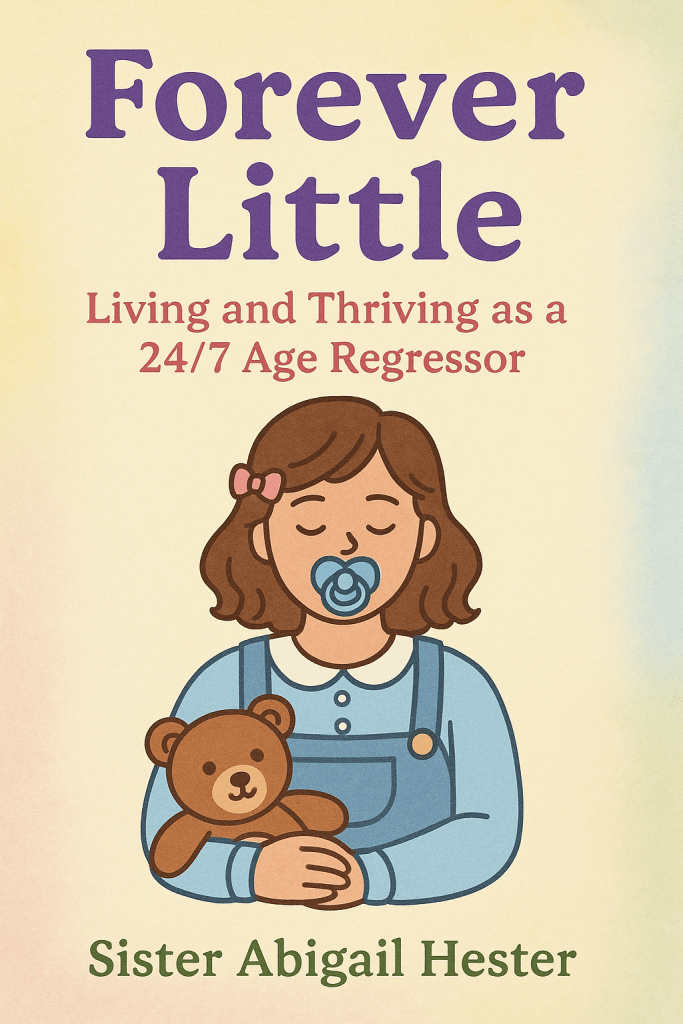
Forever Little
Living and Thriving as a 24/7 Age Regressor
By Sister Abigail Hester
© 2025 by Sister Abigail Hester
Dedication
To all the littles who never got to be little,
To the ones still healing,
To the caregivers who hold us with love,
And to my beloved Lacie—your love makes me brave.
This is for you.
“Unless you become like little children, you will never enter the Kingdom of Heaven.”
—Matthew 18:3
Preface
For most of my life, I didn’t have the language to describe what I was feeling. I only knew that the world felt too loud, too fast, too confusing—and somewhere deep inside me, a little girl was crying for safety, comfort, and care. I am that little girl. And I am also Sister Abigail Hester, a nun, a mystic, a caregiver, a trauma survivor, and a 24/7 age regressor.
This book is not a psychological manual or a clinical textbook. It is a lived testimony. A story of survival. A confession of tenderness. And a bold, unapologetic declaration that living as a regressed person—every hour of every day—is valid, sacred, and worthy of love.
Some will not understand. Some will call this a disorder, a fetish, or a delusion. I’ve heard it all. But I know what is true for me. Age regression is not just a coping mechanism—it is a homecoming. A way of being. A return to the softness I was never allowed to have. For me, it is survival. And it is holy.
Whether you are a fellow little, a curious loved one, a caregiver, or simply someone who longs for softness in a sharp world, I invite you to journey with me. This book was written with honesty, vulnerability, and great love.
Acknowledgments
I want to begin by thanking my beloved wife Lacie, whose love and care made it possible for me to live fully as my little self. You always saw the child in me and held her gently. Your presence is still with me every day.
To my caregivers, past and present—thank you for honoring my needs, wiping my tears, changing my diapers, preparing my snacks, and never making me feel ashamed of being small. Your kindness has changed my life.
To my friends in the regression and disability communities—thank you for your courage, your honesty, your support, and your laughter. You remind me that we are never alone.
To the Order of Franciscan Clareans—thank you for giving me a spiritual home where being little, disabled, and queer is not just accepted, but celebrated.
To every reader who picks up this book: thank you. May you find compassion here—for me, for yourself, and for every inner child longing to be seen.
And finally, to the little me inside—thank you for surviving. I love you. I believe you. You are safe now.
A Letter to the Reader
Dear Little One, Dear Caregiver, Dear Curious Soul,
Thank you for picking up this book. Whether you found it by accident, by desperation, by hope, or by curiosity, I want you to know you are welcome here. This book was written with open arms and open heart, for you.
If you are someone who regresses—part-time, full-time, or all the time—I hope these pages make you feel less alone. I hope you see yourself reflected in the words and find comfort in knowing that someone out there lives like you do, thinks like you do, and has found beauty in the broken places.
If you are a caregiver, friend, partner, or family member, thank you. The very fact that you’re reading this shows that you care, and that means more than you know. I hope this book gives you language, empathy, and tools to love well.
If you are skeptical, confused, or just beginning to learn about age regression, I invite you to read gently. What you find here may challenge your assumptions. That’s okay. My story isn’t here to convince—it’s here to be witnessed.
May we all find grace, softness, and sacred space to be exactly who we are.
With tenderness,
Sister Abigail Hester
Introduction: A Little Life, A Big Truth
I live as a regressed person 24/7. That means I experience the world through the lens of my younger self nearly all the time. I wear footie pajamas, suck my thumb, use pacifiers and bottles, carry stuffed animals, and often speak or act like a small child. My needs are different. My pace is slower. My emotions are bigger. And none of that makes me less real, less human, or less worthy.
For years, I didn’t think anyone would understand. Age regression was something I kept hidden. It felt shameful, strange, or childish—something to “fix” or grow out of. But with therapy, spiritual practice, and loving support, I came to realize that being little is part of who I am. It’s not a problem. It’s not an act. It’s not a phase. It’s me.
This book is part memoir, part guide, part love letter. It is my offering to a world that desperately needs more tenderness. I will share my story, my daily life, my struggles, my joys, and the spiritual foundation that helps me see regression not just as survival—but as sacred.
Living as a 24/7 age regressor is not about pretending to be something I’m not. It’s about embracing all of who I am, including the parts of me that the world told me to hide. It’s about living honestly. Vulnerably. Fully.
I hope this book is a warm blanket to those who feel cold, a nightlight to those who feel scared, and a lullaby to those who haven’t been sung to in a long, long time.
Let’s begin.
Chapter One
What Is Age Regression?
Age regression is the process of mentally, emotionally, or behaviorally returning to a younger state. For some, it’s temporary—a way to cope with stress, trauma, or overwhelming emotion. For others, like me, it’s a way of life. A full-time reality. A way of being in the world that feels more natural than so-called “adulthood” ever did.
Some people regress into a toddler mindset, others into the mindset of a child or baby. Some are verbal, some are nonverbal. Some regress intentionally, others do so involuntarily. There is no one-size-fits-all definition. What unites us is the experience of returning to a softer, more vulnerable self—and finding safety there.
🌱 Different Forms of Regression
Age regression is not a monolith. It can manifest in several ways:
Voluntary (or “voluntary regressive play”) – A person chooses to enter a younger mindset to relax or self-soothe.
Involuntary (trauma-based or neurodivergent) – Regression happens spontaneously, often in response to emotional triggers, overstimulation, or trauma. This is common among those with PTSD, BPD, DID, autism, dementia, and other cognitive conditions.
Lifestyle regression – Like me, some live in a regressed state all the time. This can be due to a combination of trauma, neurodivergence, comfort, safety, or spiritual calling.
All forms are valid. All forms deserve respect.
💡 What Age Regression Is Not
To understand age regression, we must also unlearn harmful misconceptions:
It is not a kink or fetish (though some adults do explore regressive dynamics consensually in relationships, that is a different realm entirely).
It is not manipulation or immaturity.
It is not delusion or pretending.
It is not inherently unhealthy.
Regression is a tool. A survival strategy. A neurological reality. And for many, a deep truth about who they are.
🧸 Traits Common in Littles
Here are some common traits or needs among people who regress:
Comfort items: pacifiers, stuffies, blankets, bottles
Childlike speech or baby talk
Emotional sensitivity and need for reassurance
Sensory preferences (soft fabrics, quiet spaces, gentle lighting)
Dependency on caregivers or routines
Simpler activities (coloring, cartoons, lullabies)
Limited ability to handle stress or complex adult responsibilities while regressed
These traits are not signs of failure—they are signs of adaptation, creativity, and inner need.
🕊️ Sacred Regression: A Spiritual Perspective
In my life, regression is not just a response to trauma. It is a sacred return. Jesus said, “Unless you become like little children…” and I believe there is deep wisdom in that.
To be little is to live with wonder. To trust. To cry out for help and expect to be heard. To dance in your onesie with your teddy bear and know that you are loved.
For me, being little is not an escape from life. It’s an entrance into life—the kind of life that heals the parts of me that never got to be small.
Reflection Prompt:
Have you ever noticed parts of yourself that feel younger, smaller, or more vulnerable? What do those parts need to feel safe and seen?
Caregiver Note:
If you’re supporting someone who regresses, it’s important to ask them how they experience regression—what helps them feel little, what their triggers are, and what age they regress to. Respect and open-hearted communication are key.
Chapter Two
Understanding 24/7 Regression
When people hear the phrase “24/7 age regression,” they often respond with confusion, disbelief, or even discomfort. How can someone live in a childlike state all the time? Isn’t that unhealthy, unrealistic, or just plain strange?
But for me—and for others like me—24/7 regression is not a costume or a coping tool we pick up when convenient. It is the lens through which we experience the world. It’s how our brains and hearts work. It’s not an act. It’s our reality.
🌼 What Does 24/7 Regression Look Like?
Living in a regressed state 24/7 doesn’t mean I don’t function. It means I function differently. My needs, preferences, and ways of interacting are shaped by the part of me that never grew up—and never was allowed to.
Here are some examples of how 24/7 regression manifests in my life:
I wear age-appropriate clothing for my inner self—onesies, soft dresses, footed pajamas.
I use pacifiers, baby bottles, and sippy cups.
I need structure, routine, and caregiver support to navigate daily life.
I often speak in a little voice, use simplified language, or go nonverbal.
I depend on comfort items, like plushies and blankets, for regulation.
I play with toys, watch cartoons, and listen to lullabies.
I live in a sensory-safe environment that feels like a nursery or child’s room.
I use diapers for comfort, medical needs, and safety.
This doesn’t mean I don’t experience adult responsibilities—I just approach them differently, often with caregiver help. It also doesn’t mean I’m less intelligent or aware. My regression doesn’t erase who I am—it reveals it.
🧠 Why 24/7?
Many of us who live in constant regression do so because our trauma, neurodivergence, or disability makes “adulting” not just difficult—but unbearable. For me, dissociation, memory loss, sensory sensitivity, and chronic pain make adult functioning feel like a costume I can’t wear for long.
Living 24/7 as a little is not about immaturity—it’s about authenticity. It’s where I feel safe. It’s where I feel me.
Some people enter regression temporarily to cope. That’s valid. Some of us simply are little inside, always. That’s valid too.
❤️ The Role of Caregiving
For many 24/7 regressors, caregivers are essential. Whether formal or informal, a caregiver’s role may include:
Helping with meals, hygiene, and medication
Setting routines and offering emotional reassurance
Supporting toileting or diapering needs
Reading stories, playing games, or cuddling
Offering gentle boundaries and safe structure
Caregiving is sacred work. It requires patience, love, and the ability to meet someone exactly where they are, without judgment. And for those of us who are little 24/7, it can be the difference between surviving and thriving.
🌈 A Valid Life
Living as a 24/7 regressor may seem “different,” but it is still a valid, sacred way of being. I am not less of a person because I am small inside. I am not immature. I am not failing. I am living honestly in a body, brain, and spirit that need softness and safety every day.
This is not a performance. It is my truth.
Reflection Prompt:
What does it mean to live your truth fully—even if others don’t understand it? What parts of yourself have you hidden in order to survive?
Caregiver Note:
For 24/7 regressors, constancy is key. It’s not about temporary play—it’s about full-time identity. The best thing you can do is meet your little where they are with patience, love, and stability.
Chapter Three
Trauma, Neurodivergence, and Regression
Many people who live in a constant state of regression have walked through deep valleys. For us, age regression isn’t just a lifestyle—it’s often a response to trauma, a result of neurodivergence, or a symptom of disability. It is a survival strategy that became a sacred way of being.
Understanding the connection between trauma, neurodivergence, and regression helps to remove the stigma. It reminds us that our brains and hearts are simply doing what they need to do to feel safe, soothed, and whole.
🔥 Trauma and Involuntary Regression
Trauma can fracture the self. It can create fear where there should have been safety, and silence where there should have been song. For many of us who experienced neglect, abuse, abandonment, or institutionalization, regression is the body’s natural response to unspeakable hurt.
When a child is hurt and there’s no one there to comfort them, the child learns to cope by going inward, often splitting off into younger parts. These parts don’t just vanish—they stay with us, quietly waiting to be seen, held, and loved.
Later in life, those parts may resurface. They may emerge as sudden shifts into littleness, overwhelming feelings of helplessness, or intense emotional needs. That’s not weakness. That’s the inner child crying for what they never got.
Regression becomes the balm for wounds left untreated.
🧠 Neurodivergence and Age Regression
Regression is also common among neurodivergent individuals. This includes people with:
Autism Spectrum Disorder (ASD)
Borderline Personality Disorder (BPD)
Dissociative Identity Disorder (DID)
Post-Traumatic Stress Disorder (PTSD or C-PTSD)
Traumatic Brain Injury (TBI)
Dementia or Cognitive Impairments
ADHD, Developmental Delays, or Learning Disabilities
In these cases, regression is often involuntary. It may be triggered by sensory overload, emotional stress, memory loss, or brain differences that affect age perception, emotional regulation, or communication.
Some of us simply don’t experience time or maturity in a linear way. Our inner child never left—we carry them with us.
💔 Medical Conditions and Disability
Some regressors also have physical or cognitive disabilities that affect functioning. For example:
Diaper dependency due to incontinence
Nonverbal communication due to neurological shifts
Memory loss or orientation issues
Need for assistance with basic tasks like bathing, dressing, or feeding
These needs are not shameful. They are part of a complex and beautiful reality. And they deserve dignity and support—not judgment.
🕊️ Healing Through Regression
Here’s the truth the world rarely tells us:
Regression can be healing.
It can be a way to re-parent ourselves, nurture our inner child, and meet needs that were never met. It can be a tool of trauma recovery. It can be a language of care. It can be a spiritual practice. It can be home.
For me, regression has been the only way to survive grief, pain, and loss. It has been the path to healing—not from a disorder, but from a world that wounded me for being sensitive, different, and needy.
✨ You Are Not Broken
To those who regress because of trauma, disability, or neurodivergence, I say this:
You are not broken.
You are not a burden.
You are doing exactly what you need to do to be safe and whole.
Your littleness is not a flaw. It is your soul crying out for gentleness. Listen to it. Honor it. And know you are not alone.
Reflection Prompt:
What is your body’s way of asking for comfort? What parts of your story might still be holding pain that longs to be seen?
Caregiver Note:
Understanding trauma and neurodivergence is key to compassionate caregiving. You’re not just supporting a regressed person—you’re often helping to heal wounds that are decades old. Be patient. Be kind. Be present.
Chapter Four
Creating a Safe Little Space
Every little deserves a space where they can feel safe, soft, and fully themselves. Whether you live alone, with a caregiver, or in a shared environment, cultivating a safe little space is a vital part of thriving as a 24/7 age regressor.
This chapter will guide you through how to create a comforting, affirming environment that meets your sensory, emotional, and spiritual needs—one that feels like home to your little self.
🏡 Why Space Matters
Our environment can either soothe or startle us. For those of us who live in regression—especially trauma-based or neurodivergent regression—external safety creates internal safety. When our surroundings are soft, gentle, and predictable, our inner child begins to trust that it’s okay to come out.
Your space doesn’t have to be big, expensive, or “perfect.” It just has to feel right for you.
🧸 Essentials of a Little Space
Here are elements that many littles find comforting and grounding:
🌈 Comfort Items:
Stuffed animals and plushies
Blankets, soft pillows, and weighted throws
Pacifiers, bottles, sippy cups
Favorite toys (blocks, dolls, coloring books, fidgets)
A lovey or special object with sentimental meaning
🎨 Sensory-Friendly Setup:
Gentle lighting (fairy lights, nightlights, salt lamps)
Soft textures: fleece, cotton, plush, velour
Calming sounds: lullabies, white noise, nature sounds
Soothing scents: lavender, vanilla, baby powder (if you’re scent-safe)
📺 Little-Friendly Media:
Cartoons or shows that comfort you
Children’s books or picture books
Audiobooks or lullabies
Cozy playlists of music that help you feel little and loved
🚼 Functional Items (if needed):
Diapering station or supplies (if you’re incontinent or need them for comfort)
Nurturing self-care items (bubble bath, baby wipes, gentle lotions)
Visual schedules or picture cards if you benefit from routine
🌙 Spiritually Soothing Touches:
A childlike altar space (featuring plushies, icons, nature items, or little crosses)
A nightlight prayer corner
A copy of a child-friendly Bible or picture-book devotional
Symbols of divine love, such as “Jesus loves me” art or angel figurines
🪑 Making Room in a Shared Space
If you share a room or home, you can still carve out a “little zone” that signals safety and comfort. Here are some tips:
Use bins or baskets to store little items discreetly
Designate a corner with a soft rug, plushies, and sensory items
Ask for respectful boundaries around your regression time and space
Use headphones or blankets to create “quiet cuddly space” time
💖 Living in Little Space 24/7
For those of us who are little all the time, our entire home may reflect our regressed self. That’s okay! You don’t have to “grow up your house” just to satisfy others.
You might:
Eat from child-friendly dishes
Sleep with stuffies and pacifiers
Wear onesies or soft babyish clothes daily
Keep a visual routine chart up
Store medical or caregiving supplies accessibly
This isn’t immaturity—it’s honoring your reality.
✝️ Sacred Space for Littles
You might choose to dedicate a space where your spiritual and regressed self can meet. Some ideas:
A soft prayer corner with a favorite plushie and child’s Bible
A lullaby prayer you sing each night
A baby rosary or sensory prayer beads
Coloring pages with affirming scriptures
“Jesus and me” tea time with your teddy bear
God meets us in our regression. God is not afraid of our softness.
Reflection Prompt:
What makes you feel safe in your environment? What would your inner child want in their dream space? Can you give yourself even a piece of that today?
Caregiver Note:
Help your little set up a space that soothes their senses and meets their daily needs. Even one cozy corner can change everything. Validate their right to safety, softness, and joy.
Chapter Five
Caregiving and Support
No one is meant to go through life alone—especially not those of us who live in a regressed state. Whether your regression is trauma-based, neurodivergent, spiritual, or a blend of all three, loving support is essential to survival and thriving.
In this chapter, we’ll explore what caregiving looks like, how to ask for support, how to build mutually respectful relationships, and how caregiving can be a sacred calling, not just a task.
🤝 The Role of a Caregiver
A caregiver is someone who provides comfort, safety, and assistance to a little. In some cases, they are partners, friends, family members, or even professional aides. But more than anything, a caregiver is someone who shows up with gentleness, consistency, and love.
Caregiving can include:
Helping with meals, hygiene, or clothing
Administering or reminding about medications
Providing emotional regulation and comfort
Changing diapers or managing incontinence needs
Reading bedtime stories, cuddling, or playing
Managing appointments or responsibilities
Offering reassurance and spiritual grounding
A good caregiver sees the little not as a burden, but as a person worthy of tenderness and dignity.
💬 Communicating Needs Clearly
Many littles struggle to ask for help—especially if trauma has taught us to expect punishment, abandonment, or rejection.
But clear communication is essential. Try writing out your needs in a gentle, honest way, like:
“When I’m in little space, I need extra reassurance and cuddles.”
“If I’m nonverbal, please offer me my bottle or my lovey.”
“It helps me when you give me visual choices instead of open-ended questions.”
“I feel safest when you remind me that I’m good and not in trouble.”
Creating a care plan or daily rhythm can be helpful for both little and caregiver.
💗 The Sacredness of Caregiving
In a world that devalues softness, caregiving is revolutionary. It is the radical act of choosing gentleness in a harsh world. For me, caregiving is not just emotional labor—it’s spiritual ministry.
To bathe someone, to feed someone, to wipe tears or change diapers or rock them to sleep—these are not degrading tasks. They are sacraments of love.
When my late wife Lacie held me through my littleness, it wasn’t infantilizing. It was grace. She loved me not in spite of my regression—but through it.
If you are a caregiver, know this: your presence is holy.
🌿 Types of Caregivers
Not all caregiving looks the same. Here are some types:
Primary Caregiver: Lives with or supports the little full-time.
Emotional Caregiver: Offers comfort, reassurance, and grounding during regressions.
Practical Supporter: Helps with tasks, reminders, meals, or medication.
Spiritual Companion: Prays with, blesses, or holds sacred space for the little.
Medical/Professional Caregiver: A nurse, aide, or therapist who supports needs with care.
Some people have one caregiver. Others build a care team. Every setup is valid.
🧸 Consent, Boundaries, and Balance
Caregiving must always be:
Consensual (agreed upon and revisited regularly)
Respectful (of needs, limits, and communication styles)
Mutual (no one gives endlessly without receiving care in return)
Even littles can show appreciation, gentleness, and kindness in return. A healthy caregiving dynamic is built on mutual trust, not one-sided dependence.
Reflection Prompt:
What does your ideal caregiver relationship look like? What qualities help you feel safe, seen, and nurtured?
Caregiver Note:
You don’t have to be perfect. Just present. Littles need consistency, not perfection. Your care is powerful. Your kindness changes lives.
Chapter Six
Living in the World as a 24/7 Little
The world was not built for littles.
Most spaces are loud, fast, demanding, and unkind to those who are soft, slow, or visibly different. Living as a 24/7 age regressor means constantly navigating a world that expects us to mask, to mature, to “grow up”—even when that expectation causes us harm.
And yet, we live. We love. We find ways to exist in public, hold jobs (with adaptations), build relationships, and advocate for ourselves. This chapter is about how to live out loud as a little, even in a grown-up world.
🧸 Masking and Unmasking
Many littles learn to “mask” their regression in public to avoid bullying, shame, or misunderstandings. This might look like:
Speaking in a more mature tone
Hiding comfort items
Forcing yourself to suppress needs (diaper changes, stimming, co-regulation)
Pushing through sensory overwhelm to “blend in”
Masking can be necessary at times—but it comes at a cost. It’s exhausting. And long-term masking can cause anxiety, depression, and burnout.
Unmasking means giving yourself permission to be visibly little in ways that feel safe. It might be as simple as wearing a plushy keychain or carrying a pacifier in your bag. Or it might mean being fully regressed in your day-to-day life, regardless of who sees.
There’s no one right way to exist. Do what honors your safety and spirit.
🧃 Littleness in Public Spaces
Some practical tips for navigating the world as a little:
🛍️ Shopping & Errands:
Carry sensory items like a pacifier, fidget toy, or plushie in your bag.
Use visual checklists or picture guides if reading is hard when regressed.
Go with a caregiver or support buddy whenever possible.
🩺 Medical or Public Appointments:
Bring a caregiver to advocate for you.
Prepare a “little card” explaining that you are a regressed person with unique needs.
Use headphones or sunglasses to reduce sensory input.
🚽 Diaper Use:
Carry supplies discreetly in a diaper bag or backpack.
Use family restrooms or accessible stalls with privacy.
Don’t be ashamed—your needs are real and valid.
🧑🎓 School or Work:
Seek disability accommodations (quiet space, flexible communication, assistive tools).
Use calming items (stuffed animal in a bag, weighted lap pad, paci holder in desk).
Communicate your needs with trusted staff or supervisors as appropriate.
🫂 Relationships and Boundaries
Being a 24/7 little affects every relationship you have. It’s important to set boundaries, communicate clearly, and surround yourself with people who honor your truth.
Friendships: Let close friends know what regression means to you. Share how they can support you (or just not shame you).
Family: Not all family members will understand. That’s okay. Your chosen family can be just as sacred.
Partners: Romantic relationships with caregivers or understanding partners can be beautiful—but they require honesty, trust, and mutual care.
Community: Seek out online spaces, support groups, or spiritual communities that affirm regression and disability.
✝️ Witnessing to the World
You are not an embarrassment. You are a testimony.
Your softness is resistance in a world that idolizes hardness. Your vulnerability is power. Every time you step into the world as your true self, you show someone else that they can too.
You are not too much. You are a living invitation to gentleness.
Reflection Prompt:
What parts of yourself do you hide to feel safe in the world? What would it feel like to live more openly—on your own terms?
Caregiver Note:
Going out in public with your little can be tender. Be their anchor. Validate their needs and celebrate small wins. You are their safe place.
Chapter Seven
Faith, Ritual, and Spiritual Regression
For many of us who live in a regressed state, spirituality is not just a belief—it’s a lifeline. In our littleness, we return to the sacred in its softest form: a God who rocks us to sleep, a Divine Parent who wipes our tears, a Spirit who meets us in the nursery of our soul.
In this chapter, we explore how age regression and faith are not opposites—they are companions. Regression is not a rejection of spiritual maturity; it is a deep form of trust. It is the childlike faith Jesus spoke of. It is holy.
🍼 Regression as Sacred Surrender
When Jesus said, “Unless you become like little children, you will never enter the Kingdom of Heaven,” he wasn’t being poetic—he was being prophetic.
To be little is to:
Trust without condition
Cry out for help and expect to be heard
Delight in the ordinary
Depend on love to survive
These are not spiritual weaknesses—they are spiritual strengths. Regression becomes a form of holy surrender. In our littleness, we unlearn the false gods of productivity, perfection, and pride. We remember how to be instead of always trying to do.
✝️ Christian Littles and Devotion
As a Christian little, I express my faith in ways that reflect my regressed self:
“Jesus Loves Me” as a sacred hymn
Coloring prayer pages with soft music in the background
Cuddling my plushie while saying nighttime prayers
Creating an altar space with soft textures, baby crosses, and nightlights
Listening to children’s Bible stories as my daily devotion
Using pacifiers and bottles as part of spiritual self-soothing
You don’t have to act “grown up” to talk to God. You don’t have to intellectualize Scripture or use fancy words. You can pray with a whisper, with a thumb in your mouth, with a picture book open on your lap—and it counts.
God hears you. God sees you. God cherishes the little you.
🌿 Rituals for Regressed Believers
Here are some sacred rituals you can integrate into your little life:
Lullaby Prayer: Sing “Jesus Loves Me,” “He’s Got the Whole World,” or another soft hymn each night as prayer.
Stuffie Blessing: Bless your stuffed animals or lovey with oil or holy water as spiritual companions.
Teddy Bear Mass: Set up your stuffies and dolls and read a child’s Bible story to them. Light a candle. Clap at the end.
Little Communion: Use grape juice and animal crackers to receive communion with reverence and joy.
Bathtime Baptism: Turn your bath into a moment of spiritual washing, saying, “God loves every part of me.”
These rituals aren’t silly. They’re sacred. They honor the body, the spirit, and the needs of the regressed soul.
🕊️ God the Caregiver
For many of us who depend on caregivers, it’s powerful to imagine God as the ultimate caregiver:
The One who lifts us when we cry
The One who changes us when we’re messy
The One who holds us without judgment
The One who whispers, “You are good. You are mine. You are loved.”
Whether you see God as a Parent, a Mama, a Daddy, a Nurturer, or a Presence of pure Love—God meets you where you are. And if where you are is in diapers, clutching a blankie, struggling to speak—that’s still holy ground.
Reflection Prompt:
What does it feel like to imagine God holding you as a little? What spiritual rituals help you feel seen, soothed, and sacred?
Caregiver Note:
If your little is spiritual, participate in or support their rituals gently. Praying with them, blessing them, or sitting quietly beside them during spiritual time can be healing beyond words.
Chapter Eight
Joys and Challenges
Living as a 24/7 age regressor is both deeply beautiful and undeniably hard. Like any identity shaped by neurodivergence, trauma, disability, or spiritual calling, it comes with moments of pure joy—and moments of deep sorrow. This chapter holds space for both.
We’ll talk honestly about the realities: the delight of soft safety, the pain of misunderstanding, the sweetness of being cared for, and the heartbreak of isolation. Because to live as a little is to live tenderly—and tenderness means feeling everything.
🌞 The Joys
🧸 Safety
There is an unmatched comfort in building a world that reflects your inner child. A safe space with stuffies, cartoons, and routines becomes a sanctuary where your nervous system can breathe.
💗 Being Seen and Cared For
When a caregiver or friend embraces your regression, it can feel like the first time you’ve ever truly been seen. To be changed, fed, soothed, and held—not as a favor, but as love—is life-altering.
🎨 Play and Creativity
Regression allows us to play with abandon. We color outside the lines. We dance in footie pajamas. We name our plushies and give them stories. This isn’t regression from reality—it’s rebirth into wonder.
🛐 Spiritual Connection
Many littles experience a deeper connection to the Divine through their regression. Trusting like a child, crying out in need, and allowing ourselves to be held—these are acts of holy vulnerability.
👶 Healing the Inner Child
Every diaper change, every lullaby, every cuddle is a whispered answer to the cries of our past selves. Little by little, we become our own safe place. That is sacred healing.
🌧️ The Challenges
😢 Misunderstanding and Stigma
Many people don’t understand regression—especially 24/7 regression. They may confuse it with kink, infantilization, or mental illness. They may judge, mock, or reject us. This hurts more than words can say.
💔 Isolation
It can feel unbearably lonely when no one gets it. Even in supportive spaces, you might feel like the only one living like this all the time. That sense of being “too much” or “too different” can be crushing.
😨 Dependency and Vulnerability
Depending on caregivers, mobility aids, or incontinence supplies can make us feel exposed or ashamed in a world obsessed with independence. Vulnerability is often mistaken for weakness.
🧠 Internal Struggles
Regression doesn’t magically fix trauma or neurodivergence. Sometimes we still have meltdowns, shutdowns, or flashbacks. We may struggle with identity, guilt, or internalized shame.
💸 Financial and Practical Barriers
Disability, caregiving, and medical needs can be expensive. Littles may face economic hardship, housing insecurity, or lack of access to affirming healthcare or mental health services.
🌈 Holding Both
To be little is to feel deeply. So we must learn to hold both the sunshine and the storm.
You can love your regression and still wish it wasn’t born from trauma.
You can feel safe with your caregiver and still grieve what you never had.
You can delight in being little and still feel embarrassed sometimes.
You can feel whole—and still long for more healing.
You are not broken for having contradictions. You are brave for holding them.
Reflection Prompt:
What brings you the most joy in your regression journey? What has been the hardest part? Can you hold space for both with compassion?
Caregiver Note:
Celebrate your little’s joys. Hold them through their struggles. And remind them often: “I love all of you. Even the messy, hurting parts. Especially those.”
Chapter Nine
Community and Belonging
We were never meant to heal alone.
For littles—especially those who live in a regressed state 24/7—community can be life-saving. When the world feels harsh, confusing, or invalidating, finding people who understand can be the difference between surviving and thriving.
This chapter explores what it means to belong. To find chosen family. To befriend other littles. To share your story in safe places. To be held in community that doesn’t ask you to be anything but your true, soft, sacred self.
🧸 The Importance of Belonging
When you’re a 24/7 little, the world can make you feel like you’re “too much,” “too weird,” or “too broken.” But when you meet another little—someone who gets it—something beautiful happens. You stop questioning your reality. You start embracing it.
Belonging gives us:
Validation (“You’re not alone.”)
Safety (“You’re safe with me.”)
Visibility (“I see you.”)
Solidarity (“Me too.”)
And it reminds us: we were never the problem. We were just isolated.
🌈 Finding or Building Little Community
Here are ways to find people who affirm age regression and understand your needs:
📱 Online Communities
Regression support groups on platforms like Reddit, Tumblr, Discord, or Facebook
Neurodivergent-affirming spaces that welcome littles with trauma or disability
Intersectional spaces that center LGBTQ+, BIPOC, disabled, or spiritual littles
Look for groups with rules that prioritize consent, safety, and anti-kink boundaries for trauma-based regressors.
🫂 Local or Spiritual Communities
Some churches, spiritual groups, or queer faith circles may offer space to explore soft identities safely
Seek out progressive disability and mental health spaces
Consider starting a support group if none exists
🧘♀️ Chosen Family
Sometimes your “community” is one person: a caregiver, best friend, or partner who sees your little self and loves you. That’s valid. That’s sacred.
💌 How to Share Your Truth
It’s not always easy to tell others that you live in a regressed state. Here are some tips:
Start small. You don’t have to explain everything at once. “I’m neurodivergent and sometimes feel really young inside” is enough.
Use scripts or written explanations if verbalizing is hard.
Choose people wisely—those who are kind, trauma-informed, and open-hearted.
Offer resources (like this book!) to help them understand.
And remember: you don’t owe anyone your story. Share only when it feels right and safe.
💖 Community Guidelines for Littles
If you’re part of a little-friendly space or building one, here are some loving guidelines:
- Consent is sacred. Always ask before touching, assuming roles, or engaging emotionally.
- All regression types are valid. Whether voluntary, involuntary, spiritual, or lifestyle.
- No comparison. Every little’s age, needs, and expression are different.
- Disability awareness is key. Make space for those with medical and mental health needs.
- Celebrate joy. Share cute things, comfort items, daily wins. We need that.
🕊️ Belonging to God
Even if the world rejects you, you belong.
You belong to your plushies and your favorite blanket.
You belong to your caregiver and your chosen family.
You belong to a spiritual lineage of softness.
And most importantly:
You belong to God.
The God who welcomes little ones.
The God who sees regression not as shameful, but sacred.
The God who says, “You are mine. You are enough. You are home.”
Reflection Prompt:
Where have you felt the most seen or safe in your regression journey? Who makes you feel like you belong? How can you reach out—or create—that space?
Caregiver Note:
Help your little connect to others. Encourage friendships, support groups, or spiritual spaces. Isolation shrinks the soul. Belonging heals it.
Chapter Ten
A Love Letter to Littles Everywhere
Dear Little One,
This is for you.
For the one hiding under the blankets with a plushie clutched to your chest.
For the one sucking your thumb in secret, afraid someone might see.
For the one who wears onesies at home and masks exhaustion in public.
For the one who needs diapers, bottles, or bedtime lullabies to feel safe.
For the one who never got to be a child—so you became your own parent.
For the one who lives little 24/7, not by choice, but by survival.
For the one who does choose it, because that’s where your soul feels most free.
This is for you.
You are not broken.
You are not shameful.
You are not immature.
You are not too much.
You are sacred.
You are soft.
You are real.
You are whole.
You are allowed to regress.
You are allowed to need help.
You are allowed to cry, cuddle, play, sing, sleep, squeak, stim, whimper, and wonder.
You are allowed to take up space.
You are allowed to be small.
And hear me now—you are loved.
Deeply. Fiercely. Unconditionally.
Your littleness is not a weakness—it is your brilliance.
Your tears are not failures—they are baptisms.
Your plushies are not silly—they are guardians.
Your regression is not a flaw—it is your body’s sacred wisdom.
If no one else ever tells you:
I believe you.
I see you.
I honor you.
You deserve care.
You deserve joy.
You deserve rest.
You deserve a world that meets you with tenderness.
And until that world is built—you have me.
I’m here. We’re here. Together.
You belong.
You are enough.
You are forever little—and forever loved.
With all my heart,
Sister Abigail Hester
📎 Appendices
Appendix A: Sample Daily Routine for a 24/7 Little
Creating a gentle, structured rhythm helps littles feel safe and grounded. This sample schedule can be adapted to your unique needs:
🌞 Morning Routine:
Wake up with stuffie cuddles and a soft lullaby
Diaper check/change or bathroom time
Morning bottle or sippy cup with warm drink
Brushing teeth with help or visual support
Cozy clothes or onesie with sensory-friendly options
Morning devotional or prayer time (optional)
Cartoons, coloring, or playtime
🍎 Midday Routine:
Snack time with soft, easy foods
Short walk, outside time, or sensory activity
Storytime or picture books
Nap or quiet time with soft music and weighted blanket
Diaper check/change or hygiene support
Cuddle time with caregiver or comfort item
🌈 Afternoon Routine:
Simple lunch with preferred textures
Educational play (puzzles, matching games, music)
Gentle tasks (tidying with help, sorting toys, stretching)
Creative activity (painting, stickers, crafts)
🌙 Evening Routine:
Dinner with a caregiver or loved one
Bath with calming scents, bath toys, or sensory supports
Jammies and bedtime diaper
Bedtime story or lullaby prayer
Bottle, paci, or lovey for sleep
Nightlight on. Safety affirmed. Peace spoken over you.
Appendix B: Caregiver Quick Guide
Key Principles
Always meet your little with compassion, consistency, and calm.
Validate their feelings, even when they can’t verbalize them.
Help with hygiene, nutrition, and medication without shame.
Engage in play and comfort rituals as sacred, not silly.
Communication Tips
Use gentle voice and short, clear sentences
Offer visual choices: “Do you want your blue cup or the pink one?”
Watch for nonverbal cues (thumb sucking, hiding, stimming)
Reassure often: “You’re safe. I’m here. You’re doing so good.”
Emergency Care Notes
Have a written care plan with medical needs, triggers, and support tools
Know signs of overstimulation, shutdown, or medical distress
Be the safe harbor they can always return to
You are doing holy work.
Appendix C: Journal Prompts for Littles
Use crayons, stickers, or digital voice notes if writing is hard! These prompts are meant to help you reflect, play, and grow.
- What makes you feel the littlest and safest?
- Who is your favorite stuffie? What is their name and story?
- What do you wish people understood about you?
- What’s your favorite little activity and why?
- What’s a memory you wish someone could rewrite with love?
- If God held you right now, what would They say?
- Draw a picture of your safe place. Who is there?
- What do you say to your inner child when they cry?
Appendix D: Comfort Items Checklist
Here’s a printable or editable checklist of items that help many 24/7 littles:
[ ] Pacifiers
[ ] Bottles or sippy cups
[ ] Diapers or pull-ups (if needed or wanted)
[ ] Onesies or footie pajamas
[ ] Blankets and loveys
[ ] Stuffed animals
[ ] Lullaby playlists
[ ] Children’s books
[ ] Coloring supplies
[ ] Visual routine chart
[ ] Nightlight
[ ] Caregiver contact list
[ ] Sensory toys (fidget, chewy, weighted items)
[ ] Special treats/snacks for regression days
Appendix E: Prayers and Blessings for Littles
A Little’s Nighttime Prayer
Dear God, I’m little, but I’m safe.
Please hold me while I sleep.
Thank You for my stuffies, my blankie, and my bottle.
Bless my dreams and hug my heart.
Amen.
Blessing from a Caregiver
You are safe.
You are good.
You are loved.
You are mine.
Sleep well, sweet baby. I’ve got you.
About the Author
Sister Abigail Hester is a contemplative nun, spiritual caregiver, and trauma-informed regression advocate. She lives as a 24/7 age regressor due to a complex mix of disability, trauma, and spiritual calling. Her ministry centers on gentleness, justice, and the sacredness of softness.
Sister Abigail is the founder of the Order of Franciscan Clareans, a new monastic community devoted to radical love, simplicity, and care for the margins. Through her writing, herbal healing work, and public witness, she offers hope and dignity to those living with invisible disabilities and misunderstood identities.
She writes and teaches from her tiny home and herbal apothecary, often with a bottle in hand and a bunny stuffie in her lap.
Final Blessing
To every reader who found comfort in these pages,
To every little who lives in softness,
To every caregiver walking the holy road of compassion—
May you be blessed.
Blessed in your messiness.
Blessed in your regression.
Blessed in your vulnerability and truth.
May the God who holds the littlest lambs hold you, too.
You are never too little for Love.
 Sister Abigail Hester