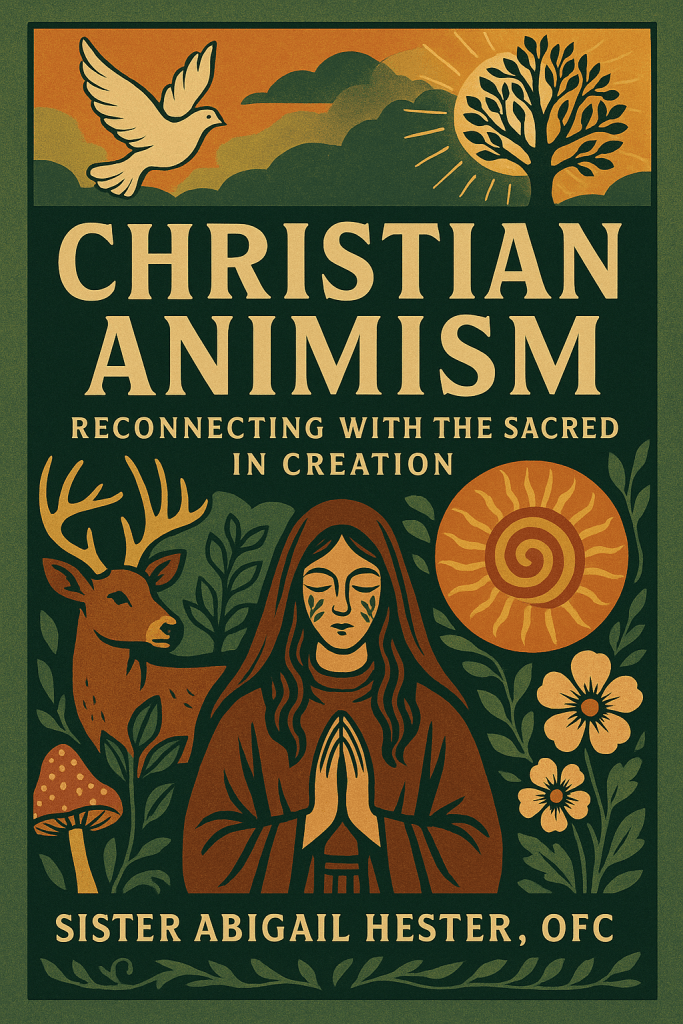
Christian Animism
Reconnecting with the Sacred in Creation
by
Sister Abigail Hester, OFC
For the trees who whispered me home,
for the wind that called me Sister,
and for Lacie, my beloved—
who dances now among the stars and wildflowers.
You taught me how to listen.
“The world is charged with the grandeur of God.”
—Gerard Manley Hopkins
Acknowledgments
This book is a weaving of soil and spirit, ancestors and activism, prayer and protest. I did not write it alone—none of us ever do.
To the Order of Franciscan Clareans, thank you for walking beside me in sacred simplicity, wild devotion, and holy rebellion. Your lives make the gospel real.
To my beloved wife Lacie, whose memory burns like a candle in the forest of my soul. You saw the Divine in every leaf and every tear. This is your book, too.
To the earth itself—the breathing forests, singing rivers, watchful stars, and medicine-bearing herbs—thank you for your patient teachings and constant companionship. You are not “resources.” You are relatives.
To the queer, disabled, Indigenous, and marginalized mystics past and present who remind us that the Divine is never far from the body, the land, or the wound. You gave me courage.
To Robin Wall Kimmerer, Thomas Berry, Hildegard of Bingen, Starhawk, Vandana Shiva, and all the wisdom keepers who taught me that reverence is resistance.
To the scholars, saints, witches, monks, poets, and fools—Marcus Borg, Richard Rohr, John Shelby Spong, Deepak Chopra, Terence McKenna, Patch Adams, bell hooks, Mary Daly, and the Westar Institute—you helped me remember that theology is not just what we believe, but how we be.
To every tree I sat beneath, every herb that healed me, and every bird who reminded me to sing—thank you for your sermons.
Finally, to the Reader, thank you for picking up this book. May you find within its pages a sacred yes: to the dirt beneath your feet, to the soul within your breath, and to the Divine animating all things.
In gratitude and kinship,
Sister Abigail Hester, OFC
Introduction
In the modern world, we often find ourselves disconnected from the land, the elements, and the sacred rhythms of creation. The divine, in many of our spiritual traditions, has been abstracted into something distant and separate, a concept that is often confined to sacred texts, buildings, or the human heart. But what if the Divine is not only within us, but in everything around us? What if God is in the trees, the rivers, the winds, and the stones? What if every living being, seen or unseen, speaks the language of the Holy?
This book, Christian Animism, invites you to return to a sacred understanding of the world—one where the Creator is present in all things, and where our relationship with the Earth is a mutual and holy covenant. Drawing from both Christian and animist traditions, we will explore how these two seemingly disparate spiritualities can be brought together in harmony, reverence, and love.
Christian animism is not a new concept. It has roots in the ancient Christian understanding that all of creation reflects God’s glory. St. Francis of Assisi, the patron saint of the environment, famously called the sun his brother, the moon his sister, and the earth his mother. His spirituality was one of profound connection with all of creation, where animals, plants, and elements were not “things” but sacred beings to be respected and cared for. For St. Clare, the same reverence extended to the simplest, most humble of creations—her spirituality was woven into the fabric of the Earth itself, where every leaf, every stone, and every drop of water spoke of the Divine.
Animism, in its simplest form, is the belief that all things—living or non-living—possess a spirit. It is an ancient worldview, held by countless Indigenous cultures and spiritual traditions around the world. Far from being a primitive belief, animism offers a path to a more holistic and deeply connected existence. It asks us to see the sacred in all things and to live in reciprocity with the Earth and its creatures.
In this book, we will explore how Christian animism allows us to reclaim our connection to the Earth, to our ancestors, and to the Divine. We will examine how ancient animist practices, such as honoring the spirits of the land, offering prayers to the elements, and acknowledging the sacredness of nature, can enrich our Christian faith. We will look at how the practice of animism can help us live more sustainably, with a deep respect for the Earth and a commitment to justice for all beings—human and non-human alike.
Through the lens of this Christian animism, we will also address the theological challenges posed by modernity, colonialism, and environmental destruction. How do we reconcile a faith that has often been used to dominate the Earth with a spirituality that calls us to care for it? How can we heal the wounds caused by centuries of disconnection, exploitation, and harm? What does it mean to live as a Christian animist in today’s world?
Each chapter of this book will offer reflections, rituals, prayers, and meditations designed to help you reconnect with the sacredness of creation and deepen your relationship with God in all things. It is my hope that as you walk this path, you will discover a more intimate, holistic, and joyous faith—one that embraces the divine presence in every blade of grass, every bird in the sky, and every heartbeat of the Earth itself.
Welcome to the journey of rediscovering the sacred in all things. May this path lead you to a deeper communion with the Earth, a more profound relationship with the Divine, and a greater sense of belonging to the whole of creation.
Chapter One: The World Is Alive—Recovering the Sacredness of Creation
“Everything that lives is holy.”
—Alice Walker
A Forgotten Knowing
Long before modern Christianity was shaped by empire, hierarchy, and industrial alienation, it was rooted in the earth. The earliest followers of Jesus lived close to the soil, depending on rain and seed, moon and sun. Jesus himself spoke in parables of mustard seeds, fig trees, wheat, and water. He walked among wild hills and taught from boats. He broke bread with animals in the background and rivers nearby. His miracles were not confined to temples but spilled out into vineyards and seas. For him, creation was not a backdrop—it was the living stage of God’s presence.
Yet somewhere along the way, many Christians were taught that only human souls are sacred. The earth became a commodity. Trees became timber. Animals became resources. Mountains became mines. The spirit was divorced from the soil.
Christian animism dares to challenge that severance. It invites us to remember a deeper truth—that the world is not dead matter, but a living sacrament.
Animism Isn’t Pagan, It’s Human
Animism is not the enemy of Christianity. In fact, it was the spiritual foundation of most human cultures for millennia—including many that shaped our biblical ancestors. To be an animist is not to worship idols, but to reverence the presence of Spirit in all things. Abraham heard God in stars. Hagar met God in the desert. Moses spoke with God through a bush. Elijah found God in a whisper of wind. These are animist moments, whether we name them as such or not.
Today, many Indigenous peoples and animist traditions remain marginalized or demonized by Christian colonizers. But perhaps it’s time we listen instead of lecture. Perhaps the Spirit is calling us to a humbler faith—a faith that learns from the wisdom of the Earth’s original caretakers.
The Gospel According to the Land
Jesus spoke of the lilies of the field and the birds of the air. He taught that the kingdom of God is like a seed, a field, a tree that shelters many. These are not just poetic devices. They are invitations to notice, to listen, to reverence.
The natural world is not only created by God; it is infused with God. To see the land as alive is not heresy—it is holiness.
St. Francis of Assisi called the sun his brother and the moon his sister. He preached to birds and blessed wolves. St. Clare saw the divine in the simplicity of things. These saints were animists in the truest Christian sense: not idolaters, but lovers of the living God in all things.
A Practice of Reverence
To begin living as a Christian animist is to shift how we relate to everything. Before harvesting herbs, we ask permission. Before entering a forest, we greet the spirits of the place. When lighting a candle, we thank the flame. When washing our hands, we bless the water.
It is not about superstition. It is about relationship. It is about reverence.
Try this:
Practice: Blessing the Earth Beneath You
Find a patch of ground—grass, soil, sand, or even concrete. Place your hand on it. Close your eyes. Say aloud or silently:
“You are sacred. You are my kin. Thank you.”
Then wait. Listen. What do you feel?
Devotional Reflection
Where in nature have you felt closest to God?
What parts of the natural world feel alive to you?
How were you taught to view creation—as sacred or as resource?
Prayer
Holy Creator,
You are the wind in the trees,
The voice in the waters,
The pulse of the Earth beneath our feet.
Teach us to see again.
Teach us to listen.
Teach us to honor every living thing
As a bearer of your sacred breath.
Amen.
Chapter Two: Spirits of Place, Saints of the Land
“There are places on the Earth where the veil is thin.”
—Celtic Christian Proverb
The Land Remembers
Every place has a story.
Before the churches and the highways, before fences and foundations, every patch of land had its own rhythm, spirit, and song. Animist traditions have long recognized that the land is not empty or neutral—it is inhabited by spirits, memories, ancestors, and energy. These spirits of place—often called land spirits, nature guardians, or elementals—are real presences, not metaphorical poetry. They are part of the communion of creation.
Christian animism does not erase these spirits. Instead, it honors them as part of God’s diverse household. Just as we revere the saints who walked among us, we can also honor the spirits who dwell in the land.
Biblical Landscapes as Sacred Beings
The Bible is full of holy places where God reveals the sacred through land itself:
The burning bush on Mount Horeb speaks the name of God.
The Jordan River parts for freedom.
The wilderness becomes a place of testing, encounter, and provision.
Jesus retreats to mountains and deserts to commune with the Divine.
These were not mere settings. The land was a participant. It was alive with meaning.
The Celtic Way: Thin Places and Sacred Groves
Early Celtic Christianity—one of the most animist-infused expressions of the faith—taught that the Divine was not only above, but all around. They spoke of “thin places”—locations where heaven and earth kissed, and the spiritual world felt near. These were often natural sites: wells, mountains, groves, and standing stones.
For the Celts, saints didn’t only reside in heaven—they lingered in the places they loved. Trees were companions, rivers were teachers, and hills held sacred memory. We can reclaim this knowing.
Indigenous Wisdom and Land Sovereignty
Indigenous spiritualities across the globe have long understood the land as sacred and alive. From Filipino diwatas to Lakota land ceremonies, from Aboriginal songlines to Andean Earth offerings, the land is recognized as sovereign—not owned, but honored.
Christian animism must be post-colonial. It must listen and repent. We must stop seeing land as property and start seeing it as kin. Land acknowledgments are not enough—we must build relationships with place, rooted in justice and reciprocity.
The Saints of the Soil
Who are the saints of the land you live on? Maybe they are not canonized in any church calendar, but they are the ancestors, the animals, the trees, the old women who prayed by the river. Maybe they are Black farmers, Indigenous water protectors, queer forest-dwellers, or monks who planted orchards centuries ago.
Christian animism calls us to listen for these saints—not just the ones in heaven, but the ones buried in the earth and whispered on the wind.
Practice: Meeting the Spirit of a Place
Find a natural location you visit often—a park, a garden, a trail, or even a tree in your backyard. Sit quietly. Breathe. Then say aloud:
“Spirit of this place,
I greet you with respect.
I come in peace and love.
Teach me how to walk gently here.”
Pay attention. How does your body respond? What feelings arise? Return to this place often and tend the relationship.
Devotional Reflection
Have you ever experienced a “thin place”? Where?
What is the history of the land you live on? Who lived there before colonization?
How might you shift from being a landowner to a land caretaker?
Prayer
Holy Spirit of Place,
I honor your wisdom.
I bless the ground beneath me
And the memories it holds.
May I tread with reverence,
Speak with humility,
And live as a guest in your holy dwelling.
Amen.
Chapter Three: The Elements Are Our Elders
“Ask the animals, and they will teach you;
the birds of the air, and they will tell you;
ask the plants of the earth, and they will teach you;
and the fish of the sea will declare to you.”
—Job 12:7–8
The Ancient Teachers
Before theology was written in books, it was whispered by wind, sung by fire, poured through rivers, and grounded in stone. The four classical elements—Earth, Water, Fire, and Air—are some of humanity’s oldest spiritual teachers. Nearly every animist tradition reveres them as sacred powers, and rightly so. Without them, there is no life.
Christian animism recognizes that these elements are not merely physical substances. They are alive with Spirit. They are the breath of God, the body of Christ, the movement of the Holy Spirit. They are our kin and our elders.
Elemental Christology
Let us reflect on Jesus through the elements:
Earth cradled him in the manger and received his body in the tomb.
Water baptized him, flowed from his side, and became wine in his hands.
Fire was in his transfiguration, his passion, his Pentecostal promise.
Air carried his words across Galilean hills and lifted his final breath.
Christ is not only incarnate in human form but in the very material world. The elements are not only symbols—they are sacraments.
Earth: The Body of God
Earth grounds us. She holds the roots, the rocks, the bones of ancestors. She feeds us and receives us when we die.
To walk gently on the Earth is to walk with reverence for the very body of God. Compost, clay, mountain, and mycelium—each one reveals divine wisdom.
Practice:
Lay on the bare ground. Press your body to the earth. Breathe deeply. Say, “I return to you, Holy Ground.”
Water: The Womb of Life
Water teaches us surrender. It flows, nourishes, cleanses, and heals. In baptism, it becomes the threshold of new life.
All life comes from water, and every tear we cry joins the great ocean of divine compassion.
Practice:
Cup water in your hands. Say, “Holy Water, bless me.” Anoint your forehead. Offer gratitude.
Fire: The Spirit’s Wild Dance
Fire is energy, transformation, passion, and light. It purifies and illuminates. The burning bush was ablaze but not consumed. The Spirit descended as tongues of flame.
Fire demands both respect and courage.
Practice:
Light a candle. Sit with it in silence. Let it speak to your soul. Pray: “Ignite my spirit, O Flame of God.”
Air: The Breath of the Divine
Air is the unseen force that animates. Breath, wind, Spirit—these are one in many languages. “Ruach” in Hebrew. “Pneuma” in Greek. The Spirit hovered over the waters in Genesis and breathed life into dust.
Practice:
Step outside. Breathe in slowly. Whisper, “Come, Holy Spirit.” Let the wind kiss your cheeks.
Elemental Balance as Sacred Living
Christian animism teaches that our bodies and souls thrive when we are in right relationship with the elements:
Grounded in earth (stability, presence)
Flowing with water (emotions, adaptability)
Burning with fire (passion, justice)
Breathing with air (clarity, inspiration)
When we ignore or disrespect these forces—through pollution, overconsumption, or spiritual disconnection—we harm both the Earth and ourselves.
Rebalancing is a sacred act.
Devotional Reflection
Which element are you most drawn to? Which do you fear or avoid?
How might you honor each element in your daily spiritual practice?
In what ways are the elements speaking to you right now?
Prayer
Breath of God,
Flame of Love,
Womb of Water,
Body of Earth—
Teach me your wisdom.
Let me live in harmony
With all that is holy,
All that is alive.
Amen.
Chapter Four: Talking with Trees and Listening to Stones
“The created world is not a problem; it is a gift to be embraced with awe and gratitude.”
—Pope Francis, Laudato Si’
More Than Metaphors
When we say “the trees are talking” or “the stones remember,” we are not being poetic—we are speaking truth. In the animist worldview, trees, stones, and all aspects of creation are alive with spirit and intelligence. They are elders, not ornaments. They are relatives, not resources.
Christian animism teaches us to slow down and listen—not just for God in creation, but for creation as a bearer of divine wisdom. Every tree is a psalm. Every stone is a prayer.
Biblical Witnesses of Creation Speaking
Scripture is filled with moments where the so-called inanimate comes alive:
“The mountains and hills will burst into song before you.” (Isaiah 55:12)
“If these were silent, the stones would shout out.” (Luke 19:40)
“Let the heavens rejoice, let the earth be glad… let all the trees of the forest sing for joy.” (Psalm 96:11–12)
These are not just metaphors. They are the testimony of ancient people who knew the land was alive.
Trees as Sacred Beings
Trees are among the most ancient, complex, and generous beings on Earth. They hold memory in their rings, wisdom in their roots, and stories in their sway. The Bible honors trees as sacred:
The Tree of Life in Eden and Revelation.
The Cedars of Lebanon used for God’s temple.
The fig tree Jesus both curses and teaches under.
The cross, itself a tree transformed into salvation.
In many cultures, trees are believed to be inhabited by spirits or ancestors. Christian animists recognize trees as co-creators of life, and even as silent saints.
Practice:
Sit under a tree. Place your hand on its trunk. Ask, “What have you seen?” Wait. Breathe. Listen.
Stones That Speak
Stones are keepers of memory. They are older than any scripture, and they hold the silence of deep time. In the Bible, stones are set up as witnesses (Joshua 24:27), as altars, and even as symbols of God’s faithfulness.
Jesus was called the cornerstone. The stone rolled away became a sign of resurrection.
Stones speak not in words, but in weight, stillness, and presence. They ground us. They hold us. They outlast us.
Practice:
Hold a stone in your hand. Feel its temperature, its texture. Say aloud: “Thank you for holding the wisdom of the ages.”
Restoring Kinship with the Natural World
To “talk” with trees or “listen” to stones is not superstition. It is humility. It is honoring the divine spark in all things.
Christian animism does not mean worshipping nature—it means relating to it as sacred kin. It invites us to participate in a web of living relationships, where every creature, leaf, and pebble is worthy of respect and attention.
This kinship is healing—not just for the Earth, but for our souls.
Devotional Reflection
Have you ever felt comforted or spoken to by a tree or a rock?
What would it mean to treat a tree like a teacher?
How can you practice listening to the wisdom of creation?
Prayer
Spirit of the Trees,
Teach me to be rooted in love.
Spirit of the Stones,
Teach me to carry sacred memory.
May I move gently through your forests
And bow low to your strength.
Amen.
Chapter Five: Angels, Ancestors, and Elemental Beings
“Are not all angels ministering spirits sent to serve those who will inherit salvation?”
—Hebrews 1:14
Spiritual Ecology: A Broader Communion
In the modern Christian imagination, spiritual beings are often reduced to two categories: angels and demons. But in the vast spiritual traditions of the world—including the Scriptures themselves—there exists a diverse and vibrant ecology of spiritual beings that dwell in, among, and alongside creation.
Christian animism expands our understanding of spiritual companionship. We live in a world not only filled with matter, but with mystery—angels, ancestors, elemental spirits, and nature beings who move through creation like wind through trees.
We do not walk alone.
Angels: Messengers of Light
Angels in the Bible often appear not as winged cherubs, but as powerful beings who deliver messages, offer protection, or provoke awe. They appear in dreams, beside rivers, on mountaintops, and in gardens. They are associated with both sky and fire.
Christian animists view angels not as distant celestial beings but as intimate messengers woven into the fabric of creation. They are as close as the breeze on your cheek or the firelight in your prayer space.
Practice:
Light a candle. Say, “Messenger of God, thank you for watching over me.” Ask what they want you to know today.
Ancestors: The Communion of the Faithful and the Forgotten
We affirm in the Creed a “communion of saints.” But that communion is not limited to canonized figures. It includes our ancestors—those whose blood, prayers, struggles, and hopes live in our bodies and breath.
Animist traditions honor the ancestors as active presences who continue to care for their descendants. Christian animism embraces this, remembering that death does not sever relationship—it transforms it.
We can pray with and to our ancestors. We can ask their guidance, remember their stories, and include them in our rituals and meals.
Practice:
Light incense or a candle. Say the names of your ancestors aloud. If you don’t know them, say: “To my unknown ancestors, I honor you. Walk with me.”
Elemental Beings and Nature Spirits
Many animist traditions, including Filipino, Celtic, African, and Indigenous cosmologies, speak of elemental beings—spirits of fire, water, earth, and air, guardians of place, and subtle beings who dwell in plants, rocks, and rivers.
Christian animism does not seek to dominate or deny these presences. Instead, it seeks relationship. We understand them as part of God’s household, fellow creatures in a vast communion of life.
Francis of Assisi preached to birds and negotiated with wolves. Hildegard of Bingen saw living lights in her visions. Teresa of Ávila spoke with inner beings. There is space in Christian mysticism for more than humans and angels.
Practice:
Before entering a forest or river, pause and say:
“Peace to the spirits of this place. I come in love. I honor your presence.”
A Word on Discernment
Christian animism does not mean engaging every spiritual being indiscriminately. As with all relationships, discernment is key. Prayer, inner peace, humility, and sacred boundaries are essential. Just as not every human is trustworthy, not every spirit should be invited into your home or soul.
Let your guiding principles be love, reverence, consent, and wisdom. Trust the Spirit of Christ within you.
Devotional Reflection
Do you feel connected to your ancestors? How might you honor them?
Have you ever sensed a spiritual presence in nature?
What would it look like to live with a deeper awareness of the spiritual ecosystem around you?
Prayer
God of all spirits,
Seen and unseen,
Of fire and feather,
Of water and wind—
Thank you for the messengers,
The guides,
The saints,
The ancestors.
May I live humbly among them,
Listening, learning, and loving.
Amen.
Chapter Six: The Sacraments of Soil and Sky
“The heavens declare the glory of God; the skies proclaim the work of His hands.”
—Psalm 19:1
Beyond Church Walls
In traditional Christianity, sacraments are visible signs of invisible grace—encounters with the Divine through ordinary elements like bread, wine, water, and oil. But what if the entire cosmos is sacramental? What if the Earth and sky themselves are holy vessels of grace?
Christian animism says: they are.
The wind that rustles the leaves, the sun that warms your skin, the scent of soil after rain—these are not just natural experiences. They are sacraments of the wild, invitations to encounter God in the cathedral of creation.
The Earth as Altar
The ancient Hebrews worshiped in tents and on mountaintops. Jesus prayed in gardens and fields. Early Christian monks built their oratories into caves and hillsides. For most of Christian history, sacred space was not confined to architecture. The Earth itself was altar, temple, sanctuary.
When we plant a seed, we participate in divine creativity. When we touch the soil, we touch the dust from which God shaped humanity.
To kneel on the ground is to bow at a living altar.
Practice:
Find a patch of ground. Lay your hands flat on it. Whisper: “This is holy ground.” Offer a prayer with no words.
The Sky as Sanctuary
Look up. The sky is a scripture of light. The moon waxes and wanes like the rhythms of our soul. The stars are the ancestors’ prayers. The clouds are psalms in motion.
The sky holds mystery, wonder, perspective. It reminds us of our smallness and our belonging.
In the rising sun, we see resurrection. In the setting sun, we learn surrender.
Practice:
Watch a sunrise or sunset in silence. As the light shifts, pray: “You are God of the horizon. You meet me in the in-between.”
Rain, Fire, Stone, and Seed: Everyday Sacraments
Rain is baptism poured from heaven.
Fire is the Spirit that dances and purifies.
Stone is God’s memory embedded in creation.
Seed is resurrection hidden in waiting.
You don’t need incense and stained glass to experience holiness. You only need to be present.
Every time you garden, walk in the woods, or wash your hands—you are participating in sacred ritual, if you do so with awareness and love.
A Theology of Sacred Matter
Christian animism echoes the mystical truth of the Incarnation: God took on flesh—and continues to do so in creation. The earth is not an illusion to escape or a tool to exploit. It is God’s self-expression. Sacred matter matters.
To bless the Earth is not pantheism. It is Christianity in its most embodied form. It is Franciscan. It is biblical. It is revolutionary.
Devotional Reflection
What elements of the natural world feel most “sacramental” to you?
How can you honor the soil and sky in your daily routines?
What rituals do you already perform that could become spiritual practices with intention?
Prayer
Blessed Creator of Earth and Sky,
You speak through roots and rain,
Through mountains and morning light.
Help me see the world not as scenery,
But as sanctuary.
May every breath be prayer.
May every tree be a tabernacle.
May I walk gently through this world
As one who kneels at every step.
Amen.
Chapter Seven: Holy Beasts and Beloved Creatures
“Are not five sparrows sold for two pennies? Yet not one of them is forgotten by God.”
—Luke 12:6
Not Just Pets—But Persons
For many people, animals are companions. For Christian animists, they are more than companions—they are siblings, teachers, and spiritual beings with their own place in the circle of creation.
The Franciscan tradition has always known this. St. Francis famously called animals “brother” and “sister.” He preached to birds, made peace with wolves, and saw divine joy in every creature’s eyes. This was not sentimentality—it was spiritual kinship.
Christian animism recognizes that animals are not lesser beings or soulless automatons. They are fully alive in God, bearing their own mysteries, dignity, and sacred roles.
Biblical Animals: Messengers and Mirrors
Scripture is filled with animals—not just as metaphors but as actors in the sacred story:
A dove signals peace and the Holy Spirit.
A donkey carries Jesus into Jerusalem.
A whale swallows and protects Jonah.
Ravens feed Elijah in the wilderness.
A lamb symbolizes innocence and sacrifice.
These are not random. Animals in Scripture are spiritual beings participating in divine drama.
The Language of Creatures
Animism teaches us that animals communicate in ways beyond human language—through movement, instinct, energy, and presence. Christian animism invites us to learn from them.
The way a cat stretches in the sun, the watchfulness of a deer, the buzzing of bees—all carry wisdom. Each animal is a reflection of a facet of the Divine.
Practice:
Spend 10 minutes observing an animal—wild or domestic. Notice their rhythm, their focus, their peace or play. What is God saying through them?
Animal Souls and the Afterlife
Many Christians were taught that animals don’t have souls. But how could a God who cares for every sparrow not also embrace them eternally?
Christian animism affirms the soulfulness of animals. They grieve. They love. They play. They feel. They worship in their own way.
Whether in this life or the next, we believe in a communion of all creation—human and non-human alike.
“All flesh shall see the salvation of God.” (Luke 3:6)
“The wolf shall dwell with the lamb.” (Isaiah 11:6)
This is not just metaphor. It is eschatological promise—a vision of reconciled, interspecies belonging.
Compassion as Spiritual Practice
To love animals is to love God in creaturely form. To protect them, advocate for them, and honor their lives is a sacred duty.
Are your food choices compassionate?
Do your prayers include animal kin?
Can your home become a sanctuary for more-than-human neighbors?
Devotional Reflection
What animals have shaped your life or brought healing?
How does your faith influence the way you relate to animals?
What might it mean to treat an animal as a spiritual being?
Prayer
Holy Creator,
You formed us from the same dust,
Gave us breath from the same wind,
And called us to live as one family.
Bless the birds and beasts,
The four-legged, the winged, the crawling and swimming.
Forgive us when we forget their worth.
May we love them as You do—
Fiercely, reverently, and with joy.
Amen.
Chapter Eight: Ritual, Magic, and the Christian Animist Life
“He made the moon to mark the seasons; the sun knows its time for setting.”
—Psalm 104:19
Living a Spirit-Filled Life with Creation
Christian animism invites us to reclaim the sacred rhythm of ritual—not as performance, but as participation. It means weaving the holy into our daily lives, honoring the living world, and cooperating with the Spirit moving through matter.
Ritual and magic are not forbidden by God when rooted in love, humility, and divine relationship. What we call “magic” today is often simply embodied prayer, intentional connection, or sacred practice. The wise ones who came before us knew this—and so do we, deep in our bones.
Reclaiming Sacred Practices
Throughout Scripture and Christian tradition, we find ritual acts and sacred tools:
The anointing of oil (used for healing and blessing)
The burning of incense (prayers rising like smoke)
The use of holy water (cleansing, blessing)
Sacred objects like staffs, stones, veils, and mantles
The laying on of hands and blessing of homes
Christian animists recognize these as ritual technologies, ways we mark sacred time, space, and intention.
Rituals Rooted in Nature
Christian animist rituals are grounded in seasonal, elemental, and bodily wisdom. We honor:
Moon phases as spiritual cycles
Solstices and equinoxes as turning points in divine time
Planting and harvesting as prayers of creation
The body as a sacred vessel of incarnate Spirit
These are not “witchcraft” in the fearful sense—they are reverent participation in the cycles God made.
Practice: Moonlit Prayer
On the night of a full moon, go outside and light a candle. Say:
“As the moon reflects the sun, may I reflect Your love. May my spirit wax in wisdom and wane in fear.”
Everyday Magic as Sacred Attention
Magic is not about control. It is about relationship. Christian animism teaches that everyday acts—blessing your tea, praying over your garden, setting protective boundaries for your home—can be acts of holy magic.
Stirring intention into soup
Naming and honoring your home as a spirit
Creating a nature altar to hold sacred objects
Writing psalms on leaves and releasing them to the wind
“Where your treasure is, there your heart will be also.” (Matthew 6:21)
To ritualize our lives is to treasure the sacredness of each moment.
Discerning Holy from Harmful
Rituals should never be coercive, ego-driven, or rooted in fear. Christian animist magic is gentle, reverent, consensual, and grounded in Divine Love. It always seeks wholeness, justice, and relationship.
Ask:
Does this bring me closer to God?
Does it honor creation?
Does it affirm love and freedom?
If yes, proceed with prayerful joy.
Ritual as Resistance
To light a candle when the world goes dark, to plant a seed in the face of climate despair, to bless water when it is polluted—these are radical acts of hope. Ritual is not escapism. It is embodied theology, political defiance, and holy remembering.
Every sacred act you do is a prayer of protest and praise.
Devotional Reflection
What rituals do you already practice, consciously or unconsciously?
How might you create sacred rhythms aligned with the seasons or elements?
In what ways can your everyday life become a liturgy?
Prayer
Holy Mystery,
You move through circles and seasons,
Through incense and soil,
Through rhythm and breath.
Teach me to live ritually,
To honor the sacred in the simple,
To pray with hands and herbs and moonlight.
May my life be a living liturgy.
Amen.
Chapter Nine: Animism and Justice—The Earth Is Crying Out
“We know that the whole creation has been groaning as in the pains of childbirth right up to the present time.”
—Romans 8:22
The Earth Is Not a Resource—It Is a Relative
Christian animism does not stop at personal reverence. It must lead us into collective action. If we believe the Earth is sacred, then our response to its suffering must be prophetic, embodied, and urgent.
The soil is not just dirt beneath our feet. It is the very body of God. The forests are not just scenery—they are choirs of praise. When the oceans are polluted, the air poisoned, and species extinguished, it is not simply a “climate issue.” It is a spiritual crisis.
Christian animism calls us to defend the sacred.
The Gospel Is Not Neutral
The gospel of Jesus was never neutral. Jesus stood with the poor, challenged the powerful, and turned over tables in a corrupt temple. Likewise, Christian animists must turn over the tables of ecological injustice—tables built by colonialism, white supremacy, capitalism, and theologies of dominion.
To be an animist Christian is to say:
“This land is not yours to destroy. This water is not yours to privatize. This tree is not yours to cut down. This world belongs to God—and we are all its caretakers.”
Listening to the Groaning
Romans 8 reminds us that creation is groaning. We see it in:
Melting ice caps and burning forests
Extinct animals and contaminated rivers
Climate refugees and poisoned communities
The disproportionate impact of pollution on Black, Indigenous, and disabled communities
These are not just scientific problems. They are the cries of our relatives, and they are cries we must answer.
Eco-Justice and Liberation Theology
Christian animism is deeply aligned with liberation theology: the idea that God takes the side of the oppressed. In this view, the Earth is among the oppressed.
Eco-justice is not a side issue—it is core to the gospel. As theologians like Leonardo Boff and Ivone Gebara teach, caring for the poor and caring for the planet are not two separate struggles. They are one.
To fight for environmental justice is to love our neighbor.
To stand with Indigenous water protectors is to stand with Christ.
To resist extractive capitalism is to honor God’s sacred web of life.
The Role of Christian Animists Today
We are called to:
Participate in land back and reparation movements
Reduce harm through sustainable and reciprocal living
Speak truth to the church about climate injustice
Pray with our feet—marching, planting, healing
Create rituals of lament, remembrance, and resistance
Practice:
Write a letter to the Earth. Apologize. Ask forgiveness. Promise change. Read it aloud to a tree or river. Then take one concrete action to honor that promise.
Hope Is Resistance
Hope does not mean pretending everything is fine. Hope means acting because everything matters.
Christian animism roots hope in relationship. We do not act alone—we act alongside saints and spirits, animals and ancestors, rivers and rebels, angels and activists. The Spirit is groaning with us—and through us.
Devotional Reflection
Where do you hear the Earth crying out?
What does justice for the land look like in your community?
What role are you called to play in the healing of creation?
Prayer
God of the Groaning Earth,
We hear the cries of your creation.
We see the wounds and the burning.
Teach us to repent—not in shame, but in love.
Move us from apathy to action,
From denial to devotion,
From comfort to courage.
Let justice roll down like mighty waters—
For the Earth, for the oppressed, for all that lives.
Amen.
Chapter Ten: A Rule of Life for Christian Animists
“Live in harmony with nature, and you will find God in the wind, in the fire, in the waters, and in the whisper of the trees.”
—Modern Franciscan Saying
The Sacred Rhythm of Daily Living
A “rule of life” is not a list of rigid commandments. It is a sacred rhythm, a spiritual compass, a way of walking that keeps us grounded and connected. Monks, mystics, and seekers throughout Christian history have lived by simple rules—paths of prayer, presence, and practice that open the heart to God.
For the Christian animist, a rule of life is a way to stay in right relationship with the Divine, with the Earth, and with all our fellow creatures. It calls us to be intentional, reverent, and lovingly awake to the world around us.
This chapter offers a suggested Rule of Life that you may adopt, adapt, or be inspired by as you walk your animist Christian path.
A Christian Animist Rule of Life
- Live Reverently
“The Earth is the Lord’s, and everything in it.” —Psalm 24:1
Begin each day by acknowledging the sacredness of the Earth beneath your feet.
Treat all living beings—human and more-than-human—as holy.
Practice gratitude for the land, water, food, and breath that sustain you.
- Honor the Seasons and the Elements
Mark the solstices, equinoxes, and moon cycles with prayer or ritual.
Deepen your relationship with Earth, Air, Fire, and Water through practice and reflection.
Live seasonally—eat with the land, rest in winter, rise with the sun.
- Pray with Creation
Make time each day to pray outside, with the trees, birds, and breeze.
Create a small altar using found natural items (stone, feather, leaf).
Bless your meals, water, and spaces with intention.
- Practice Simplicity and Reciprocity
“Live simply so that others may simply live.” —St. Elizabeth Seton
Consume mindfully. Ask: Do I need this? Where did it come from? Who was impacted?
Give back to the Earth through composting, gardening, or land stewardship.
Share what you have. Make generosity a sacred act.
- Listen to the Spirit in All Things
Pay attention to signs, dreams, and animal encounters.
Journal your spiritual experiences with nature.
Trust that God speaks through wind, fire, stones, birds, and your own body.
- Build Relationships of Justice
Stand in solidarity with Indigenous peoples and their sacred traditions.
Advocate for environmental justice and eco-reparations.
Pray not just for peace, but for right relationship—with people and planet alike.
- Rest, Grieve, and Rejoice
Observe a weekly Sabbath—rest with the land.
Allow space for eco-grief; mourn with the Earth when she suffers.
Celebrate beauty, dance under the stars, and rejoice with the rivers.
Living the Rule with Grace
This Rule of Life is not a test to pass or a law to obey. It is a path to walk with love and openness. You will forget. You will fall. And the Earth will still hold you. The Spirit will still call you. Grace is everywhere.
Let this rule be like water: flexible, flowing, and always seeking life.
Devotional Reflection
Which part of this rule resonates most with your current spiritual journey?
What small change can you make this week to align more with creation?
How can you make your home a sacred space of animist Christian living?
Prayer of Commitment
Beloved Creator,
I choose to walk gently,
To bless the Earth with each step,
To honor the sacred in all things.
May this Rule of Life be written not just in my journal,
But in my bones, my breath, my daily rhythms.
Guide me, Spirit of Life.
Teach me to live as kin to all creation.
Amen.
Conclusion: All Creation Is Waiting
“For the creation waits in eager expectation for the children of God to be revealed.”
—Romans 8:19
We Were Never Alone
The rivers have always whispered prayers.
The trees have always danced in worship.
The stones have always remembered the sacred.
We just forgot how to listen.
But now, dear reader, you have remembered. You have opened your heart to the sacred presence in all things—the breath of God in the breeze, the song of Christ in the sparrow, the embrace of Spirit in soil and sunlight. You have tasted the truth that everything is alive, and everything belongs.
Christian animism is not a return to superstition. It is a return to relationship. It is the gospel of belonging for a world estranged from itself. It is a healing path for colonized faith, for ecological despair, for bodies that have been told they are separate from Spirit.
It is a path of beauty, grief, joy, and justice.
Creation Is Not Waiting for a Savior—It’s Waiting for Us
The Earth does not need us to “fix” her. She needs us to wake up. To listen. To act. To bless and be blessed.
The groaning of creation is not just a warning—it is a call to co-create. To join God’s dream of restoration, not just through policy or protest, but through poetry and prayer, through ritual and resistance, through daily choices and sacred connections.
You are part of that dream.
You Are a Living Prayer
Your breath is prayer. Your body is sacred. Your presence in the world matters.
As you go forward from these pages, may your life become a liturgy of reverence. May you walk as if each step kisses the earth. May you speak as if your words shape reality. May you love as if every being carries the face of God.
Because they do.
Because you do.
Because all creation is waiting—for you, and for the communion of all things to be made whole again.
Final Blessing
May you walk in beauty.
May you hear the voice of wind and stone.
May your hands plant blessing.
May your tears water hope.
May the animals speak to you,
And may your soul listen.
And when the time comes to return to the Earth,
May she receive you as a beloved child coming home.
Amen.
Appendix A: Daily Animist Practices
These simple practices can help you ground your daily life in sacred awareness:
Morning Blessing:
Upon waking, place your feet on the ground and whisper,
“Earth beneath me, Spirit within me, guide my day in love.”
Meal Ritual:
Before eating, pause. Breathe. Say:
“Bless this food, gift of soil and sun, labor and love. May it nourish body and soul.”
Water Offering:
Pour out a small cup of water on the earth, saying:
“To the spirits of this land, with gratitude.”
Evening Prayer:
Step outside, look at the stars, and whisper:
“Thank you for the day. I rest in the arms of creation.”
Appendix B: Animist Christian Prayers
Prayer for the Four Elements
O Breath of God, moving in air,
Inspire my spirit with your wisdom.
O Flame of Christ, burning in fire,
Ignite my heart with holy courage.
O Womb of the Earth, cradle of all,
Root me in your grounded love.
O Waters of Life, flowing with grace,
Cleanse and renew me for the path ahead.
Amen.
Prayer to the Spirit of a Tree
Wise One of the Standing People,
I greet you in peace and kinship.
Share with me your rooted strength,
Your slow knowing, your leaf-borne joy.
Amen.
Prayer of Gratitude for the Day
Blessed is this day,
With its breath and birdsong,
Its challenges and its grace.
I walked it with Spirit.
I end it with thanks.
Amen.
Appendix C: Liturgical Calendar for Christian Animists
This seasonal rhythm blends traditional Christian feasts with animist and ecological observances.
Season Focus Suggested Rituals
Winter Solstice (Dec 21) Light in darkness Candlelight vigil, prayer for hope
Epiphany (Jan 6) Seeing the sacred in the ordinary Blessing the home and land
Imbolc (Feb 1–2) Awakening life Bless seeds, light hearth candle
Spring Equinox (Mar 20–21) Balance and renewal Garden blessing, egg ritual
Holy Week/Easter Death and rebirth Soil meditation, sunrise prayer
Beltane (May 1) Passion and growth Flower offerings, bonfire prayer
Summer Solstice (June 21) Fullness and celebration Sun dance, gratitude feast
Lammas (Aug 1) First fruits Bread baking, offering ceremony
Autumn Equinox (Sept 21–23) Harvest and balance Leaf prayer, thanksgiving altar
Samhain / All Saints (Oct 31–Nov 2) Ancestors Ancestor altar, storytelling night
Advent Sacred waiting Darkness meditations, candle wreath
Recommended Reading
Christian and Franciscan Resources
The Canticle of the Creatures – St. Francis of Assisi
Care for Creation: A Franciscan Spirituality of the Earth – Ilia Delio, Keith Douglass Warner, and Pamela Wood
The Universal Christ – Richard Rohr
The Heart of Christianity – Marcus Borg
Resurrecting Easter – John Dominic Crossan
Animism and Indigenous Spirituality
Braiding Sweetgrass – Robin Wall Kimmerer
Original Instructions – Melissa K. Nelson (Ed.)
The Spell of the Sensuous – David Abram
God Is Red – Vine Deloria Jr.
Eco-Theology and Spiritual Ecology
Laudato Si’ – Pope Francis
The Dream of the Earth – Thomas Berry
Green Christianity – Mark I. Wallace
Earth and Word – Edited by David Rhoads
Ecofeminism – Maria Mies and Vandana Shiva
Queer, Feminist, and Liberation Theology
The Queer God – Marcella Althaus-Reid
Radical Love – Patrick Cheng
Sisters in the Wilderness – Delores S. Williams
God of the Oppressed – James H. Cone
Magical and Ritual Resources
The Earth Path – Starhawk
Hildegard of Bingen’s Book of Divine Works – Matthew Fox (Editor)
The Re-enchantment of the World – Morris Berman
About the Author
Sister Abigail Hester, OFC is a Franciscan Clarean nun, spiritual teacher, and prophetic voice for the sacredness of all life. As the founder of the Order of Franciscan Clareans, she weaves together queer theology, liberation spirituality, animist wisdom, and Franciscan simplicity into a radical path of love and justice.
Abigail is a transgender Christian mystic, a certified nutritional consultant, an herbal healer, an age regressor, and a widow walking in sacred grief. She writes from the margins with tenderness and boldness, drawing from her life as a contemplative, caregiver, and spiritual activist. Her ministry speaks to the queer, the disabled, the poor, the neurodivergent, and all those seeking a living, embodied faith rooted in creation and compassion.
Through her work—including books, sermons, devotionals, and pastoral care—she invites readers into a vibrant relationship with the Earth, the elements, the ancestors, and the Spirit of Christ who animates all things.
She lives simply in a tiny house, tending to her herbal apothecary, praying under trees, and sharing wisdom through the Rebel Saint Publications imprint.
You can read more of her work, access free books, or support her ministry at:
 Sister Abigail Hester