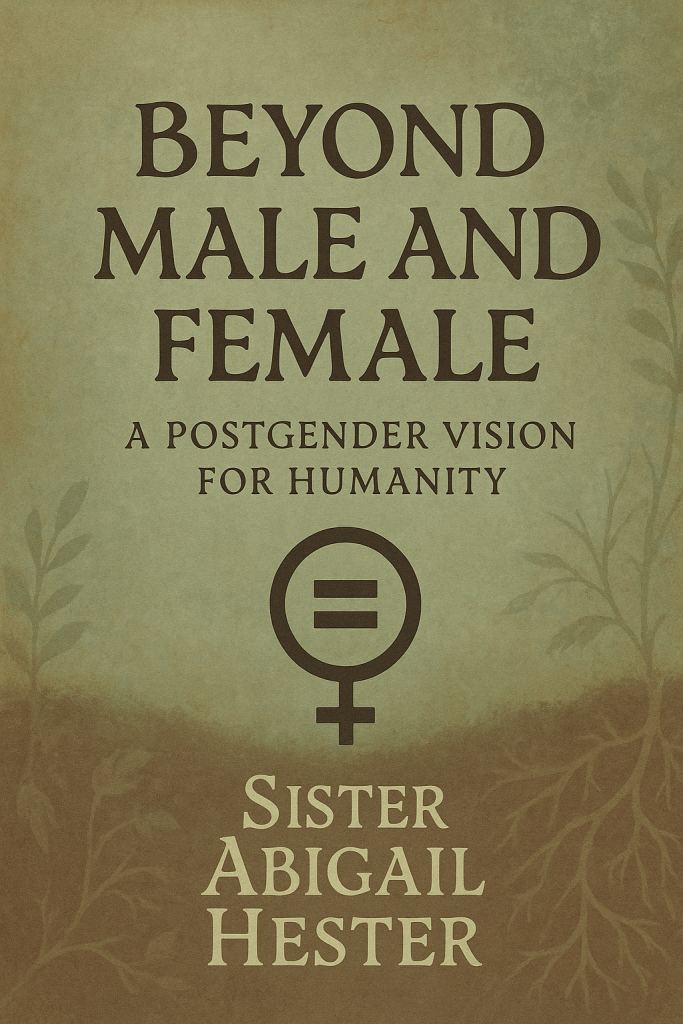
Beyond Male and Female
A Postgender Vision for Humanity
Sister Abigail Hester, OFC
Dedication
For those who were told they didn’t belong in the categories offered.
For the saints, the rebels, and the in-betweeners.
For the future where all of us are simply human — and holy.
Epigraph
“In Christ there is no male and female,
for you are all one.”
— Galatians 3:28
Preface: Why Postgender Now?
We stand at a turning point in human history. For centuries, the categories “male” and “female” have been treated as unquestionable realities — as fixed boxes into which every human being must be crammed. These boxes have been used to divide labor, restrict opportunity, assign value, and even determine who gets to live freely and who must live in fear.
But the cracks in the system are showing. Science has revealed that human biology is far more diverse than the binary allows. History shows us societies that recognized more than two genders long before colonial powers and religious institutions enforced rigid norms. Faith traditions, too, offer glimpses of a God who is not confined by human categories. And now, technology hints at a future in which reproduction, intimacy, and identity need not be governed by sexed bodies at all.
We are beginning to see what our ancestors could barely imagine: a society not simply tolerant of gender diversity, but free from the tyranny of gender itself.
Postgender thinking is not about erasing individuality — it is about liberating humanity from the idea that identity, worth, or destiny must hinge on whether you were assigned “M” or “F” at birth. This is not a denial of history, biology, or culture; it is an invitation to evolve beyond their limitations.
Why now? Because the harms of gendered systems are clearer than ever — from the wage gap to gender-based violence, from the policing of bodies to the erasure of lives that don’t fit the mold. Because climate crisis, economic instability, and political polarization demand that we stop wasting energy enforcing outdated scripts and instead channel our creativity toward survival, justice, and joy. Because every year we delay, more lives are crushed beneath the weight of a system we no longer need.
The postgender future is not an inevitability — it is a choice. And if we are willing to make it, we can imagine a world in which love, purpose, and community are no longer tethered to categories that divide us.
The following pages are my attempt to map that future: to examine the roots of the gender binary, to explore how it has shaped faith and society, and to dream aloud about what comes after. My hope is not that you will agree with me at every turn, but that you will join me in asking the most dangerous and liberating question of all:
What if gender were never the point?
— Sister Abigail Hester, OFC
Introduction: Gender is a Story We Can Rewrite
Every society tells a story about what it means to be human. For most of recorded history, that story has started with two main characters: “man” and “woman.” Everyone born is immediately assigned to one of these categories, often within seconds of emerging into the world. And from that moment on, the story begins writing itself — in pink or blue ink.
But here’s the thing: gender is not an unshakable law of the universe — it’s a story we’ve been telling ourselves for a very long time.
Like any story, it has been edited, censored, reinterpreted, and weaponized. Entire plotlines have been invented to keep certain people in power. The “rules” of the story — how a man should dress, how a woman should speak, what work belongs to each — have shifted wildly from century to century and culture to culture. And yet, despite all the evidence that gender is mutable, we’ve been taught to treat it as sacred, unchangeable truth.
Why? Because the gender binary is useful — not for liberation, but for control. It sorts people into neat boxes that can be taxed, regulated, exploited, and judged. It keeps half of humanity “in its place” and the other half constantly proving its dominance. It props up patriarchies, economies, and theologies that depend on hierarchy to function.
But stories can be rewritten.
We have already seen this with race, with class, with nationhood, with the roles of faith and science. When we discover that an old story harms more than it helps, we can — and must — imagine a new one.
The postgender vision is not an erasure of difference; it’s an expansion of possibility. It says: you are not your role, your pronouns, your chromosomes, or your assigned destiny. You are a living, breathing being with infinite potential — and you deserve a society that recognizes that.
In the chapters ahead, we will dismantle the myth of eternal gender, search for glimpses of a God beyond male and female, and look toward futures where we no longer need to check a box before we can live our truth.
You may not agree with every conclusion in these pages. You may feel a pull between what you’ve been taught and what you sense could be possible. That tension is not a threat to your identity — it’s the sign that you are standing at the doorway of a larger world.
So, take a deep breath. Step through.
Let’s tell a better story.
Chapter 1 – The Myth of Eternal Gender
The first lie we inherit is that gender has always been the way it is now — fixed, binary, and divinely ordained. It’s presented as if the categories of “man” and “woman” were stitched into the fabric of the universe, as immutable as gravity. Question it, and you’re not just defying social norms — you’re defying “nature” or “God.”
But the historical record tells a different story.
Gender Has Always Been Fluid
Long before modern Western societies hardened into a strict binary, human cultures had a kaleidoscope of gender expressions. Indigenous nations across North America recognized Two-Spirit people, whose roles often blended spiritual, social, and practical responsibilities beyond male/female lines. In parts of South Asia, hijra communities have existed for centuries, holding ceremonial and cultural significance. Ancient Mesopotamian texts reference priests who lived in identities outside male or female. Even the ancient Mediterranean had categories like the galli — devotees of the goddess Cybele who lived outside the binary.
In other words: gender diversity is not new. The binary is.
Colonialism and the Gender Straightjacket
The rigid male/female divide as we know it was not universal — it was exported. Colonial powers not only took land and resources, but also imposed cultural systems, including binary gender roles, onto conquered peoples. Many Indigenous societies that once embraced multiple genders were forced into European-style legal and religious frameworks.
Missionaries often destroyed local traditions around gender diversity, branding them as “sinful” or “uncivilized.” The binary became a tool of both cultural erasure and social control. By defining gender narrowly, colonizers could define power narrowly — and keep it in familiar hands.
Biology Is More Complicated Than the Binary
The myth of eternal gender often leans on “biology” as proof — but biology itself is far more varied than the gender binary allows. Intersex people, for instance, are born with variations in chromosomes, hormones, or anatomy that do not fit typical definitions of male or female. Estimates suggest that intersex traits are as common as naturally red hair — yet society has acted as if they are anomalies to be “fixed” rather than accepted.
Even in those assigned male or female at birth, traits like hormone levels, reproductive capacity, and secondary sexual characteristics vary widely. The neat, clean binary of biology exists mostly in textbooks — not in living human bodies.
Religion: More Diverse Than You Think
Even in religious history, the eternal binary is not as absolute as it’s been presented. In early Christian writings, baptism was said to make one “neither male nor female” (Galatians 3:28). Jewish mystical traditions described God as encompassing both masculine and feminine aspects. Many Eastern traditions speak of divine unity beyond gender.
The claim that gender as we know it was divinely created and fixed forever is, at best, selective theology — at worst, a deliberate misreading to uphold patriarchal control.
Why This Myth Persists
If gender diversity has been a constant throughout history, why does the myth of eternal gender persist? Because myths are useful. The binary provides a ready-made social order. It assigns roles, labor, and expectations without negotiation. It simplifies law, inheritance, and family structure — at least for those in power.
And most importantly: it makes rebellion easy to spot. Anyone who doesn’t “fit” can be labeled a threat.
Shattering the Myth
The truth is that gender is not eternal — it is historical, cultural, and political. Like any human system, it can change. Like any human story, it can be rewritten.
This doesn’t mean gender has no meaning; it means we stop pretending it has only one meaning. It means understanding that “man” and “woman” are chapters in the human story — not the whole book.
In the next chapter, we’ll go deeper into one of the binary’s most persistent weapons: the idea that biology determines destiny. We’ll see how science, medicine, and lived experience all point to a more complex — and liberating — reality.
Chapter 2 – When Biology Is Not Destiny
From the moment a baby is born, the first question asked is almost always the same: “Is it a boy or a girl?” That question is rarely about the child’s actual personality, interests, or calling — it’s shorthand for a thousand unspoken assumptions about how that child will live, love, dress, work, and even die.
The assumption runs deep: your body tells the whole truth about who you are and what you can be. This is the creed of biological determinism — the belief that chromosomes and anatomy set your destiny in stone.
It’s also a belief that falls apart the second we examine it closely.
The Problem with “Biological Sex” as a Fixed Reality
The idea that humans come in only two biological models is a simplification so extreme it barely survives contact with reality.
Consider:
Chromosomes: While most people have XX or XY patterns, variations like XXY, XYY, XO, or mosaicism occur naturally. These aren’t “mutations” in a pejorative sense — they’re part of human genetic diversity.
Hormones: Testosterone and estrogen are present in everyone, and levels shift over a lifetime. Even within one “sex,” hormone ranges can vary dramatically without any loss of health or function.
Anatomy: Intersex traits — differences in genitalia, gonads, or reproductive structures — are estimated to occur in about 1.7% of the population. That’s roughly as common as being born with green eyes.
Biology is not a single, binary switch. It’s a spectrum of traits, many of which don’t align neatly with “male” or “female.”
Science Versus the Social Script
Here’s where things get messy: biological variation is normal, but our social systems can’t easily handle it. So instead of building flexible frameworks, we try to force people to fit the script.
That’s why intersex infants have historically been subjected to “corrective” surgeries without consent. That’s why trans and nonbinary people are told their bodies are wrong — rather than our definitions being inadequate. That’s why competitive sports struggle with how to categorize athletes whose hormone levels defy standard male/female ranges.
The biology isn’t broken. The social story we’ve wrapped around it is.
The Dangerous Loop of Gendered Medicine
Biological determinism doesn’t just influence culture; it shapes the actual healthcare people receive. Women’s pain is more likely to be dismissed as “emotional.” Men are less likely to be diagnosed with osteoporosis because it’s considered a “women’s disease.” Nonbinary and trans people often face outright refusal of care because their bodies don’t match the provider’s assumptions.
The “destiny” assigned by biology often becomes a self-fulfilling prophecy — not because it’s inevitable, but because systems are built to enforce it.
Faith’s Complicated Relationship with Biology
Religious traditions have often used biology as a moral category — treating bodies as if they carry God’s permanent labels. But even scripture complicates that story.
In Matthew 19:12, Jesus speaks of eunuchs “who have been so from birth” and those “who have made themselves eunuchs for the sake of the kingdom of heaven.” This is a first-century acknowledgment that human embodiment is varied — and that some live outside reproductive norms by nature or by choice.
If the Creator’s image is reflected in humanity, then that image must include the full range of human variation — not just the tidy binary.
Liberating Biology from Destiny
Recognizing that biology does not dictate destiny doesn’t mean ignoring the body. It means seeing it as a starting point, not a prison. It means embracing the truth that bodies are diverse, adaptable, and shaped as much by culture as by chromosomes.
The future is not about erasing biology — it’s about refusing to let it serve as a cage. When biology becomes a canvas rather than a verdict, we can begin to imagine identities, relationships, and societies that reflect the full beauty of human possibility.
Chapter 3 – The Cost of Gender
If the gender binary were harmless — a quaint cultural tradition like driving on one side of the road — maybe it wouldn’t be worth dismantling. But it’s not harmless. It’s not neutral. It’s expensive, and the currency is human lives.
Gender is more than a set of labels; it’s a system of allocation — deciding who gets power, safety, money, time, and even the right to exist without fear. Once you see it that way, the price tag becomes impossible to ignore.
The Economic Toll
From the moment we’re sorted into “male” or “female,” the binary sets economic trajectories.
Wage Gap: Women globally earn less than men for the same work, with compounded disparities for women of color and trans women.
Unpaid Labor: Care work, housework, and emotional labor are still disproportionately assigned to women and fem-presenting people, rarely with compensation.
Access to Resources: In many parts of the world, gender determines who inherits land, who controls family income, and who can even open a bank account.
Economic inequality is not a side effect of gender — it is one of its main functions.
The Violence Tax
Gendered systems come with built-in danger.
Women and girls face heightened risk of domestic violence, sexual assault, and femicide.
Trans people — especially trans women of color — experience disproportionate rates of harassment, assault, and murder.
Men are socialized to suppress vulnerability, which contributes to higher rates of suicide, substance abuse, and violence against other men.
In all cases, the binary doesn’t just fail to protect — it creates conditions that make violence more likely.
The Health Cost
Gendered expectations have a direct impact on health outcomes:
Medical Bias: Women’s pain is underdiagnosed; men’s mental health is undertreated.
Reproductive Control: Gender has been used to justify restrictions on bodily autonomy, from forced sterilization to denial of abortion care.
Gender-Affirming Care: Trans and nonbinary people are often denied or delayed life-saving medical care due to prejudice or legal barriers.
The result is a system where health is filtered through the lens of gender before it’s filtered through the lens of humanity.
The Psychological Toll
The binary doesn’t just shape bodies; it shapes minds. Growing up inside rigid gender roles means constantly policing your own behavior:
Is this shirt “too feminine”?
Am I walking “manly” enough?
Will people think I’m “less of a woman” if I don’t have kids?
This constant self-surveillance is exhausting, and it creates anxiety, depression, and self-hatred. Those who step outside the roles — whether by choice or by nature — pay an even steeper price in social rejection, bullying, and institutional discrimination.
The Cost to Society
When half the population is limited in what they can do and the other half is burdened with the pressure to dominate, society loses out on innovation, empathy, and cooperation. The binary doesn’t just hurt individuals — it keeps entire cultures stuck in cycles of inequality.
Imagine the collective progress lost because a scientist was told she couldn’t study physics, or a boy was told he couldn’t show compassion, or a nonbinary leader was erased from history altogether.
Why We Can’t Afford It Anymore
The costs of gender are unsustainable — morally, socially, and economically. They weaken communities, fracture relationships, and waste human potential. And as crises like climate change and economic instability deepen, we can no longer afford to hobble half our population while overburdening the other.
The binary doesn’t prepare us for the future — it chains us to the past.
Chapter 4 – God Beyond Male and Female
The idea that God is “male” has been repeated so often in sermons, art, and language that many believers treat it as a core doctrine. God is “Father,” Christ is “Son,” and the Spirit — if mentioned at all — is often imagined as a kind of divine afterthought.
But here’s the problem: Scripture never claims that God is a man. In fact, every time we try to pin God down to human categories, we run headfirst into the limits of our imagination.
Scripture’s Gender-Bending God
If we read closely, the Bible offers a far more expansive vision:
In Genesis 1:27, humans are created “in the image of God… male and female God created them.” If both male and female are in God’s image, then God must encompass — and transcend — both.
In Isaiah 66:13, God says, “As a mother comforts her child, so I will comfort you.”
In Deuteronomy 32:18, God is described as a mother who gave birth to Israel.
In Matthew 23:37, Jesus likens himself to a mother hen gathering her chicks.
God is not bound to one gendered role; God moves fluidly through them all.
Mystics Who Saw the Infinite
Across traditions, mystics have intuited that God is beyond the binary:
Julian of Norwich called Christ our “true Mother,” describing salvation as a process of being nurtured in divine womb-love.
In Kabbalistic Judaism, God’s nature includes both Chokhmah (wisdom, often coded masculine) and Binah (understanding, often coded feminine) in perfect union.
In Hinduism, deities like Ardhanarishvara embody both Shiva (male) and Parvati (female) as one inseparable being.
For mystics, God’s fullness could never be contained in “he” or “she” — only hinted at in shifting metaphors.
Why Male-Only God Talk Persists
So why does the Church cling to male imagery for God? The same reason society clings to binary gender roles for humans: power.
Calling God “Father” exclusively reinforces the idea that ultimate authority is masculine.
A male-only God makes it easier to justify male-only leadership.
It trains worshippers to see maleness as closer to divinity, and femaleness (or anything outside the binary) as further from it.
This is not theology — it’s patriarchy in holy robes.
The Risk and Necessity of New Language
Changing how we speak about God feels risky because language shapes faith. But the risk of keeping our language frozen is greater: we end up worshipping a gendered idol instead of the Living God.
Postgender theology invites us to use language that stretches our imagination rather than shrinks it. Sometimes that means alternating pronouns for God. Sometimes it means using they/them, or avoiding pronouns altogether. Sometimes it means experimenting with imagery that’s never been dominant in our tradition — God as artist, dancer, gardener, weaver.
Faith Without Gender Hierarchy
When we release God from the binary, we open the door to releasing ourselves. If the Creator is beyond gender, then no human can claim superiority or authority based on gender. Spiritual leadership, moral worth, and divine image become matters of character, not chromosomes.
This is the theological root of the postgender vision: we are not abolishing something God made sacred — we are refusing to worship something humans made oppressive.
Chapter 5 – Eden Without the Fig Leaves
The Garden of Eden story has been used for centuries as Exhibit A in the case for “natural” gender roles. Adam is presented as the original man, Eve as the original woman, and their “complementarity” as the divine blueprint for all human relationships. Men lead, women follow. Men provide, women nurture. Case closed.
But the actual text is far messier — and far more liberating — than the Sunday School version.
Two Creation Stories, Not One
First, Genesis doesn’t give us one creation story; it gives us two:
- Genesis 1 presents humanity created simultaneously: “So God created humankind in God’s image, in the image of God they were created; male and female God created them.” There is no hierarchy, no delay, no rib. Both are made in the divine image, together.
- Genesis 2 — the Adam-and-Eve story — is a different tradition. Here, the first human (adam, meaning “earth creature”) is formed from the ground before gender is ever mentioned. The Hebrew doesn’t say “man” until after the creature is split into two beings.
In other words, the earliest human in this story is genderless — a being of dust and breath, not male or female.
Eve Was Not a “Helper” in the Way We Think
When God decides it’s “not good for the human to be alone,” the Hebrew word for “helper” (ezer) is used to describe Eve. But ezer is not a term for an assistant or subordinate; it’s the same word used for God as Israel’s helper in battle. Eve is a co-equal partner, not an underling.
The idea that Eve was created to serve Adam says more about later interpreters than about the text itself.
The “Fall” as the Birth of the Binary
Notice that gendered tension doesn’t even appear until after the forbidden fruit. It’s only after they eat that “he will rule over you” enters the narrative — and it’s framed as a consequence, not a commandment. The domination of one gender over another is depicted as part of the curse, not the design.
If anything, the story warns against gender hierarchy rather than endorsing it.
Naked and Unashamed
Before the fruit, Adam and Eve are naked and unashamed — unselfconscious, without gendered shame. Afterward, they sew fig leaves to cover themselves, creating the first “gendered” clothing. The covering of bodies is the moment human beings start performing gender — assigning meaning and modesty according to parts.
The fig leaf is not protection; it’s the first costume in the long-running play of the binary.
Creation Without a Gender Destiny
If we read Eden without the patriarchal overlay, we see a creation story that begins in unity and equality. The separation into male and female is not the climax of creation, but a step along the way — a step that could have unfolded in countless other directions if history and interpretation hadn’t locked it into a fixed script.
The “divine plan” here is not gender hierarchy; it’s human companionship, shared stewardship, and mutual life in the garden.
Why This Matters for Postgender Thought
If the origin story is flexible, then the future can be, too. The Eden narrative doesn’t have to chain us to a binary; it can remind us of our original state — dust, breath, and the image of God — before the fig leaves and the roles.
When we strip away the overlays of hierarchy, we find that the first human community was not built on male versus female, but on the truth that it is not good to be alone.
Chapter 6 – The Saints, Mystics, and Rebels Who Crossed Gender Lines
The history of faith is full of people who refused to stay in their assigned lanes — even when doing so meant risking their lives. Some defied gender roles to survive. Others did it to follow a calling they could not ignore. A few simply lived in ways that didn’t fit the categories available to them, leaving behind stories that unsettle our assumptions about holiness and identity.
If the Church had been honest, these figures would be household names — proof that the binary was never God’s final word. Instead, many have been forgotten, their stories sanitized or erased. Let’s bring them back into the light.
Joan of Arc: The Warrior in Armor
Joan was a teenage peasant girl who claimed visions from saints directing her to lead France’s army during the Hundred Years’ War. She wore men’s armor, cut her hair short, and moved in spaces women were barred from. For her gender nonconformity — along with her military success — she was accused of heresy and burned at the stake.
Centuries later, she was canonized as a saint. The Church that once condemned her now celebrates her, but rarely as a gender-transgressive figure.
St. Marinos the Monk
In the early centuries of Christianity, Marinos was a woman who disguised himself as a man to join a monastery. Living and serving as a monk for years, Marinos’ identity was only revealed after death. The monks buried him with honor, recognizing his devotion as greater than his conformity to gender norms.
Hildegard of Bingen: The Visionary Who Named Herself
Hildegard was a 12th-century abbess, composer, and mystic who spoke of God in profoundly gender-fluid terms. She described Jesus as both mother and bridegroom, envisioned the Spirit as a fiery feminine force, and used her own authority to write music, theology, and science at a time when women were expected to remain silent.
We’wha: The Zuni Two-Spirit Ambassador
In 19th-century America, We’wha was a Zuni person recognized as both male and female — a lhamana — who served as a cultural ambassador to Washington, D.C. We’wha was respected in Zuni society for weaving, pottery, and spiritual leadership. The binary had no claim over them until colonial forces tried to impose it.
Rumi: The Poet of Love Beyond Form
The 13th-century Sufi mystic Rumi used love poetry that blurred gender boundaries, sometimes writing as the lover, sometimes as the beloved, and often collapsing the two into one. His relationship with Shams of Tabriz defied simple categorization, pointing toward a divine union beyond gendered desire.
Why These Stories Matter
When we see gender variance as modern “trendiness,” we erase centuries — even millennia — of people whose holiness, leadership, and artistry flourished outside the binary. These saints and mystics remind us that divine calling has always been bigger than cultural categories.
They also warn us that institutions have a habit of rewriting history to fit their ideals — turning rebels into role models only after stripping away the parts that challenge the status quo.
Chapter 7 – The Collapse of Gender in Science Fiction and Futurism
When theologians hesitate to imagine life after gender, science fiction often charges ahead. Writers, filmmakers, and futurists have long used speculative worlds to question what we take for granted — including the belief that human life must be divided neatly into “male” and “female.”
In these imagined futures, biology bends, technology transforms, and social structures dissolve. What emerges are portraits of humanity that are at once alien and deeply familiar — versions of ourselves freed from one of the oldest cages we’ve known.
The Left Hand of Darkness – Gender as Seasonal
Ursula K. Le Guin’s 1969 novel The Left Hand of Darkness is still one of the most profound explorations of a postgender society. On the planet Gethen, people are ambisexual — for most of the month, they are neither male nor female, and only during a brief period (kemmer) do they develop sexual characteristics, which can be male or female depending on the partner.
The absence of fixed gender shapes everything: politics, language, relationships, and even war. Le Guin’s Gethenians aren’t perfect, but they are free from the power dynamics that flow from permanent gender categories.
Octavia E. Butler – Rewriting Biology
Butler’s work often reimagines human embodiment. In Xenogenesis (also known as the Lilith’s Brood trilogy), alien-human hybrids are engineered without binary sex, blending traits fluidly. Butler uses this to ask hard questions: If biology can be rewritten, what happens to the systems built on it?
Star Trek – The Federation’s Gender Experiments
From the androgynous J’naii in The Next Generation to the Trill symbionts whose hosts change sex across lifetimes, Star Trek has been testing the waters of postgender storytelling for decades. Sometimes these stories stumble into 1990s limitations, but the very fact they exist in mainstream media signals cultural readiness to imagine the binary as negotiable.
Cyberpunk and Transhumanism – Modding the Body
Cyberpunk visions like Ghost in the Shell and Altered Carbon push the idea that when consciousness can be transferred between bodies — or when bodies themselves are customizable tech — gender becomes an aesthetic choice, not a birth sentence. Transhumanist futurists take this further, predicting that medical advances will allow for fully fluid embodiment within a lifetime.
The Promise and the Peril
Postgender futures in science fiction are not always utopias. Some depict new hierarchies emerging around modified bodies or genetic privilege. Others show the backlash when old-world ideologies cling to new-world possibilities. The lesson here is not that technology will automatically liberate us — it’s that liberation must be intentional.
Why Theology Needs Science Fiction
Theology often works in the past tense, interpreting ancient texts for modern life. Science fiction works in the future tense, asking, “What if?” Postgender theology needs both: the rootedness of tradition and the audacity of speculation.
Fiction allows us to try on possibilities without fear. It helps us feel the strangeness of a world without gender — and to discover, often to our surprise, how much of our humanity remains intact, or even grows stronger, in its absence.
Chapter 8 – Living Beyond Labels Today
Postgender life is not just a sci-fi experiment or a far-off dream — it’s already here, scattered across the globe in quiet, vibrant pockets of resistance. While the wider world still runs on pink-and-blue defaults, countless individuals and communities are carving out spaces where gender has less power over identity, relationships, and opportunity.
These aren’t always headline-making revolutions. Sometimes they’re subtle acts of refusal. Sometimes they’re radical redesigns of community life. All of them matter.
Intentional Communities
Some activist collectives and co-ops consciously avoid gender segregation in housing, chores, and leadership roles. In these spaces:
Bathrooms are all-gender.
Language defaults to names or “they” until a person specifies otherwise.
Labor is divided by skill and preference, not gendered expectation.
These communities often find that removing gender from daily decision-making reduces conflict and increases collaboration — not because differences vanish, but because stereotypes no longer dictate the rules.
Queer and Trans Networks
In many queer spaces, gender is treated as fluid, optional, or playfully subverted. People might change pronouns for fun, wear whatever affirms them that day, or reject labels entirely. These networks often act as real-world laboratories for postgender life, showing that relationships, solidarity, and mutual care do not require the binary as an anchor.
Parenting Without Gender Scripts
A growing number of parents are raising children without assigning them a fixed gender identity from birth. They may use gender-neutral pronouns, offer clothing and toys from across the spectrum, and wait for the child to declare their own identity — or none at all.
Critics often predict confusion, but research suggests these children tend to be more confident, empathetic, and adaptable than their peers. In other words, they thrive when given the freedom to write their own script.
The Language Shift
One of the most accessible ways to live postgender is through language. Normalizing singular “they,” offering pronouns during introductions, and refusing gendered honorifics (Mr., Mrs., Miss) are small acts that chip away at the binary’s cultural dominance.
Over time, these habits shift the baseline — making gender less of a default identifier and more of an optional detail.
Everyday Acts of Resistance
Postgender living doesn’t have to mean joining a commune or rewriting your birth certificate. It can mean:
Refusing to participate in “ladies first” or “men only” customs.
Sharing childcare equally, regardless of who’s the “mom” or “dad.”
Wearing what you love, not what’s coded for your gender.
Questioning the gendering of products, spaces, and jobs.
Every small disruption sends a message: the binary is not inevitable.
The Pushback
Of course, living beyond labels comes with risks. Postgender communities often face legal barriers, social ridicule, or outright violence. The binary is deeply woven into laws, databases, and bureaucracies — everything from passport applications to medical forms.
But the fact that people continue to live this way, despite the resistance, is proof of its possibility.
Why This Matters for the Future
Postgender living today is like the early stages of renewable energy decades ago — imperfect, small-scale, but pointing toward a necessary transition. Each experiment shows us where the friction points are and where the freedoms emerge.
The more these spaces thrive, the harder it becomes to claim that humanity “needs” the binary to function.
Chapter 9 – The Moral Imagination of a Postgender Society
A society without gender sounds, to some, like a blank page. To others, it sounds like chaos. But imagining a postgender world isn’t about erasing difference — it’s about removing the arbitrary hierarchies that come with it. It’s not about making everyone the same; it’s about refusing to let birth assignments dictate destiny.
So what might such a society look like? And what moral foundations would keep it from sliding into new forms of inequality?
Law Without Gender Categories
In a postgender society:
Identification documents would not require gender markers.
Laws and policies would be written for people, not “men” or “women.”
Protections against discrimination would cover all forms of embodiment and identity, without sorting them into gendered silos.
Courts could no longer justify unequal sentencing based on “feminine vulnerability” or “masculine aggression.” Marriage laws would be gender-neutral by default. Military drafts, bathrooms, and prisons would be organized by factors like safety and consent, not chromosomes.
Economy Without Gendered Labor
Without gender scripts, work would be distributed by skill, interest, and capacity — not cultural assumptions.
Care work and domestic labor would be valued and compensated.
Jobs like nursing, teaching, and construction would be equally open to all, without stigma or pay gaps.
Parental leave would be a human right, not a “women’s benefit.”
Economic systems could finally acknowledge that what keeps a society running — feeding children, tending the sick, maintaining infrastructure — is not gendered work, but human work.
Relationships Without Gender Scripts
In a postgender world, relationships wouldn’t hinge on who’s “the man” or “the woman” in the dynamic.
Dating norms would focus on compatibility and consent, not role-playing.
Friendships could flourish without fear of crossing invisible gender lines.
Family structures could be built on mutual support, not defaulting to patriarchal or matriarchal models.
Faith Without Patriarchy
Churches, temples, mosques, and synagogues could ordain leaders based on calling and capability, not gender. Theologies could focus on the divine image in every person, without translating it into male dominance or female submission. Rituals could be inclusive of all embodiments, without assuming certain bodies belong to certain sacred roles.
Ethics Without Binary Bias
Postgender ethics would ask different questions:
Instead of “What’s appropriate for a man/woman to do?” → “Does this action promote dignity and justice?”
Instead of “Should women have the right to…?” → “Should humans have the right to…?”
Instead of protecting “traditional family values” → protecting the value of all families.
The absence of the binary wouldn’t mean the absence of morality; it would mean morality based on human flourishing, not cultural stereotypes.
The Challenge of Imagination
The hardest part of building a postgender society isn’t drafting laws or writing policies — it’s rewiring our imaginations. We’ve been taught to see gender as a primary fact about people, a shortcut to understanding them. Removing that shortcut forces us to actually listen, learn, and relate without assumptions.
That’s both the greatest challenge and the greatest gift of postgender life: it calls us into deeper relationship, where the labels are stripped away and only the person remains.
Why This Vision Matters Now
As crises mount — climate collapse, political instability, mass migration — humanity needs every ounce of creativity, resilience, and cooperation it can muster. We can’t afford to waste resources maintaining a social system that divides, limits, and wounds us.
A postgender society is not a utopia, but it’s a step toward a more just and adaptable world. It’s a refusal to let the accidents of birth dictate the possibilities of a life.
Conclusion – The End of Gender is Not the End of Us
We have been told, for as long as we can remember, that gender is the bedrock of human life. That without “man” and “woman,” society would collapse into chaos. That without the binary, there is no order, no morality, no love worth naming.
But history, science, and faith tell a different story. The binary is not our foundation — it’s scaffolding. Useful in its time, perhaps, but never meant to be permanent. And now it creaks under the weight of the future we need to build.
The Great Unlearning
Moving beyond gender begins with unlearning:
Unlearning that biology is destiny.
Unlearning that God speaks only in male tones.
Unlearning that the way things have been is the way they must be.
This unlearning is not about erasing the past, but about loosening its grip. It’s about seeing our ancestors not as jailers to obey, but as conversation partners whose wisdom must be weighed against new realities.
The Spiritual Shift
Faith traditions at their best teach us that love, justice, and compassion are not bound by category. The postgender vision is not anti-religion — it is deeply spiritual, rooted in the conviction that every person bears the divine image, unconfined by cultural boxes.
If God can be beyond male and female, so can we.
The Work Ahead
A postgender society will not arrive on its own. It requires active dismantling of laws, customs, and language that uphold the binary. It demands courage from those in positions of privilege to let go of the advantages the system gives them. It asks for imagination from artists, theologians, scientists, and everyday people to model other ways of being.
And it requires grace — for ourselves and for each other — as we stumble forward in a world where the old rules no longer apply.
Hope Without the Binary
The end of gender is not the end of us. It is the beginning of something larger, messier, and far more human. It is an opening into lives where relationships are chosen, not prescribed; where worth is measured by presence, not performance; where no one is told at birth who they must be until they die.
If we can imagine this world — and if we dare to live pieces of it now — then the binary’s collapse will not be a loss, but a liberation.
We will not be less human without gender.
We will finally have the chance to be fully human.
Appendices
Appendix A – Timeline of Gender Constructs
Pre-Colonial Era:
Many Indigenous cultures worldwide recognize multiple genders (Two-Spirit, hijra, fa’afafine, etc.).
Ancient Mediterranean, Mesopotamian, and Asian societies document gender-diverse priests, rulers, and artists.
Colonial Era:
European powers export binary gender systems through law, religion, and education.
Suppression of nonbinary identities becomes a tool of control and assimilation.
19th–20th Century:
Western science codifies binary sex in medicine and law.
Feminist movements challenge gender inequality but often remain within binary structures.
21st Century:
Global visibility of trans, nonbinary, and intersex people grows.
Postgender philosophy emerges in futurism, theology, and activism.
Appendix B – Postgender Symbol Guide
The postgender symbol is a fusion of the male (♂) and female (♀) symbols with the addition of an “X” or null point, representing the transcendence of binary categories.
Circle: Humanity’s wholeness.
Arrow + Cross: Our historical gender paths.
Slash/Null: The decision to go beyond them.
Appendix C – Resources for Postgender Living
Books:
Delusions of Gender by Cordelia Fine
Whipping Girl by Julia Serano
The Gendered Brain by Gina Rippon
Fiction:
The Left Hand of Darkness by Ursula K. Le Guin
Lilith’s Brood by Octavia E. Butler
Organizations:
Intersex Human Rights Australia (IHRA)
Gender Spectrum
OutRight International
References & Further Reading
- Le Guin, Ursula K. The Left Hand of Darkness. Ace Books, 1969.
- Butler, Octavia E. Xenogenesis Trilogy. Warner Books, 1987–1989.
- Fine, Cordelia. Delusions of Gender. W. W. Norton, 2010.
- Serano, Julia. Whipping Girl. Seal Press, 2007.
- Rippon, Gina. The Gendered Brain. Bodley Head, 2019.
- Dreger, Alice. Hermaphrodites and the Medical Invention of Sex. Harvard University Press, 1998.
- Holy Bible, NRSV and Tanakh translations.
- Various Indigenous knowledge sources (oral traditions, community histories).
About the Author
Sister Abigail Hester, OFC is a Franciscan Clarean nun, writer, and activist whose work bridges theology, social justice, and prophetic imagination. She is the founder of the Order of Franciscan Clareans, a progressive monastic community committed to following the Poor, Queer, and Crucified Christ.
Blind since early adulthood, Sister Abigail writes with a deep awareness of how systems of power — from gender norms to religious hierarchies — shape human lives. Her ministry centers on dismantling those systems in favor of liberation, equity, and radical love.
She is also an herbalist, survivalist, and mystic, drawing inspiration from both ancient traditions and the urgent needs of the present moment. Her books and teachings challenge readers to see faith as a living, evolving force — one that is unafraid to imagine a future without the chains of the past.
When not writing or teaching, she tends to her garden, brews healing infusions, and laughs often at the absurdity of life, convinced that joy is one of the holiest forms of resistance.
 Sister Abigail Hester