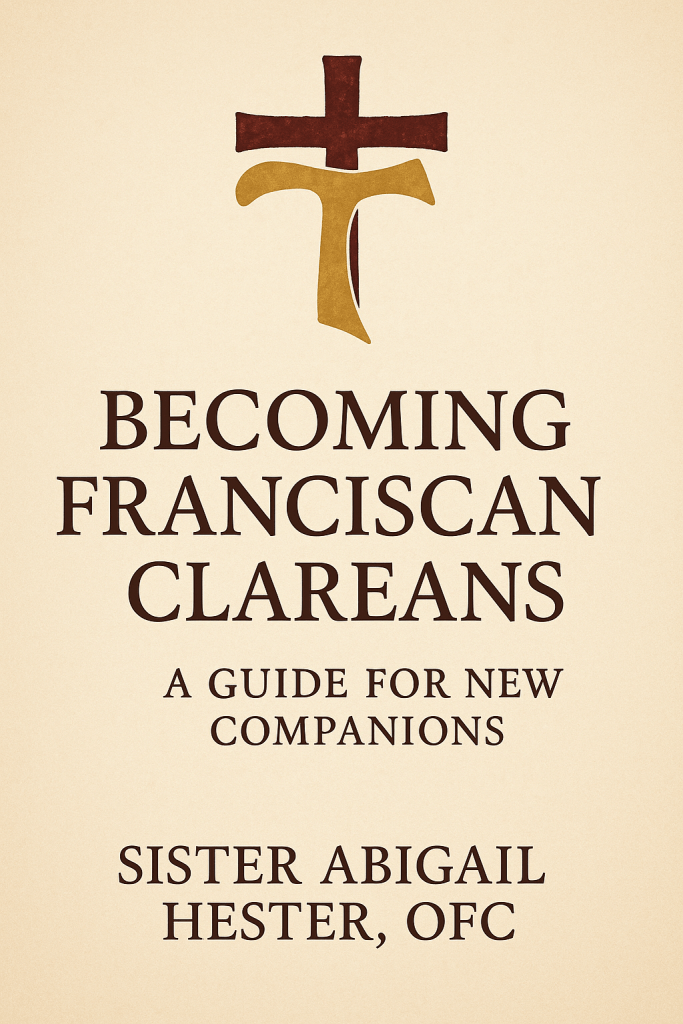
Becoming Franciscan Clarean
A Guide for New Companions
by
Sister Abigail Hester, OFC
My Work is for the Greater Good of All
All works by Sister Abigail Hester, OFC are released under the Creative Commons Attribution 4.0 International License (CC BY 4.0).
You are free to share, adapt, and build upon this material for any purpose — even commercially — provided that proper credit is given.
This work is offered freely for the benefit of humanity, in the spirit of compassion, justice, and the common good.
To view a copy of the license, visit: https://creativecommons.org/licenses/by/4.0/
Introduction
“Start by doing what is necessary, then what is possible, and suddenly you are doing the impossible.”
—Attributed to St. Francis of Assisi
We live in an age of disconnection. Many of us have walked through life as spiritual exiles—too radical for traditional religion, too spiritual for secular culture, too queer for the church, too Christian for the activist world. Some of us have found ourselves discarded by institutions, disillusioned by politics, or simply hungry for something real. We long not only for meaning, but for belonging—a place to grow, heal, struggle, and become.
This guide is for you.
Whether you are just discovering the Franciscan Clarean Way or have been walking alongside this vision for years, Becoming Franciscan Clarean is a companion on the journey. It is a spiritual formation handbook rooted in the radical simplicity of St. Francis, the fierce contemplative strength of St. Clare, and the liberating love of Christ who calls us all into deeper solidarity with one another and the Earth.
This book is not a rulebook or doctrinal manual. It is an invitation. An invitation to slow down, to listen, to show up with your whole messy self, and to begin the sacred work of becoming—together.
What Is the Franciscan Clarean Way?
The Order of Franciscan Clareans (OFC) is a new monastic movement of everyday mystics, misfits, and ministers committed to love, justice, healing, and simplicity. We follow Jesus through the eyes of Francis and Clare, drawing from queer theology, liberation theology, spiritual ecology, and universal love. We honor our bodies, the Earth, and one another as sacred. We stand with the oppressed and resist the empires of today—racism, transphobia, greed, violence, and ecological destruction.
To be Franciscan Clarean is to live prophetically and tenderly at the same time. It is to find joy in the compost pile, holiness in community gardens, and prayer in protest. It is to be unapologetically queer, unwaveringly gentle, fiercely hopeful.
Who Is This Book For?
This guide is for postulants discerning a call.
For novices who are beginning to root.
For professed companions continuing the journey.
For elders seeking to pass on wisdom.
And for anyone who has ever felt like they didn’t fit—but knew, deep down, they were made to belong.
Wherever you are in your formation, you are not alone. This path has space for your grief, your doubt, your laughter, your dreams. You are welcome exactly as you are—and you are called to become all you were created to be.
Let us walk this road together.
— Sister Abigail Hester, OFC
Chapter 1: What Is the Order of Franciscan Clareans?
“Let us begin again, for until now, we have done nothing.”
—St. Francis of Assisi
The Order of Franciscan Clareans (OFC) is not just a religious community—it is a living movement. We are a new monastic, decentralized, and inclusive order rooted in the spiritual legacy of St. Francis and St. Clare of Assisi, but also reimagined for a world aching for healing, authenticity, and justice.
We are not bound by brick-and-mortar monasteries. We are scattered across city apartments and rural gardens, trans-inclusive churches and queer coffee shops, virtual sanctuaries and sacred streets. We are companions, not consumers. We are seekers, not gatekeepers. We are pilgrims walking with saints and sinners alike.
A Franciscan Clarean Heartbeat
At our core, the Franciscan Clarean Way beats with three pulses:
- Simplicity — Rejecting the myth that our worth is measured by wealth or productivity. Choosing to live lightly, joyfully, intentionally.
- Solidarity — Standing with the marginalized, the poor, the queer, the earth, and all who are cast aside by empire. Believing that no one is disposable.
- Sacredness — Seeing the divine not only in church buildings, but in soil, laughter, tears, struggle, and stillness. Living with reverence.
Our order is open to all genders, sexualities, backgrounds, bodies, and beliefs. There is no purity test, no theological exam, no perfection required. Only a willingness to love and be transformed.
Why We Exist
The OFC exists because the world is on fire—and the church has too often remained silent. We exist because we believe Jesus was not neutral. He stood with the poor, the outcast, the sick, the scandalized. He flipped tables and told the truth. He embodied a Love that disarmed the powers.
We follow in that tradition—not as copycats of the past, but as co-creators of the future. Our formation draws on:
Liberation theology, because God sides with the oppressed.
Queer and feminist theology, because every body is holy.
Ecospirituality, because creation is not a backdrop but a sacred communion.
Trauma-informed healing, because salvation is not escape but integration.
Universalism, because Love never casts anyone out.
Why “Franciscan Clarean”?
We name both Francis and Clare to emphasize that our way is not patriarchal. Francis left behind wealth to embrace radical poverty, joy, and kinship with all beings. Clare broke from social expectations to lead a community of fierce women in prayer and simplicity. Together, they modeled a counter-cultural way of life rooted in kinship, justice, and contemplative action.
We do not idolize their medieval context—we draw inspiration from their courage to embody the Gospel in ways that made sense for their time, just as we seek to do in ours.
Companion, Not Member
You’re not joining a club. You’re entering a relationship.
To be a Companion in the OFC is to walk with others in mutual commitment and sacred trust. It means participating, praying, wrestling, celebrating. It means growing together in love and in liberation. Our life is not ruled by hierarchy, but by mutuality. Our leadership is shared. Our community is organic.
To be Franciscan Clarean is not a title you earn—it’s a path you walk. And there is always room on the path for one more.
Chapter 2: Hearing the Call
“You have called me, O Lord, and I have said yes with trembling.”
—Clare of Assisi
Not everyone hears the call the same way.
Some feel it like fire in their bones—an unmistakable summons to leave behind everything familiar and follow Christ into the wild unknown. Others feel it as a whisper, a longing, a restlessness that won’t go away. Some discover it in the chaos of deconstruction. Others meet it in the quiet grief of rejection. For many of us, the call comes not through clarity—but through ache.
A deep ache for God.
A hunger for community.
A yearning for justice.
A sacred pull toward simplicity, service, and spirit.
You Are Not Alone
If you are reading this with a heart that beats a little faster, wondering, “Could this be for me?”—know that you are not alone. You are in good company with saints and misfits, doubters and dreamers, wounded healers and holy rebels.
Hearing the call is not about being perfect. It’s not about mastering theology, earning credentials, or escaping the mess of your life. It’s about responding.
It’s about saying:
Yes, I want to live more simply.
Yes, I believe love is stronger than fear.
Yes, I want to follow Jesus, even if the church hasn’t always followed him well.
Yes, I want to walk with others who are becoming, too.
That yes is sacred. Even if it’s shaky. Even if it comes through tears. Even if it’s your thousandth time trying.
Vocation in a Fragmented World
In today’s world, we are told to climb ladders, build brands, chase success, and earn love. But vocation—the sacred calling—isn’t about performance or prestige. It’s about presence.
Francis left behind military glory and wealth to embrace a life of kinship with the poor, the leper, the bird, the tree, the enemy. Clare defied her noble family and the norms of her time to live in radical simplicity and sisterhood. Neither of them was “qualified” by the standards of their society. But they heard something deeper—and followed it.
So can you.
To be Franciscan Clarean is not to escape the world—it’s to walk into it more deeply, with open hands and a courageous heart.
Sacred Defiance, Sacred Belonging
You may be transgender. You may be disabled. You may be burned out, exhausted, or grieving. You may have been told you’re too much, too broken, too weird, too political, too queer.
We say: you are called.
You are called not in spite of your difference, but through it—because of it. The Franciscan Clarean path is not a detour around your life, but a pilgrimage into the heart of it.
There is a place for your voice.
There is room for your becoming.
There is belonging beyond the binary, healing beyond shame, and vocation beyond the institution.
You don’t have to be ready.
You only have to begin.
Chapter 3: The Way of Simplicity, Solidarity, and Sacredness
“What we are looking for is what is looking.”
—St. Francis of Assisi (attributed)
The Franciscan Clarean Way is not just a path we walk—it is a rhythm we embody. It is a way of being in the world that resists the illusions of consumerism, empire, and separation. It is a spirituality rooted in lived practice, in relational love, and in the holiness of everything.
Our charism—our spiritual DNA—can be summed up in three sacred movements:
🌱 Simplicity: Living Light in a World That Consumes
We live in an age of excess and exhaustion. Simplicity is not about poverty for poverty’s sake. It’s not about asceticism or self-harm. It’s about freedom. It’s about saying no to the clutter—spiritual, emotional, material—that crowds out the voice of the Spirit.
To live simply means:
Prioritizing people over possessions.
Making space for stillness, silence, and slowness.
Choosing joy over busyness, wonder over consumption.
Asking: What is enough? What can I let go of?
Francis stripped naked in the town square not to shock but to start over. Clare cut her hair and fled the fortress of privilege to build a sanctuary of shared life. In a world that hoards and hustles, simplicity is revolutionary.
For us, simplicity means composting our waste, making tea with weeds, praying with our breath, and uncluttering our hearts.
✊🏽 Solidarity: Belonging in the Struggle
Solidarity is more than charity—it’s kinship. It’s standing with, not over. It is the sacred practice of showing up for each other, especially for those the world would rather forget.
To live in solidarity means:
Joining struggles for justice—not as saviors, but as siblings.
Listening deeply to the voices of the poor, the oppressed, the wounded.
Naming and resisting the empires of our day: racism, ableism, transphobia, capitalism, colonialism.
Practicing mutual aid, community care, and liberative action.
Francis embraced the leper. Clare shared in the poverty of her sisters. Jesus touched the untouchables and challenged the elite. We walk that same way when we accompany refugees, defend trans youth, visit the imprisoned, or plant gardens in food deserts.
Solidarity is how we incarnate the Gospel today.
🔥 Sacredness: Seeing God in All Things
We reject the idea that holiness lives only in cathedrals or clerics. The sacred is not confined—it pulses through the cosmos. God is found in flesh and fungus, in laughter and longing, in protest and poetry.
To live sacramentally means:
Honoring our bodies as temples of the divine.
Praying with our feet and our hands and our herbs.
Seeing creation not as scenery, but as sibling.
Celebrating the ordinary as infused with glory.
Francis preached to birds and wrote poems to Brother Sun and Sister Moon. Clare contemplated the mystery of the Eucharist by candlelight. We find holiness in menstrual blood, compost piles, song circles, and sacred rage.
The Franciscan Clarean Way invites us to live with reverence—not in escape from the world, but in deeper communion with it.
Together, simplicity, solidarity, and sacredness form our way of life. They are not doctrines to memorize—they are practices to embody. They call us back to ourselves, to each other, and to the God who is Love.
In the chapters to come, you’ll explore how this way unfolds in postulancy, novitiate, and profession. But always remember: it’s not about performance. It’s about presence. It’s about practice. It’s about becoming.
Chapter 4: Postulancy — A Time of Discernment
“You are loved. You are called. You are not late.”
—Franciscan Clarean Saying
Postulancy is the sacred threshold. It is a time to explore without pressure, to listen without rushing, to begin becoming without needing to “arrive.” In the Order of Franciscan Clareans, postulancy is the entry point for those discerning whether this path is truly theirs to walk. It is not a test to pass, but a time to pay attention.
You are not expected to have all the answers. You are invited to be curious, honest, and open.
💧 What Is Postulancy?
“Postulant” comes from the Latin postulare, meaning “to ask.” A postulant is someone who is asking questions—of themselves, of God, of the community.
During this phase, you are:
Deepening your spiritual practices.
Learning about the Franciscan Clarean tradition.
Exploring your own sense of calling.
Beginning to embody simplicity, solidarity, and sacredness in your daily life.
This is not a trial period with a pass/fail outcome. It is a season of attentive listening—to your heart, to your wounds, to your longings, to the Spirit.
🌿 Daily Practices of Postulancy
We encourage postulants to begin simple rhythms that support discernment. These aren’t rigid rules, but invitations to rootedness.
Daily Practices May Include:
Morning reflection or meditation. Even five minutes of silence is sacred.
Reading a short quote or scripture. Let it echo in you throughout the day.
Journaling. What am I noticing? What am I longing for?
Prayer or breathwork. Speak to God in your own words—or sit with the silence.
Intentional simplicity. Practice letting go—of clutter, consumption, hurry.
Start where you are. If daily rhythm feels hard, begin weekly. If prayer feels foreign, begin with breath. If reading is overwhelming, begin with nature.
There is no “wrong” way to begin—only the invitation to begin again.
📚 Study and Reflection
Postulants are encouraged to study the lives of Francis and Clare, but also to engage with the voices that shape our order today.
Suggested Readings for Postulants:
The Little Flowers of St. Francis
Clare of Assisi: A Heart Full of Love by Ilia Delio
The Universal Christ by Richard Rohr
God Is a Black Woman by Christena Cleveland
Transgender Theology by Patrick Cheng
OFC’s own Rule of Life and Companion reflections
Reading is not for intellect alone—it’s for spiritual digestion. Go slowly. Let words become flesh in your life.
🔍 Discernment Questions for Postulants
Reflect on these throughout your postulancy:
What draws me to the Franciscan Clarean Way?
What fears or hesitations do I carry?
Where do I feel most alive, most whole?
How is the Spirit inviting me to change?
Can I imagine living simply, standing in solidarity, and reverencing the sacred in all things?
You may want to discuss these questions with a spiritual companion or OFC elder.
🤝 Community During Postulancy
Postulants are encouraged to:
Attend OFC gatherings, whether online or in person.
Connect with other postulants or companions.
Begin a relationship with a mentor or formation guide.
Remember, postulancy is not a solo journey. Formation is communal. We become by walking together.
🕊️ At the End of Postulancy
There is no fixed length for postulancy. Some spend three months. Others take a year. The goal is not speed but sincerity.
At the close of your postulancy, you may:
Request to begin the novitiate.
Continue discerning.
Decide this is not your path—and leave with our blessing.
Whatever you choose, you are beloved.
Postulancy Prayer
God of Becoming,
In this season of holy asking,
Grant me patience, curiosity, and courage.
Teach me to listen to the whispers within,
To trust the journey,
And to walk in grace, not urgency.
Amen.
Chapter 5: Novitiate — Deepening the Roots
“Plant yourself where your soul can grow.”
—Franciscan Clarean Wisdom
If postulancy is the time of asking, then novitiate is the season of rooting. You’ve heard the call, you’ve said yes to the path, and now you’re invited to sink deeper into the soil of this life. The novitiate is a sacred container—not for perfection, but for formation.
This is not a test of worthiness. It is an act of willingness.
🌱 What Is the Novitiate?
The novitiate is a focused time of spiritual deepening, typically lasting 6–12 months. During this season, you begin to intentionally live into the Franciscan Clarean Way—practicing the Rule of Life, engaging in study and service, and discerning your lifelong relationship to the community.
Novitiates are not “in training” to be someone else. You are practicing becoming more yourself—your truest, God-shaped self, rooted in simplicity, solidarity, and sacredness.
You will not do this alone. You will be supported by mentors, community check-ins, spiritual companionship, and the living tradition of those who’ve walked this path before you.
📿 Practices of the Novitiate
The novitiate is grounded in intentional daily rhythm, shaped by prayer, study, service, and simplicity.
Suggested Novice Practices Include:
Morning and evening spiritual practice (e.g. prayer, breathwork, journaling, or contemplative reading).
Weekly Sabbath — a time of true rest and reflection.
Service or justice work — whether it’s volunteering, community organizing, or mutual aid.
Engagement with OFC life — such as online gatherings, shared rituals, or correspondence with other companions.
Monthly reflection with a mentor or spiritual companion.
In the novitiate, you begin to shape a life you can sustain—a rhythm that nourishes your soul, not depletes it.
📚 Deepening Your Study
Novitiates are encouraged to engage more seriously with the spiritual and theological sources of the OFC. These include, but are not limited to:
Francis and Clare: The Complete Works (Paulist Press)
Everything Belongs by Richard Rohr
We Make the Road by Walking by Brian McLaren
The Queer Bible Commentary (for deeper contextual readings)
The Long Loneliness by Dorothy Day
The Sacred Earth by Thomas Berry and spiritual ecology companions
OFC’s internal documents and the Rule of Life
Remember, study is prayer. These words are companions. Let them meet you where you are.
🌀 Embodying the Rule of Life
During the novitiate, you begin practicing the OFC Rule of Life, not as an obligation but as a compass. You live the vows in real time—testing, wrestling, adapting, learning.
Some key movements include:
Love Over Fear — practicing compassion over judgment, affirmation over exclusion.
Simplicity Over Consumption — releasing what clutters the spirit and clogs the planet.
Community Over Isolation — choosing mutuality, vulnerability, and shared becoming.
Justice Over Comfort — walking with the oppressed, even when it costs something.
You will make mistakes. You will doubt. That’s holy, too.
🔍 Discernment for Profession
Near the end of your novitiate, you’ll begin asking:
Is this way of life drawing me into deeper joy and justice?
Can I imagine living the Rule long-term?
Where is the Spirit nudging me next?
Profession is not about having it all figured out. It’s about a sacred yes—one that is honest, humble, and hopeful.
Novitiate Prayer
God of Deep Roots,
Anchor me in love.
Stretch my soul toward the light.
Teach me to listen, to risk, to rest.
May my practice be real, my becoming be brave,
And my life bear the fruits of your joy.
Amen.
Chapter 6: Profession and Belonging
“Love God, love your neighbor, and do what is yours to do.”
—St. Clare of Assisi (paraphrased)
Profession is not graduation. It is not the end of your formation, but a deeper commitment to keep becoming. In the Franciscan Clarean Way, profession means choosing to live this life—not out of obligation, but out of joy. Not because you have arrived, but because you’ve decided this is the path you want to walk, stumble, and rise again upon.
This is your vow to belong.
🤲 What Is Profession?
To profess means “to declare publicly.” In the context of the OFC, it means publicly claiming your intention to live according to the Rule of Life, to walk with the community, and to continue growing in simplicity, solidarity, and sacredness.
Profession is a sacred threshold. It affirms:
You have discerned this path through postulancy and novitiate.
You feel called to continue in mutual commitment.
You are willing to root more deeply into the rhythm of Franciscan Clarean life.
Profession can be lifelong or time-bound. Some companions make annual professions; others feel called to a life vow. Both are holy. What matters is not permanence but presence.
🌿 The Ritual of Profession
The profession ritual is a communal celebration. Whether virtual or in person, it includes:
Sharing your personal reflection or statement of intention.
A reading from Scripture, Franciscan writings, or a justice-centered text.
Affirmation from companions or mentors.
A blessing of hands, heart, or symbolic item (like a candle, cloak, herb, or cross).
The communal recitation of the Companion’s Covenant (if used).
The ritual is a holy act, not because it is perfect, but because it is yours.
🏡 What Belonging Looks Like
Profession means stepping fully into the life of the Order. As a Companion, you are not expected to be flawless. You are expected to be faithful—to the path, to the people, to the God who is still speaking.
Companion Life May Include:
Regular participation in OFC gatherings (virtual or in-person).
Practicing the Rule of Life in a rhythm that makes sense for your real life.
Supporting the community materially, emotionally, or through acts of service.
Accompanying new postulants or helping to lead rituals.
Continuing your own spiritual growth through study, rest, activism, and play.
Belonging is not about bureaucracy. It’s about mutuality. You are part of a body. You are needed—and you are not alone.
📖 Lifelong Formation
Profession is not a plateau. It is a lifelong journey. There will be seasons of passion and dryness, clarity and fog, radical joy and quiet endurance. Throughout it all, the community holds you. The Rule of Life supports you. The Spirit guides you.
You may take a sabbatical. You may re-profess. You may shift your expression of the Way. All of this is part of what it means to live in freedom, not fear.
We are a people of grace, not performance.
Profession Prayer
God of Many Paths,
I stand here with trembling hands and a willing heart.
I do not know what tomorrow will bring,
But I say yes to the path of love.
Yes to the rhythm of simplicity, solidarity, and sacredness.
Yes to this community of becoming.
May I walk humbly, love boldly, and belong deeply.
Amen.
Chapter 7: Our Rule of Life
“Preach the Gospel at all times; when necessary, use words.”
—Attributed to St. Francis of Assisi
A Rule of Life is not a set of restrictions. It is a rhythm of resistance. A compass, not a cage. A sacred structure that holds space for joy, justice, and transformation.
In the Order of Franciscan Clareans, our Rule of Life is both ancient and evolving—rooted in the Gospel, inspired by Francis and Clare, and responsive to the signs of the times. It guides us in living love, not just speaking about it. It reminds us who we are and how we belong.
📜 Why a Rule?
In a world of fragmentation, the Rule holds us together. It gives shape to our longing, direction to our energy, and accountability to our commitments. The Rule helps us move from intention to practice.
The OFC Rule of Life is:
Voluntary, not enforced.
Formational, not legalistic.
Flexible, yet focused.
Communal, yet personal.
It is a shared commitment to become who we are called to be—together.
🌱 The Core Vows of the OFC
We embrace five core vows that express our unique charism. These are not rules to obey, but values to embody in the ways that make sense for our lives, contexts, and capacities.
🕊️ 1. Love Over Fear
We vow to practice radical love, beginning with ourselves and extending to the stranger, the earth, the outcast, and the enemy. We resist fear-based religion, bigotry, and moralism.
Practice: Daily affirmations, inclusive language, hospitality, reconciliation.
🍃 2. Simplicity Over Consumption
We vow to live lightly, letting go of excess and embracing what is enough. We resist consumerism, fast living, and the lie that more is better.
Practice: Decluttering, local food, homemade or shared resources, mindful spending, rest.
✊🏽 3. Justice Over Comfort
We vow to stand with the oppressed, even when it costs us something. We speak truth to power and act in solidarity.
Practice: Mutual aid, protest, organizing, reparations, prison abolition, advocacy for trans and queer rights.
🌍 4. Interbeing Over Isolation
We vow to live in deep relationship—with one another, with the earth, with the Divine. We honor our interdependence.
Practice: Communal meals, shared decision-making, land stewardship, presence with the suffering.
🕯️ 5. Sacredness Over Superficiality
We vow to recognize holiness in all things. We reject dualism and affirm the goodness of bodies, emotions, creation, and queer joy.
Practice: Embodied prayer, rituals, sacraments of daily life, menstrual theology, creation care.
🔄 Living the Rule Daily
The Rule of Life is lived, not mastered. It will look different for each Companion. Some ways to practice:
Daily: Morning stillness, evening examen, mindful breath, blessing meals, journaling.
Weekly: Acts of service, community gathering, sabbath.
Seasonally: Retreats, garden tending, liturgical rhythms, ritual marking of transitions.
Annually: Re-profession, reflection, recalibration.
Don’t aim for perfection. Aim for presence.
Rule of Life Prayer
Divine Rhythm-Maker,
Shape me into a living rule of love.
May my life preach what my lips forget.
May my body bless what the world rejects.
May my yes to you be lived, not just spoken.
Amen.
Chapter 8: Contemplation and Action
“We have to pray with our eyes open.”
—Dorothy Day
Francis and Clare were not escape artists. Their lives were soaked in prayer—but also in protest. They were mystics and activists, lovers of God and companions of the poor. In the Franciscan Clarean tradition, we reject the false divide between the inner life and the outer world.
Contemplation and action are not opposites. They are lovers.
They feed one another. Heal one another. Require one another.
🕯️ Contemplation: The Inner Fire
Contemplation is not passive. It is radical receptivity. A posture of listening that softens the ego and opens the heart to the holy. In a noisy, performative world, contemplation is revolutionary.
Contemplation helps us:
Root in God’s love beyond doctrine or fear.
Rest in being rather than doing.
Hear the cry beneath the noise.
Remember that justice work is God’s work—not just ours to carry.
Contemplative practices may include:
Breath prayer or centering prayer
Walking barefoot in the garden
Lectio divina with Scripture or poetry
Stillness with candlelight
Silence under the stars
Contemplation reconnects us with the Source. It reminds us we are not machines. We are beloved.
✊🏽 Action: The Outer Flame
But contemplation without action becomes spiritual bypassing. Francis kissed the leper. Clare resisted patriarchal control of her monastery. Jesus turned over tables. Love that does not disturb injustice is not love at all.
Action means:
Showing up at the protest and the prayer circle.
Making meals for the unhoused and writing your senator.
Healing your trauma and disrupting systems that traumatize others.
Living your theology on the ground—in choices, purchases, policies.
For us, action flows from prayer. And prayer flows from action.
We breathe in God’s presence—and breathe out God’s liberation.
🌱 Franciscan Clarean Integration
In our order, we ask each Companion to develop a rhythm of contemplation and action that nourishes both soul and society.
Questions for reflection:
What nourishes your inner life?
What breaks your heart and demands your voice?
How can you hold space for both silence and resistance in your week?
How might your activism become prayer—and your prayer fuel action?
For some, the rhythm may look like morning stillness and afternoon street ministry. For others, it’s journaling after mutual aid, or blessing herbs before delivering food boxes. The point is integration.
🌀 Spiritual Activism
We don’t burn out because we care too much. We burn out because we forget we’re not God.
Contemplative justice work means:
We honor sabbath and celebration.
We resist urgency culture.
We center marginalized voices and protect our own energy.
We hold grief without rushing solutions.
We act as vessels, not saviors.
This is not a hustle. It is a holy rhythm.
Prayer for Contemplative Action
God of Justice and Gentleness,
Let my silence speak and my speaking be sacred.
Let my protest be prayer and my prayer be fuel.
When I am tired, teach me to rest—not to quit.
When I am afraid, remind me I am held.
Let my whole life be a flame of love.
Amen.
Chapter 9: Community and Resistance
“It is no use walking anywhere to preach unless our walking is our preaching.”
—St. Francis of Assisi
In a world built on separation, individualism, and exploitation, community is an act of resistance. In the Franciscan Clarean tradition, we do not gather for comfort alone—we gather for transformation. We are not a club or a cult. We are a constellation of companions choosing to belong to each other in radical love and holy defiance.
To be in community is to say: we will not face this world alone.
🏘️ The Gift and Challenge of Belonging
Community is beautiful. And community is hard. It will bless you and stretch you. It will reveal your wounds and heal them. The Franciscan Clarean Way does not promise utopia—it promises kinship.
Community means:
Practicing forgiveness, not perfection.
Centering voices that are usually silenced.
Holding space for grief, anger, joy, and awkwardness.
Saying “I’m sorry” and “I forgive you” and “You still belong.”
We are not bound by uniformity, but by love. Not everyone in our circle will vote the same, look the same, worship the same, or need the same. We commit to navigating that tension with tenderness.
🛠️ How We Build Community
As a decentralized, new monastic movement, our community is often hybrid—online and in person, local and global, quiet and prophetic.
We build community through:
Companion Circles — intentional groups for prayer, check-ins, and discernment.
Online Gatherings — for worship, study, and support.
Mutual Aid Networks — sharing resources with those in need.
Local Solidarity Projects — showing up where our neighbors are hurting.
Rituals and Celebrations — marking transitions, honoring seasons, grieving together.
The heart of our community is mutuality, not hierarchy. Everyone gives. Everyone receives.
✊🏽 Community as Resistance
The dominant culture thrives on isolation. Empire wants you to believe you’re alone, disposable, unworthy. Capitalism wants you overworked, underrested, and numbed by consumption. White supremacy wants you fearful. Patriarchy wants you obedient. Transphobia wants you invisible.
Our very togetherness is revolutionary.
When we:
Share meals instead of competing for status,
Grow food instead of buying blindly,
Use pronouns that affirm instead of erase,
Uplift disabled bodies instead of hiding them,
Mourn the murdered and fight for the living…
…we are resisting empire. We are living the Gospel.
💥 Confronting the Systems
Francis stripped naked in a public square to renounce wealth. Clare refused the Pope’s attempts to control her community. Jesus entered Jerusalem on a donkey to mock Caesar’s parade.
To follow this way is to name:
The violence of white supremacy
The destruction of extractive capitalism
The harm of colonial Christian theology
The oppression of queer, disabled, poor, and undocumented people
We do not resist with hate—we resist with holy fire.
We organize, we disrupt, we divest, we defend, we deconstruct—and we do so grounded in prayer, story, song, and sacrament.
🤝 Belonging as Liberation
Community is not a safety net—it’s a launchpad. It is where we become strong enough to love boldly. Where we learn how to be human again. Where we find joy that no empire can steal.
You do not have to carry the revolution alone.
You are part of a living body. A circle of saints and rebels and lovers and survivors. A sacred resistance movement disguised as a spiritual community.
Welcome home.
Prayer for Community and Resistance
Holy One of Justice and Joy,
We gather in your name,
Wounded but willing, scattered but connected.
Make us a people of fire and tenderness.
Let our love dismantle empires.
Let our community heal what empire broke.
Make us one in the struggle,
And many in the Spirit.
Amen.
Chapter 10: Healing and Wholeness
“We are not punished for our wounds—we are transformed through them.”
—Franciscan Clarean Teaching
Healing is not a detour from the spiritual life—it is the spiritual life. In the Franciscan Clarean Way, we believe that the journey of faith is not about escaping the body, numbing the pain, or pretending we are whole. It is about honoring our bodies, feeling our pain, and walking together toward healing and wholeness.
We are wounded healers. We are cracked vessels where the light shines through. And our healing is never just for us—it’s always for the collective.
🧠 A Trauma-Informed Spirituality
Too often, religion has retraumatized rather than healed. It has demanded silence, shamed bodies, and spiritualized suffering. In our community, we name that harm—and we commit to doing better.
A trauma-informed spirituality:
Honors consent and agency.
Recognizes that healing is non-linear.
Respects boundaries.
Doesn’t rush forgiveness or bypass anger.
Creates space for lament, grief, and rage.
Understands that God is not a trigger, but a healer.
You are not “too broken.” You are a sacred story still unfolding.
🫁 Embodied Theology
Francis praised Brother Body. Clare embraced fasting and feasting alike. Jesus healed by touching, spitting, and weeping. Our bodies are not obstacles to God—they are temples of divine presence.
In our community, we honor:
Queer and trans bodies
Disabled and neurodivergent bodies
Fat, aging, menstruating, scarred, tattooed, and recovering bodies
Bodies that hold trauma, pleasure, grief, desire, and delight
Our theology does not separate spirit from flesh. It embraces the whole.
🌿 Herbal Wisdom and Sacred Healing
Healing is not just about therapy and theology—it’s also about plants, water, food, and rest. As part of our Franciscan Clarean way, we reclaim the ancient practice of healing with nature.
We draw upon the wisdom of:
Hildegard of Bingen and medieval monastic herbalism
The teachings of Dr. John R. Christopher and Bernard Jensen
Indigenous plant knowledge (with respect and humility)
Kitchen medicine, wildcrafting, and folk remedies
Healing as activism—restoring what capitalism extracts
Simple daily healing practices:
Herbal teas for digestion and calm
Grounding with bare feet on soil
Deep breathing with aromatherapy
Nourishing foods that honor the body
Prayer while preparing meals or tinctures
Rest—holy, non-negotiable, counter-cultural rest
This is body theology. This is justice work.
💔 Healing in Community
You don’t have to heal alone. In the OFC, healing is relational. We hold each other in:
Listening circles
Companion check-ins
Shared rituals for grief, release, and blessing
Sacred witnessing without fixing
Healing is slow. Messy. Beautiful. Holy. It is not about becoming “normal”—it is about becoming whole.
And healing always makes room for others to heal, too.
Prayer for Healing and Wholeness
God of Wounded Hands and Wild Herbs,
Bless my body with tenderness.
Bless my mind with mercy.
Bless my pain with presence.
Let me heal at the pace of love.
Let me honor my limits as sacred.
Let me trust that you are not outside of my wounds,
But pulsing within them,
Calling me toward wholeness.
Amen.
Chapter 11: Rituals of the Journey
“Wherever you find love made visible, there is your altar.”
—Franciscan Clarean Proverb
In the Franciscan Clarean tradition, rituals are not empty performances or rigid routines. They are living thresholds—moments where the sacred becomes visible, where the soul is seen, where community surrounds and affirms transformation.
Rituals help us pause. They anchor us in a world of chaos. They mark beginnings, transitions, renewals, and release. They don’t have to be fancy. They don’t need robes or incense—though those are welcome. All they need is intention and presence.
🌟 Key Rituals in the Franciscan Clarean Way
- Welcome to the Path (Postulant Blessing)
A ritual to welcome new seekers into the community with warmth and openness.
Elements may include:
A reading (from Scripture, Clare, Francis, or a contemporary theologian)
Lighting a candle or offering a token (e.g. a stone, herb, small cross)
Community prayer of welcome:
“We welcome you with open hands and open hearts.
Your story is sacred. Your presence is gift.
May this be a space of truth, tenderness, and transformation.
Come and walk with us.”
- Novice Blessing
A ritual to mark the movement from postulancy into the novitiate.
May include:
A declaration of intent by the novice
The blessing of hands or heart (using oil, water, or simple touch)
A shared vow:
“I choose to root myself in the Franciscan Clarean Way.
I will seek simplicity, solidarity, and sacredness.
I do not walk alone. I walk with you.”
- Profession of the Rule
Profession is the deepest moment of communal belonging—a vow to live as a Companion in the OFC.
Profession Ritual May Include:
Personal reflection or testimony
Community affirmation
The Companion’s Covenant (shared vow)
Receiving a symbolic gift: a stole, cross, cloak, or companion token
Music, anointing, or laying on of hands
A public proclamation:
“I, [Name], profess my intention to walk the Franciscan Clarean Way.
I choose love over fear, simplicity over consumption,
justice over comfort, interbeing over isolation,
and sacredness over superficiality.
With humility and joy, I belong to this community,
and this community belongs to me.”
- Blessings for Daily Life
We encourage small, frequent rituals to nourish the soul.
Examples include:
Blessing the body in the mirror each morning:
“This body is holy. This face is beloved. This day is sacred.”
Anointing with oil before protest or action:
“May I be brave. May I be tender. May I be light.”
Meal blessings that honor land and labor
Full moon renewal rituals or Sabbath grounding circles
Rituals don’t have to be big—they just have to be true.
- Rites of Passage and Transition
We mark the full range of human experience with sacred presence.
Rituals May Include:
Naming rituals for trans and nonbinary companions
Healing ceremonies after trauma or loss
Blessings for homes, gardens, and animals
Honoring the death of a companion or community elder
Letting go ceremonies for companions who choose to leave the order
Our rituals are not about control. They are about connection.
Each one reminds us: we are not alone.
Prayer for Sacred Rituals
Spirit of the Everyday Sacred,
Turn our bread into blessing,
Our tears into anointing oil,
Our gatherings into grace.
Let our rituals be real,
Our symbols be soulful,
And our words be windows
To the Love that holds us all.
Amen.
Chapter 12: Texts for Study and Reflection
“Let us be silent, that we may hear the whisper of God.”
—Ralph Waldo Emerson (loved by Franciscan Clareans)
Spiritual formation is not just about belief—it is about engagement. We study not to impress, but to transform. We read not to master ideas, but to let the Spirit speak through story, poetry, testimony, and silence.
The texts we engage in the Order of Franciscan Clareans are wide, wondrous, and deeply rooted in both ancient tradition and radical present-day truth. They include voices from the margins, mystics of every gender, and prophets who disturb the peace.
These texts are not rules. They are companions.
📚 Core Franciscan Clarean Readings
- Franciscan and Clarean Classics
The Little Flowers of St. Francis
The Testament of St. Clare
Francis and Clare: The Complete Works (Paulist Press)
- Mystics and Monastics
The Interior Castle by Teresa of Ávila
The Cloud of Unknowing (anonymous)
The Showings of Julian of Norwich
- Prophets and Reformers
The Long Loneliness by Dorothy Day
Strength to Love by Martin Luther King Jr.
Let the Trumpet Sound by Stephen B. Oates (on MLK)
- Modern Franciscan Voices
The Universal Christ by Richard Rohr
Franciscan Theology of the Environment by Ilia Delio
Eager to Love by Richard Rohr
Clare of Assisi: A Heart Full of Love by Ilia Delio
- Queer & Liberation Theology
Radical Love by Patrick Cheng
Indecent Theology by Marcella Althaus-Reid
Take Back the Word edited by Robert E. Shore-Goss
Jesus and the Disinherited by Howard Thurman
Sisters in the Wilderness by Delores S. Williams
- Earth, Body, and Healing
Braiding Sweetgrass by Robin Wall Kimmerer
Sacred Earth, Sacred Soul by John Philip Newell
Body Keeps the Score by Bessel van der Kolk
Healing Wise by Susun Weed
Herbs & Holiness (OFC publication)
🖋️ Quotes for Reflection
“God is not found in the soul by adding anything, but by subtracting.”
—Meister Eckhart“The Gospel takes away our right forever to discriminate between the deserving and the undeserving poor.”
—Dorothy Day“The Spirit speaks most clearly through the wounded, the wild, and the weird.”
—Franciscan Clarean proverb“Creation is not a problem to be solved but a gift to be cherished.”
—Pope Francis“Our lives begin to end the day we become silent about things that matter.”
—Martin Luther King Jr.
📓 Journaling Prompts
- What drew me to the Franciscan Clarean Way?
- Where do I feel the Spirit most clearly—scripture, silence, nature, community?
- What parts of my identity have been excluded from spiritual spaces in the past?
- What does sacredness mean to me today?
- What am I being invited to release?
- How might I live more simply this month?
- When do I feel most connected to the Earth?
- What does belonging look like for me now?
Prayer for Study and Reflection
Wisdom of Many Voices,
Open my ears to hear the hidden truth.
Open my eyes to see with sacred clarity.
Let every word I read draw me deeper into justice and joy.
Let every silence I keep prepare me to love more boldly.
Amen.
Chapter 13: Appendices
📜 Appendix A: The Companion Rule (Summary)
The Rule of the Order of Franciscan Clareans (OFC) is a living document, adapted from the radical love of Francis and Clare and reimagined through the wisdom of liberation theology, queer theology, and ecological spirituality.
Core Commitments:
- Love Over Fear
Practice radical hospitality and nonjudgment.
Affirm all bodies, identities, and stories.
- Simplicity Over Consumption
Live lightly and sustainably.
Reject excess, hoarding, and the idol of productivity.
- Justice Over Comfort
Stand with the oppressed.
Resist systemic injustice through word and action.
- Interbeing Over Isolation
Embrace interdependence with all creation.
Build circles of mutuality and shared belonging.
- Sacredness Over Superficiality
Recognize holiness in all things.
Practice reverence, ritual, and embodied theology.
Professed companions commit to embodying these vows through:
Daily prayer or meditation
Acts of service and solidarity
Simplicity in lifestyle
Ongoing study and reflection
Participating in OFC circles and community life
📚 Appendix B: Further Reading & Study
For companions seeking deeper reflection, study, and conversation:
Theological Works:
A New Kind of Christianity by Brian McLaren
The Powers That Be by Walter Wink
Queer Theology by Linn Marie Tonstad
Spiritual Ecology:
The Dream of the Earth by Thomas Berry
The Reenchantment of the World by Morris Berman
Trauma, Healing, and Wholeness:
My Grandmother’s Hands by Resmaa Menakem
When the Body Says No by Gabor Maté
Historical and Contemporary Saints:
Dorothy Day: Selected Writings
Martin & Malcolm & America by James Cone
St. Clare of Assisi: Light from the Cloister by Bret Thoman
Closing Blessing
May your feet be light, your hands open,
Your eyes soft with wonder and your heart fierce with love.
May you walk this way of Francis and Clare with courage,
Knowing you are never alone.
May your yes echo through eternity.
Welcome to the journey. Welcome home.
Closing Chapter: Always Becoming
“Let us begin again, for up until now, we have done nothing.”
—St. Francis of Assisi
You have not reached the end.
You have simply crossed another threshold.
This guide was never meant to contain you. It was meant to bless you, stir you, invite you. The Franciscan Clarean Way is not a program. It’s a path. One that will keep unfolding, keep challenging, keep comforting, and keep calling you deeper.
You will have days when you forget the Rule. You will have weeks when you wonder if you belong. You will doubt. You will delight. You will fall and rise again. And that, beloved, is the Way.
Becoming Franciscan Clarean is not a badge or title.
It is a lifestyle. A heartbeat. A holy rebellion.
It is composting capitalism and planting justice.
It is walking barefoot in the mystery.
It is praying with your tears and your laughter.
It is showing up when the empire says to stay home.
It is belonging when the world says you don’t.
You are becoming. We all are.
And we are doing it together.
Final Companion Prayer
Sacred One of Many Names,
You called Francis to give up comfort.
You called Clare to speak with fire.
Now You call me,
Not to be them, but to be fully myself.
Give me courage to keep becoming.
Give me a heart both tender and bold.
And walk with me—through compost and cathedral,
Through grief and garden, through protest and prayer.
May my life preach the Gospel.
And may I never forget:
I belong.
I am loved.
I am becoming.
Amen.
About the Author
Sister Abigail Hester, OFC is a Franciscan Clarean nun, spiritual activist, herbalist, and founder of the Order of Franciscan Clareans—a new monastic movement for queer and justice-seeking Christians. Rooted in liberation theology, queer theology, and the wild love of St. Francis and St. Clare, Sister Abigail’s work reimagines Christianity for the wounded, the wandering, and the wonderfully weird. She writes, gardens, protests, prays, and preaches from her home in the spirit—and in solidarity with all who are still becoming.
 Sister Abigail Hester
Leave a comment