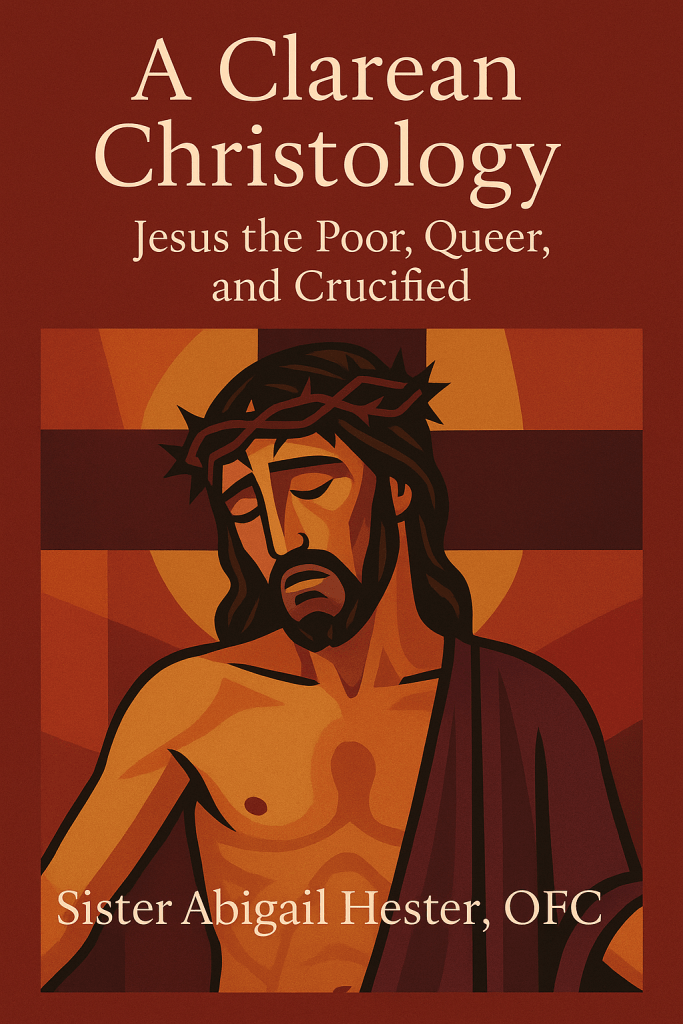
A Clarean Christology: Jesus the Poor, Queer, and Crucified
By Sister Abigail Hester, OFC
My Work is for the Greater Good of All
All works by Sister Abigail Hester, OFC are released under the Creative Commons Attribution 4.0 International License (CC BY 4.0).
You are free to share, adapt, and build upon this material for any purpose — even commercially — provided that proper credit is given.
This work is offered freely for the benefit of humanity, in the spirit of compassion, justice, and the common good.
To view a copy of the license, visit: https://creativecommons.org/licenses/by/4.0/
Introduction: Who Do You Say That I Am?
“Who do you say that I am?” —Jesus (Mark 8:29)
This question echoes through the centuries—not as a theological quiz but as a radical invitation. It is the question that pierces through doctrines and dogma and demands a response not just from our minds, but from our lives. In the face of empire, injustice, and suffering, how we answer determines whether we walk with Jesus or merely talk about him.
This book is my answer.
We live in a world where Jesus is often co-opted: by white supremacy to bless conquest, by capitalism to sell self-help slogans, by patriarchy to shame women and queer bodies, by empire to justify endless war. This is not the Jesus of Nazareth. This is not the Christ who walked with the poor, touched lepers, uplifted women, challenged Rome, and broke bread with the damned.
The Jesus I have met—through Scripture, Spirit, struggle, and sacrament—is poor, queer, and crucified.
A Poor Jesus
Jesus was not middle class. He was born to a teenage girl under colonial rule, into a family of day laborers, in a country occupied by the Roman Empire. He was economically vulnerable, politically suspect, and spiritually threatening to the status quo. He aligned himself not with kings but with beggars. His first sermon was a declaration of good news to the poor (Luke 4:18). He called blessed those who hungered, wept, and were hated.
The Jesus of holy poverty is not about romanticizing suffering but revealing solidarity. He teaches us, like St. Francis and St. Clare of Assisi, that true riches are found in kinship, simplicity, and community. He exposes the lie of consumer salvation and invites us to live differently—against greed, against accumulation, and for the common good.
A Queer Jesus
To say Jesus is queer is to say he queers expectations. He transgresses gender roles, resists rigid norms, and befriends those the religious elite deem impure. He loves with scandalous abandon. He washes the feet of his disciples like a servant-wife. He lets his body be broken and offered like a bridegroom. He calls a ragtag band of nobodies his family and redefines what holiness looks like.
Queer theology teaches us that Jesus reveals God in the margins, not the center. That trans, gay, nonbinary, intersex, and asexual people are not afterthoughts in the divine story but bearers of revelation. That to follow Jesus is to embrace fluidity, mystery, and the disruptive power of love.
A Crucified Jesus
Jesus was executed as an enemy of the state. His crucifixion was not an accident—it was the logical outcome of a life lived in radical resistance. He touched the untouchable, defied the Sabbath for the sake of healing, exposed religious hypocrisy, and proclaimed a kingdom where the last are first. For that, he was tortured and killed.
As James Cone wrote, “The cross and the lynching tree are the same tree.” The crucified Christ is found in every body targeted by police violence, every trans teen driven to suicide, every migrant child in a cage. The cross is not divine punishment—it is empire’s wrath. But it is also God’s solidarity. Jesus takes the violence of the world into his body and returns not vengeance, but resurrection.
A Franciscan Clarean Christology
This book offers a Christology shaped by the wisdom of Francis and Clare, the defiance of liberation theology, the beauty of queer theology, the clarity of feminist thought, and the mystical hope of universal salvation. It is unapologetically political, deeply pastoral, and spiritually rooted.
Each chapter will explore a facet of Jesus’s life and ministry through this lens:
His birth under empire.
His solidarity with the marginalized.
His radical poverty.
His nonviolent resistance.
His queer embodiment.
His crucifixion by the powers.
His cosmic resurrection.
His ongoing presence in the struggle for justice and joy.
To read the Gospels with queer eyes and Franciscan hearts is to discover a Jesus who cannot be tamed or owned. He is not a mascot for any denomination or institution. He is the Christ of the cracks in the system, the Christ of the compost and the protest, the Christ of the beloved community yet to come.
So again I ask: Who do you say that he is?
Come and see.
Chapter One: Jesus of Nazareth, Child of Empire
“Can anything good come out of Nazareth?” —John 1:46
“Render unto Caesar…” —Mark 12:17
“He has brought down the powerful from their thrones and lifted up the lowly.” —Luke 1:52
A God Born in the Shadows
Jesus was not born into a vacuum. He was born into an occupied territory, in a time of violent Roman colonization, and under the threat of economic injustice, religious control, and imperial brutality. Nazareth was not glamorous—it was a forgotten village in the backwoods of Galilee, far from the political centers of power, and even further from religious respectability.
To begin with Jesus is to begin with empire.
The Gospel birth narratives are not fairy tales—they are resistance stories. Caesar Augustus, Quirinius the governor, Herod the puppet king: these names are dropped not to set a scene but to locate Jesus within the machinery of domination. His family was poor enough to offer pigeons at the temple instead of a lamb (Luke 2:24). They fled as refugees to Egypt, victims of Herod’s genocidal violence.
Jesus was not the child of privilege. He was a brown-skinned Jew born under Roman rule, a descendent of the oppressed, not the oppressors. This is where our Christology must begin—not in heavenly abstractions but in colonized soil.
Jesus as Political Threat
The cross was not a religious symbol when Jesus lived. It was an instrument of state terror. Crucifixion was the Roman Empire’s warning label for anyone who disrupted the status quo. It was reserved for insurrectionists, runaway slaves, and enemies of the state.
So why was Jesus crucified?
Because he was dangerous.
Jesus challenged the religious authorities and their collaboration with Roman power. He disrupted the Temple economy (Mark 11:15–17). He gathered crowds and declared a kingdom not of Caesar but of God. He called for the reorganization of society around the poor, not the rich. His healings, meals, and parables weren’t just kind—they were subversive acts of community in a world built on hierarchy.
The Westar Institute’s scholars remind us that much of the Gospel tradition was shaped in conversation with empire. The early Jesus movement was not simply religious—it was political, economic, and anti-imperial. To proclaim “Jesus is Lord” was to reject “Caesar is lord.”
Empire Then and Empire Now
To understand Jesus rightly, we must reckon with empire—not just Rome, but the systems of domination in every age.
Today’s empire wears new names:
White supremacy
Capitalism
Religious nationalism
Colonialism and neocolonialism
Patriarchy and cisheteronormativity
Just as Rome demanded taxes, loyalty, and worship, so too our modern empires demand allegiance. Jesus’ invitation to “follow me” is not a call to passive spirituality. It is a call to reject empire and build beloved community.
Theologians like Joerg Rieger and Ched Myers argue that to preach Christ today means standing with the exploited, resisting economic violence, and embodying divine justice in public, material ways. This is not a side issue—it is at the heart of the Gospel.
The Marginal Messiah
Jesus did not rise through the religious ranks. He wasn’t a Pharisee, Sadducee, or Temple priest. He didn’t hold institutional power. Instead, he taught on hillsides and boats. He hung out with fishermen, tax collectors, and sex workers. He formed a movement, not a denomination.
His preaching was not sanitized. He called the powerful vipers (Matthew 12:34), lamented over Jerusalem, and predicted the Temple’s destruction. His vision of the Reign of God was not about escaping the world but transforming it from the margins.
As queer theologian Marcella Althaus-Reid says, “Theology is not made in the centers of power. It is born in the bodies of the violated and in the laughter of the disobedient.” Jesus’ location—social, political, and spiritual—was always with the disobedient, the violated, the dreamers.
A Christology from Below
James Cone wrote a Christology from the perspective of the Black struggle for freedom. Ada María Isasi-Díaz did the same from Latina mujerista experience. Gustavo Gutiérrez asked what it means to say “God loves the poor” in a world that doesn’t.
This Clarean Christology continues that tradition: to know Jesus, we must look to the bottom of the social order. He is not found in the thrones of theologians or the palaces of prelates, but in the dirt with the workers, in the alleys with the trans kids, in the prison cells, refugee camps, and urban margins.
“Jesus was a poor man,” St. Francis said, “and so I too must be poor.”
We must dare to say more:
Jesus was a poor, colonized, brown-skinned Jew.
Jesus was a political enemy of the state.
Jesus was and is Good News for the oppressed.
Chapter Two: The Christ of the Margins
“The stone the builders rejected has become the cornerstone.” —Luke 20:17
“Whatever you did for one of the least of these… you did for me.” —Matthew 25:40
God at the Edges
Jesus didn’t simply help the marginalized—he was one of them. And he consistently centered those others sought to erase. In his world, that meant lepers, bleeding women, Samaritans, Gentiles, children, the poor, sex workers, and even the mentally ill.
To follow Jesus is not to climb a ladder to holiness—it’s to descend into solidarity.
The Christ of the margins is not a symbolic figure. He is real and fleshy, found in human bodies bruised by exclusion, stigma, and structural violence. He is the God of queer teens kicked out of their homes, of trans women denied access to care, of disabled folks dehumanized by systems, and of the unhoused mocked on city streets.
He is found precisely where we least expect him.
Jesus and the Company He Kept
The gospels reveal a pattern: Jesus broke purity codes to build community. He constantly transgressed the boundaries of who was considered holy, clean, or acceptable.
He touched lepers, making himself “unclean.”
He welcomed menstruating women and sat with sex workers.
He healed on the Sabbath, breaking religious law for the sake of love.
He spoke with a Samaritan woman at a well—breaking rules of race, gender, and propriety in one act.
Jesus didn’t avoid scandal. He embraced it as a method of ministry.
Theologian Virginia Ramey Mollenkott wrote that Jesus’ openness to gender and sexual variance makes him a profound ally for trans and queer people. When Jesus says, “There are eunuchs who have made themselves eunuchs for the sake of the kingdom” (Matthew 19:12), he acknowledges gender variance as holy.
The Queerness of Jesus
To call Jesus queer is not to project modern identity labels onto him—it is to recognize that his life transgressed normative expectations:
He never married or had children—radical in his time.
He formed chosen family with his disciples.
He showed deep affection for men and women in ways that defied patriarchal norms.
He embodied fluidity—at times maternal, at times fierce, always unsettling the binary logic of power.
Queer theologians like Patrick Cheng and Marcella Althaus-Reid ask us to look again at the Gospels and see Jesus as a queer liberator—not just affirming queer people, but embodying queerness in his refusal to conform.
This is the Christ we need today: one who breaks open rigid theologies and replaces them with radical belonging.
Trans Resonance and Divine Solidarity
What does it mean that Jesus’ body was changed, wounded, and glorified?
For many transgender Christians, the scars of Jesus after resurrection are a point of profound connection. His body was marked, not erased. He returned not in perfection, but in continuity—resurrected, and still bearing the evidence of his suffering.
This has been life-saving for many of us.
In the words of Rev. Dr. Pamela Lightsey, a Black lesbian theologian and trans ally: “The cross is not only a site of suffering—it is a site of identification.” To see Jesus as one who transgressed norms, endured public humiliation, and rose with power is to reclaim our own stories of transition, trauma, and resurrection.
Jesus’ Chosen Family
Jesus radically redefined kinship.
In Mark 3:33–35, when told his mother and brothers are looking for him, he replies:
“Whoever does the will of God is my sibling and mother.”
This is not rejection—it is expansion. It is the foundation for queer kinship, mutual aid, and community beyond bloodlines. Jesus’ community was one of chosen family, which remains a sacred structure for LGBTQ+ people today.
In queer and trans communities, we often speak of “found family” as our sanctuary. Jesus not only affirms this—he models it.
The Church as a Marginal Community
The early church was not built in marble halls. It was built in homes, prisons, marketplaces, and catacombs. It was a movement of slaves, widows, day laborers, sex workers, and foreigners. It was poor, persecuted, and prophetic.
To follow the Christ of the margins is to remember this origin—and to refuse to let the church become an arm of empire again.
The Franciscan Clarean tradition renews this marginal identity. We do not seek power, prestige, or prosperity. We seek proximity to the suffering Christ who still walks with the broken and excluded.
Come to the Margins
The margins are not places of lack—they are places of revelation.
If you have ever been told you don’t belong—because of your sexuality, your gender, your body, your poverty, your neurodivergence, your race—you are in good company. The company of Jesus.
He is not waiting at the center for you to arrive.
He’s already at the edge, calling you by name.
Chapter Three: Poor and Beloved — Jesus and Holy Poverty
“Blessed are you who are poor, for yours is the kingdom of God.” —Luke 6:20
“Though he was rich, for your sake he became poor.” —2 Corinthians 8:9
“Jesus was a poor man, and so I too must be poor.” —St. Francis of Assisi
Poverty as the Shape of the Gospel
Jesus did not just serve the poor—he was poor. This is not a spiritual metaphor or poetic flourish; it is a central theological claim. Born in a stable, raised by working-class parents, wandering without a place to lay his head—Jesus lived in proximity to economic precarity.
The radical nature of the Incarnation lies not simply in God becoming human, but in God becoming poor.
This chapter explores what Franciscan and Clarean spirituality call Holy Poverty—not as a romantic ideal or ascetic punishment, but as a path of liberation, resistance, and solidarity with the crucified peoples of the world.
Lady Poverty: A Franciscan Love Story
St. Francis called poverty his bride. He walked away from his family’s wealth to embrace a life of radical simplicity, choosing begging over business, service over security. St. Clare followed in his steps, founding a community of women who rejected dowries, refused to marry into patriarchal systems, and chose a communal life of prayer, work, and shared need.
To the world, this looked like foolishness. But to Francis and Clare, it was the most direct imitation of Christ.
Franciscan poverty is not about glorifying misery. It’s about refusing the empire’s definitions of success, resisting wealth-hoarding, and relocating to the margins—the very place Jesus called “blessed.”
The Order of Franciscan Clareans continues this tradition today—not by literal destitution, but by intentional simplicity, economic sharing, ecological mindfulness, and justice-rooted generosity. Our vow of simplicity is a prophetic “no” to consumerism and a radical “yes” to God’s abundance.
The Myth of Deserved Wealth
The dominant theology in many churches today is what Gustavo Gutiérrez called “prosperity Christianity.” It says that if you are faithful, God will bless you with wealth. If you’re poor, it must be because you lack faith, morality, or discipline.
This is heresy.
Jesus never said wealth was a sign of God’s favor. In fact, he said the opposite:
“Woe to you who are rich.” (Luke 6:24)
“It is easier for a camel to go through the eye of a needle…” (Mark 10:25)
“Sell what you own and give to the poor.” (Luke 18:22)
Jesus critiqued wealth constantly—not because money is inherently evil, but because accumulated wealth almost always requires injustice, and it insulates us from the vulnerability that breeds compassion.
To be poor in Jesus’ time was not just an economic status—it was a social identity, often associated with shame, exclusion, and spiritual deficiency. Jesus shattered that paradigm. He declared that the poor were not cursed—they were chosen.
Jesus, the Unhoused Prophet
“The Son of Man has no place to lay his head.” —Luke 9:58
Jesus was effectively unhoused. He relied on the hospitality of others, wandered from town to town, and disrupted the comfort of those who would follow him. He did not accumulate resources, establish a base of power, or secure a retirement plan.
In a world where unhoused people are criminalized, pushed out of public view, and denied dignity, it is vital to remember that God incarnate chose their condition.
As theologian Ched Myers has noted, Jesus created a traveling mutual aid community—one in which meals, healing, and housing were shared freely. The Jesus movement was a direct affront to the privatization of wealth and the religious systems that enabled it.
Clarean Simplicity in a Consumer World
Our modern world is obsessed with consumption. Capitalism thrives on dissatisfaction, always whispering: “You are not enough. Buy more. Be more.” Even spirituality is marketed—books, retreats, crystals, apps, all promising transcendence for a price.
But Clarean poverty offers a different message: you already have enough.
To live simply is to:
Embrace contentment as resistance.
Prioritize people over possessions.
Seek joy in community, not commodities.
Detox from the myth of scarcity.
This is not austerity for its own sake. It is freedom. As Francis said, “If we had possessions, we would need weapons to defend them.” The less we own, the more we can love.
The Economy of the Reign of God
Jesus spoke often about money—not to increase offerings, but to flip economic assumptions on their head. His parables challenged fairness, redistribution, and the generosity of God:
Workers in the vineyard get paid the same no matter when they arrive (Matthew 20).
The widow’s two coins are worth more than the wealthy’s abundance (Mark 12).
The banquet is filled with the poor and disabled, not the elite (Luke 14).
In God’s economy, there is enough. There is always enough.
This vision challenges capitalism, patriarchy, and white supremacy. It invites us to create communities rooted in mutual aid, economic democracy, and shared abundance. As Dorothy Day wrote, “We hold all things in common and live in love.”
Poverty, Not as Curse but Call
In the words of liberation theologian Leonardo Boff, “The poor are the real theologians.” They do not need to be saved by the rich. They bear the presence of Christ already.
Jesus chose poverty, not as punishment, but as proximity—to the vulnerable, the excluded, the hungry, and the afraid. To be with Jesus is to move toward the poor, not away from them. To share, not hoard. To lift up, not extract from.
Holy poverty is a blessing because it frees us to belong to one another again.
Chapter Four: Jesus the Nonviolent Resister
“Put your sword back in its place, for all who take the sword will perish by the sword.” —Matthew 26:52
“If anyone strikes you on the right cheek, turn the other also.” —Matthew 5:39
“He drove out the money changers…” —John 2:15
The Lie of the Passive Jesus
Christianity has too often presented Jesus as a doormat—gentle, soft-spoken, a victim rather than an agent. But this is a distortion. Jesus was not passive in the face of evil. He resisted it, subverted it, and exposed it.
What Jesus practiced was not submission—it was nonviolent resistance: active, deliberate, bold love that refuses to return violence but never tolerates oppression. This is not weakness. This is gospel fire.
Walter Wink, in his groundbreaking work on the “Third Way,” reclaims Jesus’ teachings as revolutionary. Turning the other cheek, going the second mile, giving your cloak—these are not acts of cowardice. They are subversive, public declarations of dignity that shame empire without becoming it.
Jesus as a Disruptor
Jesus did not “play nice” with the systems of his day. He interrupted business as usual.
In the Temple, he flipped tables, scattered money, and accused the religious-industrial complex of being a den of robbers (Mark 11:15–17).
On the Sabbath, he healed deliberately—provoking outrage and asserting that human need outweighs religious legalism (Mark 3:1–6).
In his parables, he mocked landowners, kings, and corrupt judges (Luke 18; Matthew 22).
His resistance was strategic. He knew when to speak, when to flee, and when to confront. He refused to be manipulated by the traps of the Pharisees or the power games of Pilate. He saw through every false binary.
Jesus’ way was not domination, but disruption. Not violence, but power.
Exorcism as Political Liberation
The Gospels portray Jesus constantly casting out demons—but what were these “demons”?
Ched Myers, in Binding the Strong Man, suggests that Jesus’ exorcisms were symbolic confrontations with oppressive systems. Possession represented not only personal torment but social bondage: to empire, patriarchy, purity codes, and fear.
Every healing act was a restoration of personhood. Every exorcism was a liberation from dehumanizing power.
To cast out a demon was not to shame the possessed—it was to rebuke the forces that crushed them. Jesus did not see broken people as enemies; he saw the structures that broke them as the true evil.
This is the exorcistic ministry that inspired Casting Out Empire. It is a call for every Christian to engage in liberative resistance—to name and unmask the demons of white supremacy, transphobia, ecological destruction, and state violence.
The Power of Civil Disobedience
Jesus’ actions mirror the tactics of civil disobedience:
He broke unjust religious laws.
He ate with the wrong people.
He let a woman anoint him with expensive oil in front of his critics.
He rode into Jerusalem on a donkey, mocking imperial processions.
This was theater, protest, and truth-telling all rolled into one.
In modern terms, Jesus was a disruptor of the dominant narrative. Like Gandhi, Martin Luther King Jr., or the Zapatistas, he chose the path of resistance without replicating the violence of the oppressor.
Jesus’ cross was not a fluke. It was a consequence of faithful disobedience.
Pacifism Is Not Passivity
Christian pacifism does not mean silence. It means refusing to kill while refusing to submit.
This is deeply rooted in the Franciscan tradition. St. Francis crossed enemy lines to speak with a Muslim sultan. He tore off his clothes in the public square to denounce wealth. He confronted popes and prelates alike. His peace was not meek—it was fierce.
The Order of Franciscan Clareans walks this same road. We oppose war, police brutality, and the death penalty. We advocate for restorative justice and holy disruption. Our nonviolence is not naive. It is prophetic.
As bell hooks reminds us: “There can be no love without justice.” Nonviolence is not passive suffering. It is active resistance, rooted in love.
The Cross as Consequence, Not Sacrifice
Jesus did not seek death. He was not suicidal. The cross was not God’s demand for blood, but the empire’s punishment for rebellion.
John Dominic Crossan calls crucifixion “a public warning.” It was the Roman way of saying: Don’t do what he did.
But resurrection is God’s way of saying: Do it anyway.
Jesus’ death was not payment—it was consequence. And his resurrection is divine refusal to let empire have the last word.
Following the Resister Christ
To follow Jesus is not to avoid conflict but to step into it with courage and care. It is to risk our comfort, reputation, and safety for the sake of the vulnerable. It is to say no to unjust laws, no to violent policies, and no to theological abuse—even when it costs us.
The Clarean Christ is not a soft savior. He is a fierce lover. A sacred resister. A holy rule-breaker. He calls us not to politeness but to prophecy. Not to compliance but to compassion. Not to calm but to courage.
The world does not need more polite Christians.
The world needs more holy troublemakers.
Chapter Five: The Queer Crucified God
“We preach Christ crucified, a stumbling block to Jews and foolishness to Gentiles.” —1 Corinthians 1:23
“The Son of Man must suffer many things…” —Mark 8:31
“Unless I see the wounds… I will not believe.” —John 20:25
Crucifixion: Empire’s Final Word
To say Jesus was crucified is to say he was executed by the state.
The cross is not a spiritual metaphor—it is a historical reality. Crucifixion was a Roman tool of public terror, used to suppress rebellion, humiliate victims, and warn the masses: this is what happens to those who resist.
It was not private. It was not sanitized. It was slow, public, and brutal.
And it was queer.
Not in the sexual sense alone—but in the broader theological sense: the cross queers all power, all glory, all assumptions about what God is and does. On the cross, divinity is naked, shamed, wounded, and dying. The ultimate vulnerability of God explodes every expectation of strength and dominance.
As Marcella Althaus-Reid wrote, “The cross is a place of sexual and political transgression.” To reclaim the cross is to face the horror of empire and the mystery of grace in the same breath.
The God of the Lynching Tree
James Cone’s The Cross and the Lynching Tree makes the crucial connection: just as crucifixion was the empire’s warning, lynching was white supremacy’s spectacle of terror. Both were designed to strip people of dignity, identity, and life. Both were public rituals of control.
If Jesus were executed today, it would not be on a wooden cross.
It would be on death row.
In a jail cell after a “wellness check.”
In an ICE detention center.
On a city sidewalk with a cop’s knee on his neck.
In a hate crime against a trans woman walking home at night.
To worship the crucified Christ is to proclaim that God is with the victims of state violence, not the enforcers of it.
A Trans Theology of the Cross
For many transgender Christians, the cross is a deeply resonant symbol. Jesus’ body is pierced, reshaped, misunderstood, and glorified. His wounds are not erased in resurrection—they are displayed.
What does it mean that the resurrected Christ still has scars?
It means that God affirms our woundedness without reducing us to it.
It means that resurrection does not require perfection.
It means that trans bodies—scarred, transitioning, beloved—are holy.
Rev. Dr. Patrick Cheng reminds us that queer people, like Christ, often face rejection, scapegoating, and “crucifixion” at the hands of family, church, and society. And yet, like Christ, we rise.
The crucified Christ is the God of trans survival, of queer resistance, of sacred bodies that refuse to die quietly.
Public Shame, Private Glory
Crucifixion was not just about death. It was about humiliation. Victims were stripped naked, mocked, spat upon, and paraded in public. Jesus endured this with a haunting silence.
Many queer and trans people know this well:
The shame of being outed.
The pain of being laughed at for how we dress.
The fear of walking down the street as our full selves.
The humiliation of conversion therapy, misgendering, abandonment.
And yet, in Jesus, we see that God has entered even this pain. The cross says: I know what it is to be publicly shamed. And I will meet you there with love.
Resurrection with Scars
When Jesus rose from the dead, he didn’t come back spotless. He came back wounded and radiant. He invited Thomas to touch his side—to place his hand in the hole where the spear entered.
“Put your finger here… Do not doubt but believe.” —John 20:27
This is not a demand for faith but an invitation to intimacy.
Jesus shows us that healing does not mean erasure. Our scars are part of our story. They are sites of power, not shame. In trans theology, this becomes a radical affirmation: your transition, your surgeries, your survival—are resurrection stories.
God does not remove our pain. God transfigures it.
The Cross Is Not God’s Demand
Let us be clear: God did not need Jesus to die.
The cross was not divine punishment or a payment for sin. That is a theology born of empire—of sacrifice, hierarchy, and fear.
Instead, the cross is God’s protest against violence. It is God’s refusal to stay out of our suffering. It is God’s solidarity with the most despised.
John Shelby Spong writes that the cross is where God joins us in the depth of our pain—not to explain it, but to transform it. Richard Rohr calls it “the pattern of reality”: suffering, death, and resurrection are woven into the very fabric of life.
The crucified God is the God who says: You are not alone.
Cruciform Discipleship
To follow the crucified Christ is to live a cruciform life—not a life of needless suffering, but a life shaped by solidarity, resistance, and sacrificial love.
It is to:
Stand with those society discards.
Speak truth even when it costs you.
Love fiercely in a world that crucifies love.
Carry your cross—not as burden, but as commitment.
The cross is not a weapon. It is a witness. It is not a doctrine. It is a direction. It points us toward every suffering body and dares us to say: Here is Christ.
Chapter Six: Resurrected in the Bodies of the Oppressed
“Why do you look for the living among the dead? He is not here, but has risen.” —Luke 24:5
“Christ has been raised from the dead, the first fruits of those who have died.” —1 Corinthians 15:20
“When you see the face of the poor, you see the face of God.” —Dorothy Day
The Resurrection as Divine Protest
Resurrection is not God’s magic trick—it is God’s act of rebellion.
It is the refusal of divine love to stay dead. It is the ultimate “no” to empire’s power. Empire killed Jesus to silence him, to crush hope, to terrorize others into submission. But resurrection says: You failed.
Every time a Black mother rises from grief to fight for justice,
Every time a trans person survives another day in a hostile world,
Every time a migrant crosses the border in search of life,
Every time a queer elder tells their story,
Resurrection happens again.
This is the theology of Easter as protest, not passivity. Resurrection is the uprising of divine love.
The Resurrection Body Is Not a Return to Normal
The risen Jesus is not shiny and perfect. He is wounded and walking. He eats fish. He shows his scars. He appears first to women, the ones discounted by empire and ignored by male disciples.
The resurrection does not undo the crucifixion. It transfigures it.
In this, there is hope for all of us who carry trauma, who wonder if we’ll ever feel whole again. Jesus shows us: your scars are not your shame—they are the proof that love has endured.
For survivors of conversion therapy, religious trauma, racism, abuse, and poverty, this is gospel. Jesus is not distant from your story—he is risen in it.
Jesus Appears on the Margins First
In every Gospel, the risen Christ shows up not in the temple or palace, but on the road, in a garden, among ordinary people. He appears to:
Mary Magdalene, the woman with a past.
The disciples walking away in confusion.
Thomas, full of doubt.
Peter, still guilty from betrayal.
He does not demand perfection. He shows up where people are hurting.
In the queer community, this kind of God is life-giving. We have been told we must be “healed” or “fixed” before we can be loved. But the resurrection says: You are already loved. Already enough. Already seen.
Jesus rises not to shame, but to restore relationship.
Resurrected in Every Act of Justice
The resurrection is not just an ancient event—it is a present reality.
Every act of justice, every meal shared, every protest marched, every mutual aid project organized, every sermon preached from the margins—resurrects Christ in the world again.
Gustavo Gutiérrez and liberation theologians have long taught that God has a preferential option for the poor. But resurrection is more than divine preference—it is divine participation.
God rises up in:
Land defenders resisting pipelines.
Queer youth creating chosen family.
Prison abolitionists imagining a world without cages.
Workers organizing unions.
Survivors reclaiming their voice.
Christ is alive in us, not just above us.
A Cosmic Resurrection
Ilia Delio and Richard Rohr describe the resurrection as not just an individual miracle, but the cosmic pattern of creation: life emerging from death, wholeness emerging from brokenness, communion emerging from isolation.
The universe is built on resurrection.
Trees fall and become soil for new growth.
Caterpillars enter the tomb of the cocoon and emerge changed.
Human bodies die and nourish future generations.
Stars collapse and give birth to galaxies.
In Christ, this cosmic rhythm becomes personal. Resurrection is the divine yes at the heart of all existence.
Resurrection and Collective Liberation
Resurrection is not just personal—it is communal. Jesus didn’t just rise—he called others to follow.
In a Clarean Christology, resurrection is a call to:
Organize, not isolate.
Heal together, not alone.
Believe in the possibility of collective transformation.
As trans theologian and activist Aurora Levins Morales writes, “Healing is not a process of returning to the way things were. It is a journey into something never before imagined.”
Resurrection is not going back—it is going forward. It is stepping into the world as it could be.
Hope with Dirt Under Its Nails
The resurrection is not a Hallmark moment. It is gritty, grounded, and real.
It is Jesus eating with hands still torn. It is joy that comes with the memory of pain. It is hope that does not erase trauma but holds it tenderly.
This is good news for survivors. For refugees. For dreamers. For all of us who have been told resurrection is for someone else.
It’s for us. It’s already begun.
Chapter Seven: The Cosmic Christ and the Ecological Christ
“In him all things hold together.” —Colossians 1:17
“The whole creation has been groaning in labor pains…” —Romans 8:22
“Praise be You, my Lord, through Sister Earth, our Mother, who sustains and governs us.” —St. Francis of Assisi
Christ Beyond the Tomb, Christ Within the Trees
If the crucified Christ shows us God in suffering, then the Cosmic Christ shows us God in everything.
This is not a departure from Jesus of Nazareth—it is an expansion. The same Jesus who walked dusty Galilean roads and shared bread with outcasts is also the one in whom, as Paul writes, “all things were created… things visible and invisible.” (Colossians 1:16)
The Cosmic Christ is not a different Jesus—it is Jesus everywhere: in the stars, in the soil, in your breath, in the mycelium network beneath your feet.
In the Franciscan tradition, St. Bonaventure called this the “footprint of the Word” in all creation. Richard Rohr describes it as the “universal Christ.” Ilia Delio invites us to contemplate a Christ who is still emerging, still incarnating, still present in the evolutionary unfolding of the universe.
The Earth as Sacred Text
Francis of Assisi called the sun his brother and the moon his sister. He didn’t romanticize nature—he relationalized it. He saw creation not as object but as kin.
Clare, too, found God not only in the Eucharist but in light. Her name, “Clare,” means “clear” or “bright.” She saw divinity radiating through windows, in silence, in stars.
To read the Gospels with Clarean eyes is to understand Jesus as deeply embedded in the web of creation—not above it. He spoke of:
Lilies and ravens (Luke 12)
Mustard seeds and fig trees
Storms and still waters
Soil and vine
Dust and breath
He didn’t just use nature as metaphor—he was revealing God in matter.
Robin Wall Kimmerer, a Potawatomi botanist and writer, teaches us to treat the earth not as a resource, but as a relative. This is indigenous wisdom echoed in Franciscan theology: the world is not here to be used but to be loved.
Ecological Christology in an Age of Collapse
We live in a world of climate grief.
Glaciers melt. Forests burn. Species vanish. Floods rise. Corporations drill. Empires wage war for oil. The poor and displaced bear the brunt of ecological violence.
In this world, the Cosmic Christ is not luxury theology—it is survival theology.
The resurrection of Christ must now be preached as the resurrection of the Earth, not in some far-off heaven, but here, in the soil, air, and waters we are losing.
Theologians like Thomas Berry and Vandana Shiva challenge us to see ecological justice as spiritual discipline. Jesus is not indifferent to extinction. The Christ of all creation weeps with a planet on fire.
Trans Bodies, Queer Nature
Ecology and queer theology share deep resonance. Both resist rigid binaries. Both honor fluidity, interconnection, and transformation.
Nature is not “male” or “female”—it is a wild diversity of expression.
Forests transition, rivers shift, bodies evolve.
Queer and trans people are not unnatural—they are reflections of the divine complexity woven into creation itself.
Jesus’ resurrected body—transformed, scarred, unrecognizable yet familiar—offers a theological home for queer ecology. In the body of Christ, boundaries blur. In the ecology of grace, everything belongs.
As Marcella Althaus-Reid wrote: “Indecency is the sacred ground where theology and the earth meet.” Christology must no longer ignore the land.
Communion with All Beings
In the Eucharist, we remember Christ’s broken body and shared blood. But what if Eucharist is cosmic?
What if:
The bread is the soil,
The wine is the watershed,
The altar is the forest floor,
And the priesthood includes deer, fungi, and fox?
This is not pantheism. This is deep incarnation—the belief that God has so entered matter that matter matters. Jesus’ Incarnation is not a temporary costume. It is the affirmation of all embodiment.
In every tree cut down, Christ is crucified again.
In every seed planted, Christ rises anew.
A Franciscan Clarean Call to Action
To love Christ is to love the Earth.
The Order of Franciscan Clareans commits to:
Living simply and sustainably.
Rejecting extractive capitalism.
Practicing herbal healing and earth-based ritual.
Defending ecosystems and species threatened by empire.
Teaching that salvation includes soil, sea, and species.
This is not optional. It is integral.
The Cosmic Christ is not a metaphor. He is the air in your lungs. The leaf on your palm. The pulse of spring in the thawing ground. If we desecrate the Earth, we desecrate the Body of Christ.
Sister Earth, Our Teacher
The Earth is not a backdrop. She is a prophet.
She teaches us:
To die and rise again.
To be still and yet alive.
To give without exhaustion.
To resist silently and steadily.
And she reminds us: Jesus is not just the Lord of heaven. He is the soil-born God. The compost Christ. The vine and root and rock.
Chapter Eight: Come and Follow — A Discipleship of Liberation
“Take up your cross and follow me.” —Mark 8:34
“If you love me, you will keep my commandments.” —John 14:15
“Preach the Gospel at all times; when necessary, use words.” —St. Francis of Assisi
Discipleship Is Direction, Not Doctrine
Jesus never said, “Worship me.” He said, “Follow me.”
Discipleship is not about orthodoxy—it’s about embodied direction. It’s about where your feet go, who you eat with, how you spend your money, what you’re willing to risk for love and justice.
To follow Jesus is to walk the path of the poor, the queer, the crucified—and the resurrected.
A Clarean Christology invites us into a way of life, not just a theology. It is the road of voluntary simplicity, nonviolence, radical inclusivity, ecological reverence, and prophetic resistance. It is the way of Jesus, Francis, Clare, and all who build the Beloved Community on the ruins of empire.
Imitation as Incarnation
Francis and Clare understood that to love Jesus was to become like him—not in theology alone, but in action.
Francis kissed lepers, rejected wealth, and walked barefoot through the world.
Clare broke canon law to lead a women’s community in absolute poverty, refusing patriarchal control.
Both embodied the Gospel through how they lived, not just what they believed.
Today, the Order of Franciscan Clareans reclaims this tradition for our generation:
We are queer, trans, neurodivergent, disabled, chronically ill, impoverished, survivors.
We are also artists, theologians, organizers, herbalists, healers, and holy fools.
We do not wait for institutional approval—we follow Christ anyway.
Discipleship is not perfection. It is proximity. It is fidelity. It is becoming a living sermon.
The Beatitudes as Our Rule of Life
“Blessed are the poor… the mourners… the meek… the peacemakers… the persecuted.”
Jesus’ Sermon on the Mount is not a list of moral suggestions—it is a map for revolutionary living. The Beatitudes form the heart of our Clarean Rule of Life.
To follow Jesus means:
Blessed are the trans kids rejected by their families.
Blessed are the unhoused who still share.
Blessed are the disabled who teach us interdependence.
Blessed are the queers who dance in defiance.
Blessed are the dreamers who haven’t given up.
The Kingdom of God is not an afterlife reward—it is a present uprising of love. Our discipleship is not aspirational—it is incarnational.
Practicing Discipleship in a World of Empire
Discipleship is not individualistic. It is communal, countercultural, and deeply political.
We follow Christ by:
Refusing the lies of white supremacy, Christian nationalism, and corporate Christianity.
Living in intentional community, mutual aid, and solidarity with the oppressed.
Refusing to profit from systems that exploit labor, Earth, or the marginalized.
Practicing daily rituals of prayer, justice, creativity, and sacred resistance.
The world will not understand this. Many churches won’t either. But the Cross has always been a scandal, and resurrection always begins underground.
Becoming the Body of Christ
Discipleship means becoming the Body of Christ in the world today.
When we:
Heal instead of harm,
Feed instead of hoard,
Speak instead of remain silent,
Embrace instead of exile—
We do what Jesus did. We become, as Teresa of Ávila said, “the hands and feet of Christ.”
And when we fail—and we will—grace meets us. The disciples fell asleep, ran away, denied him. And still he called them back. Still he cooked them breakfast. Still he said, “Follow me.”
Following Jesus Means Losing and Finding Yourself
“Those who lose their life for my sake will find it.” —Matthew 10:39
This is not a call to martyrdom or erasure. It is an invitation to transformation.
To lose the false self—shaped by fear, status, and shame—is to find the truer self: the self made in the image of God, baptized in justice, clothed in love, and alive with sacred courage.
Discipleship doesn’t mean walking behind Jesus in sandals and robes.
It means:
Organizing a rent strike.
Welcoming refugees.
Starting a queer-inclusive faith group.
Planting a community garden.
Reading the Gospels with trans friends.
Lamenting injustice and still choosing joy.
It means becoming little Christs—not in title, but in tenderness. Not in power, but in presence.
Closing Chapter: Christ Among Us Still
“Lo, I am with you always, even to the end of the age.” —Matthew 28:20
“Whenever you did it to one of the least of these… you did it to me.” —Matthew 25:40
“Christ has no body now on earth but yours.” —St. Teresa of Ávila
He Is Not Gone — He Is Risen in Us
Jesus was not resurrected into a palace. He did not return as a king. He appeared to the grieving, the broken, the doubting, the poor.
And he still does.
The Christ of the Clarean tradition is not confined to stained glass or church walls. He is among us:
In queer shelters and soup kitchens.
In refugee tents and protest marches.
In hormone clinics and hospice beds.
In compost heaps and community gardens.
In jail cells and drag shows.
He is here, in the flesh and bones of every person we are taught to overlook.
The Jesus we have followed through these pages—poor, queer, crucified, resurrected, and cosmic—is not waiting for us in some distant heaven. He is always already beside us, within us, among us.
The Gospel Is Still Being Written
We are not called to admire Christ. We are called to incarnate him.
The Gospel is not over. The Gospel is being written:
In the handwriting of every trans child who says, “I am who God made me to be.”
In the chants of marchers crying out for Gaza, Black lives, water protectors, and workers.
In the whispered prayers of the anxious, the houseless, the chronically ill.
In the hands of the herbalist blessing wounds.
In the joy of the drag queen singing alleluia with sequins and truth.
We are the continuation of Christ’s story. Every time we show up with radical love, holy rage, tender mercy, or fierce joy—we embody the living God.
Becoming a People of Resurrection
Resurrection is not just something to believe in. It’s something to practice.
To practice resurrection is to:
Refuse to give up, even when despair seems louder.
Celebrate life in the face of death-dealing systems.
Forgive and begin again.
Make art. Make trouble. Make peace. Make bread.
Build communities where every person is beloved and every body is holy.
We will not be perfect. But we will be faithful. And that is enough.
The Christ We Follow
We follow:
Jesus the poor, who calls us to divest from empire.
Jesus the queer, who calls us to celebrate the beauty of our difference.
Jesus the crucified, who stands with the suffering.
Jesus the resurrected, who refuses to be erased.
Jesus the cosmic Christ, who fills all creation with sacred presence.
This is not the Jesus of white nationalism, corporate religion, or theological gatekeepers.
This is the Jesus of the underside, the underdog, the underbelly of the world.
And he is still calling:
Come and follow me.
Come, with your fear and your fire.
Come, with your scars and your hope.
Come, with your queerness and your questions.
Come, with your fists and your faith.
Come and follow.
About the Author
Sister Abigail Hester, OFC is a queer transgender nun, theologian, spiritual activist, and the founding sister of the Order of Franciscan Clareans—a new monastic movement grounded in simplicity, justice, and radical love.
Rooted in the prophetic traditions of queer theology, liberation theology, Franciscan spirituality, and progressive Christian universalism, Sister Abigail writes at the intersection of lived experience and theological imagination. Her ministry affirms that every body is holy, that no one is beyond grace, and that the Gospel of Jesus is good news for the poor, the outcast, and the forgotten.
Her body of work includes devotionals for transgender Christians, herbal health guides inspired by Franciscan wisdom, queer-affirming biblical commentaries, and spiritual formation texts for the OFC community. A fierce advocate for the marginalized and a joyful practitioner of resurrection hope, Sister Abigail’s work invites all people into deeper belonging—with God, with the Earth, and with each other.
 Sister Abigail Hester