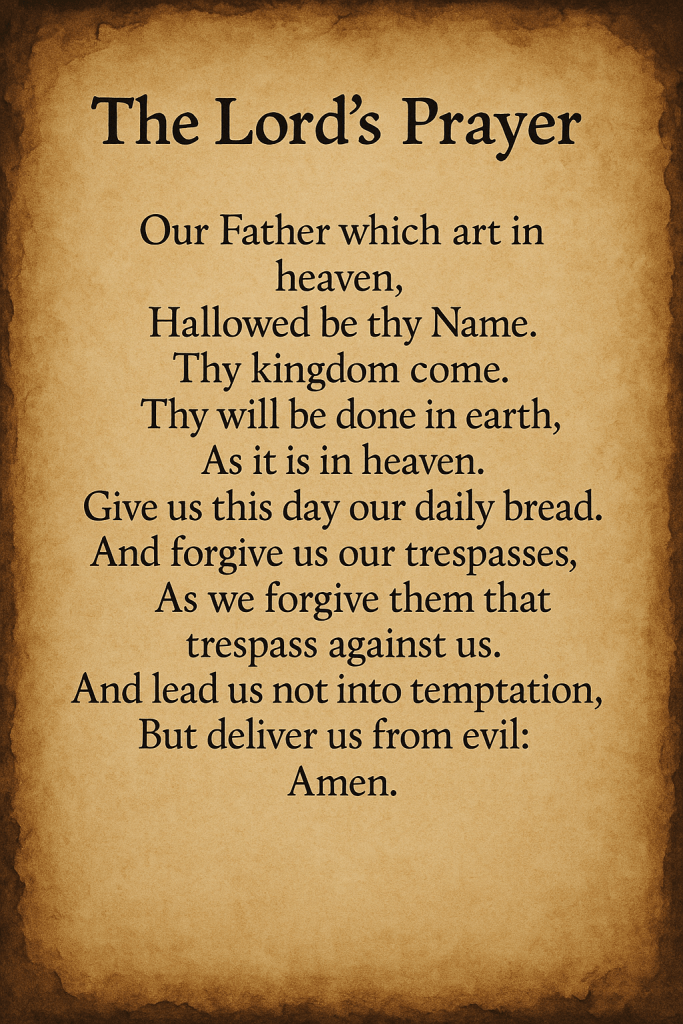
The Lord’s Prayer Matthew 6:9-13 (KJV).
“Our Father which art in heaven, Hallowed be Thy name. Thy kingdom come. Thy will be done on earth, as it is in heaven. Give us this day our daily bread. And forgive us our debts, as we forgive our debtors. And lead us not into temptation, but deliver us from evil: For thine is the kingdom, and the power, and the glory, for ever. Amen.”
A Franciscan Clarean Reflection on the Lord’s Prayer
“Our Father which art in heaven, Hallowed be Thy name.”
For Francis and Clare, God is not distant, but radically intimate. To say “Our Father” is not a claim of privilege but of solidarity — God is the parent of all, not just the chosen few. In our tradition, “hallowed be Thy name” calls us to reverence the sacred in everything: in creation, in neighbor, in ourselves. To misuse or trample on the earth, to exploit the poor, or to weaponize God’s name for nationalism or exclusion, is to desecrate what is holy.
“Thy kingdom come. Thy will be done on earth, as it is in heaven.”
Here is the heart of Franciscan prophecy: the Kingdom is not a faraway afterlife, but a present reality breaking in now. It is seen in solidarity with the oppressed, in climate justice, in queer affirmation, in peacemaking. Clare saw heaven shimmering in the Eucharist; Francis saw it in the leper’s eyes and the birds’ song. God’s will is not domination but liberation, not hierarchy but communion.
“Give us this day our daily bread.”
Daily bread is both literal and sacramental. It is food for the hungry, dignity for the poor, and manna for all creatures who depend on God’s abundance. To pray this is to stand against systems that hoard, privatize, and starve. The Franciscan Clarean way insists on simplicity: if everyone took only their “daily bread,” no one would go without. It also recalls the Eucharist — bread broken, shared without condition, open to all who hunger.
“And forgive us our debts, as we forgive our debtors.”
This is not a polite spiritual metaphor; it is a radical economic vision. In Jesus’ world, “debts” crushed the poor under empire. Forgiveness meant freedom from exploitation. Today, it still means liberation — cancellation of crushing student loans, release from predatory systems, healing of historical injustices. Forgiveness also transforms relationships: we forgive not to erase accountability, but to break cycles of violence and to open the door to reconciliation.
“And lead us not into temptation, but deliver us from evil.”
Temptation is not just personal vice but societal seduction: consumerism, militarism, nationalism, racism, patriarchy, ecological destruction. Evil is any force that distorts God’s dream of kinship. Deliverance is both personal and collective: God strengthens us to resist, to protest, to imagine alternatives. Francis and Clare resisted the temptations of wealth, power, and prestige; we are called to do the same in our age of empire and profit.
“For thine is the kingdom, and the power, and the glory, forever.”
Here is the ultimate unmasking: the empire’s power is not ultimate, Wall Street’s glory is not eternal, and nationalism’s kingdom will not stand. The true kingdom is God’s — a reign of justice, mercy, equality, and love. Francis saw that glory in Sister Moon and Brother Fire; Clare saw it shining through her life of prayer and solidarity. To end with “forever” is to remember that this Kingdom is already breaking in, and cannot be stopped.
Amen.
Amen means, “So be it.” Not passive resignation, but active commitment: “Yes, I will live this prayer.” It is both a sigh and a vow, both rest and revolution.
 Sister Abigail Hester
Leave a comment