Sister Abigail Hester

Blog

  • The Gospel of Mark (Part 1)

    🌿 The Gospel of Mark

    A Franciscan Clarean Commentary — by Sister Abigail Hester, OFC


    💫 The Wild Beginning

    Mark’s Gospel doesn’t start with cozy Christmas nostalgia. There’s no manger, no angels cooing over a baby. It starts in the wilderness — with a wild prophet, wearing camel hair, shouting about repentance.

    That’s classic Franciscan energy right there: God showing up in the margins, barefoot and untamed. The wilderness is where illusions fall away and simplicity becomes holy clarity. Mark’s Jesus bursts onto the scene not from a palace or temple, but from the desert. The message: God begins again on the edge of everything.


    🔥 The Urgency of Love

    Modern scholars call Mark’s writing “immediate.” Everything happens right now.
    From a Franciscan Clarean lens, this isn’t anxiety — it’s holy immediacy.
    The Gospel of Mark is breathless because love is urgent. The world is suffering, and compassion can’t wait until we’ve got our theology perfectly sorted.

    Francis and Clare understood that same pulse: mend what’s broken today. Feed the hungry now. Reconcile before the sun sets. Mark’s “immediately” is a heartbeat of divine action.


    💔 The Suffering Christ

    Mark’s Jesus bleeds early and often. He’s misunderstood, exhausted, betrayed, and finally screams in forsaken agony on the cross. Scholars see this as Mark’s theology of the Suffering Messiah — God revealed in pain, not power.

    We, too, know that mystery.
    The Franciscan Clarean path doesn’t chase prestige; it sits with the broken. It whispers that holiness often looks like vulnerability, like compassion that costs something.
    Mark’s Gospel turns empire’s logic upside down: greatness is service; glory is love poured out.


    🕊️ The Disciples and the Dance of Misunderstanding

    Let’s be honest — the disciples in Mark are a bit of a mess. They misunderstand nearly everything. They argue about greatness right after Jesus predicts his death.

    But Mark isn’t mocking them; he’s revealing us.
    Discipleship isn’t a test of IQ — it’s a willingness to keep walking, keep trying, keep saying yes even when you don’t get it.

    That’s the way of Clare: simple, stubborn faith that keeps loving even in the dark.
    That’s the way of Francis: joyfully failing forward in the company of Christ.


    🪞 The Messianic Secret

    Jesus tells people to keep quiet about his miracles. Why?
    Modern scholars call this the Messianic Secret. Mark’s Jesus refuses to be turned into a political slogan or celebrity. He wants hearts transformed, not crowds manipulated.

    For Franciscan Clareans, that’s spiritual humility in action — the quiet revolution of love without ego.
    Holiness doesn’t need to shout. It just is.


    🌍 The Politics of Compassion

    Mark’s story unfolds under Rome’s shadow. Power, greed, and violence define the world Jesus walks through. When he heals, eats with sinners, or touches lepers, he’s not just being “nice.” He’s resisting empire with compassion.

    Modern liberation and narrative scholars like Ched Myers and Amy-Jill Levine help us see that Mark’s Jesus is confronting systems — unbinding the “strong man” of domination.

    Francis and Clare did the same in their own century: they defied empire and Church wealth by living voluntary poverty and unarmed love. The Gospel of Mark is their manual for holy rebellion — the art of sacred disobedience.


    ✝️ The Silence at the Tomb

    The earliest ending — Mark 16:8 — leaves us hanging:

    “They fled from the tomb, trembling and bewildered… and said nothing to anyone, for they were afraid.”

    That’s the punchline of the Gospel. No resurrection appearances. No tidy closure. Just silence and fear — and an invitation.

    Mark ends with a cliffhanger because the story isn’t finished.
    It’s our turn to proclaim resurrection — through mercy, through courage, through joy.

    Franciscan Clareans pick up that unfinished sentence every day.
    Our life is the continuation of the Gospel.
    Our compassion is its new chapter.


    🌈 Reflection

    Mark’s Gospel is not a book about belief — it’s a summons to transformation.
    It’s wild, fast, apocalyptic, and full of holy surprise.
    In a world obsessed with control and comfort, Mark calls us to holy poverty, fearless love, and radical hope.
  • How to Celebrate the Feast of Saint Francis of Assisi

    Here’s how to celebrate the Feast of Saint Francis of Assisi (October 4th) — no habit, no monastery required, just an open heart and maybe a few furry friends. 🕊️🐾


    🌅 1. Start with Gratitude and Simplicity

    Francis began every day with gratitude for “Brother Sun” and “Sister Moon.”
    You can honor him by doing the same: step outside, breathe the morning air, and say something like:

    “Thank you, Creator, for this day, for breath, for life, for all creatures who share it with me.”

    Unplug for a while. Eat simply. Walk instead of drive. Let the day breathe.


    🕊️ 2. Pray or Reflect in Nature

    Francis didn’t see nature as decoration — he saw it as revelation.
    Go for a walk, sit under a tree, or open a window. Pray, meditate, or just listen.
    Read the Canticle of the Creatures (Francis’s own hymn) or Psalm 104.
    If you’re feeling poetic, write your own “Canticle of Gratitude.”


    🐕 3. Bless the Animals

    If you have pets, bless them with a short prayer or sprinkle water on their heads like a mini-baptism of love.
    If you don’t, donate to a local shelter or feed the birds.
    Francis loved all creatures — even the ones that bite.

    “Blessed are you, Lord, for Brother Dog, who teaches us joy.
    Blessed are you for Sister Cat, who shows us peace.”


    ✋ 4. Serve the Poor or Lonely

    Francis wasn’t just about fuzzy animals — he was fierce about compassion.
    Do something tangible:

    Bring food or socks to someone on the street

    Call a friend who’s struggling

    Volunteer or give anonymously

    Acts of mercy are living prayers.


    💐 5. Reconcile and Forgive

    Francis constantly sought peace.
    Take a moment to forgive someone — or yourself.
    If there’s tension with a friend, family member, or even God, offer a small olive branch.
    It doesn’t need to be dramatic — just real.


    📖 6. Read or Watch Something Franciscan

    Pick a passage from:

    The Little Flowers of St. Francis

    Brother Sun, Sister Moon (the film — gloriously 70s, but heartfelt)

    The Testament of St. Francis

    Then ask: What does “living simply” mean for me, today?


    🕯️ 7. Create a Mini-Ritual at Home

    Light a candle. Place a small cross, stone, or leaf beside it. Say:

    “Lord, make me an instrument of your peace.
    Where there is hatred, let me sow love.”

    Let the candle burn as a symbol of gentleness, humility, and hope.


    🎉 Bonus: Celebrate with Joy

    Francis loved laughter and song. Sing something, dance barefoot, share a meal with someone, or write a thank-you note to life itself.
    Holiness doesn’t have to be grim — it can sparkle.

  • Standing Against Violence, Standing for Democracy

    On September 10, 2025, Charlie Kirk was assassinated while speaking at Utah Valley University. I need to be clear from the outset: I do not agree with Charlie Kirk’s ideology, his rhetoric, or the policies he so often championed. Many of his views, in my understanding, were harmful and divisive.

    And yet — in a democracy, he had the right to hold and express those views. That right is fundamental. Disagreement is not a license to kill. Violence is not an argument; it is an annihilation. When we choose murder over debate, we abandon democracy itself.

    Murder Silences Us All

    Kirk’s assassination is not just an attack on one man. It is an attack on the fragile fabric of public discourse. Violence sends a single chilling message: that persuasion has failed, and only force remains. That message corrodes democracy and endangers us all, regardless of political affiliation.

    If we normalize responding to speech with bullets, then none of us — left, right, or center — are safe.

    Guns and the Urgency of Reform

    This tragedy again highlights a crisis we have refused to face: America’s epidemic of gun violence. Every shooting, whether political or random, chips away at our collective safety. Every murder makes the world smaller, colder, more afraid.

    I am not calling for the end of responsible gun ownership. But I am calling for common-sense laws that honor both liberty and life:

    Universal background checks to keep weapons out of dangerous hands.

    Red flag laws to intervene when someone poses a clear risk.

    Safe storage requirements to prevent guns from falling into the wrong hands.

    Waiting periods to cool moments of rage before they turn irreversible.

    These are not radical ideas. They are life-preserving ones.

    Choosing Life Over Violence

    As a Franciscan Clarean, my faith teaches me that every human life bears the image of God. That truth applies to our friends and to our enemies, to those we admire and to those we cannot stand. It applied to Charlie Kirk. It applies to those who mourn him. It applies to every life cut short by a trigger pulled too soon.

    So today I stand — not with Charlie Kirk’s politics, but with his right to live, to speak, to be heard without fear of being gunned down. I stand against murder, against gun violence, and against the lie that death is the answer to disagreement.

    A Prayer for Us All

    I pray for Charlie Kirk’s family in their grief.
    I pray for his supporters, shaken and afraid.
    I pray for a nation that seems to be forgetting how to disagree without killing.
    And I pray that we will finally have the courage to enact sensible gun reform, so that fewer lives end in tragedy.

    May we learn to listen, to argue, to resist — but never to murder.
    May we remember that democracy lives only when we choose life over death.

  • 🌿 A Franciscan Clarean Prayer to Mary

    A Franciscan Clarean Prayer to Mary

    Mother of the Poor Christ,
    you carried God’s revolution in your womb
    and sang the Magnificat with fire on your tongue.

    Sister of the Little Ones,
    teach us to say yes with courage,
    to cradle the powerless,
    to feed the hungry,
    to scatter the proud,
    to lift up the lowly.

    Mother of Mercy,
    walk with us on the margins,
    stand beside us in the streets,
    pray with us in our kitchens,
    weep with us in our sorrows,
    and laugh with us in our joys.

    Queen of the Poor,
    wrap your mantle around our Franciscan Clarean family,
    that we may live simply,
    love boldly,
    and follow your Son with reckless joy.

    Amen. ✨

  • A Franciscan Clarean Prayer for Peace

    A Franciscan Clarean Prayer for Peace

    Most Compassionate God,
    You who breathed stars into being and whispered life into the dust,
    teach us again the way of peace.

    Where nations rise in anger, let us sow dialogue and listening.
    Where greed devours creation, let us walk barefoot in reverence.
    Where hatred builds walls, let us tear them down with mercy.
    Where fear divides neighbors, let us risk love without condition.

    Christ of the wounded and the wandering,
    stand with the refugee, the prisoner, the homeless,
    and with all who are silenced by power.
    Make us companions of the poor,
    and fools for peace in a violent age.

    Spirit of holy fire and gentle dove,
    burn away the violence within our hearts.
    Give us courage to disarm not only nations,
    but our own bitterness and pride.

    We vow, in the spirit of Francis and Clare,
    to live simply,
    to love broadly,
    to forgive quickly,
    and to serve joyfully,
    until swords are beaten into plowshares,
    and every tear is wiped away.

    God of Peace, make us instruments of your healing,
    for the whole world is our monastery,
    and every creature is our brother and sister.

    Amen.

  • A New Beginning on the International Day of Peace

    On Sunday, September 21, 2025, the world pauses to recognize the International Day of Peace—a day set aside to honor the founding ideals of the United Nations: to promote peace, end conflict, and foster global cooperation. It is a day when people of every faith and nation lift up the hope that peace is not just possible, but necessary.

    And this year, on this sacred day of global reflection and renewal, we are humbled and thrilled to share an announcement close to our hearts:

    ✨ The launch of the Chaplains of Saint Francis—our new Street Ministry and the outreach arm of the Order of Franciscan Clareans. ✨


    Why Today Matters

    Choosing this day was no accident. The International Day of Peace is a call to live differently—to disarm our hearts, heal divisions, and choose love over violence. St. Francis himself, the peacemaker of Assisi, modeled this in every encounter, from embracing lepers to crossing battle lines to meet the Sultan.

    To begin our ministry on this day is to root it in the same Franciscan vision: to bring peace, compassion, and tangible hope where it is needed most—on the streets, among the marginalized, in the everyday struggles of our neighbors.


    What the Chaplains of Saint Francis Will Do

    As the outreach arm of the Order of Franciscan Clareans, the Chaplains of Saint Francis will:

    Walk with the poor, homeless, and forgotten.

    Offer pastoral care, prayer, and listening ears to those in crisis.

    Provide practical help—food, clothing, resources, and connections.

    Be visible signs of Christ’s peace in the streets, not behind walls.

    Build bridges across divisions of faith, culture, and identity.

    This isn’t charity. It’s solidarity. It’s rolling up our sleeves and stepping into the mess of real life with the conviction that every soul matters, and no one is disposable.


    A Prophetic Call to Action

    Our ministry begins in the spirit of Francis and Clare, but it belongs to everyone who hears the same radical call: to live simply, love boldly, and serve faithfully.

    If you’ve been waiting for the right moment to act, to serve, to join a movement of peace rooted in justice—this is it. We invite you to walk with us, pray with us, and serve with us. Together, we can become instruments of peace in a world aching for healing.


    🌿 On this International Day of Peace, a new chapter begins.
    The Chaplains of Saint Francis are here, and we are ready to serve.

    Peace and all good,
    The Order of Franciscan Clareans

  • What Would Francis and Clare Do About Transphobia and Christian Nationalism?


    In the town square of Assisi, Francis of Assisi stripped off his father’s fine clothes and said:
    “From now on I can truly say: Our Father who art in heaven.”[^1]

    It was more than drama—it was protest. He was rejecting wealth, patriarchy, and control. Clare of Assisi did the same when she left her noble home, cut her hair, and embraced a new life of freedom. Later, when church officials tried to bend her into obedience, she pushed back and declared to her sisters:
    “Go forward securely, joyfully, and swiftly on the path of happiness.”[^2]

    Francis and Clare lived a gospel of freedom and courage. If they were alive today, they would not be silent about the spiritual sickness of transphobia and Christian nationalism. They would name them for what they are: false gospels.


    The Franciscan-Clarean Lens

    Francis saw all creation as family—Brother Sun, Sister Moon, even Sister Death. He kissed lepers, welcomed outcasts, and called enemies “brother.” He wrote:
    “Blessed is the servant who loves his brother as much when he is sick and useless as when he is well and can be of service.”[^3]

    Clare defended the dignity of her sisters against bishops and popes, insisting that women could live the gospel without domination. She urged Agnes of Prague:
    “Place your mind before the mirror of eternity. Place your soul in the brilliance of glory.”[^4]

    In that eternal mirror, there are no flags, no borders, no gender policing—only the radiance of God shining in every creature.


    Naming Today’s Powers

    Christian nationalism fuses flag and cross, confusing domination with discipleship.

    Transphobia in the church is another mask of the same power.

    Both are rooted in fear. Both betray the gospel of Christ.

    Francis and Clare knew that same fear-driven religion in their own day: a church bloated with wealth, launching crusades, obsessed with control. And they refused to bow to it.


    How Francis Would Respond

    Francis would not sit in legislative halls waving flags. He would be on the street corners with queer youth, in shelters with trans women, and at Pride with open arms.

    This is the man who kissed lepers when others ran, who called the Sultan “brother” during the Crusades. He looked at faces and saw Christ. Today, he would see Christ in the trans teen fighting to survive, the drag queen daring to sparkle, the queer refugee seeking safety.


    How Clare Would Respond

    When soldiers came to attack her convent, Clare held up the Eucharist and prayed:
    “See, Lord, I am in your hands. Protect these whom I cannot protect.”[^5]
    The soldiers fled.

    Clare knew how to stand between the vulnerable and the powerful. She told her sisters:
    “Do not be disturbed by the clamor of the world that flies about like shadows.”[^6]

    If she lived now, she would stand in the church doorway saying, “You shall not harm my siblings.” She would not yield an inch to those who try to use God as a weapon.


    Unmasking False Piety

    Francis warned:
    “Knowledge puffs up, but love builds up.”[^7]

    Christian nationalism thrives on ideology. Transphobia thrives on theology twisted into cruelty. Both are knowledge without love—and therefore not of God.

    Clare’s reminder cuts through the noise:
    “What you hold, may you always hold. What you do, may you always do and never abandon.”[^8]

    If we claim to follow Christ, we cannot abandon His most vulnerable children.


    The Call for Us

    Francis prayed:
    “Let us all love God with our whole heart, and love our neighbor as ourselves.”[^9]

    That’s the gospel. No exceptions, no caveats, no border walls or bathroom bills. Just love.

    To follow Francis and Clare today is to stand where they would stand: with the marginalized, against the powers. It means rejecting the false gospel of nationalism and the cruelty of transphobia. It means daring to live as if God’s kingdom is already here—because it is.

    Clare said it best:
    “Love Him totally, who gave Himself totally for your love.”[^10]

    That total love includes every body, every soul, every child of God.

    The question, then, is not “What would Francis and Clare do?” The question is: What will we do?


    Footnotes

    [^1]: Thomas of Celano, The Life of Saint Francis, I.6.
    [^2]: Clare of Assisi, Rule of Clare, Chapter X.
    [^3]: Francis of Assisi, Admonitions, XXV.
    [^4]: Clare of Assisi, Fourth Letter to Agnes of Prague, 15–16.
    [^5]: The Legend of Saint Clare by Thomas of Celano, Chapter XXI.
    [^6]: Clare of Assisi, Second Letter to Agnes of Prague, 10.
    [^7]: Francis of Assisi, Admonitions, VII (echoing 1 Cor. 8:1).
    [^8]: Clare of Assisi, First Letter to Agnes of Prague, 11.
    [^9]: Francis of Assisi, Earlier Rule, Chapter XXIII.
    [^10]: Clare of Assisi, Fourth Letter to Agnes of Prague, 29.

  • Holier Than Honest, Holier Than Hype: A Reply (with receipts)

    In response to the following linked article:

    The rebuttal to my article tries to swat away questions of New Testament authorship with some familiar apologetic flourishes: Satan made you doubt, Plato had fewer manuscripts, and Peter could totally spell. Let’s sort through this — with both humor and actual scholarship.


    1. “Satan made you doubt.”

    Apparently the devil isn’t busy enough with wars, greed, and injustice — he’s moonlighting as a textual critic in a dusty library, whispering, “Pssst… Mark 16:9–20 wasn’t original.”

    But Christians noticed textual variants long before Bart Ehrman. Origen (3rd century) admitted, “The differences among the manuscripts have become great” (Commentary on Matthew 15.14). Jerome complained about “various readings” in the Latin Bible. Even Augustine admitted some texts circulated “with additions” (On Christian Doctrine 2.12).

    So if doubt comes from Satan, then apparently Origen, Jerome, and Augustine were on Beelzebub’s payroll too.


    1. “But Plato, Aristotle, Homer!”

    Yes, Plato has 7 manuscripts, Aristotle 49, Homer 643. The New Testament boasts over 5,000 Greek manuscripts. But as NT scholar Craig Blomberg (an evangelical) admits, “The abundance of manuscripts does not mean we have no variants. Quite the contrary — it means we have hundreds of thousands” (The Historical Reliability of the New Testament, 2016).

    Quantity of manuscripts is evidence of popularity, not necessarily authorship. Nobody’s eternal destiny hangs on whether Homer actually wrote the Iliad.


    1. “We know who wrote the Gospels — their names are in Acts!”

    That’s like saying, “Of course J.K. Rowling wrote Shakespeare; her name shows up in a library record.” The Gospels are anonymous. The earliest copies don’t say “The Gospel According to Matthew.” The titles appear in the late 2nd century.

    As Raymond Brown (a Catholic scholar) put it bluntly: “The present titles, which ascribe the Gospel to Matthew, Mark, Luke, and John, are not part of the original works but were added later” (Introduction to the New Testament, 1997).

    Acts mentioning “Matthew the tax collector” proves only that someone named Matthew was a tax collector — not that he wrote a 28-chapter Greek Gospel.


    1. “Paul wrote them all. Different style? Just handwriting mood swings.”

    The “multi-individuality of handwriting” defense is creative, but irrelevant. Scholars don’t base authorship on penmanship alone. They examine vocabulary, theology, and historical setting.

    For instance, Romans and Galatians pulse with Paul’s urgency. Ephesians and Colossians present a cosmic Christology and more structured Greek. That’s why most critical scholars (and even some evangelicals) classify them as “Deutero-Pauline.” Luke Timothy Johnson notes: “The differences in vocabulary, style, and theology are too great to ignore” (The Writings of the New Testament, 2010).

    That doesn’t make them fraudulent; pseudonymous writing was common in antiquity. It simply means the Pauline “school” carried forward his theology.


    1. “The Fathers quoted Paul, so that settles it.”

    Yes, Clement, Ignatius, and Polycarp cite letters attributed to Paul. But citing a text shows its authority, not its authorship. Eusebius himself (4th century) admitted debates about certain letters (Ecclesiastical History 3.25).

    Patristic testimony proves that by 100–150 CE, churches revered certain letters. It doesn’t prove Paul’s hand wrote each one.


    1. “Peter could spell. Show me a verse that says he couldn’t!”

    This is theological Uno: reverse card. The burden of proof isn’t on me to show Peter couldn’t spell. Acts 4:13 literally calls Peter and John agrammatoi (“uneducated”). That raises a fair question: how likely is it they wrote polished Greek treatises?

    Even conservative scholar Ben Witherington admits: “1 Peter’s Greek is too sophisticated for a Galilean fisherman… The hand of a secretary is almost certainly involved” (Letters and Homilies for Hellenized Christians, 2006).

    So sure, Peter could “spell” — with help. Inspiration doesn’t mean every apostle suddenly got Rosetta Stone.


    1. “But John’s Gospel and Revelation sound alike!”

    Actually, they don’t. The Gospel of John has elegant Greek; Revelation reads like someone who struggled with grammar. That’s why Dionysius of Alexandria (3rd century) argued they had different authors (Eusebius, Hist. Eccl. 7.25).

    Modern scholarship agrees. Craig Koester notes: “The differences in style and vocabulary are stark” (Revelation, Anchor Bible, 2014).

    If they’re the same author, then he went from writing like a philosopher to writing like Yoda.


    1. “You’re transgender, so you can’t be Christian.”

    This isn’t scholarship; it’s a playground taunt. My gender identity has nothing to do with whether Mark 16’s “long ending” was original. Attacking the critic instead of engaging the evidence is the definition of ad hominem.


    Conclusion: Faith, Facts, and Fear

    The New Testament is sacred, beloved, and central to Christian life. But pretending it dropped from heaven leather-bound in King James English doesn’t honor it — it cheapens it.

    Admitting that the Gospels are anonymous, that some Pauline letters are disputed, and that later scribes added a few passages doesn’t mean Christianity is false. It means the Bible has a history, just like every other ancient text.

    God’s Word isn’t fragile. If faith shatters the moment we admit Mark’s long ending was tacked on later, maybe the problem isn’t the manuscript tradition — maybe it’s our fear of facing the very human story of how God’s Word came to us.

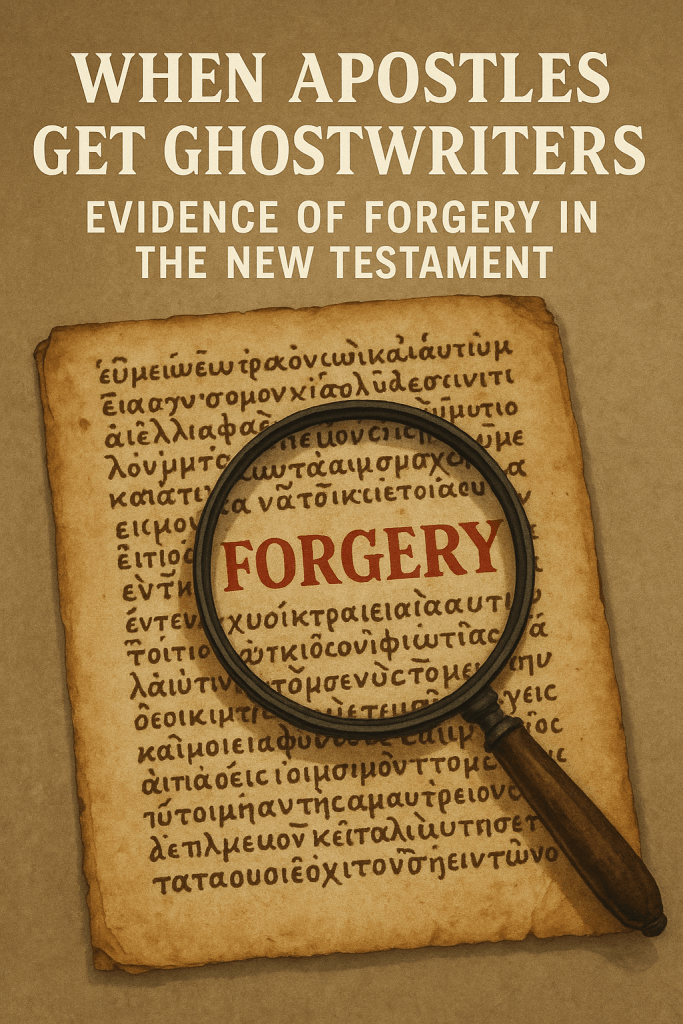
  • When Apostles Get Ghostwriters: Evidence of Forgery in the New Testament

    Introduction: Holier Than Thou or Holier Than Honest?

    The New Testament is hailed as “God’s Word,” but let’s be real: much of it is anonymous, pseudonymous, or forged. Early Christians lived in a world where writing under someone else’s name was a power move—meant to claim authority, shut down rivals, and win theological battles. Think of it as the original form of identity theft, with a halo.


    Paul: The Real vs. the Fake

    Authentic Paul (7 letters): Romans, 1–2 Corinthians, Galatians, Philippians, 1 Thessalonians, Philemon. These bear Paul’s raw, fiery voice—half-mystic, half-activist.[1]

    Imposter Paul (the rest):

    Deutero-Pauline: Ephesians, Colossians, 2 Thessalonians. These smooth-talking letters sound like Paul on decaf.[2]

    Pastorals (1 & 2 Timothy, Titus): Widely regarded as forgeries. Vocabulary and style don’t fit, the church hierarchy looks too developed, and Paul suddenly obsesses over bishops and “sound doctrine.”[3]


    Peter: The Fisherman Who Couldn’t Spell Greek

    1 Peter: Its sophisticated Greek and rhetorical polish make it unlikely that an uneducated Galilean fisherman wrote it.[4]

    2 Peter: Almost universally labeled a forgery, composed in the 2nd century, and heavily plagiarizing Jude.[5]


    The Johannine Mix-Up

    Gospel vs. Revelation: The Gospel of John is smooth, mystical Greek; Revelation is rough, broken Greek. Not the same author.[6]

    1–3 John: Anonymous letters later attributed to “John” for borrowed authority.[7]


    The Interpolations: Cutting Room Floor Additions

    Some passages look like late insertions—pious frauds with staying power:

    Mark 16:9–20: The “long ending” with snake-handling and poison-drinking is absent in earliest manuscripts.[8]

    John 7:53–8:11: The woman caught in adultery. A moving story, but added later.[9]

    1 John 5:7 (Comma Johanneum): Explicit Trinitarian formula—medieval addition, not found in Greek manuscripts.[10]

    Luke 22:43–44: Jesus sweating blood in Gethsemane—missing from earliest copies.[11]


    The Gospel Truth: They’re Anonymous

    The gospels never name their authors. “Matthew,” “Mark,” “Luke,” and “John” were attached in the 2nd century as authority branding.[12] In the ancient world, name-dropping was marketing: “Buy this scroll! Endorsed by an apostle!”


    Why It Matters

    Here’s the punchline: the church has been preaching against “bearing false witness” while canonizing forged documents. Hypocrisy much? But here’s the Franciscan Clarean twist: truth doesn’t need forgery to shine. The Spirit works even through messy, forged, and human documents. God’s love doesn’t require a flawless manuscript.


    Conclusion: Holiness Over Forgery

    If anything, forged and interpolated texts remind us that Christianity was always messy, political, and human. Faith isn’t about pretending our Scriptures dropped from heaven shrink-wrapped. It’s about hearing God’s call in the cracks, the edits, and yes—even the forgeries.

    Because if God can work through forged letters, then God can work through us—hot messes, imposters, and all.


    References

    [1]: Bart D. Ehrman, Forged: Writing in the Name of God—Why the Bible’s Authors Are Not Who We Think They Are (New York: HarperOne, 2011), pp. 95–118.
    [2]: Marcus J. Borg and John Dominic Crossan, The First Paul: Reclaiming the Radical Visionary Behind the Church’s Conservative Icon (New York: HarperOne, 2009).
    [3]: Raymond E. Brown, An Introduction to the New Testament (New York: Doubleday, 1997), pp. 668–681.
    [4]: Ehrman, Forged, pp. 122–124.
    [5]: Werner Kümmel, Introduction to the New Testament (London: SCM Press, 1975), pp. 430–433.
    [6]: Elaine Pagels, Revelations: Visions, Prophecy, and Politics in the Book of Revelation (New York: Viking, 2012).
    [7]: Brown, Introduction to the New Testament, pp. 387–393.
    [8]: Bruce Metzger, A Textual Commentary on the Greek New Testament (Stuttgart: United Bible Societies, 1994), pp. 102–106.
    [9]: Ibid., pp. 187–189.
    [10]: Metzger, Textual Commentary, pp. 647–649.
    [11]: Ehrman, Misquoting Jesus: The Story Behind Who Changed the Bible and Why (New York: HarperOne, 2005), pp. 187–189.
    [12]: Richard Bauckham, Jesus and the Eyewitnesses: The Gospels as Eyewitness Testimony (Grand Rapids: Eerdmans, 2006), though defending authenticity, still acknowledges anonymous origins.

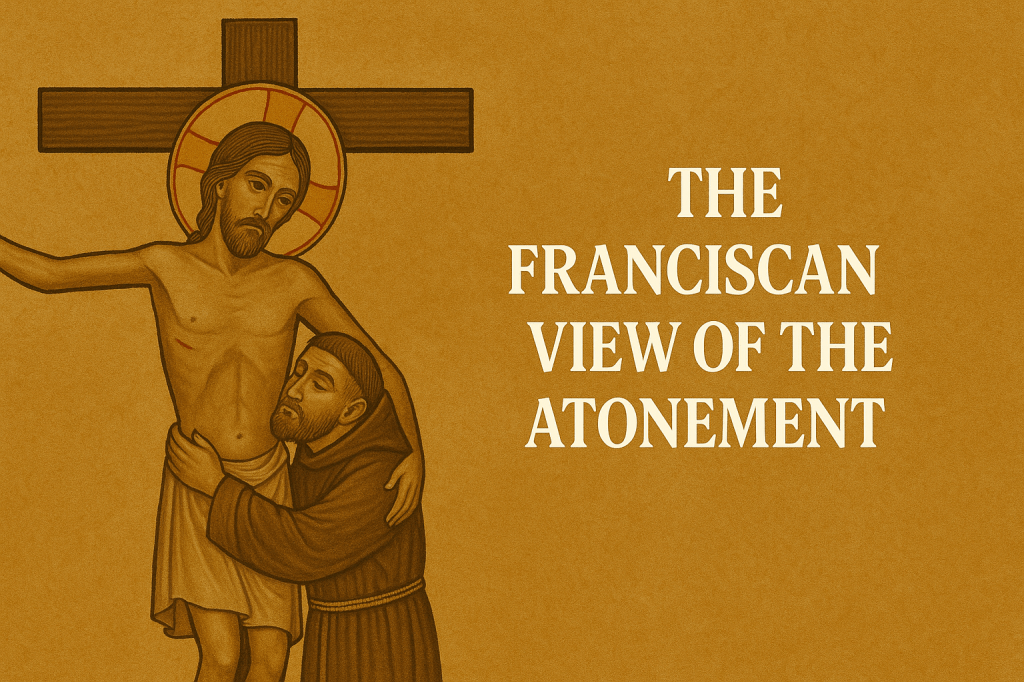
  • The Franciscan Vision of the Atonement: Love Before Law


    Introduction

    In the history of Christian theology, the doctrine of the atonement has often been framed in the language of law, debt, and punishment. Anselm of Canterbury’s Cur Deus Homo (11th century) offered the satisfaction model: humanity’s sin dishonored God, and satisfaction was required through Christ’s death.^1 Later Protestant Reformers sharpened this into penal substitution: Jesus bore divine wrath in humanity’s place.

    The Franciscan tradition, however, offers a radically different perspective. From St. Francis and St. Clare’s lived spirituality, to the speculative theology of St. Bonaventure and John Duns Scotus, Franciscans interpret the Incarnation and Cross not as reactions to sin but as the eternal expression of God’s love. For Franciscans, the atonement is not transaction but transformation, not appeasement but union.


    The Incarnation as “Plan A”

    At the heart of Franciscan atonement theology lies the Primacy of Christ. John Duns Scotus (1266–1308) argued that the Incarnation was not contingent upon human sin. God did not look down at Eden’s rebellion and scramble for a remedy. Rather, the Word-made-flesh was foreordained “before the foundation of the world” (Eph. 1:4).

    Scotus writes: “If Adam had not sinned, Christ still would have become incarnate. For the Incarnation is the greatest glory of God, and it is fitting that God should will always what is best and most glorious.”^2 In other words, Christ is not plan B after human failure, but plan A from eternity.

    This perspective reshapes the atonement: Jesus comes primarily to unite creation with God, not simply to fix sin.^3


    Bonaventure and the Cross as Revelation of Love

    St. Bonaventure (1217–1274), the “Seraphic Doctor,” emphasized the affective and mystical dimensions of the Cross. In his Tree of Life, he portrays Christ crucified as the burning heart of divine charity:

    • The wood of the cross is the ladder to heaven.
    • The wounds of Christ are windows into God’s mercy.
    • The Crucified is not merely victim but lover.

    For Bonaventure, the Cross does not primarily satisfy wrath but enflames hearts with love, drawing humanity into compassionate union with the suffering Christ.^4 The Franciscan devotion to the Passion—embodied in Francis’s stigmata—reflects this mystical vision.


    Francis and Clare: Lived Atonement in Poverty

    Francis and Clare of Assisi did not write scholastic treatises, but their lives proclaimed a theology of atonement. By embracing radical poverty, humility, and solidarity with lepers and outcasts, they embodied Christ’s own descent into littleness.

    For Francis, Christ saves not by power but by weakness. The Incarnation is God stooping down, and the Cross is God identifying with the crucified of the world.^5 To follow the Poor Christ is to share life with the poor and crucified of history.

    Clare insisted that gazing upon the mirror of the crucified Christ transforms the soul. “Place your mind before the mirror of eternity, place your soul in the brilliance of glory, place your heart in the figure of the divine substance, and transform your entire being into the image of the Godhead through contemplation.”^6 For Clare, this contemplative seeing—not legal reasoning—was the path of atonement.


    Theological Implications

    1. Union, Not Transaction
      • Salvation is not a commercial exchange of debt and payment, but a personal union of love between God and creation.^7
    2. Solidarity with the Marginalized
      • The Cross shows God standing with the oppressed. Thus, to live the atonement is to stand in solidarity with the poor, the queer, the crucified of every age.^8
    3. Cosmic Christology
      • The Incarnation integrates not only humanity but the whole cosmos into Christ. Atonement thus includes creation itself, grounding Franciscan ecological spirituality.^9
    4. Transformation of Desire
      • The Franciscan way emphasizes affectivity: the Cross changes the human heart, awakening love rather than fear.^10

    Conclusion

    The Franciscan opinion of the atonement is, at its core, a vision of divine love made visible in Christ. Against juridical models, Franciscans proclaim that God did not send Christ to change His own mind about humanity, but to change humanity’s mind about God.

    The Incarnation was always the divine intention; the Cross reveals the cost of divine love in a violent world. For Francis and Clare, Bonaventure and Scotus, the atonement is not a courtroom verdict but a love song sung from eternity: God with us, God for us, God in us.

    “Love is not loved,” Francis once lamented.^11 The Franciscan vision of the atonement dares to reply: on the Cross, Love is at last unveiled.


    Footnotes

    1. Anselm of Canterbury, Cur Deus Homo, trans. Jasper Hopkins (Minneapolis: Arthur J. Banning Press, 1974).
    2. John Duns Scotus, Ordinatio III, d.7, q.3 (see Allan B. Wolter, Duns Scotus on the Incarnation, Franciscan Institute Publications, 2004), 55–60.
    3. Richard Rohr, Eager to Love: The Alternative Way of Francis of Assisi (Cincinnati: Franciscan Media, 2014), 183.
    4. Bonaventure, The Tree of Life, in Bonaventure: The Soul’s Journey into God, The Tree of Life, The Life of St. Francis, trans. Ewert Cousins (New York: Paulist Press, 1978), 135–150.
    5. Augustine Thompson, Francis of Assisi: A New Biography (Ithaca: Cornell University Press, 2012), 102–110.
    6. Clare of Assisi, Fourth Letter to Agnes of Prague, in Francis and Clare: The Complete Works, trans. Regis J. Armstrong and Ignatius Brady (New York: Paulist Press, 1982), 66.
    7. Zachary Hayes, Bonaventure: Mystical Writings (New York: Crossroad, 1999), 89–94.
    8. Ilia Delio, A Franciscan View of Creation: Learning to Live in a Sacramental World (St. Bonaventure, NY: Franciscan Institute, 2003), 72.
    9. Ilia Delio, Christ in Evolution (Maryknoll: Orbis Books, 2008), 121–126.
    10. Ewert Cousins, Bonaventure and the Coincidence of Opposites (Chicago: Franciscan Herald Press, 1978), 142.
    11. Francis of Assisi, The Admonitions, in Francis and Clare: The Complete Works, trans. Regis J. Armstrong and Ignatius Brady (New York: Paulist Press, 1982), 36.