Introduction
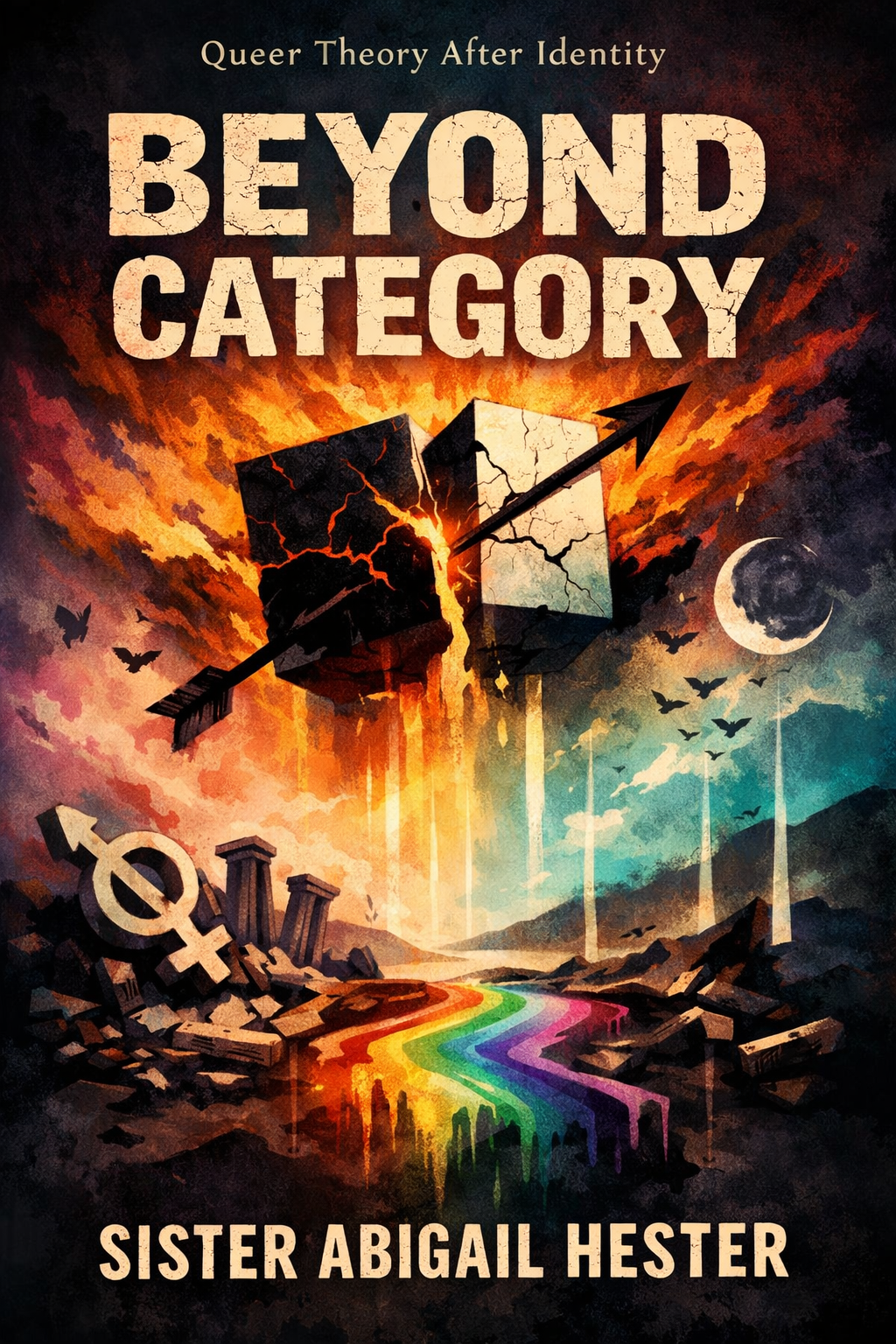
Burn the Boxes
I was told who I was before I knew how to speak.
The world handed me a script: boy or girl, straight or gay, sinner or saint, saved or lost. Check a box. Stay inside it. Don’t smudge the ink.
And if you don’t fit?
Well. Try harder.
Queer theory began as a rebellion against those boxes. It asked dangerous questions:
Who decided what is “normal”? Who benefits from the binary? Why does desire require classification? Why does the body require policing?
It cracked the architecture of certainty.
And for that, I am grateful.
But here is the uncomfortable truth:
Revolutions harden.
What begins as liberation can become doctrine. What begins as fluid can become institutional. What begins as “no more boxes” can quietly become a new, color-coded filing cabinet.
Identity saved many of us.
Identity also confines many of us.
This book is not an attack on queer theory. It is an interrogation. It is written from inside the house, not from the porch. It is written by someone who has lived in categories, fought for categories, deconstructed categories — and now suspects that categories themselves may not be the final destination.
What if identity is a bridge, not a home?
What if “LGBTQ+” is not an endpoint but a chapter?
What if liberation is not about better labels — but about loosening the need for labels at all?
We have inherited a world obsessed with sorting. Male/female. Gay/straight. Cis/trans. Saved/damned. Normal/deviant.
The sorting never stops.
And even in our resistance, we often mirror the same logic: define, declare, defend.
But what if the deepest freedom is not definition — but becoming?
Not fixed identity — but unfolding.
Not arrival — but movement.
This book will challenge conservative moralism. It will challenge liberal assimilation. It will challenge rainbow capitalism. And yes, it will challenge queer orthodoxy itself.
It will question whether our liberation movements sometimes recreate the hierarchies they sought to destroy. It will ask whether respectability politics dressed in glitter is still respectability politics. It will probe whether identity, once weaponized against us, can quietly become something we clutch for security.
That will make some people uncomfortable.
Good.
Comfort has rarely been the birthplace of transformation.
To be queer, at its most radical, was never simply to claim a category. It was to disrupt the necessity of categories. It was to expose the fragility of “normal.”
It was to reveal that the binary was always more fragile than it pretended to be.
But even queerness can calcify.
Even disruption can become aesthetic.
Even resistance can become marketable.
We live in a time where corporations sell us Pride while funding politicians who legislate our bodies. Where social media rewards perfectly packaged identities. Where algorithmic life demands that we declare ourselves in searchable terms.
Pick your label. Optimize your label. Monetize your label.
And in the middle of all that noise, some of us feel something quieter:
A refusal.
A restlessness.
A sense that the self is more fluid than our hashtags allow.
This book is for those who suspect that identity is real — but not ultimate. That gender is meaningful — but not absolute.
That sexuality is powerful — but not destiny. That the self is not a fixed statue, but a river.
It is for those who have transitioned, de-transitioned, re-transitioned, or refused to narrate their lives in neat arcs. For those who have found community in identity, but feel called beyond it. For those who sense that the future of queerness may not lie in perfect representation, but in radical indeterminacy.
We will talk about history. We will talk about medicine. We will talk about politics. We will talk about the market.
We will talk about the academy. And we will talk about the spiritual dimension that queer theory often tiptoes around.
Because beneath all of this is a deeper question:
What does it mean to be human in a world that insists on classification?
And perhaps even more unsettling:
What happens after we no longer need the classifications?
I am not offering easy answers. I am not proposing a new box labeled “post-identity” for you to inhabit.
I am inviting you into tension.
Into unfinishedness.
Into the courage to remain undefined.
If queer theory taught us anything, it is this: the structures we think are natural are often constructed. And what is constructed can be dismantled.
This book asks whether even our constructions of liberation must eventually be dismantled too.
Not to erase ourselves.
But to become more.
Welcome to the interrogation.
Let’s begin.
Chapter 1
The Invention of “Normal”
“Normal” feels ancient.
It feels natural. Obvious. Self-evident.
As if it grew out of the soil alongside trees and gravity and the need for food.
It did not.
“Normal” is a political invention.
Before the modern era, people were sinful, holy, deviant, blessed, cursed, strange, eccentric, or immoral. But they were not “statistically abnormal.” That language belongs to the 19th century — the age of measurement. The age of industrialization.
The age of charts, averages, census forms, skull measurements, and bureaucratic classification.
The word “normal” comes from the Latin norma — a carpenter’s square. A tool for measuring straightness.
Straightness.
Pause there.
The concept of “normal” did not arise from morality alone. It arose from mathematics.
From the bell curve. From the average body, the average mind, the average behavior. Once the average was established, deviation became visible — and suspect.
Difference became diagnosable.
Gender difference became measurable.
Sexual difference became categorizable.
Bodies became sites of scientific scrutiny. What had once been sin became pathology. What had once been eccentric became diagnosable disorder.
And with diagnosis came control.
The binary — male/female — was hardened not simply through theology but through medicine and law. Intersex bodies were surgically altered to maintain visual clarity. Same-sex desire was cataloged, studied, pathologized. The homosexual was no longer someone who committed certain acts; they became a type of person.
Identity was born in the laboratory.
This matters.
Because when we talk about “queer identity” today, we are operating inside a system originally designed to classify and contain.
The very framework we use to name ourselves emerged from a regime of measurement.
Normal versus abnormal. Healthy versus pathological. Male versus female. Natural versus deviant.
These are not eternal truths. They are administrative technologies.
The binary was never merely about biology.
It was about order. Industrial society required predictable workers, stable families, inheritance structures, disciplined bodies. The heterosexual nuclear family became the economic engine of modern capitalism.
Reproduction stabilized property.
Gender stabilized labor.
Desire was expected to serve production.
Anything that threatened that structure was labeled abnormal.
Queerness was not simply disliked. It was destabilizing.
To love differently was to disrupt inheritance. To embody gender differently was to destabilize labor divisions. To refuse reproduction was to interrupt the demographic logic of the state.
So the state measured.
The church moralized.
The medical establishment diagnosed.
And “normal” solidified into something that felt sacred.
But here is the fracture line:
Normal is not neutral.
It is aspirational. It demands conformity.
It promises safety in exchange for self-erasure.
And most of us tried to conform. Of course we did. Safety is seductive. Belonging is intoxicating.
Some of us succeeded at passing.
Some of us broke trying.
When queer theory emerged in the late 20th century, it did something brilliant: it exposed “normal” as performance. It revealed that gender is enacted. That heterosexuality is socially privileged, not naturally supreme. That identity categories are historically constructed.
It cracked the illusion of inevitability.
But let’s not romanticize history.
Resistance did not begin in graduate seminars. It began in bodies that refused to disappear. In drag balls. In underground networks. In street riots. In people who survived despite classification.
Theory followed survival.
Now here is the uncomfortable turn:
If “normal” is constructed — then so are its opposites.
If heterosexuality is institutionalized — so too is homosexuality once recognized and regulated.
If gender is a performance — then so is nonbinary identity once codified.
Every act of naming is both liberation and limitation.
To say “I am gay” in 1950 was dangerous.
To say “I am gay” in 2026 may be bureaucratically necessary.
Forms require boxes.
Algorithms require data.
Insurance companies require categories.
Liberation movements require definitions.
We needed names to fight back.
But names also fix what was once fluid.
The homosexual was invented as a category in the 19th century. Today we defend that category. We build community around it. We legislate around it. We marry within it.
This is not wrong.
But it is not neutral.
What began as rebellion has become institution.
And here lies the paradox: queer theory sought to destabilize “normal.” But in doing so, it sometimes reified identity itself. It multiplied categories — which was necessary — but multiplication is still classification.
The architecture remains.
More rooms. Same building.
The deeper question is not simply, “Who gets to be normal?”
The deeper question is: Why must normal exist at all?
Why is deviation measured?
Why must identity be stabilized for recognition?
Why does legitimacy require legibility?
Imagine a world where difference does not require diagnosis or defense. Where bodies are not measured against statistical averages. Where desire does not need ontological justification. Where gender variance is not radical — because nothing is fixed enough to revolt against.
That world is not here yet.
But we cannot move toward it if we pretend “normal” is natural.
Normal was engineered.
And what is engineered can be dismantled.
This chapter is not about rejecting society wholesale. It is about recognizing the blueprint. About seeing the scaffolding beneath the moral language.
About understanding that the binary was reinforced not because it was obvious — but because it was useful.
Useful to whom?
That is the question that will haunt the rest of this book.
Because if “normal” was invented, then perhaps the next frontier is not simply expanding normal.
Perhaps the next frontier is rendering it irrelevant.
We are not merely fighting for inclusion.
We are questioning the architecture itself.
And once you see the blueprint, you cannot unsee it.
The carpenter’s square is not sacred.
It is a tool.
And tools can be put down.
Chapter 2
The Medicalization of Difference
If Chapter One exposed the invention of “normal,” this chapter asks:
Who enforced it?
The answer is not just the church. Not just culture. Not just family.
It was the clinic.
Once deviation was measurable, it became treatable.
And once it became treatable, it became controllable.
In the late 19th and early 20th centuries, doctors and psychiatrists began cataloging sexual and gender variance with clinical fascination. What had once been condemned as sin was reframed as pathology. This shift is often portrayed as progress — and in some ways, it was. The language of illness softened the brutality of moral damnation.
But pathology is not freedom.
The “homosexual” became a diagnosable type. Gender variance became a disorder.
Intersex bodies became “mistakes” to be surgically corrected. Desire and identity were placed under the authority of experts.
You were no longer simply strange.
You were disordered.
And disorder requires treatment.
Here is the tension that queer communities still live inside:
Medical systems have both harmed and helped us.
Without psychiatry removing homosexuality from diagnostic manuals, legal reform would have been slower. Without gender dysphoria as a recognized condition, many trans people would not have access to hormones or surgery through insurance.
The system that pathologized also became the gateway.
Control became access.
Access required diagnosis.
And diagnosis required deficit.
You had to prove suffering.
You had to narrate your identity in clinically acceptable language. You had to demonstrate persistence, consistency, distress. You had to perform stability in order to be allowed transformation.
The gatekeeping was subtle but powerful.
“I have always known.”
“I hate my body.”
“I fit this narrative.”
Those stories are true for many.
But not for all.
And yet the medical system often rewards the most linear story. It prefers coherence. It prefers predictability. It prefers an identity that can be stabilized and codified.
Messiness makes bureaucracies nervous.
The medicalization of difference did something profound: it shifted authority over the self from community and experience to institution.
Doctors could affirm you.
Doctors could deny you.
Experts became translators of your own interiority.
And this is not ancient history.
Trans people today often still require psychological evaluation letters to access surgery. Intersex infants are still surgically altered to preserve binary clarity. Mental health diagnoses continue to mediate insurance coverage.
The body is still being negotiated in offices with fluorescent lighting.
Now let’s be honest.
Many of us are grateful for medical intervention. Hormones save lives.
Surgeries relieve dysphoria. Mental health care prevents suicide.
This book is not anti-medicine.
It is anti-monopoly.
When medicine becomes the sole arbiter of legitimacy, something subtle happens. The self becomes a case study. Identity becomes conditional upon expert validation.
And here is the deeper layer:
Medicalization does not simply regulate bodies. It shapes how we understand ourselves.
If your identity is framed primarily through dysphoria, you may come to experience yourself primarily through distress. If your sexuality is framed as orientation, you may understand desire as fixed and inherent rather than fluid and contextual.
Language reshapes consciousness.
Queer theory helped expose this. It showed how the “homosexual” was constructed through discourse. It revealed how psychiatric labels produce the identities they describe.
But even queer theory sometimes stops at exposure.
It tells us identity is constructed — but we still need identity for legal survival.
We critique diagnosis — but we rely on diagnosis for coverage.
We resist pathology — but we organize politically around medically recognized categories.
This is the paradox of liberation inside institutional systems.
You cannot easily dismantle the structure you depend on for care.
And yet dependence shapes identity.
Consider how many people discover they are “trans” or “nonbinary” not through embodied exploration alone, but through online diagnostic frameworks. Lists of symptoms. Checkboxes of experiences.
Criteria for belonging.
Does this invalidate identity? No.
But it reveals how identity is mediated.
The medicalization of difference did not end with removing homosexuality from diagnostic manuals. It evolved. It refined. It adapted.
Now we live in an era of optimization.
Hormone levels are tracked. Surgeries are improved. Bodies are modifiable. Identity can be technologically supported.
This is powerful.
It is also deeply entangled with systems of power.
Pharmaceutical companies profit from lifelong hormone therapy. Surgical industries expand. Insurance companies define coverage. Medical boards establish standards.
The body becomes both liberated and commodified.
We must hold both truths.
The danger is not transition.
The danger is uncritical faith in institutions.
The danger is believing that legitimacy comes only through certification.
What if your identity does not require pathology to be real?
What if difference does not need to be explained as distress to be valid?
What if becoming is not an illness to be cured, but a human condition?
The medicalization of difference was born from a desire to categorize and control.
It has evolved into a complex ecosystem of harm and help. To reject it entirely would be naïve. To trust it unquestioningly would be equally naïve.
Queer theory taught us to interrogate discourse.
Now we must interrogate dependency.
Because the deeper question is not simply whether medicine affirms us.
It is whether we have ceded too much authority over our own becoming.
The body is not a problem to be solved.
It is a site of unfolding.
And unfolding does not always fit diagnostic criteria.
As we move forward, we must ask:
If identity once required diagnosis to exist, what happens when identity outgrows the need for validation?
Can we imagine forms of embodiment that do not require medical narratives to be legitimate?
Can we imagine care without gatekeeping?
Can we imagine autonomy without institutional permission?
These are not abstract questions.
They shape who gets access. Who gets believed. Who gets to live.
The clinic is not neutral territory.
It never was.
And if we are to move beyond category, we must understand how category was written into the body itself.
Next, we turn to the politics of respectability — because once identity becomes recognized, it faces a new temptation:
To become acceptable.
Chapter 3
The Respectability Trap
Once you are no longer classified as diseased, the next demand appears:
Be acceptable.
Be understandable.
Be safe.
Every liberation movement eventually confronts this moment. The shift from survival to visibility. From resistance to recognition. From riot to legislation.
And recognition always comes with terms.
In the early days of queer resistance, visibility itself was radical. To say “I am here” was an act of defiance. To love publicly was dangerous. To gather was risky. To refuse shame was revolutionary.
But once the state begins listening — even reluctantly — the negotiation changes.
“We will tolerate you,” it says.
“Prove you are just like us.”
This is the respectability trap.
You are allowed rights — if you demonstrate normalcy.
You can marry — if your relationship mirrors heterosexual domesticity.
You can serve in the military — if you pledge loyalty to the same institutions that once excluded you.
You can adopt — if you replicate the nuclear family.
You can exist — if you are legible.
Respectability politics is not new. It has shaped movements across race, gender, and class. It tells marginalized people: behave impeccably, dress conservatively, speak politely, and the dominant culture will accept you.
Sometimes that strategy works.
But it always extracts a cost.
When queer liberation became centered on marriage equality, something subtle shifted. Marriage is not evil. Many couples found real security and joy in legal recognition. But the elevation of marriage as the pinnacle of queer achievement narrowed the horizon.
It suggested that the ultimate goal was inclusion into an existing institution — not reimagining intimacy altogether.
Radical possibilities were quietly sidelined.
Polyamory became inconvenient. Chosen families without romantic coupling became invisible. Sex-positive subcultures became embarrassing. Gender nonconformity that resisted neat presentation became difficult to market.
Pride became a parade of corporate floats.
And corporations love respectability.
They can sponsor it.
Rainbow logos cost little. Structural change costs more.
The radical edge of queerness — the part that disrupted capitalism, questioned property structures, destabilized family norms — was softened. Marketed. Branded.
“Love is love” became the slogan.
Beautiful.
True.
Safe.
But safe slogans rarely dismantle systems.
The respectability trap does something more insidious than assimilation. It reshapes aspiration. It teaches younger generations that success looks like blending in.
Get married. Get a mortgage. Get a curated social media presence. Be inspirational but not disruptive.
The queer rebel becomes the queer role model.
And role models are expected to be digestible.
Now here is the tension we must hold:
Safety matters.
Legal protection matters.
Healthcare access matters.
Representation matters.
We cannot romanticize marginalization.
But we must also ask: At what point does inclusion dull critique?
When your liberation depends on approval, your rebellion softens.
When your funding depends on corporate sponsorship, your rhetoric moderates.
When your identity becomes brandable, it becomes predictable.
The respectability trap tells us that liberation is achieved when we are indistinguishable from the majority.
But queerness was never about indistinguishability.
It was about exposing the fragility of norms.
It was about revealing that “normal” was always narrower than reality.
Here is the paradox:
To survive, we sometimes had to prove we were normal enough.
To remain radical, we must resist the need to be normal at all.
And this is where tension emerges within queer communities themselves.
Those who are visibly disruptive — drag performers, sex workers, gender-nonconforming youth, non-monogamous families — are often quietly distanced from mainstream advocacy campaigns.
They complicate the narrative.
They frighten donors.
They make it harder to argue, “We are just like you.”
But what if being “just like you” was never the point?
What if the power of queerness lies not in similarity, but in exposure?
Exposure of the arbitrariness of gender roles. Exposure of the fragility of heterosexual privilege. Exposure of the constructed nature of the family.
Respectability politics narrows imagination.
It turns liberation into assimilation.
It reduces revolution to policy reform.
Necessary policy reform, yes.
But insufficient.
And now we arrive at a deeper critique.
Respectability politics doesn’t just shape public strategy. It reshapes internal culture.
Within queer communities, new norms form. New standards of acceptable identity emerge. New expectations about how to narrate yourself.
Be proud — but not messy.
Be fluid — but still labelable.
Be authentic — but not confusing.
Even rebellion becomes curated.
And those who refuse coherence can find themselves marginalized again — this time within the movement.
This is how revolutions institutionalize.
This is how edges become centers.
The respectability trap is subtle because it feels like progress. It feels like maturity. It feels like victory.
But if liberation is measured solely by proximity to dominant norms, we have not dismantled the architecture of “normal.”
We have just expanded its walls.
The question we must ask is not:
“How do we gain inclusion?”
The deeper question is:
“What kind of world are we building?”
One where difference is tolerated so long as it behaves?
Or one where difference no longer needs to justify itself at all?
The future of queer theory cannot be limited to expanding representation within existing structures. It must ask whether those structures themselves require transformation.
Marriage. Family. Gender. Labor. Nation.
Not simply access — but reimagination.
Respectability is seductive because it offers safety.
But safety purchased at the cost of imagination is not freedom.
If we are moving beyond category, we must also move beyond the desire to be approved.
Because approval is still a form of dependency.
And dependency shapes identity.
Next, we turn inward — to queer theory itself.
Because even critique can become institution.
And even liberation can harden into orthodoxy.
Chapter 4
Identity as Idol
Every liberation movement begins with naming.
To name yourself is to refuse erasure.
To declare yourself is to disrupt silence.
To claim identity is to step into visibility.
For many of us, that naming saved our lives.
But what begins as salvation can slowly become something else.
An idol.
An idol is not merely something false. It is something partial that becomes ultimate. Something useful that becomes unquestionable. Something powerful that begins demanding loyalty.
Identity can become that.
“I am gay.”
“I am trans.”
“I am nonbinary.”
“I am queer.”
These statements are real. They are often hard-won. They are often dangerous to speak.
But when identity shifts from descriptor to destiny — from articulation to foundation — something tightens.
The label that freed you can begin to define you.
The narrative that explained you can begin to confine you.
Queer theory, at its most radical, taught us that identity categories are constructed. That sexuality and gender are shaped by discourse, power, and history. That the self is not fixed but relational, contextual, and fluid.
And yet, in practice, identity often becomes solidified.
We build community around it. We build politics around it. We build culture around it. We defend it fiercely — because it has been attacked.
Defense is understandable.
But defense can calcify.
Within queer spaces, identity can become moral currency. Correct terminology signals belonging. The right self-description grants credibility. The wrong phrasing can trigger suspicion.
Language evolves rapidly — sometimes beautifully, sometimes anxiously.
We say this is about respect.
Often, it is.
But sometimes it is about control.
Identity begins to operate as a gatekeeping mechanism.
Are you queer enough?
Are you trans enough?
Are you radical enough?
Are you properly deconstructed?
The irony is sharp.
A movement that sought to dismantle rigid categories can unconsciously create new rigidity around how categories are inhabited.
The idolization of identity does something subtle: it shifts the center of gravity from becoming to being.
Instead of asking, “How am I unfolding?” we ask, “What am I?”
Instead of exploring experience, we curate definition.
Instead of allowing ambiguity, we rush to classification.
But human experience is rarely neat.
Desire shifts over time. Gender expression fluctuates. Self-understanding deepens. Trauma influences perception. Community shapes articulation.
Identity is not a static object discovered in a vault.
It is an ongoing negotiation between body, culture, history, and language.
When identity becomes idolized, questioning it feels like betrayal.
If you outgrow a label, others may interpret it as regression. If you resist labeling entirely, you may be seen as evasive. If your experience does not align with dominant narratives, you may feel pressure to edit your story.
Liberation movements need solidarity.
Solidarity requires some shared language.
But shared language should not demand fixed selfhood.
Here is the tension:
Without identity, political organizing is difficult.
With rigid identity, existential freedom narrows.
We need categories for protection.
We do not need categories to define our souls.
The idolization of identity is amplified by social media culture. Platforms reward clarity. Algorithms prefer keywords. Bios demand concise descriptors.
You are asked to summarize yourself in a line.
Fluidity does not trend well.
Ambiguity is hard to monetize.
And so identity becomes aesthetic. Performative. Optimized.
This does not mean it is false.
But it can become curated in ways that distance us from our own unfolding.
Now let’s go deeper.
Why does identity feel so stabilizing?
Because in a world that once denied our existence, identity offers coherence.
It answers the question, “Who am I?” in a way that resists shame.
But perhaps the more radical question is not “Who am I?” but “How am I becoming?”
Being suggests finality.
Becoming suggests motion.
Queer theory began as a disruption of fixed being. It revealed the instability of the binary. It exposed how identity categories were constructed through power.
But once those categories are reclaimed, they can be re-solidified.
Reclamation is necessary.
Re-solidification is optional.
The danger is not claiming identity.
The danger is believing identity is ultimate.
What if identity is a stage of liberation, not its completion?
What if we needed to say, “I am this” in order to survive — but we are not required to remain there forever?
What if the future of queerness is not more precise categorization — but comfort with indeterminacy?
This does not erase anyone’s experience.
It expands possibility.
To move beyond identity as idol is not to abandon identity. It is to loosen our grip on it. To treat it as tool rather than temple. As language rather than law.
The self is not a brand.
The self is not a fixed ontology.
The self is a process.
And processes cannot be idolized.
They can only be lived.
The question that lingers is unsettling:
If identity is not ultimate, what remains?
That is where we are headed.
Because once we loosen identity’s hold, we must ask whether queer theory itself — the intellectual engine of so much liberation — is ready to be questioned.
Even theory can become orthodoxy.
And orthodoxy resists interrogation.
Chapter 5
The Academic Capture of Queerness
Queer theory did not begin in universities.
It began in bodies.
In bars that could be raided.
In streets where police batons swung.
In whispered networks and chosen families.
In drag balls and underground publications.
Theory followed life.
But over time, something shifted.
Queer theory entered the academy — and the academy reshaped it.
Universities have power. They produce language. They legitimize discourse. They publish, cite, canonize. When queer theory moved into academic departments, it gained intellectual rigor and institutional credibility.
It also gained distance.
The language became denser. The prose more abstract. The arguments more specialized. Entire conversations unfolded in journals inaccessible to the very communities whose lives sparked the theory.
This is not an attack on scholarship. Intellectual work matters. Precision matters. Historical excavation matters.
But we must ask:
Who benefits when theory becomes inaccessible?
Who is centered when liberation discourse requires graduate-level fluency?
Academic capture happens subtly. A field emerges. Conferences form. Departments allocate funding. Career incentives shape research agendas. Citations create hierarchies of authority.
Certain thinkers become canonical.
Certain voices are amplified.
Others are footnotes.
Queer theory in the academy often excels at deconstruction. It dismantles categories, critiques binaries, interrogates norms. But sometimes it hesitates to move beyond critique.
Deconstruction can become performance.
The language of subversion can become stylistic rather than structural.
Meanwhile, outside the university, queer communities are navigating healthcare access, housing insecurity, violence, and survival. The distance between theoretical radicalism and lived vulnerability widens.
Theory risks becoming aesthetic rebellion rather than material intervention.
There is another tension.
Academic institutions are not neutral spaces. They are embedded within capitalism. Tuition is expensive. Access is unequal. Knowledge production is influenced by funding structures.
When queer theory becomes professionalized, it must survive within those systems.
Radical ideas may be celebrated rhetorically — so long as they do not destabilize the institution funding them.
This is not conspiracy.
It is structural reality.
The academy rewards novelty, but it also rewards coherence. It prefers arguments that can be published, defended, cited. It requires definitions, even when the subject matter is fluidity itself.
And so queer theory sometimes becomes paradoxically rigid in its frameworks.
Certain interpretations of gender performativity dominate. Certain critiques of heteronormativity are expected. Certain genealogies of thought are treated as foundational.
Deviation from those intellectual norms can be quietly discouraged.
Orthodoxy forms.
The irony is sharp.
A theory born to destabilize norms can develop its own norms.
A movement rooted in lived defiance can become academically gatekept.
Now here is the danger:
When queer theory is overly academicized, community knowledge can be undervalued. Elders who survived earlier eras may not speak in theoretical vocabulary. Youth experimenting with identity may not frame their experience through Foucault or Butler.
But their lives are no less profound.
When language becomes too rarefied, theory risks detaching from the bodies it claims to defend.
And yet we cannot simply reject intellectual work. Without historical analysis, we forget patterns. Without conceptual tools, we struggle to articulate structural critique.
The problem is not scholarship.
The problem is monopoly.
When only credentialed voices are treated as authoritative, liberation narrows.
When theory speaks over lived experience, something fractures.
Queerness did not originate in footnotes.
It originated in refusal.
In improvisation.
In messy embodiment.
Perhaps the future of queer theory requires rebalancing.
Not anti-intellectualism — but intellectual humility.
Not rejection of academia — but resistance to its capture.
What if theory moved back toward community? What if scholarship was written with accessibility as a form of solidarity? What if lived narratives were treated as epistemology rather than anecdote?
Knowledge is not only produced in institutions.
It is produced in survival.
And survival has always been queer theory’s raw material.
As we move forward, we must ask a more destabilizing question:
If queer theory has been shaped by institutions, and institutions are shaped by capitalism, what happens when queerness itself becomes a market?
That is where we turn next.
Because the rainbow now comes with a price tag.
Chapter 6
Rainbow Capitalism and the Marketed Self
There was a time when being visibly queer could cost you your job.
Now there are corporations that sell you a Pride-themed coffee mug.
Progress? Yes.
But not simple progress.
Because capitalism has a remarkable skill: it absorbs resistance and resells it.
What once disrupted the market now fuels it.
Pride began as protest. It was defiant, angry, raw. It remembered police raids. It carried grief. It demanded visibility because invisibility was lethal.
Now Pride season is a marketing quarter.
Limited edition sneakers. Rainbow banking campaigns. Insurance ads with soft-focus queer couples. Corporate floats towering over grassroots organizers.
The market has learned our language.
“Authenticity.”
“Self-expression.”
“Be you.”
“Love wins.”
These slogans are emotionally resonant. They mirror liberation rhetoric. But they are also profitable.
Capitalism does not care about your soul. It cares about segmentation.
Once queer identity became statistically measurable — once census data, marketing analytics, and social research could identify us as a demographic — we became a target audience.
Target audiences are not liberated.
They are monetized.
Now here is the nuance:
Representation in advertising can feel validating. Seeing yourself reflected in mainstream culture can reduce isolation. Visibility has psychological impact.
But representation is not redistribution.
A rainbow logo does not guarantee healthcare access. A Pride-themed product does not dismantle housing discrimination. Corporate sponsorship does not equal structural justice.
And corporations rarely risk profit for principle.
They sponsor Pride in cities where it is safe to do so. They remain quiet in regions where queer visibility threatens revenue. Their advocacy bends with the market.
This is not surprising.
It is business.
The deeper issue is how capitalism reshapes identity itself.
In a market-driven society, the self becomes a brand.
You curate your identity. You signal your affiliations. You purchase items that reflect who you are. Your politics, aesthetics, and orientation become part of a consumer profile.
Queerness becomes lifestyle.
Aesthetic.
Merchandise.
You are encouraged to express yourself — through products.
And this is where identity as idol meets identity as commodity.
The more clearly you define yourself, the easier you are to market to. The more stable your identity category, the more predictable your purchasing behavior.
Fluidity complicates segmentation.
Ambiguity disrupts algorithms.
The marketed self prefers clarity.
Now consider how this influences queer culture.
Bars become branded spaces. Pride becomes ticketed. Influencers curate queer aesthetics for sponsorship deals. Activism is sometimes filtered through Instagram-ready design.
Again, none of this is inherently evil.
But it shifts the center.
When liberation is framed through consumption, structural critique dulls.
You are told you are powerful because you can choose.
Choose your label. Choose your pronouns. Choose your fashion. Choose your streaming content.
Choice feels empowering.
But choice within a limited marketplace is not the same as systemic transformation.
Capitalism thrives on individual expression while resisting collective disruption.
You can be queer — so long as your queerness does not challenge property relations, labor exploitation, or wealth inequality.
A married, dual-income, mortgage-holding queer couple fits comfortably into capitalism’s logic.
A queer collective questioning private ownership? Less marketable.
The market loves difference that can be stylized.
It struggles with difference that destabilizes hierarchy.
Rainbow capitalism also reshapes internal community dynamics.
Affluence becomes visible. Certain bodies become idealized. Fitness culture, fashion, travel, curated domesticity — these become aspirational within queer spaces, mirroring broader capitalist norms.
Those who cannot afford the aesthetic may feel excluded.
Queer liberation becomes subtly stratified by class.
And then there is the global dimension.
Western corporations celebrate Pride while benefiting from labor in countries where queer people face violence. Supply chains are rarely rainbow.
The symbol travels farther than justice.
Now here is the unsettling question:
When queerness is fully integrated into the market, does it lose some of its disruptive power?
Or does it gain reach?
The answer is complicated.
Visibility can normalize. Normalization can reduce stigma. Reduced stigma can save lives.
But normalization can also neutralize critique.
If queerness becomes simply another demographic, it is no longer threatening.
It is profitable.
And profitability rarely dismantles systems.
So we must ask:
Is liberation about inclusion in the market?
Or is it about reimagining value itself?
Because if identity becomes primarily a consumer identity, we risk shrinking queerness to aesthetic preference.
And queerness was never just aesthetic.
It was existential.
It challenged how bodies relate. How families form. How labor is organized. How intimacy is structured. How power circulates.
The market can sell you a flag.
It cannot sell you transformation.
As we move beyond category, we must move beyond commodified identity.
We must ask whether our sense of self is shaped more by desire — or by advertising.
And that question leads us into deeper waters.
If identity is not ultimate, if the market cannot define us, if institutions cannot fully contain us — what remains?
Next, we begin to move beyond critique.
We begin to imagine.
Because dismantling without vision leaves a vacuum.
And vacuums get filled quickly.
It’s time to talk about becoming.
Chapter 7
Postgender and the Refusal of Category
After critique, there is always a moment of vertigo.
If the binary is constructed…
If identity is unstable…
If institutions mediate legitimacy…
If the market commodifies difference…
Then what are we standing on?
This is where many people retreat back into certainty.
But what if instead we lean forward?
Postgender does not mean “gender never mattered.”
It does not mean “bodies are irrelevant.”
It does not mean “everyone is the same.”
Postgender is not erasure.
It is refusal.
Refusal of compulsory categorization.
Refusal of destiny assigned by anatomy.
Refusal of identity as final form.
To be postgender is not to deny that gender has shaped your life. It is to question whether gender must define your future.
The binary once dictated survival. To be assigned male or female meant access to specific social scripts. Those scripts were enforced through law, religion, medicine, and violence.
Queer and trans movements cracked that enforcement open.
Nonbinary identities destabilized it further.
But even nonbinary can become a category.
Postgender asks a deeper question:
What if the goal is not more accurate gender labeling — but decreasing the centrality of gender altogether?
This is not about pretending bodies are neutral.
Bodies are real. Hormones affect experience. Socialization leaves marks. Trauma lingers. Biology intersects with culture in complex ways.
But gender as hierarchy is optional.
Gender as destiny is optional.
Gender as compulsory classification is optional.
Postgender imagines a world where embodiment is expressive rather than prescriptive.
Where clothing, voice, gesture, and desire are not read as evidence of an underlying category.
Where pronouns are descriptive tools, not ontological prisons.
Where children are not groomed into pink and blue futures.
Where adulthood does not require alignment with inherited scripts.
Some fear that moving toward postgender erases hard-won trans identities.
But consider this:
Trans liberation emerged from the assertion that gender is not determined solely by assigned sex.
Postgender extends that logic.
If gender is not fixed by biology, perhaps it is not fixed at all.
If selfhood is fluid, perhaps gender is one language among many — not the primary axis of meaning.
Postgender does not demand that anyone abandon their identity.
It invites loosening.
You may still identify as woman, man, trans, nonbinary.
But you are not required to anchor your entire being there.
The refusal of category is not chaos.
It is humility.
It acknowledges that language trails behind experience. That no label can capture the totality of a human life.
Queer theory taught us that identity is constructed.
Postgender asks whether construction can remain unfinished.
Now let’s address the discomfort.
Categories provide safety. They create community. They enable political organizing.
If we dissolve them too quickly, we risk fragmentation.
So postgender cannot be imposed.
It must emerge organically, culturally, relationally.
It is not a decree.
It is a direction.
Imagine bureaucratic forms where gender is optional rather than mandatory. Imagine healthcare organized around specific needs rather than assumed gender categories. Imagine social rituals that celebrate becoming rather than assigning.
Postgender does not abolish embodiment.
It abolishes compulsory interpretation.
It does not flatten difference.
It de-centers hierarchy.
And perhaps most radically:
It allows you to change.
You are not required to remain consistent for others’ comfort.
You are not required to narrate a linear identity arc.
You are not required to arrive.
Becoming is allowed.
In a postgender imagination, identity is iterative.
You can inhabit language provisionally.
You can experiment.
You can grow.
You can contradict yourself.
This is frightening in a society obsessed with legibility.
Institutions prefer stability.
Markets prefer predictability.
Movements prefer solidarity.
But human beings are not spreadsheets.
We are processes.
Postgender is not the absence of meaning.
It is the refusal to freeze meaning.
And this opens a door to something deeper.
If gender can loosen, perhaps other categories can too.
Perhaps queerness itself evolves.
Perhaps humanity is not a static condition.
In the next chapter, we widen the frame.
Because once you step beyond fixed identity, you are no longer simply queer in opposition to normal.
You are participating in a larger unfolding.
We move from identity to becoming.
And becoming changes everything.
Chapter 8
Becoming Instead of Being
Most of us were taught to answer one central question:
What are you?
Male or female.
Gay or straight.
Cis or trans.
Normal or deviant.
The grammar of our culture revolves around being.
Being implies stability.
Being implies essence.
Being implies completion.
You are this. You remain this.
But what if that grammar is wrong?
What if the more honest question is not “What are you?” but “How are you becoming?”
Becoming is unsettling.
It has no fixed endpoint.
It cannot be fully branded.
It resists summary.
And yet becoming may be closer to how life actually functions.
Bodies change.
Desires shift.
Beliefs evolve.
Identities deepen or dissolve.
Even cells replace themselves.
The illusion of stable being is psychologically comforting. It gives coherence to memory. It allows us to narrate our lives as consistent stories.
But coherence is often retroactive.
We smooth the edges. We edit contradictions. We frame transitions as inevitable.
Reality is messier.
Queer theory destabilized fixed identity categories. But it often still operated within the grammar of being:
“I am queer.”
“I am trans.”
“I am nonbinary.”
Becoming does not deny those statements.
It refuses to freeze them.
To become is to remain porous to experience.
It allows contradiction without collapse.
You may once have identified strongly as one thing — and later find that identity shifting. That does not invalidate your past. It reveals your movement.
Becoming is not indecision.
It is dynamism.
Now let’s go deeper.
Why does being feel safer than becoming?
Because institutions reward stability.
Insurance forms require consistency. Legal systems prefer fixed markers. Social groups form around shared definitions.
Even friendships often rely on predictability.
Becoming introduces risk.
If you change, others must adapt.
If you evolve, relationships may reconfigure.
If you refuse to solidify, people may feel disoriented.
And yet growth demands motion.
Becoming also disrupts hierarchy.
If identity is fixed, it can be ranked. Categories can be compared. Legitimacy can be measured.
But if identity is fluid, ranking becomes unstable.
Hierarchy depends on rigidity.
Becoming undermines it.
There is also a spiritual dimension here — even if you prefer secular language.
To be human is not to be finished.
You are not a static object.
You are an unfolding event.
Your gender, your sexuality, your politics, your embodiment — these are expressions within that unfolding.
They matter.
They are not the whole.
When identity becomes idol, it demands permanence.
Becoming offers freedom.
But freedom is disorienting.
If you are always becoming, when do you arrive?
Perhaps you don’t.
Perhaps arrival is a myth sold by systems that prefer fixed citizens.
Becoming re-centers experience over definition.
It prioritizes curiosity over certainty.
It allows you to say, “This is where I am right now,” instead of, “This is what I am forever.”
For some, that sounds destabilizing.
For others, it feels like oxygen.
In a culture obsessed with clarity, becoming feels rebellious.
You are allowed to experiment without publishing a manifesto.
You are allowed to change without apology.
You are allowed to inhabit ambiguity without turning it into aesthetic.
This does not mean commitment disappears.
It means commitment is chosen continuously rather than assumed permanently.
Now consider how this reshapes queerness.
If queerness is defined primarily by identity category, it risks narrowing into demographic description.
But if queerness is understood as orientation toward openness — toward resisting rigid norms, toward embracing fluidity — it becomes practice.
Queerness becomes less about what you are and more about how you relate.
How you resist hierarchy.
How you honor embodiment.
How you allow others to unfold.
Becoming does not erase struggle.
Discrimination still exists. Violence still exists. Laws still regulate bodies.
But becoming refuses to let oppression define your ontological core.
You are not merely a category under siege.
You are movement.
And movement cannot be fully captured.
The grammar of being builds monuments.
The grammar of becoming plants forests.
Monuments are easier to photograph.
Forests are harder to control.
If this book stopped here, it might sound like abstract philosophy.
But becoming has practical implications.
It reshapes how we raise children.
How we design institutions.
How we narrate transition.
How we imagine aging.
It loosens the grip of identity as destiny.
And that brings us to the next frontier.
If we are becoming rather than being, if gender can loosen, if identity can remain provisional — what does this mean for humanity itself?
Because once categories begin dissolving, the question is no longer just “Who am I?”
It becomes:
What is a human?
And that question changes everything
Chapter 9
Queer Spirituality Without Gatekeepers
For a long time, queerness and spirituality were framed as enemies.
Religion policed bodies.
Queerness destabilized doctrine.
The binary was declared sacred.
Deviation was declared sin.
Many queer people left faith traditions not because they lacked depth — but because the gatekeepers locked the doors.
But here is the irony:
Queerness has always carried spiritual undertones.
It disrupts rigid hierarchy.
It challenges idolatry of normativity.
It questions fixed essence.
It exposes illusion.
Those are spiritual acts.
The problem was never spirituality itself.
The problem was control.
Institutions claimed authority over identity. They declared certain embodiments holy and others disordered. They fused metaphysics with social hierarchy and called it divine order.
But if gender and sexuality are not fixed ontological categories, then theological systems built upon rigid binaries wobble.
And when systems wobble, gatekeepers panic.
Queer spirituality begins with a simple refusal:
No institution owns the sacred.
Not a church.
Not a doctrine.
Not a clergy class.
Spirituality is not validated by conformity to a template.
It is encountered in experience.
Now let’s be clear.
Queer spirituality is not about slapping a rainbow on theology.
It is not about polite inclusion in inherited dogma.
It is about reimagining what holiness even means.
If identity is fluid, perhaps the sacred is not static either.
If becoming is central to humanity, perhaps the divine is not a fixed monarch in the sky, but an unfolding presence.
Queer spirituality does not demand certainty.
It tolerates mystery.
It allows paradox.
It welcomes contradiction.
Traditional metaphysics often rely on binaries: pure/impure, male/female, heaven/hell, saved/damned.
Queer spirituality questions those dualisms.
Not to dissolve moral discernment — but to expose false rigidity.
When you live outside prescribed categories, you learn quickly that categories are often human constructions masquerading as eternal law.
That insight destabilizes more than gender.
It destabilizes authoritarian theology.
Gatekeeping in spirituality functions similarly to gatekeeping in medicine or academia. Credentials matter. Language matters. Orthodoxy matters.
But queer experience teaches something radical:
Authority over your own embodiment cannot be outsourced.
Why would authority over your interior life be any different?
Queer spirituality is embodied.
It refuses the split between body and soul. It does not treat flesh as obstacle. It sees becoming as sacred process.
It also resists purity culture — not just sexual purity narratives, but intellectual purity, ideological purity, doctrinal purity.
Purity systems depend on exclusion.
Queer experience exposes how exclusion wounds.
This does not mean boundaries disappear.
It means boundaries are relational rather than hierarchical.
There is another layer here.
When identity becomes idol, spirituality can become another badge — another way to signal virtue.
But queer spirituality without gatekeepers is quieter.
It is not performative righteousness.
It is not moral branding.
It is the practice of remaining open.
Open to change.
Open to difference.
Open to the possibility that truth is larger than inherited frameworks.
It does not collapse into relativism.
It simply refuses ownership claims over ultimate reality.
Some will argue that without fixed doctrine, spirituality dissolves into chaos.
But rigidity is not the same as depth.
Fluidity is not the same as emptiness.
Water has no fixed shape, yet it shapes stone.
Queer spirituality is not anti-tradition.
It is anti-monopoly.
It allows traditions to be resources rather than prisons.
It allows language about the sacred to evolve as we evolve.
It invites us to ask:
What if holiness is not conformity — but courage?
What if sacredness is not purity — but presence?
What if the divine is not offended by fluidity — but expressed through it?
When identity loosens, when becoming replaces being, spirituality transforms from rulebook to relationship.
And relationship cannot be gatekept indefinitely.
The sacred does not require a binary to function.
It requires openness.
This brings us to the final movement.
If gender can loosen.
If identity can remain provisional.
If markets cannot define us.
If institutions cannot contain us.
What kind of world are we actually imagining?
The last chapter is not deconstruction.
It is invitation.
Because critique alone is not enough.
We must dare to envision life after the boxes.
Chapter 10
A World After Labels
Imagine filling out a form with no gender box.
No panic. No erasure. No political statement.
Just… irrelevance.
Imagine introducing yourself without the quiet calculation of how you will be categorized. Imagine a culture where your body is not pre-interpreted before you speak.
That world is not here.
But it is imaginable.
And imagination is the beginning of structural change.
A world after labels does not mean a world without language. It does not mean chaos. It does not mean erasing history or pretending oppression never existed.
It means labels lose their gravitational pull.
They become descriptive rather than determinative.
Optional rather than compulsory.
Contextual rather than central.
Right now, identity often functions as primary metadata. It organizes access, safety, social belonging, political affiliation. It shapes algorithms, institutions, bathrooms, sports teams, dating apps, and legal rights.
It determines who you are before you act.
But what if identity were no longer predictive?
What if embodiment did not pre-script personality, career, temperament, desire?
What if masculinity and femininity were aesthetic languages, not destiny?
What if sexuality were understood as relational expression, not fixed orientation?
This is not utopian naïveté.
It is trajectory.
History shows us that once-rigid categories soften. Race, gender roles, class mobility — none have remained static across centuries. They mutate. They destabilize. They reorganize.
The question is not whether categories change.
It is whether we cling to them as permanent.
A world after labels would not erase queer history. It would honor it as necessary rupture.
It would remember that people fought, bled, rioted, and legislated so that identity could be spoken without shame.
But it would also recognize that identity was always transitional — a tool to survive within a classificatory system.
The future may require new tools.
Here is what such a world might look like:
Children are raised without destiny scripts tied to anatomy.
Healthcare is organized around specific physiological needs, not assumed gender roles.
Clothing is simply clothing.
Pronouns are flexible linguistic tools.
Relationships are structured around consent and care rather than gender complementarity.
In such a world, queerness as resistance might shift.
If normativity dissolves, queerness is no longer defined by opposition.
It becomes posture.
Openness. Fluidity. Refusal of rigid hierarchy.
But let’s be honest.
Power does not dissolve quietly.
Institutions cling to classification because classification simplifies governance. Markets cling to segmentation because segmentation increases profit. Cultural systems cling to binaries because binaries reduce ambiguity.
Ambiguity requires maturity.
A world after labels would require collective psychological growth.
We would have to tolerate not knowing exactly what someone “is.”
We would have to resist ranking bodies by conformity.
We would have to detach worth from category.
That is not small work.
It demands more than policy reform.
It demands interior evolution.
This is where many liberation movements hesitate. It is easier to demand inclusion than to cultivate transformation.
Inclusion says: Let us in.
Transformation says: Why are the walls here at all?
A world after labels would not eliminate difference.
Difference would flourish.
But it would not be weaponized into hierarchy.
Bodies would vary. Desires would vary. Expressions would vary.
But none would claim ontological supremacy.
Some fear that without labels, identity disappears.
But perhaps identity becomes lighter.
Less burdened by expectation.
Less required to explain.
Less required to defend.
You could still say, “I am a woman,” or “I am queer,” or “I am trans.”
But those statements would not anchor your worth.
They would simply describe one thread in a larger tapestry.
And here is the quiet revolution beneath all of this:
When labels lose supremacy, comparison loses dominance.
And when comparison loosens, hierarchy weakens.
The binary was never just about gender.
It was about order.
Undoing labels is not aesthetic rebellion.
It is structural recalibration.
It invites us to ask:
What if humanity is not divided into fixed categories — but unified through shared becoming?
That does not erase struggle.
Oppression must still be named.
Injustice must still be resisted.
But perhaps the long arc of liberation is not toward perfect labeling.
It is toward less need for labeling at all.
The world after labels will not arrive overnight.
It may not arrive fully in our lifetime.
But every refusal to over-identify. Every act of allowing ambiguity. Every institutional reform that removes unnecessary classification — these are seeds.
And seeds do not look like forests.
Until they grow.
This book began by burning boxes.
It ends by imagining life without them.
Not chaos.
Not erasure.
But spaciousness.
The courage to remain unfinished.
The courage to let others remain unfinished.
The courage to live as becoming rather than being.
That is not just queer theory.
That is human evolution.
And it has already begun.
Conclusion
The Courage to Remain Unfinished
You have been trained to arrive.
Arrive at a gender.
Arrive at a sexuality.
Arrive at a political position.
Arrive at a coherent narrative.
Arrival feels responsible. Mature. Stable.
But arrival is often just compliance in disguise.
This book has questioned the invention of “normal,” the medicalization of difference, the seduction of respectability, the capture of queerness by institutions, the commodification of identity, and the idolization of labels.
Not to tear down meaning.
But to loosen what has hardened.
Because when identity becomes fixed, it begins demanding loyalty.
And loyalty to rigidity suffocates becoming.
Here is the tension we cannot escape:
Identity saved lives.
Identity still saves lives.
And yet identity is not ultimate.
It is scaffold, not cathedral.
Scaffolding is necessary during construction.
But no one worships the scaffolding.
To remain unfinished is not to be confused.
It is to resist premature closure.
It is to refuse the demand that your life resolve into a tidy arc.
It is to say, “This is where I am — and I reserve the right to evolve.”
The world will pressure you toward certainty.
Institutions prefer clarity.
Markets prefer stability.
Movements prefer coherence.
Ambiguity makes people nervous.
Good.
Ambiguity is fertile.
To remain unfinished is an act of courage.
It means you may disappoint people who want you fixed.
It means you may outgrow communities.
It means you may change language.
It means you may revise yourself.
Growth always unsettles something.
But here is what unfinishedness gives you:
Room.
Room to breathe.
Room to experiment.
Room to contradict yourself.
Room to age differently than you imagined.
You are not a category.
You are not a demographic.
You are not a marketing segment.
You are not a case study.
You are not even a perfectly coherent theory.
You are process.
And process cannot be idolized — only lived.
Queer theory began as disruption. It cracked the illusion of natural hierarchy.
It exposed the fragility of binaries.
But disruption is only the first stage.
The deeper work is learning to live without rebuilding the same structures under new names.
If we are serious about liberation, we must ask not only who gets included — but whether the system of categorization itself remains necessary.
Some categories may endure.
Some may soften.
Some may dissolve.
The goal is not erasure.
It is spaciousness.
A world where difference does not require defense.
A world where becoming is not punished.
A world where holiness is not conformity.
A world where identity is tool, not idol.
You do not have to dismantle every box in one lifetime.
But you can refuse to mistake the box for yourself.
You can hold your identity lightly.
You can allow others to unfold without interrogation.
You can resist the urge to freeze what is still forming.
The courage to remain unfinished is not weakness.
It is evolution.
And evolution is rarely tidy.
If there is a manifesto hidden inside this book, it is this:
Do not shrink yourself to fit the available language.
Do not confuse explanation with essence.
Do not worship the label that once saved you.
And do not be afraid to outgrow what once defined you.
The future of queerness may not lie in more precise categorization.
It may lie in learning to live without the need to categorize at all.
Not yet fully.
But more than before.
Stay fluid.
Stay curious.
Stay unfinished.
That is not instability.
That is life.
About Sister Abigail Hester
Sister Abigail Hester is an interfaith minister, contemplative rebel, and cultural provocateur whose work lives at the intersection of queer theory, embodied spirituality, and radical hospitality.
She does not write from the safety of abstraction.
She writes from the inside.
A transgender nun and founder of intentional spiritual communities, Sister Abigail has spent years navigating institutions that both shaped and resisted her existence. Rather than choosing between faith and queerness, she interrogates both — refusing the false binary that says one must cancel the other.
Her work challenges rigid categories wherever they appear: in theology, in gender, in activism, in academia. She believes identity can be life-saving — and also limiting. She believes institutions can nurture — and also gatekeep. She believes becoming is holier than certainty.
Drawing from lived experience, philosophical inquiry, and contemplative practice, Sister Abigail calls readers beyond the comfort of labels and into the courage of unfinishedness. She questions assimilationist politics, critiques rainbow capitalism, and refuses to let queer theory calcify into orthodoxy.
At the heart of her work is a simple conviction:
No institution owns the sacred.
No category contains the human soul.
No identity is the final word.
Through her writing, teaching, and community-building, Sister Abigail invites others into a spirituality without gatekeepers, a queerness without commodification, and a future where becoming matters more than being.
She lives as experiment, not conclusion.
And she is not finished yet.
Leave a Reply